Introduction
Partisan influence on policy has been the subject of research for decades (Cameron Reference Cameron1978; Castles and McKinlay Reference Castles and McKinlay1979; Hibbs Reference Hibbs1977). The prevailing idea is that policies change when the party in office changes. Incumbency change causes policy change because parties’ ideologies (op. cit.) or election promises differ (Klingemann, Hofferbert and Budge Reference Klingemann, Hofferbert and Budge1994). This deep-rooted belief in the incumbent party's ability to decide policy has been reflected in an almost exclusive focus in the literature on the policy impact of the governing party. Since the party entering office has its electoral promises to fulfil and holds the parliamentary majority to pass its proposals, this focus is not surprising. However, besides the government's well-described latitude to change policy, I argue that the opposition can influence policy through policy agenda-setting, which is an opportunity for partisan influence that has been overlooked so far. By putting particular issues on the policy agenda, the opposition can make the government change policy in the direction of the opposition's policy stance, simply because the government is willing to go far to avoid an unwanted issue politicisation.
In a quantitative analysis based on unique quarterly observations, I apply this idea to the issue of law and order in Denmark from 1984 to 2001. This case is interesting because, when left-wing parties took office in 1993, the issue repeatedly and unequivocally became the subject of penal policy restrictions to punish violent offenders until the left-wing parties were defeated in the 2001 election. Existing partisan theory struggles to explain this remarkable policy development because it was completely unanticipated from the incoming parties’ policy position. Nor can it be reduced simply to a need for the government to respond to a surge in crime. I demonstrate that partisan theory may still apply if a broader perspective is adopted that incorporates the opposition parties in the party-policy equation. Crime figured prominently in the right-wing parties’ manifestos in the early 1990s and questions to the minister on the issue rose markedly when the right-wing parties became the opposition in 1993. Based on this line of reasoning, I argue that the issue emphasis of the right-wing opposition may explain the crime policy development. A quantitative test demonstrates that questions to the minister by the right-wing opposition led the left-wing government to restrict the penal policy.
This finding is based on a thorough theoretical elaboration of the fight between the opposition and the government to set the agenda as well as win the next election and its policy implications. The theorising as well as the empirical analysis call for a revitalisation of the “politics matters” perspective that will incorporate the significance of the opposition and the importance of policy agenda dynamics for policy change.
Parties and policy
The extent to which different parties adopt different policies has been studied extensively for decades. Early scholars believed that parties pass diverging policies because of their diverging ideologies (Cameron Reference Cameron1978; Castles and McKinlay Reference Castles and McKinlay1979; Hibbs Reference Hibbs1977). Klingemann, Hofferbert, and Budge (Reference Klingemann, Hofferbert and Budge1994) have put forward a revised version of this argument, the mandate thesis, which for good reasons has received a lot of attention. They argue that the party in office can shape policy because it – based on actual promises in the manifesto – receives a mandate from the majority of the voters to do so.
The approaches have in different ways turned the “does politics matter” question into a “do differences in the partisan composition of government matter for public policy” question (Schmidt Reference Schmidt1996, 155). The impetus of change lies in the alternation of parties in office (Blais et al. Reference Blais, Blake and Dion1993, 49; Imbeau et al. Reference Imbeau, Pétry and Lamari2001, 9; Klingemann et al. Reference Klingemann, Hofferbert and Budge1994, 31; Schmidt Reference Schmidt1996, 155). To be in opposition is to lack formal legislative power. This entrenched belief in the primacy of incumbency is epitomised clearly by Klingemann et al.: “Incumbents have a record, but the opposition has only its words” (1994, 28). The government decides policy.
If the opposition is not completely ignored, its policy influence is at the margin of the real issue of concern, namely the extent to which the government party matters for policy. Several studies exemplify. Klingemann et al. introduce an agenda model in conjuncture with their mandate model to take into account that, apart from the direct influence of the government's priorities, the sum of campaigning parties’ issue focus may inform later policy changes (1994, 44–47). With a more direct focus on the opposition, Pétry (Reference Pétry1991) looks at the impact of the opposition's campaign agenda on policy, whereas Hicks and Swank (Reference Hicks and Swank1992) present a contagion model in which a left (right) opposition in proportion to its strength (in terms of vote share and parliamentary seats) moderates the welfare policy enactments of a right (left) government.
Although these steps indeed incorporate the opposition into the party-policy model, the opportunities in the policy agenda-setting between elections for the opposition to influence policy is not addressed. This underestimates the opposition's policy influence. As this article suggests, opportunities for the opposition to influence policy may extend beyond campaigns and be considerably more direct and tangible than what has been considered so far.Footnote 1
Although the opposition's opportunities to influence policy have been advanced by others, the topic deserves more attention. Evidence of the governing party's policy influence does not preclude an important opportunity for the opposition to influence policy in a more substantial way than previously believed.
The opposition's policy influence
Drawing on the policy agenda literature (Baumgartner and Jones Reference Baumgartner and Jones1993; Cobb and Elder Reference Cobb and Elder1983; Kingdon Reference Kingdon1995), I propose an idea that brings forth the policy impact of the opposition. A key insight from this literature is that agenda dynamics have policy implications (Baumgartner and Jones Reference Baumgartner and Jones1993, 21). That is, if an issue attracts decision-makers’ attention, policy often changes. According to agenda theorists, policy agenda dynamics exceed changes in government from elections as an impetus of policy change (Mortensen et al. Reference Mortensen, Green-Pedersen, Breeman, Bonafont, Jennings, John, Palau and Timmermans2011).
This puts the party-policy question in a new light. Policy is not always decided by the party that controls the cabinet (Klingemann et al. Reference Klingemann, Hofferbert and Budge1994, 48), but can be indirectly decided by the party that sets the policy agenda. Recent studies suggest that the opposition's opportunity to set the policy agenda is considerable (Green-Pedersen and Mortensen Reference Green-Pedersen and Mortensen2010, 271). According to a “politics matters” perspective, the opposition's activities should not be of much concern to the government since it has other concerns such as fulfilling its electoral promises and catering to its backbenchers and constituencies. A policy-agenda perspective leads to a different answer. The government's motivation for re-election in combination with the opposition's opportunity to set the policy agenda make the government attentive to the opposition. As a consequence, some policy changes are a result of the opposition's persistent issue emphasis.
From a policy agenda perspective, it is not only the control of a parliamentary majority that distinguishes the government from the opposition but also the responsibility for policy (ibid. 261). Parties are not only in government to fulfil electoral promises as emphasised in the mandate model. Governments govern. And governing is inherently difficult (Rose Reference Rose1990; Weaver Reference Weaver1986). Because the government bears policy responsibility, it is vulnerable to blame. The government is not only exposed to blame for the unemployment rate or hospital waiting lists (Weaver Reference Weaver1986), but also for not paying sufficient attention to certain issues (Sulkin Reference Sulkin2005). Although often unable to effectively solve such problems, it is blamed by the voters nevertheless (Rudolph Reference Rudolph2003) and its issue-handling reputation suffers (Petrocik Reference Petrocik1996, 828). Hence, having such problematic issues high on the policy agenda is not electorally fortunate for the government (Budge and Farlie Reference Budge and Farlie1983; Carmines Reference Carmines1991; Rudolph Reference Rudolph2003).
Since the opposition will use any opportunity to politicise problematic issues by highlighting the government's weaknesses on the issue (Baumgartner and Jones Reference Baumgartner and Jones1993, 37–38; Budge and Farlie Reference Budge and Farlie1983; Thesen Reference Thesen2011, 37), the government may have to take precautionary steps to avoid or counter the blame (Carmines Reference Carmines1991; Sulkin Reference Sulkin2005). The issue may never come up in the next campaign and factor into the vote choice, but the government is unlikely to run the risk and will respond nevertheless (Arnold Reference Arnold1990).
If the opposition successfully initiates a crusade on an issue against the government, it may be difficult for the government to wait for the issue to disappear from the agenda without making a countermove (Green-Pedersen and Mortensen Reference Green-Pedersen and Mortensen2010, 261). Since politicisation is often motivated by societal problems, which rarely vanish on their own, the government may have to address the underlying problems through legislation to depoliticise the issue (Green-Pedersen Reference Green-Pedersen2011, 128–30). If the legislation not only alleviates the problems but also moves policy in the direction of the opposition's preferences, the depoliticisation may be more effective. By accommodating the opposition's request, the government can rhetorically turn the issue into an issue of agreement, and hence an issue largely free of contestation (Riker Reference Riker1996). As conflict fuels politicisation, the absence of conflict may eventually depoliticise the issue (Schattschneider Reference Schattschneider1960).
Passing legislation that reflects the opposition's policy stance may compromise on the government's policy objectives, but will be accomplished nevertheless to hold on to office (Adams and Somer-Topcu Reference Adams and Somer-Topcu2009; Strøm Reference Strøm1990). Empirical evidence suggests that parties and governing parties in particular (Tavits Reference Tavits2007) – despite ideological constraints – do adapt to changes in their immediate environment (Adams et al. Reference Adams, Clark, Ezrow and Glasgow2004, Reference Adams, Clark, Ezrow and Glasgow2006; Adams and Somer-Topcu Reference Adams and Somer-Topcu2009; Meguid Reference Meguid2005), in this case the opposition-generated increased saliency of the issue.
Based on these considerations, I argue that the opposition is more important to policy change than previously held in the party policy literature. From a policy agenda perspective, it should be possible to observe situations where the government would not have legislated had it not been for the opposition's criticism. Certainly, this argument does not question the governing party's ability to put through its electoral promises, but it begs a new view on the opposition's influence on policy.
Making this argument entails several challenges that must be addressed. When it appears that the government is responding to the opposition, it may simply be that both are responding concomitantly to societal inputs such as the media, public opinion or statistical indicators. Testing if the circumstances are more important to policy than an internal dynamic between the opposition and the government is, hence, a prerequisite (Baumgartner et al. Reference Baumgartner, Brouard and Grossman2009, 77–79). Furthermore, it should be ruled out that the opposition criticises the government and the government reacts only because it is vulnerable in the first place. It may be argued that a weak government is more alert vis à vis the opposition but a weak government is also more likely to become the subject of opposition criticism simply because the opposition has greater expectations of its opportunities to pressurise the government. According to the model I have put forward, even a government doing well may be attacked by the opposition and respond to stay on top. If I am wrong and the opposition's influence depends entirely on the government's performance, a potential problem of endogeneity may be present. I will address this concern by taking bad approval ratings of the government into account as well as the election that looms since both may make the government more exposed to blame and more anxious about being criticised (Weaver Reference Weaver1986; Rose Reference Rose1990).
Case selection
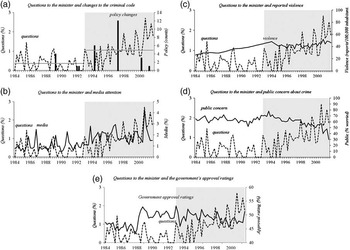
Development on the issue of law and order in Denmark from 1982 to 2001 presents a puzzle to the “politics matters” literature: during their 11 years in opposition from 1982 to 1993, the leftwing parties, i.e. the Social Democrats, the Socialist People's Party and the Red-Green Alliance, showed little interest in crime and no intentions of tightening the criminal code. Low activity in questions to the minister on the issue during their time in opposition reflects this (see Figure 1a). Furthermore, as evident in several parliamentary debates just before and after they took office in 1993, the left-wing parties and the Social Democrats in particular did not hesitate to oppose the right-wing parties’ call for a change in penal policy and to stubbornly defend their law and order policy focus on rehabilitation (Parliamentary minutes [Folketingstidende (FT)] 1992–93, 2232–2236). In 1993, the left-wing parties entered office and a curious development occurred. Despite its softer stance on crime, the left-wing government did not enhance rehabilitation but turned against criminals and increased sentencing dramatically in several steps in 1994, 1997 and 2001, the year it lost office.
The issue of law and order in Denmark 1984–2001
Grey area indicates left-wing government 1993–2001. Grey lines in Figure 1a indicate average percentage of questions for the right-wing government 1984–1993 and the left-wing government 1993–2001.

From a classic “politics matters” perspective, such changes are surprising because they take place under a left-wing and not a right-wing government. This makes this policy development an interesting case on which to apply the argument. A left-wing government should neither focus on law and order nor increase penalties (Petrocik Reference Petrocik1996, 831–32). In the mandate model, the changes are equally unexpected, since nothing in the government manifesto forecasts this development. Why did the left-wing government compromise on focusing on its electoral promises and so radically counter its own policy priorities and spend time in office adopting right-wing policies on a right-wing issue?
Interestingly, the right-wing parties, i.e. the Liberals and the Conservatives, turned immediately to the issue of law and order in 1993 after 11 years in office constrained by resistance to penal policy restrictions from its support party, the Social Liberals. The substantial surge in questions activity on the issue reflects this (see Figure 1a). With reference to every tabloid cover story about assaults, they vehemently criticised the government for not doing enough and called for a tougher penal policy (FT 1992–1993, 834–842). With the Social Liberals now part of the left-wing government, the right-wing parties presumably saw an opportunity to portray the government as unable to maintain law and order in society.
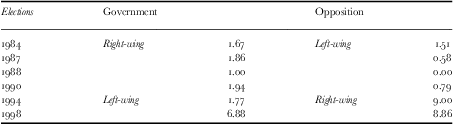
Accordingly, the left-wing and the right-wing clearly diverged in their approach to law and order in 1993 at the change in government. This divergence is also evident in the party manifestos; see Table 1. In the 1994 election following the change in government in 1993 (the right-wing government stepped down due to a scandal), the right-wing parties devoted on average one-tenth of their manifesto to this issue. The left-wing parties hardly mentioned it but took up the issue in the 1998 election.
Average mentioning (%) of the issue of law and order across Danish parties’ manifestos 1984–1998
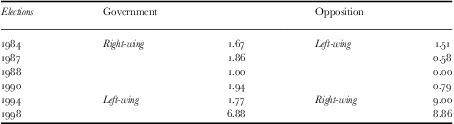
Source: Danish Policy Agendas Project (see Green-Pedersen Reference Green-Pedersen2005).
The aggressive line taken by the right-wing opposition appears to have forced the left-wing government to attend to the issue. Not only did it adopt the right-wing opposition's rhetoric and characterisation of the development in crime to a surprising extent as it emerges in several parliamentary debates (FT 1993–1994, 2032–33; 1996–1997, 3599), it also accommodated large parts of the opposition's policy demands in the legislation it passed. This was a move away from prevention towards punishment ostensibly to match the right-wing opposition. The overlap in the content of the parliamentary resolutions tabled by the opposition (L35 in 1993, L134 in 1997 and L2 and L161 in 2001) and subsequent enactments by the government (L366 in 1993, L350 in 1997 and L27 in 2001) is difficult to dismiss. In all, it seems hard to account for the tightening of the criminal code in Denmark in the 1990s without including the opposition. This will be put to a test in a quantitative analysis of quarterly observations on opposition criticism and government legislation from 1984 to 2001.Footnote 2
The Danish parliamentary system appears to be appropriate for the test since an opposition working to replace the incumbents is clearly distinguishable from the government. As demonstrated in other studies (Green-Pedersen and Mortensen Reference Green-Pedersen and Mortensen2010; Green-Pedersen and Thomsen Reference Green-Pedersen and Thomsen2005), the Danish political system – despite its multiparty character – resembles a two-party system such as the Westminster system with regard to the political competition structure. Although formally often a minority coalition, Danish governments tend to enjoy a de facto legislative majority through loyal support parties (op. cit.). This also applies to the case of the analysis in which the government's passing of legislation did not require “true” opposition parties’ consent.
Indicators
In the data collection, law and order is restricted to the sub-categories violence and assaults. A debate on violence and assaults and the appropriate policy has been very prominent in Denmark since the early 1990s (Balvig Reference Balvig2005).
The dependent variable is a count of changes to the criminal code. The measure is intended to capture significant changes to the penal policy. Such changes often come without new appropriations in the budget or lengthy alterations to the law, but simply consist of a numerical change, e.g. increasing the maximum penalty from “6 years” to “10 years” in the text. In other words, regulation of punishment for illegal acts is at the core of the issue of law and order. Hence, coding the content of changes to the criminal code is preferable to alternative measures often used in the literature, such as public expenditures (e.g. Klingemann et al. Reference Klingemann, Hofferbert and Budge1994) and the length of word changes to the law (Huber et al. Reference Huber, Shipan and Pfahler2001, 336–37) because these measures would not capture some of the most profound changes to the policy.
Based on the Danish Law Database, which records the evolving criminal code (Retsinformation 2011), every significant change to the criminal code has been counted by asking whether the change increased either the likelihood of incarceration for an offence or the length of incarceration. In line with findings in other studies, the criminal code has been tightened (see Balvig Reference Balvig2005, 167–69; Estrada Reference Estrada2004, 419–21). Since all changes unequivocally enhance the provisions to incarcerate, the dependent variable is directional. Provisions to incarcerate can be enhanced in different ways, as evident in Appendix 1, which provides a complete list of the changes. The criminal code may be expanded to previously unregulated offences, maximum imprisonment may be increased, or the list of aggravating circumstances may be enlarged. Hence, all changes move policy in the same more restrictive direction, which is a direction often associated with right-wing parties’ crime policy (Balvig Reference Balvig2005, 171; Estrada Reference Estrada2004, 428–30). Taking the direction of policy change explicitly into account in this way therefore presents an additional improvement to the measures conventionally used for policy change such as budgets or the length of the law (e.g. Klingemann et al. Reference Klingemann, Hofferbert and Budge1994; Huber et al. Reference Huber, Shipan and Pfahler2001, 336–37).
As an indicator of the opposition's criticism, the proportion of all questions to the minister addressing the issue of violence and assaults will be used because it has proven a good indicator of the opposition's issue emphasis (provided by the Danish Policy Agendas Project (DPAP); see Green-Pedersen Reference Green-Pedersen2005; Green-Pedersen and Mortensen Reference Green-Pedersen and Mortensen2010). The level of opposition activity at a given time will be in focus rather than the changes in activity levels because a high level of pressure from the opposition, not a change from a low level to a slightly higher level, is expected to pay off legislatively. Leaving out questions from government support partiesFootnote 3, the indicator for the analysis focuses on all questions tabled by the opposition, which works to replace the government.Footnote 4
A number of societal factors are included as controls in the analysis in addition to the government's approval rating (Thomsen Reference Thomsen2012), an election year dummy (election year = 1, otherwise 0) and a count variable since the last election.Footnote 5 Among the non-political factors suggested by others as possibly influencing the agenda for policy change are the media (Green-Pedersen and Stubager Reference Green-Pedersen and Stubager2010; Soroka Reference Soroka2002), the public's dissatisfaction with policy (Erikson et al. Reference Erikson, MacKuen and Stimson2006; Soroka Reference Soroka2002), and the level of reported violence for the issue of law and order (Balvig Reference Balvig2005, 170–71; Estrada Reference Estrada2004, 421).
Media attention is measured as the quarterly average proportion of each daily 12 o'clock national news broadcast devoted to law and order, since this particular news source is an important media agenda-setter (Green-Pedersen and Stubager Reference Green-Pedersen and Stubager2010; DPAP, in Green-Pedersen Reference Green-Pedersen2005). Unfortunately, consistent opinion polls on whether the public prefers more or less punishment for crime are not available. Instead, a measure of the percentage of the public that expresses concern with crime is used (DPAP, in Green-Pedersen Reference Green-Pedersen2005). The level of violence is measured as the number of reported assaults per 100,000 inhabitants (for 1984 to 1995 extrapolated from annual data, Falck et al. Reference Falck, von Hofer and Storgaard2003, 31; for 1995 to 2001 quarterly data from the Danish Statistics Bureau 2011, Table “straf1”).
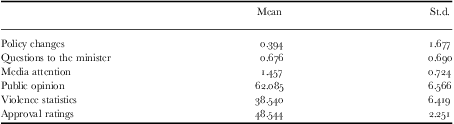
Developments in the questions activity, policy changes and the societal factors are illustrated in Figure 1. Figure 1a shows how questions and legislative activity increase substantially with the change in government in 1993 (the difference in average questions in the two periods is illustrated by the grey lines). With the public becoming generally less worried about crime throughout the period (Figure 1d) and crime reports remaining generally stable in the 1990s (Figure 1c), neither appears to suggest a need to tighten the penal policy in the 1990s. Development in the media agenda closely resembles the corresponding development in questions to the minister (Figure 1b). This probably reflects the mutual influence of the media and politicians (Soroka, Reference Soroka2002). The approval rating is fluctuating and from about 1995 it declines until the 2001 election (Figure 1e). Hence, to what extent policy systematically changes when media attention rises or the approval rating deteriorates is hard to tell from the graphs. Only statistical testing can tell. All variables are summarised in Table 2.
Descriptive statistics, the issue of law and order in Denmark 1984–2001
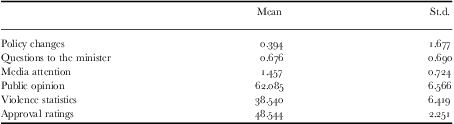
Data is in three-month periods from 1984 to 2001 comprising 71 observations in total.
With the longitudinal data, the independent variables may enter the model with lags. Choosing the lag time is difficult and conclusive answers are few. Thus, the choice of lags rests on substantial considerations. Since the laws in the analysis were passed through parliament in 4.6 months on average (FT 2012), i.e. less than two quarters from the bill are introduced to its vote, questions precede policy by three quarters in the analysis. This seems like a realistic assumption on the drafting and approval of a bill in this area since, for example, raising the maximum level of incarceration for offences does not require the same consultation as, for example, labour market adjustments or health care reforms. Moreover, this time span establishes the most direct link between opposition criticism and the government's legislative reaction. The connectedness enhances the certainty that legislation is in fact a reaction to the criticism. Hence, keeping in mind that reality is surely more complicated than can be expressed in this simplified specification, it appears to be the best choice. Moreover, to rule out spurious findings, the societal factors precede questions by another two lags. This ensures sufficient time to argue that both opposition criticism and government legislation simply follow the societal factors (Baumgartner and Jones Reference Baumgartner and Jones1993).
Analysis
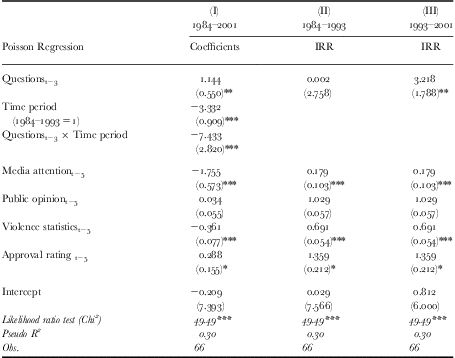
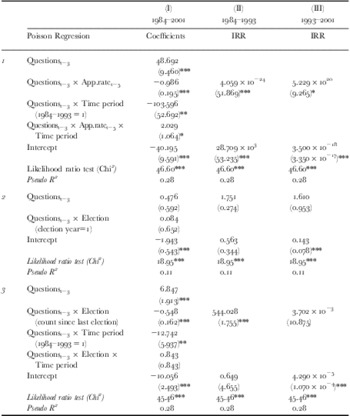
Policy changes triggered by opposition criticism are expected to take place predominantly from 1993 to 2001 when the left-wing parties hold office and the right-wing opposition is highly attentive to the issue. To test this, a dummy variable is introduced, which takes the value 0 after the first quarter in 1993 and the value 1 until the first quarter of 1993 (the left-wing parties took office on 25 January 1993). Because the effect of questions on policy change is expected to depend on the time period, an interaction variable of the questions variable and the period dummy is included in the model. According to the argument, the estimated coefficient for the interaction variable should be negative and significant (Brambor et al. Reference Brambor, Clark and Golder2006). This coefficient is reported in model I in Table 3. Moreover, the dynamic between the opposition and the government is expected to have policy implications independent of the societal and political circumstances. To test this, the influence of opposition criticism on policy is put against the role of the societal factors as well as the government's vulnerability.
Estimation of the effect of questions on the number of policy changes on the issue of law and order in Denmark 1984–2001
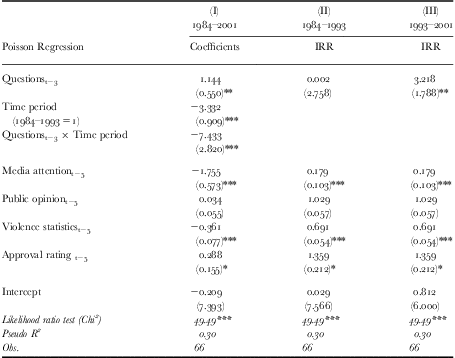
*p < 0.10; **p < 0.05; ***p < 0.01 (two-tailed). Standard errors in brackets. Model II and III report the IRR for the coefficients in model I. In model II, the time period variable is added to the intercept and the interactions variable is added to the questions variable before calculating the IRR. In model III, the opposition variable and the interactions variable are not included (Brambor et al. Reference Brambor, Clark and Golder2006; Hilbe Reference Hilbe2008).
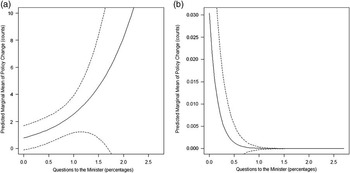
The opposition's ability to make the government change policy is estimated using Poisson regression.Footnote 6 To assess the difference between 1984 to 1993 and 1993 to 2001 in the effect of questions on policy, incidence-rate ratios (IRRs; Hilbe Reference Hilbe2008) are reported separately for each time period in models II and III in Table 3 and marginal effects are depicted in Figure 2 (based on the results in Table 3). The IRRs in models II and III are calculated from the coefficients in model I. The IRRs indicate the expected policy changes when the independent variable takes the value 1 in comparison to the expected changes to policy when it is 0. If an IRR is above 1, the incidence rate of policy changes increases with the presence of this variable, whereas an IRR between 0 and 1 marks a decrease in the incidence rate of policy changes in comparison to the absence of this variable.
Marginal effects of questions to the minister on the likelihood of policy change in two periods
Figure A, 1993–2001; Figure B, 1984–1993. Estimate based on Table 3.

Corroborating the expectations, the effect of criticism on policy is markedly lower under the left-wing opposition of 1984 to 1993 than the effect under the right-wing opposition of 1993 to 2001. This difference is demonstrated by the statistically significant, negative coefficient for the interaction variable of the questions and the period dummy in model I in Table 3. As anticipated, a low level of questions to the minister does not provoke much legislation in 1984 to 1993 (an IRR of 0.002 in model II in Table 3). In contrast, from 1993 to 2001 the right-wing opposition's questions to the minister push the left-wing government to tighten the criminal code. Controlling for media attention, public opinion, violence statistics and the government's approval ratings, a one percentage increase in opposition criticism sparks a tripling of restrictions to the criminal code according to the estimated IRR (model III in Table 3).Footnote 7 This is a statistically significant finding that remains when the election variables (the election count variable and the election year dummy) are used instead of the approval ratings as a control in the analysis (not reported).Footnote 8 Hence, in affirmation of the supposition, the opposition appears to affect policy above and beyond the government's vulnerability and the government's need to make legislative adaptations to the development on the issue.Footnote 9
The weak influence of societal factors on the likelihood of policy change in Table 3 is not surprising since the development in societal factors – crime statistics and public concern in particular – does not square with the evolution in policy (see Figure 1). Although Figure 1 indicates a possible connection, the influence of the government's approval rating is not statistically significant and the influence of the media is statistically significant but very weak.
Due to its importance for the argument, I conduct a further test of the role of the government's performance. If the opposition's influence depends on the government's approval rating and the looming election, the triple interaction terms with questions, the time period and each of the three conditional factors, i.e. the approval rating and the two election variables, should at a minimum be statistically significant in Table 4, but they are not.Footnote 10 In other words, the opposition's ability to pressurise the government does not appear to depend on the government's vulnerability. In combination with the finding from Table 3 that questions to the minister increase the likelihood of policy change also when I control for the government's vulnerability, this alleviates concerns about endogeneity in the model of opposition influence.
Estimation of the conditional effect of questions on the number of policy changes on the issue of law and order in Denmark 1984–2001
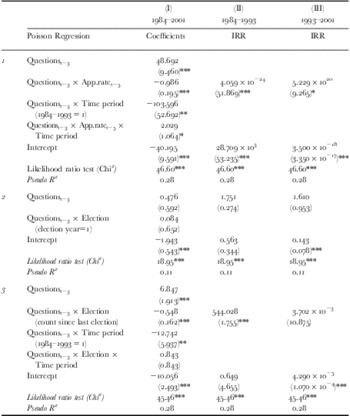
*p < 0.10; **p < 0.05; ***p < 0.01 (two-tailed). N = 66. The conditional factor, the time period, the interaction variables with questions and time period and the conditional factor and time period are included in the models but not reported. Standard errors are in brackets. Model II and III report the IRR for the coefficients in model I. (Brambor et al. Reference Brambor, Clark and Golder2006; Hilbe Reference Hilbe2008).
Since the prediction of policy changes depends on the specific percentage level of questions asked, Figure 2 may be illuminating: whereas the effect of the opposition's questions on the probability of policy changes is infinitesimal under the left-wing opposition before 1993 (see Figure 2b), the probability of a policy change in 1993 to 2001 increases considerably when the right-wing opposition exerts pressure on the government (see Figure 2a). That is, asking questions on a small scale (less than half a per cent) does not alter the expectations of policy remarkably, but deliberately devoting particular attention to the issue affects the likelihood of policy change. When the proportion of questions to the minister on crime reaches a level of about 1 per cent in a three-month period, more than two restrictions to the criminal code are expected about nine months later. It may amount to almost four changes when the level of questions on this issue reaches 1.5 per cent. This level does occur (in about 15 per cent of the observations) but is uncommon. Beyond this level, the confidence intervals become very wide. Hence, it is not the mere presence of an opposition that makes the government automatically and substantively move policy in the direction of the opposition, but rather the intense pressure from an opposition vehemently criticising the government.
In sum, the empirical testing supports the opposition-influence argument. In this light, the literature's neglect of the opposition's impact on policy does not seem justified. Sometimes an issue becomes the subject of policy changes due to the opposition's aspirations rather than the government's intentions.
Discussion
Drawing on the policy agenda literature, I have unfolded the argument that opposition parties have an opportunity to indirectly change policy. Since the opposition is in a position to politicise issues, I argue that it can capitalise on the government's vulnerability to blame and motivation to stay in office and put the government in a position where changing policy in the direction of the opposition is hard to avoid. By making this argument, the article represents a first attempt to move the “politics matters” literature beyond its narrow focus on the policy influence of the governing party to gain a broader understanding of how parties affect policy.
The argument is applied to the issue of law and order in Denmark since a remarkable policy development during the left-wing government of 1993 to 2001 runs counter to the “politics matters” perspective. Unequivocal and repeated restrictions to the penal policy should be expected under a right-wing government, not a left-wing government, especially if the left-wing parties’ manifestos in the early 1990s prior to the policy development were silent on the turn in penal policy. Parties may still explain policy, though, because the right-wing parties championed crime punishment in their manifestos and showered the left-wing government with critical questions on the issue after they got into opposition in 1993. The analysis confirms this idea and shows that the right-wing opposition's intense criticism led the left-wing government to tighten the criminal code from 1993 to 2001. This effect cannot be reduced to crime coverage in the media, worry among the public for crime or violence statistics, or a matter of bad performance by the government or election year dynamics. This finding does not mean that “politics does not matter” but that, for this policy development, the party in opposition mattered.
Although demonstrated in the right-wing opposition parties’ influence on law and order, nothing suggests that the same dynamic should not apply equally well to, for example, left-wing opposition parties’ influence on the issue of the environment. Hence, existing partisan literature may have overlooked a potential mechanism of policy change through opposition criticism. This is a possible mechanism that should be further unfolded. Short of comparative analyses of other relevant issues and political systems, the argument and findings of this article merely represent a first step in exploring such party competition dynamics and policy implications.
Further comparative studies may explore the role of the party competition structure for the described dynamic. As part of a party system, a party must always ask who is a friend and who is foe. In a multiparty system like the Danish, the frequent participation of centre parties in government makes the parties in opposition depend on them to form the next government. Having a friend among the enemies may dampen the opposition's aggression against the incumbents to not jeopardise its chances of assuming office. The cautiousness of the opposition should be even more pronounced in the Netherlands due to the Christian Democrats’ pivotal role in coalition formation (Keman Reference Keman1994). In comparison, the Westminster system typically has only one party in office, which should make the opposition more relentless (Norton Reference Norton1990, 13–15). Accordingly, Britain and the Netherlands are interesting cases to advance the insights gained in this study. In contrast, in divided political systems such as the American or German, where the government and the opposition are legislatively entangled and the line between them in this sense is blurred, the opposition argument would need modifications to apply.
Addressing this aspect of the argument could further disentangle the dynamic and, hence, add more insights about why policy sometimes changes due to the opposition party's criticism rather than the governing party's electoral promises.
Acknowledgements
The author wishes to thank Christoffer Green-Pedersen and Peter Bjerre Mortensen as well as anonymous reviewers of the Journal of Public Policy for very constructive criticism of earlier versions of this article.
Appendix 1 Overview of changes to the criminal code on violence and assaults in Denmark 1984–2001