Implications
The administration of a selenium-enriched yeast strain has been shown to be an interesting alternative to inorganic selenium in the supplementation of the trace element to finishing beef cattle. As compared to sodium selenite, the supplementation with Se yeast throughout the finishing did not modify cattle growth performance, but it was a way to enrich the Se content in muscle tissue. This result along with further positive effects induced by this treatment on meat quality, such as the increased colour lightness and the decreased drip loss and shear force, should have a favourable impact on both retailer and consumer choices.
Introduction
Selenium is an essential trace element for humans and animals because, in the form of selenocysteine, it is a core structural component of several specific enzymes (Arteel and Sies, Reference Arteel and Sies2001). Antioxidant enzymes glutathione peroxidases (GSH-Px) containing selenium catalyse the reduction of lipid and hydrogen peroxides to less harmful products providing a defence against oxidative stress (Hardy and Hardy, Reference Hardy and Hardy2004). Therefore, an adequate Se provision is needed to decrease the risk of immunodeficiency, myopathy, cardiovascular diseases and other Se deficiency syndromes (Hartikainen, Reference Hartikainen2005).
Selenium content in feed crops is variable and it depends to a large extent on their growing site. In Europe, the Se content in soil is quite low (Oldfield, Reference Oldfield2002) and dietary Se supplementation of farm animals has become a common practice. So far, the demand for Se in cattle rations has been generally fulfilled by supplementing with inorganic sources such as sodium selenite or selenate. However, organic sources of Se from enriched yeast strains have been recently approved in animal nutrition by the European Union (Commission Regulation: 2006/1750/EC). Organic Se is less toxic than selenite (Brown et al., Reference Brown, Pickard, Nicol, Beckett, Duthie and Arthur2000), which may act as a pro-oxidant at increased dietary concentrations (Seko et al., Reference Seko, Saiti, Kitahara and Imura1989).
Comparisons between Se yeast and inorganic sources of Se in fattening cattle were mainly focused on the retention of the element in muscle tissue and the consequent effect on the oxidative stability of beef meat (O'Grady et al., Reference O'Grady, Monohan, Fallon and Allen2001; Juniper et al., Reference Juniper, Phipps, Ramos-Morales and Bertin2008b) as well as on the tolerance of the animals to the administration of supranutritional doses as a strategy to produce an Se-enriched beef product (Juniper et al., Reference Juniper, Phipps, Givens, Jones, Green and Bertin2008a).
According to Swecker et al. (Reference Swecker, Eversole, Thatcher, Blodgett, Schrig and Meldrum1989), Se supplementation may improve animal performance indirectly by strengthening its immunocompetence and enabling it to better withstand the stressful condition of the intensive fattening systems. To verify this hypothesis, the present study compared different strategies of dietary Se supplementation during the finishing period of intensively fattened Charolais young bulls focusing on cattle growth response, Se blood levels and slaughter performance. Moreover, since the antioxidant functions of Se have been shown to persist post mortem delaying the onset of oxidation reactions in muscle tissue (DeVore et al., Reference DeVore, Colnago, Jensen and and Breene1983), the experimental protocol addressed the effects of Se treatments on a large set of meat quality traits. The experimental treatments considered the single or combined administration of two sources of the trace element (sodium selenite and a selenium-enriched yeast). To broaden the existing knowledge on the effect of Se supply in beef cattle, the adopted target concentration of trace element in the diet was chosen to be in agreement with previous studies.
Material and methods
Animals and management
The study was carried out in a commercial intensive beef fattening unit located in the town of Correzzola (PD), Italy using a single batch of 84 Charolais young bulls imported from France. This cattle breed is the main European beef breed accounting for >25% of the total population for suckling cows (Charolais, 2011). The animals had a mean initial age of 382 ± 52 days and a mean initial BW of 434.2 ± 31.9 kg and they were stratified by live weight and equally assigned to one of three Se treatments. Each treatment consisted of 28 bulls housed in four pens of seven bulls each. All the pens were contiguous and located in the same barn and they had a fully slatted floor with a space allowance of 3 m2/head and a manger space of 0.6 m/head. Each pen was equipped with two waterers to allow free access to drinking water.
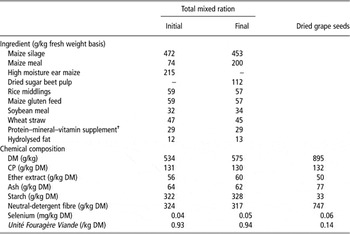
The three treatment groups of cattle received the same basal diets prior to and during the experimental period which started on 4 April 2009 and which was concluded on 2 November 2009, after 210 days. An initial basal diet (Table 1) was fed for 15 days preceding the onset of the experimental period to 1st August and it was then replaced by a final basal diet in which high moisture ear maize was substituted with maize meal and dried sugar beet pulp to maintain the same energy and protein contents (Table 1). The daily diet was prepared as total mixed ration (TMR) by weighing and mixing all the feed ingredients for 20 min with an AGM mixing wagon (Unifast S.p.A., Bagnoli di Sopra, Italy). The TMR was offered at 0930 h in a single administration. An ad libitum intake was assured by adjusting the amount of food delivered to each experimental pen in order to obtain an approximate recovery of a 3% food residue (as-fed basis) 24 h after delivery.
Ingredient and chemical composition of the basal total mixed rations fed during the finishing period and chemical composition of dried grape seeds used for selenium administration

DM = dry matter.
†Contained per kg of supplement: CP 260 g; ether extract 35 g; ash 380 g; neutral-detergent fibre 123 g; Ca 80 g; Na 33 g; P 45 g; Mg 18 g; urea 40 g; Zn 1200 mg; Mn 960 mg; Fe 360 mg; Cu 200 mg; I 16 mg; Co 10 mg; vitamin A 80 350 UI; vitamin D3 10 500 UI; α-tocopherol 180 mg.
Experimental treatments
From the start of the experimental period, young bulls were fed a given basal diet supplemented with three different sources of selenium:
• NaSe: administration of sodium selenite during the entire finishing period;
• Se-Y: administration during the entire finishing period of a selenised yeast [Alkosel® R397 produced by a specific strain of Saccharomyces cerevisiae (NCYC R397), manufactured and supplied by Lallemand SAS (Blagnac, France)];
• Switch: administration of sodium selenite for 140 days replaced by Alkosel® R397 during the last 70 days of the finishing period.
The last treatment aimed at evaluating the effects of the provision of selenium yeast as an alternative to inorganic Se for a short time period, as the last part of the finishing process. The inclusion rate of the Se sources (sodium selenite or Alkosel® R397) in all treatments was targeted to achieve 0.3 mg of Se/kg of dry matter (DM) in the complete feed. This concentration was chosen to be consistent with previous studies on dietary supplementation with the trace element in beef cattle (Nicholson et al., Reference Nicholson, McQueen and Bush1991; O'Grady et al., Reference O'Grady, Monohan, Fallon and Allen2001; Juniper et al., Reference Juniper, Phipps, Ramos-Morales and Bertin2008b),
In order to promote a balanced intake of Se among all the pen-mates, the two Se sources were separately pre-mixed with dried grape seeds (Table 1). An amount of 0.3 kg/head of a given Se pre-mixture was top-dressed and then thoroughly mixed manually with the basal TMR delivered into each pen manger of the corresponding Se treatment at the time of feed distribution.
Measurements
The individual weight of bulls was recorded in five weighting sessions during the experimental period: at the start of the finishing period (day 0), at days 60, 120 and 180 and at the end of the finishing period (day 210). Average daily gain (ADG) was measured by dividing the difference between final and initial live weight by the number of days of the period. In order to better estimate the effect of the substitution of NaSe with Se-Y in the Switch treatment, the daily gain of bulls was analysed for the whole fattening period and separately for the two sub-periods from 0 to 120 days and from 121 to 210 days. Pen dry matter intake (DMI) was recorded three times a week during the experimental fattening period by weighing the feed distributed and the residue in the manger 24 h later. Pen feed conversion ratio was calculated by dividing DMI by the mean ADG of the pen-mates. Individual blood samples were collected at days 0, 120, 180 and 210 of the fattening period from the same four bulls/pen randomly chosen among the pen-mates. In this way, data from 16 bulls/treatment were available at each sampling session. Samples were taken from the jugular vein and they consisted of two 5-ml Vacutainer® tubes (Becton Dickinson Italia, Buccinasco, Italy) filled per animal: one tube with lithium heparin for Se and GSH-Px analysis and one tube without anticoagulant for serum total antioxidant status determination (TAS). Glutathione peroxidase is an Se-containing enzyme that protects body tissues from oxidative damage by removing peroxides resulting from free radicals, whereas TAS is a simple assay to estimate the total antioxidative capacity in serum. After 210 days of finishing, all animals were slaughtered at the same EU-approved abattoir which had routine veterinary inspection. Carcasses were weighed and their dressing proportion was calculated as (hot carcass weight/slaughter live weight) × 100. Subsequently, the carcasses were chilled and stored at 2 to 4°C and two sample joints of the muscle Longissimus thoracis (LT) were excised from the fifth to the seventh ribs of each right half carcass from a random sample of four bulls/pen 24 h post mortem. These samples were weighed, packaged in a vacuum atmosphere and then stored for 5 and 10 days, respectively, at 4°C in a chilling room for a total ageing period of 6 and 11 days post mortem. Meat samples were blot dried and weighed again after the two ageing periods, and drip losses were calculated as the difference between the weight prior to vacuum storage and that at the end of the ageing period. Subsequently, meat pH was measured with a portable pH-meter (HANNA Instruments®, Inc., Woonsocket, RI, USA) equipped with a glass electrode (3 mm Ø conic tip) suitable for meat penetration. Instrumental colour determination was carried out on a fresh, unoxidised surface of the samples after exposure for 1 h to air at 2°C (Boccard et al., Reference Boccard, Buchter, Casteels, Cosentino, Dransfield, Hood, Joseph, McDougall, Rhodes, Shön, Timbergen and Touraille1981). A CR 100 Chromameter (Minolta Camera, Osaka, Japan) equipped with C illuminant was used and colour data were expressed according to the Hunter-Lab system. Weight cooking losses were determined on 2.5 cm-thick steaks heated in a water bath at 75°C for 50 min and cooled in running tap water for at least 40 min (Boccard et al., Reference Boccard, Buchter, Casteels, Cosentino, Dransfield, Hood, Joseph, McDougall, Rhodes, Shön, Timbergen and Touraille1981). Ten meat cylindrical cores, 1.25 cm in diameter, were then excised from the cooked steak for the instrumental measurement of meat tenderness carried out using a Warner-Bratzler shear force meter (Instron, High Wycombe, UK; Joseph, Reference Joseph1979). A further sub-sample of LT was collected from the same four bulls/pen 24 h post mortem to be freeze-dried and stored for meat composition analysis.
Chemical analysis
Samples of the experimental diet were collected every month and chemically analysed for DM, CP, ether extract, ash and starch according to the methods of the Association of Official Analytical Chemists (AOAC, 1990). Neutral-detergent fibre analysis of the same samples was conducted according to Van Soest et al. (Reference Van Soest, Robertson and Lewis1991). The net energy content of the diet measured in Unité Fouragère Viande units was calculated using for all feed ingredients the reference values reported by the Institut National de la Recherche Agronomique (INRA, 1988). The meat protein, ash and intramuscular fat contents were measured according to the Association of Official Analytical Chemists (1990) after grinding the freeze-dried samples. Total Se in TMR, plasma and meat samples was determined after sample mineralisation by using inductivity coupled plasma/mass spectrometry (Agilent Technologies, Palo Alto, CA, USA) with an instrumental detection limit of 50 ng/l. Serum TAS and blood GSH-Px were determined by commercial kits (Randox Laboratories, Crumlin, UK) applied to a BM Hitachi 911 analyzer (ROCHE, Basel, Switzerland). Meat sub-samples from the joints stored for the two ageing periods were submitted to a rapid aqueous acid extraction thiobarbituric acid method for measuring malondialdehyde (MDA) as a marker of lipid peroxidation in muscle tissue (Botsoglou et al., Reference Botsoglou, Fletouris, Papageorgiou, Vassilopoulos, Mantis and Trakatellis1994).
Statistical analysis
Pen was the experimental unit for live weight of bulls, ADG, feed intake and feed conversion ratio and these data were statistically analysed adopting a linear model which considered the effects of treatment (source of Se) and pen within treatment (random effect). The same linear model was used for the processing of carcass measurements and meat chemical composition data. A repeated mixed model which considered the effects of treatment, time (sampling session), pen within treatment and a random effect of animal within the pen was used for processing blood variables recorded at different sampling sessions as well as meat quality data recorded after the two ageing periods. In all the statistical analyses, the 2 degrees of freedom of the treatment factor were used to perform the following set of orthogonal contrasts:
1. NaSe v. Others [(Se-Y + Switch)/2];
2. Se-Y v. Switch.
Differences were considered significant at P < 0.05. Overall and partial correlation coefficients between plasma Se and GSH-Px as well as between TAS and meat Se content were calculated. All the statistical analyses were carried out using the SAS package (SAS, 2001).
Results
Despite the changes in the feed ingredients, the chemical composition of the two diets was constant throughout the fattening period (Table 1). Monthly samples collected during the progress of the experiment showed an Se content of 0.29 ± 0.04 mg/kg of DM (mean ± s.d.) in the complete feed for NaSe treatment, whereas the mean value for the diet supplemented with Se yeast was 0.28 ± 0.07 mg/kg of DM.
Growth performance
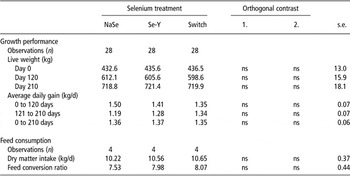
No differences due to Se treatment were recorded for ADG and final live weight of bulls (Table 2). Regardless of Se treatment, the animals tended to reduce their growth rate in the second part of the fattening period. Consistent with the daily gain, DMI and feed conversion ratio of bulls were not affected by the different Se sources (Table 2).
Effect of different strategies of dietary selenium supplementation during the finishing period on growth performance and feed consumption of Charolais young bulls

NaSe = sodium selenite during the entire finishing; Se-Y = Alkosel® R397 during the entire finishing period; Switch = sodium selenite for 140 days replaced by Alkosel® R397 during the last 70 days of finishing.
1. Contrast NaSe v. Others [(Se-Y + Switch)/2].
2. Contrast Se-Y v. Switch.
ns P > 0.05.
Blood selenium status
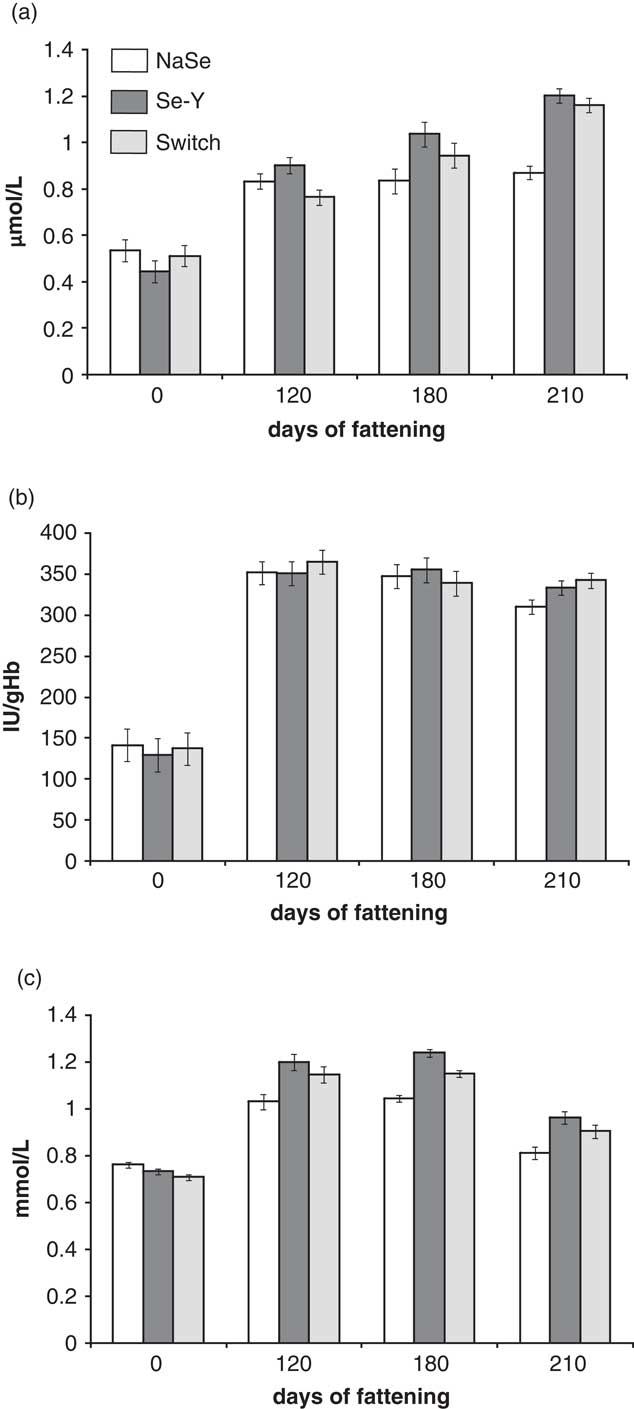
Mean values recorded for plasma Se in the three treatments at different sampling times are shown in Figure 1a. The statistical analysis of this variable showed a significant treatment × time interaction (P < 0.001). The supplementation with the trace element promoted a general increase in plasma Se concentration during the first 120 days. Afterwards, plasma Se showed a steady state in NaSe bulls, whereas a further increase was observed in both groups of animals receiving organic Se (Se-Y and Switch).
Effect of selenium supplementation with NaSe, Se-Y or Switch during the finishing period on (a) plasma selenium concentration; (b) glutathione peroxidase activity and (c) total antioxidant status of Charolais young bulls (mean ± s.e.).
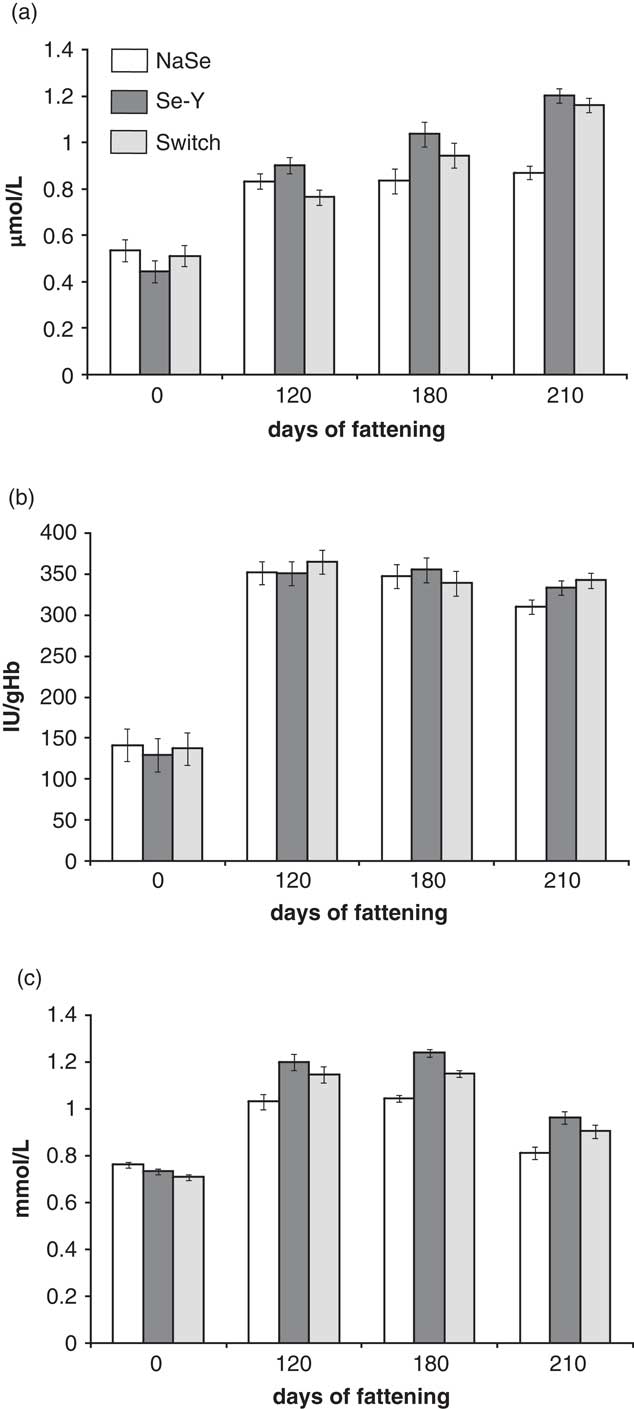
According to a significant time effect (P < 0.001), the concentration of GSH-Px was sensitive to Se supplementation, but no treatment effect was observed for this variable (Figure 1b). Selenium supplementation promoted a significant increase in GSH-Px activity during the first 120 days of finishing. The enzyme concentration slowly decreased in the final sampling session, but it always remained significantly higher than the initial baseline (day 0). There was a good overall correlation between plasma Se and GSH-Px concentration (r = 0.63; P < 0.001), and the calculation of partial correlation coefficients showed similar r values for the different Se treatments (NaSe: r = 0.72, P < 0.001; Se-Y: r = 0.67, P < 0.001 and Switch: r = 0.60, P < 0.001).
Dietary Se supplementation also increased serum TAS, but the response observed at the following sampling sessions was not consistent across treatments according to a significant treatment × time interaction (P < 0.001) (Figure 1c). As compared to the day 0 values, only bulls that received organic Se during the whole finishing process (Se-Y) or in its final part (Switch) showed a significant increase in serum TAS at all the following sampling sessions (Figure 1c). Overall correlation between plasma Se and TAS (r = 0.41; P < 0.001) was significant but lower than that with GSH-Px. Correlation coefficients between plasma Se and TAS for the three Se treatments showed that the significance was substantially due to provision of the Se yeast (NaSe: r = 0.20, P > 0.05; Se-Y: r = 0.49, P < 0.001 and Switch: r = 0.29, P < 0.05).
Slaughter performance and meat quality
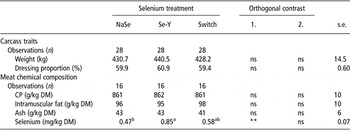
Consistent with the growth performance, at the abattoir, there were no differences due to the Se treatment in carcass weight and dressing percentage (Table 3). The protein, fat and ash content of the LT muscle did not show any significant effect due to Se treatment. However, a significant difference (P < 0.01) due to the source of the trace element was instead observed for Se content in muscle tissue (Table 3). Compared with NaSe, higher Se concentrations were recorded in meat samples taken from Se-Y bulls, whereas Switch treatment resulted in intermediate concentrations. There was a significant overall correlation between plasma Se and Se content in muscle tissue (r = 0.41; P < 0.001). However, as for TAS, the observed significance was substantially due to the two Se treatments using the organic source of the trace element (NaSe: r = 0.20, P > 0.05; Se-Y: r = 0.48, P < 0.001 and Switch: r = 0.30, P < 0.05).
Effect of different strategies of dietary selenium supplementation during the finishing period on carcass traits and chemical composition of Longissimus thoracis muscle of Charolais young bulls

NaSe = sodium selenite during the entire finishing; Se-Y = Alkosel® R397 during the entire finishing period; Switch = sodium selenite for 140 days replaced by Alkosel® R397 during the last 70 days of finishing; DM = dry matter.
1. Contrast NaSe v. Others [(Se-Y + Switch)/2].
2. Contrast Se-Y v. Switch.
a,bMean values within a row with different superscript letters are significantly different at P < 0.05.
ns P > 0.05; **P < 0.01.
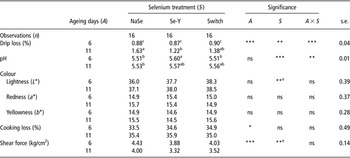
The outcomes of the quality evaluation carried out on meat samples after 6 and 11 days of ageing under vacuum package are reported in Table 4. A significant treatment × ageing interaction was observed for drip loss and pH. Meat drip loss increased according to the time of ageing, but this trend was less marked in Se-Y samples. Meat pH was always within the range of normality. The instrumental colour determination showed a significant treatment effect on meat lightness (P < 0.01). Regardless of the ageing days, meat from bulls fed Se yeast had higher L* values than that from NaSe bulls. The levels of MDA measured after 6 days of ageing were always below the detection threshold of the spectrophotometer (0.001 mg of MDA/kg), whereas mean values recorded after 11 days of ageing were very low and similar across Se treatments (NaSe = 0.007; Se-Y = 0.007 and Switch = 0.011 mg of MDA/kg). Meat cooking losses were not affected by Se treatment while they increased according to the ageing days (P < 0.05). As expected, prolonged ageing had a positive effect on meat tenderness as shown by the reduced shear force (P < 0.001). On this parameter, there was also an Se treatment effect (P < 0.01) because meat samples from bulls supplemented with Se yeast required a reduced shear force in comparison to NaSe ones.
Effect of different strategies of dietary selenium supplementation during the finishing period on quality traits of Longissimus thoracis muscle of Charolais young bulls after 6 and 11 days of ageing post mortem

NaSe = sodium selenite during the entire finishing; Se-Y = Alkosel® R397 during the entire finishing period; Switch = sodium selenite for 140 days replaced by Alkosel® R397 during the last 70 days of finishing.
a,b,cMean values within a variable having different superscript letters differ at P < 0.05.
ns P > 0.05; *P < 0.05; **P < 0.01;***P < 0.001.
†Contrast NaSe v. Others [(Se-Y + Switch)/2] significant at P < 0.05.
Discussion
The study compared different strategies of supplementing Se during the finishing period of intensively finished Charolais young bulls by using two sources of the trace element (sodium selenite and Se yeast). The growth performance and slaughter traits of bulls were not affected by the different sources of Se supplemented during the finishing period, confirming previous results recorded in growing and finishing cattle (Nicholson et al., Reference Nicholson, McQueen and Bush1991; Lawler et al., Reference Lawler, Taylor, Finley and Wand Caton2004).
As compared with the values measured at day 0, all Se treatments increased plasma Se concentration. However, as in previous studies (Awadeh et al., Reference Awadeh, Kincaid and Johnson1998; Gunter et al., Reference Gunter, Beck and Phillips2003), the provision of Se yeast further increased the bioavailability of the trace element resulting in higher plasma Se concentrations than NaSe at the end of the fattening period. While supplementing fattening steers with a similar target level of Se adopted in the present study, Juniper et al. (Reference Juniper, Phipps, Ramos-Morales and Bertin2008b) found that plasma Se concentration would achieve a steady state after approximately 150 days of treatment, but the asymptotic value obtained with the provision of an organic source was significantly higher than that of sodium selenite.
Consistent with Van Ryssen et al. (Reference Van Ryssen, Deagen, Beilstein and Whanger1989) and Gunter et al. (Reference Gunter, Beck and Phillips2003), no significant differences in GPS-Px activity were observed in animals that had been offered diets supplemented with comparable doses of inorganic Se and Se yeast. However, a better status of animals receiving Se yeast was indicated by the higher values of TAS observed for Se-Y and Switch treatments in the final part of the finishing process. This integrated parameter, which considers the cumulative action of all the antioxidants present in plasma, is more sensitive and reliable than the measure of a single antioxidant and it may be a useful indicator to assess animal welfare (Celi, Reference Celi2010).
The bimodal trend observed for GSH-Px and TAS in all the Se treatments might be the result of a temporary pro-oxidant behaviour caused by a prolonged supplementation with the trace element. However, as reported by Halliwell (Reference Halliwell2008) and Mézes and Balogh (Reference Mézes and Balogh2009), the pro-oxidant activity of Se may not be detrimental because it provides a useful cytoprotection effect against infective agents.
As for farm animals, selenium is an essential trace mineral for humans and Se deficiency is still a global problem in many countries requiring specific strategies to produce Se-rich foods (Fisinin et al., Reference Fisinin, Tigran and Surai2009). Beef is a major source of dietary selenium for humans (Zhang et al., Reference Zhang, Xiao, Samaraweera, Lee and Ahn2010) and the result of the present study indicated that the prolonged supplementation with organic Se (Se-Y) is more effective to increase Se concentration in muscle tissue than inorganic Se. The efficacy of Se yeast to enrich the trace mineral content in meat has been reported not only in beef (Juniper et al., Reference Juniper, Phipps, Ramos-Morales and Bertin2008b) but also in veal (Skřivanová et al., Reference Skřivanová, Marounek, De Smet and Raes2007), lamb (Vignola et al., Reference Vignola, Lambertini, Mazzone, Giammarco, Tassinari, Martelli and Bertin2009), chicken (Skrivan et al., Reference Skrivan, Marounek, Dlouha and Sevcikova2008) and pork (Mahan et al., Reference Mahan, Cline and Richert1999). According to Juniper et al. (Reference Juniper, Phipps, Ramos-Morales and Bertin2008b), the greater concentration of Se in the muscle tissue of bulls offered organic Se when compared with NaSe might arise from an enhanced availability and tissue retention of the trace element. Both Se sources can be incorporated into GSH-Px, but Se-methionine from the organic one is also non-specifically incorporated into body proteins as a replacement for methionine (Vignola et al., Reference Vignola, Lambertini, Mazzone, Giammarco, Tassinari, Martelli and Bertin2009). In this regard, Juniper et al. (Reference Juniper, Phipps, Ramos-Morales and Bertin2008b) reported a higher concentration of Se in almost all tissues of beef cattle fed Se yeast than selenite as the result of a greater proportion of total Se comprised in tissue protein as Se-methionine. Besides the enrichment of beef and beef products, the increased Se muscular content promoted by the organic source of trace element could also be beneficial for the animal. Muscle tissue acts as an important endogenous reserve of the trace element being utilised in case of periods of Se deficiency (Vignola et al., Reference Vignola, Lambertini, Mazzone, Giammarco, Tassinari, Martelli and Bertin2009).
The provision of Se yeast during the whole finishing process led to lower drip losses in meat aged under vacuum package for 11 days according to a treatment × ageing interaction. This positive effect of organic Se on beef drip loss is consistent with that observed in chicken meat from broilers supplemented with organic Se rather than selenite (Edens, Reference Edens1996), whereas in pork meat a similar trend was close to the threshold of statistical significance (Mahan et al., Reference Mahan, Cline and Richert1999). The effect of Se on muscle drip loss could arise from a decreasing cell membrane oxidation (Dunshea et al., Reference Dunshea, D'Souza, Pethick, Harper and Warner2005).
The ageing of the meat samples under vacuum package did not allow us to verify whether the different source of selenium was capable of reducing lipid peroxidation. However, O'Grady et al. (Reference O'Grady, Monohan, Fallon and Allen2001) suggested that dietary Se has limited potential for increasing the oxidative stability of beef. Beef lightness is unrelated to myoglobin chemical status changes (McKenna et al., Reference McKenna, Mies, Baird, Pfeiffer, Ellebracht and Savell2005), but it is closely related to muscle and protein structures (MacDougall, Reference MacDougall1982). Therefore, the increased meat lightness and the decreased shear force observed in samples from bulls receiving organic Se could arise from changes in muscle tissue most likely promoted by the increased accumulation of selenoamino acids. Regardless of the Se treatment, the prolonged ageing time of meat samples in a vacuum atmosphere led to a decreased shear force confirming the results of Lindahl et al. (Reference Lindahl, Lagerstedt, Ertbjerg, Sampels and Lundström2010). Consistent with the same authors, the prolonged ageing period also increased beef cooking losses.
Conclusions
In comparison with an inorganic source of Se, the supplementation of the finishing diet with Se yeast targeted to achieve 0.3 mg of Se/kg of DM in the complete feed did not affect the growth and slaughter performance of bulls. However, the provision of organic Se throughout the finishing period improved the Se status of the young bulls by increasing the Se content and TAS of blood. In addition, Se-Y treatment was a way to increase the Se content in muscle tissue and to reduce meat drip loss and shear force. The replacement of sodium selenite with organic selenium in the last part of the finishing process led to similar advantages, except for the enrichment of the trace mineral content in meat.
Acknowledgements
The authors are grateful to the personnel of the Guzzo farm for the logistic and practical support to the research. A very special thanks to the farm vet Dr. Pierluigi Zuanon and to Dr. Daniele Dalle Palle, Mr. Roberto Chimetto and Mr. Roberto Rampazzo for their skilled technical assistance.