Vancomycin-resistant Enterococcus (VRE) is a significant healthcare-associated pathogen. VRE has become endemic in many countries and repeatedly causes nosocomial outbreaks. Some epidemic clones are highly transmissible and able to persist up to 16 weeks on inert surfaces.Reference Bonten, Hayden and Nathan 1 – Reference Tacconelli and Cataldo 3 Measures to limit the spread of this bacterium, notably cohorting of VRE carriers and extensive screening and cohorting of contact patients, appear essential to control a VRE outbreak. 4 – Reference De Angelis, Cataldo and De Waure 7
Contact patients discharged before exclusion of VRE carriage can be the source of reintroduction of VRE into the hospital upon readmission. Despite this risk, there is no recommendation about the optimal management of contact patients. At Lausanne University Hospital, readmitted contact patients are quarantined in contact isolation until 3 consecutive rectal swab samples are negative.
After a vanB Enterococcus faecium outbreak, we evaluated the VRE carriage of discharged contact patients through VRE home screenings by visiting nurses. A VRE contact was defined as a patient who had shared the room of a patient carrying VRE or who had stayed in a ward with at least 2 VRE cases within the previous month. Contact patients were identified through administrative databases. VRE colonization was ruled out when 3 rectal swab samples taken at least a week apart were negative. 4 Contact patients who had left the hospital before undergoing the collection of the 3 swab samples were introduced into an alert system and followed up: those who lived in Lausanne and suburbs were first informed by letter and then contacted by telephone in order to obtain their consent for VRE screening at home. A mobile team of 5 nurses visited the consenting patients between July and December 2011 and completed the screening protocol.
Rectal swab samples were inoculated into an enrichment broth containing vancomycin and incubated at 37°C for 24 h. The broth was inoculated onto a selective chromogenic plate (ChromID VRE; bioMérieux) and incubated at 37°C for 48 h.
The cost of the ambulatory screening campaign was computed by summing up the nursing wage (€48.74 per hour), the travel cost (€0.67 per km), and the laboratory cost of swab tests (€100.00 if positive, €40.00 if negative). The isolation cost was estimated by summing up the costs of contact precautions material, additional nurse and physician time, cleaning of room,Reference Senn, Petignant, Chabanel and Zanetti 8 and extra for single room (sum of isolation costs, €100.00 per day).
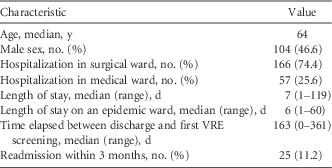
In our hospital, the prevalence of vancomycin resistance in enterococci isolated from clinical samples is less than 1%. During the course of the outbreak, we identified 44 VRE-positive patients, of whom 5 were identified by clinical samples and 39 were contact patients detected by screening during their hospital stay.Reference Henard, Lozniewski, Aissa, Jouzeau and Rabaud 9 Within the 453 remaining contact patients, 115 (25%) had 3 negative screenings before discharge, 28 (6%) had died, and 54 (12%) lived outside the investigation area. Thus, 256 contact patients were eligible for ambulatory screening, of whom 33 (13%) were excluded: 27 could not be reached and 6 refused to participate. Of the 223 included patients, 203 (91%) completed the screening protocol (3 swabs), 16 (7%) had 2 swabs, and 4 (2%) had 1 swab. Characteristics of the patients are presented in Table 1. All included patients were ambulatory and living independently. Of the 203 screened patients, most (170 [84%]) had the 3 successive screenings performed at home.
Characteristics of 223 Vancomycin-Resistant Enterococcus (VRE) Contact Patients Screened at Home

None of the included patients were colonized by VRE. The mobile team needed 554 hours (€27,000.00) and 2,396 km (€1,600.00), and they performed 645 screening swabs (€25,800.00). Thus, the total cost of the home screening process was €54,400.00. Twenty-five of the 223 included contact patients (11%) were readmitted within 3 months, totaling 214 isolation days at a cost of €21,400.00.
To our knowledge, this is the first report of a home screening campaign of VRE contacts. Patient acceptance was good. We did not identify any VRE carriage. Hypotheses to explain this result could be the relatively short length of stay on an epidemic ward (median, 7 days) and the delay between discharge and VRE screening (median, 163 days), whereas the median time of VRE carriage during a large outbreak was 42 days.Reference Pearman, Perry and Kosaras 10 A screening performed sooner after discharge as well as longer hospitalizations could have led to higher rate of VRE-positive contacts. Pearman et alReference Pearman, Perry and Kosaras 10 described the screening of 1,977 ward contacts after discharge from hospital. Screening swab samples were obtained in outpatient clinics, upon readmission, or upon admission to another hospital. Screening lasted for 6 months and detected 54 cases of VRE carriage (acquisition rate, 2.73%), with a decreasing yield over time.
Screening contact patients at home by a mobile team managed by the hospital guarantees an exhaustive monitoring and centralization of results. The cost generated by the procedure and the time required for the organization of the mobile team are limiting factors. However, the cost is partially offset because screened contact patients will not be the source of new transmissions in case of readmission, and contact isolation days are avoided.
In conclusion, we showed the feasibility of home screening by visiting nurses. This approach could be useful in the case of an outbreak of a virulent pathogen that requires strict infection control measures in contact patients. On the basis of our experience and the literature,Reference Pearman, Perry and Kosaras 10 we now recommend in our hospital isolation and screening of VRE contact patients if readmitted within 3 months after discharge, and screening without isolation beyond that time.
ACKNOWLEDGMENTS
Financial support. None reported.
Potential conflicts of interest. All authors report no conflicts of interest relevant to this article.