Introduction
Ethiopia takes the lead in livestock population and is a gateway of domestic animal migration from Asia to Africa, thus rolled for widespread distribution and huge population size in the country (Halima, Reference Halima2007). Poultry contribute socio-economic roles in food (security), generation of additional cash and income, etc. (Kondombo, Reference Kondombo2005; Salam, Reference Salam2005). Therefore, almost all rural and many peri-urban families keep a small flock of scavenging chickens (Jens et al., Reference Jens, Anders, Charlotte, Ainsh and Lone2004). In Ethiopia, the population of chickens is estimated at about 49.3 million of which 97.3, 0.38 and 2.32 percent are indigenous, hybrid and exotic breeds, respectively (CSA, 2011). Indigenous chickens have a good potential to adapt in different agro-ecological conditions throughout their habitual management system (Tadelle and Alemu, Reference Tadelle and Alemu1997). Local chickens are non-descriptive type and show a large variation, which might be attributed to their widespread distribution (Tadelle, Alemu and Peters, Reference Tadelle, Alemu and Peters2003; Halima, Reference Halima2007; Fisseha, Abera and Tadelle, Reference Fisseha, Abera and Tadelle2010).
Indigenous chickens are underestimated because of their poor performance. To this effect they have been neglected and little attention has been given to them by researchers, development workers and policy-makers (Tadelle, Reference Tadelle2003). Some researchers (Tadelle, Reference Tadelle2003; Halima, Reference Halima2007; Dana et al., Reference Dana, Tadelle, Elisabeth and Johan2009) have made phenotypic and genetic characterization of indigenous chicken in some parts of Ethiopia. Poultry production and market system were studied in Southern Ethiopia by Mekonnen (Reference Mekonnen2007); characterization of poultry productivity and market system by Bogale (Reference Bogale2008) and genetic parameters on Horro chickens for weights and egg production traits was conducted by Dana, van der Waaji and Johan (Reference Dana, van der Waaji and Johan2010). However, comprehensive genetic resources identification in the remote districts of Northern Gondar zone in general and identification, and characterization of new local chicken ecotypes in particular were not studied. Therefore, the objective of this study was to identify and characterize the new local chicken ecotypes in the north Gondar zone of Ethiopia.
Materials and methods
Description of the study area
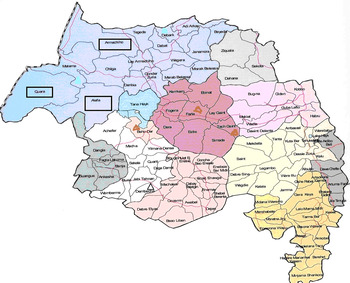
The study was conducted in three districts of the north Gondar zone (Quara, Alefa and Tache Armacheho) of Ethiopia (Figure 1). The altitude of the north Gondar zone ranges from 528 to 4620 m mean sea level (MSL) with annual rainfall of 880–1772 mm and temperature ranging from 44.5 to –10 °C. Quara district is located in the western part of the north Gondar zone between 11°47′ and 12°21N latitude and between 35°16′ and 35°47′E longitude. It is 1123 km from Addis Ababa and 324 km from Gondar town and at an altitude between 528 and 654 m above MSL. The annual temperature ranges from 25 to 44 °C with annual rainfall range of 600–1000 mm (CSA, 2011). Alefa district is located in the southwest of Gondar town and 909 km from Addis Ababa with the temperature of 25–30 °C and annual rainfall of 900–1400 mm. Armacheho district is located 814 km northwest of Addis Ababa and 65 km northwest of Gondar town at an altitude of 600–2000 m above MSL with the temperature of 25–42 °C and annual rainfall of 800–1800 mm (CSA, 2011).
Map of the study area (Amhara region), and the three districts where the ecotypes identified are indicated in rectangular shape.

Data collection methods
In addition to exploratory field survey, semi-structured questionnaires and participatory rural appraisal, focus group discussion, field observation, trait characterization and body measurements were employed to derive the required information. For the morphological and biometrical measurements, all matured chicken ecotypes n = 450, 150 males and 300 females, were measured. Qualitative traits such as plumage size, body shape, comb type, shank colour, skin colour, head shape and eye colour were documented through direct visualization. Whereas measurable traits like body weight (kg), body length, wing span, shank length and circumference, wattle length and width, keel length, spur length, beak length, comb length and width were measured using a spring balance and a measuring tape in cm, measuring to the nearest two digits (FAO, 2011).
Data management and statistical technique
Data from personal observation and focus group discussions were summarized and synthesized by researchers, whereas, the other quantitative and qualitative data were analysed using SAS software version 9, 2002. Particularly, general linear model was used to analyse quantitative traits (SAS, 2002). Tukey's comparison test was used to compare the sub factor brought significant difference. The model was used for body weight and linear body measurement of chickens’ ecotypes by considering the fixed effects of sex and ecotype.
 $${Y_{ijk}}=\mu+{A_i}+{D_j}+A{D_{ij}}+{e_{ijk}}\comma$$
where Y ijk is the observed body weight and linear body measurement of chickens; μ is the overall mean; A i is the fixed effect of ith eco-type (i = 1, 2 and 3); D j is the effect of kth sex (j = male and i = female); AD ji is the fixed effect interaction of ith eco-type with jth sex; and E ijk is the random residual error.
Multiple liner regression analysis was performed to predict the body weight of matured cocks and hens using 11 linear body measurements (independent variables) in each ecotype
 $$\eqalign{{Y_j} & = {\beta _0} + {\beta _1}{X_1} + {\beta _2}{X_2} + {\beta _3}{X_3} + {\beta _4}{X_4} + {\beta _5}{X_5} + {\beta _6}{X_6} \cr & + {\beta _7}{X_7} + {\beta _8}{X_8} + {\beta _9}{X_9} + {\beta _{10}}{X_{10}} + {\beta _{11}}{X_{11}} + {e_{ijk}}\comma}$$
where Y j is the dependent variable or predicted mean body weight of chickens; β 0 is the intercept; X 1, X 2, X 3, X 4, X 5, X 6, X 7, X 8, X 9, X 10 and X 11 are the independent variables for wing span, body length, shank length, shank circumference, keel length, spur length, beak length, wattle length, wattle width, comb length and comb width, respectively.
β 1, β 2, β 3, β 4, β 5, β 6, β 7, β 8, β 9, β 10 and β 11 are partial regression coefficients of the variables X 1, X 2, X 3, X 4, X 5, X 6, X 7, X 8, X 9, X 10 and X 11 and e ijk is the residual error.
Results
Naked neck chicken
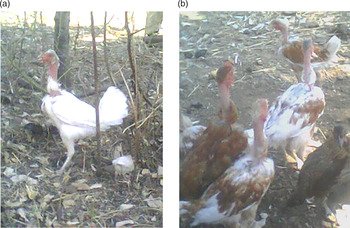
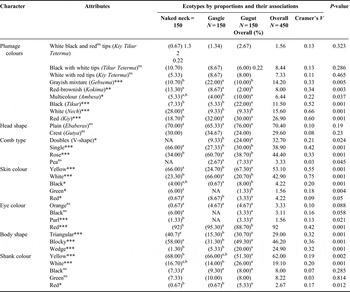
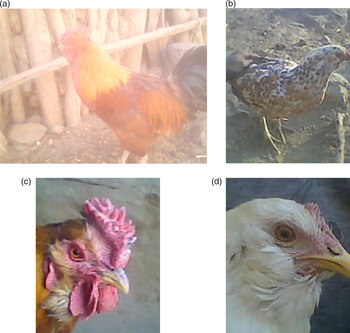
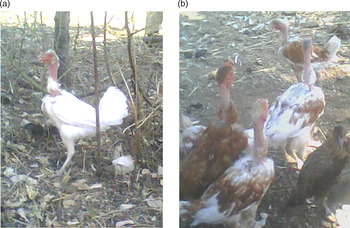
Naked neck chickens are found in a very hot ecological zone of the Quara district (Figure 2) and are maintained under scavenging system with small feed supplementation and sheltered outside the family house (perch). These chickens having predominantly white (28 percent) and red (20 percent) body plumage colours. However, they have heterogeneity and diverse additional plumage colour like red-brownish (0.7 percent), white with red tips (5.3 percent), black with white tips (10.7 percent), black (7.3 percent), multicolour (5.3 percent) and white black red tips (13.3 percent). About 53 percent of the birds have white skin colour, 66 percent have single combs, 34 percent have rose combs and 70 percent have plain headed facial appearance (Table 1 and Figure 2). The other peculiar features of this ecotype include aggressive behaviour, higher feed intake, good productive and reproductive performance, tolerance to common diseases and higher dressing percentage.
Typical Naked neck male (right) and female (left) chicken ecotypes.
Description of dominant body plumage colours, head shape, comb type and skin colour of newly reported indigenous chicken ecotypes (N = 450).

NA, not available and different superscripts within a row indicate significantly different means (P<0.05).
Gasgie chicken ecotype
Gasgie chicken ecotype is distributed in the Alefa district and (Figure 3) most households keep this chicken sheltered in the family house during the night, while they spend the day scavenging in the backyards supplemented with grains and food leftovers. The chicken have a predominantly red (32 percent) body plumage colour though have other diverse plumage colours such as white (9.3 percent), red-brownish (9 percent), white with red tips (9 percent), black with white tips (9 percent), black (5.3 percent), multicolour (4 percent) and white black red tips (1.3 percent). About 60.7 percent of the ecotypes are rose combed (Figure 3 and Table 1). Long neck (especially males), short weaning time, docile and good productive and reproductive performances are the unique features of this ecotype.
Typical Gasgie male (left) and female (right) chicken types.

Gugut chicken ecotype
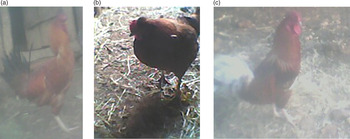
Gugut chickens (Figure 4) are distributed in the Debresina area of Tache Armacheho district. Most of the households keeping these chickens provide separate hanging shelters during night time to protect them from hyperthermia. Dense feathers from the neck, absence of wattle in female, low performance, short beak length, ability to resist endemic disease, small body size, passive and easily exposed to predators are the unique behaviours of the ecotype. These chicken are dominated by white (22 percent) body plumage colour and other diverse plumage colour such as multicolour (10 percent), red (9.3 percent), black (9.3 percent), white with red tips (8 percent), red-brownish (2 percent), black with white tips (2 percent) and white black red tips (2 percent). The investigated chicken ecotype showed additional heterogeneity in quantitative traits (Table 1).
Typical Gugut male and female chicken types.

The results indicated that the dominant average plumage colour of newly identified average three local chicken ecotypes were 26.90 percent red followed by 15.60 percent white and 14.20 percent greyish mixture. About 44.4 percent are rose comb type, 42.90 percent have white skin colour, 46.20 percent have blocky body shape and 70.40 percent are plain headed and are the most dominant observable traits of Gugut chickens ecotypes. About 34, 60.7 and 38.7 percent of chicken from Naked neck, Gasgie and Gugut ecotype, respectively, were characterized by rose comb type. The proportion of plain head shape in chicken populations of Naked neck, Gasgie and Gugut was comparable with 70, 65.3 and 76 percent, respectively (Table 1 and Figure 3). This variation could be adaptation fitness to their environment (Dana, Reference Dana2011).
Quantitative traits of (Naked neck, Gasgie and Gugut) chickens
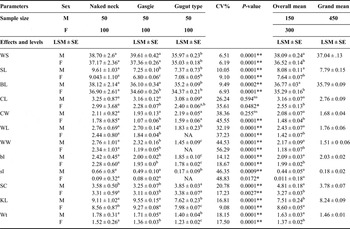
A total of 450 adult hens and cocks with 12 measurable parameters such as wing span (WS), shank length (SL), shank circumference (SC), body length (BL), comb length (CL), comb width (CW), wattle length (WL), wattle width (WW), beak length (bl), spur length (sl), keel length (KL) (cm) and body weight (Wt) (kg) for different sexes were considered. The least-squares mean of body weight and body measurements of Naked neck, Gasgie and Gugut chickens with Honestead significant difference comparison tests are presented in Table 2. The overall least-squares mean of wing span, shank length, shank circumference, body length, comb length, comb width, wattle length, wattle width, beak length, spur length, keel length (in cm) and body weight (in kg) were (37.04 ± 0.13), (7.79 ± 0.15), (3.78 ± 0.07), (35.79 ± 0.09), (2.76 ± 0.09), (1.68 ± 0.04), (1.76 ± 0.06), (1.51 ± 0.06), (2.03 ± 0.02), (0.18 ± 0.02), (8.24 ± 0.09) and (1.46 ± 0.01), respectively.
Overall sex effect body weight mean squares of male and female chickens were 1.63 ± 0.03 and 1.37 ± 0.02 kg, respectively. Naked neck chicken male body weight (1.78 ± 0.31 kg) is significantly (P < 0.01) higher than the Gugut male chicken 1.40 ± 0.04 kg but not body weight of Gasgie 1.71 ± 0.05 kg. Further, the Naked neck cocks and hens were found to have significantly taller shank length of 9.61 ± 1.03 and 9.043 ± 1.10 (cm), respectively, than the Gugut. However, shank circumference of Gugut cocks and hens are inversely superior in shank circumferences than Naked neck and Gasgie male and female chickens (Table 3). A non-significant comb length variation between sexes of Naked neck chicken was obtained. While Naked neck and Gasgie cocks had the longest beak length of 2.42 ± 0.45 and 2.00 ± 0.02 cm, respectively, than Gugut cocks 1.85 ± 0.10 (cm). Beak length variation is recorded among ecotypes but not with in ecotype in respective sexes (Table 3).
Comparison (LSM ± SE) of body weight (kg) and linear body measurements (cm) and extraction effect of independent variables of the three indigenous chickens.

WS, wing span; SL, shank length; BL, body length; CL, comb length; CW, comb width; WW, wattle width; WL, wattle length; KL, keel length; sl, spur length; bl, beak length; SC, shank circumference, in the measurement of cm; Wt, weight (kg); NA, not available; LSM, least-squares mean; SE, standard error and different superscripts within a row indicate significantly different means (P < 0.05).
Correlations of body weight and other linear body measurements
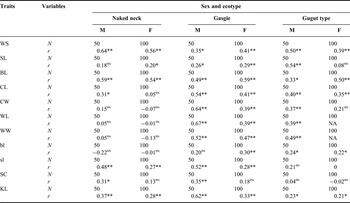
Live weight was positively correlated (r = 55.5, P < 0.01) with wing span. Body length and spur length in Naked neck were positively correlated, males (r = 0.62, P < 0.01) and females (r = 0.55, P < 0.01). Whereas WL is the highest correlated trait (r = 0.67, P < 0.01) with body weight of Gasgie male chickens. The high correlation coefficients between body weight and other body measurements (P < 0.01) helped to predict body weight of chickens (Table 3).
Coefficient of correlations between body weight and linear body measurements for female and male in all ecotypes in the study area (N = 450).

WS, wing span; SL, shank length; BL, body length; CL, comb length; CW, comb width; WL, wattle length; WW, wattle width; bl, beak length; sl, spur length; SC, shank circumference; KL, keel length; N, number of samples and r, correlation coefficients.
Prediction equation models
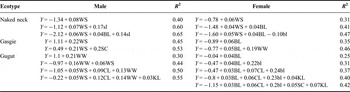
First WS, BL and WW traits were used as linear regression to predict body weight of chickens. Whereas stepwise multiple regression was considered to predict the dependant variables by considering other traits like sl, SC, CL, bl and KL at a time in the three chicken ecotypes. In linear regression result, the body weight prediction value of Naked neck cocks and hens and Gasgie cocks were 0.40, 0.31 and 0.45, respectively. In addition to liner regression, multiple regression analysis was considered to determine the effects of other body measurements on body weight prediction (Table 4). To increase meat and egg production it requires genetic improvement of body weight of chickens. But proper measurement of this variable is often hard in villages due to lack of weighing scales. Hence, easily measurable linear body measurements are more relevant for chickens’ body weight prediction at farmers’ level rather subjectively judging manually. In addition, the present farmers are active at early morning by providing supplementary feed to their chicken before bringing them to the market to increase the temporary body weight of their chickens. Therefore, prediction equation was important.
Prediction equations in multiple regression analysis of body weight on other variables of female and male.

WS, wing span; sl, spur length; BL, body length; SC, shank circumference; WW, wattle length; CL, comb length and KL, keel length, all variables left in the model are significant at the 0.05 level. No other variable met the 0.05 significance level for entry into the model on body weight.
Discussions
Analysing the research result evidenced that more than 70 percent of the population of chicken ecotypes in the study area were carrying the Naked neck chicken characteristics. This is new and significantly (P < 0.001) higher in number than reported result in other parts of Ethiopia (7.9 percent; Aberra and Tegene, Reference Aberra and Tegene2011; <2 percent; Dana, Reference Dana2011), Nigeria (6 percent; Gueye, Reference Gueye1998) and Botswana (3.6 percent; Badubi, Rakereng and Marumo, Reference Badubi, Rakereng and Marumo2006). The other results on plumage colours of the identified chicken ecotypes are different from the report result from northwest Ethiopian (Halima, Reference Halima2007). Variations of rose comb types, white skin colour, blocky body shape and plain head types are the dominant visible traits of chicken ecotypes. This result was not in lined with the reported result done at Bure and Fogera districts in the Amhara region and Dale district in Southern Ethiopia (Fisseha, Abera and Tadelle, Reference Fisseha, Abera and Tadelle2010). This variation could be a breed-specific trait, nutritional status, genotype and reflected adaptation fitness to their environment (Aberra and Tegene, Reference Aberra and Tegene2011; Dana, Reference Dana2011). Complete absence of wattle from Gugut females, long neck and early weaning of Gasgie chicken ecotype is the unique character from the previous studies in Ethiopia and elsewhere in the tropics by Halima (Reference Halima2007), Aberra and Tegene (Reference Aberra and Tegene2011) and Dana (Reference Dana2011).
Overall body weight of male and female chickens are varied from Ethiopian chickens reported by Dana (Reference Dana2011) which is 1.63 kg for males and 1.27 kg for females. Body weight of Naked neck and Gasgie chickens were higher than chicken in central (Danna, 2011) and northwest Ethiopia (Halima Reference Halima2007) in the body weight of 1.26 and 0.87 kg for adult male and female, respectively. The frequency of chicken ecotypes carrying the Naked neck gene that we studied was significantly (P<0.001) higher than those reported in other parts of Ethiopia (<2 percent; Dana, Reference Dana2011), Nigeria (6 percent; Gueye, Reference Gueye1998) and Botswana (3.6 percent; Badubi, Rakereng and Marumo, Reference Badubi, Rakereng and Marumo2006).
Conclusions and recommendations
Naked neck, Gasgie and Gugut chickens are newly identified ecotypes from Quara, Alefa and Tache Armacheho district in the northern parts of Ethiopia, respectively. The identified chicken ecotypes had diversified variations in both qualitative and quantitative characters. As an example, phenotypic characterizations like 12 quantitative and seven qualitative traits were considered among the three chicken ecotypes. Heavier adult body weight and longer shank length were measured from the Naked neck, followed by the Gasgie chicken ecotypes. Qualitatively, the Gasgie chicken eco-type had normal feather morphology and others like the Naked neck chicken ecotype is easily distinguished by the complete absence of feather at neck and chest. Whereas Gugut chicken ecotype is characterized by complete absence of wattle in hens, it is the smallest of all and has dunce feather at neck in both the sexes. All these findings indicated that the investigated chicken ecotypes show heterogeneity in most traits considered. Thus, in-depth molecular characterization using genetic markers should be undertaken to confirm the level of genetic variations and relationships among newly identified and other indigenous chicken ecotypes.
Acknowledgements
This work is funded by the German International (GIZ) project to which we are grateful. We also thank all interviewed village chicken owners, district agricultural office experts, key informants and other participants who helped us to carry out every activity on this research.