




No CrossRef data available.
Article contents
A pilot study of the impact of a grief camp for children
Published online by Cambridge University Press: 19 July 2005
Abstract
Objective: Research indicates that children benefit from supportive interventions to help them cope with the loss of a loved one. The aim of this pilot study was to evaluate children's perceptions of the effectiveness of a grief camp.
Methods: Semistructured interviews were performed with 18 children who attended a weekend-long grief camp. Children also responded to follow-up interviews via telephone. Their parents also completed surveys before camp began and either after camp ended or at a follow-up evaluation. Data were analyzed using descriptive statistics and content coding to uncover key themes in the interviews.
Results: Children reported that art activities helped them to express feelings about their grief and release feelings of sadness and worry related to the death. Parents and children felt that the camp was a positive experience and that the children benefited from being in groups with peers who had also lost family members.
Significance of results: Evaluating the impact of grief camps, using practical methods such as the ones for this study, is important, as these camps are becoming more popular interventions. Children and parents may benefit from contact at specified follow-up periods after camp to determine if they would benefit from further therapy. Results also provide evidence of the success of this program, which supports the need for funding these types of interventions.
Information
- Type
- Research Article
- Information
- Copyright
- © 2004 Cambridge University Press
INTRODUCTION
The death of a family member is an adverse event for children (Worden 1996), which may represent “a profound psychological insult” (Raveis et al., 1999, p. 165). Approximately 4% of children who are younger than 18 and live in the United States experience the death of a parent (Sandler et al., 2003). The death of a loved one initiates a bereavement reaction, typically characterized by feelings of sadness and feeling as if a loved one was taken away from the family (Reynolds et al., 1995; Buckingham, 1996). Young children who have lost a parent or sibling are likely to exhibit problems in emotional, social, and behavioral functioning (Worden, 1996; Thompson et al., 1998). They may feel sadness and anxiety during the grieving process (Raveis et al., 1999; Sandler et al., 2003).
Community-based programs for bereaved children are becoming more common and popular. Research on the effectiveness of community-based programs, like hospice services, for children coping with the loss of a loved one is needed (Armstrong-Dailey & Zarbock, 2001; Curtis & Newman, 2001; Davies, 2001). The purpose of this study was to examine children's opinions about a hospice-sponsored grief camp. During camp children participated in art and counseling activities designed to improve emotional expression, build positive memories, and improve abilities to cope with the loss of a family member. The children completed group activities with peers who had also lost a family member. Groups were facilitated by hospice counselors and trained volunteers. This type of experience offers an important outlet for children, who may not discuss their feelings with family members in order to protect them from experiencing additional emotional distress (Reynolds et al., 1995).
The opportunity to share feelings of grief in a supportive environment among peers who have endured the death of a loved one may be one of the most powerful aspects of the camp experience (Tremblay & Israel, 1998; Christ et al., 2002). A literature search revealed one study examining the impact of summer camps for helping siblings of children with cancer cope with grief related to their brother's or sister's terminal illness (Spirito et al., 1992). These researchers reported that participating in the summer camp improved support for children and helped them to express, remember, and actualize their feelings regarding their sibling's terminal illness. A literature search revealed no similar studies assessing the effectiveness of bereavement camps.
This pilot study contributed to the literature by providing information about children's perceptions of the impact of a grief camp. Interviews were used to record children's views about their camp experience, as qualitative methods are recommended to provide explanatory information about grief reactions (Nadeau, 1998; Christ, 2000). The study assessed perceptions of children between 6 and 12 years of age. Children in this age range may be at increased risk for adjustment problems following the loss of a family member (Worden, 1996). Children's groups focusing on interventions designed to promote emotional expression, such as the art activities at this camp, can facilitate opportunities for children to cope with emotions that they might not be able to share in the home environment.
METHODS
Participants
Eighteen children (9 boys and 9 girls) attended the camp and participated in this project. Children were in the first through sixth grades, and had lost a parent or grandparent. Sixteen of the children were Caucasian and 2 were African American. Nine of the children had participated in counseling, 6 were in individual counseling and 3 were in family counseling. Most of the children (n = 16) were making “As” or “Bs” in school. Six children had lost their mother, 11 had lost a father, and 1 had lost a grandparent (cause of death varied). Parental consent and child assent were required for participation and a university-based institutional review board approved this study.
Camp Description
The camp was designed to provide a 3-day experience (over a weekend) for bereaved children between the ages of 6 and 12. Campers stay overnight and are assigned to a peer buddy, and then assigned to cabins and a volunteer counselor. These groups stay in the same cabin. Trained counselors from hospice and similar programs as well as trained volunteers staff the camp. The mission of the camp is to allow children to meet in an informal atmosphere to help reduce the sense of isolation they may feel when coping with their grief. Another goal is to provide opportunities to learn about the grieving process (e.g., that grieving is normal and involves many types of emotions). Children and staff participate in scheduled activities during camp, which include art activities, crafts, games, and sports. Rules for the children are posted: “(1) Stay focused on the group activity, (2) share thoughts and feelings one at a time, and (3) no hurting other people's bodies, feelings, or objects.”
A manual, developed by Hospice of the Bluegrass1
The training manual and questionnaires are available from the first author: Laura Nabors, Department of Psychology, Mail Location 376, University of Cincinnati, Cincinnati, OH 45221-0376, USA.
Evaluation Procedures
Parents completed a survey during an orientation session before camp and another after camp ended. The initial survey requested background information (child's gender, type of loss) and required parents to answer questions about changes in their child's emotional functioning (e.g., sadness, worry), using 4-point Likert scales (1 for no change and 4 for a high level of emotion) or “yes” or “no” questions. Five parents completed a similar survey immediately after camp ended. Four parents completed the follow-up survey 6 months after camp ended.
During camp, children completed surveys to record their satisfaction with two art activities designed to facilitate emotional expression: painting feelings masks and a making their own board game about grief reactions. A research assistant and the first author asked the children about their satisfaction with these two activities and recorded their responses about their level of satisfaction on 4-point Likert scales (1, no help or satisfaction, 4, a lot of help or satisfaction). The research assistant and the first author also recorded why and how much the activities (using the 4-point Likert scales) helped them cope with feelings of sadness and anxiety related to the loss.
At the end of camp, children worked with camp staff to complete questions to evaluate their opinions of camp. These questions were open ended, and most of the children finished answering them in about 10 min. Staff also recorded their ideas about what the camp meant for the children.
Six months after camp ended, 5 of the children who attended camp completed a follow-up survey. A research assistant administered survey questions by telephone. Questions examined the children's views about how camp helped them and what activities they remembered enjoying and the reasons why these activities helped them cope with their grief (see footnote 1).
RESULTS
Parent Report Prior to Camp
All but one of the parents reported that their family functioning was poor and reflected a state of distress. Five of the 17 parents (29%) reported that their child was experiencing a high degree of sadness about their parent's death. Eight parents (47%) reported that their child was experiencing some sadness related to the loss. Sixty-seven percent reported that their child was experiencing significant anxiety related to the death. Four parents (22%) reported that they believed the child's academic performance had declined because of grief related to the death. Sixteen of the 18 parents (89%) reported that their children's friends remained a strong source of support for them and that their children were still playing as often with friends as they were before the death.
Five parents completed evaluation forms the day camp ended. They all had positive things to say about the camp like, “I think it was very uplifting for my child.” Another parent said that her son “thoroughly enjoyed it and said it was great to be able to freely express grief with others who understood it.” On rating scales, however, no significant changes were noted in the children's levels of sadness or anxiety.
Four parents provided information about 6 children (2 of the children had siblings who attended camp) at a 6-month follow-up. Four of the children were still experiencing some sadness or grief related to the death. One child, a boy who had lost a father, experienced an emotional low about a month after camp when he “hit rock bottom” and talked about suicide. After being hospitalized his emotions stabilized. Another girl lost her grandfather during the follow-up period. She had lost her father before camp. Her mother reported that her daughter remained withdrawn and was still experiencing a moderate level of sadness and a high level of anxiety. All of the parents were very positive about the camp experience, even the parent of the boy who was hospitalized, stating that their children had a great time and “wanted to go back.” The mother of the daughter who had experienced the loss of her grandfather said, “I think Camp Great Escape was a very good program for my daughter and I remember picking her up and how excited she was.”
Eighteen of the children provided responses about their satisfaction with the feelings mask and game activities. Fourteen of the children were very satisfied with the feelings mask activity. Nine (50%) felt that the feelings mask was “very helpful” and 6 (33%) stated that the activity was helpful for expressing feelings of sadness related to their parent's death. Most of the children (n = 16, 89%) reported that the feelings masks were a very helpful activity for coping with anxiety related to their loss. The children were less satisfied with the board game. Only 28% were very satisfied with the game or found the game “very helpful” in addressing their feelings of sadness and 2 children did not enjoy the game or find it helpful in addressing feelings of sadness or anxiety. Eleven children (61%) thought the game was very helpful for addressing anxiety, and 7 children thought the game was very helpful for coping with feelings of sadness.
Children's Views of their Camp Experience
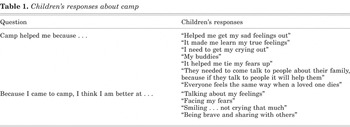
All of the children reported that camp helped them. Children provided answers indicating that they valued the peer support and counseling activities at camp. Quotes representing children's perceptions are presented in Table 1.
Children's responses about camp

Counselors provided similar answers to those provided by the children about the benefits of camp. One counselor reported, “It (camp) helped them learn that with support they could overcome their fears and difficulties.” Counselors also mentioned that the camp afforded the children opportunities for emotional expression and a chance to begin to build a positive memory of the loved one.
A research assistant completed a telephone survey with 5 children at a 6-month follow-up. The children all rated their camp experience as “good” and “very helpful.” One 11-year-old boy stated that participating in camp “got me over my anger.” Another 11-year-old girl said that at camp she learned that, “You're not the only one going through losing somebody.” The children remembered participating in the feeling masks activity and enjoying it, and they also mentioned benefiting from memorial activities involving rituals. The girl who had lost her grandfather during the follow-up period completed the survey via mail. She reported that at camp she learned that “everybody gets born and at some time they have to pass away.” She rated her camp experience as good and said that attending camp was very good (4) at helping her deal with her sadness over her father's death and O.K. (3) in helping her cope with worry related to losing her father.
Questions for the Doctor Session
Children were divided into two groups, one for older children (ages 9 to 12) and one for younger children (ages 6 to 8) to explore questions about death. Ten children participated in the “older” group. The question of most interest was “What happens after a person dies?” The older children wanted explanations about changes to the body after death, such as, “Why is the skin a funny color after a person dies?” The younger children wanted to know about the medical changes that cause death (e.g., the heart stops). Other questions were “Can dead people come back to life?” and “Can I catch what they had and die too?”
DISCUSSION
Results for this pilot study indicated that the children appreciated and were involved in the camp experience, can be successfully approached, and are responsive to questions about their experience. They valued opportunities to share with others who had gone through similar experiences in a supportive environment (Worden, 1996; Worden & Monahan, 2001). The children also enjoyed the art activities as opportunities to express feelings they might not otherwise be able to process. Several studies have shown art activities to be an effective method for helping children process intense emotional reactions (Reynolds et al., 2000).
Parents also reported that their children benefited from participating in the camp. A few of the parents also came to camp and observed some of the activities, and the popularity of the camp experience for parents has led Hospice of the Bluegrass to begin developing a family grief camp. Involving the children and their families in rituals to explore feelings about the loss and create a memory of the loved one are important activities to facilitate coping throughout the grieving process (Rando, 1985). Involving parents may improve young children's abilities to adjust to the loss of a loved one (Hurd, 1999). Improving parent–child communication between the surviving child and parent, so that the child can express his or her feelings in an open way, can further enhance the child's ability to cope with the loss (Sandler et al., 2003).
Findings also indicated that most of the children were experiencing feelings of sadness and anxiety related to the loss of their mother or father (Reynolds et al., 1995; Buckingham, 1996; Worden, 1996; Raveis et al., 1999). However, these feelings did not appear to cause a change in relationships with friends. Activities with friends may serve as a protective factor for children who have lost a parent. More research is needed on protective factors for these children (Worden, 1996).
Follow-up interviews revealed that one child experienced a significant emotional reaction after the camp and another went through another significant loss experience. Parents were provided with referrals at camp and the mother of the boy who expressed suicidal thoughts reported that he received appropriate treatment and began to improve, in terms of his emotional functioning. The researchers contacted the parents of the boy and girl who had experienced further emotional stress to ensure that they were receiving or had received appropriate services. Study results indicated that it is important to keep in contact with children who have lost a family member, because some may experience overwhelming emotions at some point after the loss or may experience other events that trigger memories of the previous loss (Thompson et al., 1998). Researchers need to continue to improve knowledge about factors related to severe changes in children's behavior, such as suicidal thoughts, following parental loss.
Children's questions for the doctor were consistent with existing literature reflecting children's concepts and understanding of death. Some children in the younger group were still learning about the finality of death, in terms of the cessation of physical or biological functioning. Most of the older children, however, understood that death was irreversible and indicated nonfunctionality (Speece & Brent, 1987). Similar to Melear's (1973) report, children in the younger age group asked questions about whether the deceased was still experiencing pain. They also were inquisitive about the biological processes that were involved in the death experience for their loved one. Older children asked more questions about what happens to the person after death. Therapeutic interventions, such as the “Questions for the Doctor” session, allow children to explore their understanding of a loved one's death. This is important because young children may misunderstand the causes of death and mistakenly blame themselves for the loss of a loved one (Christ et al., 2002).
CONCLUSION
This pilot study provided information supporting the benefit of grief camps for children, and results can be used to seek funding for these types of programs. The camp fulfilled its mission of creating a supportive environment for children to process grief experiences with peers who had similar experiences. On the other hand, the study was a pilot project using a small sample and relied primarily on qualitative data and data from self-report measures without well-established psychometric properties. More studies are needed to determine outcomes for children who participate in grief camps. Others have written about the benefits of hospice services and proposed that more research is necessary to support the positive effects of these services in helping children and families cope with grief (Armstrong-Dailey & Zarbock, 2001; Davies, 2001). Consequently, longitudinal research to assess whether improvements in psychosocial functioning are related to therapeutic experiences, like camps and other grief support groups, is needed to determine factors related to adjustment and coping for children who have lost a family member. Children and family members were responsive to our efforts to learn about their perceptions and track the children's progress, suggesting that evaluations such as this project are possible and may be beneficial in assisting practitioners in evaluating children's progress following grief camp experiences.
References
REFERENCES
Armstrong-Dailey, A. &
Zarbock, S.
(2001).
Hospice Care for Children
(2nd ed.).
New York:
Oxford University Press.
Buckingham, R.W.
(1996).
The Handbook of Hospice Care.
New York:
Prometheus Books.
Christ, G.H.
(2000).
Healing children's grief: Surviving a parent's death from
cancer.
London:
Oxford University Press.
Christ, G.H.,
Siegel, K., &
Christ, A.E.
(2002).
Adolescent grief: “It never really hit me … until it
actually happened.”
Journal of the American Medical Association,
288,
1269–1278.Google Scholar
Curtis, K. &
Newman, T.
(2001).
Do community-based support services benefit bereaved children? A
review of empirical evidence.
Child: Care, Health and Development,
27,
487–495.Google Scholar
Davies, B.
(2001).
Assessment of need for a children's hospice program.
Death Studies,
20,
247–268.Google Scholar
Hurd, R.C.
(1999).
Adults view their childhood bereavement experiences.
Death Studies,
23,
17–41.Google Scholar
Melear, J.R.
(1973).
Children's conceptions of death.
Journal of Genetic Psychology,
123,
359–360.Google Scholar
Nadeau, J.W.
(1998).
Families Making Sense of Death.
Thousand Oaks, CA:
Sage.
Rando, T.A.
(1985).
Creating therapeutic rituals in the psychotherapy of the
bereaved.
Psychotherapy: Theory, Research, Practice, and Training,
22,
236–240.Google Scholar
Raveis, V.H.,
Siegel, K., &
Karus, D.
(1999).
Children's psychological distress following the death of a
parent.
Journal of Youth and Adolescence,
28,
165–180.Google Scholar
Reynolds, L.A.,
Miller, D.L.,
Jelalian, E.,
et al.
(1995).
Anticipatory grief and bereavement. In
Handbook of Pediatric Psychology,
2nd ed.
Roberts, M.C. (ed.), pp.
142–164.
New York:
Guilford Press.
Reynolds, M.W.,
Nabors, L.A., &
Quinlan, A.
(2000).
The effectiveness of art therapy: Does it work?
Art Therapy: Journal of the American Art Therapy Association,
17,
207–213.Google Scholar
Sandler, I.N.,
Ayers, T.S.,
Wolchik, S.A.,
et al.
(2003).
The family bereavement program: Efficacy evaluation of a
theory-based prevention program for parentally bereaved children and
adolescents.
Journal of Consulting and Clinical Psychology,
71,
587–600.Google Scholar
Speece, M.W. &
Brent, S.B.
(1987).
Irreversibility, nonfunctionality, and universality:
Children's understanding of the 3 components of a death
concept. In
Children and Death: Perspectives from Birth through
Adolescence,
Schowalter, J.E.,
Buschman, P.,
Patterson, P.R.,
et al. (eds.), pp.
19–29.
New York:
Praeger.
Spirito, A.,
Foreman, E.,
Ladd, R.,
et al.
(1992).
Remembering services at a camp for childhood cancer patients.
Journal of Psychosocial Oncology,
15,
467–477.Google Scholar
Thompson, M.P.,
Kaslow, N.J.,
Kingree, J.B.,
et al.
(1998).
Psychological symptomatology following parental death in a
predominantly minority sample of children and adolescents.
Journal of Clinical Child Psychology,
27,
434–441.Google Scholar
Tremblay, G. &
Israel, A.
(1998).
Children's adjustment to parental death.
Clinical Psychology Science and Practice,
5,
424–438.Google Scholar
Worden, J.W.
(1996).
Children and Grief: When a Parent Dies.
New York:
Guilford Press.
Worden, J.W. &
Monahan, J.R.
(2001).
Caring for bereaved parents. In
Hospice Care for Children,
2nd ed.,
Armstrong Dialey A., &
Zarbock, S. (eds.), pp.
137–156.
London:
Oxford University Press.
Children's responses about camp
 You have
Access
- 10
- Cited by