Since 2003, the US federal government has encouraged households to take basic protective measures before, during, and after an emergency through the Ready.gov campaign and Citizen Corps. 1 , 2 Specifically, before an emergency, households are encouraged to meet emergency preparedness metrics, such as having a 3-day supply of food and water, medication, and a written household evacuation plan, to improve their ability to respond during an emergency by enabling self-reliance and decreasing dependence on emergency services and health care systems during periods of service disruption. 3 , Reference Sutton and Tierney 4 Despite the promotion of household preparedness, regional and national surveys have found variable but overall below target rates of preparedness. 3 , 5 , Reference Ablah, Konda and Kelley 6 To estimate current levels of self-reported household preparedness and to use the information for disaster response planning and to build local, regional, and state capacity for conducting community assessments, the Virginia Department of Health (VDH) with remote technical assistance from the Centers for Disease Control and Prevention (CDC) conducted a community assessment in Portsmouth, Virginia, in 2013 by use of the Community Assessment for Public Health Emergency Response (CASPER) methodology. 7
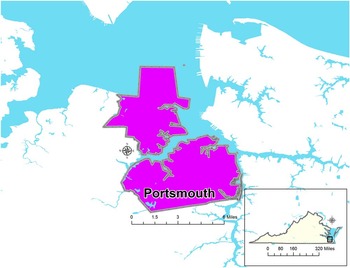
Portsmouth, a southeastern Virginia city with an estimated population of 95,535 residents and 40,806 housing units according to the 2010 census, is part of the Hampton Roads metropolitan region (Figure 1). This region consists of approximately 7500 km2 of low-lying coastal plains that are subject to hurricane storm surge.Reference Kleinosky, Yarnal and Fisher 8 VDH’s Portsmouth Health District was selected for this first CASPER in Virginia because of its potential to be impacted by a natural disaster (eg, hurricanes) and because district staff expressed an interest in assessing community preparedness by using the CASPER methodology.
Map of Portsmouth, Virginia.

Methods
This project received exemption approval by VDH’s Institutional Review Board (study #50149) and was determined to be public health nonresearch by the CDC’s Office of Public Health Preparedness and Response human subjects review board.
VDH applied the CASPER methodology described in the CDC CASPER Toolkit Version 2.0. 7 This methodology utilizes a 2-stage probability sampling technique. First, 35 clusters within the Portsmouth Health District jurisdiction were selected, with their probability of selection being proportional to the estimated number of housing units in each cluster. Second, 6 households were randomly selected within each cluster for interviews to meet the target of 210 representative households. Of note, each housing unit within a multiple-unit housing structure (eg, apartment building) was treated as an individual housing unit during both sampling stages. Investigators opted to use the modified sampling design (35×6) over the traditional design (30×7) to reach the targeted number of 210 households because of the anticipated lower number of households in certain clusters and to increase the chance of completing the number of household interviews per cluster. Eleven or 12 two-person teams conducted interviews over 3 consecutive evenings in May 2013, spending approximately 270 person-hours in the field. Household interviews were conducted with an English-speaking, adult household member who provided consent; households in which an adult, English-speaking member was not available were replaced because interpreters were not available. Participating households were provided with educational materials about fire safety and public health services available at the Portsmouth Health District.
A standardized questionnaire consisting of 43 questions was administered to capture information across the major categories of emergency preparedness and communication during an emergency, current medical conditions and needs, preventive care, nutrition, and physical activity. Each interview team collected data using both paper and handheld electronic devices (Trimble GeoXT 2005 and 2008 Series; Trimble Navigation Limited, Sunnyvale, CA). A 4-hour just-in-time training was offered to all staff and volunteers on the first day of the assessment to address methodology, safety, logistics, data collection, and interviews. In addition, a separate 2-hour training the week before the CASPER was provided on the handheld units to recruited epidemiologists and public health staff who would be their primary users.
Data were analyzed by using SAS software (version 9.3; SAS Institute Inc, Cary, NC). Data collected electronically were downloaded into Microsoft Office Excel software (version 2007; Microsoft Corp, Redmond, WA). After comparing data from paper and electronic devices on a subset of surveys, the team decided to use electronically captured data for the analysis because variation in answers across all answer fields was considered minimal (<10%). Weighted cluster analyses based on the total number of households within the sampling frame, the number of clusters randomly selected, and the number of interviews completed in each cluster were performed to estimate the frequency and 95% confidence intervals (CIs) within the sampling frame for a particular variable.
Results
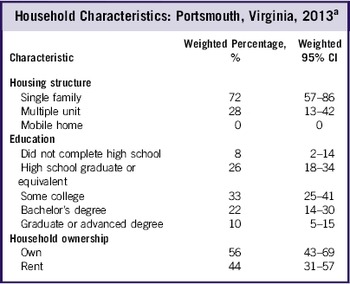
The interview teams completed 180 of the targeted 210 interviews (86%). Based on the weighted analysis, the majority of households (72%) were single-family households and the remaining 28% were multiple-unit structures, such as apartments, condominiums, or townhomes (Table 1). The highest levels of education among anyone in the household varied, with 26% of households having a member who had completed high school and 22% having a member receiving a college bachelor’s degree (Table 1).
Household Characteristics: Portsmouth, Virginia, 2013Footnote a

a Abbreviation: CI, confidence interval. Results from Community Assessment for Public Health Emergency Response (CASPER) conducted in Portsmouth, Virginia, on May 13–15, 2013. Responses of “Not Applicable” or “Refused” were excluded from the analyses. Weighted cluster analyses based on the total number of households within the sampling frame, the number of clusters randomly selected, and the number of interviews completed in each cluster were performed to estimate the frequency and 95% CIs within the sampling frame for a particular variable.
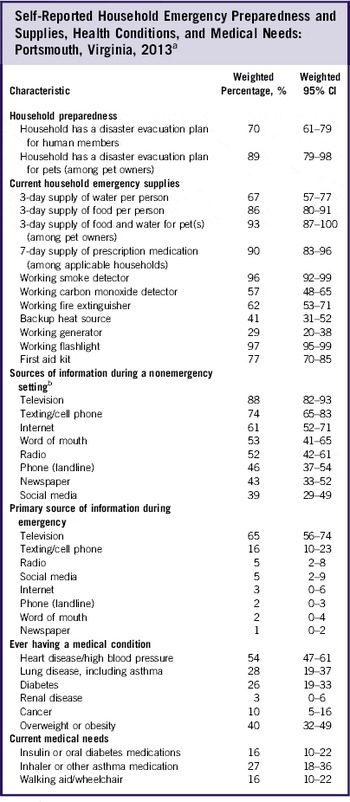
Weighted analyses of household preparedness characteristics, including emergency plans, current supplies, and communication methods, are summarized in Table 2. When asked if the household had a disaster evacuation plan (which did not have to be a written evacuation plan in our survey) that described evacuation destinations, most (70%) reported having such a disaster evacuation plan. Among the 44% of households that owned a pet, most (89%) reported having a similar evacuation plan for their pets and multiple interviewees commented that this meant that the pet would go with its owner. The majority of households (86%) had a 3-day supply of canned or prepackaged food per person, but fewer (67%) had a 3-day supply of bottled or fresh water per person. Among households with pets, 93% reported having a 3-day supply of food and water for their pets. Eighty-one percent of households had a household member taking prescription medications, and of these households, 90% had a 7-day medication supply. In terms of safety supplies, most (96%) households had a working smoke detector, but fewer households had a working fire extinguisher (62%) or working carbon monoxide detector (57%). A backup heat source (41%) and working generator (29%) were less commonly reported. Nearly all (97%) households had a working flashlight and the majority (77%) had a first aid kit.
Self-Reported Household Emergency Preparedness and Supplies, Health Conditions, and Medical Needs: Portsmouth, Virginia, 2013Footnote a

a Abbreviation: CI, confidence interval. Results from Community Assessment for Public Health Emergency Response (CASPER) conducted in Portsmouth, Virginia, on May 13–15, 2013. Responses of “Not Applicable” or “Refused” were excluded from the analyses. Weighted cluster analyses based on the total number of households within the sampling frame, the number of clusters randomly selected, and the number of interviews completed in each cluster were performed to estimate the frequency and 95% CIs within the sampling frame for a particular variable.
b Respondents could select multiple sources of information.
During nonemergencies, the television (88%) and cellular phones for texting or phone calls (74%) were the most common sources of information, followed by the internet (61%), word of mouth (53%), radio (52%), landline telephone (46%), newspaper (43%), and social media (39%) (Table 2). During an emergency, 65% of households reported that the television would be the primary source of information; cellular phones or texting ranked a distant second (16%), followed by radio (5%) and social media (5%) (Table 2).
When asked if any household member had ever been diagnosed by a doctor with a chronic condition, heart disease or hypertension (54%), overweight or obesity (40%), lung disease including asthma (28%), and diabetes (26%) were more commonly reported than cancer (10%) or renal disease (3%) (Table 2). Households in which a member had heart disease or diabetes were more likely to have a 7-day medication supply than were households without these conditions (heart disease: 99% vs. 77%, Wald chi-square test, P<0.01; diabetes: 98% vs. 86%, P<0.05). In terms of current medical needs, using an inhaler was the most common need reported (27%), followed by insulin (16%) and walking support (16%). Few households reported a household member currently requiring in-home medical care (3%), an oxygen supply (2%), or confinement to a bed (1%). No households reported a family member undergoing dialysis. Approximately 10% of households had a member with special medical needs or health conditions that required help in performing activities like bathing, dressing, feeding, or toileting.
Discussion
For community preparedness performance metrics, the US Department of Homeland Security recommends that at least 80% of households maintain disaster supplies, including food, water, medicine, and a first aid kit, as part of pre-incident preparation planning. 9 Findings from the CASPER assessment in Portsmouth, Virginia, suggest that household preparedness levels are below the recommended levels. Thirty percent of Portsmouth households did not have an evacuation plan, 33% did not have a 3-day supply of water for each member, and 23% did not have a first aid kit. Only approximately 60% of households in Portsmouth had working carbon monoxide detectors or fire extinguishers. Compared to a previous study about household preparedness in 14 states, 3 the Portsmouth findings about emergency food, water, and medication supplies are similar; however, the proportion of households with an emergency evacuation plan may have been substantially higher in Portsmouth than at the other sites because our survey question did not specify that the evacuation plan had to be in writing. Overall, these results identify important opportunities for stakeholders across a variety of sectors, including the Portsmouth Health District, Portsmouth Office of Emergency Management, and Portsmouth Fire Department, to educate the public about the importance of emergency planning and having emergency supplies on hand before a disaster occurs.
Although television remains a primary way that people receive information during emergency and nonemergency situations, newer means of communication such as social media, internet, and texting were also widely used by Portsmouth households to get information during nonemergencies. Public health and emergency management should continue to disseminate pre-emergency messages across a variety of platforms to reach households. Because most households reported that the television would be the primary source of information during an emergency, local messaging should also target this specific medium during emergencies if it is operational.
Persons with chronic conditions, such as heart or lung disease and diabetes, are more vulnerable than are healthy persons during a disaster.Reference Aldrich and Benson 10 The fact that many Portsmouth households reported a household member with an underlying medical condition and that the most commonly reported medical needs involved medications for diabetes or asthma are important not only for public health education and outreach, but also for understanding the health-related needs in the community for emergency response planning and response.
Since conducting the first CAPER in Virginia in 2013, the Portsmouth Health District has enhanced its local emergency response planning and communication strategies. The household preparedness and chronic condition data have been used to address health priorities in the community and influence the development of Portsmouth’s Community Health Improvement Plan. Also, health district staff have substantially increased the use of social media and television broadcasts to provide critical public health messaging. Through the 2013 CASPER, health department staff and volunteers gained experience in implementing this type of assessment, interviewing households, and collecting data in the field. In October 2014, the Portsmouth Health District conducted another CASPER to collect household behavioral information about healthy eating, physical activity, and tobacco use that will be used as a baseline before implementing the Community Health Improvement Plan. Last, lessons learned and materials developed during the 2013 CASPER in Portsmouth have been applied toward CASPERs in other health districts in Virginia.
The CASPER methodology used to assess household emergency preparedness provides an objective quantification of baseline information about the community and identifies opportunities for targeting public health outreach. The results can be used to monitor progress. Since the early 2000s, the number of CASPERs conducted by public health agencies has been increasing. CDC offers technical assistance and training on CASPER to public health agencies that want to conduct a CASPER, typically by deploying an epidemiology response team. Virginia’s experience indicates that remote assistance from CDC is another feasible option for health departments to consider.
The findings from the CASPER are subject to at least 2 limitations. First, data were self-reported; therefore, they may be subject to self-report bias if respondents overestimated their emergency preparedness or healthy lifestyle. Second, the findings were based on data captured electronically, which might be subject to operational errors. Nearly all staff and volunteers were first-time users of the electronic devices. However, an initial assessment of the data collected by paper and electronically showed relatively minimal variation (<10%) across all answer fields.
Conclusions
Data collected over a relatively short time (eg, 3 days) that are representative of the Portsmouth population can be used to guide community and public health decision-makers who share common goals of public health and safety. Specifically, information collected during this CASPER has been used to target emergency preparedness education, influence the development of Portsmouth’s Community Health Improvement Plan, and improve the local health district’s communication strategies with the public. In addition, conducting a CASPER in a nondisaster situation helped Virginia Department of Health staff and volunteers gain experience with the methodology and learn firsthand about the opportunities and challenges associated with conducting this type of rapid community assessment.
Acknowledgments
The authors acknowledge support and assistance from Master Firefighter Bill Hoddinott and Battalion Chief Spence Campbell from the Portsmouth Fire Department, Mr Dwight Richards at Portsmouth Health District, Dr Doug Thoroughman and Dr Jeffery Brock from Kentucky Department of Public Health, Mr Joseph Roth at Tennessee Department of Health, Dr Rachel Radcliffe, formerly at West Virginia Department of Health and Human Services, and Dr Diane Woolard at Virginia Department of Health. The authors also thank the state health departments in Michigan, Tennessee, Texas, and West Virginia for sharing CASPER tools and resources and the community of Portsmouth for participation in the survey.
Funding
One author (KC) was supported by an appointment to the Applied Epidemiology Fellowship Program administered by the Council of State and Territorial Epidemiologists (CSTE) and funded by the Centers for Disease Control and Prevention (CDC) Cooperative Agreement Number 5U38HM000414.
Disclaimer
The findings and conclusions in the report are those of the author(s) and do not necessarily represent the official position of the Centers for Disease Control and Prevention. Use of trade names and commercial sources is for identification only and does not imply endorsement by the Centers for Disease Control and Prevention, the Public Health Service, or the US Department of Health and Human Services.