Introduction
While reviewing the order Cyrtocerinida Mutvei, Reference Mutvei2015, in preparation for the revision of Part K of the Treatise on Invertebrate Paleontology, it has become clear that a re-evaluation of Eothinoceras Ulrich et al., Reference Ulrich, Foerste, Miller and Unklesbay1944, was required because it appears that the type species, E. americanum Ulrich et al., Reference Ulrich, Foerste, Miller and Unklesbay1944, is markedly different from the species subsequently assigned to the genus. This has several implications for the systematics of the order Cyrtocerinida.
The type specimens of Eothinoceras americanum consist of a set of randomly oriented sections representing four individuals preserved on three blocks of limestone collected by W.B. Dwight during the latter half of the 19th century from the Lower Ordovician (Stairsian, late Tremadocian) Rochdale Formation in the vicinity of Rochdale, (Dutchess County, New York). In erecting E. americanum and the family Eothinoceratidae, Ulrich et al. (Reference Ulrich, Foerste, Miller and Unklesbay1944, p. 131) drew attention to the similarity of the connecting rings on this material to those of Cyrtocerina Billings, Reference Billings1865, from the Upper Ordovician of North America, but they assigned the specimens to the new genus Eothinoceras on the grounds that the conch was regarded as orthoconic and breviconic, and that its resemblance to Cyrtocerina was believed to be superficial.
Teichert and Glenister (Reference Teichert and Glenister1954, p. 48, 49) summarized the history of the systematics of the Eothinoceratidae and Cyrtocerinidae Flower, Reference Flower1946, noting that Flower and Kummel (Reference Flower and Kummel1950) included Eothinoceras and Cyrtocerina in the Cyrtocerinidae. Flower and Kummel (Reference Flower and Kummel1950) regarded evidence that Eothinoceras possessed an orthoconic conch as inconclusive. Based on the similarity of the connecting rings of the type species, Teichert and Glenister (Reference Teichert and Glenister1954) erected E. maitlandi Teichert and Glenister, Reference Teichert and Glenister1954 from the Lower Ordovician (late Tremadocian–early Floian) Emanuel Limestone Formation of northwestern Australia, employing the characters of this species to supplement and emend the diagnosis of Eothinoceras. Since this emendation, two other species of Eothinoceras have been erected (E. marchense Balashov, Reference Balashov1960 and E. renatae Cecioni and Flower, Reference Cecioni and Flower1985) and four genera (Margaritoceras Cecioni and Flower, Reference Cecioni and Flower1985; Saloceras Evans, Reference Evans2005; Sacerdosoceras Evans, Reference Evans2005; and Mutveiceras Cichowolski et al., Reference Cichowolski, Waisfeld, Vaccari and Marengo2014) have been assigned to the Eothinoceratidae.
The illustrations of the type material of Eothinoceras americanum figured by Ulrich et al. (Reference Ulrich, Foerste, Miller and Unklesbay1944) have proved difficult to interpret. A restudy of the type species of E. americanum, based on high-resolution images kindly provided by the New York State Museum, supplies the basis for this reassessment of the status of Eothinoceras. Eothinoceras americanum is here found to be a moderately breviconic endogastric cyrtocone, and thus differs markedly from those taxa subsequently assigned to the genus.
Materials and methods
Repository and institutional abbreviation
NYSM, New York State Museum, Albany.
Type material of Eothinoceras americanum
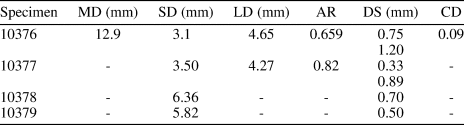
Details of the holotype and paratypes of Eothinoceras americanum are set out in Tables 1 and 2.
Relationship of the type series of Eothinoceras americanum to illustrations by Ulrich et al. (Reference Ulrich, Foerste, Miller and Unklesbay1944) with observations regarding the condition of each specimen.

Comparison of the type material based in available measurements of sections. AR = ratio SD/LD, providing an indication of the obliquity of the siphuncle within the section; CD = relative cameral depth as ratio of distance between septa to dorsoventral diameter of phragmocone; DS = apparent distance between septa; LD = longest diameter of the siphuncle within the section; MD = maximum diameter of phragmocone visible; SD = shortest diameter of the siphuncle within the section.

Preservation of type material
In their study of the Rochdale Formation cephalopod faunas of eastern New York State, Kröger and Landing (Reference Kröger and Landing2008) were unable to identify the locations of D.W. Dwight’s collecting sites in Dutchess County with confidence but noted that their section Wap-R might be along strike from Dwight’s locality F (Kröger and Landing, Reference Kröger and Landing2008, fig. 6). They observed that the top of the Rochdale Formation in section Wap-R consists of a thrombolitic limestone containing many basslerocerids and endocerids. The clotted textures visible in the block containing the type series of E. americanum indicate that they are preserved in a thrombolite, suggesting that they could have originated from the thrombolite forming the top of the Wap-R section. The cephalopods themselves consist of fragments of conchs that were most probably broken prior to final burial, and then underwent a degree of stylolitisation during their diagenesis, resulting in truncated septa and missing conch walls. The holotype (NYSM 10376) represents the most intact individual, whereas NYSM 10377 (Ulrich et al., Reference Ulrich, Foerste, Miller and Unklesbay1944, pl. 67, figs. 2, 3) consists of a single, heavily stylolitized phragmocone that includes the siphuncle.
Description of holotype NYSM 10376
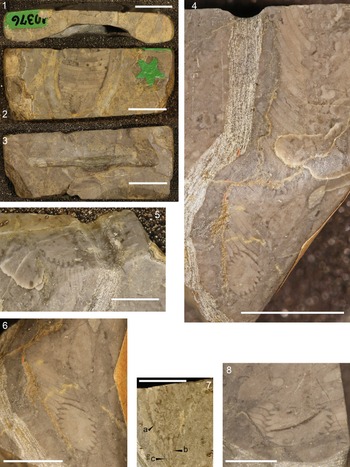
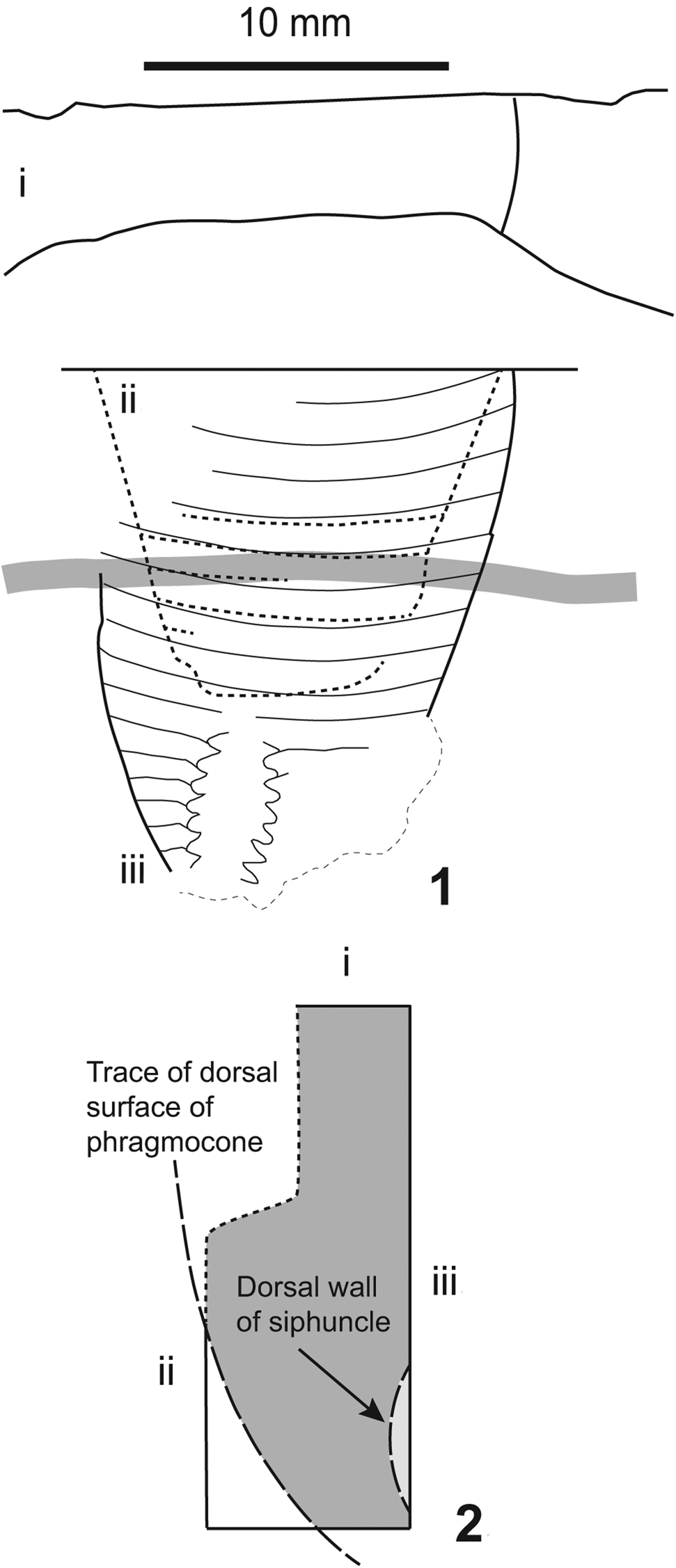
The illustration of the holotype (Ulrich et al., Reference Ulrich, Foerste, Miller and Unklesbay1944, pl. 67, fig. 5; Figs. 1.1–1.3, 2.1, 2.2) represents an oblique sagittal section through a phragmocone that is truncated adorally. The visible section is 17.5 mm long and increases in width from ~3 mm (where the phragmocone is truncated by breakage) to 12.9 mm at mid-length and 11.8 mm at the truncated adoral end. The siphuncle is visible at the apical end and shows an elliptical section. The length of siphuncle exposed is 4.67 mm and its maximum diameter is 3.1 mm. Because the conch wall curves in toward the siphuncle at the apical end (Figs. 1.2, 2.1), the siphuncle is interpreted as being located close to the phragmocone wall. The septal necks are achoanitic to loxochoanitic with a very slight apicad deflection of the septa around the septal foramen. The connecting rings are concave and substantially thickened, developing prominent subtriangular projections into the lumen of the siphuncle. Each connecting ring reaches its maximum thickness at approximately three-fifths of its length adorally. Septa are 0.75 mm apart at the apical end of the phragmocone and increase to 1.2 mm apart adorally.
Type material of Eothinoceras americanum Ulrich et al., Reference Ulrich, Foerste, Miller and Unklesbay1944, from the Rochdale Formation, Lower Ordovician (Stairsian), near Rochdale, Duchess County, New York: (1–3) holotype NYSM 10376: (1) section through adoral end of specimen showing trace of phragmocone wall on right; (2) upper face of holotype (also figured by Ulrich et al., Reference Ulrich, Foerste, Miller and Unklesbay1944, pl. 67, fig. 5) showing section of siphuncle at apical end and decreasing width of section adorally; (3) roughly prepared section through back of specimen (although septa are intact at apical end in vicinity of phragmocone wall, there is no evidence of presence of siphuncle on this surface); (4, 6) paratype NYSM 10377 (also figured by Ulrich et al., Reference Ulrich, Foerste, Miller and Unklesbay1944, pl. 67, figs. 2, 3): (4) section through whole specimen showing continuity of septa (surface containing siphuncle is oblique to rest of section); (6) detail of siphuncle and adoral end of phragmocone; (5, 7) paratype NYSM 10379 (also figured by Ulrich et al., Reference Ulrich, Foerste, Miller and Unklesbay1944, pl. 67, fig. 4): (5) section through siphuncle and surviving septa (wall of siphuncle extends all the way to distant edge of block); (7) section through siphuncle on face as continuing from far edge of that shown in (5); (8) paratype NYSM 10378 (also figured by Ulrich et al., Reference Ulrich, Foerste, Miller and Unklesbay1944, pl. 67, fig. 1), oblique dorsoventral section through siphuncle and septa with possibly intact phragmocone wall on left. a = siphuncle wall and connecting ring protruding into lumen of siphuncle; b = septa; c = wall of phragmocone. Scale bars = 10 mm (1–5), 5 mm (6–8).

Partial reconstruction of the phragmocone of Eothinoceras americanum based on the holotype NYSM 10376: (1) sketches of visible sections from images (gray shading marks zone where thickness of block rapidly decreases); (2) interpreted reconstruction of dorsoventral section (pale gray shading = siphuncle; darker gray shading = septate part of phragmocone). i = adoral end; ii = back of specimen (dashed lines); iii = front of specimen (continuous lines) overlain to match positions on either side of block.

The section visible on the reverse side of the block is 10.9 mm long. Adorally, the width of the section increases rapidly, reaching 9.1 mm over 4 mm, with most of the expansion occurring within the first 1.5 mm. The section reaches 13.2 mm in diameter at the truncated adoral end. Septa are 0.95 mm apart. There is no sign of the siphuncle.
The adoral transverse section shows the block to be 8.44 mm thick but appears to have been scooped out so that the area exposing the underside of the specimen is only 3.85 mm thick. The lateral surfaces of the phragmocone wall are visible in the section and reach a maximum separation of 14.3 mm, undergoing inflection within the section.
Interpretation
As interpreted here, the proximity of the siphuncle to the conch wall at the apical end of the section (Fig. 1.2) is taken to indicate that the siphuncle is located close to the conch wall, if not in contact with it. The cross section of the siphuncle can be interpreted as a markedly oblique longitudinal section through the siphuncle, but its maximum diameter is less than that seen in any of the paratypes, whereas the ratio of the lateral diameter to the apparent dorsoventral diameter is substantially smaller than those of the paratypes. Because the conchs of two of the paratypes (NYSM 10377, 10378) are similar in diameter to that of the holotype at their apical ends, a difference in the lateral diameter of the siphuncle in the holotype seems unlikely to be the explanation for the differences in apparent diameter with those of the paratypes. An alternative would be that the section of the siphuncle seen in the holotype represents a tangential cut through one side of a siphuncle curved along its axis. Consequently, the plane of section does not penetrate the siphuncle to a sufficient depth to generate values for the siphuncle diameter like those of the paratypes.
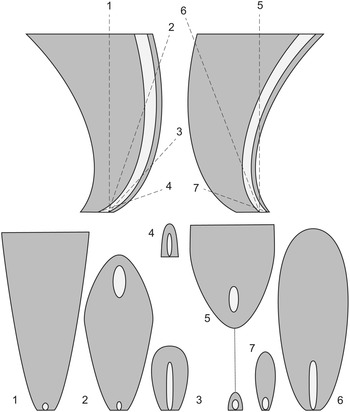
The siphuncle is not visible in the section on the underside of the block (Fig. 1.3). Although the surface of the section is roughened and visibility is poor, the septa are visible, and it would be expected that the siphuncle would also be visible if it were present within the section. Because the siphuncle lies close to the conch wall on the upper side of the specimen, it would be expected to appear at the apical end of this underside section were it present. Because the siphuncle is not seen on the underside, it is concluded that it must be close to the conch wall on the opposing side of the phragmocone. The offset between the intersection of the conch wall on the upper- and undersides of the block indicates that the phragmocone expands rapidly, with the conch wall having a convex curvature on the underside of the block. The increase in the apparent distance between septa along the length of the section figured by Ulrich et al. (Reference Ulrich, Foerste, Miller and Unklesbay1944, pl. 67, fig. 5) could also be a consequence of the curvature of the phragmocone. The slight decrease seen in the width of the section adorally (Fig. 1.2) can be interpreted as indicating that the conch is either breviconic or curved. The fact that the adoral width of the section on the underside of the block is greater than on the topside could be an indication of the curvature of the conch axis and/or an ovoid cross section with the antisiphuncular side of the conch more broadly rounded that the siphuncular side.
Comparison of the combined sections of the holotype (Fig. 2.1, 2.2) with a range of hypothetical dorsoventral sagittal sections through cyrtocononic phragmocones (Fig. 3) indicates that the best fit is with that of a rapidly expanding endogastric cyrtocone.
Hypothetical dorsoventral sections through exogastric (top left) and endogastric (top right) cyrtoconic brevicones showing the traces of lateral sections (lower 1–7). Of the hypothetical lateral sections, (6) appears to match the section of NYSM 10376 (Fig. 1.2), the holotype of Eothinoceras americanum, most closely.

Description of paratype NYSM 10377
This specimen (Ulrich et al., Reference Ulrich, Foerste, Miller and Unklesbay1944, pl. 67, figs. 2, 3; Fig. 1.4, 1.6), is represented by two sections that are in continuity but lie at ~45° to each other. The larger section shows a portion of an incomplete phragmocone 17 mm long, probably close to the lateral plane. The conch wall is not preserved and appears to have been lost to stylolitisation whereas the other lateral half of the phragmocone is missing and was probably lost through damage to the conch prior to burial. The apparent distance between the septa is 0.89 mm parallel to the conch axis. The apical end of the specimen is connected to the adoral portion by a tenuous but continuous series of septa. The section lies in a lateral plane but is oblique to the conch axis. The apparent distance between the septa is 0.33 mm. At the apical end, the siphuncle is almost in contact with the conch wall and the width of the section increases to an estimated 12 mm over 8 mm. The lateral diameter of the siphuncle is 4.27 mm and the length visible is 5.1 mm. The septal necks are loxochoanitic. The connecting rings are concave facing into the camerae, thickened and subtriangular in section. The projections of the connecting rings into the lumen of the siphuncle are elongated and markedly acute, indicating that the section is oblique dorsoventrally relative to the axis of the siphuncle.
Interpretation
The loss of one lateral side of the phragmocone makes interpretation of this specimen more difficult because there is no evidence on which to base an interpretation of the shape of the adoral portion of the phragmocone. Nevertheless, the apical portion of the conch agrees with the holotype in possessing a marginal or submarginal siphuncle and an apparently rapid rate of expansion of the conch. The section through the siphuncle rises from the apical end adorally toward the antisiphuncular side of the phragmocone. It is not possible to determine the direction of curvature of the conch because the adoral portion of the specimen is so incomplete that the siphuncle, if it was ever visible on this surface, has not been preserved. Thus, the absence of the siphuncle cannot be used as evidence that the conch had a concave curvature on the siphuncular side of the phragmocone.
Description of paratype NYSM 10378
This specimen (Ulrich et al., Reference Ulrich, Foerste, Miller and Unklesbay1944, pl. 67, fig. 1; Fig. 1.8), consists of a short (4.46 mm) length of phragmocone that is truncated adorally and stylolitized apically. It comprises a siphuncle 6.36 mm in diameter and the remnants of the septa and phragmocone wall. The siphuncle lies close to the conch wall. Within the section, the width of the phragmocone reaches at least 9.6 mm and the apparent distance between the septa is 0.7 mm. The septal necks are loxochoanitic and the connecting rings are concave facing into the camerae but are thickened so that they project into the lumen of the siphuncle. The difference in the acuteness of the thickenings of the connecting rings on either side of the siphuncle could suggest that the plane of section is oblique to its long axis and lies somewhere between the lateral and dorsoventral planes.
Interpretation
The truncation of the section of the siphuncle makes interpretation difficult, but as with NYSM 10377, with the rapid increase in the width of the section of the phragmocone, it is likely that the section through the siphuncle is an oblique cut from one side to the other.
Description of paratype NYSM 10379
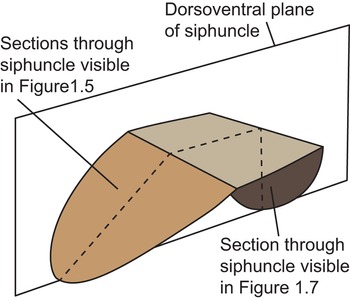
The upper surface of the block (Ulrich et al., Reference Ulrich, Foerste, Miller and Unklesbay1944, pl. 67, fig. 4; Figs. 1.5, 1.7, 4) exposes a rough surface through a section of the siphuncle that at one end is attached to a small area of intact septa and phragmocone wall. What little remains of the septa and phragmocone wall suggests that the width of the phragmocone could increase at a high angle. The apical side of the phragmocone appears to be truncated, or possibly stylolitized, so that it is not clear whether the apparent extended/elongated apical side of the siphuncle is a real feature. Where visible, the apparent distance between the septa is 0.5 mm and the septal necks are loxochoanitic. The connecting rings are thickened, and where the cut of the section appears nearly parallel with the siphuncle wall, they are elongate and acute. On the adoral side of the siphuncle there appear to be traces of the siphuncle wall, but as with the opposite side of the siphuncle, it is difficult to discern the connecting rings and this surface could also be stylolitized. The trace of the siphuncle walls continues onto the adjacent face of the block, where it closes and inflects. The region of the inflection also preserves a few septa 0.5 mm distant, as well as a fragment of the conch wall. The connecting rings in this zone are elongate and acute, matching those of the other surface in the angle that they are directed.
Interpretation
This specimen appears to represent three cuts at different angles that penetrate deep into the siphuncle but do not go right through it (Fig. 4), instead exiting on the same side as the cut entered, so that the two inflections are on the same side of the siphuncle and connected by the wall of the siphuncle (Fig. 4). Because the exposed lateral surfaces of the siphuncle appear to be stylolitized and the rest of the siphuncle wall is only exposed in oblique transverse sections, it is not possible to determine the direction of curvature of the siphuncle axis, or for that matter, whether it is curved at all.
Interpretation of paratype NYSM 10379. Shaded areas represent the surfaces visible on the actual specimen. The leftmost section is that represented by Ulrich et al. (Reference Ulrich, Foerste, Miller and Unklesbay1944, pl. 67, fig. 4). The specimen represents a short length of the siphuncle where one side has been lost to weathering.

Discussion
The holotype and all three of the paratypes possess siphuncles with loxochoanitic septal necks and thick connecting rings. The surfaces of the connecting rings facing into the camerae are concave, whereas the surfaces facing into the lumen of the siphuncle are strongly convex and possesses triangular cross sections. In all of the specimens, the siphuncle is located close to the conch wall whereas the conch appears to increase in diameter at a rapid rate. Two of the paratypes (NYSM 10377, 10378) provide no additional information on the morphology of Eothinoceras americanum, but the holotype (NYSM 10376), based on the section through the siphuncle combined with the absence of the siphuncle on the underside of the specimen, indicates that the conch has a markedly endogastric curvature. As with the other paratypes, NYSM 10379 does not provide any unequivocal evidence with reference to the degree of curvature of the conch but would be likely to do so if sectioned. In conclusion, contrary to previous interpretations of Eothinoceras, E. americanum is here interpreted as a moderately breviconic endogastric cyrtocone with a compressed cross section.
The state of preservation of the type material is such that it is not possible to constrain the degree of curvature of the conch of Eothinoceras americanum with confidence, but it appears most similar to that of Protothinoceras Chen and Teichert, Reference Chen and Teichert1987, and differs from that of Tangshanoceras Chen, Reference Chen1976 in being less strongly curved although the diameter of the siphuncle increases more slowly. Chen and Teichert (Reference Chen and Teichert1987, p. 155) regarded the oldest member of the family Cyrtocerinidae, Tangshanoceras, as having been derived from Protothinoceras. Here we note that Tangshanoceras might as easily have been derived from Eothinoceras.
Protothinoceras and Tangshanoceras came from the Langchiashan Formation of Hebei Province, North China (Chen, Reference Chen1976; Chen and Teichert, Reference Chen and Teichert1987). The Liangchiashan and Rochdale formations are both Tremadocian in age and broadly coeval with each other (An et al., Reference An, Zhang, Xiang, Zhang, Xu, Zhang, Jiang, Yang, Lin, Cui and Yang1983; Chen and Teichert, Reference Chen and Teichert1987; Zhen and Nicoll, Reference Zhen and Nicoll2009). They were deposited at similar latitudes and in similar environments: stromatolitic reefs (Chen and Teichert, Reference Chen and Teichert1987) and thrombolitic facies (Kröger and Landing, Reference Kröger and Landing2008, fig. 5), respectively. Although only two cephalopod genera are common to both formations (see Chen and Teichert, Reference Chen and Teichert1987, p. 151, 152; Kröger and Landing, Reference Kröger and Landing2008, p. 497), this increases to six if other coeval Laurentian faunas are included (see Ulrich et al., Reference Ulrich, Foerste, Miller and Furnish1942, Reference Ulrich, Foerste and Miller1943, Reference Ulrich, Foerste, Miller and Unklesbay1944), although many of these genera have long stratigraphical ranges.
Implications for the systematics of the Cyrtocerinida
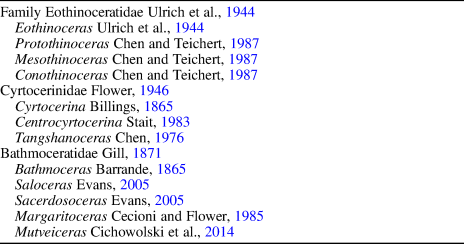
Because all other species assigned to Eothinoceras differ from E. americanum in possessing a relatively slowly expanding orthoconic conch that can have a slight exogastric curvature and an almost circular conch cross section, it seems untenable to retain those species in the genus. Moreover, because the preservation of the type material of E. americanum is too poor to permit the genus to be recognized as the senior synonym of Protothinoceras or Tangshanoceras with any certainty, the genus is best regarded as monospecific, and represented only by the type material of E. americanum. For now, a pragmatic solution would be to retain a family Eothinoceratidae, containing Eothinoceras, Protothinoceras, and Mesothinoceras Chen and Teichert, Reference Chen and Teichert1987. Those genera possessing a very marked endogastric curvature and high rate of conch expansion, including Cyrtocerina, Conothinoceras Chen and Teichert, Reference Chen and Teichert1987, Centrocyrtocerina Stait, Reference Stait1983, and Tangshanoceras, are placed in the Cyrtocerinidae Flower, Reference Flower1946 (Table 4).
Those species that were previously assigned to Eothinoceras are here placed in Saloceras. Saloceras (Table 3, column 6) is an orthoconic longicone that has a moderately broad marginal siphuncle with achoanitic to weakly orthochoanitic septal necks and connecting rings that are thickened and protrude strongly into the lumen of the siphuncle. Externally, the distance between the sutures ranges from 0.07–0.17 of the conch diameter, whereas the sutures form narrow but prominent saddles over the siphuncle. Other than Eothinoceras americanum, all three of the species previously assigned to Eothinoceras (Table 3, columns 3–5) are morphologically very similar to Saloceras and are here reassigned to that genus.
Comparison of the type species, Eothinoceras americanum, with other species subsequently assigned to the genus and with Saloceras sericeum. AA = apical angle; CC = conch curvature; CD = relative cameral depth as ratio of distance between septa to dorsoventral diameter of phragmocone; CS = conch shape; CX = conch cross section; RSD = relative diameter of siphuncle as ratio of siphuncle diameter to phragmocone diameter; SP = relative position of the siphuncle; VS = ventral saddle; * = estimated from reconstruction (see Figs. 1, 2).

Saloceras appears to be closely related to Bathmoceras Barrande, Reference Barrande1865. The latter could arise from the former through an increasing height of the ventral saddle. This led to an increase in the circumference of the connecting ring but did not alter the circumference of the siphuncle as illustrated by Mutvei (Reference Mutvei2015, fig. 1c). This, when combined with the extension of the inner surface of the connecting ring into the lumen of the siphuncle, resulted in Dapingian and Darriwilian forms in which the ratios of the surface area of the connecting ring to the cameral volume are increasingly enhanced. For this reason, Saloceras is assigned to the Bathmoceratidae Gill, Reference Gill1871. The orthoconic Margaritoceras and the slightly exogastric Sacerdosoceras and Mutveiceras all exhibit similar siphuncle morphologies to Saloceras sericeum (Salter in Ramsay, Reference Ramsay1866) and are here assigned to the Bathmoceratidae (Table 4). The enigmatic genus Desioceras Cecioni, Reference Cecioni1953 from northwestern Argentina cannot be included in this new scheme until more material is available to permit a revision of its morphology.
Proposed revised familial composition of the Cyrtocerinida.

Acknowledgments
We are most grateful to L. Amati (NYSM) for providing the high-resolution images of the type material of Eothinoceras americanum. Without her help in this matter, it would not have been possible to conduct this investigation. We are grateful to the reviewers M. Aubrechtová and K. Histon and to the editor M. Yacobucci for their helpful suggestions to improve this manuscript.
Declaration of competing interests
The authors declare that they have no competing interests.