The problem motivating Doris's work is that conscious agency, thought to be required for responsibility attribution, might not be frequently exercised. He finds this morally problematic, as he would like to be able to hold people responsible for what they do. Thus, the goal of his book is to change the definition of agency, such that people can be justifiably deemed responsible more often.
Doris does a good job in providing a descriptively accurate picture of how humans attribute exercise of agency. If the goal of his book was to explain the pattern of responsibility attribution, its value would be beyond any doubt. Unfortunately, Doris (Reference Doris2015b) is not primarily interested in the descriptive, but in the normative question, as he wants to justify the practices of responsibility attribution (pp. x, 14). The underlying logic of his book can be summarized as follows (pp. x, 33–34): (1) We often want people to be held morally responsible, (2) if we want people to be held morally responsible, we need a theory justifying such attributions, therefore (3) we need to devise it. Given this goal, the tone of Doris's work is far from neutral. He depicts his attempt not as an investigation of compatibility between the knowledge about human mind and the notion of moral responsibility, but as a “rescue mission” that is supposed to protect the allegedly valuable notion of agency and responsibility from the threat of skepticism. He bravely “resists pessimism” (p. x), “worries” about skepticism (p. 135), but does not “succumb to skeptical panic” (p. 160), such that he no longer feels “skeptical anxiety” (p. 33).
In this commentary I illustrate why such an attitude might be deeply problematic. Determining the degree of agency and responsibility always carries a moralistic flavor (Waller Reference Waller2011). Can I take credit for my positive acts? Can others blame me for my negative acts? Am I allowed to avenge those who did some wrong to me? When these questions are asked, the responder's reputation is at stake and his or her answers reflect this contingency. Hence, in addition to the intuitive appeal of agency attribution (see Wegner Reference Wegner2002), there is also a moralistic appeal of agency attribution – proclaiming some attribution of responsibility carries evaluative weight, and agents are interested in putting forward their interpretation of reality.
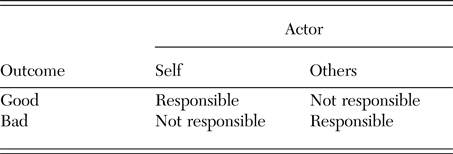
Limits imposed by believability notwithstanding, a general pattern of how responsibility is assigned in social interactions is depicted in Table 1.
Table 1.
Pattern of responsibility attribution.
Due to the importance of reputation in human groups, it is in an individual's interest to claim responsibility for positive actions and deny responsibility for negative ones (see Alexander Reference Alexander1987). The opposite is true for the actions of others – humans are readily willing to assign responsibility for negative outcomes, as it justifies punitive sentiments toward them, but are not so concerned in the case of positive outcomes (Alicke Reference Alicke2000; Clark et al. Reference Clark, Luguri, Ditto, Knobe, Shariff and Baumeister2014). As the human reasoning system is adapted to self-interestedly defend desired conclusions (Mercier & Sperber Reference Mercier and Sperber2011), the responsibility-related language of excuses and justifications can be seen as a tool for bargaining over the meaning of particular actions (see Bandura Reference Bandura1990; Scott & Lyman Reference Scott and Lyman1968).
It is a truism that beliefs and behavior form a feedback system: Beliefs can inform behavior and behavior can inform beliefs. In research on human excuse-making this point is quite clear: It might be both the case that the pattern of excuses people believe in facilitates immoral behavior (Sykes & Matza Reference Sykes and Matza1957), but it might also be the case that people form excuses post hoc as they observe and interpret their own behavior (Maruna & Copes Reference Maruna and Copes2005; Shalvi et al. Reference Shalvi, Gino, Barkan and Ayal2015).
Experiences and interpretations of single actions contribute over one's lifetime to the formation of generalized beliefs. Just like responses to particular events, these generalized beliefs and philosophical positions should also be seen as a consequence of human predilections (see Cushman & Greene Reference Cushman, Greene, Mikulincer and Shaver2012). Topics of philosophical debates are not arbitrary, but reflect the disputants' interests.
If there is individual variability in these beliefs, it might be the case that already formed beliefs influence one's behavior (i.e., they become a self-fulfilling prophecy), but it is also true that individual experiences must have led to their formation. Interestingly, in research on lay notions of free will and moral responsibility, this relationship tends to be treated as unidirectional, that is, the question tends to be framed not as “what circumstances foster belief in free will versus determinism,” but as “how belief in free will versus determinism influences individual behavior” (e.g., Baumeister et al. Reference Baumeister, Masicampo and DeWall2009; Feldman et al. Reference Feldman, Chandrashekar and Wong2016; Vohs & Schooler Reference Vohs and Schooler2008; but see Clark et al. Reference Clark, Luguri, Ditto, Knobe, Shariff and Baumeister2014).
Such a focus is strange; in situations where human interests are at stake it can be expected that they contribute to the formation of generalized beliefs and moral views (e.g., Deffains et al. Reference Deffains, Espinosa and Thöni2016). While not denying the importance of discussion of how conscious acceptance of given beliefs influences subsequent decision-making, I would like to focus on a more fundamental question that considers the determinants of belief in agency and responsibility in the first place and interpret Doris's contribution in this light. Why then do humans believe in responsibility?
Agents are usually distinguished from other objects by their ability to self-generate their actions. This intuitive distinction works reasonably well, but can sometimes clash with another lay belief: that agents can, just like objects, be influenced by external factors. Such a belief is usually invoked for denying responsibility and excusing one's own wrongdoing as determined (Bandura Reference Bandura1990; Sykes & Matza Reference Sykes and Matza1957).
When one realizes that humans can be influenced, then the “ideal” exercise of agency (i.e., libertarian self-determination of one's actions) becomes untenable (see G. Strawson Reference Strawson1994). As people want to retain both intuitive theory of agency and the possibility of being influenced, they “adjust” their concept of agency such that it does not need to be fully independent from influencing factors (see Monroe & Malle Reference Monroe and Malle2010).
That leads to a practical problem. When one wants to assault someone else with the charge of responsibility for immoral behavior, one needs to concoct a justification for this attribution. One is perfectly aware that there exists a long causal chain of past events that has eventually led to a given behavior (even if they only influenced, rather than determined it), but assigns exclusive moral responsibility to the final action executor only (unless I am the wrongdoer, in which case the importance of external factors is obvious). That is to say, even if one is aware that the “ideal” agency was not exercised, one acts as if it was, “forgetting” about the prior history.
As this is objectively unfair, creating a situation in which blame judgments depend on factors that cannot be controlled by the actor (i.e., it forms so-called moral luck problems), it leads to the challenge of how to justify the entire practice. Philosophers seem especially reluctant to honestly admit that the only reason for such a blame assignment is to satisfy people's thirst for revenge, so they engage in the task of finding different justifications (but see Waller Reference Waller2011). The most obvious one, however, a utilitarian appeal to convenience and societal benefits following from revenge, is also usually thought to be insufficient (e.g., P. Strawson Reference Strawson1962; Smilansky Reference Smilansky2000). As the argument goes, there must be “deeper” reasons justifying current practices.
One prevalent proposal consists in denying the existence of determinants. Past events might have happened, but the final actor has the power to counteract them, as he or she exercises conscious agency. Doris (Reference Doris2015b) is dissatisfied with that approach primarily because he would like to accuse some as responsible in cases where conscious agency did not take place and excuse some others as not responsible even if conscious agency took place (e.g., pp. 24, 128). Thus, he approaches the problem in a different way. Instead of outright denying the existence of determinants or calling for a wishful disbelief in them (see e.g., Dennett Reference Dennett1984; Smilansky Reference Smilansky2000), he accepts that conscious agency is not usually exercised, but argues that this fact might or might not matter for responsibility attribution (p. 11).
Doris (Reference Doris2015b) rejects the normative importance of conscious thoughts and proposes “pluralism about agency and responsibility,” which is a convenient euphemism for arbitrariness. Criteria for responsibility attribution may vary across different circumstances in a way that ultimately follows lay intuitions (pp. 171–75). Such a proposal is nothing new; Strawson's (Reference Strawson1962) classic treatment posited finding a justification for existing institutions in the intuitive appeal of our retributive instincts. Doris moves the problem one level up by positing that responsibility should be determined by evaluating if the offered explanation agrees with the values present in actor's lifetime and if it is approved by others. Naturally, if determinism is true, all of this is equally independent from the actor in the same way atomic actions are. Because of that, he needs to appeal to intuitions over when determination should imply responsibility and when it should not.
Let me give an example of what divergent responsibility judgments Doris (Reference Doris2015b) seeks to justify: When one claims responsibility for choosing the right numbers in a lottery, we ridicule it (p. 134), but when someone has worked hard and claims responsibility for his or her life successes, we often uncritically grant it. Such an intuition is to be expected if one's source of money is work, rather than gambling, but it does not change the fact that this is arbitrary and unjustified, as both agents benefit from mechanisms beyond their control, be they genetic, environmental, or random. What is then the value of a theory that, instead of realizing unfairness of some attributions, seeks to “legalize” them?
I am not so much concerned about how Doris proceeds in “rescuing” agency and responsibility; in the end, if the work starts with an assumption that the existence of agency is good and the lack of agency is bad, it should not come as a surprise that Doris found agency to exist (in the cases where it conforms to his intuitions). What I find more problematic is that Doris (Reference Doris2015b) does not make a compelling case about why we actually need to devise normative notions of agency in the first place. The only reason for believing in agency and holding others responsible is that it is supposed to be useful (pp. x, 136). But this point, presumably assumed to be so clear that is does not require any explanation, is in fact not clear at all. Doris claims that failure to justify the existence of agency would lead to pessimism (p. x), that he does not like approaches leading to the disintegration of the mind and feels responsible for restoring the sense of personhood and agency (p. 3), or offers general remarks that bad theorizing can lead to “morally reprehensible” consequences (p. 9). But what exactly would happen if we stopped believing in agency and responsibility?
The answer to this question is not obvious as there are divergent intuitions over what, if anything, would change if the belief in moral responsibility was abandoned (e.g., Caruso Reference Caruso2014; Waller Reference Waller2011). Unless anti-skeptics have some sound conception of consequences of finding or not finding a justification for moral responsibility, the motivation behind these contributions needs to be taken with caution. If the proposed explanation boils down to a conjecture that agency exists because one wants it to exist, one will always find a reason why it is so; Doris's work is neither the first nor the last attempt of this kind. Persistence of anti-skeptics in finding solutions to their own problems raises the question of what inspires these “rescue missions.” Taking into consideration the strategic context in which the social construction of responsibility takes place, I am afraid that there is no other plausible explanation for these attempts other than the need to devise a theory allowing them to justify their retributive instincts and take credit for what they do not deserve (see also Miles Reference Miles2015).





 You have
Access
The problem motivating Doris's work is that conscious agency, thought to be required for responsibility attribution, might not be frequently exercised. He finds this morally problematic, as he would like to be able to hold people responsible for what they do. Thus, the goal of his book is to change the definition of agency, such that people can be justifiably deemed responsible more often.
Doris does a good job in providing a descriptively accurate picture of how humans attribute exercise of agency. If the goal of his book was to explain the pattern of responsibility attribution, its value would be beyond any doubt. Unfortunately, Doris (Reference Doris2015b) is not primarily interested in the descriptive, but in the normative question, as he wants to justify the practices of responsibility attribution (pp. x, 14). The underlying logic of his book can be summarized as follows (pp. x, 33–34): (1) We often want people to be held morally responsible, (2) if we want people to be held morally responsible, we need a theory justifying such attributions, therefore (3) we need to devise it. Given this goal, the tone of Doris's work is far from neutral. He depicts his attempt not as an investigation of compatibility between the knowledge about human mind and the notion of moral responsibility, but as a “rescue mission” that is supposed to protect the allegedly valuable notion of agency and responsibility from the threat of skepticism. He bravely “resists pessimism” (p. x), “worries” about skepticism (p. 135), but does not “succumb to skeptical panic” (p. 160), such that he no longer feels “skeptical anxiety” (p. 33).
In this commentary I illustrate why such an attitude might be deeply problematic. Determining the degree of agency and responsibility always carries a moralistic flavor (Waller Reference Waller2011). Can I take credit for my positive acts? Can others blame me for my negative acts? Am I allowed to avenge those who did some wrong to me? When these questions are asked, the responder's reputation is at stake and his or her answers reflect this contingency. Hence, in addition to the intuitive appeal of agency attribution (see Wegner Reference Wegner2002), there is also a moralistic appeal of agency attribution – proclaiming some attribution of responsibility carries evaluative weight, and agents are interested in putting forward their interpretation of reality.
Limits imposed by believability notwithstanding, a general pattern of how responsibility is assigned in social interactions is depicted in Table 1.
Pattern of responsibility attribution.
Due to the importance of reputation in human groups, it is in an individual's interest to claim responsibility for positive actions and deny responsibility for negative ones (see Alexander Reference Alexander1987). The opposite is true for the actions of others – humans are readily willing to assign responsibility for negative outcomes, as it justifies punitive sentiments toward them, but are not so concerned in the case of positive outcomes (Alicke Reference Alicke2000; Clark et al. Reference Clark, Luguri, Ditto, Knobe, Shariff and Baumeister2014). As the human reasoning system is adapted to self-interestedly defend desired conclusions (Mercier & Sperber Reference Mercier and Sperber2011), the responsibility-related language of excuses and justifications can be seen as a tool for bargaining over the meaning of particular actions (see Bandura Reference Bandura1990; Scott & Lyman Reference Scott and Lyman1968).
It is a truism that beliefs and behavior form a feedback system: Beliefs can inform behavior and behavior can inform beliefs. In research on human excuse-making this point is quite clear: It might be both the case that the pattern of excuses people believe in facilitates immoral behavior (Sykes & Matza Reference Sykes and Matza1957), but it might also be the case that people form excuses post hoc as they observe and interpret their own behavior (Maruna & Copes Reference Maruna and Copes2005; Shalvi et al. Reference Shalvi, Gino, Barkan and Ayal2015).
Experiences and interpretations of single actions contribute over one's lifetime to the formation of generalized beliefs. Just like responses to particular events, these generalized beliefs and philosophical positions should also be seen as a consequence of human predilections (see Cushman & Greene Reference Cushman, Greene, Mikulincer and Shaver2012). Topics of philosophical debates are not arbitrary, but reflect the disputants' interests.
If there is individual variability in these beliefs, it might be the case that already formed beliefs influence one's behavior (i.e., they become a self-fulfilling prophecy), but it is also true that individual experiences must have led to their formation. Interestingly, in research on lay notions of free will and moral responsibility, this relationship tends to be treated as unidirectional, that is, the question tends to be framed not as “what circumstances foster belief in free will versus determinism,” but as “how belief in free will versus determinism influences individual behavior” (e.g., Baumeister et al. Reference Baumeister, Masicampo and DeWall2009; Feldman et al. Reference Feldman, Chandrashekar and Wong2016; Vohs & Schooler Reference Vohs and Schooler2008; but see Clark et al. Reference Clark, Luguri, Ditto, Knobe, Shariff and Baumeister2014).
Such a focus is strange; in situations where human interests are at stake it can be expected that they contribute to the formation of generalized beliefs and moral views (e.g., Deffains et al. Reference Deffains, Espinosa and Thöni2016). While not denying the importance of discussion of how conscious acceptance of given beliefs influences subsequent decision-making, I would like to focus on a more fundamental question that considers the determinants of belief in agency and responsibility in the first place and interpret Doris's contribution in this light. Why then do humans believe in responsibility?
Agents are usually distinguished from other objects by their ability to self-generate their actions. This intuitive distinction works reasonably well, but can sometimes clash with another lay belief: that agents can, just like objects, be influenced by external factors. Such a belief is usually invoked for denying responsibility and excusing one's own wrongdoing as determined (Bandura Reference Bandura1990; Sykes & Matza Reference Sykes and Matza1957).
When one realizes that humans can be influenced, then the “ideal” exercise of agency (i.e., libertarian self-determination of one's actions) becomes untenable (see G. Strawson Reference Strawson1994). As people want to retain both intuitive theory of agency and the possibility of being influenced, they “adjust” their concept of agency such that it does not need to be fully independent from influencing factors (see Monroe & Malle Reference Monroe and Malle2010).
That leads to a practical problem. When one wants to assault someone else with the charge of responsibility for immoral behavior, one needs to concoct a justification for this attribution. One is perfectly aware that there exists a long causal chain of past events that has eventually led to a given behavior (even if they only influenced, rather than determined it), but assigns exclusive moral responsibility to the final action executor only (unless I am the wrongdoer, in which case the importance of external factors is obvious). That is to say, even if one is aware that the “ideal” agency was not exercised, one acts as if it was, “forgetting” about the prior history.
As this is objectively unfair, creating a situation in which blame judgments depend on factors that cannot be controlled by the actor (i.e., it forms so-called moral luck problems), it leads to the challenge of how to justify the entire practice. Philosophers seem especially reluctant to honestly admit that the only reason for such a blame assignment is to satisfy people's thirst for revenge, so they engage in the task of finding different justifications (but see Waller Reference Waller2011). The most obvious one, however, a utilitarian appeal to convenience and societal benefits following from revenge, is also usually thought to be insufficient (e.g., P. Strawson Reference Strawson1962; Smilansky Reference Smilansky2000). As the argument goes, there must be “deeper” reasons justifying current practices.
One prevalent proposal consists in denying the existence of determinants. Past events might have happened, but the final actor has the power to counteract them, as he or she exercises conscious agency. Doris (Reference Doris2015b) is dissatisfied with that approach primarily because he would like to accuse some as responsible in cases where conscious agency did not take place and excuse some others as not responsible even if conscious agency took place (e.g., pp. 24, 128). Thus, he approaches the problem in a different way. Instead of outright denying the existence of determinants or calling for a wishful disbelief in them (see e.g., Dennett Reference Dennett1984; Smilansky Reference Smilansky2000), he accepts that conscious agency is not usually exercised, but argues that this fact might or might not matter for responsibility attribution (p. 11).
Doris (Reference Doris2015b) rejects the normative importance of conscious thoughts and proposes “pluralism about agency and responsibility,” which is a convenient euphemism for arbitrariness. Criteria for responsibility attribution may vary across different circumstances in a way that ultimately follows lay intuitions (pp. 171–75). Such a proposal is nothing new; Strawson's (Reference Strawson1962) classic treatment posited finding a justification for existing institutions in the intuitive appeal of our retributive instincts. Doris moves the problem one level up by positing that responsibility should be determined by evaluating if the offered explanation agrees with the values present in actor's lifetime and if it is approved by others. Naturally, if determinism is true, all of this is equally independent from the actor in the same way atomic actions are. Because of that, he needs to appeal to intuitions over when determination should imply responsibility and when it should not.
Let me give an example of what divergent responsibility judgments Doris (Reference Doris2015b) seeks to justify: When one claims responsibility for choosing the right numbers in a lottery, we ridicule it (p. 134), but when someone has worked hard and claims responsibility for his or her life successes, we often uncritically grant it. Such an intuition is to be expected if one's source of money is work, rather than gambling, but it does not change the fact that this is arbitrary and unjustified, as both agents benefit from mechanisms beyond their control, be they genetic, environmental, or random. What is then the value of a theory that, instead of realizing unfairness of some attributions, seeks to “legalize” them?
I am not so much concerned about how Doris proceeds in “rescuing” agency and responsibility; in the end, if the work starts with an assumption that the existence of agency is good and the lack of agency is bad, it should not come as a surprise that Doris found agency to exist (in the cases where it conforms to his intuitions). What I find more problematic is that Doris (Reference Doris2015b) does not make a compelling case about why we actually need to devise normative notions of agency in the first place. The only reason for believing in agency and holding others responsible is that it is supposed to be useful (pp. x, 136). But this point, presumably assumed to be so clear that is does not require any explanation, is in fact not clear at all. Doris claims that failure to justify the existence of agency would lead to pessimism (p. x), that he does not like approaches leading to the disintegration of the mind and feels responsible for restoring the sense of personhood and agency (p. 3), or offers general remarks that bad theorizing can lead to “morally reprehensible” consequences (p. 9). But what exactly would happen if we stopped believing in agency and responsibility?
The answer to this question is not obvious as there are divergent intuitions over what, if anything, would change if the belief in moral responsibility was abandoned (e.g., Caruso Reference Caruso2014; Waller Reference Waller2011). Unless anti-skeptics have some sound conception of consequences of finding or not finding a justification for moral responsibility, the motivation behind these contributions needs to be taken with caution. If the proposed explanation boils down to a conjecture that agency exists because one wants it to exist, one will always find a reason why it is so; Doris's work is neither the first nor the last attempt of this kind. Persistence of anti-skeptics in finding solutions to their own problems raises the question of what inspires these “rescue missions.” Taking into consideration the strategic context in which the social construction of responsibility takes place, I am afraid that there is no other plausible explanation for these attempts other than the need to devise a theory allowing them to justify their retributive instincts and take credit for what they do not deserve (see also Miles Reference Miles2015).