1. INTRODUCTION
The topic of the charge state and energy loss of energetic ions penetrating matter, be it at ambient conditions or in the plasma state, has been a subject of very extensive and longstanding experimental and theoretical research (Deutsch et al., Reference Deutsch, Maynard, Bimbot, Gardes, Dellanegra, Dumail, Kubica, Richard, Rivet, Servajean, Fleurier, Sanba, Hoffmann, Weyrich and Wahl1989; Dietrich et al., Reference Dietrich, Hoffmann, Boggasch, Jacoby, Wahl, Elfers, Haas, Dubenkov and Golubev1992; Gardes et al., Reference Gardes, Bimbot, Dellanegra, Dumail, Kubica, Richard, Rivet, Servajean, Fleurier, Sanba, Deutsch, Maynard, Hoffmann, Weyrich and Wahl1988; Hoffmann et al., Reference Hoffmann, Weyrich, Wahl, Gardes, Bimbot and Fleurier1990; Kojima et al., Reference Kojima, Mitomo, Sasaki, Hasegawa and Ogawa2002; Nardi et al., Reference Nardi, Maron and Hoffmann2007; Nardi & Zinamon, Reference Nardi and Zinamon1982; Ogawa et al., Reference Ogawa, Neuner, Kobayashi, Nakajima, Nishigori, Takayama, Iwase, Yoshida, Kojima, Hasegawa, Oguri, Horioka, Nakajima, Miyamoto, Dubenkov and Murakami2000; Sigmund & Narmann, Reference Sigmund and Narmann1995; Stockl et al., Reference Stockl, Boine Frankenheim, Roth, Suss, Wetzler, Seelig, Kulish, Dornik, Laux, Spiller, Stetter, Stowe, Jacoby and Hoffmann1996). Since the advent of intense proton and light ion beams generated by intense lasers, this field has experienced a renaissance due to applications ranging from inertial fusion with fast ignition to medical applications (Barriga-Carrasco, Reference Barriga-Carrasco2008; Cook et al., Reference Cook, Kozioziemski, Nikroo, Wilkens, Bhandarkar, Forsman, Haan, Hoppe, Huang, Mapoles, Moody, Sater, Seugling, Stephens, Takagi and Xu2008; Eliezer et al., Reference Eliezer, Murakami and Val2007; Evans, Reference Evans2008; Flippo et al., Reference Flippo, Hegelich, Albright, Yin, Gautier, Letzring, Schollmeier, Schreiber, Schulze and Fernandez2007; Hora, Reference Hora2007; Romagnani et al., Reference Romagnani, Borghesi, Cecchetti, Kar, Antici, Audebert, Bandhoupadjay, Ceccherini, Cowan, Fuchs, Galimberti, Gizzi, Grismayer, Heathcote, Jung, Liseykina, Macchi, Mora, Neely, Notley, Osterholtz, Pipahl, Pretzler, Schiavi, Schurtz, Toncian, Wilson and Will2008). Regarding the effect of density on the charge state in cold matter, two models with very different views were proposed: the Bohr Lindhard model, (BL) (Bohr & Lindhard, Reference Bohr and Lindhard1954) and the Betz-Grodzins model, (BG) (Betz & Grodzins, Reference Betz and Grodzins1970). Both these models attempt to explain the higher charge state in a solid target compared to a gas one. Some very recent papers dealing with the charge state in solids provide important insight regarding this problem (Eisenbarth et al., Reference Eisenbarth, Rosmej, Shevelko, Blazevic and Hoffmann2007; Lifschitz & Arista, Reference Lifschitz and Arista2004; Rosmej et al., Reference Rosmej, Pikuz, Korostiy, Blazevic, Brambrink, Fertman, Mutin, Efremov, Pikuz, Faenov, Loboda, Golubev and Hoffmann2005). The results obtained by these authors in connection with energy deposition, are consistent with the assumption that: the average charge q state of the ion inside the solid is approximated by q exit, the charge state of the ion exiting the solid. The essential equality of q and q exit can explain the experimental observation that Auger electrons in significant numbers are not observed after the ion exits the solid, in contradiction to the BG model. This analysis supports the BL model according to which, the ion upon penetrating the solid, experiences a rapid sequence of collisions. Excited states thus populated as well as those populated by recombination, undergo ionization, effectively increasing the ionization cross-section, relative to a gas target. In the low density gas target case, excited states decay before being ionized by a subsequent collision. We note here that Maynard et al. (Reference Maynard, Chabot and Gardes2000) thoroughly analyzed the gas solid difference for the projectile energy range dealt with in this paper, from a stopping power theory point of view. One of their conclusions is that the effects discussed in their paper favor the BL model for projectile atomic numbers greater than that of this paper.
The charge state of energetic projectile ions traveling through completely ionized plasma was shown theoretically by Nardi and Zinamon (Reference Nardi and Zinamon1982) to be significantly higher than for the same projectile species in cold matter. This strongly affects the range and shape of the energy deposition curve bringing about a dramatic range shortening effect in the plasma. These basic predicted effects were verified experimentally by Hoffmann et al. (Reference Hoffmann, Jacoby, Laux, Demagistris, Boggasch, Spiller, Stockl, Tauschwitz, Weyrich, Chabot and Gardes1994) at Gesellschaft für Schwerionenforschung (GSI). A recent experiment by Roth et al. (Reference Roth, Stockl, Suss, Iwase, Gericke, Bock, Hoffmann, Geissel and Seelig2000) also at GSI, dealt with the interaction of high energy Zn ions at 5 MeV/A, with a laser produced partially ionized carbon target.
The purpose of this paper is to formulate density dependence of the projectile charge state in targets containing plasma electrons as well as bound electrons. Such situations are encountered in solids; see below, or in partially ionized plasma. The model proposed here is different from the BL theory and not intended to replace it. It deals with the influence of the electronic environment on the electron capture and loss processes. In this connection, we mention very recent work where the extraordinary, experimentally observed, energetic cluster-ion data, regarding ionic charge state suppression of the cluster components, was explained by accounting for the electronic environment into which the cluster expanded (Nardi & Tombrello, Reference Nardi and Tombrello2006).
In this paper a solid target is treated, specifically amorphous carbon, whose valence electron gas is assumed to be an electron plasma. The method outlined here is applicable to partially ionized plasma targets as well. The essential point of this paper is the effect of the plasma target electrons on the electron states of the projectile, specifically on the depression of the ionization energy through dynamic screening. The depression of the ionization energy is density dependent, and when applying this to the electron ionization model, a significant increase in the ionization cross-section is obtained. This causes an increase in the charge state of the projectile for high density targets relative to low density ones. In addition, the recombination cross-section decreases as a result of ionization depression also bringing about an increase in the charge state. In Section 2, the theoretical method is described, while in Section 3, the results are presented and discussed.
2. THEORY and CALCULATIONS
2.1. Plasma Effect on Projectile Binding Energy
The dense plasma environment affects the level structure of a fast ionic projectile in a manner similar to an ion in equilibrium plasma. In the latter case, the binding energy of the levels in an ion submerged in plasma is reduced due to the polarization of the plasma medium by

Eq. (1) describes the Debye approximation of the lowering of the ionization energy. Here the interparticle distances are smaller or equal to R D, where R D is the Debye screening length (Stewart & Pyatt, Reference Stewart and Pyatt1966), and z is the ionic charge state of the plasma atoms. If the plasma density of the system is high enough so that quantum mechanical effects have to be taken into account, Eq. (1) has to be replaced by the Debye-Hückel approximation that was given in Ebeling et al. (Reference Ebeling, Kraeft and Kremp1976) and applied for hydrogen and alkali plasmas by Meister (Reference Meister1982). The highly excited atomic states with isolated–ion binding energies E bind < ΔE will be eliminated, thus effectively reducing the binding energy of the ion by an amount equal to ΔE.
For the energetic ion moving in a dense plasma with velocity v, the plasma electrons dynamically screen the projectile Coulomb potential, much in the same way as the static screening noted above. We make use here of the simplifying basic approximation, where the dynamical screening due to the energetic ion motion within the plasma is assumed to be an isotropic Yukawa potential. Specifically, we employ the widely used approximation (Brandt, Reference Brandt1975; Lindhard, Reference Lindhard1954), where the Coulomb potential is multiplied by the screening factor e −r/a, where a is the screening length (Brandt, Reference Brandt1975). The value of a was also dealt with, among others, by Lifschitz and Arista (Reference Lifschitz and Arista1998) on the basis of the Friedel sum rule, extended to finite velocities. The latter authors obtained that for ν > νF, a rapid conversion to a = ν/ωp, the value given by Brandt (Reference Brandt1975), is obtained, where ν is the projectile velocity, νF is the Fermi velocity, and ωp is the plasma frequency. Nagy and Bergara (Reference Nagy and Bergara1996) derived the velocity dependence of the screening length as well, also converging to the same value as given originally by Brandt (Reference Brandt1975). In this paper, we assume that the screening length is given by the high velocity limit or Brandt's value. We note that this form described well the screening needed to explain charge state suppression of energetic clusters, where the problem also involved the slowing down of 2 MeV Carbon ions (Nardi & Tombrello, Reference Nardi and Tombrello2006). It should also be mentioned that the actual screening potential is more complex than the simple Yukawa form proposed by Brandt (Reference Brandt1975). This was studied, for example, by Jakubassa (Reference Jakubassa1977), who found, however, good agreement between Eigen values for the ground state energy of hydrogen moving in an aluminum target calculated using the full potential compared to those obtained using the approximation given above.
This paper is essentially based on the dynamical screening experiment using fast He ions by Chevalier et al. (1990), and on the results of the investigations by Rogers et al. (Reference Rogers, Graboske and Harwood1970) who calculated bound Eigen states in static screened Coulomb potentials. Chevalier et al. (1990) analyzed their results using the latter paper. Chevalier et al. (1990) observed a velocity threshold for the binding of the 3p state of fast He+ ions. As the velocity increases, the screening length becomes larger, bringing about an effective decrease in the screening of the projectile potential. Thus, for velocities higher than the threshold velocity, at 1.4 MeV, the 3p level becomes bound. In analyzing their experiment, Chevalier et al. (1990), based on Rogers et al. (Reference Rogers, Graboske and Harwood1970), determined ΔE to be the same as in Eq. (1), but with R D replaced by the dynamic screening length a. For the sake of completeness, we show how this is derived: The Coulomb potential ze 2/r of the projectile, assumed here to be hydrogen-like, is multiplied by the screening factor, discussed above, exp(−r/a). Following Rogers et al. (Reference Rogers, Graboske and Harwood1970), the exponent is expanded to the first order. Thus the radial Schrodinger equation will now contain an additive term of ze 2/(ν/ωp) to that of the energy. The uppermost energy levels will thus be raised relative to the isolated projectile energy levels by this amount, thereby inducing an effective depression of the ionization energy by

The equation above is the basic assumption of the model presented here, where it is applied to the ionization and recombination cross-sections. The screening length for the solid amorphous target is computed in the same way as for plasma, assuming four plasma screening electrons. The choice of four screening electrons for the amorphous carbon target was discussed in detail by Nardi and Tombrello (Reference Nardi and Tombrello2006), where papers dealing with the resonance in electron slowing down and optical properties were also cited. Calculations of ionic charge suppression in the clusters mentioned above, indicated that the experimental data is clearly best reproduced, assuming four plasma electrons (Nardi & Tombrello, Reference Nardi and Tombrello2006).
Detailed calculations of the electronic states in the dynamical screening potential for fast ions traversing a solid have been calculated by Muller and Burgdorfer (Reference Muller and Burgdorfer1991). These authors also find velocity thresholds for the existence of excited states in agreement with Chevallier et al. (Reference Chevallier, Clouvas, Faria, Mazuy, Gaillard, Poizat, Remillieux and Desesquelles1990). By also making the hydrogenic approximation, they find that the projectile levels are broadened creating manifolds, with a depression in the ionization energy as that given by Eq. (2), but multiplied by a factor of π/2. Last but not least, it has to be mentioned that Kraeft et al. (Reference Kraeft, Kremp, Ebeling and Ropke1986) studied already a many-particle approach to the dynamic screening. And in Kremp et al. (Reference Kremp, Schlanges and Kraeft2005), the lowering of the ionization energy of nonideal hydrogen was carefully explored.
As to be discussed below, the depression of the projectile ionization energy brought about by the dynamic screening, causes an increase in the projectile ionization cross-section, as well as a reduction in the projectile recombination cross-section. Both these effects cause an increase in the projectile charge state, relative to the case where no target plasma electrons are present.
2.2. Projectile Ionization and Recombination Cross-sections
The electron ionization and recombination cross-sections for the energetic ions penetrating the target are basically calculated and described by Nardi and Tombrello (Reference Nardi and Tombrello2006). The topic dealt with the charge state suppression of the ions constituting a penetrating and expanding energetic cluster. The increase in the ionization energy due to the neighboring cluster components, screened by the plasma electrons (in contrast to the decrease in the ionization energy in the cases studied here) brought about a decrease in the charge state of the constituents relative to the case of an isolated projectile ion. In this article, the depression in the ionization energy causes the opposite effect, an increase in the ionic charge state relative to the low density target.
Loss of the projectile bound electrons is due to ionization resulting from the Coulomb interaction of these electrons with the nuclei of the target atoms. The model used here is the binary encounter approximation (BEA) (Richard, Reference Richard1985) and first by Gryzinski (Reference Gryzinski1965). The cross-section for the ionization of a projectile electron, bound in the n-th shell, by the energy U n is given by,

where

with erf (V) = (2/(√π)) × ∫v0 exp(−t 2)dt, being a function of V = ν/νn, the scaled projectile velocity, where ν is the projectile velocity and νn is the orbital velocity of the bound electron. Z t denotes the effective charge of the screened ionized target atoms whose value was given in Nardi and Tombrello (Reference Nardi and Tombrello2006). If the binding energy U n decreases by ΔE as given in Eq. (2), the cross-section σI will thus increase relative to the case that U n retains its unperturbed isolated atomic value.
The model employed here for describing electron recombination is that due to Bohr and Lindhard (Reference Bohr and Lindhard1954), which was used in very recent calculations (Nardi & Tombrello, Reference Nardi and Tombrello2006; see also Andersen et al., Reference Andersen, Gruner, Ryabov and Uguzzoni2002) for a recent use of this classical model. The model basically involves a two-stage calculation. At first, we calculate the release distance R r, defined as the distance between ion and target electron, at which the force F a, exerted by the projectile on the electron in a given electron shell is greater than the binding force within the atom. Thus, where q is the projectile charge state,

The second step deals with the question of whether the liberated electron is captured by the projectile, depending on whether the potential energy of binding is greater than the kinetic energy of the electron in the projectile rest system. Bohr and Lindhard argue that the strong ionic fields induced by the projectile during capture greatly reduce the bound electron velocity with respect to the atom. Consequently, they assume that the target electron velocity can be neglected. Thus, where ν is the projectile velocity,
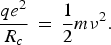
For R c > R r, the capture cross-section is simply σCAP = πRr2. Bohr and Lindhard also allow for capture if R c < R r. Denoting the Bohr radius of the bound electron by r n, and the bound electron velocity by νe, they stipulate, that since release is a gradual process, which takes place with a probability per unit time of the order of νe/r n and the time during which capture can occur is approximately R c/ν, the probability that the released electron will be captured is roughly (νe/r n)(R c/ν). Thus for R c<R r, they approximate the capture cross section by

This model is amenable to the quantitatively introduction of the decrease in the ionization energy ΔE. Subtracting ΔE from the left-hand side of Eq. (5), causes a decrease in R c, thus making the recombination cross-section smaller, also bringing about an increase in the charge state. Should the Monte Carlo calculation give recombination, than the final projectile state is determined on the basis of the relative Oppenheimer Brinkman Kramers approximation recombination cross-sections (Betz, Reference Betz1983) for the given available final states of the projectile.
An empirical scaling factor is needed to calibrate the cross-section in order to obtain agreement with the experimentally determined charge state, since the BEA ionization cross-sections as well as the recombination cross-section do not give the correct absolute results. The scaling factor needed is adjusted such that the calculated equilibrium charge state is q = 2.86, for the solid amorphous carbon target at ambient conditions obtained by interpolation from Shima et al. (Reference Shima, Kuno, Yamanouchi and Tawara1992) and Stoller et al. (Reference Stoller, Suter, Himmel, Bonani, Nessi and Wolfli1983). We note that according to the present model the ionization energy is depressed.
The ion track is divided into sufficiently small path lengths, such that the probability of projectile charge change does not exceed 0.1 within the given path length. The increase or decrease of the charge state of the projectile within the path interval is determined by means of the Monte Carlo method. The energy loss of the projectile as it traverses the target is neglected.
3. RESULTS AND DISCUSSION
Given here are results for a carbon beam at 2 MeV incident on a variety of cold carbon targets. These targets are a low density gas target, a solid amorphous carbon target at ambient conditions, and two examples of compressed solid targets. For the solid target at ambient conditions, four plasma or screening electrons are assumed to be present in the target. This is based on the Chevallier et al. (Reference Chevallier, Clouvas, Faria, Mazuy, Gaillard, Poizat, Remillieux and Desesquelles1990) experiment discussed above, as well as on Nardi and Tombrello (Reference Nardi and Tombrello2006). In the latter publication, it was shown, that in order to explain charge state suppression in 2 MeV/C carbon cluster beams penetrating and expanding within an amorphous medium, the Coulomb potential between cluster ions had to be shielded by four plasma or valence electrons. The latter reference quotes other publications that support the number of plasma electrons for amorphous carbon as given above. The value of ΔE, basic to the model discussed here, is determined according to Eq. (2). For the compressed solid targets, the number of screening electrons is still four, since the target K shell electrons are not pressure ionized at these conditions.
The level structure of the projectile is included in the calculation. For the cases of the solids treated here, the excited n = 3 states are unbound, due to the depression of the ionization energy, as are the n = 2p states for the target density of 5 × 10²³ atoms/cm3. Intra-level transitions within the projectile are consequently of negligible importance for the final charge state result when accounting for ionization depression. For the gaseous target (denoted by 1020 atoms/cm3), ΔE is assumed to be equal to 0 and the recombining electron populates the lowest unoccupied level.
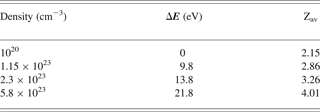
Table 1 summarizes the results for the 2 MeV carbon beam. The values of the average equilibrium charge states as well as ΔE, for z = 1 are given for the various densities. The average equilibrium charge state was obtained by averaging over 1000 projectile case histories. In Figure 1 is plotted the average charge state as a function of penetration depth for the gas target, the solid at ambient conditions as well as the compressed cold solid at twice the ambient density.
(Color online) Charge state as a function of penetration depth in a gas target (lower curve), solid target at ambient conditions (middle curve) and for a cold solid target at twice the density of the target at ambient conditions (upper curve). The projectile is carbon at 2 MeV.

Average equilibrium projectile charge state for 2 MeV carbon ions incident on an amorphous carbon target. ΔE is the decrease in the ionization energy of the carbon projectile according to Eq. 2 with z = 1. Zav was obtained by averaging over 1000 case histories
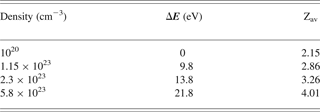
The present calculations predict a gas solid effect. The equilibrium charge state in the amorphous solid at ambient conditions, at the density of 1.15 × 10²³ atoms/cm3, is higher than that in a gas by 0.7 units. As the density increases by a factor of two, the equilibrium charge state increases by 0.5 units, while at five times the natural density, the projectile retains only its K shell electrons.
The gas solid effect on the charge state for the solid at ambient conditions is due here essentially to the ionization depression only. Excited levels are virtually non-existent, since due to dynamic screening only 1s, 2s, and 2p levels are bound, with the 2s and 2p levels becoming very close in energy as the ionization level increases. The broadening and the creation of manifolds of the projectile levels (Muller & Burgdorfer, Reference Muller and Burgdorfer1991) do not effect the results of the present calculations.
A very recent experiment that demonstrates the substantial difference between the charge states in a solid carbon target compared to that for an Argon target, for U ions was carried out by Perumal et al. (Reference Perumal, Horvat, Watson, Peng and Fruchey2005). This publication also summarizes the data from the literature from 0.01 to 10 MeV/amu. In this problem, the projectile excited states should play a prominent role in the ionization process for the solid target in contrast to the problem treated here. In connection with the calculation presented in this paper, it would be of great interest to measure the charge state for a carbon gas target at 2 MeV and compare it to the experimentally determined value for solid carbon (Shima, Reference Shima, Kuno, Yamanouchi and Tawara1992). The detailed analysis of Paul (Reference Paul2004) based on Schiwietz and Grande (Reference Schiwietz and Grande2001) on the solid gas difference, gives a very wide range of measured values in the range of the reduced velocity of the case analyzed in this paper. This underlines the importance of carrying out this experiment, which could be carried out as follows: For the solid target a 1 µm/cm2 carbon foil can be used. For the gas target, a windowless differentially pumped gas cell, filled with CH, with the same carbon mass thickness, is suggested. It is however also proposed here to fill the gas cell with CH2 and even CH4, with the same amount of carbon, in order to ascertain the “perturbation” of the less effective hydrogen on the charge state. In this manner, we propose a system where the solid gas difference can be measured using the same target material for the gas and for the solid.
Moreover, measuring the charge state in solid dielectric targets where plasma electrons are less excited would also be of major interest regarding the model presented here. In future work, it is our intention to apply this model to heavier projectiles, where the excited levels and intra-level transitions play an important role.
In summary we have dealt with the effect of the dynamic screening of plasma electrons on the charge state of energetic ions. This was carried out by making a number of simplifying assumptions regarding the depression of the ionization as given by Eq. (2). The basic assumption made was in regard to the screening potential. It was assumed here that this complicated potential is isotropic and of the simple Yukawa form. Moreover, we also assumed the high velocity limit of the dynamic screening length. In addition to this, we made use of the hydrogenic model for calculating the depression in the ionization energy of the ion, as well as simplified ionization, and recombination cross sections. We have also assumed that the number of active screening electrons is four; this point was dealt with above in detail. As discussed and cited here, the assumptions pointed out above are commonly used in the literature. Performing the present calculations, using the full, more accurate potential, as well as improved atomic physics, is beyond the scope of the present work.
In spite of these simplifying assumptions, it is our belief that the model given here highlights an effect that must be treated, when dealing with the gas solid effect, on the charge state of energetic ions, interacting with targets consisting of bound as well as plasma electrons. Furthermore, it is our belief that the current model describes well enough the physics, in fact, the same set of assumptions were employed in the successful explanation of the charge suppression in energetic clusters, as mentioned above (Nardi & Tombrello, Reference Nardi and Tombrello2006). However, detailed comparison with experiment is required to ascertain the validity of the model and also of the simplifying assumptions made. Also, as noted, an interesting possibility is applying the present model to the experimental gas solid results for energetic uranium ions carried out by Perumal et al. (Reference Perumal, Horvat, Watson, Peng and Fruchey2005), where a very large gas solid effect was reported.
ACKNOWLEDGMENT
This work was supported by the Minerva foundation (the German Federal Ministry for Education and Research).