Introduction
Allergic rhinitis is a common chronic disease that seriously affects patients' quality of life. During the past 40 years, as industrialisation has progressed, lifestyle and environmental changes have occurred, and the average incidence rate of allergic rhinitis has reached 25–35 per cent.Reference Weber1, Reference Kay2 In recent years, the incidence rate has continued to increase, particularly in children, with a prevalence of 20–40 per cent reported in children in developed countries.Reference Nathan3
Only a few studies of paediatric allergic rhinitis prevalence in China have been reported. W-J Kong et al. reported that the prevalence of allergic rhinitis in pre-school students (aged three to six years) in Wuhan, a populous city in central China, was 10.8 per cent.Reference Kong, Chen, Zheng, Shi and Zhou4 The current study is the first to evaluate the prevalence of allergic rhinitis among elementary and middle school students (aged 10–17 years) in Changsha city, the central-south region of China. We aimed to understand the clinical characteristics, risk factors and impact on quality of life of allergic rhinitis.
Materials and methods
Subjects
For this study, 10–17-year-old students were chosen as the subjects. Forty-three schools were randomly selected from 4 districts (Yuhua, Kaifu, Yuelu and Tianxin) in Changsha city, China, including 8 elementary schools and 35 middle schools.
In order to improve the accuracy of the study findings, both a stratified sampling survey and a cluster sampling survey were conducted. The stratified sampling survey was performed in 39 schools (32 middle schools and 7 elementary schools), and the cluster sampling survey was performed in 4 schools (3 middle schools and 1 elementary school).
This study was approved by the Institutional Review Board of Hunan Children's Hospital and the Third Xiangya Hospital of Central South University.
Stratified sampling survey
In total, 7023 questionnaires (specific content included name, sex, age, school, contact information and allergic rhinitis symptoms) were distributed in selected schools, and 6407 questionnaires were correctly completed and returned.
We defined the students as having ‘self-reported allergic rhinitis’ if they complained of at least two of the four classic symptoms of allergic rhinitis (nasal obstruction, rhinorrhoea, sneezing and itching in the nose), lasting for more than one year. In order to confirm the accuracy of the questionnaires, we randomly selected 1275 (20 per cent) of the 6407 students and communicated with their parents. These results showed that 4.7 per cent of the 1275 students misunderstood the symptoms and/or duration of allergic rhinitis; thus, an adjusted self-reported allergic rhinitis rate was calculated according to the error rate.
A total of 515 potential allergic rhinitis patients were invited to the Third Xiangya Hospital or the Hunan Children's Hospital for specialised examinations and skin prick tests.
Cluster sampling survey
All 814 of the students from 4 schools (from 16 classes) in Changsha city were selected to receive the questionnaires and undergo skin prick tests. For the children whose skin prick tests were positive, further medical histories were obtained and nasal examinations were performed to obtain a definitive diagnosis. For children who showed symptoms of asthma, a respiratory physician was asked to make a definitive diagnosis.
Survey details
The questionnaire contained visual analogue scales, as well as questions related to: general demographic characteristics (name, sex, age, grade, height, weight, school, family address and contact information); allergic rhinitis, such as the presence of classic allergic rhinitis symptoms (nasal obstruction, rhinorrhoea, and sneezing and itching in the nose); simultaneous phenomena; related risk factors; history of contact with allergens; onset seasons; history of allergic disease; family medical history; and living and family economic conditions.
Anterior rhinoscopy
This was performed during physical examinations to investigate whether the nasal mucosa was swollen and/or pale, and assess whether rhinorrhoea was present in the nasal cavity. Children with a high likelihood of allergic rhinitis underwent skin prick tests.
Allergen skin prick tests
Our colleagues investigated the aeroallergen spectrum of paediatric patients with allergic rhinitis living in the Changsha area of China.Reference Zhong, Wang, Wang, Li and Tan5 These results showed that the four most common allergens were Dermatophagoides farinae, Dermatophagoides pteronyssinus, mugwort and fungi. Thus, the four allergens described above were selected for the allergen skin prick test (ALK-Abelló, Hørsholm, Denmark).
The skin prick test was performed according to the International Study of Asthma and Allergies in Childhood (‘ISAAC’) phase II procedure. Histamine (10 mg/ml) and diluent (sodium chloride) were used as positive and negative controls, respectively. A positive skin prick test result was defined as a wheal with a mean diameter that was at least 3 mm greater than that of the negative control.
Statistical analysis
In our study, the associations between allergic rhinitis and age, sex, living environment or family history, and a moderate-to-severe effect of allergic rhinitis on quality of life were assessed using the chi-square test. The Clopper–Pearson method was used to calculate 95 per cent confidence intervals for proportions. The Wilcoxon rank sum test was used to compare differences between the two groups (allergic rhinitis group and control group) in terms of effects on sleep, emotion and memory. A p value of less than 0.05 was considered to be significant.
Results
Survey efficiency
In the stratified sampling survey, 7023 questionnaires were distributed, and 6407 questionnaires were correctly completed and returned. The response rate was 91.2 per cent, and included 1934 (30.2 per cent) elementary school students (aged 10–12 years) and 4473 (69.8 per cent) middle school students (aged 13–17 years).
In the cluster sampling survey, all 814 elementary and middle school students completed the questionnaire and underwent skin prick tests, including 164 (20.1 per cent) elementary school students and 650 (79.9 per cent) middle school students.
Self-reported allergic rhinitis
The analysis of 6407 questionnaires showed that 2857 students (44.6 per cent) self-reported that they were suffering from allergic rhinitis, including 1521 boys (53.2 per cent) and 1336 girls (46.8 per cent). The final self-reported allergic rhinitis rate after error rate adjustment was 42.5 per cent (2723 out of 6407).
Allergic rhinitis prevalence
The stratified sampling survey showed that 105 (21.8 per cent) of 482 elementary school students and 144 (18.1 per cent) of 793 middle school students were diagnosed with allergic rhinitis; the average prevalence rate was 19.4 per cent.
The cluster sampling survey showed that 140 (17.2 per cent) of 814 elementary and middle school students were diagnosed with allergic rhinitis. The prevalence rates for the different ages were: 15.8 per cent in the 10–12-year-olds, 17.0 per cent in the 13–14-year-olds and 18.0 per cent in the 15–17-year-olds. Both sampling surveys showed that the prevalence of elementary and middle school students with allergic rhinitis increased with age, but there was no statistical significance (p > 0.05; Table I). The distributions of students with allergic rhinitis based on living environment and sex are shown in Table I; no statistical significance was found (p > 0.05).
Student distributions based on age, sex and living environment

Data are presented as absolute numbers and percentages (in parentheses) of students, unless indicated otherwise. *Non-allergic-rhinitis group
Allergen distribution
Of 140 patients diagnosed with allergic rhinitis in the cluster sampling survey, 4 had a reaction to mugwort and the remaining 136 had a reaction to mites. This indicates that the main allergen of allergic rhinitis among elementary and middle school students was mites (97.1 per cent, 136 out of 140).
Other allergen-related disease
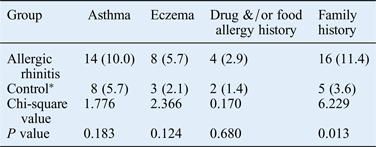
We investigated the prevalence of other allergen-related diseases in 140 allergic rhinitis students in the cluster sampling survey, and we randomly selected 140 students with no allergic rhinitis as the control group. In the allergic rhinitis group, 14 patients (10 per cent) also had asthma, 8 patients (5.7 per cent) had eczema, 4 patients (2.9 per cent) had a history of drug and/or food allergy, and 16 patients (11.4 per cent) had a family history of allergic rhinitis. In the control group, eight students (5.7 per cent) had asthma, three students (2.1 per cent) had eczema, two students (1.4 per cent) had a history of drug and/or food allergy, and five students (3.6 per cent) had a family history of allergic rhinitis. The only significant difference between the allergic rhinitis group and control group was in family history (Tables II and III), which indicated that genetic factors have an effect on the prevalence of allergic rhinitis.
Prevalence of allergen-related disease

Data are presented as absolute numbers and percentages (in parentheses) of students, unless indicated otherwise. *Non-allergic-rhinitis group
95 per cent confidence intervals for allergen-related disease proportions
*Non-allergic-rhinitis group. CI = confidence interval
Atopy prevalence
In the cluster sampling survey, the skin prick test results were positive for 214 of the 814 students, indicating that the prevalence of atopy was 26.3 per cent. Of those students with positive results, 140 (17.2 per cent) had allergic rhinitis and 17 (2.1 per cent) had asthma. Seventy-one (8.7 per cent) of the students with positive skin prick test results had no symptoms of allergic rhinitis.
Effect on sleep, emotions and memory
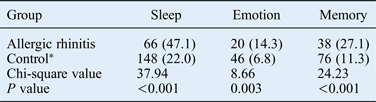
Visual analogue scales were used to assess the effect of allergic rhinitis on the sleep, emotions and memory of the 814 students in the cluster sampling survey. These results showed that the percentages of students who were troubled by sleep, emotional and memory problems in the allergic rhinitis group are significantly greater than those in the control group (Table IV).
Effect of allergic rhinitis on sleep, emotions and memory
Data are presented as absolute numbers and percentages (in parentheses) of students, unless indicated otherwise. *Scores ranged from 1 to 10: ‘0’ points indicates no effect, ‘~4’ points indicates slight effect, ‘~7’ points indicates moderate effect and ‘~10’ points indicates severe effect. †Non-allergic-rhinitis group. VAS = visual analogue scale
The chi-square test was used to analyse those with a moderate-to-severe impact of allergic rhinitis on sleep, emotions and memory. The rate of children reporting a moderate-to-severe impact of allergic rhinitis symptoms on sleep was 47.14 per cent, compared to 21.96 per cent for children with no allergic rhinitis (p < 0.001). The rate of children reporting a moderate-to-severe impact of allergic rhinitis symptoms on emotion was 14.29 per cent, compared to 6.83 per cent for children with no allergic rhinitis (p = 0.003). The rate of children reporting a moderate-to-severe impact of allergic rhinitis symptoms on memory was 27.14 per cent, compared to 11.28 per cent for children with no allergic rhinitis (p < 0.001) (Tables V and VI).
Students with moderate-to-severe impact of allergic rhinitis on sleep, emotions and memory
Data are presented as absolute numbers and percentages (in parentheses) of students, unless indicated otherwise. *Non-allergic-rhinitis group.
95 per cent confidence intervals for proportions of moderate-to-severe impact on sleep, emotions and memory
*Non-allergic-rhinitis group. CI = confidence interval
Discussion
The current study is the first to investigate the prevalence of allergic rhinitis among elementary and middle school students in Changsha city, which is the capital of Hunan province and the centre of industry, finance, culture and education in the central-south region of China. The development of a social economy has given rise to a significant change in the spectrum of disease; for instance, there is a decreased prevalence of malnutrition, parasitic disease and infectious disease, and an increased prevalence of tumours, angiocardiopathy and allergic disease. During the past 30 years, approximately 500 million people worldwide have been diagnosed with various allergic diseases, resulting in a global public health problem. Despite being non-life-threatening, the irritating nature of allergic rhinitis symptoms can severely affect daily activities, including the ability to work,Reference Blanc, Trupin, Eisner, Earnest, Katz and Israel6 examination performance,Reference Vuurman, van Veggel, Sanders, Muntjewerff and O'Hanlon7, Reference Walker, Khan-Wasti, Fletcher, Cullinan, Harris and Sheikh8 quality of life and psychosocial wellbeing.Reference Meltzer, Nathan, Selner and Storms9, Reference Leynaert, Neukirch, Liard, Bousquet and Neukirch10
Epidemiological investigations showed that the prevalence rate of allergic rhinitis among elementary and middle school students in Japan in the 1940s was less than 10 per cent, but after 2002 this prevalence was greater than 20 per cent.Reference Nishima, Chisaka, Fujiwara, Furusho, Hayashi and Hiraba11 In the USA in 2003, the prevalence rate of allergic rhinitis was 10–30 per cent in adults and approximately 40 per cent in children, which suggests that the prevalence has increased over time.Reference Lai, Casale and Stokes12 In Beijing, China, childhood allergic rhinitis accounts for approximately 46.1 per cent of respiratory allergic disease, and the prevalence of allergic rhinitis is positively correlated with age.Reference Zhao, Ma, Chen and Han13 Children as young as one year had symptoms of allergic rhinitis, and the symptoms increased by the age of six years; approximately 40 per cent of the patients were diagnosed with allergic rhinitis at this age.
The findings of the investigations described above indicate that the prevalence rate of allergic rhinitis increases with age. In our study, two different investigation methods were performed to examine the prevalence rate of allergic rhinitis among elementary and middle school students in Changsha city. The stratified sampling survey showed that the self-reported rate of allergic rhinitis was 42.5 per cent, which was consistent with that of other allergic rhinitis related articles.Reference Zhao, Bai, Shen, Xiang, Huang and Chen14, Reference Zhang, Han, Huang, Wu, Dong and Xu15 The prevalence rate of allergic rhinitis among middle school students (21.8 per cent) was slightly higher than that among elementary school students (18.1 per cent), and the average prevalence rate was 19.4 per cent. The cluster sampling survey showed that the prevalence rate of allergic rhinitis was 17.2 per cent, and it increased with age among elementary and middle school students; this result was similar to that found in developed countries.Reference Nishima, Chisaka, Fujiwara, Furusho, Hayashi and Hiraba11, Reference Lai, Casale and Stokes12 The prevalence rates of the two survey methods were similar, with a difference of approximately 2 per cent, which may be associated with the sampling method and small differences in region, environment and age structure.
Previous studies have shown that the prevalence rate of allergic rhinitis combined with asthma was 40–60 per cent, indicating that allergic rhinitis causes asthma or has a close relationship with asthma.Reference Burgess, Walters, Byrnes, Matheson, Jenkins and Wharton16, Reference Gradman and Wolthers17 A domestic study showed that 77 per cent of the children with allergic rhinitis in Beijing presented with airway hyperreactivity.Reference Zhao, Ma, Chen and Han13 The concept of ‘one airway, one disease’ has been universally accepted by experts of allergic rhinitis and asthma. This concept is based on the following observations. Firstly, allergic rhinitis and asthma exhibit similar four-stage allergic responses (sensitisation, acute-phase mast-cell activation, acute-phase neuronal response and late-phase response), which correlate with clinical signs and symptoms.Reference Bousquet, Van Cauwenberge and Khaltaev18 Secondly, allergic rhinitis and asthma share common mechanisms for the airway inflammatory process; the mediators and triggers involved produce mucosal oedema, inflammation, excessive mucus production and airway constriction.Reference Simons19 In patients with both allergic rhinitis and allergic asthma, the clinical data suggest that effective treatment of allergic rhinitis can reduce the severity or frequency of allergic asthma flare-ups.Reference Simons19–Reference Schoenwetter, Dupclay, Appajosyula, Botteman and Pashos21 In our study, only 10 per cent of allergic rhinitis patients also had asthma, and the prevalence rate of allergic rhinitis increased during the adolescent period with no obvious increase in asthma (2.1 per cent). Based on the prevalence rate and disease progression, the specific mechanisms of allergic rhinitis and asthma may be different. Further studies are required to elucidate these findings.
Atopic status is the basis of allergic disease, and an atopic state is a risk factor for allergic rhinitis and asthma. A previous investigation showed that the prevalence rate of atopy in Beijing, Guangzhou and Hong Kong was 23–41 per cent, and atopic status was considered a primary risk factor for allergic rhinitis and asthma.Reference Wong, Hui, Chan, Fok, Leung and Zhong22 In the cluster sampling survey of 814 students, the skin prick test results of 214 students were positive, indicating that the prevalence of atopy was 26.3 per cent. In total, 140 students in this study were diagnosed with allergic rhinitis and 14 students also had asthma, while 71 students with an atopic status (positive skin prick test results) had no symptoms of allergic rhinitis or asthma. Further observation is needed to determine whether these 71 students are likely to develop allergic rhinitis and/or asthma. The reason why some atopic individuals display no symptoms of allergic rhinitis and/or asthma for a long period of time is still unclear; perhaps this phenomenon is due to immune tolerance that has occurred in the nasal or bronchial mucosa. The specific mechanism for this tolerance requires further study and may provide new clues for an innovative treatment of allergic rhinitis.
The aetiology of allergic rhinitis is complex and the pathogenesis is not completely clear. From a clinical and genetic perspective, not all people who are exposed to the same environmental factors suffer from allergic rhinitis, which indicates that genetic factors play an important role in the occurrence of allergic rhinitis. Ma et al. found that the role of heredity in a family with allergic rhinitis is obvious, wherein several genes plus environment factors may cause allergic rhinitis.Reference Ma, Chen, Zhang, Wang, Shi and Ji23 This finding is consistent with the characteristics of a polygene heredity disease. In our study, a significant difference was found in the family history between the allergic rhinitis group and control group; students with a family history of allergic rhinitis were more susceptible to allergic rhinitis. Exploration of the pathogenesis of allergic rhinitis from a genetic angle provides an alternative avenue for research on allergic rhinitis, and may be more prospective in improving the prevention strategies, diagnosis and therapeutic measurement of allergic rhinitis.
• The prevalence of allergic rhinitis among 10–17-year-old students was 15.8–19.4 per cent
• Prevalence increased during the adolescent period, with no obvious increase in asthma
• Atopy prevalence was 26.3 per cent
• Seventy-one atopic students had no allergic rhinitis or asthma symptoms; an immune tolerance may have occurred in nasal or bronchial mucosa
• Genetic factors affect allergic rhinitis prevalence
• Allergic rhinitis had an effect on students' sleep, emotions and memory
Allergic rhinitis symptoms have a negative impact on patients' quality of life. A European-wide survey showed that two-thirds of allergic rhinitis patients reported at least one symptom that was sufficiently severe to interfere with sleep quality, cognitive function, work productivity, school performance, psychosocial wellbeing or overall quality of life.Reference Valovirta, Myrseth and Palkonen24 Poor sleep is a particular problem. In a study conducted in France, 44 per cent of allergic rhinitis patients reported feeling tired after a night's sleep, and were also more prone to anxiety and depression.Reference Léger, Annesi-Maesano, Carat, Rugina, Chanal and Pribil25 In another European-wide survey, one-third of patients felt irritable, and 12 per cent of both persistent and intermittent sufferers struggled with depression.Reference Canonica, Bousquet, Mullol, Scadding and Virchow26 Our study showed that the sleep quality and memory of 10–17-year-old students with allergic rhinitis significantly decreased, and emotional issues increased, with the onset of allergic rhinitis. All of these changes were primarily due to allergic rhinitis symptoms (nasal obstruction, rhinorrhoea, sneezing and itching in the nose). Thus, to improve patients' quality of life, allergic rhinitis professionals should focus on the prevalence of allergic rhinitis, correctly diagnose and treat the condition, and strive for maximum control of the symptoms.
Acknowledgements
This study was supported by: the Hunan Provincial Innovation Foundation for Postgraduate (China) (grant number CX2013B125); the Nature Science Foundation of Hunan Province (China) (grant number 12JJ2053); the Science and Technology Project of Hunan Province (China) (grant number S2013F1023); and the Doctoral Foundation of Education Department (China) (grant number 20110162110023).