Implications
Male pigs immunized against gonadotrophin releasing factor are physiologically entire males for most of their life and as such they should be fed as entire males at least up until the second immunization. Shortly after that time, testicular function is suppressed and the hormonal and metabolic status rapidly adjusts to resemble that of a physical castrate. As a consequence, feed intake and tissue deposition change and after the second immunization the lysine requirement could be up to 1.5 g/kg lower than boars. The existence of these two metabolic phases creates additional flexibility for dietary manipulation to help producers meet specific production targets.
Introduction
In pigs, as in many other domestic species, entire males are generally more muscular, less fat and more metabolically efficient than females or physical castrates (barrows; Campbell and Taverner, Reference Campbell and Taverner1988; Dunshea et al., Reference Dunshea, King, Campbell, Sainz and Kim1993). Despite these advantages, however, the traditional practice in most countries is to physically castrate male piglets early in life. The major reason for doing this is to control boar taint, which is an offensive smell present in the meat of many sexually mature entire male pigs. The presence of boar taint can greatly reduce the acceptability of pork to consumers. A second reason is to control aggression and sexual behaviour in entire male pigs as they approach slaughter weight. Although boar taint and entire male behaviour are only problems in the older pig, for practical reasons, the physical act of castration is performed in the young piglet. The potential benefit of the higher entire male performance is thus lost for the entire growing period.
Driven by both the potential for productivity gains and, in some countries, animal welfare concerns, effort has been devoted to looking for alternative ways to control boar taint and remove the necessity for physical castration (EFSA, 2004). One method is immunization against gonadotrophin releasing factor (GnRF), also referred to as immunological castration (Dunshea et al., Reference Dunshea, Colantoni, Howard, McCauley, Jackson, Long, Lopaticki, Nugent, Simons, Walker and Hennessy2001). The world's first, and only, commercial anti-GnRF vaccine is now freely available in many countries under several trade names (Improvac, Improvest, Vivax, Innosure; Zoetis Madison, NJ, USA). By using the immunization approach, physical castration early in life is replaced by a temporary immunological suppression of testicular function relatively near slaughter. Immunized animals temporarily become like castrates, with similar lack of boar taint and entire male behaviour. However, the difference in timing means that male pigs reared using an immunization regimen are allowed to grow as entire males for most of the growing–finishing period, benefiting from the naturally better feed conversion efficiency and improved carcass composition of entire males (Dunshea et al., Reference Dunshea, Colantoni, Howard, McCauley, Jackson, Long, Lopaticki, Nugent, Simons, Walker and Hennessy2001; Millet et al., Reference Millet, Gielkens, De Brabander and Janssens2011).
From a physiological perspective, the life of a male pig reared using an anti-GnRF immunization protocol can be divided into two phases – the first phase is before full immunization (two doses); the second phase from full immunization until slaughter. The immunization regimen requires two doses at a minimum interval of 4 weeks apart. The first ‘priming’ dose is generally given at any time after 10 weeks of age. The second dose is typically given 4 to 6 weeks before slaughter, although in some markets the timing of the second dose may be from 3 to 10 weeks before slaughter. Irrespective of the timing, until shortly after the second dose, the pig is a normal entire male. Following the second dose, testicular function is suppressed and hormonal status rapidly adjusts to resemble that of a barrow (Dunshea et al., Reference Dunshea, Colantoni, Howard, McCauley, Jackson, Long, Lopaticki, Nugent, Simons, Walker and Hennessy2001). As a consequence, feed intake and tissue deposition characteristics also change, but initially these reflect the unique characteristics of an animal transitioning from one metabolic state to another and are not identical to those of a long-term physical castrate. The goal of this review is to provide some guidance for the energy and lysine requirements of entire male pigs reared using immunization against GnRF as the method to control boar taint. This will reflect the two distinct physiological phases in the lives of such animals, initially being those of entire males where there is a significant body of existing knowledge, and secondly after full immunization when the physiology and metabolism of the immunized boar becomes more castrate-like. To understand the nutritional requirements of immunized boars, a series of meta-analyses and some modelling of recent published data was undertaken.
Material and methods
Meta-analysis is a robust technique that utilizes the magnitude of, and the error around, the difference between treatments (in this case sex) to quantify the expected effect and the degree of uncertainty around this estimated effect. Meta-analyses are particularly valuable where a reasonable body of published data exists and especially where there may be some equivocal findings or small differences (Glass, Reference Glass1976).
Study inclusion
In this review, we report on a series of meta-analyses on data from up to 32 data sets from recent peer reviewed published reports and articles with improved genotypes. Non-peer reviewed papers, such as many conference proceedings, were excluded. Details of the references used for the meta-analyses are given in Supplementary Table S1.
Fourteen studies, post-2000, were used for the comparison between entire males and barrows (studies listed in supplementary Table S1); 19 published reports, post-2000, were used for the comparison between immunocastrated males and entire males (see supplementary Table S1); and 21 post-2000 reports for the final comparison between barrows and immunocastrated males (see supplementary Table 1 for the details of studies included). Some studies reported the performance of entire males, castrates and immunocastrated males. Only studies performed with group housed pigs were used, any studies that used individual housing were excluded. For the comparisons incorporating anti-GnRF immunized males only studies that were performed with the commercial anti-GnRF vaccine, from Zoetis, and that utilized a 4 to 6 week post-second immunization period were used. Studies that used an experimental, non-commercially available anti-GnRF vaccine or that were purported to require a single immunization strategy were excluded. Only studies that reported a measure of variation from which a standard error of the difference could be derived were used. Where studies included treatments with ractopamine or somatotropin only, the data for the non-ractomamine/somatotropin controls were used. In addition, only studies that reported separate data from second immunization to slaughter as opposed to the entire growing/finishing period were included. Any studies that did not meet these criteria were excluded from the analyses and are listed in supplementary Table S2.
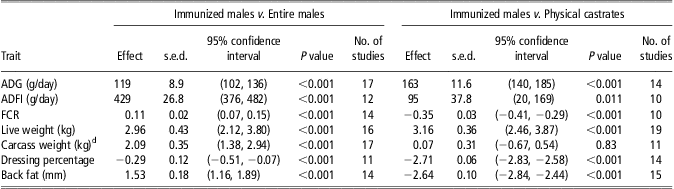
Average fixed effects of immunization against GnRF compared with either entire males (immunized males – entire males) or physical castrates (immunized males – physical castrates) from meta-analyses of data from peer reviewed studies (n = 19 data sets for entire male comparison and n = 21 data sets for comparison with castrates) with group-housed pigsFootnote aFootnote bFootnote c

ADG = average daily gain; ADFI = average daily feed intake; FCR = feed conversion ratio.
a Analyses only included data from studies with animals slaughtered between 4 and 6 weeks after the second immunization (mean final live weight 107 to 110 kg).
b Differences were determined over the period between the second immunization and slaughter or equivalent time in barrows.
c Studies included were: McCauley et al. (Reference McCauley, Watt, Suster, Kerton, Oliver, Harrell and Dunshea2003 and Reference McCauley, Cronin, King, Hemsworth, Barnett, Luxford, Smits, Hennessy, Campbell and Dunshea2004), Dunshea et al. (Reference Dunshea, Colantoni, Howard, McCauley, Jackson, Long, Lopaticki, Nugent, Simons, Walker and Hennessy2001 and Reference Dunshea, Cronin, Barnett, Hemsworth, Hennessy, Campbell, Luxford, Smits, Tilbrook, King and McCauley2011), Oliver et al. (Reference Oliver, McCauley, Harrell, Suster, Kerton and Dunshea2003), Zamaratskaia et al. (Reference Zamaratskaia, Andersson, Chen, Andersson, Madej and Lundstrom2008), Hémonic et al. (Reference Hémonic, Courboulay, Kuhn, McClaughlin, Martin, Brock and Pearce2009), Fuchs et al. (Reference Fuchs, Nathues, Koehrmann, Andrews, Brock, Sudhaus, Klein and Beilage2009), Pauly et al. (Reference Pauly, Spring, O'Doherty, Ampuero Kragten and Bee2009), Rikard-Bell et al. (Reference Rikard-Bell, Curtis, van Barneveld, Mullan, Edwards, Gannon, Henman, Hughes and Dunshea2009), Schmoll et al. (Reference Schmoll, Kauffold, Pfutzner and Baumgartner2009), Fàbrega et al. (Reference Fàbrega, Cros, Soler, Velarde, Gispert and and Suarez2010), Boler et al. (Reference Boler, Kutzler, Meeuwse, King, Campion, McKeith and Killefer2011 and Reference Boler, Killefer, Meeuwse, King, McKeith and Dilger2012), Font i Furnols et al. (Reference Font-i-Furnols, Gispert, Soler, Diaz, Garcia-Regueiro, Diaz and Pearce2012), Lealiifano et al. (Reference Lealiifano, Pluske, Nicholls, Dunshea, Campbell, Hennessy, Miller, Hansen and Mullan2011), Moore et al. (Reference Moore, Dunshea and Mullan2011), Andersson et al. (Reference Andersson, Brunius, Zamaratskaia and Lundstrom2012), Schmidt et al. (Reference Schmidt, Calabrese, Grodzycki, Paulick, Pearce, Rau and von Borell2011), Skrlep et al. (Reference Škrlep, Batorek, Bonneau, Prevolnik, Kubale and Čandek-Potokar2012), Yuan et al. (Reference Yuan, Li, Zhang, Li, Gao and Zhou2012), Akit (Reference Akit2013) and Lanferdini et al. (Reference Lanferdini, Lovatto, Melchior, Orlando, Ceccantini and Poleze2013). Some references reported more than one data set.
d Since there was evidence of heterogeneity (P = 0.05) in the immunized males v. entire males comparison a random effects model was used.
Meta-analysis methodology
Data were subjected to meta-analyses (Genstat Version 13) utilizing the response to immunization against GnRF as the effect and standard error of the difference of this effect as the measure of variation. Since the Genstat default measure of heterogeneity of Cochrane's Q has low power when the number of studies is small, as in these analyses, heterogeneity was assessed using the I2 statistic (Higgins et al., Reference Higgins, Thompson, Deeks and Altman2003). There was no evidence of heterogeneity in the responses, so a fixed effect model was used for the meta-analyses. The exception was for carcass weight in the GnRF-immunized males v. entire males where there was indication of heterogeneity (P = 0.05) and, in this case, a random effects model was used. All effects were visually appraised using Forest and Radial plots (Whitehead and Whitehead, Reference Whitehead and Whitehead1991) but, for ease of presentation, the responses are presented as mean fixed effects (random effect for carcass weight) with 95% confidence intervals. Similar principles were applied to the meta-analyses reported later in this paper.
InraPorc modelling methodology
The InraPorc model was used to characterize the nutritional requirement of pigs (van Milgen et al., Reference van Milgen, Valancogne, Dubois, Dourmad, Sève and Noblet2008). On the basis of average feed intake and BW observed at different ages in entire males, castrated males and gilts by Quiniou et al. (Reference Quiniou, Courboulay, Salaün and Chevillon2010), relationships between BW and age and between feed intake and BW were fitted to data using a Broyden–Fletcher–Goldfarb–Shanno optimization method. In the InraPorc model, a Gompertz function is used to describe protein deposition and thus BW gain. An exponential function (a.(1-eb.BW)) was used to express the relationship between feed intake and BW. Then, the relationship between dietary lysine requirement and BW was simulated for each type of pigs.
Results and discussion
Impact of physical castration on growth performance and carcass characteristics
The potential lean tissue growth and efficiency of weight and lean tissue gain are greater in entire males than in barrows prompting the cessation of castration 30 years ago in a few markets, particularly those that are focused on lean meat production. Some of these differences in tissue nutrient partitioning rates were demonstrated in a recent study designed to investigate the interactions between housing and gender in contemporary genotypes (Suster et al., Reference Suster, Leury, Kerton DJ Borg, Butler and Dunshea2006). These authors found that under group-housed conditions, there was very little difference between entire males and barrows in daily gain and lean tissue content until 122 days of age (ca. 77 kg BW). Beyond 17 weeks of age, the barrows ate more feed and grew faster than the entire males but deposited less lean tissue and more fat. Thus, at 150 days of age, the entire males weighed 5 kg less than the barrows but contained 3 kg more lean tissue and almost 6 kg less fat. In pigs raised in individual pens, the differences in body composition were even more profound in favour of entire males while the live weights were similar (73.1 v. 66.8 kg lean tissue and 20.6 v. 27.1 kg fat for entire males v. barrows, respectively). Over the finisher phase, the feed conversion ratio (FCR; kg feed/kg gain) was 13% higher in barrows than in entire males. These data for efficiency and P2 back fat were very similar to those observed elsewhere (Noblet et al., Reference Noblet, Karege and Dubois1994; Dunshea et al., Reference Dunshea, Colantoni, Howard, McCauley, Jackson, Long, Lopaticki, Nugent, Simons, Walker and Hennessy2001; Quiniou et al., Reference Quiniou, Courboulay, Salaün and Chevillon2010; Millet et al., Reference Millet, Gielkens, De Brabander and Janssens2011).
The outcomes of the current meta-analysis of up to 14 studies conducted with group-housed contemporary pigs (data since 2000) shows that compared with entire male pigs physical castration significantly (P < 0.001) increases feed intake (+420 ± 35.5 g/day), FCR (+0.47 ± 0.03), back fat (+4.6 ± 0.32 mm) and carcass weight (+2.6 ± 0.59 kg) with no effect on growth rate (+2.4 ± 12.9 g/day, P = 0.85) over the last 4 to 6 weeks of the finisher phase. These outcomes in group housed pigs of the modern improved genotype are fully in agreement with the recent paper by Lovatto et al. (Reference Lovatto, Lehnen, Andretta, Kipper and Demori2010) who performed a meta-analysis on data from 22 studies conducted over the last 38 years with both individual- and group-housed pigs and found that physical castration increases feed intake, FCR, back fat, carcass weight (at a given BW because of the extra yield), carcass length and dressing percentage, and decreases daily gain and lean meat percentage. Although the differences in FCR have been extensively chronicled during the finishing phase, where they are most pronounced because of the decline in lean tissue deposition in the barrows, entire males are actually more feed efficient and leaner than barrows throughout the entire post-weaning growth phase (Campbell and Taverner, Reference Campbell and Taverner1988).
Although it is accepted that boars are leaner and more efficient than barrows, the growth performance of entire males housed in groups is generally less than that of individually housed entire males (McCauley et al., Reference McCauley, Cronin, Barnett, Butler, Hennessy, Campbell, Luxford, Smits, Tilbrook and Dunshea2000; Suster et al., Reference Suster, Leury, Kerton DJ Borg, Butler and Dunshea2006), suggesting that the putative benefits may not be as marked as assumed when pigs are housed under commercial conditions. Furthermore, during the late finishing phase, group-housed entire males often grow at a similar or slower rate than barrows (Dunshea et al., Reference Dunshea, Colantoni, Howard, McCauley, Jackson, Long, Lopaticki, Nugent, Simons, Walker and Hennessy2001; Suster et al., Reference Suster, Leury, Kerton DJ Borg, Butler and Dunshea2006; Quiniou et al., Reference Quiniou, Courboulay, Salaün and Chevillon2010). This could be because of increased sexual and aggressive activities between entire males. From the peri-pubertal period onwards (as early as 16 to 17 weeks of age), boars exhibit negative aggressive and sexual behaviours that can detract from feeding (Cronin et al., Reference Cronin, Dunshea, Butler, McCauley, Barnett and Hemsworth2003; Rydhmer et al., Reference Rydhmer, Lundstrom and Andersson2010). Similarly, these negative behaviours that occur with mixing of boars around slaughter cause carcass damage and reduced meat quality (Dunshea et al., Reference Dunshea, Cronin, Barnett, Hemsworth, Hennessy, Campbell, Luxford, Smits, Tilbrook, King and McCauley2011; Lealiifano et al., Reference Lealiifano, Pluske, Nicholls, Dunshea, Campbell, Hennessy, Miller, Hansen and Mullan2011).
Impact of immunization against GnRF on growth performance, carcass characteristics and metabolism
Growth performance and carcass characteristics
Immunization against GnRF is an alternative method of inhibiting sexual development and aggressive behaviours in the late finisher phase and reducing the accumulation of boar taint compounds in carcass fat. This results in a reduction in plasma gonadotrophins and testosterone (Bonneau et al., Reference Bonneau, Dufour, Chouvet, Roulet, Meadus and Squires1994; Dunshea et al., Reference Dunshea, Colantoni, Howard, McCauley, Jackson, Long, Lopaticki, Nugent, Simons, Walker and Hennessy2001; McCauley et al., Reference McCauley, Watt, Suster, Kerton, Oliver, Harrell and Dunshea2003; Oliver et al., Reference Oliver, McCauley, Harrell, Suster, Kerton and Dunshea2003). The reduction in testosterone as a result of immunization against GnRF has a profound effect upon behaviour (Rydhmer et al., Reference Rydhmer, Lundstrom and Andersson2010). Cronin et al. (Reference Cronin, Dunshea, Butler, McCauley, Barnett and Hemsworth2003) found that there was a reduction in both aggressive and sexual activities in immunized boars who exhibited similar activities as barrows. As a consequence, the immunized pigs increased the amount of time they spent eating and feed intake rose. Further details of the metabolic and hormonal changes following the second immunization are discussed later in this review.
In comparison with individually housed contemporary boars the growth performance of the group-housed boars, during the finisher phase, was well below their growth potential (Pauly et al., Reference Pauly, Spring, O'Doherty, Ampuero Kragten and Bee2009). Immunization against GnRF provided a means of ameliorating the reduction in performance in group housed boars (Dunshea et al., Reference Dunshea, McCauley, Barnett, Cronin, Hemsworth, King, Campbell, Luxford, Smits, Hennessy, Butler and Tilbrook2000). The growth rate of group-housed immunized boars and individually housed entire boars were identical over the 5-week period after the second immunization (1090 v. 1099 g/day), being ∼20% and 15% higher than the group-housed entire boars and barrows, respectively. The variation in growth performance was also less which makes nutritional and sales management easier (Dunshea et al., Reference Dunshea, Cronin, Barnett, Hemsworth, Hennessy, Campbell, Luxford, Smits, Tilbrook, King and McCauley2011).
There are now a number of studies conducted with anti-GnRF immunization across the globe and these have been incorporated into a series of meta-analyses. These analyses of 19 studies look only at the period between second immunization and slaughter and show that, compared with non-immunized boars, immunization against GnRF significantly (P < 0.001) increases feed intake (+429 g/day) and average daily gain (ADG; +119 g/day), with increase in FCR (+0.11). Final carcass weight is significantly increased (+2.1 kg) over that of entire males, as is P2 back fat (+1.5 mm; Table 1). Carcass dressing percentage is significantly decreased in immunized pigs (−0.3 percentage point). The decrease in dressing percent in immunized boars compared with non-immunized boars could possibly be because of increased gut size and fill as a consequence of the increased feed intake following the second immunization. The small increases in FCR appear to occur in smaller group sizes (4 to 8 pigs/pen) where negative activities, such as aggression and sexual activity, in the entire male controls may not be as great as in larger groups.
There are now sufficient data comparing the growth performance and carcass characteristics of immunized boars with those of barrows to conduct comparative meta-analyses as outlined previously. These analyses of up to 21 studies are looking only at the period post-second immunization. They show that, during this phase, immunization against GnRF significantly (P < 0.05) increases feed intake (+95 g/day) and ADG (+163 g/day) and decreases FCR (−0.35, P < 0.001), compared with contemporary barrows (Table 1). Final slaughter measurements show a significantly (P < 0.001) increased live weight (+3.2 kg), decreased P2 back fat (−2.7 mm) and decreased dressing percentage (−2.7 percentage point), with no effect on carcass weight (+0.07 kg, P = 0.83). The decreased dressing percentage in immunized boars compared with castrates is presumably mainly because of the presence of testes and other sex organs and also to the effect of increased feed intake and hence increased gut size and fill. However, these slaughter measurements reflect the combined effect of growth both before (boar phase) and after second immunization. These measurements could be strongly influenced by the duration between the second immunization and slaughter. The analysis was performed on studies where this interval was 4 to 6 weeks.
The findings reported above are in complete alignment with the magnitude and direction of the growth responses reported in a recent meta-analysis from up to 30 studies (Batorek et al., Reference Batorek, Candek-Potokar, Bonneau and van Milgen2012). The meta-analysis by Batorek included studies conducted with experimental vaccines as well as with the commercially available anti-GnRF vaccine, Improvac. In markets where physical castration is not practiced, the increased growth rate and carcass weight of males immunized against GnRF, combined with assurances of better quality pork free of boar taint, provide real incentives. In the majority of markets, where physical castration is currently the norm, using immunization against GnRF when the technology is permitted, would allow producers to capture the production advantages of entire males. Compared with physical castrates, performance improvements are evident in both the boar and post-immunization phases. In order to maximize the returns, however, it is necessary to know the nutrient requirements and constraints to growth both before and after immunization. It is also important to understand the temporal nature of the metabolic and hormonal responses to immunization against GnRF.
Metabolic and hormonal responses
Antibody titres to GnRF peak a week after the second dose and gradually decline over the next 8 weeks or longer (Claus et al., Reference Claus, Lacorn, Danowski, Pearce and Bauer2007; Dunshea et al., Reference Dunshea, McCauley, Jackson, Long, Nugent, Simons, Walker and Hennessy2008; Bauer et al., Reference Bauer, Lacorn and Claus2009). The intensive studies of Claus et al. (Reference Claus, Lacorn, Danowski, Pearce and Bauer2007) and Bauer et al. (Reference Bauer, Lacorn and Claus2009) show that plasma androstenone, testosterone and LH had all reached a nadir 6 to 10 days after the second immunization. Similarly, plasma urea nitrogen (PUN), an accurate proxy for excess amino acid catabolism, was found to be increased at 14 and 28 days after immunization against GnRF (McCauley et al., Reference McCauley, Watt, Suster, Kerton, Oliver, Harrell and Dunshea2003). This is a result of either increased protein intake, decreased lean tissue deposition or both. The temporal studies of Claus et al. (Reference Claus, Lacorn, Danowski, Pearce and Bauer2007) and Bauer et al. (Reference Bauer, Lacorn and Claus2009) indicate that PUN begins to increase within the first few days after immunization, before any increase in feed intake. This suggests that changes in protein metabolism occur very quickly. Indeed, when feed intake was restricted to either 2 or 3 kg/day, there was a rapid increase in PUN between 8 and 10 days after the second immunization (Bauer et al., Reference Bauer, Lacorn and Claus2009). This increase in PUN is associated with the timing of the decrease in testicular activity as measured by plasma testosterone. Plasma IGF-I, which has been shown to be positively related to previous growth rate, decreased more gradually in immunized pigs and did not reach a plateau until beyond 14 days after the second immunization (Metz and Claus, Reference Metz and Claus2003; Claus et al., Reference Claus, Lacorn, Danowski, Pearce and Bauer2007; Bauer et al., Reference Bauer, Lacorn and Claus2009). Plasma leptin concentration was increased at 14 and 28 days after immunization against GnRF (McCauley et al., Reference McCauley, Watt, Suster, Kerton, Oliver, Harrell and Dunshea2003), possibly in response to increased feed intake and fat deposition that occurs around this time. However, there are no data investigating the temporal pattern of plasma leptin in the immediate period after immunization.
The above data suggest that boars immunized against GnRF have reduced steroidogenic capacity soon after the second dose with the accompanying effects on muscle and fat metabolism, as well as feed intake occurring very soon after. The effects on steroidogenic capacity seem to be still present at least 8 weeks after the second dose even though antibody titres are decreasing (Dunshea et al., Reference Dunshea, McCauley, Jackson, Long, Nugent, Simons, Walker and Hennessy2008).
Nutritional constraints to growth
For the past three decades, a major driver of improved productive efficiency in the pig industry has been the efficient deposition of lean tissue. The major determinant of lean tissue deposition is protein deposition. Most management practices, therefore, are now aimed at maximizing protein deposition while minimizing or controlling fat deposition. As a consequence, we now have an excellent understanding of many of the nutritional constraints to protein deposition. Numerous factors such as genotype, gender, age and environment can impact lean tissue growth and development (Standing Committee on Agriculture (SCA), 1987; Quiniou et al., Reference Quiniou, Noblet, Dourmad and van Milgen1999; de Lange et al., Reference de Lange, Birkett and Morel2001; National Research Committee (NRC), 2012). In order to optimize the response to dietary protein (or lysine) in males immunized against GnRF, it is important to understand the relationship between protein deposition and protein intake and how this relationship is altered by energy intake, genotype and age.
A theoretical response to dietary protein intake in an individual pig is shown in the supplementary Figure S1 which depicts the two distinct phases of protein deposition. The first phase is an initial protein-dependent phase where protein deposition increases linearly with protein intake regardless of energy intake, whereas the second phase is an energy-dependent phase in which protein deposition will only increase if additional energy is provided. These theoretical relationships have been confirmed for a very homogeneous group of pigs (see SCA 1987; Moehn et al., Reference Moehn, Gilles, Moughan and de Lange2000).
Knowledge of the relationship between protein deposition and energy intake is crucial to determining optimum feeding strategies for different classes of pigs, including those immunized against GnRF. These relationships are outlined in models proposed by the SCA (1987), van Milgen et al. (Reference van Milgen, Valancogne, Dubois, Dourmad, Sève and Noblet2008), Brossard et al. (Reference Brossard, Dourmad, Rivest and van Milgen2009) and NRC (2012) and are illustrated in Figure 1. The potential impact of energy intake upon body composition is closely related to what intake, if any, for a particular pig corresponds to a point ‘Q’ because beyond this level of intake, there is a sharp linear increase in the ratio of fat to protein in BW gain. Therefore, whether protein deposition continues to respond linearly up to the limit of appetite or reaches a plateau at an intermediate energy intake can have profound effects upon the composition of weight gain, body composition and FCR (SCA, 1987; NRC, 2012).
Effect of energy intake on total energy (solid line) and energy deposited as protein (dashed line) or fat (dashed line with triangles) (from SCA, 1987). Energy retained as protein increases linearly up to a maximum at an energy intake of Q, beyond which further energy has no effect on protein deposition. After Q, an increase in the rate of fat deposition occurs. At zero, energy balance (R), protein gain is still marginally positive, whereas fat deposition is negative (energy level indicated by horizontal dashed line).
Effect of gender on protein and lysine requirements
There are very few published data comparing the protein or lysine requirements of contemporary entire males and barrows. Given that the lysine requirements of gilts are generally considered to be similar to, or slightly higher than, that of barrows (Quiniou et al., Reference Quiniou, Courboulay, Salaün and Chevillon2010; NRC, 2012), and that there have been a number of studies comparing the lysine requirement of entire males and gilts, it is pragmatic to use the gilt requirements as a reference point.
During the early 1980s, a number of studies were conducted that suggested that the protein deposition potential (g/day) and the estimated lysine requirement of entire grower males (up to 60 kg) was slightly higher than those of gilts (Batterham et al., Reference Batterham, Giles and Dettmann1985; Giles et al., Reference Giles, Batterham and Dettmann1986). However, studies from the early 2000s suggested that, although the daily protein deposition and growth potential of entire males was greater than that of gilts, there was little difference in the lysine (g/kg feed) requirement of grower and finisher entire males and gilts (King et al., Reference King, Campbell, Smits, Morley, Ronnfeldt, Butler and Dunshea2000; O'Connell et al., Reference O'Connell, Lynch and O'Doherty2005 and Reference O'Connell, Lynch and O'Doherty2006).
King et al. (Reference King, Campbell, Smits, Morley, Ronnfeldt, Butler and Dunshea2000) found that there was no difference in the lysine requirement to maximize protein deposition and minimize FCR in heavy (80 to 120 kg BW) finisher entire males and gilts. O'Connell et al. (Reference O'Connell, Lynch and O'Doherty2005) found that, in three studies in grower entire males and gilts (20 to 68 kg BW), there were no differences in the lysine requirements (g/kg) to maximize growth and minimize FCR. In heavier pigs (60 to 100 kg BW), these authors found the lysine requirement (g/kg) was slightly higher in entire males than in gilts in one study but not in two others (O'Connell et al., Reference O'Connell, Lynch and O'Doherty2006). However, in the most recent studies conducted with high-performing grower pigs, it was found that the lysine requirement of entire males was higher than that of gilts (Quiniou et al., Reference Quiniou, Courboulay, Salaün and Chevillon2010; Moore et al., Reference Moore, Mullan, Campbell and Kim2012; Rikard-Bell et al., Reference Rikard-Bell, Pluske, van Barneveld, Mullan, Edwards, Gannon, Henman and Dunshea2012).
The studies that have shown no difference in lysine requirement have often been conducted with individually penned pigs where the full feed intake potential can be expressed and sometimes, in these cases, entire males may consume more feed than gilts (Dunshea et al., Reference Dunshea, King, Eason and Campbell1998; King et al., Reference King, Campbell, Smits, Morley, Ronnfeldt and Dunshea2004). However, in commercial conditions, the ad libitum feed intake of entire males is well below that seen when entire males are penned in individual pens and slightly less than gilts (Dunshea, Reference Dunshea2005). This may be where the differences in lysine requirement between entire males and gilts may be exhibited. It is likely that, as a result of both a greater protein deposition potential and a lower feed intake under commercial conditions, entire males have higher dietary lysine requirements than gilts and barrows. In addition, many of the studies have used different means of defining lysine requirements and there is a need to harmonize the way in which lysine requirements are expressed (Stein et al., Reference Stein, Sève, Fuller, Moughan and de Lange2007).
In an effort to clarify the situation, the published data in which lysine requirements of entire males and gilts have simultaneously been determined (n = 13) were subject to a meta-analysis using a fixed effects model (since there was no evidence of heterogeneity) as outlined previously. Values were converted to standardized ileal digestible (SID) lysine (Stein et al., Reference Stein, Sève, Fuller, Moughan and de Lange2007) using collated values for ingredients (NRC, 2012) and expressed on an energy basis (i.e. per MJ digestible energy (DE)). The studies used in these analyses included those reported by Batterham et al. (Reference Batterham, Giles and Dettmann1985), Giles et al. (Reference Giles, Batterham and Dettmann1986 and Reference Giles, Batterham, Dettmann and Lowe1987), Campbell et al. (Reference Campbell, Taverner and Curic1988), Hansen and Lewis (Reference Hansen and Lewis1993), King et al. (Reference King, Campbell, Smits, Morley, Ronnfeldt, Butler and Dunshea2000), O'Connell et al. (Reference O'Connell, Lynch and O'Doherty2005 and Reference O'Connell, Lynch and O'Doherty2006), Moore et al. (Reference Moore, Mullan, Campbell and Kim2012) and Rikard-Bell et al. (Reference Rikard-Bell, Pluske, van Barneveld, Mullan, Edwards, Gannon, Henman and Dunshea2012) with some publications containing more than one study. The meta-analysis indicated that entire males have a higher dietary lysine requirement than gilts (0.600 v. 0.549 g SID lysine/MJ DE, P = 0.009) over the finisher stage. As these studies were conducted across a wide range of live weights and period of time, these factors may have an impact on lysine requirements; these data were also subjected to multi-regression analyses. For these analyses, estimated lysine requirements were regressed against average live weight, sex and year of publication using the Generalized Linear Models procedure in Genstat 13. The regression analysis indicates that lysine requirements decrease with live weight (−0.0043 ± 0.00058 g SID lysine/MJ DE per kg BW P < 0.001), and are greater for entire males than for gilts (+0.051 ± 0.0233 g SID lysine/MJ DE P = 0.039) and have increased over time (+0.0093 ±0.00139 g SID lysine/MJ DE per year P < 0.001). Since the slope of the protein dose response curve is greater in entire males than in gilts, the penalty in growth performance for having inadequate dietary lysine will be greater in the former (Hansen and Lewis, Reference Hansen and Lewis1993).
Quiniou et al. (Reference Quiniou, Courboulay, Salaün and Chevillon2010) characterized the growth performance and feed intake patterns of gilts, boars and barrows. According to simulations performed with the InraPorc software over the 25 to 116 kg BW range, the SID lysine requirement was on average 0.050 and 0.063 g SID lysine/MJ DE higher for entire males than for gilts and barrows (Figure 2). In the Quiniou simulation, the entire male and gilt lysine requirements decline over time and the relative (percentage) differences become greater at heavier live weights. Although the InraPorc model did not include anti-GnRF immunized pigs these simulations, combined with the temporal pattern of tissue, hormone and metabolite responses to the secondary immunization can assist with estimation of likely requirements.
Relationship between estimated standardized ileal digestible (SID) lysine content (g/MJ DE) and BW in boars (solid line), barrows (dashed line) and gilts (dotted line). Estimates were obtained from InraPorc (van Milgen et al., Reference van Milgen, Valancogne, Dubois, Dourmad, Sève and Noblet2008) simulations of performance data (after Quiniou et al., Reference Quiniou, Courboulay, Salaün and Chevillon2010).
Lysine requirements of immunocastrated pigs
The rate of lean tissue deposition of immunized males appears to be maintained (Oliver et al., Reference Oliver, McCauley, Harrell, Suster, Kerton and Dunshea2003; Dunshea et al., Reference Dunshea, McCauley, Jackson, Long, Nugent, Simons, Walker and Hennessy2008; Moore et al., Reference Moore, Dunshea, Mullan, Hennessy and D'Souza2009) or decreased slightly (McCauley et al., Reference McCauley, Watt, Suster, Kerton, Oliver, Harrell and Dunshea2003; Rikard-Bell et al., Reference Rikard-Bell, Curtis, van Barneveld, Mullan, Edwards, Gannon, Henman, Hughes and Dunshea2009; Huber et al., Reference Huber, Wey and de Lange2012) compared with that of entire males until approximately 4 weeks after the second immunization. Similarly, the rate of protein deposition, as measured continuously in respiration chambers, was maintained in the 4 weeks after the second immunization (J. Noblet, E. Gonzalo, E. Labussière, S. Dubois and J. van Milgen, unpublished data). This would suggest a similar daily requirement for lysine to entire males. However, it should be noted that feed intake is universally increased beyond 10 to 14 days after secondary immunization (Figure 3) and, therefore, the dietary SID lysine content of the diet could likely be reduced beyond this point since the daily requirement is either unchanged or decreased. In limit-fed immunized pigs, where the increase in feed intake is not allowed to occur, PUN increases after approximately 1 week after secondary immunization suggesting that there is excess protein (lysine) at this time (Claus et al., Reference Claus, Lacorn, Danowski, Pearce and Bauer2007) and that lean tissue deposition is reduced relative to entire males at least in limit-fed animals. In contrast, in ad libitum fed pigs an increase in PUN could be, at least in part, because of the increase in feed intake rather than simply a reduction in lean tissue deposition.
Effect of time relative to the second immunization against GnRF on feed intake in group-housed pigs (Dunshea et al., Reference Dunshea, Cronin, Barnett, Hemsworth, Hennessy, Campbell, Luxford, Smits, Tilbrook, King and McCauley2011). Data are means with the standard error of the difference indicated on the entire males.
Although there are no tissue deposition rate data beyond 4 weeks after secondary immunization, it is likely that the rate of lean tissue would decrease and fat deposition increase relative to entire males beyond 4 weeks. The reduction in ratio of lean to fat in BW gain would become more pronounced with increased time after secondary immunization. This is provided that energy intake is not limiting protein deposition before the secondary immunization. If this was the case, then high rates of protein deposition may be maintained. Research by King et al. (Reference King, Campbell, Smits, Morley, Ronnfeldt and Dunshea2004) showed that contemporary higher genotype boars did not reach a plateau in protein deposition at feed intakes up to 3.4 kg/day.
Recent data obtained using a dose titration approach suggests that, based on FCR, the SID lysine requirement of immunized pigs could be up to 0.084 g /MJ DE lower than entire males after the second immunization (Moore et al., Reference Moore, Dunshea and Mullan2011). It should be noted that these requirements were determined over the entire 6 weeks after second immunization. Further interrogation of the data from Moore et al. (Reference Moore, Dunshea and Mullan2011) shows that the lysine requirements of immunized boars are actually similar to entire boars during the first 2 to 3 weeks after the second immunization and then decrease (Figure 4; K.L. Moore, F.R. Dunshea and B.P. Mullan, unpublished data). Similar serial N-balance observations (Huber et al., Reference Huber, Wey and de Lange2012) and data from trials in respiration chambers (J. Noblet et al., unpublished data) also indicate that a sharp decrease in amino acid requirements of immunized boars (in addition to the usual decrease because of increased BW) occurs during the third week after the second immunization.
Effect of standardized ileal digestible lysine (g/MJ DE) on feed conversion ratio in entire males and males immunized against GnRF. Data are shown for both the first 3-week period after the second immunization (open symbols) and for the second 3-week period after the second immunization (solid symbols; KL Moore, FR Dunshea and BP Mullan, unpublished data from Pork CRC project).
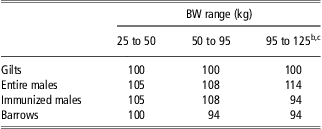
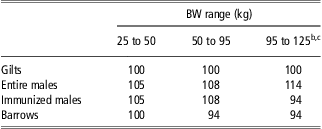
The temporal pattern of the hormonal, metabolic and feed intake responses after immunization would support the prolonged use of a boar diet for ∼2 weeks after secondary immunization, before reducing the dietary lysine content. Taken together, the following estimates of lysine requirements for entire and immunized males have been developed as a starting point (Table 2). These estimates are highly consistent with factorially derived estimates of lysine requirements of immunized males according to the NRC (2012). They have been developed with the aim of maximizing lean tissue gain and minimizing FCR.
Suggested dietary standardized ileal digestible SID lysine requirements (% of diet or g/unit of energy) in a three-phase feeding programme adapted to meet requirements for pigs from different gendersFootnote a (levels are expressed relative to those for gilts, %)
a See Figures 3 and 4 for a guide to requirements.
b Equivalent to 4 to 5 weeks between second injection and slaughter.
c Where possible may commence the immunized male feeding programme 1 week after the second immunization.
Effect of gender on energy requirements
The slope of the relationship between energy intake and protein deposition is steeper for entire males than for gilts or barrows (Campbell et al., Reference Campbell, Taverner and Curic1985; Quiniou et al., Reference Quiniou, Dourmad and Noblet1996; Dunshea et al., Reference Dunshea, King, Eason and Campbell1998; King et al., Reference King, Campbell, Smits, Morley, Ronnfeldt and Dunshea2004). Although older data suggest that, in finisher pigs, a plateau in protein deposition was achieved in all genders at an intake of around 33 to 42 MJ DE/day (Campbell et al., Reference Campbell, Taverner and Curic1985; Campbell and Taverner, Reference Campbell and Taverner1988), studies conducted with genetically improved pigs suggest that the plateau occurs at higher feed intakes or, in the case of elite entire males, not at all (Rao and McKracken Reference Rao and McKracken1992; Dunshea et al., Reference Dunshea, King, Eason and Campbell1998; King et al., Reference King, Campbell, Smits, Morley, Ronnfeldt and Dunshea2004).
The practical message from these studies is that in many lines of genetically improved entire male pigs, and many lines of genetically improved gilts and barrows, can often be fed ad libitum to maximize protein deposition without the pigs getting over fat. This is particularly so when it is realized that feed intake is generally lower under commercial conditions than it is in the individually housed pigs that have been used for many of these studies (Dunshea, Reference Dunshea2005). One implication from these findings is that the growth performance and rate of lean tissue deposition of the improved pig, regardless of gender, is vulnerable to any factors that reduce feed intake. The recommendations for feeding entire males are to maximize energy intake from weaning through until slaughter, and this will apply to pigs reared using immunization against GnRF, at least up until the second immunization.
After the second immunization, there is a dramatic increase in feed intake (Figure 3) with a resultant increase in daily gain, carcass weight and P2 back fat depth (see Table 1). However, according to a recent trial performed with different feeding levels after the second immunization, only ADG was reduced in restrictively fed immunized lean-type males when compared with ad libitum fed ones, whereas neither FCR nor carcass leanness were improved (Quiniou et al., Reference Quiniou, Monziols, Colin, Goues and Courboulay2012). Such results seem to indicate that after the second immunization, the plateau in protein deposition is still not reached in lean-type pigs even under increased feed intake.
Where a producer is paid on carcass weight, then they may choose to continue to feed ad libitum to maximize the effect on weight gain. In many markets, the increase in fatness is not an issue and may really be desirable especially since it may be associated with an increase in intramuscular fat (D'Souza et al., Reference D'Souza, Hennessy, Danby, McCauley and Mullan2000). These markets will be also those that can make use of the increase in carcass weight. If local directions for use allow it, some may wish to extend the slaughter age out to 8 weeks after immunization to maximize carcass weight without compromising boar taint compounds (Dunshea et al., Reference Dunshea, McCauley, Jackson, Long, Nugent, Simons, Walker and Hennessy2008). There needs to be research aimed at investigating the way in which the additional energy consumed by immunized boars can be converted to carcass and/or carcass lean to maximize the profitability in various markets. These strategies will clearly not be the same in all markets.
Conclusions
Recent data suggest that the dietary SID concentration that meets the requirement of entire males is higher (ca. 10%) than for gilts, and that the difference increases with BW, but it is important that this is verified and further quantified. Given that the penalty in growth performance for inadequate dietary lysine is greater in entire males than in gilts or barrows, it is important to ensure that dietary lysine requirements are met to obtain the maximum benefits of the entire male production phase in animals immunized against GnRF. It is also important that the temporal pattern of tissue deposition rates and feed intake be further explored to be incorporated into growth models to predict nutrient requirements over the second period of rapidly changing metabolism. Keeping in mind the increase in feed intake and decline in protein deposition, a substantial reduction in dietary lysine concentration should be possible over this period.
The existence of two metabolic phases potentially creates additional flexibility and opportunities for dietary manipulation to help producers meet specific production targets. A full understanding of nutritional requirements, and their interaction with management decisions on immunization timing and target slaughter weights, will be important to ensure that the benefits of immunization against GnRF can be optimized in all the markets where it will be available.
Acknowledgements
The authors acknowledge the financial support of Zoetis for the conduct of the meta-analyses and preparation of this manuscript.