Introduction
Schwannomas (also know as neurilemmomas and neurinomas) are benign, encapsulated tumours of neuroectodermal origin,Reference Pessey, Serrano and Percodani1 which arise from the nerve sheath.Reference Pessey, Serrano and Percodani1–Reference Verocay3 Most head and neck schwannomas involve the VIIth cranial nerve.Reference Putney, Morran and Thomas4 Facial nerve schwannomas are uncommon and slow-growing neoplasms, and only 9 per cent of cases are intraparotid.Reference Forton, Moeneclaey and Offeciers5 The incidence of all facial nerve neoplasms in parotid region tumours is estimated to be 0.2–1.5 per cent.Reference Sneige and Batsakis6
From the international literature, a detailed review of 79 cases has been conducted, describing the involvement of the various portions of the facial nerve, from the main trunk (including its intramastoid and intratemporal tract) to the peripheral branches. Determination of the extent of the tumour and the involvement of different branches of the facial nerve is very important in order to enable correct prognostic evaluation and appropriate therapeutic decision making. Based on these considerations, it may be important to have a classification, based on anatomical and pathological evaluation, which can supply information on facial functional outcomes.
In addition, we present the case of a 74-year-old woman with a long history of a right parotid mass and facial paresis.
Case report
A 74-year-old woman with a history of a right parotid mass presented to our ENT department complaining of three months' facial paresis (House–Brackmann grade II), local irritation and pain.
Physical examination revealed a 3 × 1 cm, non-tender, partially mobile mass located between the tragus and the mandibular angle. No cervical adenopathy was evident. There was no history of von Recklinghausen's disease in the patient or her family.
Magnetic resonance imaging (MRI) revealed a contrast-enhancing, intraparotid mass, which the radiologist described as a VIIth nerve neurinoma or, less likely, a pleomorphic adenoma. Fine needle aspiration cytology (FNAC) was inconclusive; it reported the presence of a small amount of bloody-serous material, with regularly structured salivar tissue.
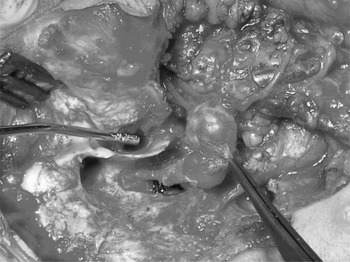
During the operation, a yellow-brown, apparently encapsulated neoplasm was seen, with a cystic component. It was 3 × 1 × 1 cm in size and extended from the intramastoid tract of the facial nerve to the divisions of the branches of the main trunk (Figure 1). The parotid gland was normal. The tumour was completely removed by superficial parotidectomy. Because of the extent of the intramastoid tract of the facial nerve, a mastoidectomy was performed. Dissection of the mass from the nerve was impossible, so the continuity of the VIIth nerve was interrupted to allow removal of the mass. The facial nerve was then repaired with a greater auricular nerve graft, using a proximal suture to the main trunk and distal sutures to the three branches exiting the mass (using nylon 9-0 sutures). The anastomosis was coated with venous material.
Intra-operative appearance of intraparotid facial nerve schwannoma after mastoidectomy, showing the intrapetrous extension and the three outgoing branches of the nerve.

The post-operative and follow-up course were uneventful.
Immediate post-operative facial function was House-Brackmann grade VI. Six months after the operation, the patient had achieved a grade V facial function.
Definitive histological examination confirmed the presence of normal parotid tissue fragments, and the radiological diagnosis of schwannoma.
Review and discussion
The first report on intraparotid facial nerve schwannoma was published by Ibarz in 1927,Reference Ibartz7 containing some pathologic findings but no other information about the patient, the symptoms or the therapy. About 20 years later, O'Keefe published the first complete case report.Reference O'Keefe2
From a review of the literature, 79 cases of intraparotid facial nerve schwannoma were located, and the following data compiled.
Sex, age and side
Facial nerve schwannoma occurred in both sexes with a similar prevalence (69 patients, 36 men and 33 women). The average age (for 63 patients) at diagnosis was 44.6 years; the timing of tumour appearance ranged from six months to 91 years. Of 40 patients, 18 tumours were found on the left side and 22 on the right side.
Signs and symptoms
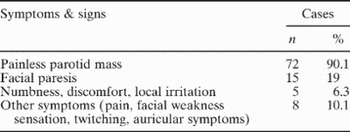
For the 79 patients (Table I), the usual presenting symptom of facial nerve schwannoma was a painless, slow-growing parotid mass, with normal VIIth nerve function (91.1 per cent). The mass appeared mobile, smooth and hard to the touch. Nineteen per cent of all cases had a pre-operative hemifacial paresis or paralysis; a hemifacial paresis could also be an initial symptom in tumours with an exclusively extratemporal location. In some other cases (6.3 per cent), patients reported discomfort in the parotid region. Other symptoms comprised facial twitching, facial pain and a sensation of facial weakness. Auricular symptoms were only present in patients with intratemporal involvement.
Symptoms and signs of intraparotid facial nerve schwannoma

Pathology
The tumour size in the parotid region (excluding multicentric neoplasms) varied from 1.5 to 6.5 cm (maximum diameter).
On macroscopic examination, the tumours showed a wide variety of colours (tan, reddish-tan, whitish-grey, yellow, yellow-pink and dark purple). They appeared as a translucent, well defined and circumscribed mass, with a smooth surface, although some cases were lobulate with broad, finger-like projections. Cystic degeneration was present in 11 tumours.
In some cases (6/57; 10.5 per cent), the facial nerve schwannoma presented in multiple locations.
On microscopic examination, the tumours showed two different growth patterns: (Reference Pessey, Serrano and Percodani1) the Antoni A pattern, with elongated cells and cytoplasmic processes arranged in fascicles in areas of high cellular density, little stromal matrix and Verocay bodies (acellular cores between nuclear palisading); and (Reference O'Keefe2) the Antoni B pattern, with lower cellularity and a loose meshwork of elongated cells, along with microcysts and myxoid changes.Reference Maly, Maly, Doviner, Reinartz and Sherman8
Our review located 3/79 malignant tumours (3.9 per cent),Reference Conley and Janecka9, Reference Hasan and Kazi10 with mitosis, pleomorphism and infiltration of salivary glands.Reference Hasan and Kazi10
Of 17 patients, FNAC established a diagnosis of schwannoma in only three (17.6 per cent). In the remaining cases, the diagnosis was inconclusive or, in two cases,Reference Caughey, May and Schaitkin11, Reference Balle and Greisen12 incorrect. Perhaps the characteristics of tumours of neurogenic origin, with firmly attached cells, made it difficult to obtain a positive cytological result.Reference Bretlau, Melchiors and Krogdahl13
Radiology
The radiological diagnosis was also difficult. Magnetic resonance imaging is the ‘gold standard’ for the study of the relationship between the facial nerve and its surrounding tissues.Reference Fisch-Ponsot, Sigal, Schmuntz, Dacher, Brazeau-Lamontagne and Marchand14, Reference Martin, Sterkers, Mompoint and Nahum15
Computed tomography scanning can assess enlargement of Fallopio's canal in its intramastoid tract. Without this extension, facial nerve schwannoma cannot be distinguished from other parotid neoplasms, especially pleomorphic adenomas.Reference Balle and Greisen12, Reference Fisch-Ponsot, Sigal, Schmuntz, Dacher, Brazeau-Lamontagne and Marchand14, Reference Martin, Sterkers, Mompoint and Nahum15
In conclusion, there are no definitive radiological findings for intraparotid schwannomas.
Localisation, therapy and facial outcomes
From the literature, two important characteristics of intraparotid facial nerve schwannoma emerged. Some tumours could be dissected from the facial nerve, preserving nerve integrity. However, others were tightly adherent to the nerve, requiring the surgeon to remove the tumour along with a variable length of facial nerve tract, followed by reconstruction.
Tightly adherent schwannomas could involve any portion of the facial nerve. Most exclusively involved the main trunk (16/46; 34.8 per cent) or a peripheral division (5/46; 10.8 per cent). In these cases, simple excision of the tumour, with reconstruction via an end-to-end anastomosis or a nerve graft, could give a good post-operative functional outcome. In other cases, the tumour involved a larger tract of the facial nerve (both the main trunk and the temporo-facial and cervico-facial divisions), and an extended operation was required, sacrificing the main branches. The subsequent reconstructive phase was difficult, with a poor functional outcome (Table II).
Intraparotid facial nerve schwannoma treatments reported

Anast = anastomosis
It is important to point out that, in cases in which the mass is asymptomatic, the cytological and radiological features are strongly indicative of schwannoma, and no facial deficit or aesthetic reasons are present, a conservative treatment (i.e. follow up alone) is recommended. This takes into account the risk to facial function should surgery be undertaken. However, it is important to note that, in most patients, the diagnosis of schwannoma is made intra-operatively; radiological and cytological methods assist identification in only a few cases.
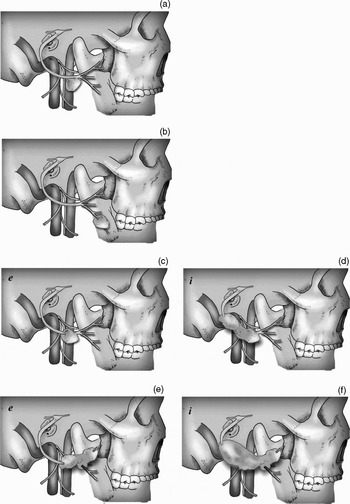
The following classification is proposed in order to describe all of the possible localisations and extents of facial nerve schwannoma, and to indicate the important prognostic and therapeutic implications of these characteristics (Figure 2).
Classification of intraparotid facial nerve schwannomas. (a) Type A: tumour is resectable without sacrifice of the facial nerve. (b) Type B: tumour is resectable only with partial sacrifice of the facial nerve, involving one of the peripheral branches or its distal divisions. (c) & (d) Type C: tumour is resectable only with sacrifice of the facial nerve involving the main trunk, with extratemporal extent (subtype e; (c)) or intra-extratemporal extent (subtype i; (d)). (e) & (f) Type D: tumour is resectable only with sacrifice of the facial nerve, involving the main trunk and at least one of the temporo-facial or cervico-facial branches, without intratemporal extent (subtype e; (e)) or with intratemporal extent (subtype i; (f)).

Proposed classification of intraparotid facial nerve schwannoma
We propose that intraparotid facial nerve schwannomas be classified as types A, B, C and D.
Type A tumours would comprise neoplasms resectable without sacrifice of the facial nerve. From the review, this would include 19/46 cases (41.3 per cent).Reference Maly, Maly, Doviner, Reinartz and Sherman8, Reference Conley and Janecka9, Reference Bretlau, Melchiors and Krogdahl13, Reference Chung, Ahn, Kim, Nam, Kim and Lee16–Reference Shah, Kantaria and Shenoy27
Type B tumours would be resectable only with partial sacrifice of the facial nerve, involving one of the peripheral branches or its distal divisions. From the review, this would include 5/46 cases (10.8 per cent).Reference Hasan and Kazi10, Reference Balle and Greisen12, Reference Aston and Sparks28–Reference Vellin, Mom, Kemeny, Essamet and Gilain31
Type C tumours would be resectable only with sacrifice of the main trunk of the facial nerve, with extratemporal extent (subtype e) or intra-extratemporal extent (subtype i). From the review, of 46 cases, 10 would be subtype e and six subtype i (34.7 per cent).Reference Conley and Janecka9, Reference Chung, Ahn, Kim, Nam, Kim and Lee16, Reference Ulku, Uyar, Acar, Yaman and Avunduk17, Reference Aston and Sparks28, Reference Wade32–Reference Avery and Sprinkle38
Type D tumours would be resectable only with sacrifice of the main trunk of the facial nerve and at least one of the temporo-facial or cervico-facial branches, either with (subtype i) or without (subtype e) intratemporal extent. From the review, of 46 cases, one would be subtype e, and five subtype i (13.0 per cent).Reference Caughey, May and Schaitkin11, Reference Chiang, Chang and Lou39–Reference O'Donoghue, Brackmann, House and Jackler41 Our case report would fall into this category.
Type A
From the literature review, we classified 19 cases as type A. In 14 of these, an exhaustive description of the post-operative grade of facial paralysis was available. Of these 14 patients: 13 had no pre-operative facial deficit; 11 completely recovered their facial function a few days after the operation (i.e. House–Brackmann grade I); and two had paralysis of House–Brackmann grades I and II, verified after two years of follow up. Only one patient presented with a pre-operative House–Brackmann grade IV paralysis, which persisted through two years of post-operative follow up. In all cases, the facial nerve was not resected.
Therefore, from the above, we can consider type A schwannomas to have a favourable prognosis for facial function. The nerve function is always preserved, and surgery to remove the tumour should not damage the VIIth nerve.
Type B
From the review, five patients had a type B neoplasm (5/46; 10.8 per cent). In one patient, reconstructive treatment was not reported. In all other cases, the sacrifice of a variable tract of the VIIth nerve was necessary. In one case, the subsequent reconstructive phase was carried out with a greater auricular nerve graft, and in another case with an end-to-end anastomosis. Both cases had good functional recovery in the post-operative period (although the House–Brackmann grade was not specified). In two other cases, no reconstructive phase was performed, and the nerve was not repaired; the authors did not supply any other information regarding post-operative recovery of facial function.
We believe that, in type B neoplasms, good recovery of facial function depends more on the functional importance of the branch involved than on the reconstructive procedures. Therefore, this is probably the most variable type in our classification of functional outcomes.
Type C
Sixteen review patients presented with type C facial nerve schwannomas. In three cases, the authors did not describe the reconstructive treatment used. In the remaining cases, the authors proceeded by removing the tumour along with a tract of the nerve. The continuity of the nerve was restored in seven cases by a greater auricular nerve graft, with fair post-operative functional recovery (House–Brackmann grade II–IV in four cases; no grade reported in three cases).
In two cases out of the remaining six, the continuity of the facial nerve was not restored.
In the last four cases, reconstructive treatment was carried out by an end-to-end anastomosis in two patients and by facial–hypoglossal anastomosis in another two patients, with overall outcomes described as satisfactory during follow up (the House–Brackmann grade was not reported).
Type D
Six review patients presented with type D facial nerve schwannomas. In all these cases, both the main trunk and the principal branches of the facial nerve had to be interrupted to allow removal of the neoplasm, and only in three cases did the authors proceed to reconstruction with a nerve graft (using a greater auricular nerve graft in two cases and a sural nerve graft in one case). In three cases, reconstructive treatment was not carried out. Even those patients with restoration of facial nerve continuity had compromised post-operative facial function (House–Brackmann grades V–VI).
From the above, we can see that type D tumours are treated by extended resection of the facial nerve, which requires a more difficult reconstructive phase, employing a nerve graft that does not often give acceptable recovery of facial function.
In 11 review patients with a type C or D tumour, the facial nerve schwannoma had an intramastoid extension. In these cases, a mastoidectomy was required to isolate and remove all neoplastic tissue.
Tumour follow up
In the literature, three cases of distant metastases and local malignant recurrence were reported.
In two malignant tumoursReference Conley and Janecka9 spreading into all regional tissues, late involvement of the skull base and haematogenous metastatic dissemination were observed. In the third case, no local or distant recurrence occurred after two years of follow up.Reference Hasan and Kazi10
Conclusions
Intraparotid facial nerve schwannomas are rare and unsuspected neoplasms, comprising only 0.2–1.5 per cent of all facial nerve neoplasms. Radiological findings are not always definitive and FNAC is often not diagnostic. As a result, pre-operative diagnosis can prove difficult or incorrect, and multidisciplinary collaboration with the ENT surgeon, cytologist and radiologist is often necessary.
The treatment and outcomes strictly depend on the characteristics and extent of the tumour. In type A tumours, the facial nerve can be completely preserved, allowing excellent post-operative facial function.
Tumours with tight adhesion to the nerve must be removed, involving sacrifice of a section of facial nerve, and reconstruction should then be carried out. In these cases, the difficulty of facial nerve reconstruction will depend on the extent of the tumour. In type B or C tumours, the VIIth nerve can be repaired by end-to-end anastomosis or a greater auricular nerve graft; in these cases, post-operative function recovery will be fair (House–Brackmann grade III–IV). Type D, tightly adherent tumours with involvement of the main trunk and at least one of the cervico-facial or temporo-facial divisions require wide resection of the facial nerve. The reconstructive phase is more difficult, and significant post-operative functional sequelae ensue (House–Brackmann grade V–VI).