Introduction
Most persons with dementia, regardless of disease etiology or stage, will experience neuropsychiatric symptoms (NPS; Lyketsos et al., Reference Lyketsos2011). Also referred to as behavioral symptoms or behavioral and psychological symptoms of dementia (BPSD), NPS include a wide range of behaviors that appear to cluster into five domains: depression, agitation, aggression, apathy, and psychosis (McShane, Reference McShane2000). Other behavioral symptoms are also common although their phenotype is not well-delineated or understood. Behaviors such as sleep disturbances, anxiety, rejection of care, wandering, ingestion of dangerous objects, and repetitive questioning overlap with but also are distinguished from NPS clusters, and often present as the most challenging and distressful to families (Gitlin et al., Reference Gitlin, Winter, Dennis and Hauck2007; Volicer et al., Reference Volicer, Bass and Luther2007; Gitlin et al., Reference Gitlin, Winter, Dennis, Hodgson and Hauck2010; Volicer et al., Reference Volicer, van der Steen and Frijters2013).
NPS can have dire consequences. For people with dementia, untreated symptoms are associated with poor quality of life (Karttunen et al., Reference Karttunen2011), premature nursing home placement (Chan et al., Reference Chan, Kasper, Black and Rabins2003), higher healthcare utilization and costs (Murman et al., Reference Murman, Chen, Powell, Kuo, Bradley and Colenda2002), and more rapid disease progression (Rabins et al., Reference Rabins2013). Similarly, for informal caregivers, behavioral symptoms are associated with negative health and psychosocial consequences (Brodaty and Arasaratnam, Reference Brodaty and Arasaratnam2012) including increased caregiver depression and burden (Okura and Langa, Reference Okura and Langa2010). For formal providers, caring for persons with behavioral symptoms is associated with higher job dissatisfaction and burnout (Brodaty et al., Reference Brodaty, Draper and Low2003; Miyamoto et al., Reference Miyamoto, Tachimori and Ito2010).
Despite the immense clinical and public health sequelae of NPS, behaviors typically remain unidentified and therefore untreated in clinical settings. This may be due in part to the lack of understanding by health professionals of the importance of monitoring behavioral symptoms in dementia care and that adequate assessment tools for detection of behaviors exist (Gitlin et al., Reference Gitlin, Kales and Lyketsos2012; Kales et al., Reference Kales, Gitlin and Lyketsos2014). The first step in managing NPS is detecting their occurrences (Gitlin et al., Reference Gitlin, Kales and Lyketsos2012; Kales et al., Reference Kales, Gitlin and Lyketsos2014). The Physician Consortium for Performance Improvement (PCPI) recommends that people with dementia be assessed for occurrences of behavioral symptoms in physician practices on a yearly basis at a minimum and that reliable and validated instruments be used (Odenheimer et al., Reference Odenheimer2013). It is unclear however the extent to which this recommendation is practiced. Also, there are no guidelines as to what measures to use, or how behaviors should be assessed and by whom, particularly for people with dementia who live in the community. Typically, behavioral symptoms are brought to the attention of physicians or health professionals by concerned family members or other healthcare providers either following a behavioral event or when troublesome behaviors persistently disrupt care or compromise patient or family safety. This is in contrast to systematic and on-going assessment for detection of behaviors as recommended by PCPI.
To help close the gap between recommended and current practices as it pertains to the assessment of behavioral symptoms, we conducted a systematic review of existing, psychometrically sound measures of NPS. Previous reviews of measures are limited in that they targeted specific health professionals (e.g. nurses; Neville and Byrne, Reference Neville and Byrne2001), were not systematic in their approach (Conn and Thorpe, Reference Conn and Thorpe2007), reviewed a subset of scales (Jeon et al., Reference Jeon2011), or need to be updated (Cummings, Reference Cummings1996). In this review, we sought to be comprehensive and include all identified scales available in English that had been developed and/or tested with dementia populations and which had demonstrated psychometric adequacy. Our primary purpose is to evaluate the state of measurement in this area and compare characteristics of measures. Also, we identify measurement gaps that require future research, which, if pursued, could improve clinical practice.
Methods
Search procedure
A comprehensive computerized search of peer-reviewed published studies (January 1, 1980–December 1, 2013) was conducted in PubMed, CINAHL, CINAHL Plus, PsychInfo, Medline, and Mental Measurement Yearbook using the following search terms: neuropsychological tests, neuropsychological measurements, dementia, Alzheimer's disease, behavior, delusions, hallucinations, agitation, aggression, depression, anxiety, eating, euphoria, apathy, disinhibition, irritability, motor disturbance, sleep, and vocalizations. Additionally, a search of review papers and meta-analyses of neuropsychological measures was completed and the reference section cross-checked with the original search. Papers identified through this process were further searched for additional references to measures. All titles and abstracts of papers were reviewed independently by three trained coders (KAM, IHS, and BRH) who then met among themselves and the primary author to reconcile differences. Measures were selected with the following criteria: (a) published and available in English; (b) developed for or tested in people with dementia; (c) a sample size was reported for the testing of the measure; and (d) one or more psychometric properties were reported.
Measures were reviewed for seven characteristics: behavioral domains included in the measure, number of items, method of administration (e.g. self-report, observation), response categories used, targeted population, setting (e.g. nursing homes, hospitals), and psychometric properties (e.g. reported reliability, validity, sensitivity to change).
Results
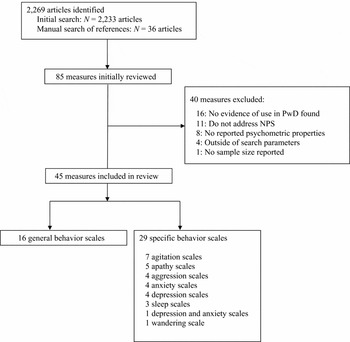
The initial search yielded 2,233 papers. Through manual searches of these papers, an additional 36 papers were identified (see Figure 1). Among these 2,269 papers, 85 measures were identified, of which 45 (45/85; 52.9%) were included in this review as they had adequate psychometric properties and had been developed for and/or used with people with dementia (Tables 1 and 2). Measures developed for other populations (e.g. hospital patients) but for which there was evidence of use with persons with dementia were included.
Search flowchart. PwD = Person with dementia.

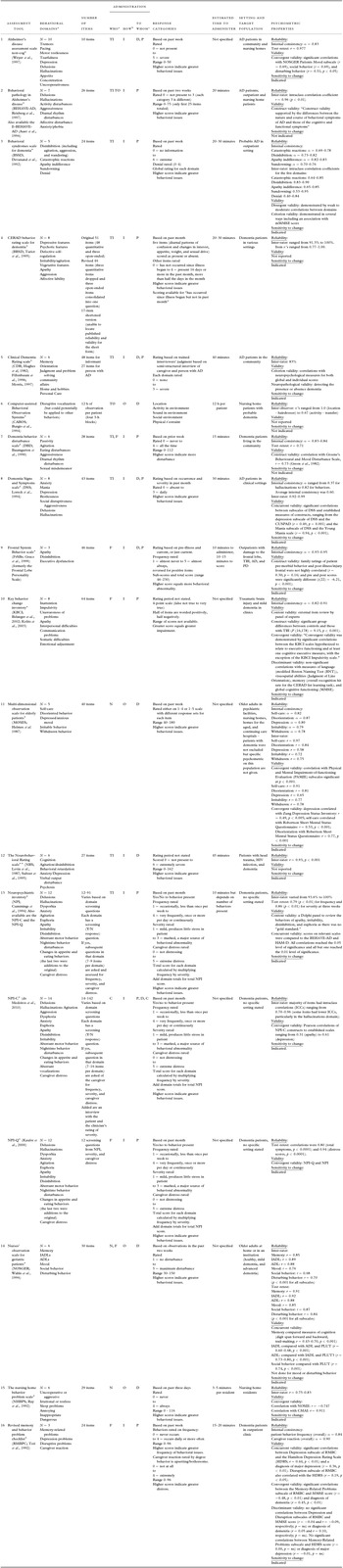
Summary of general measures of neuropsychiatric symptoms for persons with dementia (n = 16)

aThe Behavioral Domain column lists area using the labeling of behaviors as reported within the cited paper.
bN = nurse; F = family caregiver; TI = trained interviewer; TO = trained observer; C = clinician.
cO = observation; I = interview.
dD = person with dementia; P = proxy respondent; C = clinician.
*Scale developed for use in persons with dementia.
**Scale developed for use in a population other than dementia, tested to be reliable and valid in persons with dementia.
***Scale developed for use in general population, used in dementia population but psychometrics untested or inconsistent results.
α = Cronbach's alpha.
BEHAVE-AD = Behavioral Pathology in Alzheimer's Disease.
BRSD = CERAD Behavior Rating Scale for Dementia.
BSSD = Behavioral Syndromes Scale for Dementia.
CABOS = Computer Assisted Behavioral Observation Systems.
CDR = Clinical Dementia Rating Scale.
DBD = Dementia Behavior Disturbance Scale.
DSS = Dementia Signs and Symptoms Scale.
FrSBe = Frontal System Behavioral Scale.
KBCI = Key Behavior Change Inventory.
MOSES = Multidimensional Observation Scale for Elderly Subjects.
NHBPS = The Nursing Home Behavior Problem Scale.
NOSGER = Nurses’ Observation Scale for Geriatric Patients.
NPI = Neuropsychiatric Inventory.
NPI-C = Neuropsychiatric Inventory – Clinician.
NPI-Q = Neuropsychiatric Inventory – Questionnaire.
NRS = The Neurobehavioral Rating Scale.
RMBPC = Revised Memory and Behavior Problem Checklist.
Summary of specific measures of behaviors to assess neuropsychiatric symptoms in persons with dementia (N = 29)

aN = nurse; F = family caregiver; TI = trained interviewer; TO = trained observer; C = clinician; D = person with dementia.
bO = observation; I = interview, CR = chart review.
cD = person with dementia; P = proxy respondent; C = clinician.
*Scale developed for use in persons with dementia.
**Scale developed for use in a population other than dementia, tested to be reliable and valid in persons with dementia.
***Scale developed for use in general population, used in dementia population but psychometrics untested or inconsistent results.
α = Cronbach's alpha.
ABID = Agitated Behavior in Dementia Scale.
ABS = Aggressive Behavior Scale.
ADL = Activities of Daily Living.
AES–C = Apathy Evaluation Scale–Clinician.
AES–I = Apathy Evaluation Scale–Informant.
AES–S = Apathy Evaluation Scale–Self.
AES = Apathy Evaluation Scale.
AWS = Algase Wandering Scale.
V2 = version 2.
BAI = Beck Anxiety Inventory.
BARS = Brief Agitation Rating Scale.
BDI = Beck Depression Inventory.
CCL–A = Cognition Checklist for Anxiety.
CCL–D = Cognition Checklist for Depression.
CMAI = Cohen Mansfield Agitation Inventory.
CSDD = Cornell Scale for Depression in Dementia.
DAIR = Dementia Apathy Interview and Rating Scale.
DBRS = Disruptive Behavior Rating Scales.
DMAS = The Dementia Mood Assessment Scale.
DSM-IV-TR = Diagnostic and Statistical Manual of Mental Disorders IV.
ESS = Epworth Sleepiness Scale.
GAI = Geriatric Anxiety Inventory.
GDS = Geriatric Depression Scale.
HADS = Hospital Anxiety and Depression Scale.
HAM-A = Hamilton Rating Scale for Anxiety.
HAM-D = Hamilton Rating Scale for Depression.
HD = Huntington's Disease.
IADL = Instrumental Activities of Daily Living.
IA = Apathy Inventory.
IAS = Irritability Apathy Scale.
LARS = Lille Apathy Rating Scale.
MCI = Mild Cognitive Impairment.
MDS = Minimum Data Set.
mMMSE = Modified Mini-Mental Status Exam.
MOAS = Modified Overt Aggression Scale.
NOISE = Nurse Oriented Scale for Inpatient Evaluation.
OAS = Overt Aggression Scale.
OASS = Overt Agitation Severity Scale.
PANSS = Positive and Negative Symptom Scale.
PAS = Pittsburgh Agitation Scale.
PD = Parkinson's Disease.
PHQ-9 = Patient Health Questionnaire–9.
PLUT = Plutchik Scale.
PSQI = Pittsburgh Sleep Quality Index.
RAGE = Rating Scale for Aggressive Behavior in the Elderly.
RAID = Rating Anxiety in Dementia.
RAS = Ryden Aggression Scale.
SANS = Scale for the Assessment of Negative Symptoms.
SDI = The Sleep Disorders Inventory.
SF–20 = 20-item Short Form Survey.
SOAPD = Scale to Assess Observed Agitation in Persons with Dementia of the Alzheimer Type.
TBI = Traumatic Brain Injury.
Of 40 measures not included in the review, 16 (40.0%) were excluded because there was insufficient evidence of their use in people with dementia. Eleven (27.5%) measures did not address neuropsychiatric behaviors; eight (20.0%) measures did not report psychometric properties; and one (2.5%) did not report a sample size. Additionally, despite placing limits on the search, four (10.0%) measures were initially identified but upon further inspection were determined to be outside of our search parameters (e.g. published before 1980).
Behaviors
We categorized measures as either general that included a wide range of behavioral domains, or as specific, in which a particular behavioral domain was targeted. Of 45 measures, 16 (35.6%) were general in which the number of behavioral domains for any one measure varied from 1 to 14 (Table 1). There was no consistency across measures as to the specific domains or behavioral items included. Some measures also addressed behaviors that did not reflect NPS such as items related to self care (Helmes et al. Reference Helmes, Csapo and Short1987; Wahle et al., Reference Wahle, Häller and Spiegel1996).
Of 45 measures, most (n = 29, 64.4%) targeted a specific NPS (Table 2). Measures were identified for eight specific behavioral domains: agitation representing the most number of measures of the specific type (n = 7, 24.1%; Cohen-Mansfield et al., Reference Cohen-Mansfield, Marx and Rosenthal1989; Mungas et al., Reference Mungas, Weiler, Franzi and Henry1989; Finkel et al., Reference Finkel, Lyons and Anderson1993; Rosen et al., Reference Rosen1994; Yudofsky et al., Reference Yudofsky, Kopecky, Silver and Endicott1997; Hurley et al., Reference Hurley1999; Logsdon et al., Reference Logsdon1999), followed by apathy (n = 5, 17.2%; Burns et al., Reference Burns, Folstein, Brandt and Folstein1990; Marin et al., Reference Marin, Biedrzycki and Firinciogullari1991; Robert et al., Reference Robert2002; Strauss and Sperry, Reference Strauss and Sperry2002; Sockeel et al., Reference Sockeel, Dujardin, Devos, Deneve, Destee and Defebvre2006), aggression (n = 4, 13.8%; Yudofsky et al., Reference Yudofsky, Silver, Jackson, Endicott and Williams1986; Ryden, Reference Ryden1988; Patel and Hope, Reference Patel and Hope1992; Perlman and Hirdes, Reference Perlman and Hirdes2008), anxiety (n = 4, 13.8%; Beck et al., Reference Beck, Epstein, Brown and Steer1988; LaBarge, Reference LaBarge1993; Shankar et al., Reference Shankar, Walker, Frost and Orrell1999; Pachana et al., Reference Pachana, Byrne, Siddle, Koloski, Harley and Arnold2007), depression (n = 4, 13.8%; Yesavage et al., Reference Yesavage1983; Alexopoulos et al., Reference Alexopoulos, Abrams, Young and Shamoian1988; Sunderland et al., Reference Sunderland1988; Kroenke et al., Reference Kroenke, Spitzer and Williams2001), sleep (n = 3, 10.3%; Buysse et al., Reference Buysse, Reynolds, Monk, Berman and Kupfer1989; Johns, Reference Johns1991; Tractenberg et al., Reference Tractenberg, Singer, Cummings and Thai2003), depression and anxiety (n = 1, 3.4%; Zigmond and Snaith, Reference Zigmond and Snaith1983), and wandering (n = 1, 3.4%; Algase et al., Reference Algase, Beattie, Bogue and Yao2001; Table 2). No measures were identified that specifically targeted euphoria, delusions, hallucinations, irritability apart from aggression or anxiety, or motor and verbal disturbances.
Number of items
Across all 45 measures, the number of items was highly variable, ranging from 3 to a potential of 142 (Tables 1 and 2). For general measures, the number of items ranged from 10 (Weyer et al., Reference Weyer, Erzigkeit, Kanowski, Ihl and Hadler1997) to 142 (Cummings et al., Reference Cummings1994). The latter – the Neuropsychiatric Inventory (NPI-C) – was comprised of 14 behavioral domains (delusions, hallucinations, agitation, aggression, dysphoria, anxiety, euphoria, apathy, disinhibition, irritability, aberrant motor behavior, nighttime behavior disturbances, changes in appetite and eating behaviors, and aberrant vocalizations). Each domain in the NPI-C had a yes/no screening question with potential follow-up questions (ranging from 7 to 16 items) that specify different possible behaviors of that domain.
For targeted measures, the number of items was also highly variable ranging from 3 (Robert et al., Reference Robert2002) to 38 (Algase et al., Reference Algase, Beattie, Song, Milke, Duffield and Cowan2004).
Method of administration
We examined who administered measures and format of ascertainment. Of 45 measures, 14 (31.1%) were administered by an interviewer trained in that measure (Hughes et al., Reference Hughes, Berg, Danziger, Coben and Martin1982; Yesavage et al., Reference Yesavage1983; Sunderland et al., Reference Sunderland1988; Buysse et al., Reference Buysse, Reynolds, Monk, Berman and Kupfer1989; Johns, Reference Johns1991; Devanand et al., Reference Devanand1992; Cummings et al., Reference Cummings1994; Loreck et al., Reference Loreck, Bylsma and Folstein1994; Sultzer et al., Reference Sultzer, Berisford and Gunay1995; Tariot et al., Reference Tariot1995; Reisberg et al., Reference Reisberg, Auer and Monteiro1997; Weyer et al., Reference Weyer, Erzigkeit, Kanowski, Ihl and Hadler1997; Strauss and Sperry, Reference Strauss and Sperry2002; Tractenberg et al., Reference Tractenberg, Singer, Cummings and Thai2003). Some measures were administered by nurses (n = 6, 13.3%; Yudofsky et al., Reference Yudofsky, Silver, Jackson, Endicott and Williams1986; Helmes et al., Reference Helmes, Csapo and Short1987; Patel and Hope, Reference Patel and Hope1992; Ray et al., Reference Ray, Taylor, Lichtenstein and Meador1992; Finkel et al., Reference Finkel, Lyons and Anderson1993; Rosen et al., Reference Rosen1994), clinicians (n = 5, 11.1%; Alexopoulos et al., Reference Alexopoulos, Abrams, Young and Shamoian1988; Burns et al., Reference Burns, Folstein, Brandt and Folstein1990; Shankar et al., Reference Shankar, Walker, Frost and Orrell1999; Robert et al., Reference Robert2002; Sockeel et al., Reference Sockeel, Dujardin, Devos, Deneve, Destee and Defebvre2006), or by trained observers (n = 4, 8.9%; Burgio et al., Reference Burgio1994; Yudofsky et al., Reference Yudofsky, Kopecky, Silver and Endicott1997; Hurley et al., Reference Hurley1999; Perlman and Hirdes, Reference Perlman and Hirdes2008). Several of the measures used self-administration by family caregivers (n = 3, 6.7%; Teri et al., Reference Teri, Truax, Logsdon, Uomoto, Zarit and Vitaliano1992; Grace et al., Reference Grace, Stout and Malloy1999; Kolitz et al., Reference Kolitz, Vanderploeg and Curtiss2003) or the person with dementia (n = 3, 6.7%; Zigmond and Snaith, Reference Zigmond and Snaith1983; Beck et al., Reference Beck, Epstein, Brown and Steer1988; LaBarge, Reference LaBarge1993). Ten (22.2%) measures were designed to be administered by more than one person (Ryden, Reference Ryden1988; Cohen-Mansfield et al., Reference Cohen-Mansfield, Marx and Rosenthal1989; Mungas et al., Reference Mungas, Weiler, Franzi and Henry1989; Baumgarten et al., Reference Baumgarten, Becker and Gauthier1990; Marin et al., Reference Marin, Biedrzycki and Firinciogullari1991; Wahle et al., Reference Wahle, Häller and Spiegel1996; Logsdon et al., Reference Logsdon1999; Algase et al., Reference Algase, Beattie, Bogue and Yao2001; Kroenke et al., Reference Kroenke, Spitzer and Williams2001; Pachana et al., Reference Pachana, Byrne, Siddle, Koloski, Harley and Arnold2007).
Most measures (n = 30, 66.7%) were in interview format (Hughes et al., Reference Hughes, Berg, Danziger, Coben and Martin1982; Yesavage et al., Reference Yesavage1983; Zigmond and Snaith, Reference Zigmond and Snaith1983; Alexopoulos et al., Reference Alexopoulos, Abrams, Young and Shamoian1988; Beck et al., Reference Beck, Epstein, Brown and Steer1988; Ryden, Reference Ryden1988; Buysse et al., Reference Buysse, Reynolds, Monk, Berman and Kupfer1989; Cohen-Mansfield et al., Reference Cohen-Mansfield, Marx and Rosenthal1989; Baumgarten et al., Reference Baumgarten, Becker and Gauthier1990; Burns et al., Reference Burns, Folstein, Brandt and Folstein1990; Johns, Reference Johns1991; Marin et al., Reference Marin, Biedrzycki and Firinciogullari1991; Devanand et al., Reference Devanand1992; Teri et al., Reference Teri, Truax, Logsdon, Uomoto, Zarit and Vitaliano1992; LaBarge, Reference LaBarge1993; Cummings et al., Reference Cummings1994; Loreck et al., Reference Loreck, Bylsma and Folstein1994; Sultzer et al., Reference Sultzer, Berisford and Gunay1995; Tariot et al., Reference Tariot1995; Reisberg et al., Reference Reisberg, Auer and Monteiro1997; Weyer et al., Reference Weyer, Erzigkeit, Kanowski, Ihl and Hadler1997; Grace et al., Reference Grace, Stout and Malloy1999; Logsdon et al., Reference Logsdon1999; Kroenke et al., Reference Kroenke, Spitzer and Williams2001; Robert et al., Reference Robert2002; Strauss and Sperry, Reference Strauss and Sperry2002; Kolitz et al., Reference Kolitz, Vanderploeg and Curtiss2003; Tractenberg et al., Reference Tractenberg, Singer, Cummings and Thai2003; Sockeel et al., Reference Sockeel, Dujardin, Devos, Deneve, Destee and Defebvre2006; Pachana et al., Reference Pachana, Byrne, Siddle, Koloski, Harley and Arnold2007), whereas 11 (24.4%) used direct observation (Yudofsky et al., Reference Yudofsky, Silver, Jackson, Endicott and Williams1986; Helmes et al., Reference Helmes, Csapo and Short1987; Patel and Hope, Reference Patel and Hope1992; Ray et al., Reference Ray, Taylor, Lichtenstein and Meador1992; Finkel et al., Reference Finkel, Lyons and Anderson1993; Burgio et al., Reference Burgio1994; Rosen et al., Reference Rosen1994; Wahle et al., Reference Wahle, Häller and Spiegel1996; Yudofsky et al., Reference Yudofsky, Kopecky, Silver and Endicott1997; Hurley et al., Reference Hurley1999; Algase et al., Reference Algase, Beattie, Bogue and Yao2001), and one (2.2%) used chart review (Perlman and Hirdes, Reference Perlman and Hirdes2008). Three (6.7%) measures utilized two different formats of administration such as interview and chart extraction (Sunderland et al., Reference Sunderland1988; Mungas et al., Reference Mungas, Weiler, Franzi and Henry1989; Shankar et al., Reference Shankar, Walker, Frost and Orrell1999).
For each scale, we also examined who provided the behavioral information. Over half of the scales were administered directly only to the person with dementia (n = 24, 53.3%; Yesavage et al., Reference Yesavage1983; Zigmond and Snaith, Reference Zigmond and Snaith1983; Yudofsky et al., Reference Yudofsky, Silver, Jackson, Endicott and Williams1986; Helmes et al., Reference Helmes, Csapo and Short1987; Beck et al., Reference Beck, Epstein, Brown and Steer1988; Sunderland et al., Reference Sunderland1988; Buysse et al., Reference Buysse, Reynolds, Monk, Berman and Kupfer1989; Mungas et al., Reference Mungas, Weiler, Franzi and Henry1989; Marin et al., Reference Marin, Biedrzycki and Firinciogullari1991; Patel and Hope, Reference Patel and Hope1992; Ray et al., Reference Ray, Taylor, Lichtenstein and Meador1992; Finkel et al., Reference Finkel, Lyons and Anderson1993; LaBarge, Reference LaBarge1993; Burgio et al., Reference Burgio1994; Rosen et al., Reference Rosen1994; Sultzer et al., Reference Sultzer, Berisford and Gunay1995; Wahle et al., Reference Wahle, Häller and Spiegel1996; Yudofsky et al., Reference Yudofsky, Kopecky, Silver and Endicott1997; Hurley et al., Reference Hurley1999; Algase et al., Reference Algase, Beattie, Bogue and Yao2001; Kroenke et al., Reference Kroenke, Spitzer and Williams2001; Sockeel et al., Reference Sockeel, Dujardin, Devos, Deneve, Destee and Defebvre2006; Pachana et al., Reference Pachana, Byrne, Siddle, Koloski, Harley and Arnold2007; Perlman and Hirdes, Reference Perlman and Hirdes2008), whereas 12 (26.7%) relied only upon proxy report (Cohen-Mansfield et al., Reference Cohen-Mansfield, Marx and Rosenthal1989; Baumgarten et al., Reference Baumgarten, Becker and Gauthier1990; Burns et al., Reference Burns, Folstein, Brandt and Folstein1990; Devanand et al., Reference Devanand1992; Teri et al., Reference Teri, Truax, Logsdon, Uomoto, Zarit and Vitaliano1992; Cummings et al., Reference Cummings1994; Tariot et al., Reference Tariot1995; Reisberg et al., Reference Reisberg, Auer and Monteiro1997; Logsdon et al., Reference Logsdon1999; Strauss and Sperry, Reference Strauss and Sperry2002; Kolitz et al., Reference Kolitz, Vanderploeg and Curtiss2003; Tractenberg et al., Reference Tractenberg, Singer, Cummings and Thai2003), and nine (20.0%) were administered to both the person with dementia and a proxy (Hughes et al., Reference Hughes, Berg, Danziger, Coben and Martin1982; Alexopoulos et al., Reference Alexopoulos, Abrams, Young and Shamoian1988; Ryden, Reference Ryden1988; Johns, Reference Johns1991; Loreck et al., Reference Loreck, Bylsma and Folstein1994; Weyer et al., Reference Weyer, Erzigkeit, Kanowski, Ihl and Hadler1997; Grace et al., Reference Grace, Stout and Malloy1999; Shankar et al., Reference Shankar, Walker, Frost and Orrell1999; Robert et al., Reference Robert2002).
Among the general measures (n = 16), most were administered by trained interviewers (n = 8, 50.0%), of which only the clinical version of the NPI (NPI-C) was designed to be completed by a clinically trained individual (Hughes et al., Reference Hughes, Berg, Danziger, Coben and Martin1982; Devanand et al., Reference Devanand1992; Cummings et al., Reference Cummings1994; Loreck et al., Reference Loreck, Bylsma and Folstein1994; Sultzer et al., Reference Sultzer, Berisford and Gunay1995; Tariot et al., Reference Tariot1995; Reisberg et al., Reference Reisberg, Auer and Monteiro1997; Weyer et al., Reference Weyer, Erzigkeit, Kanowski, Ihl and Hadler1997). Three (18.8%) of the general measures were for self-administration by families (Teri et al., Reference Teri, Truax, Logsdon, Uomoto, Zarit and Vitaliano1992; Grace et al., Reference Grace, Stout and Malloy1999; Kolitz et al., Reference Kolitz, Vanderploeg and Curtiss2003), two (12.5%) were for nurses to complete (Helmes et al., Reference Helmes, Csapo and Short1987; Ray et al., Reference Ray, Taylor, Lichtenstein and Meador1992) and one (6.3%) was designed for administration by a trained observer (Burgio et al., Reference Burgio1994). Two (12.5%) could be administered by multiple persons including a trained interviewer or nurse or a family caregiver (Baumgarten et al., Reference Baumgarten, Becker and Gauthier1990; Wahle et al., Reference Wahle, Häller and Spiegel1996). Twelve (75.0%) of the general scales were in an interview format (Hughes et al., Reference Hughes, Berg, Danziger, Coben and Martin1982; Baumgarten et al., Reference Baumgarten, Becker and Gauthier1990; Devanand et al., Reference Devanand1992; Teri et al., Reference Teri, Truax, Logsdon, Uomoto, Zarit and Vitaliano1992; Cummings et al., Reference Cummings1994; Loreck et al., Reference Loreck, Bylsma and Folstein1994; Sultzer et al., Reference Sultzer, Berisford and Gunay1995; Tariot et al., Reference Tariot1995; Reisberg et al., Reference Reisberg, Auer and Monteiro1997; Weyer et al., Reference Weyer, Erzigkeit, Kanowski, Ihl and Hadler1997; Grace et al., Reference Grace, Stout and Malloy1999; Kolitz et al., Reference Kolitz, Vanderploeg and Curtiss2003) and the remaining four (25.0%) relied on observation (Helmes et al., Reference Helmes, Csapo and Short1987; Ray et al., Reference Ray, Taylor, Lichtenstein and Meador1992; Burgio et al., Reference Burgio1994; Wahle et al., Reference Wahle, Häller and Spiegel1996).
Four (25.0%) of the general measures asked both a proxy and the person with dementia to provide information (Hughes et al., Reference Hughes, Berg, Danziger, Coben and Martin1982; Loreck et al., Reference Loreck, Bylsma and Folstein1994; Weyer et al., Reference Weyer, Erzigkeit, Kanowski, Ihl and Hadler1997; Grace et al., Reference Grace, Stout and Malloy1999), seven (43.8%) relied on proxy response only (Baumgarten et al., Reference Baumgarten, Becker and Gauthier1990; Devanand et al., Reference Devanand1992; Teri et al., Reference Teri, Truax, Logsdon, Uomoto, Zarit and Vitaliano1992; Cummings et al., Reference Cummings1994; Tariot et al., Reference Tariot1995; Reisberg et al., Reference Reisberg, Auer and Monteiro1997; Kolitz et al., Reference Kolitz, Vanderploeg and Curtiss2003) and five (31.3%) were data provided by the person with dementia (Helmes et al., Reference Helmes, Csapo and Short1987; Ray et al., Reference Ray, Taylor, Lichtenstein and Meador1992; Burgio et al., Reference Burgio1994; Sultzer et al., Reference Sultzer, Berisford and Gunay1995; Wahle et al., Reference Wahle, Häller and Spiegel1996). Of these five, four were observation and only one, the Neurobehavioral Rating Scale (NRS; Levin et al., Reference Levin1987; Sultzer et al., Reference Sultzer, Berisford and Gunay1995), was an interview format directed only towards the person with dementia.
Among the behavior-specific measures (n = 29), six (20.7%) were administered by a trained interviewer (Yesavage et al., Reference Yesavage1983; Sunderland et al., Reference Sunderland1988; Buysse et al., Reference Buysse, Reynolds, Monk, Berman and Kupfer1989; Johns, Reference Johns1991; Strauss and Sperry, Reference Strauss and Sperry2002; Tractenberg et al., Reference Tractenberg, Singer, Cummings and Thai2003), four (13.8%) by a nurse (Yudofsky et al., Reference Yudofsky, Silver, Jackson, Endicott and Williams1986; Patel and Hope, Reference Patel and Hope1992; Finkel et al., Reference Finkel, Lyons and Anderson1993; Rosen et al., Reference Rosen1994), five (17.2%) by a clinician (Alexopoulos et al., Reference Alexopoulos, Abrams, Young and Shamoian1988; Burns et al., Reference Burns, Folstein, Brandt and Folstein1990; Shankar et al., Reference Shankar, Walker, Frost and Orrell1999; Robert et al., Reference Robert2002; Sockeel et al., Reference Sockeel, Dujardin, Devos, Deneve, Destee and Defebvre2006), three (10.3%) addressed the person with dementia directly (Zigmond and Snaith, Reference Zigmond and Snaith1983; Beck et al., Reference Beck, Epstein, Brown and Steer1988; LaBarge, Reference LaBarge1993), and trained observers were used by three (10.3%) of the behavior-specific measures (Yudofsky et al., Reference Yudofsky, Kopecky, Silver and Endicott1997; Hurley et al., Reference Hurley1999; Perlman and Hirdes, Reference Perlman and Hirdes2008). Eight (27.6%) of these measures could be completed by multiple people (Ryden, Reference Ryden1988; Cohen-Mansfield et al., Reference Cohen-Mansfield, Marx and Rosenthal1989; Mungas et al., Reference Mungas, Weiler, Franzi and Henry1989; Marin et al., Reference Marin, Biedrzycki and Firinciogullari1991; Logsdon et al., Reference Logsdon1999; Algase et al., Reference Algase, Beattie, Bogue and Yao2001; Kroenke et al., Reference Kroenke, Spitzer and Williams2001; Pachana et al., Reference Pachana, Byrne, Siddle, Koloski, Harley and Arnold2007). Most targeted measures were administered, at least in part, through interview format (n = 18, 62.1%; Yesavage et al., Reference Yesavage1983, Reference Yudofsky, Silver, Jackson, Endicott and Williams1986; Zigmond and Snaith, Reference Zigmond and Snaith1983; Alexopoulos et al., Reference Alexopoulos, Abrams, Young and Shamoian1988; Beck et al., Reference Beck, Epstein, Brown and Steer1988; Ryden, Reference Ryden1988; Buysse et al., Reference Buysse, Reynolds, Monk, Berman and Kupfer1989; Cohen-Mansfield et al., Reference Cohen-Mansfield, Marx and Rosenthal1989; Burns et al., Reference Burns, Folstein, Brandt and Folstein1990; Johns, Reference Johns1991; Marin et al., Reference Marin, Biedrzycki and Firinciogullari1991; LaBarge, Reference LaBarge1993; Logsdon et al., Reference Logsdon1999; Algase et al., Reference Algase, Beattie, Bogue and Yao2001; Kroenke et al., Reference Kroenke, Spitzer and Williams2001; Robert et al., Reference Robert2002; Strauss and Sperry, Reference Strauss and Sperry2002; Tractenberg et al., Reference Tractenberg, Singer, Cummings and Thai2003; Sockeel et al., Reference Sockeel, Dujardin, Devos, Deneve, Destee and Defebvre2006; Pachana et al., Reference Pachana, Byrne, Siddle, Koloski, Harley and Arnold2007), seven (24.1%) used observation (Yudofsky et al., Reference Yudofsky, Silver, Jackson, Endicott and Williams1986; Patel and Hope, Reference Patel and Hope1992; Finkel et al., Reference Finkel, Lyons and Anderson1993; Rosen et al., Reference Rosen1994; Yudofsky et al., Reference Yudofsky, Kopecky, Silver and Endicott1997; Hurley et al., Reference Hurley1999), and three (10.3%) utilized multiple methods (Sunderland et al., Reference Sunderland1988; Mungas et al., Reference Mungas, Weiler, Franzi and Henry1989; Shankar et al., Reference Shankar, Walker, Frost and Orrell1999). Only one (3.4%) measure relied solely on chart review (Perlman and Hirdes, Reference Perlman and Hirdes2008), utilizing the Minimum Data Set (MDS) data. Most (n = 19, 65.5%) of the targeted measures relied on data exclusively from the person with dementia (Yesavage et al., Reference Yesavage1983; Zigmond and Snaith, Reference Zigmond and Snaith1983; Yudofsky et al., Reference Yudofsky, Silver, Jackson, Endicott and Williams1986; Beck et al., Reference Beck, Epstein, Brown and Steer1988; Sunderland et al., Reference Sunderland1988; Buysse et al., Reference Buysse, Reynolds, Monk, Berman and Kupfer1989; Mungas et al., Reference Mungas, Weiler, Franzi and Henry1989; Marin et al., Reference Marin, Biedrzycki and Firinciogullari1991; Patel and Hope, Reference Patel and Hope1992; Finkel et al., Reference Finkel, Lyons and Anderson1993; LaBarge, Reference LaBarge1993; Rosen et al., Reference Rosen1994; Yudofsky et al., Reference Yudofsky, Kopecky, Silver and Endicott1997; Hurley et al., Reference Hurley1999; Algase et al., Reference Algase, Beattie, Bogue and Yao2001; Kroenke et al., Reference Kroenke, Spitzer and Williams2001; Sockeel et al., Reference Sockeel, Dujardin, Devos, Deneve, Destee and Defebvre2006; Pachana et al., Reference Pachana, Byrne, Siddle, Koloski, Harley and Arnold2007; Perlman and Hirdes, Reference Perlman and Hirdes2008), five (17.2%) targeted measures were administered to both the person with dementia and a proxy (Alexopoulos et al., Reference Alexopoulos, Abrams, Young and Shamoian1988; Ryden, Reference Ryden1988; Johns, Reference Johns1991; Shankar et al., Reference Shankar, Walker, Frost and Orrell1999; Robert et al., Reference Robert2002) and five (17.2%) were administered only to a proxy (Cohen-Mansfield et al., Reference Cohen-Mansfield, Marx and Rosenthal1989; Burns et al., Reference Burns, Folstein, Brandt and Folstein1990; Logsdon et al., Reference Logsdon1999; Strauss and Sperry, Reference Strauss and Sperry2002; Tractenberg et al., Reference Tractenberg, Singer, Cummings and Thai2003).
Response categories
Time frames used in measures ranged from a 15-minute observational period (e.g. Yudofsky et al., Reference Yudofsky, Kopecky, Silver and Endicott1997), to the past three days (e.g. Ray et al., Reference Ray, Taylor, Lichtenstein and Meador1992), past week (e.g. Weyer et al., Reference Weyer, Erzigkeit, Kanowski, Ihl and Hadler1997), past two weeks (e.g. Wahle et al., Reference Wahle, Häller and Spiegel1996), past month (e.g. Loreck et al., Reference Loreck, Bylsma and Folstein1994), past year (e.g. Ryden, Reference Ryden1988), or a comparison of premorbid state to present condition (e.g. Burns et al., Reference Burns, Folstein, Brandt and Folstein1990). Some scales did not specify a response time frame (e.g. LaBarge, Reference LaBarge1993).
Measures also varied widely as to the response categories used. For example, the Cohen-Mansfield Agitation Inventory (CMAI; Cohen-Mansfield et al., Reference Cohen-Mansfield, Marx and Rosenthal1989), a 29-item measure to assess agitation through an informant interview, has a response format that ranges from 1 = never to 7 = several times in an hour in the past two weeks, with possible scores ranging from 0 to 203. Three (6.7%) measures assessed presence and absence of behaviors (Cummings et al., Reference Cummings1994; Robert et al., Reference Robert2002; Pachana et al., Reference Pachana, Byrne, Siddle, Koloski, Harley and Arnold2007); however, if present, then two scales involved follow-up questions to obtain a more nuanced assessment of the specific characteristics of the behavioral occurrence, their frequency, and severity (Cummings et al., Reference Cummings1994; Robert et al., Reference Robert2002).
Of the 45 measures, 25 (55.6%) assessed frequency of occurrence although the ascertainment of frequency varied widely. For example, the Dementia Signs and Symptoms Scale (DSS) included 43 items and eight subscales, and answer choices reflected behaviors over the past month ranging from 0 = absent to 3 = daily (Loreck et al., Reference Loreck, Bylsma and Folstein1994).
Only four (8.9%) measures assessed caregiver reaction to behaviors (Teri et al., Reference Teri, Truax, Logsdon, Uomoto, Zarit and Vitaliano1992; Cummings et al., Reference Cummings1994; Logsdon et al., Reference Logsdon1999; Tractenberg et al., Reference Tractenberg, Singer, Cummings and Thai2003).
Target population and setting
Most measures were developed for use with any of the dementias; this was the case for both general and targeted measures. Only one measure was designed specifically for persons with frontotemporal dementia: the Frontal System Behavior Scale (FrSBe; Grace et al., Reference Grace, Stout and Malloy1999). This is a 46-item scale that assesses three domains of functioning: apathy (e.g. “Speaks only when spoken to”), disinhibition (e.g. “Does or says embarrassing things”), and executive dysfunction (e.g. Says one thing, then does another). Response items range from 1 = Almost Never to 5 = Almost Always, with higher scores representing greater behavioral abnormality (Table 1).
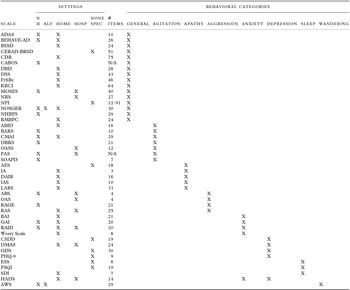
Among measures included in this review, most (n = 37, 82.2%) were designed for use in a specific setting (Table 3): 15 (33.3%) for use in home or community-based settings (Hughes et al., Reference Hughes, Berg, Danziger, Coben and Martin1982; Beck et al., Reference Beck, Epstein, Brown and Steer1988; Baumgarten et al., Reference Baumgarten, Becker and Gauthier1990; Burns et al., Reference Burns, Folstein, Brandt and Folstein1990; Devannand et al., Reference Devanand1992; Teri et al., Reference Teri, Truax, Logsdon, Uomoto, Zarit and Vitaliano1992; LaBarge, Reference LaBarge1993; Loreck et al., Reference Loreck, Bylsma and Folstein1994; Grace et al., Reference Grace, Stout and Malloy1999; Logsdon et al., Reference Logsdon1999; Robert et al., Reference Robert2002; Strauss and Sperry, Reference Strauss and Sperry2002; Kolitz et al., Reference Kolitz, Vanderploeg and Curtiss2003; Tractenberg et al., Reference Tractenberg, Singer, Cummings and Thai2003; Sockeel et al., Reference Sockeel, Dujardin, Devos, Deneve, Destee and Defebvre2006); six (13.3%) for use in nursing homes (Mungas et al., Reference Mungas, Weiler, Franzi and Henry1989; Patel and Hope, Reference Patel and Hope1992; Ray et al., Reference Ray, Taylor, Lichtenstein and Meador1992; Finkel et al., Reference Finkel, Lyons and Anderson1993; Burgio et al., Reference Burgio1994; Hurley et al., Reference Hurley1999); and three (6.7%) for use in the hospital setting (Yudofsky et al., Reference Yudofsky, Silver, Jackson, Endicott and Williams1986; Sultzer et al., Reference Sultzer, Berisford and Gunay1995; Yudofsky et al., Reference Yudofsky, Kopecky, Silver and Endicott1997). Thirteen (28.9%) were designed and tested for psychometrics in multiple settings (Zigmond and Snaith, Reference Zigmond and Snaith1983; Helmes et al., Reference Helmes, Csapo and Short1987; Ryden, Reference Ryden1988; Sunderland et al., Reference Sunderland1988; Cohen-Mansfield et al., Reference Cohen-Mansfield, Marx and Rosenthal1989; Rosen et al., Reference Rosen1994; Wahle et al., Reference Wahle, Häller and Spiegel1996; Reisberg et al., Reference Reisberg, Auer and Monteiro1997; Weyer et al., Reference Weyer, Erzigkeit, Kanowski, Ihl and Hadler1997; Shankar et al., Reference Shankar, Walker, Frost and Orrell1999; Algase et al., Reference Algase, Beattie, Bogue and Yao2001; Pachana et al., Reference Pachana, Byrne, Siddle, Koloski, Harley and Arnold2007; Perlman and Hirdes, Reference Perlman and Hirdes2008). Further, eight (17.8%) of the 45 measures did not specify a specific setting (Yesavage et al., Reference Yesavage1983; Alexopoulos et al., Reference Alexopoulos, Abrams, Young and Shamoian1988; Buysse et al., Reference Buysse, Reynolds, Monk, Berman and Kupfer1989; Johns, Reference Johns1991; Marin et al., Reference Marin, Biedrzycki and Firinciogullari1991; Cummings et al., Reference Cummings1994; Tariot et al., Reference Tariot1995; Kroenke et al., Reference Kroenke, Spitzer and Williams2001).
Comparison of measures along settings, and numbers and types of items (N = 45)

NH = nursing home.
ALF = assisted living facility.
HOME = refers to any community based setting including the person's home, outpatient clinics, or community centers.
HOSP = Hospital.
None spec = setting not specified by papers.
General = broad range of behavioral categories included.
Depress/anxiety = includes scales focusing on depression only, anxiety only or depression and anxiety combined.
N/A = not applicable or difficult to determine as number.
Psychometric properties
As stated, inclusion criteria for this review narrowed the scope of assessment measures chosen for review to those for which psychometric data (e.g. either validity or reliability) were explicitly reported. Also, we examined if sensitivity to change was reported. Among 45 scales included in this review, 42 (93.3%) reported on validity and 44 (97.8%) reported on reliability. Using the specific terminology found in the papers cited in Tables 1 and 2, overall validity reports included convergent validity (n = 12; Yesavage et al., Reference Yesavage1983; Zigmond and Snaith, Reference Zigmond and Snaith1983; Helmes et al., Reference Helmes, Csapo and Short1987; Beck et al., Reference Beck, Epstein, Brown and Steer1988; Burns et al., Reference Burns, Folstein, Brandt and Folstein1990; Marin et al., Reference Marin, Biedrzycki and Firinciogullari1991; Ray et al., Reference Ray, Taylor, Lichtenstein and Meador1992; Teri et al., Reference Teri, Truax, Logsdon, Uomoto, Zarit and Vitaliano1992; Weyer et al., Reference Weyer, Erzigkeit, Kanowski, Ihl and Hadler1997; Yudofsky et al., Reference Yudofsky, Kopecky, Silver and Endicott1997; Strauss and Sperry, Reference Strauss and Sperry2002; Kolitz et al., Reference Kolitz, Vanderploeg and Curtiss2003), concurrent validity (n = 15; Alexopoulos et al., Reference Alexopoulos, Abrams, Young and Shamoian1988; Mungas et al., Reference Mungas, Weiler, Franzi and Henry1989; Patel and Hope, Reference Patel and Hope1992; Teri et al., Reference Teri, Truax, Logsdon, Uomoto, Zarit and Vitaliano1992; Finkel et al., Reference Finkel, Lyons and Anderson1993; LaBarge, Reference LaBarge1993; Cummings et al., Reference Cummings1994; Loreck et al., Reference Loreck, Bylsma and Folstein1994; Wahle et al., Reference Wahle, Häller and Spiegel1996; Hurley et al., Reference Hurley1999; Shankar et al., Reference Shankar, Walker, Frost and Orrell1999; Robert et al., Reference Robert2002; Sockeel et al., Reference Sockeel, Dujardin, Devos, Deneve, Destee and Defebvre2006; Pachana et al., Reference Pachana, Byrne, Siddle, Koloski, Harley and Arnold2007; Perlman and Hirdes, Reference Perlman and Hirdes2008), construct validity (n = 10; Ryden, Reference Ryden1988; Sunderland et al., Reference Sunderland1988; Baumgarten et al., Reference Baumgarten, Becker and Gauthier1990; Burns et al., Reference Burns, Folstein, Brandt and Folstein1990; LaBarge, Reference LaBarge1993; Reisberg et al., Reference Reisberg, Auer and Monteiro1997; Grace et al., Reference Grace, Stout and Malloy1999; Shankar et al., Reference Shankar, Walker, Frost and Orrell1999; Kroenke et al., Reference Kroenke, Spitzer and Williams2001; Kolitz et al., Reference Kolitz, Vanderploeg and Curtiss2003), content validity (n = 7; Ryden, Reference Ryden1988; Cummings et al., Reference Cummings1994; Yudofsky et al., Reference Yudofsky, Kopecky, Silver and Endicott1997; Hurley et al., Reference Hurley1999; Shankar et al., Reference Shankar, Walker, Frost and Orrell1999; Kolitz et al., Reference Kolitz, Vanderploeg and Curtiss2003; Tractenberg et al., Reference Tractenberg, Singer, Cummings and Thai2003), discriminant validity (n = 8; Beck et al., Reference Beck, Epstein, Brown and Steer1988; Burns et al., Reference Burns, Folstein, Brandt and Folstein1990; Marin et al., Reference Marin, Biedrzycki and Firinciogullari1991; Teri et al., Reference Teri, Truax, Logsdon, Uomoto, Zarit and Vitaliano1992; Yudofsky et al., Reference Yudofsky, Kopecky, Silver and Endicott1997; Robert et al., Reference Robert2002; Strauss and Sperry, Reference Strauss and Sperry2002; Kolitz et al., Reference Kolitz, Vanderploeg and Curtiss2003), criterion validity (n = 4; Hughes et al., Reference Hughes, Berg, Danziger, Coben and Martin1982; Devanand et al., Reference Devanand1992; Kroenke et al., Reference Kroenke, Spitzer and Williams2001; Strauss and Sperry, Reference Strauss and Sperry2002), divergent validity (n = 1; Devanand et al., Reference Devanand1992), and neuropathological validity (n = 1; Hughes et al., Reference Hughes, Berg, Danziger, Coben and Martin1982). For four measures, the type of validity was unspecified (n = 4; Cohen-Mansfield et al., Reference Cohen-Mansfield, Marx and Rosenthal1989; Rosen et al., Reference Rosen1994; Logsdon et al., Reference Logsdon1999; Algase et al., Reference Algase, Beattie, Bogue and Yao2001).
Overall reliability reports included internal consistency (n = 32; Yesavage et al., Reference Yesavage1983; Zigmond and Snaith, Reference Zigmond and Snaith1983; Helmes et al., Reference Helmes, Csapo and Short1987; Alexopoulos et al., Reference Alexopoulos, Abrams, Young and Shamoian1988; Beck et al., Reference Beck, Epstein, Brown and Steer1988; Ryden, Reference Ryden1988; Buysse et al., Reference Buysse, Reynolds, Monk, Berman and Kupfer1989; Cohen-Mansfield et al., Reference Cohen-Mansfield, Marx and Rosenthal1989; Baumgarten et al., Reference Baumgarten, Becker and Gauthier1990; Burns et al., Reference Burns, Folstein, Brandt and Folstein1990; Johns, Reference Johns1991; Marin et al., Reference Marin, Biedrzycki and Firinciogullari1991; Devanand et al., Reference Devanand1992; Patel and Hope, Reference Patel and Hope1992; Teri et al., Reference Teri, Truax, Logsdon, Uomoto, Zarit and Vitaliano1992; Finkel et al., Reference Finkel, Lyons and Anderson1993; LaBarge, Reference LaBarge1993; Loreck et al., Reference Loreck, Bylsma and Folstein1994; Weyer et al., Reference Weyer, Erzigkeit, Kanowski, Ihl and Hadler1997; Yudofsky et al., Reference Yudofsky, Kopecky, Silver and Endicott1997; Grace et al., Reference Grace, Stout and Malloy1999; Hurley et al., Reference Hurley1999; Logsdon et al., Reference Logsdon1999; Shankar et al., Reference Shankar, Walker, Frost and Orrell1999; Algase et al., Reference Algase, Beattie, Bogue and Yao2001; Kroenke et al., Reference Kroenke, Spitzer and Williams2001; Robert et al., Reference Robert2002; Strauss and Sperry, Reference Strauss and Sperry2002; Kolitz et al., Reference Kolitz, Vanderploeg and Curtiss2003; Sockeel et al., Reference Sockeel, Dujardin, Devos, Deneve, Destee and Defebvre2006; Pachana et al., Reference Pachana, Byrne, Siddle, Koloski, Harley and Arnold2007; Perlman and Hirdes, Reference Perlman and Hirdes2008), inter-rater (or inter-observer) reliability (n = 28; Hughes et al., Reference Hughes, Berg, Danziger, Coben and Martin1982; Yudofsky et al., Reference Yudofsky, Silver, Jackson, Endicott and Williams1986; Helmes et al., Reference Helmes, Csapo and Short1987; Alexopoulos et al., Reference Alexopoulos, Abrams, Young and Shamoian1988; Ryden, Reference Ryden1988; Sunderland et al., Reference Sunderland1988; Cohen-Mansfield et al., Reference Cohen-Mansfield, Marx and Rosenthal1989; Mungas et al., Reference Mungas, Weiler, Franzi and Henry1989; Burns et al., Reference Burns, Folstein, Brandt and Folstein1990; Devanand et al., Reference Devanand1992; Patel and Hope, Reference Patel and Hope1992; Ray et al., Reference Ray, Taylor, Lichtenstein and Meador1992; Finkel et al., Reference Finkel, Lyons and Anderson1993; Burgio et al., Reference Burgio1994; Cumming et al., Reference Cummings1994; Loreck et al., Reference Loreck, Bylsma and Folstein1994; Rosen et al., Reference Rosen1994; Tariot et al., Reference Tariot1995; Wahle et al., Reference Wahle, Häller and Spiegel1996; Reisberg et al., Reference Reisberg, Auer and Monteiro1997; Yudofsky et al., Reference Yudofsky, Kopecky, Silver and Endicott1997; Hurley et al., Reference Hurley1999; Shankar et al., Reference Shankar, Walker, Frost and Orrell1999; Robert et al., Reference Robert2002; Strauss and Sperry, Reference Strauss and Sperry2002; Sultzer et al., Reference Sultzer, Berisford and Gunay1995; Sockeel et al., Reference Sockeel, Dujardin, Devos, Deneve, Destee and Defebvre2006; Pachana et al., Reference Pachana, Byrne, Siddle, Koloski, Harley and Arnold2007), and test–retest reliability (n = 17; Yesavage et al., Reference Yesavage1983; Beck et al., Reference Beck, Epstein, Brown and Steer1988; Ryden, Reference Ryden1988; Buysse et al., Reference Buysse, Reynolds, Monk, Berman and Kupfer1989; Baumgarten et al., Reference Baumgarten, Becker and Gauthier1990; Burns et al., Reference Burns, Folstein, Brandt and Folstein1990; Marin et al., Reference Marin, Biedrzycki and Firinciogullari1991; Patel and Hope, Reference Patel and Hope1992; Cummings et al., Reference Cummings1994; Wahle et al., Reference Wahle, Häller and Spiegel1996; Weyer et al., Reference Weyer, Erzigkeit, Kanowski, Ihl and Hadler1997; Logsdon et al., Reference Logsdon1999; Shankar et al., Reference Shankar, Walker, Frost and Orrell1999; Robert et al., Reference Robert2002; Strauss and Sperry, Reference Strauss and Sperry2002; Sockeel et al., Reference Sockeel, Dujardin, Devos, Deneve, Destee and Defebvre2006; Pachana et al., Reference Pachana, Byrne, Siddle, Koloski, Harley and Arnold2007).
All 16 general assessment scales reported on reliability data, with eight (50.0%) reporting on internal consistency (e.g. Chronbach's α; Helmes et al., Reference Helmes, Csapo and Short1987; Baumgarten et al., Reference Baumgarten, Becker and Gauthier1990; Devanand et al., Reference Devanand1992; Teri et al., Reference Teri, Truax, Logsdon, Uomoto, Zarit and Vitaliano1992; Loreck et al., Reference Loreck, Bylsma and Folstein1994; Weyer et al., Reference Weyer, Erzigkeit, Kanowski, Ihl and Hadler1997; Grace et al., Reference Grace, Stout and Malloy1999; Kolitz et al., Reference Kolitz, Vanderploeg and Curtiss2003), 11 (68.8%) reporting on inter-rater (or inter-observer) reliability (Hughes et al., Reference Hughes, Berg, Danziger, Coben and Martin1982; Helmes et al., Reference Helmes, Csapo and Short1987; Devanand et al., Reference Devanand1992; Ray et al., Reference Ray, Taylor, Lichtenstein and Meador1992; Burgio et al., Reference Burgio1994; Cumming et al., Reference Cummings1994; Loreck et al., Reference Loreck, Bylsma and Folstein1994; Tariot et al., Reference Tariot1995; Wahle et al., Reference Wahle, Häller and Spiegel1996; Reisberg et al., Reference Reisberg, Auer and Monteiro1997; Sultzer et al., Reference Sultzer, Berisford and Gunay1995), and four (25.0%) reporting on test–retest reliability (Baumgarten et al., Reference Baumgarten, Becker and Gauthier1990; Cummings et al., Reference Cummings1994; Wahle et al., Reference Wahle, Häller and Spiegel1996; Weyer et al., Reference Weyer, Erzigkeit, Kanowski, Ihl and Hadler1997). No general assessment scale reported on all three of these reliability metrics.
With regard to validity data, 13 (81.2%) of the general assessment measures reported data on one or more of the following: convergent validity (n = 5; Helmes et al., Reference Helmes, Csapo and Short1987; Ray et al., Reference Ray, Taylor, Lichtenstein and Meador1992; Teri et al., Reference Teri, Truax, Logsdon, Uomoto, Zarit and Vitaliano1992; Weyer et al., Reference Weyer, Erzigkeit, Kanowski, Ihl and Hadler1997; Kolitz et al., Reference Kolitz, Vanderploeg and Curtiss2003), concurrent validity (n = 4; Teri et al., Reference Teri, Truax, Logsdon, Uomoto, Zarit and Vitaliano1992; Cummings et al., Reference Cummings1994; Loreck et al., Reference Loreck, Bylsma and Folstein1994; Wahle et al., Reference Wahle, Häller and Spiegel1996), construct validity (n = 4; Baumgarten et al., Reference Baumgarten, Becker and Gauthier1990; Reisberg et al., Reference Reisberg, Auer and Monteiro1997; Grace et al., Reference Grace, Stout and Malloy1999; Kolitz et al., Reference Kolitz, Vanderploeg and Curtiss2003), content validity (n = 2; Cummings et al., Reference Cummings1994; Kolitz et al., Reference Kolitz, Vanderploeg and Curtiss2003), discriminant validity (n = 2; Teri et al., Reference Teri, Truax, Logsdon, Uomoto, Zarit and Vitaliano1992; Kolitz et al., Reference Kolitz, Vanderploeg and Curtiss2003), criterion validity (n = 2; Hughes et al., Reference Hughes, Berg, Danziger, Coben and Martin1982; Devanand et al., Reference Devanand1992), divergent validity (n = 1; Devanand et al., Reference Devanand1992), and neuropathological validity (n = 1; Hughes et al., Reference Hughes, Berg, Danziger, Coben and Martin1982).
A similar pattern emerged for the 29 specific behavior scales. The majority presented reliability data (n = 28; 96.6%), of which 24 reported internal consistency (e.g. Chronbach's α; Yesavage et al., Reference Yesavage1983; Zigmond and Snaith, Reference Zigmond and Snaith1983; Alexopoulos et al., Reference Alexopoulos, Abrams, Young and Shamoian1988; Beck et al., Reference Beck, Epstein, Brown and Steer1988; Ryden, Reference Ryden1988; Buysse et al., Reference Buysse, Reynolds, Monk, Berman and Kupfer1989; Cohen-Mansfield et al., Reference Cohen-Mansfield, Marx and Rosenthal1989; Burns et al., Reference Burns, Folstein, Brandt and Folstein1990; Johns, Reference Johns1991; Marin et al., Reference Marin, Biedrzycki and Firinciogullari1991; Patel and Hope, Reference Patel and Hope1992; Finkel et al., Reference Finkel, Lyons and Anderson1993; LaBarge, Reference LaBarge1993; Yudofsky et al., Reference Yudofsky, Kopecky, Silver and Endicott1997; Hurley et al., Reference Hurley1999; Logsdon et al., Reference Logsdon1999; Shankar et al., Reference Shankar, Walker, Frost and Orrell1999; Algase et al., Reference Algase, Beattie, Bogue and Yao2001; Kroenke et al., Reference Kroenke, Spitzer and Williams2001; Robert et al., Reference Robert2002; Strauss and Sperry, Reference Strauss and Sperry2002; Sockeel et al., Reference Sockeel, Dujardin, Devos, Deneve, Destee and Defebvre2006; Pachana et al., Reference Pachana, Byrne, Siddle, Koloski, Harley and Arnold2007; Perlman and Hirdes, Reference Perlman and Hirdes2008), 17 reported inter-rater reliability (Yudofsky et al., Reference Yudofsky, Silver, Jackson, Endicott and Williams1986; Alexopoulos et al., Reference Alexopoulos, Abrams, Young and Shamoian1988; Ryden, Reference Ryden1988; Sunderland et al., Reference Sunderland1988; Cohen-Mansfield et al., Reference Cohen-Mansfield, Marx and Rosenthal1989; Mungas et al., Reference Mungas, Weiler, Franzi and Henry1989; Burns et al., Reference Burns, Folstein, Brandt and Folstein1990; Patel and Hope, Reference Patel and Hope1992; Finkel et al., Reference Finkel, Lyons and Anderson1993; Rosen et al., Reference Rosen1994; Yudofsky et al., Reference Yudofsky, Kopecky, Silver and Endicott1997; Hurley et al., Reference Hurley1999; Shankar et al., Reference Shankar, Walker, Frost and Orrell1999; Robert et al., Reference Robert2002; Strauss and Sperry, Reference Strauss and Sperry2002; Sockeel et al., Reference Sockeel, Dujardin, Devos, Deneve, Destee and Defebvre2006; Pachana et al., Reference Pachana, Byrne, Siddle, Koloski, Harley and Arnold2007), and 13 reported test–retest reliability (Yesavage et al., Reference Yesavage1983; Beck et al., Reference Beck, Epstein, Brown and Steer1988; Ryden, Reference Ryden1988; Buysse et al., Reference Buysse, Reynolds, Monk, Berman and Kupfer1989; Burns et al., Reference Burns, Folstein, Brandt and Folstein1990; Marin et al., Reference Marin, Biedrzycki and Firinciogullari1991; Patel and Hope, Reference Patel and Hope1992; Logsdon et al., Reference Logsdon1999; Shankar et al., Reference Shankar, Walker, Frost and Orrell1999; Robert et al., Reference Robert2002; Strauss and Sperry, Reference Strauss and Sperry2002; Sockeel et al., Reference Sockeel, Dujardin, Devos, Deneve, Destee and Defebvre2006; Pachana et al., Reference Pachana, Byrne, Siddle, Koloski, Harley and Arnold2007).
With regard to validity data, the following were reported for the specific behavior scales: convergent validity (n = 7; Yesavage et al., Reference Yesavage1983; Zigmond and Snaith, Reference Zigmond and Snaith1983; Beck et al., Reference Beck, Epstein, Brown and Steer1988; Burns et al., Reference Burns, Folstein, Brandt and Folstein1990; Marin et al., Reference Marin, Biedrzycki and Firinciogullari1991; Yudofsky et al., Reference Yudofsky, Kopecky, Silver and Endicott1997; Strauss and Sperry, Reference Strauss and Sperry2002), concurrent validity (n = 11; Alexopoulos et al., Reference Alexopoulos, Abrams, Young and Shamoian1988; Mungas et al., Reference Mungas, Weiler, Franzi and Henry1989; Patel and Hope, Reference Patel and Hope1992; Finkel et al., Reference Finkel, Lyons and Anderson1993; LaBarge, Reference LaBarge1993; Hurley et al., Reference Hurley1999; Shankar et al., Reference Shankar, Walker, Frost and Orrell1999; Robert et al., Reference Robert2002; Sockeel et al., Reference Sockeel, Dujardin, Devos, Deneve, Destee and Defebvre2006; Pachana et al., Reference Pachana, Byrne, Siddle, Koloski, Harley and Arnold2007; Perlman and Hirdes, Reference Perlman and Hirdes2008), construct validity (n = 6; Ryden, Reference Ryden1988; Sunderland et al., Reference Sunderland1988; Burns et al., Reference Burns, Folstein, Brandt and Folstein1990; LaBarge, Reference LaBarge1993; Shankar et al., Reference Shankar, Walker, Frost and Orrell1999; Kroenke et al., Reference Kroenke, Spitzer and Williams2001), content validity (n = 5; Ryden, Reference Ryden1988; Yudofsky et al., Reference Yudofsky, Kopecky, Silver and Endicott1997; Hurley et al., Reference Hurley1999; Shankar et al., Reference Shankar, Walker, Frost and Orrell1999; Tractenberg et al., Reference Tractenberg, Singer, Cummings and Thai2003), discriminant validity (n = 6; Beck et al., Reference Beck, Epstein, Brown and Steer1988; Burns et al., Reference Burns, Folstein, Brandt and Folstein1990; Marin et al., Reference Marin, Biedrzycki and Firinciogullari1991; Yudofsky et al., Reference Yudofsky, Kopecky, Silver and Endicott1997; Robert et al., Reference Robert2002; Strauss and Sperry, Reference Strauss and Sperry2002), criterion validity (n = 2; Kroenke et al., Reference Kroenke, Spitzer and Williams2001; Strauss and Sperry, Reference Strauss and Sperry2002), and type not specified (n = 4; Cohen-Mansfield et al., Reference Cohen-Mansfield, Marx and Rosenthal1989; Rosen et al., Reference Rosen1994; Logsdon et al., Reference Logsdon1999; Algase et al., Reference Algase, Beattie, Bogue and Yao2001).
Of the 45 measures reviewed, sensitivity to change was discussed for 31 (68.9%) of the measures, although the reporting quality was highly variable (Hughes et al, Reference Hughes, Berg, Danziger, Coben and Martin1982; Yesavage et al., Reference Yesavage1983; Zigmond and Snaith, Reference Zigmond and Snaith1983; Yudofsky et al., Reference Yudofsky, Silver, Jackson, Endicott and Williams1986; Helmes et al. Reference Helmes, Csapo and Short1987; Levin et al., Reference Levin1987; Alexopoulos et al., Reference Alexopoulos, Abrams, Young and Shamoian1988; Ryden, Reference Ryden1988; Sunderland et al., Reference Sunderland1988; Buysse et al., Reference Buysse, Reynolds, Monk, Berman and Kupfer1989; Mungas et al., Reference Mungas, Weiler, Franzi and Henry1989; Marin et al., Reference Marin, Biedrzycki and Firinciogullari1991; Devanand et al., Reference Devanand1992; Patel and Hope, Reference Patel and Hope1992; Ray et al., Reference Ray, Taylor, Lichtenstein and Meador1992; Teri et al., Reference Teri, Truax, Logsdon, Uomoto, Zarit and Vitaliano1992; Cummings et al., Reference Cummings1994; Loreck et al., Reference Loreck, Bylsma and Folstein1994; Rosen et al., Reference Rosen1994; Tariot et al., Reference Tariot1995; Wahle et al., Reference Wahle, Häller and Spiegel1996; Weyer et al., Reference Weyer, Erzigkeit, Kanowski, Ihl and Hadler1997; Grace et al., Reference Grace, Stout and Malloy1999; Logsdon et al., Reference Logsdon1999; Shankar et al., Reference Shankar, Walker, Frost and Orrell1999; Kroenke et al., Reference Kroenke, Spitzer and Williams2001; Robert et al., Reference Robert2002; Kolitz et al., Reference Kolitz, Vanderploeg and Curtiss2003; Sockeel et al., Reference Sockeel, Dujardin, Devos, Deneve, Destee and Defebvre2006; Boddice et al., Reference Boddice, Pachana and Byrne2008; Perlman and Hirdes, Reference Perlman and Hirdes2008). Reports ranged from actual tests and data for sensitivity to change analyses (e.g. Weyer et al., Reference Weyer, Erzigkeit, Kanowski, Ihl and Hadler1997) to statements acknowledging the need for future studies to test for sensitivity to change (e.g. Yesavage et al., Reference Yesavage1983). For the remaining 14 (31.1%) measures, there was no indication or discussion of sensitivity to change (Beck et al., Reference Beck, Epstein, Brown and Steer1988; Cohen-Mansfield et al., Reference Cohen-Mansfield, Marx and Rosenthal1989; Baumgarten et al., Reference Baumgarten, Becker and Gauthier1990; Burns et al., Reference Burns, Folstein, Brandt and Folstein1990; Johns, Reference Johns1991; Finkel et al., Reference Finkel, Lyons and Anderson1993; LaBarge, Reference LaBarge1993; Burgio et al., Reference Burgio1994; Reisberg et al., Reference Reisberg, Auer and Monteiro1997; Yudofsky et al., Reference Yudofsky, Kopecky, Silver and Endicott1997; Hurley et al., Reference Hurley1999; Algase et al., Reference Algase, Beattie, Bogue and Yao2001; Strauss and Sperry, Reference Strauss and Sperry2002; Tractenberg et al., Reference Tractenberg, Singer, Cummings and Thai2003).
Discussion
Undetected and therefore untreated NPS have potent effects on disease course, disease management, and health-related morbidity and mortality for people with dementia, their family members, and formal providers. Thus, assessing behavioral symptoms in clinical settings using reliable and valid measures is critical. Also, with the need to develop and test treatment strategies for effectively managing behavioral symptoms, it is important to identify adequate and standardized measures that can be used in clinical trials testing either pharmacologic or non-pharmacologic treatment strategies.
This systematic review uncovered 45 measures published in English with reported psychometric properties that can identify behavioral occurrences among people with dementia and which can be used in a multitude of clinical and research contexts. Measures varied widely in their characteristics reflecting in part the lack of consensus as to what constitutes NPS, and how behaviors should be identified, characterized, classified, and assessed. However, it also reflects the variegated needs of clinical settings and research purposes. Thus, this array of measures provides opportunities for assessing behaviors for almost any clinical or research purpose or context. Given that all 45 measures were selected because they had at least minimal adequate psychometric properties (validity and/or reliability), we show that clinicians and researchers have a robust set of tools from which to choose.
It is not possible to indicate if one measure is superior to another as use depends upon a number of important considerations. Choice of a measure should be guided by several considerations including the purpose of measurement (need for a general screen or a more targeted behavioral assessment), the setting in which the assessment of behaviors will occur, who will assess for behaviors and how assessment will occur (observation, proxy interview), and the amount of time and resources available for assessing for behavioral symptoms. Recent algorithmic decision-trees for behavioral management (Gitlin et al., Reference Gitlin, Kales and Lyketsos2012) suggest that clinicians should start with a general measure of behavioral symptoms that can serve as an all-purpose screen for a wide range of behavioral domains. Then, based on the screen, a specific, behavior-targeted measure could be introduced as a follow-up to provide greater specificity as to the type of behaviors manifested per domain and to obtain a more nuanced understanding of the presenting behavior.
In selecting a measure to use from these 45, it would also be important to determine the setting and population for which it was validated. For example, a measure developed for hospital use may not be appropriate for the nursing-home setting. Some measures require clinical input to complete although most can be administered by persons of unspecified backgrounds who become familiar with the instrument. Most measures rely on proxy report and are dependent upon the reporter's memory of behavioral events. Direct or video-captured observations for documenting behavioral occurrences may afford real time ratings that are more objective than patient or proxy report. However, a direct observational approach would appear most feasible in long-term care settings; to date there is a lack of adequate tools and analytic strategies for capturing video-recorded behavioral occurrences in home environments for either clinical or research purposes, although this is an important direction for future research. Additionally, the choice of measure will depend upon the behaviors of most concern in either the clinical or research context. For example, a study on agitation would obviously want to include measures targeting this one domain of behaviors.
The NPI-C is worth highlighting as it stands out as one of the most efficient measures; it involves multiple behavioral domains at a general level as well as targets specific behaviors within domains; it can be used in multiple clinical settings as well as for research purposes; and various scores can be generated based on one's purpose. For example, from the NPI-C, the following scores can be generated: a total score reflecting frequency, a total score reflecting severity of behaviors, a total frequency times severity behavior score, number of behavioral domains affected, number of behavioral items endorsed for any one domain, caregiver level of upset for any one behavioral item, domain and overall. Additionally, the NPI-C is the only measure to be validated in multiple countries, and to yield subscales that have been validated for use as stand-alone measures (e.g. depression, agitation subscales). There are also briefer derivatives (NPI, NPI-Q) that facilitate ease of use in a variety of clinical settings. Finally, the NPI-C integrates both a general and targeted approach: it offers general screening for the presence or absence of a behavioral domain, followed by more detailed questions about specific behaviors within a domain that is endorsed as occurring. Follow-up questions elicit the frequency and severity of specific behaviors representing the behavioral cluster (e.g. agitation).
Noteworthy is that most measures were developed up to 30 years ago. Yet, assessment of behavioral symptoms does not appear to be part of routine care in setting such as primary care in which most persons with dementia receive on-going medical attention. This may reflect in part limited awareness as to the importance of monitoring behavioral symptoms, lack of knowledge that standardized assessment tools exist, belief that clinical judgment is better than validated tools, lack of time during the medical encounter, and concern that if behaviors are detected, there are no evidence-based practices for their management (Murphy et al., 2014). Research to identify current practices and the barriers and facilitators to detecting behaviors using standardized measures and then managing behaviors in different practice settings would be an important endeavor for advancing dementia care in this area.
There are important limitations to this group of measures and which point to the need for significant measurement development in order to enhance clinical practice as it concerns behavioral detection. First, papers reporting on measures do not typically discuss the theoretical underpinnings of item selection and scale construction. Scales have been developed mostly by and within specific disciplines (e.g. neurology, psychiatry, social science) and thus implicitly represent different conceptualizations of behaviors. Item selection has tended to be based primarily upon empirical observations of persons with dementia and there is a lack of a shared framework for defining behaviors, and their underlying causes and measurement across instrumentation. This is an observation initially reported by Cummings in 1996 and which persists up to today. Second, there are no measures to our knowledge that systematically identify and assess the ecosystem or contextual characteristics in which behaviors occur. Characterizing behaviors independent of context has been the primary focus of existing scales. Existing measures decontextualize behaviors, focusing narrowly on the reporting of the frequency and/or severity of occurrences. This may be due to the implicit assumptions of most measures that behaviors are a direct consequence of neuropathology and as such the brain–behavior relationship dominates the approach to measurement.
However, current thinking is that behavioral symptoms may be a consequence of the confluence of multiple factors including neuropathology as well as medical and physical and social environmental conditions. Neurodegenerative changes may enhance vulnerabilities to stressors in the physical and social environment (Gitlin et al., Reference Gitlin, Kales and Lyketsos2012). Most behavioral symptoms such as agitation or aggression cannot be accounted for alone by neurological impairment. Rather, they appear to reflect unmet needs or a sensitivity to a combination of issues including comorbidities, pain, sleep disturbances, anxiety, fear, underlying infection, and/or factors related to the physical and social environment such as excessive clutter, and complex caregiver communications (Hodgson et al., Reference Hodgson, Gitlin, Winter and Czekanski2010; Reference Hodgson, Gitlin, Winter and Hauck2013). Each of these factors has been implicated in behavioral disturbances.
Currently, measures assume a reactive stance, capturing behavioral events during or after their occurrence. However, attention to potential modifiable risk factors would lead to a preventive care approach in which strategies could be introduced to minimize their contribution to behavioral manifestations. As the goal should be to prevent behavioral symptoms, identifying specific, known risk factors and assessing for those factors on a routine basis would be important. Research has shown for example that aggressive behaviors are associated with pain and caregiver burden (Kunik et al., Reference Kunik2010). As these factors are modifiable, early detection of the presence of these conditions may prevent or minimize the occurrences of aggressive behaviors. Therefore, developing measures that capture known risk factors and the contextual characteristics in which behaviors occur would be important to pursue.
One promising measurement approach involves using smart home technologies or computer assisted video and audiography to capture behaviors in real time. This would enable documentation of antecedent conditions and consequences from which to better characterize the contexts in which behaviors occur in real time. These approaches may lead to measures that systematically capture contextual factors of behavioral occurrences. For example, deriving simple checklists of the presence or absence of key factors identified as contributing to behaviors could be developed and integrated into a measurement approach to more fully understand behavioral occurrences. A related point is that while most measures identified the frequency of behavioral occurrences, only a few evaluated the severity of behaviors to patients or considered caregiver level of upset. None assessed the level of caregiver confidence or self-efficacy in managing behaviors. Assessing proximally related factors such as caregiver reaction and confidence could provide a more holistic understanding of context and direct clinical intervention.
A third measurement consideration is that most scales depend upon a proxy to report observed behaviors. However, it is unclear as to the relationship of proxy report to direct observation and clinician ratings. There is some evidence that family report of behavioral occurrences is influenced by their own mood and distress (de Vugt et al., Reference de Vugt2004). There is also some evidence to suggest that both clinician experiences and the institutional culture may affect the choice of intervention used, suggesting that a similar dynamic may be at play when rating the behavior itself (Cohen-Mansfield et al., Reference Cohen-Mansfield, Golander, Arnheim and Cohen2014). Level of knowledge and understanding of behaviors, job satisfaction, and frustrations caring for persons with dementia, and personal values may all influence scoring, particularly for the severity rating of a particular behavior. Thus, research is needed to examine the extent to which behavioral reports by families are congruent with clinician observations and what factors influence ratings by both clinicians and families.
Yet another area of need is for the development of clinical practice guidelines for assessing NPS. A protocol might include regular and on-going brief screening for risk factors and actual occurrences of NPS, followed by in-depth examination of frequency, severity, and caregiver reactions to behavioral occurrences in addition to obtaining a deep description of the biopsychosocial and environmental context in which the behaviors occurred (Gitlin et al., Reference Gitlin, Kales and Lyketsos2012; Kales et al., Reference Kales, Gitlin and Lyketsos2014). Of importance would be for research to evaluate the treatment benefits of integrating routine behavioral detection and assessment in clinical settings.
This review is subject to several limitations. First, only published studies of scales available in English were included. We were unable to determine if identified scales have been translated into other languages; nor were we able to review scales that have been developed in other languages but which are not available in English. There may be scales developed in other languages from which to choose. Second, we were unable to discern the feasibility or practicalities of using any one measure nor the extent to which they are used. Papers did not report the barriers or facilitators of using a particular measure in a specific context. Third, most publications did not indicate whether a measure was sensitive to change nor the impact of its use over multiple testing occasions. Thus, we were unable to draw firm conclusions in this regard. However, attention to the sensitivity of a scale is important as assessments may occur on repeated occasions, and also be used to evaluate behavioral changes due to a treatment. Finally, the science of behavioral symptoms of dementia is evolving. For example, rejection to care behaviors or disorders of personality has recently been identified as dementia-related behaviors distinct from agitation or other behavioral forms. Thus, a limitation of this review may be its scope or focus. That is, as behavioral types are further identified, a review of their measurement should be considered in future reviews.
Beyond the limitations posed by the measures themselves as well as this review, we demonstrate that there are many measures to use for the purposes of assessing NPS in persons with dementia. These measures have strong psychometric properties, and are available to clinicians and researchers alike for use in a variety of settings. From an assessment perspective, attention to behavioral detection is possible and the lack of systematic monitoring of behaviors is not warranted. One hesitation to assess for behaviors by clinicians may be the perception that there is an inadequate evidence-base for treatments. However, this is not the case and there is an emerging evidence base that supports intervening if behavioral symptoms are present. As to current treatments, pharmacologic agents are typically favored although they have been shown to have limited utility in behavioral management. The most commonly used atypical anti-psychotics may pose more harm than benefit, carry a FDA black box warning for older dementia patients, and tend to be ineffective for behaviors that families and formal providers identify as most problematic such as rejection of care or agitated-type behaviors (Sink et al., Reference Sink, Holden and Yaffe2005; Kales et al., Reference Kales2007; Gitlin, et al., Reference Gitlin, Winter, Dennis, Hodgson and Hauck2010; Kales et al., Reference Kales2011). However, a recent clinical trial found citalopram to be effective for agitation in patients with dementia although with cardiac and cognitive adverse effects (Porsteinsson et al., Reference Porsteinsson2014). Noteworthy is that non-pharmacologic treatments (e.g. educating caregivers, identifying and addressing unmet needs, simplifying the physical environment and caregiver communications, establishing structured daily routines or using meaningful activities) have a growing evidence base and are widely endorsed by multiple medical organizations as first-line treatments (Lyketsos et al., Reference Lyketsos2006; Rabins et al., Reference Rabins2007; Salzman et al., Reference Salzman2008; Brodaty et al., 2012; Gitlin et al., Reference Gitlin, Kales and Lyketsos2012; Kales et al., Reference Kales, Gitlin and Lyketsos2014; Samus et al., Reference Samus2014).
Thus, given the number and range of available measures, the known harms of behavioral symptoms, and emerging algorithms and evidence-base for treating behavioral symptoms, the ascertainment of behavioral symptoms should be a key feature of comprehensive dementia care in all settings in which persons with dementia reside or are treated.
Conflict of interest
None.
Description of authors’ roles
L.N. Gitlin conceptualized the paper and designed the approach, drafted the paper. K.A. Marx, helped to conduct the literature review, was one of the coders of measures, helped to construct the tables, drafted sections of the paper and critically read versions. I.H. Stanley helped to conduct the literature review, was one of the coders of measures, helped to construct the tables, drafted sections of the paper, helped to draft and critically read versions. B.R. Hansen helped to conduct the literature review, was one of the coders of measures, and critically read the final version. K.S. Van Haitsma critically read previous draft versions and provided conceptual guidance.
Acknowledgments
This research was supported by a grant from the National Institute on Aging (R01AG041781; L.N. Gitlin), the Alzheimer's Association (NPSASA-10-174625; L.N. Gitlin), and The Commonwealth Fund (K.S. Van Haitsma). We would like to thank Ann M. Kolanowski, PhD, Hartford Center of Geriatric Nursing Excellence School of Nursing, Penn State, University Park, Pennsylvania, USA for her support and guidance in this research.
Partial results from this study were presented as a poster at the 2013 Alzheimer's Association International Conference in Boston, Massachusetts and in a symposium at the 66th annual Scientific Meeting of the Gerontological Society of America in New Orleans, Louisiana. A previous version of this review was developed in part for the Centers for Medicare and Medicaid Services Tool Kit to facilitate assessment of neuropsychiatric behaviors and use of non-pharmacologic practices in nursing homes.