Nearly 700,000 children are victims of childhood maltreatment in the United States annually, with 15% of these children experiencing two or more forms of maltreatment (U.S. Department of Health & Human Services, Administration for Children and Families, Administration on Children, Youth and Families, Children's Bureau, 2021). Youth who have experienced childhood maltreatment are at heightened risk for developing several forms of psychopathology (Becker, Nitsch, Miltner, & Straube, Reference Becker, Nitsch, Miltner and Straube2014; Dennison et al., Reference Dennison, Rosen, Sambrook, Jenness, Sheridan and McLaughlin2019; Dillon et al., Reference Dillon, Holmes, Birk, Brooks, Lyons-Ruth and Pizzagalli2009; Vidal-Ribas et al., Reference Vidal-Ribas, Benson, Vitale, Keren, Harrewijn, Fox and Stringaris2019). Emerging research suggests that individual differences in the positive reward system could operate as a neural mechanistic risk pathway linking childhood maltreatment to psychiatric illness across the life span (for reviews, Kujawa, Klein, Pegg, & Weinberg, Reference Kujawa, Klein, Pegg and Weinberg2020; Novick et al., Reference Novick, Levandowski, Laumann, Philip, Price and Tyrka2018). However, not all youth who experience maltreatment exhibit aberrant reward functioning styles and subsequent psychopathology, suggesting the presence of other factors that may increase children's risk for atypical neurobiological patterns in reward processing. Therefore, the examination of moderators that influence reward processing patterns in youth exposed to maltreatment is essential and may help to increase precision in targeted prevention efforts aimed at modifying reward responsiveness among maltreated youth.
Early Life Adversity and Reward Processing
Most of the research on early life adversity and reward processing patterns has utilized brain imaging. Studies utilizing functional magnetic resonance imaging (fMRI) have indicated that early childhood adversity, including stressful life events and maltreatment, is associated with decreased activation in the ventral striatum, a brain region activated in response to reward-related stimuli (e.g., monetary rewards; Becker et al., Reference Becker, Nitsch, Miltner and Straube2014; Hanson et al., Reference Hanson, Albert, Iselin, Carre, Dodge and Hariri2016; Kujawa et al., Reference Kujawa, Klein, Pegg and Weinberg2020; Novick et al., Reference Novick, Levandowski, Laumann, Philip, Price and Tyrka2018). Furthermore, research has demonstrated that alterations in the neurobiological mechanisms that govern reward processing and behavior moderate and mediate relations between early life adversity and stressful events and adolescent depression (Corral-Frías et al., Reference Corral-Frías, Nikolova, Michalski, Baranger, Hariri and Bogdan2015; Hanson, Hariri, & Williamson, Reference Hanson, Hariri and Williamson2015; Nikolova, Bogdan, Brigidi, & Hariri, Reference Nikolova, Bogdan, Brigidi and Hariri2012). For example, blunted ventral striatum activation has been shown to mediate the effect of emotional neglect on increases in depressive symptoms during adolescence (Hanson et al., Reference Hanson, Hariri and Williamson2015). In terms of moderating effects, other work suggests that the link between early childhood maltreatment and future symptoms of anhedonia and depression is most pronounced among individuals exhibiting blunted ventral striatal reactivity during reward processing (Corral-Frías et al., Reference Corral-Frías, Nikolova, Michalski, Baranger, Hariri and Bogdan2015). This work is complemented by studies showing that several brain regions involved in reward processing (e.g., posterior cingulate/precuneus, middle temporal gyrus, and superior occipital cortex, medial prefrontal cortex) also appear to be impacted by early life adversity, which increases risk for depression vulnerability (Birn, Roeber, & Pollak, Reference Birn, Roeber and Pollak2017; Romens et al., Reference Romens, Casement, McAloon, Keenan, Hipwell, Guyer and Forbes2015).
More recent research suggests that the timing of early life adversity influences the directionality of brain activation patterns during reward processing among youth (Novick et al., Reference Novick, Levandowski, Laumann, Philip, Price and Tyrka2018). For stressors experienced during early childhood, reduced activation in reward-related brain regions has been associated with higher levels of adversity, whereas the opposite pattern (i.e., heightened activation in mesocorticolimbic brain regions) has been observed for stressors experienced later in adolescence (Novick et al., Reference Novick, Levandowski, Laumann, Philip, Price and Tyrka2018). Moreover, neuroimaging work has provided compelling evidence that adversity that occurs early in life has the most profound effects on neural regions involved in reward processing, and those that develop aberrant patterns are at greatest risk for depression (Corral-Frías et al., Reference Corral-Frías, Nikolova, Michalski, Baranger, Hariri and Bogdan2015; Novick et al., Reference Novick, Levandowski, Laumann, Philip, Price and Tyrka2018).
Consistent with neuroimaging findings, researchers have also utilized event-related potentials (ERPs), derived from electroencephalography (EEG), to study electrocortical properties of reward processing in relation to stressful life events across development. Specifically, the reward positivity (RewP) – previously referred to as the feedback negativity (FN) – is an ERP component that measures response to reward feedback (Holroyd & Coles, Reference Holroyd and Coles2002; Holroyd, Pakzad-Vaezi, & Krigolson, Reference Holroyd, Pakzad-Vaezi and Krigolson2008; Kujawa, Smith, Luhmann, & Hajcak, Reference Kujawa, Smith, Luhmann and Hajcak2013; Proudfit, Reference Proudfit2015; Proudfit, Bress, Foti, Kujawa, & Klein, Reference Proudfit, Bress, Foti, Kujawa and Klein2015). The RewP assesses individual differences in reward processing across the life span and is linked with activation in reward-related brain regions, including the striatum (Carlson, Foti, Mujica-Parodi, Harmon-Jones, & Hajcak, Reference Carlson, Foti, Mujica-Parodi, Harmon-Jones and Hajcak2011; Gotlib & Joormann, Reference Gotlib and Joormann2010). Blunted RewP is thought to represent a predisposition toward lack of motivation to engage with tasks and situations that elicit pleasure and excitement (for review, Kujawa & Burkhouse, Reference Kujawa and Burkhouse2017).
A few studies have documented interactions between blunted RewP and stressful life events (i.e., social stress, school and family problems) in predicting greater symptoms of depression in adolescents (Burani et al., Reference Burani, Klawohn, Levinson, Klein, Nelson and Hajcak2021; Goldstein et al., Reference Goldstein, Kessel, Kujawa, Finsaas, Davila, Hajcak and Klein2020; Pegg et al., Reference Pegg, Ethridge, Shields, Slavich, Weinberg and Kujawa2019). Other work with youth has also indicated that blunted reward processing prospectively predicts life stress generated by adolescents and future depressive symptoms (Mackin et al., Reference Mackin, Kotov, Perlman, Nelson, Goldstein, Hajcak and Klein2019). Together, this emerging research suggests that individuals with blunted RewP might be particularly vulnerable to the experience of stressful life events and subsequent depression risk. However, these prior studies focused exclusively on stressful life events, versus more severe forms of early life adversity, such as childhood maltreatment. In a sample of adults, researchers found limited evidence for associations between childhood maltreatment history and RewP response (Boecker-Schlier et al., Reference Boecker-Schlier, Holz, Buchmann, Blomeyer, Plichta, Jennen-Steinmetz and Meyer-Lindenberg2016); however, there may be undetected dual risk moderating processes that qualify relations between RewP and childhood maltreatment that have yet to be examined in prior studies. Clarifying this question in a sample of children and adolescents has the potential to pinpoint subgroups of youth at greatest risk for reward processing deficits and subsequent psychopathology.
Maternal Depression and Reward Processing in Youth
One potential subgroup of youth at high risk for blunted response to rewards following experiences of childhood maltreatment may be offspring of mothers with a history of major depressive disorder (MDD). Across several neuroimaging and ERP studies, maternal MDD history has been associated with reduced reward processing among offspring (Kujawa & Burkhouse, Reference Kujawa and Burkhouse2017). For example, neuroimaging studies have shown that offspring of depressed, relative to nondepressed, mothers demonstrate reduced activation in striatal, prefrontal, and temporal brain regions in response to reward feedback (Gotlib & Joormann, Reference Gotlib and Joormann2010; Luking, Pagliaccio, Luby, & Barch, Reference Luking, Pagliaccio, Luby and Barch2016; Olino et al., Reference Olino, McMakin, Morgan, Silk, Birmaher, Axelson and Forbes2014; Sharp et al., Reference Sharp, Kim, Herman, Pane, Reuter and Strathearn2014; Wiggins et al., Reference Wiggins, Schwartz, Kryza-Lacombe, Spechler, Blankenship and Dougherty2017). In the ERP literature, children of mothers with a lifetime history of depression demonstrate an attenuated RewP compared to children of mothers with no history of depression (Kujawa, Proudfit, & Klein, Reference Kujawa, Proudfit and Klein2014). Additionally, a reduced RewP has been found to moderate the relationship between maternal MDD and depressive symptoms in offspring, suggesting that reduced reward responsiveness may be a familial mechanism for depression vulnerability that can be detected in youth (Kujawa, Hajcak, & Klein, Reference Kujawa, Hajcak and Klein2019). Notably, children living in stressful environments are disproportionally exposed to maternal depression (Liu et al., Reference Liu, Kaaya, Chai, McCoy, Surkan, Black and Smith-Fawzi2017; Walker et al., Reference Walker, Gelfand, Katon, Koss, Von Korff, Bernstein and Russo1999), and in one study, children exposed to both maternal depression and childhood maltreatment were at almost 12 times greater risk of developing psychopathology relative to offspring not exposed (Pawlby, Hay, Sharp, Waters, & Pariante, Reference Pawlby, Hay, Sharp, Waters and Pariante2011). By contrast, some studies have not found an association between maternal depression history and childhood maltreatment (Frye & Garber, Reference Frye and Garber2005; Hentges, Graham, Plamondon, Tough, & Madigan, Reference Hentges, Graham, Plamondon, Tough and Madigan2021; Sellers et al., Reference Sellers, Harold, Elam, Rhoades, Potter, Mars and Collishaw2014) and thus these variables should be examined independently. Despite common links to individual differences in reward processing among childhood maltreatment and maternal MDD, and some evidence for associations between these variables, no studies to date have examined the interplay between childhood maltreatment and maternal depression in predicting reward processing in youth, particularly in diverse community samples where psychosocial and reward processing relations can be tested across varying levels of risk.
Diathesis–Stress/Dual-Risk Perspective
As noted by other investigators (e.g., Kujawa et al., Reference Kujawa, Klein, Pegg and Weinberg2020), many existing studies that have examined direct linkages between environmental and familial influences on reward processing have focused on single variable main effect models. As previously described, in the ERP literature, there have been virtually no studies that have tested interactive effects between early life adversity and other risk processes in relation to reward processing patterns, which could increase understanding of the different pathways leading to altered reward processing and the development of depression later on. Developmental psychopathology (Cicchetti & Rogosch, Reference Cicchetti and Rogosch1996) and diathesis–stress/dual-risk frameworks (e.g., Monroe & Simons, Reference Monroe and Simons1991; Sameroff, Reference Sameroff, Mussen and Kessen1983; Zuckerman, Reference Zuckerman and Zuckerman1999) propose that it is the combination of risk and protective factors that shape neurodevelopment and psychopathology outcomes across the life span. Evidence in other areas has found that some individuals are particularly vulnerable to the deleterious impact of early life adversity (e.g., childhood trauma) on their neurodevelopment and mental health due to the presence of other familial or biological risk factors that increase their likelihood of developing psychopathology (Cicchetti, Rogosch, Lynch, & Holt, Reference Cicchetti, Rogosch, Lynch and Holt1993; Dackis, Rogosch, Oshri, & Cicchetti, Reference Dackis, Rogosch, Oshri and Cicchetti2012; Tyrka et al., Reference Tyrka, Price, Gelernter, Schepker, Anderson and Carpenter2009). Based on these principles, it seems tenable that exposure to severe early life adversity, such as childhood maltreatment, in combination with maternal history of depression, may predict individual differences in reward processing in youth, which in turn could identify which individuals are at greatest risk for the future development of depression.
The Present Study
Guided by developmental psychopathology (Cicchetti & Rogosch, Reference Cicchetti and Rogosch1996) and diathesis–stress/dual-risk frameworks (Monroe & Simons, Reference Monroe and Simons1991; Sameroff, Reference Sameroff, Mussen and Kessen1983; Zuckerman, Reference Zuckerman and Zuckerman1999), the present study sought to be the first to examine the interactive effects between childhood maltreatment and maternal depression history in association with neural reward responsiveness in youth, as measured by the RewP. We hypothesized that the relation between childhood maltreatment and reduced reward responsiveness in youth would depend on whether offspring had a mother with a history of major depression, reflecting a diathesis for aberrant reward processing styles, that might be more likely to manifest when youth have experienced maltreatment. We utilized a high-risk (HR) design where approximately half of the youth who were recruited had mothers with histories of MDD (e.g., single or recurrent), while the other half had mothers with no histories of any psychopathology. The present study focused on RewP as a measure of reward responsiveness given the lack of research examining how interactions between maternal depression and childhood maltreatment impact this ERP component, despite work suggesting that both of these variables are independently associated with reward dysfunction across development (Hanson et al., Reference Hanson, Hariri and Williamson2015; Kujawa et al., Reference Kujawa, Proudfit and Klein2014, Reference Kujawa, Hajcak and Klein2019; Novick et al., Reference Novick, Levandowski, Laumann, Philip, Price and Tyrka2018). Furthermore, some of the major benefits of EEG is that it provides a direct measure of neural activity in response to reward stimuli, has excellent temporal resolution (on the order of milliseconds), demonstrates good retest reliability (Luking, Nelson, Infantolino, Sauder, & Hajcak, Reference Luking, Nelson, Infantolino, Sauder and Hajcak2017; Proudfit, Reference Proudfit2015), can delineate individual differences in reward responsiveness in clinical and community samples of youth (e.g., Kujawa et al., Reference Kujawa, Klein, Pegg and Weinberg2020), and is much cost-efficient relative to other neuroscience tools (i.e., neuroimaging).
Method
Participants and procedures
Participants were 96 youth between the ages of 9 and 16 (M = 12.29, SD = 2.20; 68.8% were female). Youth were enrolled as part of two larger studies on the intergenerational transmission of maternal depression. Recruitment strategies, study procedures, and research personnel administering study protocols were identical across both studies. Participants were recruited in a large urban metropolitan city in the Midwest from flyers, community events, and Internet postings (e.g., Facebook). Recruitment focused on obtaining a sample of youth whose biological mothers had experienced a major depressive episode (n = 56), and a comparison group of youth whose biological mothers were lifetime free of any psychiatric disorder (n = 40) based on Diagnostic and Statistical Manual of Mental Disorders, fifth edition (DSM-5) criteria. Interested dyads were invited to the laboratory where they completed diagnostic interviews, childhood history of maltreatment and depressive symptom measures, and the Doors Reward Task while EEG was recorded. Study exclusions for mother–child dyads included substance/alcohol dependence within the past 6 months or histories of bipolar spectrum disorder or schizophrenia, intellectual disability, serious medical conditions, and pervasive developmental disorders. Of note, because we combined two studies there were three biological sibling pairs in the current sample.
Trained research assistants and master's- or doctoral-level clinicians administered diagnostic interviews to mothers and youth. Psychiatric diagnoses were also obtained for youth using the Schedule for Affective Disorders and Schizophrenia for School-Age Children (K-SADS-PL; Kaufman et al., Reference Kaufman, Birmaher, Axelson, Perepletchikova, Brent and Ryan2016). In the low-risk (LR) and HR groups, youth could not meet criteria for current MDD but were allowed to have a lifetime history of MDD. Four HR youth met criteria for past MDD but not current MDD. Across both risk groups, some youth met criteria for past and/or current psychiatric diagnoses, including attention-deficit hyperactivity disorder (current, n = 10), generalized anxiety disorder (current, n = 10), social anxiety disorder (current, n = 6), specific phobia (current, n = 2), panic disorder (past, n = 2), oppositional defiant disorder (current, n = 1; past, n = 2), posttraumatic stress disorder (current, n = 1), and disruptive mood dysregulation disorder (current, n = 1; past, n = 3).
Psychiatric diagnoses for mothers were confirmed using the Structured Clinical Interview for DSM-5 (SCID-5; First, Williams, Karg, & Spitzer, Reference First, Williams, Karg and Spitzer2015). Among the 56 HR mothers with current or lifetime MDD, 47 met criteria for recurrent MDD while nine met criteria for a single episode (current or lifetime). Eight of the HR mothers met criteria for current MDD. Furthermore, 55 HR mothers experienced a major depressive episode within the target child's lifetime. Of the HR moms, 23 met criteria for a current or past anxiety disorder (social anxiety, n = 16, generalized anxiety, n = 12, panic disorder, n = 4, specific phobia, n = 3, and agoraphobia, n = 2). Weekly supervision meetings were dedicated to discussing individual interviews and creating consensus ratings across parent and child ratings.
In terms of the racial and ethnic composition of the sample, youth identified as White (52.1%), African American (21.9%), Asian (10.4%), other (12.5%), and multiracial (3.1%), and 28.1% identified as Hispanic/Latinx. The median family income across the sample was $80,001–$85,000 (US Dollars), with incomes ranging from $0,000 to greater than $115,000 a year.
The University of Illinois at Chicago (UIC) Institutional Review Board approved study procedures before the start of data collection, and the study complied with the ethical standards of the Helsinki Declaration of 1975 as revised in 2008. Informed consent and assent were obtained from mothers and their children, respectively, after study procedures were explained to them.
Self-report measures
Childhood maltreatment history
Youth completed the Childhood Trauma Questionnaire (CTQ), which is a 28-item self-report measure of traumatic events occurring in childhood (Bernstein & Fink, Reference Bernstein and Fink1998; Bernstein et al., Reference Bernstein, Fink, Handelsman, Foote, Lovejoy, Wenzel and Ruggiero1994). Participants responded on a 5-point Likert-type scale about experiences they had as a child: “never true,” “rarely true,” “sometimes true,” “often true,” or “always true.” Example items include: “People in my family hit me so hard that it left me with bruises or marks;” “I believe that I was emotionally abused;” and “I didn't have enough food.” The CTQ has five subscales that assess different maltreatment experiences: physical neglect (α = .62), physical abuse (α = .71), emotional neglect (α = .83), emotional abuse (α = .79), and sexual abuse (α = .89). All of the subscale scores were positively and significantly correlated with each other, rs ranged from .27 to .61, p < .01. The total CTQ score was calculated by aggregating the subscales and was used in the analysis to measure childhood maltreatment history dimensionally. Higher total CTQ scores indicated greater severity in childhood maltreatment history.
Youth depressive symptoms
Youth completed the Center for Epidemiological Studies Depression Scale (CES-D; Radloff, Reference Radloff1977), which is a 20-item self-report measure that assesses depressive symptoms in the past week. Youth reported how they felt or their behavior in response to each item on a 4-point scale, “Rarely or none of the time (less than one day);” “some or a little of the time (1–2 days);” “occasionally or a moderate amount of time (3–4 days);” and “most or all of the time (5–7 days).” Example items include: “I felt sad;” “I could not get going;” and “I did not feel like eating, my appetite was poor.” The total score was internally consistent (α = .84).
Reward responsiveness task
Doors reward
Participants were asked to complete a guessing game that was administered on a computer using Presentation software. During the task, participants were shown an image of two identical doors – one on the left and one on the right. The experimenter instructed the participants to select a door using the left or right mouse button. Before the task began, experimenters told participants that receiving feedback in the form of a green arrow indicated that they chose the right door and won $0.50 while seeing a red arrow indicated that they chose the wrong door and lost $0.25. After the selection was made, a fixation cross appeared on the screen for 1,000 ms, followed by either a green arrow pointing up, indicating that the participant guessed correctly and won $0.50, or a red arrow pointing down, indicating that the participant guessed incorrectly and lost $0.25. These amounts were chosen to give gains and losses equivalent subjective values (Tversky & Kahneman, Reference Tversky and Kahneman1992). After the arrow, a fixation mark is presented for 1,500 ms, followed by a screen reading “click for the next round.” Once the participant responded, a new trial would begin. All participants completed 20 gain trials and 20 loss trials. Images were displayed on a black background.
EEG data acquisition and processing
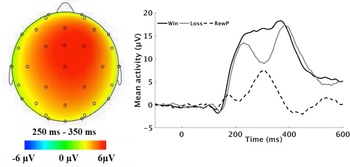
Continuous EEG was recorded during the task using the ActiveTwo BioSemi system (BioSemi, Amsterdam, Netherlands). This system uses a 32 standard electrode cap with FCz and Iz added, totaling 34 electrodes. One electrode was placed on each mastoid. The EEG signal was pre-amplified at the electrode to improve the signal-to-noise ratio. To account for ocular artifacts that result from eye blinks and other eye movements, electrooculargram (EOG) signals were recorded from two electrodes placed 1 cm above and below the right eye to measure vertical eye blinks and movements and two electrodes placed 1 cm beyond the outer edge of each eye to measure horizontal eye blinks and movements. The data were digitized at 24-bit resolution with a least significant bit value of 31.25 nV and a sampling rate of 1,024 Hz. The voltage from each active electrode was referenced online with respect to a common mode sense active electrode. Off-line analyses were performed using Brain Vision Analyzer 2 software (Brain Products, Gilching, Germany). Data were re-referenced to the average of the two mastoids and high-pass (.1 Hz) and low-pass (30 Hz) filtered. Standard eyeblink and ocular corrections were performed (Miller, Gratton, & Yee, Reference Miller, Gratton and Yee1988), and semiautomated artifact rejection procedures removed artifacts with the following criteria: voltage step of more than 50 μV between sample points, a voltage difference of 300 μV within a trial, and a maximum voltage difference of less than .5 μV within 100 ms intervals. Additional artifacts were removed using visual inspection. Data were baseline corrected using the 200 ms interval prior to feedback. ERPs were averaged across gain and loss trials and the RewP was scored as the mean amplitude 250–350 ms following feedback at a pooling of FCz, Fz, and Cz sites where the gain minus the loss difference was maximal (Figure 1). Consistent with previous research (Proudfit, Reference Proudfit2015; Proudfit et al., Reference Proudfit, Bress, Foti, Kujawa and Klein2015), analyses focused on the gain minus loss difference score (RewP); more positive values for the difference score indicate greater reactivity to reward feedback. The average number of included trials following artifact rejection across participants was 18.56 for win and 18.49 for loss trials. HR and LR groups did not differ in the average number of win (t (94) = .01, p = .99) or loss (t (94) = −.19, p = .85) trials. Split-half reliabilities were computed by separating each subject's available trials into odd and even trials, conducting a Pearson correlation between the mean amplitudes of odd and even trials, and then adjusting the correlation using the Spearman–Brown prophecy formula to obtain an internal consistency estimate. The reliabilities were the following: win (r = .68), loss (r = .55), and RewP (r = .51).
The topographic map of neural activity (gain minus loss) and response-locked event-related potential (ERP) waveforms at an average Cz, FCz, Fz across the entire sample. The raw waveforms for gain and loss responses and the gain minus loss difference score (RewP; dotted line) are shown in the graph. More positive values for the difference score indicate greater reactivity to reward feedback.

Data analytic plan
We utilized SPSS Version 27 for our analyses and conducted a series of multilevel mixed models to test the relations between childhood maltreatment history and group, and their interaction in relation to RewP. Because some of the data were interdependent, we utilized multilevel mixed modeling with restricted maximum likelihood estimator, which allowed for the shared variance between the biological sibling pairs to be modeled. We accomplished this by creating a unique family identification variable for each participant while each pair of siblings had the same family identification number because they were in the same family unit. This variable was included as a random factor in all of the models. Children's depressive symptoms, age, and gender were entered as covariates in the model. The mean-centered continuous variables, gender, and group were entered as fixed factors for all analyses. The CTQ variable was positively skewed and therefore we performed a log transformation to reduce skewness. There was also an outlier on the CTQ variable (>3.5 SDs from the centered mean). We re-ran the models after winsorizing the case to 3 SDs above the mean and the results were maintained. We chose to retain the original value of the case in the analyses to maintain the integrity of the original data. The interaction variable was computed by multiplying the mean-centered log transformed CTQ and dichotomous group variable. In addition, there were four youth in the HR group that had histories of past MDD. All the analyses were reconducted, excluding these youth with a history of MDD, to determine whether youth MDD history could be influencing the results. All findings were maintained when we excluded these four youth with histories of MDD from our models. We chose to include them in the analyses to retain the full sample.
Results
Demographic characteristics
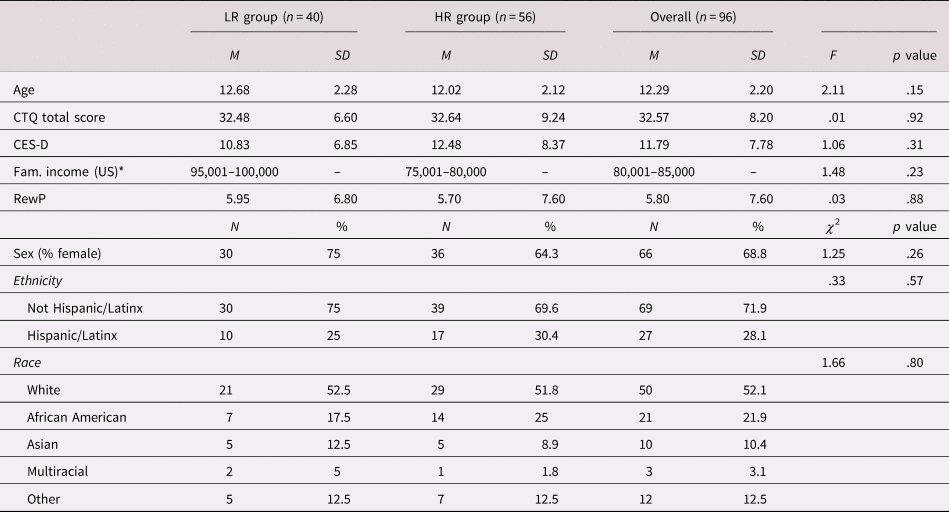
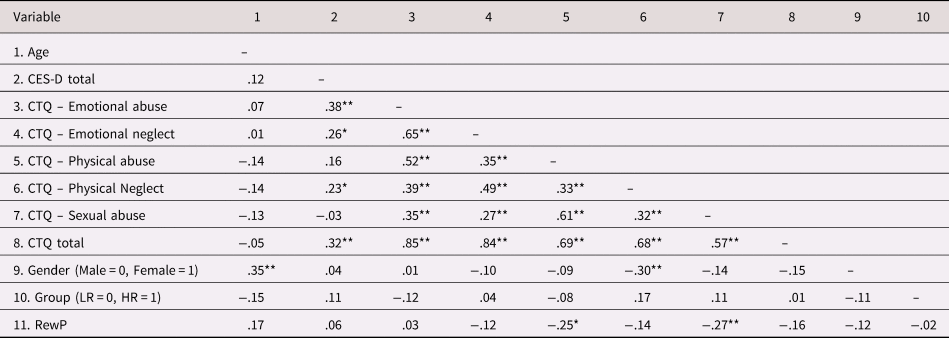
Descriptive and group comparison analyses were conducted with SPSS Version 27 (IBM Corp., Armonk, N.Y., USA). Table 1 shows the means and standard deviations of study variables per HR and LR group and for the overall sample. As shown in Table 1, the HR and LR groups did not differ significantly on any demographic, clinical, or ERP variables. Table 2 displays the correlations among study variables across the full sample.
Demographic characteristics

Note. SD = standard deviation; RewP = reward positivity. *The median is reported for family income.
Correlations among the variables in the study
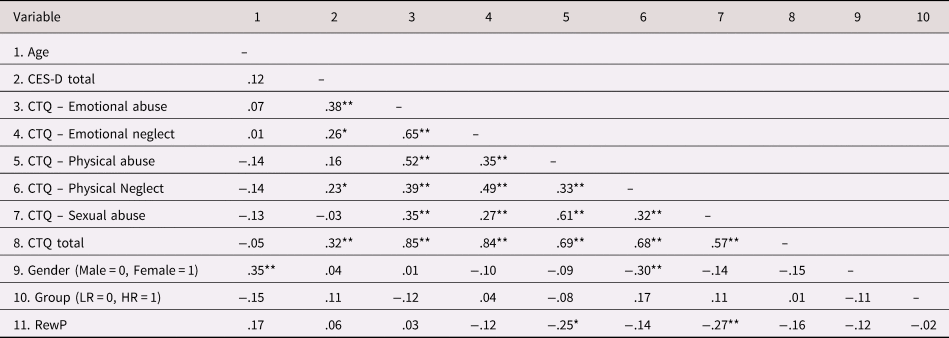
Note. CES-D = Center for Epidemiological Studies Depression Scale. CTQ = Childhood Maltreatment Questionnaire. LR = low risk. HR = high risk. RewP = reward positivity. *p < .05, **p < .01.
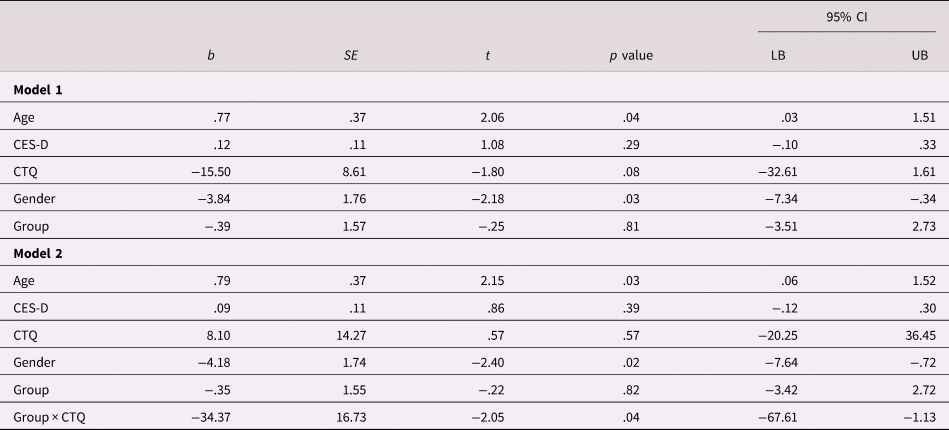
In our first multilevel mixed model, we examined the main effects of group and childhood maltreatment in relation to RewP. There was a trend level main effect of childhood maltreatment on RewP such that greater childhood maltreatment severity was marginally associated with reduced RewP amplitudes (b = −15.50, SE = 8.61, t = −1.80, p = .08, 95% confidence interval [CI] −32.61, 1.61). There was not a significant main effect of risk group on RewP (b = −.39, SE = 1.57, t = −.25, p = .81, 95% CI −3.51, 2.73). Gender was significantly associated with RewP, such that girls demonstrated a more blunted RewP relative to boys (b = −3.84, SE = 1.76, t = −2.18, p = .03, 95% CI −7.34, −.34). Age was positively associated with RewP response (b = .77, SE = .37, t = 2.06, p = .04, 95% CI .03, 1.51). Youth current depressive symptoms were not significantly associated with RewP (b = .12, SE = .11, t = 1.08, p = .29, 95% CI −.10, .33).
In the next model, we included the two-way interaction between childhood maltreatment and risk group in relation to RewP. The two-way interaction between childhood maltreatment and group on RewP was significant (b = −34.37, SE = 16.73, t = −2.05, p = .04, 95% CI −67.61, −1.13). See Table 3 for all the results.
Multilevel mixed model results
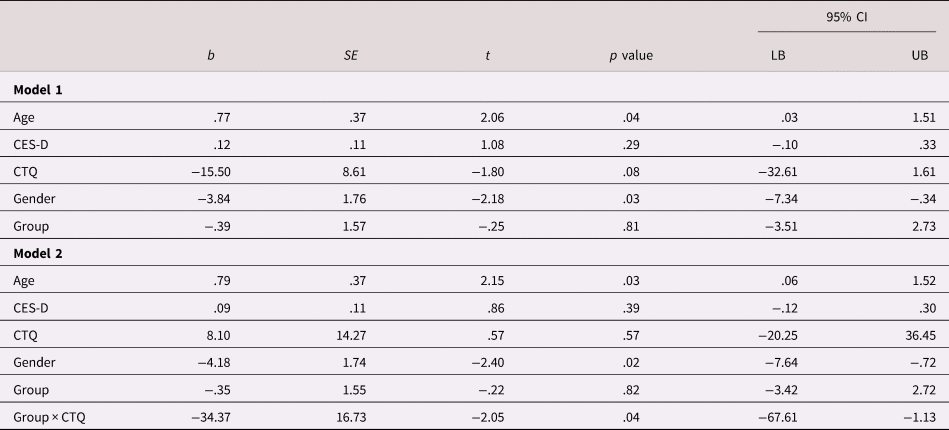
Note. CTQ = Childhood Trauma Questionnaire. CES-D = Center for Epidemiological Studies Depression Scale. LB = Lower Bound. UB = Upper Bound.
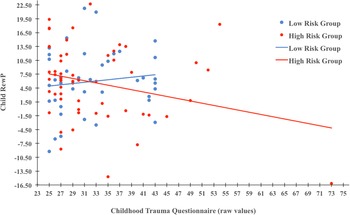
The two-way significant interaction effect between childhood maltreatment and risk group in association with RewP was followed up with a simple slope analysis. Risk group was set as the moderator. The simple slope for the HR and LR groups were plotted at ±1 SD from the centered mean on the CTQ. For the LR group, the relation between childhood maltreatment severity and RewP response was not significant (b = 8.10, t = .57, p = .57). In contrast, in the HR group, greater childhood maltreatment severity was significantly associated with a reduced RewP response (e.g., blunted reward responsiveness, b = −26.27, t = −2.64, p = .01). Figure 2 depicts the association between the CTQ (raw values) and the RewP by group.
Plot of the significant childhood maltreatment × group interaction on youth's reward positivity (reward positivity (RewP). CTQ = childhood trauma questionnaire. Cases and simple slopes are colored coded by group status. Blue indicates the low-risk (LR) group and red indicates the high-risk (HR) group.

Discussion
Our findings are consistent with the National Institute of Mental Health (NIMH) Research Domain Criteria (RDoC) framework, which emphasizes that reward processing and responsiveness are shaped by environmental experiences and likely act as a potential biological mechanism that underlies the development of depression (Insel et al., Reference Insel, Cuthbert, Garvey, Heinssen, Pine, Quinn and Wang2010; Shankman & Gorka, Reference Shankman and Gorka2015). A growing body of literature has demonstrated that environmental stressors, such as childhood maltreatment and a family history of depression, are implicated in altered reward responsiveness, measured via fMRI and the RewP ERP component, which potentially predates the onset of MDD in HR youth (for reviews, Kujawa et al., Reference Kujawa, Klein, Pegg and Weinberg2020; Kujawa & Burkhouse, Reference Kujawa and Burkhouse2017). In the current study, we did not observe main effects of childhood maltreatment and maternal depression history on RewP, as the RewP findings were driven by their interaction. Specifically, we found that an attenuated RewP was only observed when youth had experienced childhood maltreatment and had mothers with a history of MDD. Critically, our results were maintained while statistically adjusting for children's current levels of depressive symptoms and when excluding the four youth in the study with a lifetime history of MDD, suggesting the results were not simply a consequence of children's own depression. Together, the current findings suggest that the relation between childhood maltreatment history and patterns of reduced reward responsiveness in youth may depend on whether youth have mothers with a history of major depression and can be detected before the onset of major depression.
It is important to note that some of our results are inconsistent with some research that has shown that children of mothers with lifetime histories of depression demonstrate an attenuated RewP compared to children of mothers with no history of depression (Kujawa et al., Reference Kujawa, Proudfit and Klein2014). However, a couple of heritability studies have only found moderate positive correlations between the RewP of siblings (Silverman et al., Reference Silverman, Krueger, Iacono, Malone, Hunt and Thomas2014) and between parental and offspring RewP (Moser, Fisher, Hicks, Zucker, & Durbin, Reference Moser, Fisher, Hicks, Zucker and Durbin2018). These prior findings could indicate that it is the interplay of psychosocial risk process that lead to individual differences in RewP patterns. Moreover, consistent diathesis–stress/dual-risk frameworks (e.g., Monroe & Simons, Reference Monroe and Simons1991; Sameroff, Reference Sameroff, Mussen and Kessen1983; Zuckerman, Reference Zuckerman and Zuckerman1999, our findings may suggest that maternal depression history reflects a hereditary predisposition for blunted reward responsiveness that only manifests when an individual has experienced high levels of psychosocial adversity, such as childhood maltreatment.
Differences in parenting styles may also represent a mechanism implicated in pathways to altered reward responsiveness. For instance, maternal depression has been linked to maladaptive parenting styles (e.g., harsh, critical, disengaged; Lovejoy, Graczyk, O'Hare, & Neuman, Reference Lovejoy, Graczyk, O'Hare and Neuman2000), even after maternal depression has remitted (e.g., for review, Goodman et al., Reference Goodman, Rouse, Connell, Broth, Hall and Heyward2011). Indeed, parenting styles have been shown to moderate links between maternal history of depression and RewP response in youth (Kujawa, Proudfit, Laptook, & Klein, Reference Kujawa, Proudfit, Laptook and Klein2015). Interestingly, despite documented significant relations between parental maltreatment, parenting styles, and depression history (Kaplan, Sunday, Labruna, Pelcovitz, & Salzinger, Reference Kaplan, Sunday, Labruna, Pelcovitz and Salzinger2009; Michl-Petzing, Handley, Sturge-Apple, Cicchetti, & Toth, Reference Michl-Petzing, Handley, Sturge-Apple, Cicchetti and Toth2019), the current study did not observe a correlation between maternal depression history and childhood maltreatment, which may be attributed to the inclusion of a community sample of youth versus a more severe sample of families involved in Childhood Protective Services. Alternatively, other work suggests that maternal depression does not independently predict maltreatment or negative parenting practices, rather in many cases there are other moderating variables (e.g., child characteristics and psychopathology, maternal aggression) that play a role in these associations (Frye & Garber, Reference Frye and Garber2005; Hentges et al., Reference Hentges, Graham, Plamondon, Tough and Madigan2021; Sellers et al., Reference Sellers, Harold, Elam, Rhoades, Potter, Mars and Collishaw2014). Relatedly, another explanation for the results is that more adaptive parenting techniques (i.e., parental warmth) may have been more prevalent in LR offspring, which may have buffered against the negative consequences of childhood maltreatment and an altered RewP response. Consistent with this possibility, risk groups reported similar rates of childhood maltreatment experiences, which could suggest the presence of protective factors such as positive parenting. Indeed a large body of research has shown that sensitive and responsive parenting protects children from the effects of early adversity (Buckner, Mezzacappa, & Beardslee, Reference Buckner, Mezzacappa and Beardslee2003; Miller et al., Reference Miller, Lachman, Chen, Gruenewald, Karlamangla and Seeman2011; Suor, Sturge-Apple, Davies, Cicchetti, & Manning, Reference Suor, Sturge-Apple, Davies, Cicchetti and Manning2015). Future studies are needed to evaluate the role of parenting styles in pathways of maternal depression, childhood maltreatment, and RewP response.
As noted above, current depressive symptoms among youth were not significantly related to RewP. Of note, youth were recruited for depression risk and current or past histories of MDD were exclusionary criteria for one of the studies from which participants were drawn. Examination of the CES-D scores demonstrated that the majority of youth across the groups had total scores below the clinical cut-off (<16), which likely accounts for why we did not observe an association between youth depressive symptoms and individual differences in RewP. Nonetheless, it will be crucial for future work to examine these associations among a sample of currently depressed youth to determine whether the combination of maternal depression history and childhood maltreatment is associated with blunted reward processing.
Limitations
The current study represents the first to examine the interactive effects between childhood maltreatment and maternal depression in relation to neural reward responsiveness in a sample of youth enriched for depression vulnerability and with maltreatment histories across HR and LR groups. Despite these strengths, there were several limitations that are important to consider when interpreting the results. First, the current study was correlational and cross-sectional; and therefore, causality and temporal associations cannot be established. Next, our study focused on two sociocontextual and familial risk factors associated with individual differences in reward processing. There are likely other mechanisms that contribute to reduced reward processing that were not examined in the present study, including other parenting styles, child traits (e.g., negative emotionality, inhibitory control), and maternal neural vulnerabilities that increase risk for pathogenic parenting practices (e.g., blunted RewP, aggression), and biological (e.g., inflammation) processes that are likely associated with blunted reward responsiveness in youth (e.g., Kujawa et al., Reference Kujawa, Klein, Pegg and Weinberg2020). Investigations of additional biological, behavioral, and environmental factors that could contribute to individual differences in reward processing styles in youth and predate the onset of depression are important future directions for increasing nuance and further precision in developmental models. Future studies might also benefit from examining the interactive effects between specific dimensions of maltreatment, such as threat (i.e., physical, emotional, and sexual) and deprivation (i.e., emotional and physical neglect) and reward responsiveness. Some work employing the threat-deprivation model (McLaughlin, Sheridan, & Lambert, Reference McLaughlin, Sheridan and Lambert2014; Sheridan & McLaughlin, Reference Sheridan and McLaughlin2014) has found differential effects of threat and deprivation forms of maltreatment on neurobiological outcomes (for review, McLaughlin, Weissman, & Bitrán, Reference McLaughlin, Weissman and Bitrán2019). We were unable to examine this in our current study due to the moderately high correlations between threat and deprivation forms of maltreatment (r = .61, p < .01), which demonstrated multicollinearity when we formed threat (physical abuse, sexual abuse, emotional abuse subscales) and deprivation (physical neglect, emotional neglect) constructs derived from the CTQ subscales and included them in our analytic models (variance inflation factors >5). Indeed, to adequately test the threat-deprivation model or examine whether specific types of maltreatment drive rewarding processing patterns, additional assessments of childhood maltreatment are required given potential effects of shared method variance from using a single measure. However, it has been well-documented that youth exposed to maltreatment more often than not experience multiple, versus isolated, forms of abuse or neglect (Cecil, Viding, Fearon, Glaser, & McCrory, Reference Cecil, Viding, Fearon, Glaser and McCrory2017; Edwards, Holden, Felitti, & Anda, Reference Edwards, Holden, Felitti and Anda2003; Warmingham, Handley, Rogosch, Manly, & Cicchetti, Reference Warmingham, Handley, Rogosch, Manly and Cicchetti2019) and therefore identifying specificity in effects may be challenging. Nonetheless, it will be important for other studies to use a multi-method approach (e.g., structured interviews, coding of Child Protective Services records, and self-report) to explore the presence of unique effects and evaluate the threat-deprivation model in relation to reward processing styles in youth.
The sample of the current study was moderate in size. Therefore, it will be important for future work to determine if findings can be reproduced in larger samples of youth. Indeed, big data, cumulative science approaches could be particularly useful for fine-tuning the understanding of neural profiles of risk implicated in depression vulnerability (Luby et al., Reference Luby, Allen, Estabrook, Pine, Rogers, Krogh-Jespersen and Wakschlag2019). The HR group was heterogeneous in terms of maternal depression history. Although the majority of mothers had histories of recurrent MDD (84% had ≥ 2 major depressive episodes) there were nine mothers that had only experienced a single major depressive episode. Although most mothers in the study were in remission, there were a small number of mothers (n = 8) who met criteria for current MDD. Moreover, other characteristics of maternal MDD were not assessed in the current study (e.g., duration and total number of episodes of MDD beyond confirming recurrent MDD). Although studies in this area have been scarce, some recent neuroimaging research has suggested that timing and chronicity of maternal depression might exert differential impacts on processing of affective stimuli and neural structures implicated in depression vulnerability (e.g., Wen et al., Reference Wen, Poh, Ni, Chong, Chen, Kwek and Qiu2017), and that more chronic maternal depressive symptoms are associated with increased probability for childhood psychopathology among offspring (e.g., Matijasevich et al., Reference Matijasevich, Murray, Cooper, Anselmi, Barros, Barros and Santos2015). Various characteristics of maternal MDD (single vs. recurrent MDD, current vs. past MDD, duration and severity of MDD) may have an impact on the current findings. Future studies are needed to evaluate potential timing influences on these associations.
Future work should also evaluate the role of paternal psychopathology given research showing paternal depression has a significant and deleterious effect on paternal parenting styles (Wilson & Durbin, Reference Wilson and Durbin2010) and child psychiatric outcomes (Sweeney & MacBeth, Reference Sweeney and MacBeth2016). Next, a small number of youth in the HR group (n = 4) had experienced a past major depressive episode. An accumulating amount of evidence does suggest that reduced reward responsiveness to feedback predates the onset of depression in youth (Forbes, Shaw, & Dahl, Reference Forbes, Shaw and Dahl2007; Kujawa & Burkhouse, Reference Kujawa and Burkhouse2017; Rawal, Collishaw, Thapar, & Rice, Reference Rawal, Collishaw, Thapar and Rice2013) and distinguishes those with family histories of depression from those without family histories (e.g., Gotlib & Joormann, Reference Gotlib and Joormann2010). Nonetheless, longitudinal studies that follow at-risk children across multiple developmental periods are needed to establish temporal linkages among environmental and familial risk factors, neural reward processing, and depression vulnerability. Finally, split-half reliability analyses suggested that the RewP demonstrated lower reliability relative to the win and loss variables. This is consistent with prior studies showing that difference and residual scores exhibit lower internal consistency across ERP and fMRI methods relative to raw estimates of win and loss (Luking et al., Reference Luking, Nelson, Infantolino, Sauder and Hajcak2017). Given this, replication of the current results is recommended. Future studies may benefit from the inclusion of additional win and loss trials to increase internal consistency estimates across participants.
Conclusion
In sum, this study represents a methodological advance from previous work which in large part has employed single variable main effect analyses in examining the potential impact of specific family risk processes (e.g., childhood trauma, maternal depression) on RewP (Kujawa et al., Reference Kujawa, Proudfit and Klein2014) and activation in reward-relevant brain structures (e.g., Hanson et al., Reference Hanson, Hariri and Williamson2015; Luking et al., Reference Luking, Pagliaccio, Luby and Barch2016; Romens et al., Reference Romens, Casement, McAloon, Keenan, Hipwell, Guyer and Forbes2015). In addition the present study also advances knowledge in the RewP literature as prior studies have only examined how individual differences in RewP might moderate the impact of stressful life experiences on depression outcomes (e.g., Burani et al., Reference Burani, Klawohn, Levinson, Klein, Nelson and Hajcak2021; Goldstein et al., Reference Goldstein, Kessel, Kujawa, Finsaas, Davila, Hajcak and Klein2020; Pegg et al., Reference Pegg, Ethridge, Shields, Slavich, Weinberg and Kujawa2019) rather than examining how RewP patterns might be driven by the interaction of psychosocial risk processes and emerge before adolescent depression onset.
Lastly, in terms of potential clinical implications, recent evidence indicates that biological markers may enhance the prediction of mental health outcomes and treatment response when combined with behavioral assessments (Gabrieli, Ghosh, & Whitfield-Gabrieli, Reference Gabrieli, Ghosh and Whitfield-Gabrieli2015), which supports the potential utility of EEG in clinical neuroscience research. Applied to the current study, incorporating a measure of RewP in conjunction with more traditional assessments (self-report) of reward responsiveness could lead to novel ways to target reward processing styles more effectively in treatment. One advantage of ERP methodology relative to other neuroimaging methods is that it is less expensive and well tolerated by children of all ages, which increases its potential feasibility for implementation in clinical settings (Brooker et al., Reference Brooker, Bates, Buss, Canen, Dennis-Tiwary, Gatzke-Kopp and Schmidt2019; Kujawa et al., Reference Kujawa, Hajcak and Klein2019, Reference Kujawa, Klein, Pegg and Weinberg2020). Future interventions aimed at enhancing RewP may be beneficial for youth at risk for depression due to childhood maltreatment and family histories of depression.
Acknowledgments
The content is solely the responsibility of the authors and does not necessarily represent the official views of the National Institutes of Health, Klingenstein Third Generation Foundation, and Brain and Behavior Foundation. We are much appreciative of the mothers and children who participated in this project. We also thank the students and staff on the project, including: Kaveh Afshar, Sophia Chervak, Nicholas Defelice, Hannah Duttweiler, Bailey V. Hamner, Shannon Karich, Gabrielle Munoz, and Jaime Sosa.
Funding Statement
The research reported in this publication was supported by awards from the National Institute of Mental Health [K23-MH113793 award] to KLB and F32-HD100075 award from the National Institute of Child Health and Human Development [F32-HD100075] to JHS. Research is also supported by grants from the Klingenstein Third Generation Foundation and Brain and Behavior Research Foundation awarded to KLB and by the National Center for Advancing Translational Sciences, National Institutes of Health, through Grant UL1TR002003.
Conflicts of Interest
None.