Introduction
Fasciolosis is a zoonotic parasitic disease caused by the liver flukes Fasciola hepatica and Fasciola gigantica (Trematoda: Digenea). This helminthic disease is of worldwide distribution (Mas-Coma et al., Reference Mas-Coma, Valero and Bargues2009) and is considered as an important veterinary health problem due to the substantive economic losses it gives rise to livestock husbandry. Moreover, it is of great public health importance in some countries, due to its high pathogenicity (Mas-Coma et al., Reference Mas-Coma, Agramunt and Valero2014) and is therefore included within the group of Foodborne Trematodiases among Neglected Tropical Diseases (NTDs) by the World Health Organization (WHO, 2013).
Fasciola hepatica has a worldwide distribution and F. gigantica is found in tropical climates and restricted to Africa, the Middle East and South and East Asia. In America, fasciolosis is caused by F. hepatica and transmitted by many different intermediate snail hosts belonging to the family Lymnaeidae, mainly species included within the Galba/Fossaria group. In South America, human endemic areas have been described in Andean regions, mainly in highlands of Bolivia, Peru and Chile, and sporadic cases are reported in other countries (Mas-Coma, Reference Mas-Coma2005; World Health Organization, 2013; Carmona and Tort, Reference Carmona and Tort2016).
It is generally assumed that entry of F. hepatica to America coincided with the first arrival of the Europeans and their associated livestock in the late 15th century. Throughout the 500 years since its introduction, the parasite gained new definitive hosts among native species. The South American camelids – llamas, alpacas, vicuñas and guanacos – the natural livestock of the Andean region, might have represented the first to be parasitized, since these species would graze along with the introduced livestock (Mas-Coma et al., Reference Mas-Coma, Valero and Bargues2009; Bargues et al., Reference Bargues, Gayo, Sanchis, Artigas, Khoubbane, Birriel and Mas-Coma2017). The parasite is now widespread in livestock and can be mapped across the whole South America and certain regions of North America.
Argentina has a large livestock production, where sheep and cattle constitute important economic sources. Animal fasciolosis is currently found in spots across the country, according to official slaughterhouses, and the most important hosts are cattle and sheep. Goats, horses, pigs and some wild native and non-native mammals (deer, vicuña, guanacos, llamas, rabbits, hares and capybaras) are also found infected by F. hepatica. Despite the fragmented and anecdotal nature of several reports of liver flukes in South American wildlife, it is evident that diverse species can host the parasite and eventually act as reservoirs (Issia et al., Reference Issia, Pietrokovsky, Sousa-Figueiredo, Russell Stothard and Wisnivesky-Colli2009; Carmona and Tort, Reference Carmona and Tort2016).
Given the medical and veterinary importance of fasciolosis, there are several multidisciplinary studies investigating parasite origins and dispersals across the world; shared objectives include elucidation of palaeobiogeographical origins and colonization within and between continents (Mas-Coma et al., Reference Mas-Coma, Valero and Bargues2009).
Palaeoparasitology is the study of parasite remains from archaeological and palaeontological sites (Ferreira, Reference Ferreira, Ferreira, Reinhard and Araújo2014), focused on the knowledge of parasite-induced illness of humans in the past and on the palaeoecological knowledge of the environment, ecology, settlement, diet, hygiene and health in the antiquity (Reinhard, Reference Reinhard1992). In a previous palaeoparasitological study, digenean eggs similar to F. hepatica were found in coprolites from one of the two endemic species of deer inhabiting the narrow Andean-Patagonian temperate forest strip in the west of southern America, the southern pudú (Pudu puda) and the huemul (Hippocamelus bisulcus). The samples were obtained from an archaeological site of Patagonia named ‘Cueva Parque Diana’ (CPD) and were dated around 2300 years B.P. (Late Holocene) (Beltrame et al., Reference Beltrame, Tietze, Pérez and Sardella2017). In order to contribute with the study of the palaeobiogeographical origins of F. hepatica and their settlement across America, the main objective of the present study is to identify the digenean eggs found from CPD from an ancient DNA (aDNA) study.
Material and methods
Sample collection
In a previous study (Beltrame et al., Reference Beltrame, Tietze, Pérez and Sardella2017), 34 coprolites were processed for palaeoparasitological purposes. Coprolites belonged to native deer identified as P. puda or H. bisulcus. Samples were collected from the CPD archaeological site, Lanín National Park, North Patagonia, Argentina (40°19′93″S, 71°20′74″W). This site is a rock shelter part of the archaeological locality named Meliquina. It is located at 964 m.a.s.l. and 50 m close to the Hermoso River. The archaeological sequence was divided into three components representing different hunter–gatherer occupation processes. The Upper Component was dated between 760 ± 60 and 580 ± 60 14C years B.P. (vegetal charcoal), the Middle Component was dated between 990 ± 60 and 900 ± 60 14C years B.P. (vegetal charcoal) and the Lower Component was dated at 2370 ± 70 14C years B.P. (vegetal charcoal). The site was occupied by hunters–gatherers and fishermen along the late Holocene (Pérez, Reference Pérez2010; Pérez et al., Reference Pérez, Aguirre and Graziano2015). The weather in the area is cold and wet, with annual precipitations around 1500–2000 mm.
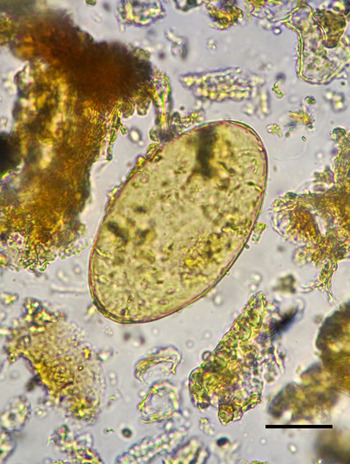
Eighteen of the 34 samples were positive for digenean eggs. Positive coprolites were found in the upper, middle and lower components. The analysed eggs (Fig. 1) in this study belong to two positive samples studied in Beltrame et al. (Reference Beltrame, Tietze, Pérez and Sardella2017) from the lower component. The eggs were identified under a light microscope (100× magnification) and were manually isolated by the use of a micropipette and stored in PCR tubes with phosphate-buffered saline. The isolated eggs were used for aDNA extraction, amplification and sequencing of partial regions from the cytochrome c oxidase subunit 1 (COI) and the nicotinamide adenine dinucleotide dehydrogenase subunit 1 (NADHI) mitochondrial genes.
Ancient trematode egg found from deer coprolites from ‘Cueva Parque Diana’ archaeological site, Patagonia, Argentina. Bar = 40 μm.

aDNA extraction and polymerase chain reaction amplification
Before DNA extraction, 30 eggs were washed three times in ultrapure water (Invitrogen by Thermo Fisher Scientific, Waltham, MA, USA). Once washed, a first disruption step was performed by five continuous cycles of freezing (immersion in liquid nitrogen for 10 s) and heating (immersion of the tube in boiling water for 2–3 s).
DNA was extracted using the ZR Fecal DNA Miniprep kit (Zymo Research, Irvine, CA, USA), following the manufacturer's instructions. PCR reactions were individually carried out for each partial fragment of the mtDNA genes coding for NADHI and COI. Each reaction was constituted into a final volume of 50 μL, containing 37.5 μL of ultrapure distilled water (Invitrogen), 5 μL of 10× buffer, 4.5 μL of PCR mix containing 1 mmol of MgCl2, (2 μL) 0.2 mm of DNTPs (1 μL), 50 pmol of each primer (1 μL) and 2.5 U of Taq Polymerase (0.5 μL) (all reagents from Invitrogen), plus 3 μL of each template. PCR primers and temperature settings were previously described by Ichikawa and Itagaki (Reference Ichikawa and Itagaki2012) for NADHI and COI. The primers’ sequences were 5′-AAGGATGTTGCTTTGTCGTGG-3′ (forward), 5′-GGAGTACGGTTACATTCACA-3´ (reverse), for NADHI, and 5′-ACGTTGGATCATAAGCGTGT-3′ (forward), 5′-CCTCATCCAACATAACCTCT-3′ (reverse), for COI. Negative controls (ultrapure water and PCR reagents) were also ran along with templates amplification.
Amplicons were visualized in 2% agarose gels stained with SybrSafe (Invitrogen) using a blue light transilluminator (Safe Imager, Invitrogen), and purified by a commercial kit (DNA Clean & Concentrator-5, Zymo Research), according to the manufacturer's instructions. Purified PCR products were elected into 10 μL and submitted to Macrogen's sequencing service (Seoul, Korea), for capillary electrophoretic sequencing using the same primers as for the PCR reactions. Once available, the sequences were submitted to the GenBank database (NCBI).
Data analysis
Electropherograms were scored and analysed using Chromas2.01 (Technelysium, Helensvale, QLD, Australia) and aligned using CLUSTALW2 (Larkin et al., Reference Larkin, Blackshields, Brown, Chenna, McGettigan, McWilliam, Valentin, Wallace, Wilm, Lopez, Thompson, Gibson and Higgins2007) in MEGA 7.0.26 (Kumar et al., Reference Kumar, Stecher and Tamura2016) using default settings. Homologies were performed using the BLASTN programme from the National Center for Biotechnology Information website (http://www.ncbi.nlm.nih.gov/BLAST).
In order to prove the phylogenetic identity, our mitochondrial partial sequences of aDNA from COI and NADHI were compared with the corresponding mitochondrial sequences of COI and NADHI of current individuals of F. hepatica. These last mitochondrial sequences of both molecular markers correspond to the following GenBank accession numbers: KR422380–KR422388, MG870561, MG870563–MG870566, MG870568–MG870570, MG987190, MG9871902, LC273097, LC273100, LC273110, LC273111 and LC273113 from COI; and LC273198–LC273202, MG972375–MG972379, MG972405–MG972409, LC076246, LC076249, LC076255, LC076259, LC076261, KR422389–KR422393 and KJ852771 from NADHI. Both COI and NADHI sequences were selected from several continental regions in order to include a broad representation of genetic diversity of these parasites characterized by a wide distribution worldwide. As out-groups we used mitochondrial sequences from two species of the family Fasciolidae (F. gigantica and Fascioloides magna); with the GenBank accession numbers AB385622, AB385621, AB385620, AB207176, AB207181, EF534996, EF534997 and EF534998 from COI; and MG972405, MG972406, MG972407, MG972408, MG972409, EF534999 and EF535000 from NADHI.
Phylogenetic inferences
We used jModelTest (Darriba et al., Reference Darriba, Taboada, Doallo and Posada2012) to infer the best-fit substitution model for both sets of data (COI and NADHI). To assess the robustness of parameter estimates, four independent chains were run with identical settings. Log-files were analysed in Tracer v1.7.1 (Rambaut et al., Reference Rambaut, Drummond, Xie, Baele and Suchard2018) and effective sample sizes were used to evaluate Markov chain Monte Carlo (MCMC) convergence within chains. We used the most credible substitution models in both cases: the HKY + G substitution model with four γ categories was performed for the COI dataset, and the HKY + I substitution model was performed for the NADHI dataset, using in each case a Yule branching rate prior, with rate variation across branches assumed to be uncorrelated and log-normally distributed (Drummond et al., Reference Drummond, Ho, Phillips and Rambaut2006).
We constructed a Bayesian phylogenetic tree using BEAST v2.5.2 (Bouckaert et al., Reference Bouckaert, Vaughan, Barido-Sottani, Duchêne, Fourment, Gavryushkina, Heled, Jones, Kühnert, De Maio, Matschiner, Mendes, Müller, Ogilvie, du Plessis, Popinga, Rambaut, Rasmussen, Siveroni, Suchard, Wu, Xie, Zhang, Stadler and Drummond2019), which employs a Bayesian MCMC approach. Each MCMC chain was run for 107 iterations (with a burn-in of 50% of the total chains), with parameters sampled every 1000 steps. For comparison, three independent MCMC runs were performed to validate the topology of each phylogenetic tree. Examination of MCMC samples using Tracer v1.7.1 (Rambaut et al., Reference Rambaut, Drummond, Xie, Baele and Suchard2018) suggested that the independent chains were each adequately sampling the same probability distribution and effective sample sizes for all parameters of interest were >500, conditions suggested by the authors for the proper functioning of the analysis.
A phylogenetic tree was also constructed using a maximum likelihood approach (ML) implemented in MEGA7 (Kumar et al., Reference Kumar, Stecher and Tamura2016), considering the same out-groups used in the Bayesian phylogenetic inference. The programme implements simultaneous Nearest Neighbor Interchanges (NNIs) to improve a reasonable topology of the starting tree. The final run of MEGA7 considered the best substitution model inferred by jModeltest (see above; Darriba et al., Reference Darriba, Taboada, Doallo and Posada2012), where both the transitions/transversions ratio and γ distribution parameter were empirically estimated. Consistency for internal branch and nodes was assessed using the standard bootstrapping method (sample with replacement, 1000 bootstrap replicates) implemented in MEGA7.
Results
The morphological observations of the ancient eggs indicated that they all belonged to the same trematode. The eggs were ovoid, operculated, brown-yellowish and thin-shelled. The length (n = 102) ranged from was 131.7 ± 7.82 μm (range = 120.0–147.5) and the width was 72.8 ± 5.96 μm (range = 62.5–87.5). Eggs were well-preserved and were identified as Class Trematoda, Subclass Digenea, Family Fasciolidae, possibly F. hepatica. The PCR analysis, elicited bands of ~600 and 550 bp for NADHI and COI, in concordance with controls of F. hepatica and previous reports (Ichikawa and Itagaki, Reference Ichikawa and Itagaki2012). The sequences were assigned with the accession numbers MN207487 and MN207488 for COI and NADHI, respectively. Final alignments represented smaller fragments of 417 bp from NADHI, and 350 bp from COI, compared to the length of the PCR band. Compared to the whole mitochondrial genes (Le et al., Reference Le, Blair, Agatsuma, Humair, Campbell, Iwagami, Littlewood, Peacock, Johnston, Bartley, Rollinson, Herniou, Zarlenga and McManus2000), our 417 bp partial sequence included positions 99–516 of the NADHI gene, and the 350 bp partial sequence included the bases 15–365 of the COI gene. Non-indels or gaps were detected neither for NADHI nor COI when we compared our target sequence and the other sequences of this analysis.
In both cases, these genes showed 100% of identity compared to some of the GenBank's records of F. hepatica (NCBI nucleotide Blast: https://blast.ncbi.nlm.nih.gov/Blast.cgi).
The phylogenetic inferences (ML and Bayesian) strongly support the hypothesis that our target sequences of deer effectively correspond to F. hepatica (Fig. 2). In our phylogenetic tree, these two sequences of mitochondrial aDNA were clearly included within the clade of F. hepatica, showing high node supports using both phylogenetic inferences. Also, these sequences showed high genetic distances relative to F. gigantica and F. magna within the phylogenetic tree.
The evolutionary history was inferred by using the ML method (values of the nodes are given in percentage) and the Bayesian phylogenetic inference (values of the nodes are given in posterior probabilities) based on the Hasegawa–Kishino–Yano model + G for COI (A), and on the Hasegawa–Kishino–Yano model + I for NADHI (B) (Tamura and Nei, Reference Tamura and Nei1993). For the ML tree, initial tree(s) for the heuristic search were obtained automatically by applying Neighbor-Join and BioNJ algorithms to a matrix of pairwise distances estimated using the Maximum Composite Likelihood (MCL) approach, and then selecting the topology with superior log likelihood value. The rate variation model allowed for some sites to be evolutionarily invariable ([+I], 39.94% sites). Topology of the tree corresponds to that obtained from Bayesian phylogenetic inference (Drummond and Rambaut, Reference Drummond and Rambaut2007). The tree is drawn to scale, with branch lengths measured in the number of substitutions per site. Fascioloides magna and Fasciola gigantica were selected as out-groups in both phylogenetic trees. The analysis involved 33 nucleotide sequences for COI (350 positions in the final dataset) and 29 nucleotide sequences for NADHI (417 positions in the final dataset). Genebank accession numbers and their geographical origin by countries are given in parenthesis (Ec.: Ecuador; Pol.: Poland; Ir.: Iran; Ar.: Armenia; Pe.: Peru; Eg.: Egypt). Only the geographical origin of the F. hepatica sequences is shown.

Discussion
The sequences of the mitochondrial aDNA used in this study demonstrate that the trematode eggs from native deer coprolites from the CPD archaeological site belong to F. hepatica. The results confirm the presence of this trematode in South America from at least 2300 years B.P. This is the first report and the first aDNA study of F. hepatica in South America prior to the arrival of the European cattle in the 15th century. Previous palaeoparasitological studies have reported the presence of this parasite in Europe and Asia (e.g. Bouchet, Reference Bouchet1995; Bouchet et al., Reference Bouchet, Harter and Le Bailly2003; Dittmar and Teegen, Reference Dittmar and Teegen2003; Askari et al., Reference Askari, Mas-Coma, Bouwman, Boenke, Stöllner, Aali, Rezaiian and Mowlavi2018). The first study that identifies aDNA of Fasciola sp. was made by Søe et al. (Reference Søe, Nejsum, Fredensborg and Kapel2015). In this study, Fasciola sp. eggs were recovered from environmental samples collected at a Viking-age settlement in Viborg, Denmark, dated at 1018–1030 A.D. Ancient DNA studies also were performed from European archaeological sites such as Côté et al. (Reference Côté, Daligault, Pruvost, Bennett, Gorgé, Guimaraes, Capelli, Le Bailly, Geigl and Grange2016) and Søe et al. (Reference Søe, Nejsum, Seersholm, Fredensborg, Habraken, Haase, Hald, Simonsen, Højlund, Blanke and Merkyte2018). In a recent study, Le Bailly et al. (Reference Le Bailly, Goepfert, Prieto, Verano and Dufour2019) found one trematode egg in domestic camelids which could belong to Fasciola recovered from the pre-Hispanic Chimú culture site of Huanchaquito-Las Llamas, Peru. Although its diagnosis has not been confirmed yet, this would correspond to an additional evidence of the presence of the liver fluke genus Fasciola in pre-Hispanic times of America.
The current knowledge of the presence of F. hepatica on current native deer from Patagonia is limited. Some studies reported the presence of F. hepatica in the southern pudú (Cortés, Reference Cortés2006; Bravo Antilef, Reference Bravo Antilef2013) and in the huemul (Díaz and Smith-Fluek, Reference Díaz and Smith-Fluek2000; Serret, Reference Serret2001). It was also registered in the introduced red deer (Cervus elaphus) (Flueck and Smith-Flueck, Reference Flueck and Smith-Flueck2012).
Our COI sequence of aDNA was mostly related with contemporary South American DNA sequences (Ecuador and Peru), and was most distant to DNA sequences from Asia, Africa and Europe. However, the NADHI sequence not only showed a great phylogenetic affinity with sequences of South America, but with Armenia and Egypt (see Fig. 2). The objective of this work was to identify digenean eggs found from deer coprolites from an aDNA study, without a deeper more conclusive evaluation of their possible palaeobiogeographical origin or colonization routes within this continent. In this sense, there are many methodological limitations that hinder the inference about a possible geographical origin of these aDNA sequences reported here, beyond including contemporary DNA samples from various regions of the world in our phylogenetic analyses. In principle, knowledge about the dynamics of migration and colonization of this parasite among different continents seems to be very complex. Demographic patterns of F. hepatica have not only been conditioned by the regional history of domestic animal translocations performed by humans in recent decades, but also to their associations with populations of native mammal species. The latter can lead to confusing the biogeographic and demographic history of F. hepatica at the continental level, especially when the ancient material is compared with current DNA samples. The need for future palaeoparasitological studies around the world is evident in order to contribute to the palaeobiogeographical origin of this trematode.
The fact that F. hepatica was present in America before the arrival of the Europeans in the 15th century indicates that the species was not first introduced by the European cattle during this time, but there was another alternative route of prior entry. At the moment our data do not allow us to propose a plausible hypothesis about the possible entry of F. hepatica to the American continent prior to this period. Future palaeoparasitological studies are needed which should consider the different migratory routes into the American continent in pre-Hispanic times. Evolutionary relationship among F. hepatica and American native hosts, both definitive and intermediate, is an interesting point to be studied in future studies. The pre-Hispanic presence of F. hepatica in South America brings new insights to the common assumption on the palaeobiogeography and settlement of this species.
Financial support
None.
Conflict of interest
None.
Ethical standards
Not applicable.