Management of chronic diseases is a major problem for many health systems around the world. Due to aging populations and severe shortages of nursing and medical resources, meeting the demand for these services is becoming increasingly difficult and onerous. In such an environment, health systems are obliged to make optimal use of human resources and reorganize modes of homecare delivery. To this end, many industrialized countries have established policies to make the shift toward ambulatory care, and many authorities and organizations have strongly recommended homecare for patients with chronic diseases (e.g., 1–3). One important success factor in such transformations is closely associated with the judicious use of information and communication technologies, which are being developed at an ever faster rate (4). As such, telehealth is recognized as a key link in the remote delivery of healthcare services.
Home telemonitoring is one of the main telehealth applications used in Canada (5). Home telemonitoring is the remote transmission (by patients) and collection (by healthcare professionals) of physiological and biological data (such as vital signs and symptoms) and behavioral data (such as compliance with medication and activity level) for the purposes of patient monitoring, data interpretation and clinical decision making (Reference Roine, Ohinmaa and Hailey6). This mode of health delivery can play an important role in the provision of homecare to chronically ill patients. The technological device may serve many purposes. First, it can detect problems, generate alerts (to both the patient and the case manager) and make suggestions to patients on how to adjust their therapeutic plans. It can also reduce measurement entry and transmission errors by having medical technologies such as sphygmomanometers, blood glucose meters and spirometers transmit the electronic data. Depending on the sophistication of the device, it can provide additional benefits, such as improving patient education and empowering patients to manage their own health (Reference Paré, Moqadem, Pineau and St-Hilaire7). If necessary, the case manager can intervene directly by contacting the patient by phone or video conferencing.
Health systems that adopt and disseminate home telemonitoring programs may also obtain major benefits such as less emergency room congestion (Reference Dang, Dimmick and Kelkar8–Reference Paré, Jaana and Sicotte10) and fewer hospitalizations related to chronic illnesses (Reference Paré, Jaana and Sicotte10–Reference Clarke, Shah and Sharma12). Even though a growing number of home telemonitoring programs are already in operation—particularly in North America and Europe—there have been relatively few solid empirical studies on the economic issues surrounding this innovation. The present study attempts to fill this gap.
Background
We consulted the MEDLINE (PubMed interface) and The Cochrane Library databases and found a total of twenty-six systematic reviews on the impacts of home telemonitoring. The search was conducted on July 3, 2012. Review articles that considered multiple types of telehomecare interventions such as home teleconsultation, videoconferencing, home telemonitoring, and telephone-based monitoring, were excluded. Two of these reviews dealt specifically with the issue of economic viability. First, Seto (Reference Seto13) analyzed the existing economic evidence to determine whether home telemonitoring of patients with congestive heart failure results in decreased costs. She analyzed data from a total of ten different home telemonitoring studies. Nine of these studies analyzed the direct costs to the healthcare system. All of them found cost reductions from telemonitoring compared with usual care, ranging from 1.6 percent to 68.3 percent. The cost reductions were mainly associated with savings from reduced expenditures on hospitalizations and, to a lesser extent, home visits. However, these studies varied in how the telemonitoring intervention was implemented, the system defined as usual care, the items included in the economic analysis and the method for comparing costs, the duration of the study, and the sample size. The author concludes that these differences make direct comparisons of the economic analyses difficult and that future economic assessments are required for informed investment decisions.
Second, Polinesa et al. (Reference Polinesa, Coyle, Coyle and McGill14) also reviewed the literature on the cost-effectiveness of home telehealth for chronic disease. Their review included economic assessments such as cost minimization analyses, cost-effectiveness analyses, cost utility analyses and cost benefit analyses. A total of twenty-two empirical studies were found to be relevant for inclusion in the database, most of which were from the United States and a majority focused on patients with congestive heart failure. Half of the included studies (n = Reference Maric, Kaan, Ignaszewski and Lear11) were concerned specifically with home telemonitoring interventions (as defined above) while the other half referred to other forms of home telehealth programs such as telephone case management and video-based nursing consultations. As in the previous review, usual care varied across the studies and the home telehealth interventions tended to be complex, often with differences in more than one facet of patient management in the intervention phase of the study. Most economic studies involved an assessment of the costs associated with specific healthcare resources, including hospitalizations and emergency department visits. The authors found that, in most studies (ten of eleven), home telemonitoring led reduced spending on healthcare resources. However, the overall quality of the economic studies varied considerably, and so was their relevance for decision making.
Of the twenty-four other systematic reviews, five make no mention of the economic issues associated with telehomecare (Reference Paré, Moqadem, Pineau and St-Hilaire7;Reference Polinesa, Tran and Cimon9;Reference Klersy, De Silvestri and Gabutti15–Reference Polinesa, Tran and Cimon17) and the other nineteen deal only superficially with the issue of economic viability, as shown by the data summary presented in Supplementary Table 1, which can be viewed online at www.journals.cambridge.org/thc2013087. All the review articles published in the last 5 years strongly recommend that future research rigorously conduct economic assessments of home telemonitoring.
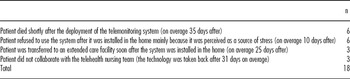
Reasons for Patient Withdrawal

METHODOLOGY
Site
The Jardins-Roussillon health and social services center (hereafter called the JR Health Center) was created in 2004 through the merger of a regional hospital, three local community health services centers as well as eleven residential and long-term care centers. The JR Health Center covers a very large service area in south-western Montérégie, near Montreal, Canada. Home care services represent a major service segment for the JR Health Center, and it has three home support services working out of its local community health services centers. Recent statistics suggest that the number of people over the age of 65 served by the JR Health Center will more than double between 2001 and 2026. In 2011, the home care service at JR Health Center employed sixteen nurse practitioners, eighteen registered nurses, and six licensed practical nurses.
Nature of the Technology and Intervention
The telehomecare program in this study serves elderly clients suffering from a variety of chronic health problems. As for the technology used, the patients were equipped with a tactile screen and an integrated modem (from Telus Health Solutions). The device came programmed with a personalized monitoring protocol that monitored various health parameters, and the nurses taught the patients how to use the device at their initial meeting. On average, a training session last approximately 60 min. Then the patients were expected to send clinical data over an Internet connection each time the data was collected. More specifically, the patient needed to complete a data entry table every day, documenting vital signs, symptoms, and medication taken. The tool was designed to show the patient relationships between his or her health status and the environment, life habits and medication management, thereby empowering him or her to manage his or her illnesses by applying a therapeutic action plan.
The changes introduced through the telemonitoring system therefore consisted of: (a) how the patient entered and transmitted their clinical information; and (b) above all, the resulting effect, which allowed real-time responses of advice to the patient (intelligent functions programmed into the system) as well as delayed responses (regular remote consultations by the case manager on the status of the intervention based on the stored electronic data). In sum, the value added by telehealth in comparison to the usual homecare was at three distinct levels: (a) the close and remote monitoring of the patient's health status and behavior; (b) the system's capacity for immediate intervention through the pre-programmed functions when discrepancies are noted in state of health or behavior; and (c) the reinforcement of behavior produced when the system issues advice that is tailored to the patient's particular condition.
Study Design
The research design is a pre-post cohort study. Patient selection was guided by a strict set of inclusion and exclusion criteria. First, the program was directed at patients with serious chronic illnesses requiring frequent home visits. Four main diagnoses were targeted: level 3 or higher congestive heart failure, hypertension when the patient had experienced an acute attack that was difficult to control (as identified by the physician), persons with uncontrolled diabetes, and chronic obstructive pulmonary disease (COPD) patients upon hospital discharge. Patients considered for this study had to have a regular physician, demonstrate a desire to manage their own care (with or without assistance from an informal caregiver) given their health condition, and have a working telephone line. Patients were excluded from the study if they were unable to read and understand written French or English, suffered from psychological or psychiatric disorders, presented a cognitive deficit that made them unable to participate in their own treatment, or were suffering from a visual of motor deficit that would make them unable to use the telemonitoring technology (unless their informal caregiver agreed to assume this responsibility).
DATA SOURCES
The main indicators used in this study are associated with how much the patients used the health services associated with their main diagnoses, including home visits by nurses, emergency room visits, and hospitalizations (including length of hospital stay). Based on these indicators, we conducted a detailed economic analysis, comparing the costs associated with managing a chronic patient (our unit of analysis) following the usual approach to home care services (the pre phase) with the costs associated with the telemonitoring approach (the per phase). The following section describes the specific methodology used in this analysis. The data on consumption of health services were extracted from the computerized medical records used at the JR Health Center and other related information systems. Furthermore, we measured the patients’ satisfaction with the technological device using a self-administered questionnaire. The ethics committee of the health facility issued a notice of compliance for this research project.
RESULTS
Profile of the Participants
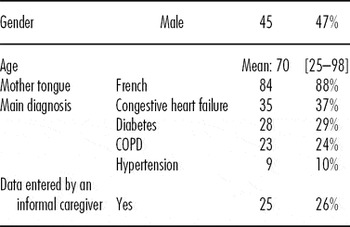
A total of 113 patients satisfying all the above criteria were identified by two case managers and agreed to participate in the research project (participation rate = 94 percent). As shown in Table 1, eighteen of the recruited patients needed to be removed from the study for a variety of reasons. In view of the somewhat high attrition rate (16 percent), it was necessary to determine how similar the “drop out” group was of those who remained in the sample. As recommended by Miller and Hollist (Reference Miller and Hollist18), we conducted a logistical regression analysis which includes demographic (age, gender, and primary diagnosis), clinical (primary diagnosis), as well as cost variables associated with the pre period (nurse home visits, emergency visits, and hospitalizations). No statistically significant coefficient was found, indicating that there is no evidence of attrition bias. Table 2 presents a profile of our final sample of 95 patients.
Profile of the Participants (n = 95)

COPD, chronic obstructive pulmonary disease.
Consumption of Healthcare Services
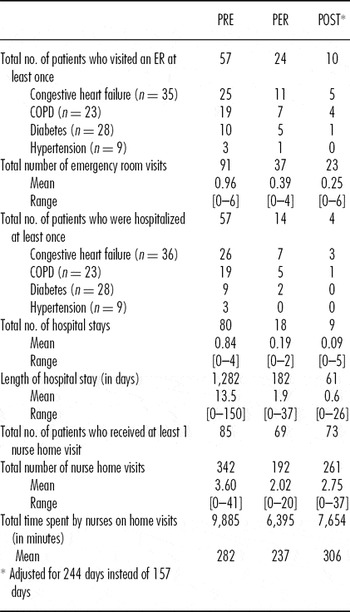
First, the results presented in Table 3 show that the number of patients who visited an emergency room (ER) declined from fifty-seven (the pre period) to twenty-four (the per period) to ten (post period). It is important to mention that we only compiled emergency room visits related to the primary diagnosis. As expected, the patients with congestive heart failure and COPD were the ones most likely to visit an emergency room in each of these periods.
ER Visits, Hospitalizations, Length of Stay, and Nurse Home Visits

ER, emergency room; COPD, chronic obstructive pulmonary disease.
To assess the impact of home telemonitoring on the consumption of healthcare services, including ER visits, the data for the post period had to be adjusted from 157 to 244 days (so the number of days before and after system deployment equals 365). After this adjustment, the total number of ER visits fell from ninety-one (pre) to thirty-seven (per) to twenty-three (post). This suggests a 34 percent decrease in ER visits following deployment of the technological device (91 versus 60). This result is statistically significant at the 0.1 level (t = 1.8; p = .08).
The second healthcare consumption index is related to hospitalizations. As in the case of emergency room visits, our analyses only took into account hospitalizations associated with the main diagnosis. The data in Table 3 reveal that the number of patients who had stayed in hospital declined from 57 (pre) to 14 (per) to 4 (post). Here again, patients with congestive heart failure and COPD were the ones most often hospitalized. The total number of hospital stays fell from 80 (pre) to 18 (per) to 9 (adjusted post). We, therefore, observe a 66 percent decrease in the number of hospitalizations during the post period compared with the pre-period (80 versus 27). This result is statistically significant (t = 3.8; p < .001). Lastly, the average number of days of hospitalization fell from 13.5 (pre) to 1.9 (per) to 0.6 (adjusted post). Hence, the difference in length of stay before (pre) and after (per and adjusted post) system deployment is statistically significant (t = 4.6; p < .001).
The third healthcare consumption index is related to home visits by nurses. Table 3 indicates that the number of patients receiving home visits declined from 85 (pre) to 69 (per) and then went up to 73 (post). For its part, the actual number of home visits grew from 342 (pre) to 453 (per and adjusted post). Against all expectations, the number of home visits by nurses increased 32 percent during the per and post periods compared with the pre period. This increase, however, was not statistically significant (t = −1.6; p = 0.11). The total number of minutes spent providing direct care to patients increased from 9,885 (pre) to 14,049 (per + adjusted post). This increase of over 42 percent was statistically significant (t = −3.3; p < .005). In sum, we found that the home visits by nurses after system deployment were more frequent but shorter than during the pre period.
Patients’ Satisfaction with the Telemonitoring System
We asked the 95 participants to indicate their satisfaction with the technological device after they had spent 4 months in the home telemonitoring program. As shown in Supplementary Table 2 (which can be viewed online at www.journals.cambridge.org/thc2013088), the results indicate very high satisfaction among the vast majority of respondents. The results are 4 or slightly higher on a scale of 5 (where 1 = not at all and 5 = enormously) for seven of the eight statements in the scale (with an overall average of 4.1). Furthermore, in response to the question, “If you could keep the automated telemonitoring system in your home, would you continue to use it in the future?”, four of five respondents, or 80 percent, said that they would.
Cost-minimization Analysis
The economic analysis strategy adopted for this study was one of cost minimization (Reference Drummond, O'Brien, Stoddart and Torrance19). This strategy can be used to compare the costs of different interventions whose clinical results are considered similar to determine which costs the least. It provides a comparative basis that, beyond calculations of costs and benefits, must be able to indicate whether the new program appears to be better than the usual model. The purpose of the analysis performed for this assessment was to confirm the extent to which telehomecare leads to cost savings. In this regard, the analysis is based on identifying costs and any additional gains (e.g., costs avoided) obtained following implementation of a telehomecare program. It is a “pre/post” comparison, where the “pre” situation serves as a benchmark for assessing the intervention's effectiveness. The economic analysis is therefore focused on assessing the costs associated with health service consumption before and after the intervention as well as the cost of operating the home telemonitoring program.
This economic analysis was performed from a health system point of view. This means that costs incurred by patients were not considered. It is our view that such costs should not change the results of the economic assessment, because the costs associated with the technology used were assumed by the health facility and both intervention types (usual home care and telehomecare) took place in the home, so that the expenses incurred by the patient should be similar. Finally, it should be noted that the calculations were made in Canadian dollars (CAD).
The cost incurred for nursing was calculated by multiplying the average hourly rate under the nurses’ collective agreement ($41.39/hour, including employee benefits) by the total time spent in home visits (time spent with patients). The travel cost takes into account the actual time spent by nurses on the road (in transit) and the reimbursement of the mileage travelled at the rate specified in the collective agreement: 43¢ per kilometer. The cost of hospitalizations and emergency room visits was estimated separately for each of the 95 patients. To this end, we obtained the average hospitalization costs (daily costs) in 2009–10 for each of the four chronic diseases included in this study (COPD = CAD363.17; congestive heart failure = CAD383.30; diabetes = CAD401.42; hypertension = CAD391.55) and the average cost of a visit to the emergency room in 2010: CAD157.32. To have comparative data, we adjusted all the above-mentioned costs associated with the post period to a 365-day period.
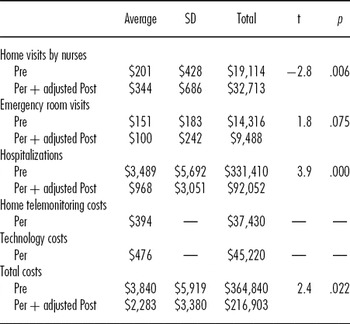
The cost of operating the telehomecare program came to CAD394 per patient (the cost incurred for nurses). This is based on the fact that 10 hours per weekday and 1 hour per day on weekends were spent in patient telemonitoring, making telephone calls and coordinating and following up on interventions in the field with road nurses and other health professionals. Finally, the costs associated with the technology were estimated using the prices negotiated with the application's supplier amortized over a 3-year period. These costs include the costs associated with purchasing and installing equipment in patient homes; purchasing, hosting, and maintaining a regional server; purchasing and installing the user application; purchasing and installing the application server used by the case managers; preparing clinical protocols; and professional services (including the training of nurses and technical services and support). The total estimate for these costs was CAD45,220, representing CAD476 per patient (n = 95). Table 4 provides detailed information on the costs calculated for each of the three periods.
Economic Analysis (costs per patient)

The above economic analysis provided positive results. For one thing, the telehomecare program (per period) cost a total of CAD171,309 representing an average cost of CAD1,803 per patient. Considering that patients participated in the home telemonitoring program for 157 days on average, the daily cost of the intervention per patient equals CAD11.48. Using annualized data, the cumulated cost of the per and post periods is CAD216,903 or CAD147,937 less than the usual home care services program (pre period). This represents savings of CAD1,557 per patient (t = 2.4; p < .05) or a net benefit of 41 percent compared with the usual patient monitoring program, whose operating cost was close to CAD365,000.
The main source of savings under telehomecare stemmed from drastic reductions to the number of hospitalizations and the average hospital stay which fell from 15.2 days (pre) to 11.1 days (per) to 6.9 days (adjusted post). The cost of hospitalizations represented 91 percent of the total operating costs of the usual home care services program, compared with 40 percent of the total operating costs of the telehomecare program (per period). Although smaller in scale, additional savings were realized through fewer emergency room visits (t = 1.8; p < .10).
However, total savings were offset by increased hours of nursing during home visits. Although we expected fewer hours of nursing in the home after system deployment, the data show a significant increase compared with the pre period. According to the managers of the home care services program, this increase was in large part due to the case managers’ lack of experience with telemonitoring. At the start of the assessment period, the nurses participating in this project had no prior experience with telehomecare. They provided prompt responses to the system's automated alerts (signaling an abnormal situation or a problem) and went to the patient's home to personally check on the patient's condition.
Lastly, as expected, the savings achieved through the telehomecare program were partly reduced by the costs associated with using the technology and the cost of the time that the nurses spent running the program. These costs totaled CAD82,650, or 48 percent of the home telemonitoring program's total costs (per period).
DISCUSSION
As mentioned earlier, few assessments have been made of the economics of home telemonitoring, and the quality of evidence has often been weakened by methodological flaws. The main objective of this study was therefore to conduct a rigorous and exhaustive economic assessment of a home telemonitoring program recently implemented by a Quebec healthcare facility. More specifically, we analyzed the consumption of health services by 95 patients with a variety of chronic diseases over a period of 21 months: 12 months before, 4 months during and 5 months after deployment of the telehomecare program.
Despite the inherent limitations of this evaluative approach, including the absence of a control group, the omission to measure potential effects of the intervention on clinical outcomes such as quality of life, and the absence of marginal and sensitivity analyses, we firmly believe that our results are valid for several reasons. First, the estimates of costs come from reliable sources. Second, as recommended by Drummond et al. (Reference Drummond, O'Brien, Stoddart and Torrance19), our assessment compares costs with and without home telemonitoring. Third, all resources (human and technology) associated with the intervention program were identified and measured. Last, our assessment is based on a relatively long period of observation, that is, 21 months.
Basically, our study reveals that the telehomecare program implemented at the JR Health Center resulted in significant savings, that is, a net gain of 41 percent. As mentioned above, these savings were mainly due to a significant reduction in the number of hospitalizations and ER visits as well as shorter hospital stays, supporting the findings of previous studies (e.g., Reference Johnson, Wheeler, Deuser and Sousa20–Reference Lehmann, Mintz and Giacini22). Importantly, we observed that these effects were more significant for heart failure and COPD patients. This finding, which also supports conclusions of prior systematic reviews (e.g., Reference Paré, Jaana and Sicotte10;Reference Maric, Kaan, Ignaszewski and Lear11;Reference Polinesa, Tran and Cimon16), has major implications for policy makers and healthcare managers who must establish priorities in terms of chronic disease management programs and select patients who participate in these interventions. Lastly, the operating costs of the home telemonitoring program and the costs associated with the technology represented 38 percent of the home telemonitoring program's total costs.
As an additional remark, case managers were asked to take note of each emergency room visit during the telehomecare period that may have been avoided due to an early intervention made possible by the technological device. To do so, they applied specific decision rules based on a set of clinical criteria. For example, for COPD the signs of exacerbation are increased shortness of breath, abundant secretions, changes in the color of secretions (yellow or greenish) and fever. An early intervention by the case manager would generally take the form of an adjustment to the patient's medication and advice for improved breathing. When the patient's health status improved following such an intervention, allowing him or her to continue living at home, this was recorded as an avoided emergency room visit. As another example, signs of exacerbation in diabetic hypoglycemia are: stomach ache, frequent urination, drowsiness, fatigue, and intense thirst. In such cases, an early intervention by a case manager usually consists of adjusting the patient's medication or diet and giving other professional advice. Maintaining blood glucose levels between 4 and 7 mmol/L and attenuating signs and symptoms can result in avoidance of an emergency room visit. All in all, seventy-five emergency room visits were prevented over the 4-month period. These avoided visits involved thirty-five patients, most of whom were being treated for congestive heart failure or diabetes.
CONCLUSION
In conclusion, despite the positive and significant results found in this cost minimization study, future research will nevertheless be needed to confirm the cost-effectiveness of home telemonitoring programs. We concur with Polinesa et al. (Reference Polinesa, Coyle, Coyle and McGill14) that to support informed decision making, these assessments will need to be conducted in a rigorous manner and take into account not only economic parameters, but also the improvements brought to the quality of care and clinical outcomes.
SUPPLEMENTARY MATERIAL
Supplementary Table 1: www.journals.cambridge.org/thc2013087
Supplementary Table 2: www.journals.cambridge.org/thc2013088
CONTACT INFORMATION
Guy Paré, PhD, (guy.pare@hec.ca), Holder of the Canada Research Chair in IT in Health Care, HEC Montréal, Montréal, Québec, Canada
Placide Poba-Nzaou, DBA, (poba-nzaou.placide@uqam.ca), Professor of Information Technologies, Faculty of Management, Université du Québec à Montréal, Montréal, Québec, Canada
Claude Sicotte, PhD, (claude.sicotte@umontreal.ca), Full Professor, Health Administration Department, Faculty of Medicine, Université de Montréal, Montréal, Québec, Canada
CONFLICTS OF INTEREST
All authors report they have no potential conflicts of interest.