When skilled readers are asked to mark all occurrences of a target letter while reading a prose passage for comprehension, they often do not achieve perfection though the task may seem easy (for a review, see Klein & Saint-Aubin, Reference Klein and Saint-Aubin2016). Letters (e.g., t) are more likely to be omitted when they are embedded in a frequent function word (e.g., the) than in a less frequent content word (e.g., tie or toe). This effect is known as the missing-letter effect (MLE), which has been widely observed in English (e.g., Corcoran, Reference Corcoran1966; Healy & Cunningham, Reference Healy and Cunningham2014) and many other alphabetic languages, including Dutch (e.g., Assink & Knuijt, Reference Assink and Knuijt2000), French (e.g., Plamondon, Roy-Charland, Chamberland, Quenneville, & Laforge, Reference Plamondon, Roy-Charland, Chamberland, Quenneville and Laforge2017; Saint-Aubin & Klein, Reference Saint-Aubin and Klein2004), German (e.g., Müsseler, Koriat, & Nißlein, Reference Müsseler, Koriat and Nißlein2000; Müsseler, Nißlein, & Koriat, Reference Müsseler, Nißlein and Koriat2005), and Greek (e.g., Chitiri & Willows, Reference Chitiri and Willows1997). Moreover, the magnitude of MLE has been shown to be influenced by the position of the target letter in the word (e.g., Assink & Knuijt, Reference Assink and Knuijt2000; Guérard, Saint-Aubin, Poirier, & Demetriou, Reference Guérard, Saint-Aubin, Poirier and Demetriou2012; Schneider & Healy, Reference Schneider and Healy1993) and the function role of affixes (i.e., prefix or suffix) in a morpheme (e.g., Beyersmann, Ziegler, & Grainger, Reference Beyersmann, Ziegler and Grainger2015; Drewnowski, Reference Drewnowski1981; Koriat & Greenberg, Reference Koriat and Greenberg1991). However, the questions of whether, and if so, how position and semantic function at the sublexical level interactively affect MLE remain unexplored, especially in a nonalphabetic language such as Chinese whose basic writing units are not letters but logographemes.
Contemporary models of MLE, developed on the basis of English alphabetic language, have described the roles of item properties such as word frequency (i.e., the unitization model: Healy, Reference Healy1976, Reference Healy1994; Minkoff & Raney, Reference Minkoff and Raney2000), word functionality (i.e., the structural hypothesis: Koriat & Greenberg, Reference Koriat and Greenberg1991, Reference Koriat and Greenberg1994), the interaction between word frequency and function and contextual constraints (i.e., the guidance-organization model: Greenberg, Healy, Koriat, & Kreiner, Reference Greenberg, Healy, Koriat and Kreiner2004), and the timing of attentional disengagement (i.e., the attentional-disengagement model: Roy-Charland, Saint-Aubin, Klein, & Lawrence, Reference Roy-Charland, Saint-Aubin, Klein and Lawrence2007). However, the impact of these item properties at the sublexical level and their possible interaction with readers’ contextual knowledge were neglected in these models due to the constraints of English orthography. Languages using nonalphabetic scripts, like Chinese, are particularly well-suited for testing and extending these models because Chinese logographic characters contain unique sublexical units such as logographemes that cannot be found in English and other alphabetic orthographies.
Specifically, unlike English and other alphabetic languages, which use distinct letters to form words, Some complex Chinese characters can be decomposed into independent, identifiable logographemes, that is, units equal to or smaller than radicals but larger than strokes (e.g., Law & Leung, Reference Law and Leung2000; State Language Commission, 1998). For example, the left-right structured character 喝 (to drink) comprises five basic logographemes (i.e., 口, 日, 勹, 人, and 乚). More importantly, logographemes exhibit positional and semantic functional properties so that they can appear in different positions and convey different degrees of semantic relatedness to their embedded characters. A typical example is the commonly used Chinese logographeme 口 /kou3/ (mouth; Language Commission, 1998), which can occur in the left (e.g., 喝 to drink), right (e.g., 知 to know), top (e.g., 呆 expressionless), bottom (e.g., 吞 to swallow), or inside (e.g., 问 to ask) position of a character indicating mouth-related concepts or meanings. However, 口 can also exist in these positions but convey little mouth-related meaning to its embedded characters, as in left (e.g., 叶 leaf ), right (e.g., 加 to add), top (e.g., 员 member), bottom (e.g., 台 platform), or inside (e.g., 句 sentence). Such unique positional and functional properties exhibited by the Chinese sublexical logographemes allow us to examine an important theoretical question missing from contemporary MLE models: do position and semantic relatedness of the target logographeme interactively influence the omission rate of the target logographeme search during the reading/viewing of a Chinese passage?
To date, only two studies have examined the Chinese missing logographeme effect during Chinese passage reading (Greenberg & Chuan, Reference Greenberg and Chuan2010; Tao & Healy, Reference Tao and Healy2002). One study by Greenberg and Chuan (Reference Greenberg and Chuan2010) demonstrated that the function of a Chinese character influenced the radical detection during Chinese text reading. In their study, skilled adult Chinese readers were asked to search for the embedded target radical 彳 in the character 得, which can act in compound words as either a function morpheme (e.g., 免得 in case and 捨得 willing to), a vacuous morpheme (e.g., 贏得 to win and 曉得 to know), or a content morpheme (e.g., 難得 difficult to come by and 只得 have to). By contrasting the omission rates of these three types of target morphemes, Greenberg and Chuan (Reference Greenberg and Chuan2010) found that function and vacuous morphemes exhibited higher omission rates than content morphemes, while no difference occurred between function and vacuous morphemes, thus emphasizing the role of character function in missing Chinese logographeme effect during reading.
Another study by Tao and Healy (Reference Tao and Healy2002) showed that the omission rate of the target radical was influenced by the position of its embedded morpheme. In their study, three groups of participants (i.e., native Chinese readers, native English readers with 2 years of Chinese learning experience, and native English readers with no Chinese learning experience) were instructed to detect the radical 氵(water) while reading a Chinese prose passage. By manipulating the character frequency and position, that is, the initial position (e.g., 法律 law) of two-character words, the final position of two-character words (e.g., 違法 break the law), and the single character condition (e.g., 滑 slip), they found that native Chinese readers tended to omit the target radical when it appeared in the final position of high frequency two-character words.
Although these two studies provided initial evidence that position and function roles of Chinese radicals influenced the radical detection performance during Chinese passage reading, it is worth noting that neither of these studies directly manipulated the position or the semantic function of the target radical within a character nor the possible interaction between them. Specifically, Greenberg and Chuan (Reference Greenberg and Chuan2010) looked only at the effect of semantic function of the character on detection performance during Chinese reading, while Tao and Healy (Reference Tao and Healy2002) focused solely on the position effect of two-character compound words. In Tao and Healy’s study, it should be noted that the preassigned target radical 氵 (water) had a fixed left position across all of its embedded characters, and it provided a semantic clue indicating water-related concepts for some embedded characters, including 海 (sea) and 渴 (thirsty), but not for other embedded characters, such as 法 (law) and 消 (disappear), which makes it difficult to distinguish whether the observed effect reflected the position effect of the radical or a combination of position effect and semantic relatedness effect to the whole character. In addition, in both Greenberg and Chuan’s (Reference Greenberg and Chuan2010) and Tao and Healy’s (Reference Tao and Healy2002) studies, “position” and “function” are defined in terms of the whole character rather than the target radical, which neglects entirely the possible effect of positional and semantic function properties exhibited by the radicals, as well as the interaction between them. Thus, the first aim of the present study is to extend these previous studies by examining the possible interaction between position and semantic relatedness at the sublexical level during Chinese prose reading.
In addition to the properties of Chinese logographemes, readers’ language knowledge may also play a role in the omission of the target logographeme during prose reading. For example, Tao and Healy (Reference Tao and Healy2002) investigated whether language knowledge influenced Chinese radical detection by recruiting five groups of participants with different language backgrounds: native Chinese speakers, native English speakers with 2 years of Chinese language experience, native English speakers with 1 year of Chinese language experience, English speakers with no Chinese language experience, and native Japanese speakers with no Chinese language experience. By comparing the detection task performances of these five groups, Tao and Healy (Reference Tao and Healy2002) found that native Chinese speakers exhibited the largest difference of omission rates between high-frequency and low-frequency Chinese compound words, while this difference was smallest for native English speakers with 2 years of Chinese language experience. Furthermore, native English speakers with 1 or 2 years of Chinese language experience and native Japanese speakers demonstrated no character familiarity effect on the search task. However, due to the limitation of the design, Tao and Healy (Reference Tao and Healy2002) did not examine how item properties (i.e., the position and semantic relatendess of the radicals) and language knowledge jointly influenced the missing logographeme effect in Chinese. Thus, the second aim of the present study is to examine how different language experiences (i.e., Chinese readers vs. English readers) and item properties (i.e., position and semantic relatedness of the target logographeme) influence the detection of Chinese logographemes during passage reading.
Our motivation for this second aim comes from the striking differences between Chinese and English writing systems. Unlike English, Chinese is a morphosyllabic writing system that uses logographic characters to indicate sounds and meanings (for a review, see Tong & McBride, Reference Tong and McBride2018). One Chinese character represents one lexical morpheme, which corresponds to one single word or a part of a compound word. The character, which can be visually complex, appears in the sentence as a fixed visual block without an obvious interword boundary, which may increase the difficulty of identifying these characters (e.g., Liu, Chen, & Wang, Reference Liu, Chen and Wang2016). In contrast, English is an alphabetic language with clear visual spacing between each word. Therefore, due to the higher visual complexity of Chinese script, a stronger visual–spatial skill is required for reading complex graphemes with larger grapheme inventories, which, in turn, can be influenced by reading experience (Chang, Plaut, & Perfetti, Reference Chang, Plaut and Perfetti2016).
In addition, most English letters occur in various positions, rather than a fixed one, in English words (Bourne & Ford, Reference Bourne and Ford1961) so that participants may adopt a bottom-up processing manner when they are instructed to detect a preassigned target letter in English reading. Unlike English letters with unpredictable positions, Chinese logographemes exhibit distributional position properties in the formation of Chinese characters. For example, the most typical and frequently occurring position of 口 is the left or the bottom for left-right or top-bottom structured characters, respectively. Such distributional information of 口 is usually acquired through extensive exposure of Chinese characters by skilled Chinese readers. Thus, we would expect Chinese readers to adopt a top-down mechanism when instructed to search for the logographeme 口 in a prose passage. Taken together, we hypothesized that language experience would influence the detection of a logographeme. Specifically, English speakers who lack orthographic and lexical knowledge of Chinese would have a higher omission rate than Chinese readers when asked to detect the preassigned Chinese logographeme 口 during Chinese text reading. In addition, the visual positional properties of Chinese logographemes may influence the detection performance even for English readers who do not possess sufficient language knowledge of Chinese.
To summarize, the present study aims to utilize unique position and semantic function of logographemes in Chinese to examine two theoretically important but unresolved questions relevant to MLE across languages. The first question focuses on whether the position (i.e., left, right, top, bottom, and inside) and semantic relatedness (i.e., the semantic relations between the logographeme and its embedded characters) influence the omission rate of a preassigned logographeme during Chinese prose reading. The second question investigates whether, and if so, how language knowledge and item properties interactively affect Chinese logographeme detection during Chinese prose reading. To address these two questions, native Chinese and English readers were asked to search for the target logographeme 口 while reading a Chinese prose passage. Given that frequency effect has been extensively explored in previous studies, only high frequency characters were used as target characters in the present study, and the omission rates between native Chinese and English groups were compared.
Method
Participants
The participants were 84 native Chinese readers and 55 native English readers between the ages of 19 and 25. All Chinese readers were native Mandarin-speaking undergraduates studying at South China Normal University in China, and all English participants were native English-speaking undergraduates with no Chinese or other Asian language learning experience studying at Dalhousie University in Canada. According to the self-reported language background questionnaire, all participants were proficient readers of their native language, and none had any history of language, reading, or other types of specific learning difficulties.
Materials
The testing materials consisted of the logographeme searching task (i.e., instructions, a practice passage, a testing passage, and the multiple-choice questions) and a language background questionnaire (see Appendix A).
The Logographeme Searching task was designed according to the principle and format of the English MLE task and served to assess participants’ attention to the details of Chinese characters during Chinese prose reading/viewing. Participants were instructed to circle all characters containing the target logographeme 口 in the text. The practice passage was eight sentences in length and was provided to familiarize participants with the test instructions.
Both practice and test passages were designed by the first author. The test passage was a fantasy story consisting of 84 sentences with 3,378 characters. A total of 35 Chinese characters containing the logographeme 口 were selected as the target characters. All were high-frequency characters found in the “List of Frequently Used Modern Chinese Characters” (State Language Commission of China, 1988). The average number of strokes and the mean frequency of all target characters were 7 (SD = 2.37, range from 5 to 16) and 0.16 (SD = 0.24, range from 0.00 to 0.98), respectively.
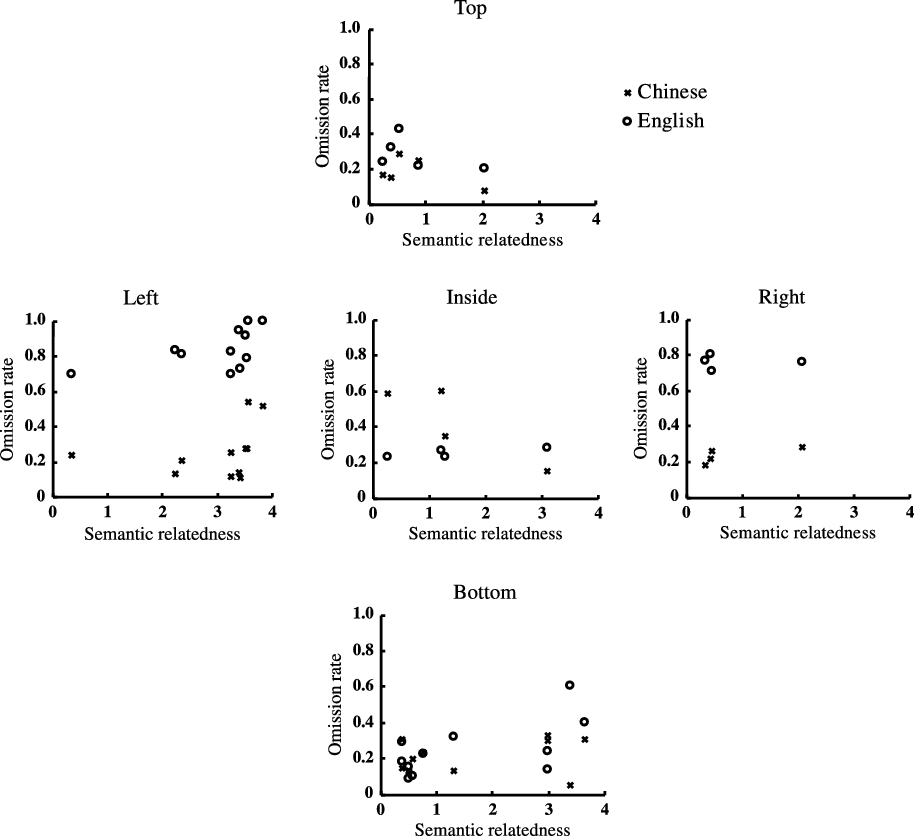
Because the logographeme 口 could appear in the five different positions (i.e., left, right, top, bottom, or inside) carrying varied degrees of semantic relatedness to its embedded characters (see Figure 1), 11 different characters contained 口 on the left side (e.g., 叶 leaf and 喝 to drink), 4 on the right side (e.g., 加 to add and 知 to know), 5 in the top position (e.g., 员 member and 呆 expressionless), 11 in the bottom position (e.g., 台 platform and 吞 to swallow), and 4 in the inside position (e.g., 句 sentence and 问 to ask). In order to increase the reliability, the target logographeme 口 appeared 241 times (i.e., left: 49 times; right: 57 times; top: 36 times; bottom: 67 times; and inside: 32 times) in different target characters embedded in the formal reading passage. Across all these occurrences, the logographeme 口 did not appear as a separate, individual character, and it always appeared in a compound word, phrase, or sentence context.
The mean omission rate of the target appeared in the top, left, inside, right, and bottom positions with different levels of semantic relatedness by Chinese and English participants.

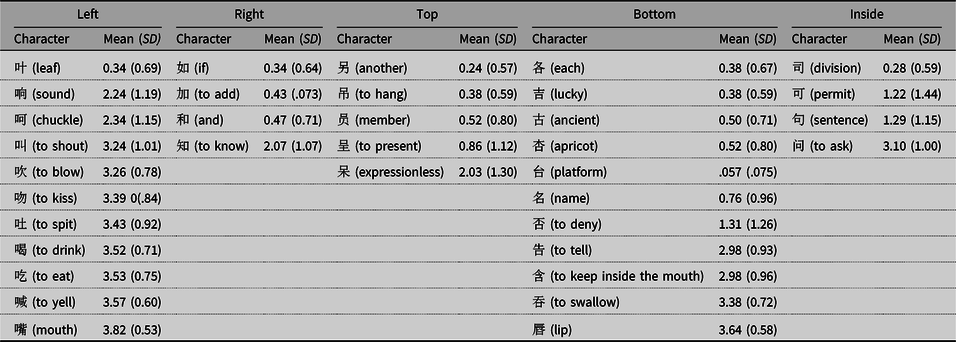
A semantic-relatedness rating on the logographeme 口 and its embedded characters was conducted to ensure that our semantic relatedness manipulation reflected native Chinese readers’ perceived semantic relatedness. We asked 58 native Chinese speakers to rate the semantic relatedness between semantic radicals and their embedded characters on a 5-point Likert scale (0 = not related at all to 4 = highly related). The mean semantic relatedness of all target characters was 1.81 (SD = 1.35, range from 0.24 to 3.83). The mean semantic ratings for each individual character was reported in Table 1, and these semantic ratings were used for further analyses.
Means and standard deviations of 5-point Likert ratings (0 = unrelated at all; 4 = highly related) of semantic relatedness between the logographeme and its embedded target characters

In addition, to ensure that participants were attentive during the testing, participants were asked to answer six multiple-choice questions at the end of each prose passage. For Chinese readers, all reading materials were written in simplified Chinese. For English readers, the instructions and questions were written in English, but the practice and experimental texts were written in simplified Chinese. Among the six multiple-choice questions of the test passage, three of them were designed to assess participants’ understanding of the passage while the other three aimed at assessing whether participants were attentive when reading the prose. More specifically, two visual symbols (i.e., a four-leaf clover and a clock) and one number (i.e., 16) were inserted into the test passage. Despite the fact that English readers cannot comprehend Chinese texts, they were expected to correctly answer these three questions regarding the detection of the symbols and number in the formal testing session. The multiple-choice questions aimed to assess whether Chinese participants read the passage for comprehension and English readers were attentive to the text as instructed.
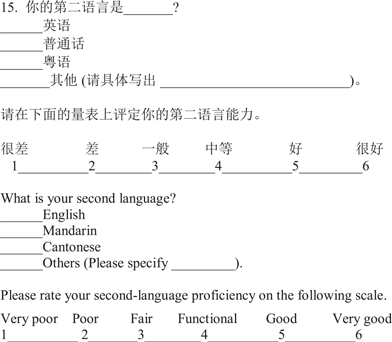
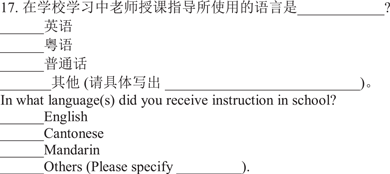
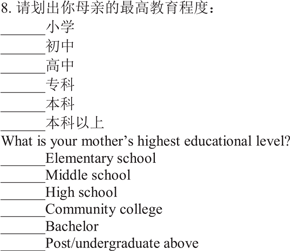
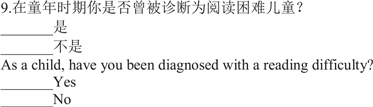
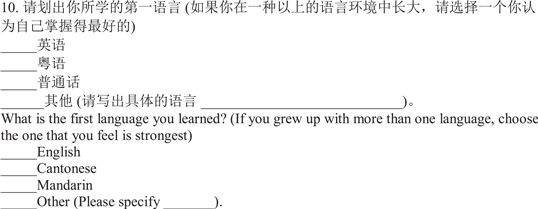
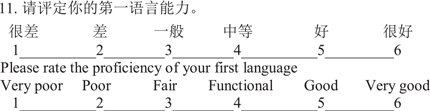
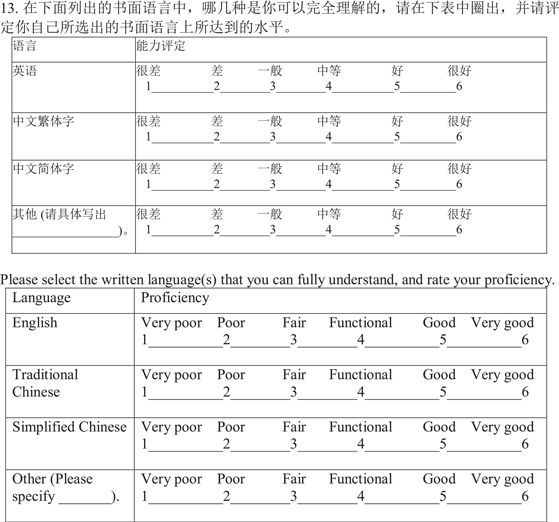
The Language Background Questionnaire consisted of 18 questions that collected information about participants’ socioeconomic status, educational background, first and second language competences in terms of both oral and written domains, as well as the age of acquisition/learning. In addition, participants were asked to report their reading experience and the frequency of use of different languages. The full questionnaire can be found in Appendix A.
Procedure
Each participant received a stapled booklet comprising instructions, practice and formal tests, and a language background questionnaire (see Appendix A). In the instructions, the participants were explicitly told to read the text for comprehension at their normal reading speed and circle all of the instances of 口 embedded in the individual characters. The practice test was a one-page prose passage accompanied by two multiple-choice questions. The formal test was a four-page prose passage with six multiple-choice questions. In both the practice and formal testing sessions, the participants were told that if they missed instances of 口 in the previous session, they were not allowed to return and circle the target logographeme later. The target logographeme 口 was displayed as a reminder in the upper left corner of each page. In addition, the participants were informed that they needed to read the passage carefully and complete the multiple-choice questions afterward.
Data analysis
As our dependent variable was the omission rate, our data were analyzed using the generalized linear mixed model (GLMM; Baayen, Reference Baayen2008) with the maximum likelihood approach (Laplace approximation). The analyses were computed using R software (Version 3.6.1; R Development Core Team, 2011). The lme4 (Version 1.1–12) and car (Version 2.1.4) packages were adopted for the data analyses. Two English speakers were excluded from data analysis because they did not complete the task. In the final data set, 137 participants were analyzed with 84 native Chinese speakers and 53 native English speakers.
Results
Prior to the analysis of the omission data, our analysis of the response accuracy of the reading comprehension questions showed that the mean percentages of correct responses for Chinese and English readers were 84.72% (SD = 0.14) and 40.57% (SD = 0.21), respectively. The linear mixed-effect model included language as the fixed effect and the accuracy rate of the multiple-choice question as the dependent variable. The results showed that the accuracy rate of reading comprehension in Chinese readers was significantly higher than in English readers (Estimate = –0.44, SE = 0.03, t = –14.65, p < .001; Chinese readers were set as the reference level).
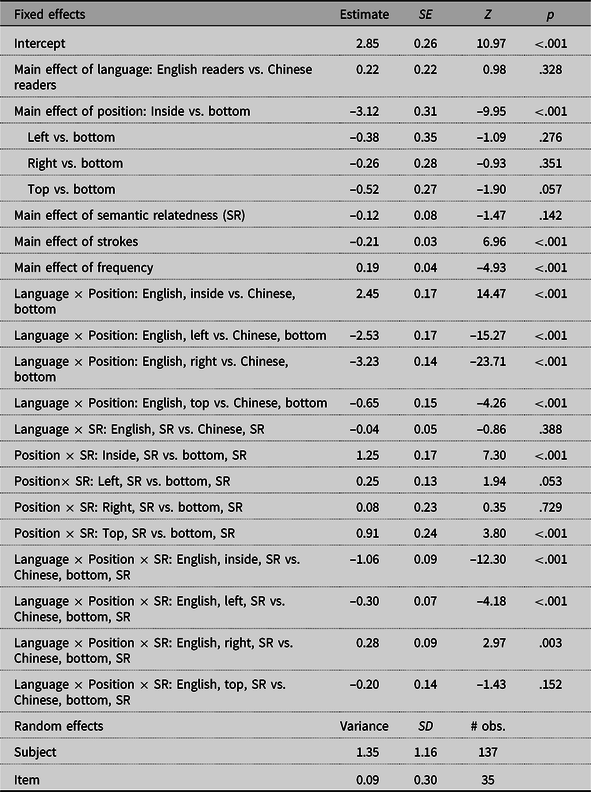
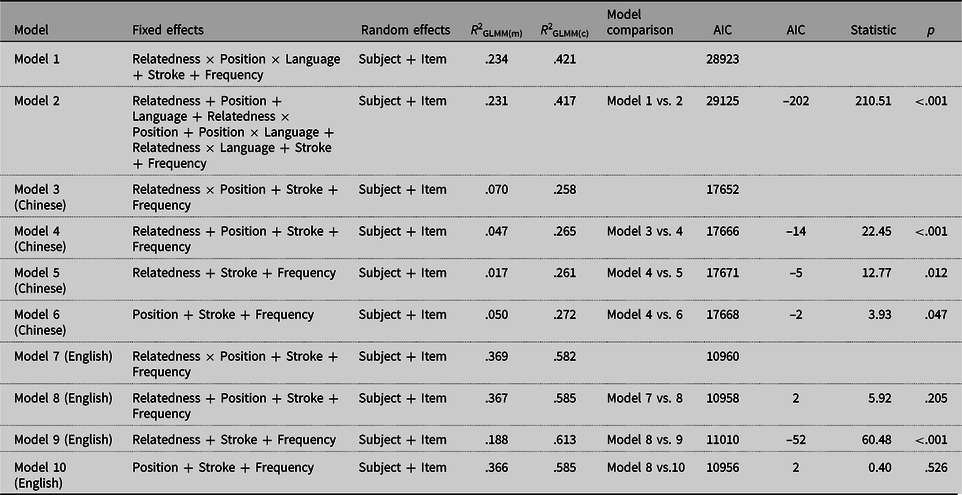
Figure 1 shows that the mean omission rate of the target logographeme appeared in different positions with different levels of semantic relatedness by Chinese and English readers. To examine the roles of logographeme properties and language knowledge in target logographeme detection between Chinese and English readers, we first evaluated the full GLMM on the omission rate with the position (i.e., left vs. right vs. top vs. bottom vs. inside), semantic relatedness, language knowledge (i.e., Chinese readers vs. English readers), and their interactions as fixed effects; and the item and subject as random intercepts. In addition, we controlled for the visual complexity (i.e., strokes) and frequency (i.e., the log of word frequency) by including these variables as fixed effects. In this model, the Chinese readers and the bottom position were set as the references. Table 2 shows the estimated fixed and random effects of the full model (i.e., Model 1). As shown in Table 2, the main effect of position (p < .001), the two-way interaction effects of Language × Position (ps < .001) and Position × Semantic Relatedness (ps < .001), and the three-way interaction effect of Language × Position × Semantic Relatedness (ps < .01) were all significant. To further understand the three-way interaction of Language × Position × Semantic Relatedness, we compared the full model with the reduced models (see Table 3 for model comparisons), and the results showed that the interaction of Language × Position × Semantic Relatedness was significant, AIC (Akaike information criterion) = –202, χ2 (4) = 210.51, p < .001.
The fixed and random effects in the full model (i.e., Model 1)

Note: The generalized linear mixed effect model was applied because the dependent estimate was dichotomous (i.e., omitted or detected) and the mixed-effects were logistically regressed for participants’ correct identification on multiple items. In this model, Chinese readers and the bottom position were the reference levels.
The summary of the model comparison

Note: R 2 GLMM(m) indicates the variance explained by the fixed factors, while R 2 GLMM(c) indicates the variance explained by the full model.
We further analyzed the interactions separately for Chinese readers and English readers. For Chinese readers, the full model included position, semantic relatedness, and their interaction as fixed effects and item and subject as random intercepts. In addition, the visual complexity (i.e., strokes) and frequency (i.e., the log of word frequency) were controlled in the model. Table 3 presents the results of the comparisons of the full models with the reduced models. By comparing the full model with the reduced model, the interaction effect of Position × Semantic Relatedness was significant, AIC = –14, χ 2 (4) = 22.45, p < .001. In addition, the main effects of position, AIC = –5, χ 2 (4) = 12.77, p = .012, and semantic relatedness, AIC = –2, χ 2 (1) = 3.93, p = .047, were both significant. Post hoc comparisons showed that semantic relatedness influenced the omission rate of the right (Estimate = –0.15, SE = 0.06, z = –2.56, p = .010), top (Estimate = 1.28, SE = 0.20, z = 6.55, p < .001), and inside (Estimate = 3.08, SE = 0.38, t = 8.08, p < .001) positions, but not the other positions (ps > .05).
For English readers, significant main effects were found for the position only, AIC = –52, χ2 (4) = 60.48, p < .001, but not for semantic relatedness, AIC = 2, χ2 (1) = 0.40, p = .526. Specifically, higher omission rates were found in the left or right positions than in the top (left: Estimate = 3.19, SE = 0.35, z = 9.00, p < .001; right: Estimate = 2.66, SE = 0.41, z = 6.51, p < .001), bottom (left: Estimate = 3.64, SE = 0.29, z = 12.44, p < .001; right: Estimate = 3.12, SE = 0.36, z = 8.69, p < .001), and inside (left: Estimate = 2.83, SE = 0.40, z = 7.08, p < .001; right: Estimate = 2.30, SE = 0.44, z = 5.20, p < .001) positions. In addition, the logographeme 口 appeared to be omitted more in the inside position than in the bottom position (Estimate = –0.82, SE = 0.37, z = –2.20, p = .028). The interaction effect of semantic relatedness and position was not found, AIC = 2, χ2 (4) = 5.92, p = .205.
Discussion
By manipulating the position of the target logographeme 口 (i.e., left, right, top, bottom, or inside) and the degree of semantic relatedness to its embedded characters, we demonstrated that for Chinese readers, a higher omission rate occurred when 口 appeared in the top and inside positions and exhibited low semantic relatedness with its embedded characters, whereas 口 appeared to be omitted more when it was positioned on the right and exhibited high semantic relatedness with its embedded characters. In contrast, for English readers, 口 was omitted more when it appeared in the left or right position irrespective of its semantic relatedness. In addition, 口 appeared to be omitted more when it appeared in the inside position, rather than in the bottom position. These findings indicate that both item properties at the sublexical level and reader’s language knowledge influence the detection of the target logographeme.
We found that skilled Chinese readers omitted 口 more when it appeared in the right position and was more semantically related to its embedded characters, but such a pattern was not found in English readers. This difference may reflect different processing mechanisms employed in the Chinese logographeme searching task, with Chinese readers employing more top-down processing while English readers use bottom-up processing strategies when searching for the logographeme 口. Most skilled adult Chinese readers know that 口 occurs more frequently in the left position indicating mouth-related meanings (114 times in the “List of Frequently Used Modern Chinese Characters”; State Language Commission of China, 1988) than in the nontypical right position (only 5 times). Thus, it is not surprising that Chinese readers allocated more attention to the left, rather than the right, side of the embedded characters. In addition, our current result aligns well with the structural hypothesis model suggesting that a higher omission rate was found when a target letter was embedded in an affix (i.e., frequent spelling patterns with meaning function) rather than a nonaffix (e.g., Beyersmann et al., Reference Beyersmann, Ziegler and Grainger2015; Drewnowski & Healy, Reference Drewnowski and Healy1980).
In contrast, skilled Chinese readers appeared to omit 口 more when it was in the top and inside positions and exhibited low semantic relatedness with its embedded characters. This may also reflect the distributional statistics of 口 in forming top-bottom structured characters. According to the “List of Frequently Used Modern Chinese Characters” (State Language Commission of China, 1988), 口 appears 12 times in the top position, 34 times in the bottom position, and 7 times in the inside position. Compared to the bottom position, the top and inside positions are nontypical positions for 口 in top-bottom structured characters. As a result, skilled native Chinese readers tend to disengage their attention if the logographeme occurs in nontypical positions (i.e., top and inside positions), especially when 口 is less semantically related to its embedded characters.
To no one’s suprprise, an extremely higher omission rate was found among English readers with no Chinese language ability compared to native Chinese readers, which is consistent with previous research (e.g., Tao & Healy, Reference Tao and Healy2002). It is obvious that due to a lack of Chinese character knowledge, English readers did not utilize a top-down processing strategy during their search for the target logographeme. In other words, unlike native Chinese readers, English readers were not able to access or activate semantic information. Consequently, no context facilitation effect was found in English readers when searching for the target logographeme 口.
The unique character structure of Chinese provided a fascinating window to explore how visual-spatial features affected a visual search task. As demonstrated in our study, English readers missed the target logographeme 口 more when it appeared in either the left or the right position, and the inside position had a higher omission rate than the bottom position regardless of semantic relatedness. The omission at the left or the right position can be explained by the way Chinese characters are laid out in a passage. Unlike words in English, each Chinese character is a unique, square-shaped structure with limited space between individual characters in a sentence. In contrast, the lengths of individual English words vary, and there is an obvious space between words in a sentence that serves as a boundary for word recognition (Greenberg & Chuan, Reference Greenberg and Chuan2010).
The distinct interspace between Chinese and English writing systems may also account for the higher omission rates on the left and the right sides for English readers (e.g., Bai, Yan, Liversedge, Zang, & Rayner, Reference Bai, Yan, Liversedge, Zang and Rayner2008; Blythe et al., Reference Blythe, Liang, Zang, Wang, Yan, Bai and Liversedge2012; Chen, Gu, & Christoph, Reference Chen, Gu and Christoph2016; Saenger, Reference Saenger1997). According to Saenger (Reference Saenger1997), if the interword space is eliminated, English readers spend more cognitive resources, and may even encounter comprehension difficulty, when attempting to process the uninterrupted word sequence. This interword effect was also demonstrated in some Chinese studies (Bai et al., Reference Bai, Yan, Liversedge, Zang and Rayner2008; Bassetti, Reference Bassetti2009; Blythe et al., Reference Blythe, Liang, Zang, Wang, Yan, Bai and Liversedge2012; Chen et al., Reference Chen, Gu and Christoph2016). In the current study, when the target logographeme unit appeared on the left or the right side of the character, the preceding or following character, respectively, might interfere with the detection of the target logographeme because of the limited space separating the characters in a Chinese sentence (Tao & Healy, Reference Tao and Healy2002).
In addition, the varying physical features of 口 in different positions provide another explanation for the omission in the left, right, and inside positions. For example, the typical square 口 resembles a horizontal rectangle when it occurs in the top position (e.g., character 呈 to present), a vertical rectangle when it appears in the left-side position (e.g., character 叶 leaf), and a square when it appears in the inside position (e.g., character 问 to ask). The visual differences between these horizontal and vertical structures might lead to difficulties in logographeme detection for English readers who did not have any previous knowledge of Chinese.
In particular, the higher omission rates for English readers when 口 appeared in the left, right, or inside position cannot be explained by the unitization model or the structural hypothesis model. The unitization model highlighted the role of frequency, while the structural hypothesis model emphasized the functional role in letter detection. These two models neglected the possible influence from the visual–spatial features of language. The attentional–disengagement model might provide an explanation for the higher omission rates in left, right, and inside positions for English readers. Specifically, different spatial positions of logograhemes might carry different visual characteristics, which can lead to different attentional allocation patterns. For English readers, the attentional engagement pattern might be influenced by the visual physical features of the logographeme 口. Again, it should be noted that we did not directly manipulate attention components in the current study; thus, whether and how attention disengagement occurred for English readers needs further exploration.
Overall, the findings of our study extend the missing letter effect into a nonalphabetic language by using the Chinese logographeme 口 to examine the interaction effect of item properties and language experience. It is worth noting that our study is innovative in exploring the semantic-related effect on character processing by focusing on different types of spatial structures of Chinese characters. More important, by taking advantage of the positional variation and semantic relatedness of the logographeme 口, the present study demonstrated for the first time that item properties (i.e., semantic relatedness and the position) at the sublexical level and readers’ language experience interactively influenced the detection of the target Chinese logographeme. Our findings extend the contemporary MLE models by showing how a sublexical unit, such as a logographeme, also plays a role in word recognition. In addition, our finding of the interdependence between semantic relatedness and position effect of 口 suggests that Chinese language teachers should instruct students to pay more attention to the nontypical position information of sublexical radicals. Furthermore, our findings of the effect of visual–spatial features on English readers’ logographeme searching indicate that the educational programs for learning Chinese as a foreign language need to include various positional features of logographemes in order to facilitate foreigners learning Chinese characters.
However, although the present study has systematically manipulated the semantic relatedness and positional variations of the logographeme 口 within its embedded characters, we did not examine the effect of positional frequency and the possible influence of phonetic relatedness when 口 served as the phonetic radical for providing sound information of its embedded character (e.g., 口 /kou3/ (mouth) in the characters 扣 (to buckle) /kou4/ and 叩 (to knock) /kou4/) in the logographeme searching. This is partly because, among the commonly used Chinese characters, 口 /kou3/ serves as the phonetic radical only in these two: 扣 (to buckle) /kou4/ and 叩 (to knock) /kou4/. In addition, in our study, semantic relatedness was assumed to be an intervally scaled variable; consequently, our model analysis treated this variable as an equal interval. However, in reality, semantic relatedness may not be an interval variable. Moreover, it is possible that the difference between successive intervals of semantic relatedness is not equal. Furthermore, only five typical positions of the logographeme 口 were examined in the present study, and the similar shape of the logographeme 口 can also appear in the outside (e.g., 国 country) and the middle (e.g., 克 gram) positions. In addition, we did not examine the position frequency. Thus, future research may consider quantifying semantic relatedness more precisely and investigate further the effects of positional frequency and phonetic relatedness on the logographeme searching.
It should also be noted that the current study focused on simplified Chinese characters only. Although both simplified Chinese and traditional Chinese characters share the same origin, they are different in terms of the visual complexities, with traditional Chinese characters being more visually complex. Thus, an extension of the present study should examine whether the same omission patterns would also be observed in reading traditional Chinese prose. Furthermore, the present study utilized a paper–pencil task, which makes it difficult to infer the online processing of Chinese missing logographeme effect. Thus, it is worthwhile to use eye movement techniques to further investigate the process of attention allocation and verify the attentional disengagement model. In addition, though a significant interaction effect between semantic relatedness and position was found for Chinese readers, it should be noted that the current study only used the logographeme 口 as the preassigned target unit. Given the diverse logographeme units in the Chinese writing system (about 560 basic units; Shi, Li, Zhang, & Shu, Reference Shi, Li, Zhang and Shu2011), one important theoretical question that should be addressed in future studies is whether our current results, focused entirely on 口, can be generalized for other Chinese logographemes. Finally, although all of our Chinese undergraduate participants were skilled Chinese readers, it is still unclear whether word reading skills, reading speed, or reading fluency influenced the logographeme detection effect. Thus, future research may consider controlling for these reading-related skills when exploring the missing logographeme effect.
Despite these limitations, our study took the first step to demonstrate that Chinese reader’s detection rate of the logographeme 口 was influenced by both its position and the degree of semantic relatedness to its embedded characters. In particular, Chinese readers were more likely to omit 口 when it appeared in the top and the inside positions and exhibited low semantic relatedness with its embedded characters, whereas 口 appeared to be omitted more when it was positioned on the right of a character and exhibited high semantic relatedness with its embedded characters. In contrast, for English readers, 口 was omitted more when it appeared in the left or the right position irrespective of semantic relatedness; in addition, 口 appeared to be omitted more when it appeared in the inside, rather than the bottom, position. These results highlight the impact of Chinese-specific visual–spatial features on MLE, and suggest that missing logographeme effect patterns are governed by both item properties and readers’ language experience, which, in turn, provide additional evidence for Chinese missing logographeme effect.
Acknowledgment
This work was supported by funding from the General Research Fund (Grant 17609518, 2018–2020) from the Hong Kong Government Research Council to Xiuli Tong. We are grateful to all participants for their participation. We would like to thank Muyang Xu for her assistance in creating and writing the first draft of the practice and testing passages. In addition, we are grateful to Haiyan Tong for her help with pilot testing of our testing passage. We also want to sincerely thank several student volunteers of the Language & Literacy Lab at Dalhousie University who helped code and input the data.
Appendix A
Instruction, practice passage, testing passage, and language background questionnaire
1a. Testing instruction for English participants
Dear Participant,
We first thank you for your participation in this visual searching experiment. You will be shown a passage written in Chinese starting on the next page. This particular Chinese text is presented in a horizontal direction, which is typically read from left to right. Your task is to read the text for comprehension at your normal reading speed. In addition to reading normally, your task will be to circle each instance of the symbol “口” included in this passage, which might appear as one part of an individual character. For example, the target symbol could be embedded in a character like

or in a character like
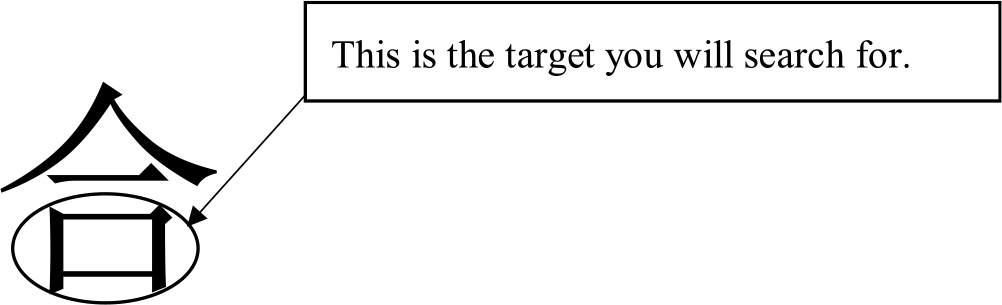
The target symbol “口” is displayed as a reminder at the top of each page. You must be attentive to this search task because, afterward, you will be asked to answer six multiple-choice questions about the passage. You should not slow down your reading speed to get every “口,” and if you ever notice a “口” that you missed in a previous character, don’t retrace your steps to circle it.
This experiment includes practice, testing, and a language questionnaire. You can ask the experimenter questions during practice. In the testing, you must look at each line starting from the left and then move to the right. When you finish reading the first page, move to the next one. When you get to the end of the text, turn the page. Please answer the six multiple-choice questions. Afterward, you must fill in a language questionnaire at the end.
1b. Testing instruction for Chinese participants
同学,您好!首先感谢您参加本阅读实验。
下面我们将会给您呈现一篇文章,这篇文章是以水平的方式呈现的,您需要从左至右,从上到下依序进行阅读。请您以您感到舒服的正常速度阅读和理解这篇文章。在理解文章的同时,还要请您找出包含“口”的字,请您边读边把看到的这些字划出来。例如,我们要划出的“口”在下面的汉字
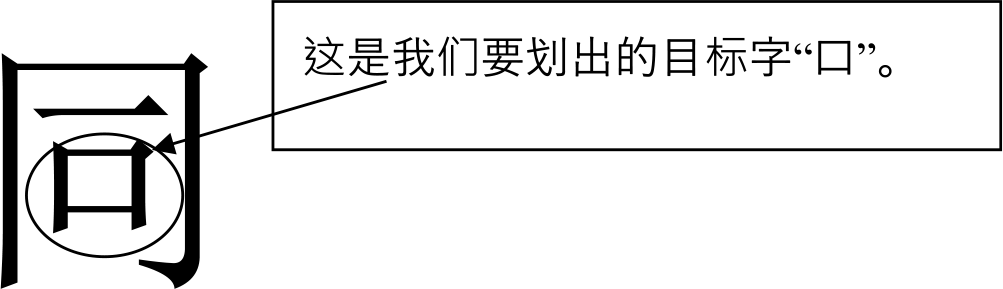
或者“口” 在下面的汉字
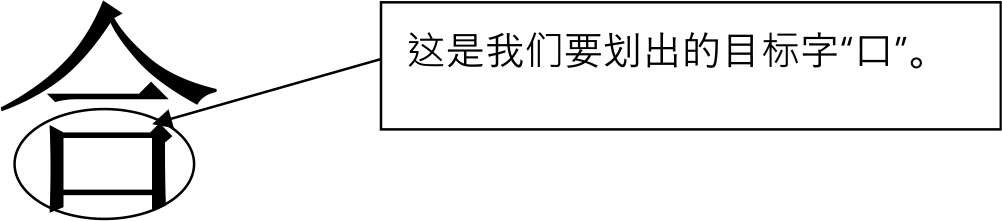
在下面的文章中,每一页的上方会呈现“口”提醒你在阅读理解的同时需要划出包含“口”的字。你需要认真阅读和理解这篇文章,读完以后,我们将向您呈现六个阅读理解题,需要您根据文章的内容做出回答。请注意,您无需放慢速度来划出所有含“口”的字,只需要以正常的速度阅读则可。有时您可能会发现自已先前错过了某个包含“口”的字,如果出现这种情况,请不要回头重阅读,而是继续阅读下文。这个实验包含练习、正式测试和语言背景问卷三个部分。在练习阶段,你可以就不懂的地方提问。
2. Practice passage and multiple-choice questions (The characters containing the target logographeme 口 are highlighted in gray color)
过年了,动物王国里洋溢着节日的气氛,家家户户都挂上了红灯笼,准备了的各具特色的休闲小吃,有七里香的板栗,芝麻街的杏仁,川西的叶儿粑……
为了欢庆这个具有传统意义的节日,动物王国的丞相大象先生举办了一场盛大的年夜会,他邀请了动物界最具才华的曲艺明星和最有声望的社交名流。小动物们各个都准备了精彩的节目,争相表演。美丽的小百灵在舞台上空翱翔,且飞且鸣,声音空灵婉转,随着这美妙自然的天籁之音,风度翩翩的孔雀王子携着清秀优雅的白鹤公主款款走上舞台,他们翩翩起舞,舞到尽处,孔雀王子在白鹤的的唇上印上深深一吻,在小动物们还沉醉于孔雀和白鹤的曼妙的舞姿之时,一阵刺耳而生涩的声音从舞台上空传来,原来是乌鸦小姐迫不及待地想展示她的才艺。淘气的小猴子吐出了刚刚放进嘴里的椰香杏仁, 憨厚的小狮子扣紧了衣服,因为乌鸦小姐的声音让他觉得寒冷。这时,机灵的小白鼠怂恿老虎国王的秘书熊猫教授上台发表演讲,因为他不想让大家再忍受乌鸦小姐拙劣的表演。熊猫教授首先代表老虎国王对动物王国的成员表示节日的问候,接着,熊猫教授慢条斯理地展开他的演讲:“从古至今,我们动物王国发生了很多变化,经历了无数次重大考验,世世代代的努力让我们今天能和伟大的人类和平共处,在这新年大吉大利的日子,我希望我们动物王国的国民们在新的一年里再接再厉,再创辉煌。” 熊猫教授振奋人心的讲演让小动物们各个眉开眼笑 ,对新的一年充满了希望。伴随着悠扬的乐声和欢快的笑声,动物的年夜会拉下了帷幕,动物王国呈现出一片欢乐祥和的节日气象。
Multiple-choice questions were presented in Chinese and in English for Chinese and English participants, respectively
请划出你认为是正确的答案/ Please circle the answer that you think is correct.
-
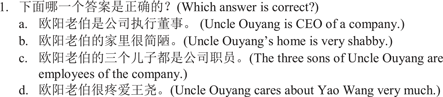
1. 下面的哪一个答案是正确的? (Which answer is correct in this story?)
-
a. 狮子是动物之王。 (The lion is the king of animals.)
-
b. 猴子正在吃香蕉。 (The monkey is eating a banana.)
-
c. 熊猫的演讲振奋人心。(Panda’s speech is upbeat.)
-
d. 小金鱼喜欢跳舞。(The little golden fish likes dancing.)
-
-
2. 你是不是看到 “
 ” 出现在文章中?(Did you see “” in the text?)
-
a. 是。(Yes.)
-
b. 不是。(No.)
-
3. The testing passage and multiple-choice questions (The characters containing the target logographeme 口 are highlighted in gray color)
“铃铃铃……”下课铃声准时响起,老师走出了教室,坐在前排的王尧掀开盖在头上的叶形扇子,揉了揉朦胧的睡眼,抚摸着胸前的金色吊坠,打着呵欠道:“终于下课了,不知道妈妈现在到家没有?”
在这久负盛名的有着“大学生摇篮”之称的天问学院,王尧是众人皆知的才貌俱佳的学生名人。他不仅刚转到这里就用完美的成绩征服了老师们,而且其帅气的外形和卓尔不凡的谈吐令全校的女生为之着迷。他被这里的女生们评为知书达理,谈吐优雅的绅士。每天放学的时候,班里的女生都要缠着他问一些让他觉得有些无聊的与各学科有关的各类作业题。其实,王尧知道这些女生不过是想用请教他问题的方式接近他而已。今天是王尧16岁生日,他为了能早些到家见到他朝思暮想的海外访学归来的妈妈,他箭步如飞地奔出了教室。
今天王尧和往日一样有私家车来接,他家的司机张山在那辆红色的名牌车前等他,王尧走到司机身旁,热情地叫着张叔叔。这位张叔叔和蔼风趣,开朗健谈,是看着王尧长大的多年的老司机,张叔叔每天都会和王尧讲一些有趣的见闻,让王尧能更多的了解学校之外的世界。王尧和这位张叔叔很亲近,他是王尧可以倾诉成长烦恼的人。张叔叔小心翼翼地打开名车的车门,让王尧坐在司机座位旁的位置上。王尧坐进车里立刻发现一袋杏干在自己的座位上,“一定是老爸放的,他知道我从小爱吃天津“十八街”的杏干。王尧美美地想道,此时的他嘴角微微上扬,薄唇勾起一抹淡淡的微笑。他快乐地打开那袋杏干,“好一股杏花绕鼻香!”他把一个金灿灿的杏干迫不及待地放进嘴里并慢慢地吞了下去。忽然,一道刺眼的光芒让王尧无法张开眼睛,更是叫不出声来。他双唇发麻,根本无法张嘴发声,他想喝水,却找不到,他知道这不是吉祥的迹象,但是他又无能为力。过了一会儿,那种另类的光消失了,他慢慢地睁开眼睛,发现司机张叔叔不见了,在他眼前呈现的是一个完全陌生的世界,“难道我穿越到古代了?”他无奈地自问道,迷茫而不知所措。他木然地呆在那里,一动不动,真的是完全地呆住了,看上去像木木的呆头鹅。过了一会儿,王尧稍清醒些,他吻了几下挂在胸前的吊坠。此刻,他多么希望能有人来告诉他这一切仅仅是个梦而已,但又有谁能真的告诉他这是上古神灵在那袋“十八街”的杏干里偷偷地加入了具有无边法力的名为“神魔科司巫”、人类肉眼无法看到的另类法术。
“真是一个可怜的孩子!”王尧机械地朝着未知的前方走着,他不敢问自己前方到底会有什么,他也不知道前方等待他是什么,他如一个不懂世事的呆子一样麻木地走着……这时,眼前出现了一个清清的水池,王尧走过去喝水并寻思着了解一下这个陌生的地方,他叫住了一位迎面走来的老者,礼貌地问道:“老伯,您好!请问这是……?”“这是无人不知无人不晓的秦朝,这里有着最健全的司法机关,最清廉的军政要员与最为杰出的艺术名流……”
眼看天色渐晚,又从老伯那里知道了一些现今社会不会有的另类的法规,王尧在心底暗暗发誓,一定要尽力让老伯收留他。于是,他从嘴里艰难地吐出好多好多句子:“恳请老伯收留我这个从小吃尽人间辛酸,又吞尽人间泪,无家可归,举目无亲,身世可怜的三好学员入住您家!”当你看到王尧讲完这些句子时那慈祥和蔼的老伯彻底呆住的表情,你定会扣案捧腹,拍案叫绝的!真服了王尧这股子吹牛功夫,也许是平日里和那位有些名不见经传却健谈的司机张叔学的。没想到,这位古代老伯还真让王尧去他的家了。
王尧随着老伯走过一个吊桥,看到一个典雅古朴的大宅院,紫色门柱上赫然写着“知文理,晓琴乐,自古雄才创伟业;问世事,转乾坤,内外和谐天下策”对仗优美,韵律生动的句子;再放眼望去,那另样的院门外观,有着古代建筑特有的典雅华丽,而门旁的两棵杏树花满枝头,绿油油的叶子展示着春天的勃勃生机。他们没有叩门,直接走进院里。王尧看到有位貌美如花的丫环边走边喊道:“快迎接我们的欧阳老爷!”这时,就见那些家丁和侯着的朝廷要员将士,以及家里大小成员纷纷赶出来叩首请安,那阵势颇为壮观。王尧随着老伯走进宅院内,当他看到里面美轮美奂的陈设装饰,立刻呆住了:“这简直是人间仙境,世外桃源,即使是现代的建筑也没有如此的纤巧华丽!”在王尧暗暗称赞欧阳府邸的奢华典雅之时,一行浅笑嫣然,美艳如花的八个丫环端着茶水袅袅走进庭院,她们微微欠身叩首,眉目含笑带俏,温润之态,令人如沐春风。王尧在欧阳老伯的引荐下,一一叩首拜见在座的各位英武的将士,当朝要员及家眷,还有庞大的欧阳家族的成员们。并且,欧阳老伯的儿子们也很快成为王尧的知心好友。他们是老大欧阳凌云,老二欧阳飞宇,还有老三欧阳晴雪。这三位算得上多知博学,风度儒雅,谈吐不凡,具有上知天文下晓地理,运筹帷幄,用兵如神之才能。在王尧看来,他们身上既有古人之风,更有今人之神气,是不可多得的人才。王尧心里想:“这三位在古代是有些屈才,他们要是在现代的公司由一个普通小员工起步,最终一定会成为有建树的董事会里最有发展潜力的要员之一。到那时国民经济指数一定会呈上升趋势,祖国万里呈现一派繁荣祥和之气象!”
此时的王尧表面沉默淡定,不动声色,心里却长了草,他好想去找个人炫耀一下自己拥有这样出色的新朋友。但在这么个叫天不应,又叫地不灵的地方,他最多是吻了几下那个金色吊坠来求个平安 。
由于王尧的吹牛天下第一的功夫,再加上他那张薄唇微勾,眉眼含笑,玉树临风,俊美到极致外表,以及他那张诙谐幽默倾倒众生的嘴巴,令欧阳府上下对他是大加称赞。此外,王尧通晓音律,才思敏捷,令他显得更加才华出众。而且,王尧待人谦和有礼,与欧阳府大小都能和睦相处,令欧阳老伯对他更加疼爱。于是,王尧在欧阳府里过上了如神仙般的吃穿不愁的日子。他每天都能喝着上等铁观音茶尖嫩叶水,还时不时地和欧阳家三位公子去吊两下小曲,去看几台精彩的秦腔古韵的大戏,学学秦人曲艺名流的风雅。王尧的日子过得是悠闲自在,轻松快乐。不过,王尧很快发现欧阳老伯的另类特征,那就是一个字“严”。这边仆人没打扫好庭院要扣钱;那边的花叶蔫了也扣钱;园内有几片零星的叶子,不好意思还要扣钱,庭院里的花枝绿叶没有及时修剪,也是要扣钱;饭菜准备得稍微有些迟,还是要扣钱的。王尧有时候都怀疑这栋华丽的宅子是不是用这另类的严厉制度扣出来的,他有时担心无钱让老伯扣的他,会不会被老伯一辈子扣在这里。
这一天阳光灿烂,风和日丽,花美叶秀,王尧早早起了床,静静地喝了一杯嫩尖花叶茶,他先去前庭给老伯叩首请安,接着去各个庭院一一问候老伯的夫人们。他没有吃早饭,一个人往欧阳府外边的山里走去。他是应该一个人静一静了,毕竟来古代好久了,也不知父母怎么样了,他们会不会想他这个有时呆有时灵的儿子。山上的空气清新宜人,王尧一人悠游漫步。他一边观山望水,一边吃着刚从树上摘下的青果,他双唇微抿,微微上扬的嘴角勾出好看的弧度,双目含泪,整个人在山色笼罩下呈现淡淡的忧郁情怀。“想不到我这次竟然出了这么远的一次门” 他轻声道。清清如玉的小溪在山间淙淙而流,细软如丝的柳枝细叶随风轻轻曼舞,淡淡的野花如星星般镶嵌在平滑如毯的绿草间,参天的百年古木郁郁葱葱,繁茂的枝叶相互交错,犹如绿色的天棚。王尧面对这秀美如画的山色,突然心生灵感:“我王尧不能在这里自我否定,更不能枉费这穿越的时机,我要在秦古时代大有作为,留名青史, 我要用我的能力告诉这里的人,不要做书呆子。我还要告诉这里的人,这座山是一块吉祥宝地,我要先在这里建个戏台让那些热爱戏曲的名流雅士为最普通的平民百姓表演,展示他们的才艺。曲韵幽幽,山色空蒙,青黛含翠,山色撩人,人入山色,那将是多么和谐美好的画面!”刚刚萌生的雄心壮志扣动着王尧的心扉,让他久久无法平静。
夕阳西下,远处袅袅的炊烟升起,王尧见天色已不早了 , 他起身,想出山去欧阳老伯家。突然,从树上面传来一个清晰声音:“你好,你是不是发烧了?”王尧仰头,寻着声音望去,树叶浓密,无人,树枝上的小鸟温润如玉,娇小温顺,犹如降临凡间的精灵。王尧首先否定了有人的猜想,但他很想知道是不是树枝上的小鸟在问候他,于是,他大声叫道:“难道是你在问候我?”“是我在问你,你是不是发烧了?”小鸟应声到。“可爱的小家伙,不用再问我有没有没发烧了!我很好!”“真是太神了,太另类了,我要带它到老伯家!”他想着如是道:“小家伙,你是否愿意离开这山林,愿意和我去一个新的地方?我会好好待你的,一定不会让人吃了你!”没想到那白色的小鸟就真的随着他飞起来了。那小鸟一边飞,一边吐出许多果核,王尧不经意间捡起一颗,发现竟然是杏核,王尧越发觉得有些有不可思议:先是吃了爸爸车里面的杏干,然后自己就莫名其妙的穿越到了上古秦朝,又偶然遇到了欧阳老伯,欧阳老伯家里也是满庭院的杏树,怎么这一切都与杏有关?
在他百思不得其解的时候,他已经走过了含烟蓄翠,依水而建的吊桥,他很快走到了欧阳府。“这小东西一定是我的吉祥物”王尧想到。到了欧阳府,王尧在杏树旁建了一个很有现代特色的吊脚楼,为了预防老伯扣住他的小鸟,他巧妙地让浓密的树叶严严实实地遮盖住吊脚楼的天窗,从外边根本无法看见枝叶间穿梭轻舞的白色精灵,而且,他还在外围修了环形台阶以方便自己进出,这样就没人能扣住他们了。从此,他和小鸟快乐地住在了一起。也许,他自己还不知道,也没有人会告诉他,这仅仅是这台戏的开端,许多扣人心悬的精彩都将在他的人生舞台上一一铺展呈现……
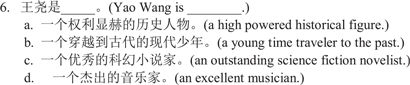
请划出你认为是正确的答案。(Please circle the answer that you think is correct.)




4. Language background questionnaire
请尽量完成下面的各项问题,您所提供的所有资料仅供研究之用。非常感谢!
Please answer the following questions to the best of your knowledge.
A. 背景信息. Demographic Information








C. 第二语言学习 (这里所指的第二种语言包括方言。如果你从来没有学过第二种语言,则下面的问题你不需要回答,到此您已经完成本问卷。) Second-Language Exposure (If you have not learned a second language, you have completed the test and you do not need to answer the following questions.)