School performance is an important part of individual and societal development with effects across life and generations. It opens opportunities to move on to higher levels of education which, in turn, is associated with better life outcomes, such as higher employment chances and income, improved social status and access to social networks, as well as stronger civic engagement. On the other hand, individuals with lower education levels have a higher risk of unemployment and are more vulnerable to economic crisis [Organization for Economic Co-operation and Development (OECD), 2015]. The impact of education on health and wellbeing is also well known: Individuals with higher levels of education report better health outcomes, higher levels of health-related activity, higher levels of life satisfaction, and higher life expectancy (Feinstein, Sabates, Anderson, Sorhaindo, & Hammond, Reference Feinstein, Sabates, Anderson, Sorhaindo, Hammond, Desjardins and Schuller2006).
Several factors affect school performance. Research has highlighted various, ranging from personal factors like motivation or behavioral strategies, to social-contextual factors, where family, peers and school features are the most studied ones (Hattie, Reference Hattie2009; Lee & Shute, Reference Lee and Shute2010). Some of these factors are well known determinants of school performance, either for top performers or low achievers. However, like every group, top performers and low achievers are not homogeneous groups. Since different factors can be present and determine different paths to the similar outcomes, the aim of this study is to select relevant personal and contextual variables, associated with those paths that predict top performance and low achievement in a sample of Portuguese and Spanish adolescent students.
School performance snapshot
In the last two decades, several surveys focusing on school performance, conducted on a regular basis and in many countries, have appeared. The main goal of these studies is to investigate international performance, to uncover the determinants of the best performances and to use the results to improve educational standards worldwide. This is the case with PISA (Program for International Student Assessment) (OECD, 2016). The PISA study evaluates the extent to which 15-year-old students have acquired key knowledge and competences (science, mathematics, reading, problem solving) that are determinants for active participation in society. The results of the latest study, the PISA 2015 study, revealed that the OECD average percentage of low achievers (around 20%) doubles the percentage of top performers (around 10%) in the three subjects. Looking at the results in Portugal and Spain, it is possible to verify that the Portugal average is significantly above the OECD average in two domains (science and reading), as well as above the Spain average, which is below OECD average in one domain (mathematics). The share of top performers in at least one of these three subjects is 15.6% for Portugal and 10.9% for Spain, while the share of low achievers in all the three subjects is 10.7% for Portugal and 10.3% for Spain.
However, the results of the HBSC 2013/14 study (Inchley et al., Reference Inchley, Currie, Young, Samdal, Torsheim, Augustson and Barnekow2016), concerning comparisons between Portugal and Spain, appear to be inconsistent with the more recent PISA results. In the HBSC study, the data on perceived school performance for 15-year-old students indicates that the percentage of Spanish students that report good or very good school performance (55%) is higher than the Portuguese students’ percentage (43%). This is also valid for the 13 (66% of Spanish students vs 54% of Portuguese students) and 11-year-old students (85% of Spanish students vs 65% of Portuguese students), especially for girls in the three age groups and 11 and 13-year-old boys. The study also confirms a decrease in perceived school performance as age increases.
School performance determinants
Several factors are associated with school performance. In an extensive literature review of studies, conducted over the last 60 years, on student achievement on reading and mathematics, Lee and Shute (Reference Lee and Shute2010) found two groups of variables related to personal and social-contextual factors that are directly linked to K–12 students’ achievement. On one hand, in the personal variables group there were student engagement variables, like behavioral engagement (e.g. attending classes or participate in school activities), cognitive-motivational engagement (e.g. intrinsic motivation, academic self-beliefs), and emotional engagement (e.g. interest, curiosity). On the other hand, there were learning strategies, such as cognitive strategies (e.g. summarizing, applying), metacognitive strategies (e.g. monitoring and evaluating cognitive processes), and behavioral strategies (e.g. time management, help-seeking). In the social-contextual group, there were school climate variables and social-familiar influences. The school climate variables encompass factors like academic emphasis (e.g. high expectations, positive relations), teacher variables (e.g. teacher empowerment, sense of affiliation) and principal leadership (e.g. collegiality, clearly conveyed goals). Finally, within social-familiar influences, parental involvement (e.g. attitudinal and behavioral approach to education) and peer influences (e.g. peer support, peers’ achievement) were found to be significant.
Personal factors
One interesting group of variables in this field are health-related problems, risk behaviors and well-being. Health-related problems, like poor physical health, psychological health, social relationships, and living environment are associated with school difficulties (school absenteeism, academic performance, and school dropout ideation) (Chau et al., Reference Chau, Kabuth, Causin-Brice, Delacour, Richoux-Picard, Verdin and Chau2016). Certain longitudinal studies in the field provide evidence that the relationship between education and health and well-being is reciprocal (Weidman, Augustine, Murayama, & Elliot, Reference Weidman, Augustine, Murayama and Elliot2015). Some authors infer that in some cases the impact of these variables on academic achievement is not direct, but rather acts through school engagement (Gutman & Vorhaus, Reference Gutman and Vorhaus2012). Gutman and Vorhaus (Reference Gutman and Vorhaus2012) point out that schools can promote the emotional and behavioral well-being of students, which is very important for school engagement (and becomes more important for adolescents), and in this way boost positive educational outcomes.
Another important set of factors are health-risk behaviors. These behaviors, like substance use, are associated with poor academic achievement (Bradley & Greene, Reference Bradley and Greene2013; Chau et al., Reference Chau, Kabuth, Causin-Brice, Delacour, Richoux-Picard, Verdin and Chau2016), especially as age increases (Gutman & Vorhaus, Reference Gutman and Vorhaus2012). For physical activity, a review of 50 studies on school-based physical activity (including physical education) and academic performance (including indicators of cognitive skills and attitudes, academic behaviors, and academic achievement) shows apparently inconsistent results: In about half of the studies all the associations were positive, whereas in the other half the associations were not significant (Rasberry et al., Reference Rasberry, Lee, Robin, Laris, Russell, Coyle and Nihiser2011). For screen time (which includes watching television, playing videogames, and the general use of information and communications technology), some studies also appear inconsistent, ranging from a non-significant relationship between television and video game use and grades (Ferguson, Reference Ferguson2011), to a negative relationship between video gaming and academic achievement (Jackson, von Eye, Witt, Zhao, & Fitzgerald, Reference Jackson, von Eye, Witt, Zhao and Fitzgerald2011).
Still, in the personal factors category, variables related to school attitudes and behaviors have been found to be significant. One of these factors is the attitude towards school, which is associated with perceived academic achievement (Simões, Matos, Tomé, Ferreira, & Chaínho, Reference Simões, Matos, Tomé, Ferreira and Chaínho2010). On the behavioral side, homework and schoolwork appear as an important element for school performance. When considering schoolwork in general, as well as the consequent psychological pressures, the HBSC results (Inchley, et al., Reference Inchley, Currie, Young, Samdal, Torsheim, Augustson and Barnekow2016) reveal that boys report more frequently feeling pressured by schoolwork at age 11 and girls at 15, but there is an increase with age that is more evident in girls. Self-reported schoolwork pressure is associated with poor health indicators (Inchley, et al., Reference Inchley, Currie, Young, Samdal, Torsheim, Augustson and Barnekow2016), as well as a negative attitude towards school (Ercan et al., Reference Ercan, Erginoz, Alikasifoglu, Uysal, Yurtseven and Fiscina2017).
Social-contextual factors
As previously mentioned, several social-contextual factors have an effect on school performance, with family, school and peers being some of the most relevant ones. The influence of family factors on school performance has been widely studied. In this context, factors like parental level of education, family income and structure, and parental support are regarded as important. For instance, parental level of education is found by several studies to be positively associated with academic achievement (Erola, Jalonen, & Lehti, Reference Erola, Jalonen and Lehti2016). The HBSC study (Inchley, et al., Reference Inchley, Currie, Young, Samdal, Torsheim, Augustson and Barnekow2016) reports a positive association between family affluence and school perceived performance, school performance being higher in high-affluence backgrounds in almost 30 countries.
Looking at school variables, in particular teacher-related variables, the student-teacher relationship is described in the literature as fundamental to students’ success (Hamre & Pianta, Reference Hamre, Pianta, Bear and Minke2006). A positive relationship with teachers (high levels of support and low levels of conflict) is associated with security and feelings of competence, better relationships with peers, and better academic indicators (García-Moya, Brooks, Morgan, & Moreno, Reference García-Moya, Brooks, Morgan and Moreno2015; Hamre & Pianta, Reference Hamre, Pianta, Bear and Minke2006), such as achievement goals orientation (Thijs & Fleischmann, Reference Thijs and Fleischmann2015) or engagement (Wu, Hughes, & Kwok, Reference Wu, Hughes and Kwok2010). In contrast, a negative student-teacher relationship increases the likelihood of antisocial behavior, peer rejection, negative attitudes towards school, adjustment difficulties, lower school attendance, and poorer academic engagement and achievement (McGrath & Van Bergen, 2015). Perceived support from classmates is related to perceived academic competence, academic initiative, motivation and achievement, and school well-being (Danielsen, Wiium, Wilhelmsen, & Wold, Reference Danielsen, Wiium, Wilhelmsen and Wold2010; Wentzel, Battle, Russell, & Looney, Reference Wentzel, Battle, Russell and Looney2010). Besides classmates, friends also seem to have an important role in the students’ academic performance and academic engagement. The study of Carbonaro and Workman (Reference Carbonaro and Workman2016) indicates that the grade point average of the students’ friends predicts their grades. Another interesting variable in this domain is the time spent after-school with friends. Some studies show that after-school time in structured activities is associated with positive social and academic outcomes (Anderson, Reference Anderson, Gibson and Krohn2013), while unsupervised after-school time with friends increases the likelihood of risk behaviors (Lee & Vandell, Reference Lee and Vandell2015) and of dropping out of school (Anderson, Reference Anderson, Gibson and Krohn2013).
As stated, there is a huge and complex network of influences on academic achievement. Some of the relationships between school performance and personal and social-contextual variables appear to be more highly associated with academic performance; this is well established. But in other domains, other than the evidences of the associations between health and well-being related factors and school performance, more research is needed, as Thorburn and Dey (Reference Thorburn and Dey2017) pointed out. The aim of this study is precisely to investigate the influence of personal variables, namely adolescents’ health and wellbeing, health-related behaviors and lifestyle, and social-contextual variables on perceived school performance in two different groups: top performers and low achievers.
Method
Participants
In this study, data from the Portuguese and Spanish 2013/14 HBSC study (Health Behavior in School-aged Children)Footnote 1 was used (Matos, Simões, Camacho, Reis, & Equipa Aventura Social, 2015; Moreno et al., Reference Moreno, Ramos, Rivera, Jiménez-Iglesias, García-Moya, Sánchez-Queija and Morgan2016). To obtain a representative sample of Portuguese students, according to the international HBSC protocol (Currie, Smith, Boyce, & Smith, Reference Currie, Smith, Boyce and Smith2001), 473 classes (from 6th, 8th and 10th grades) from 36 groups of schools (stratified by the five continental regions) were randomly selected from the Portuguese state schools. For the Spanish sample, 402 schools were selected with a random multi-stage sampling, stratified by conglomerates, bearing in mind (in addition to the age of the adolescents, which in the case of Spain covered until age 17–18) the geographical area (region of the country, using 19 strata corresponding to the 18 autonomous communities and autonomous cities, Ceuta and Melilla), habitat (rural and urban) and type of education center (public or private). The school response rate was 97.2% (80.5% for classes and 79% for students) for the Portuguese sample and 85% (83% for classes and students) for the Spanish sample. From a total sample of 6,026 Portuguese students and 31,058 Spanish students, students that responded in one of the two extreme answer options (below average and very good) of the Perceived School Performance question, and concurrently answered all the questions used in the analysis, were selected: 782 Portuguese students and 1,998 Spanish students. A random selection of the Spanish sample cases was performed to equalize them to the number of Portuguese students in the selected categories of the Perceived School Performance question. After these adjustments, the final sample for this study was constituted by 1,564 adolescents (782 Portuguese students and 782 Spanish students). Respondents ranged from 10 to 19 years old (Portuguese sample mean age = 13.71, SD = 1.67; Spanish sample mean age = 14.22; SD = 2.08). Of these, 56% were boys and 44% were girls in the Portuguese sample, and 48.3% were boys and 51.7% were girls in the Spanish sample. The research project was submitted and approved by several national organizations (Ministry of Education and Ethics Commission in Portugal, and Ethics Commission of the University of Seville in Spain).
Measures
Data was analyzed from surveys conducted in Portugal and Spain as part of the HBSC study (Currie, et al., Reference Currie, Smith, Boyce and Smith2001; Matos, et al., Reference Matos, Simões, Camacho and Reis2015; Moreno, et al., Reference Moreno, Ramos, Rivera, Jiménez-Iglesias, García-Moya, Sánchez-Queija and Morgan2016). The survey instrument used in the HBSC study is a standard questionnaire developed by the international research network. The questionnaire consists of a set of mandatory questions that each participant country or region must use to facilitate the collection of a common data set. It is based on a strong conceptual framework and includes a coherent set of indicators of the social and individual determinants of health, as well as of health and behavioral outcomes (Inchley, et al., Reference Inchley, Currie, Young, Samdal, Torsheim, Augustson and Barnekow2016). The main HBSC survey included questions on demographics (age, gender, and socio-demographics), school-related variables, tobacco and alcohol use, physical activity and leisure, nutrition, safety, psychosocial health aspects, general health symptoms, social relationships and social support in main life contexts. For the present study, 26 variables were used. The dependent variable was Perceived School Performance: “In your opinion, what do your class teachers think about your school performance compared to your classmates” (1 = very good; 2 = good; 3 = average; 4 = below average – for this study only the two extreme categories were used).
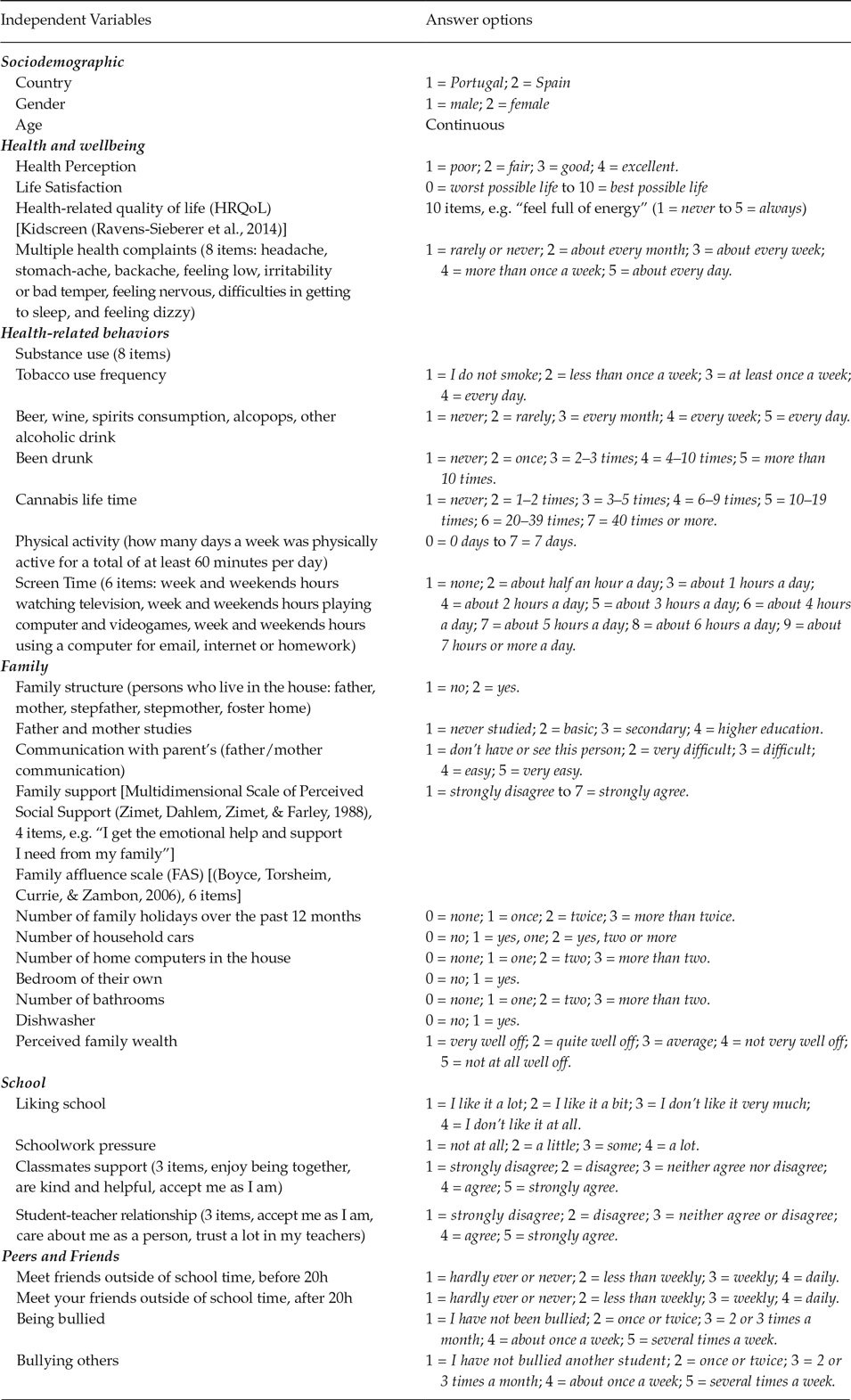
The other 25 variables were independent variables (see Table 1), categorized here in six domains (sociodemographic, health and well-being, health-related behaviors, family, school, peers and friends) to facilitate their description.
Independent Variables Used in the Study

Procedure
Data was collected through anonymous self-completion of online questionnaires administered at schools. In Portugal, after being selected, the schools were contacted by telephone to confirm their availability to participate in the study. Afterwards, an email was sent to the schools’ principals introducing the study and its procedures, as well as the links and passwords for each school year and classes, and the informed consent for the parents. The questionnaires were answered in class under the supervision of a teacher and took about 60–90 minutes to be completed. Data was transferred from Limesurvey to a SPSS database to be analyzed. In Spain, new information and communication technologies (ICT), based on a CAWI (Computer-Assisted Web Interviewing) model, were used in the data collection process. The data was always collected in the school setting under the supervision of teachers. In schools with internet-connection problems or problems with the condition or number of computers, members of the research team travelled personally to those schools to collect data using tablets. Detailed information about the survey procedures can be found in the national report of each country: Portugal – Matos et al. (Reference Matos, Simões, Camacho and Reis2015); Spain - Moreno, et al. (2016).
Data analysis
In order to understand the variables that predict the top performance and low achievement of Portuguese and Spanish adolescents, a Decision Tree was created using statistical software IBM SPSS Statistics 21.0. Decision trees are a non-parametric procedure that predicts a dependent variable on the basis of a set of independent variables. The Decision Tree procedure creates a tree-based classification model, presented through a visual diagram, which allows us to identify groups, discover relationships between groups, and predict future events. In this study, the algorithm used was Exhaustive CHAID (Exhaustive Chi-squared Automatic Interaction Detection) and the chi-square test, at the .05 significance level (Silvente, Hurtado, & Baños, Reference Silvente, Hurtado and Baños2013), was used as the statistical test to limit the number of variables. A 10-fold cross-validation was used (the data is divided into 10 equal subsets).
Before running the decision tree, reliability analyses were conducted with the items of each multiple item variables. The results of these analysis varied from Cronbach’s alpha = .77 for classmates to Cronbach’s alpha = .97 for family support, in the Portuguese sample, and from Cronbach’s alpha = .82 for classmates to Cronbach’s alpha = .93 for family support in the Spanish sample. After the reliability analysis, the items of each set of multiple item variables were summed. To prevent “tree overgrowth”, these variables were categorized into three equal groups (low, medium and high scores) through visual binning in SPSS (2 cut points, equal percentiles based in scanned cases). This same procedure was applied to scale single item variables, like age, physical activity and life satisfaction. Family affluence scale items were summed, and the scale obtained was categorized in three groups according to the international cut points (Boyce, Torsheim, Currie, & Zambon, Reference Boyce, Torsheim, Currie and Zambon2006).
Categorical variables, like health perception, being bullied or bullying others, liking school, and schoolwork pressure were split in two categories, as was family structure (after the computation to obtain the different families types). The two variables related to time spent with friends and perceived family wealth were sorted in three categories, as was communication with parents (that was first computed from the variables relating to communication with father and mother). The categories obtained for the different variables are presented in table 1.
Results
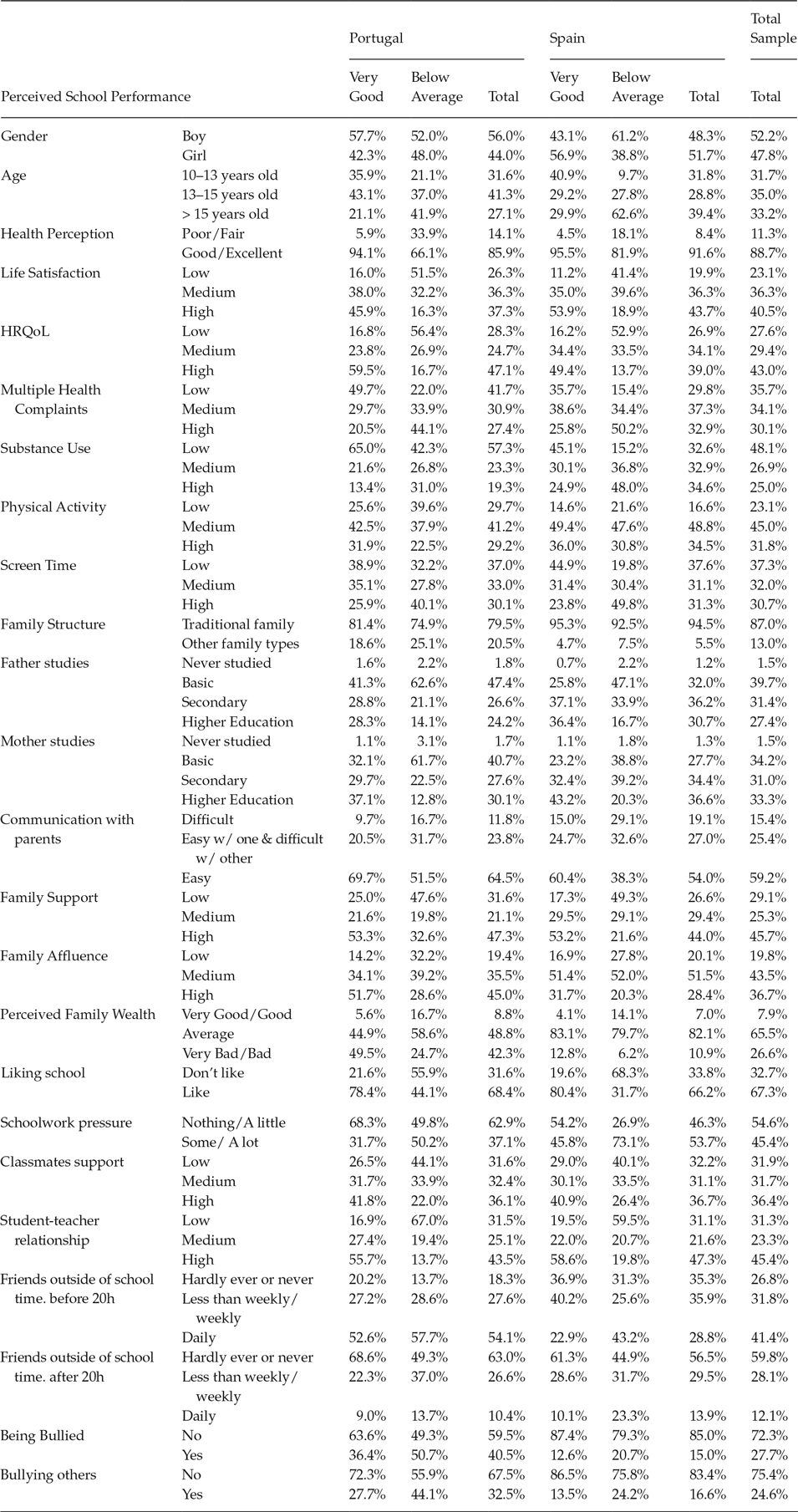
Considering the total sample, 71% of the adolescents report very good school performance, and 29% report performance below average. More Portuguese boys report higher achievement in comparison to girls (73.1% boys vs 68.3% girls), whereas the opposite situation was found within the Spanish sample (78.2% girls vs 63.2% boys). More Portuguese girls (31.7% girls vs 26.9% boys) and more Spanish boys report low achievement (36.8% boys vs 21.8% girls). Younger students report better achievement (80.6% of the Portuguese cases and 91.2% of the Spanish cases) in comparison to the students above 15 years old (55.2% of the Portuguese cases and 53.9% of the Spanish cases).
Table 2 shows the descriptive statistics for the independent variables by perceived school performance categories and country, as well as for the total sample. A majority of students report positive health indicators (e.g. good health, being positioned in the bottom or middle parts of the distribution for the negative indicators, and in the middle or top parts for the positive indicators), positive family indicators (e.g. easy communication with both parents, being positioned in the middle or top parts of the distribution for family affluence and family support), as well as in the peer context (e.g. not being bullied or bullying others) and school context (e.g. liking school, being positioned in the middle or top parts of the distribution for classmates support and student-teacher relationship). It is also apparent that the percentage of students that report these positive indicators is higher within the Portuguese and Spanish top performers in comparison with the low achievers.
Descriptive Statistics (%) for Independent Variables by Perceived School Performance Categories and Country, and for Total Sample

Decision tree
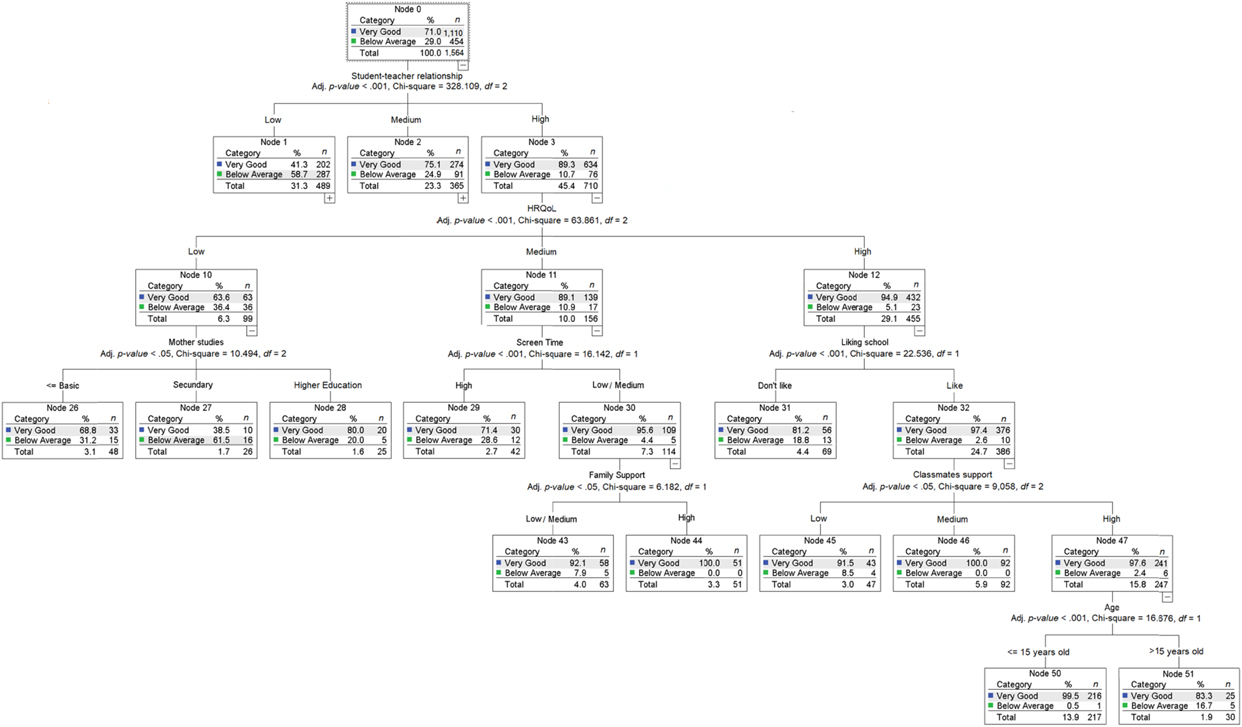
The decision tree presents an estimation risk of .22 (cross-validation) and a standard error of .10, classifying correctly 82.2% of the students (86.6% of the top achievement students and 70.5% of the low performance students). The root variable in the decision tree is perceived school performance (71% top performers; 29% low achievers). The first predictive variable is student-teacher relationship, χ2(2) = 328.11, p < .001. This variable splits the tree in three branches headed by low, medium and high scores on the student-teacher relationship variable.
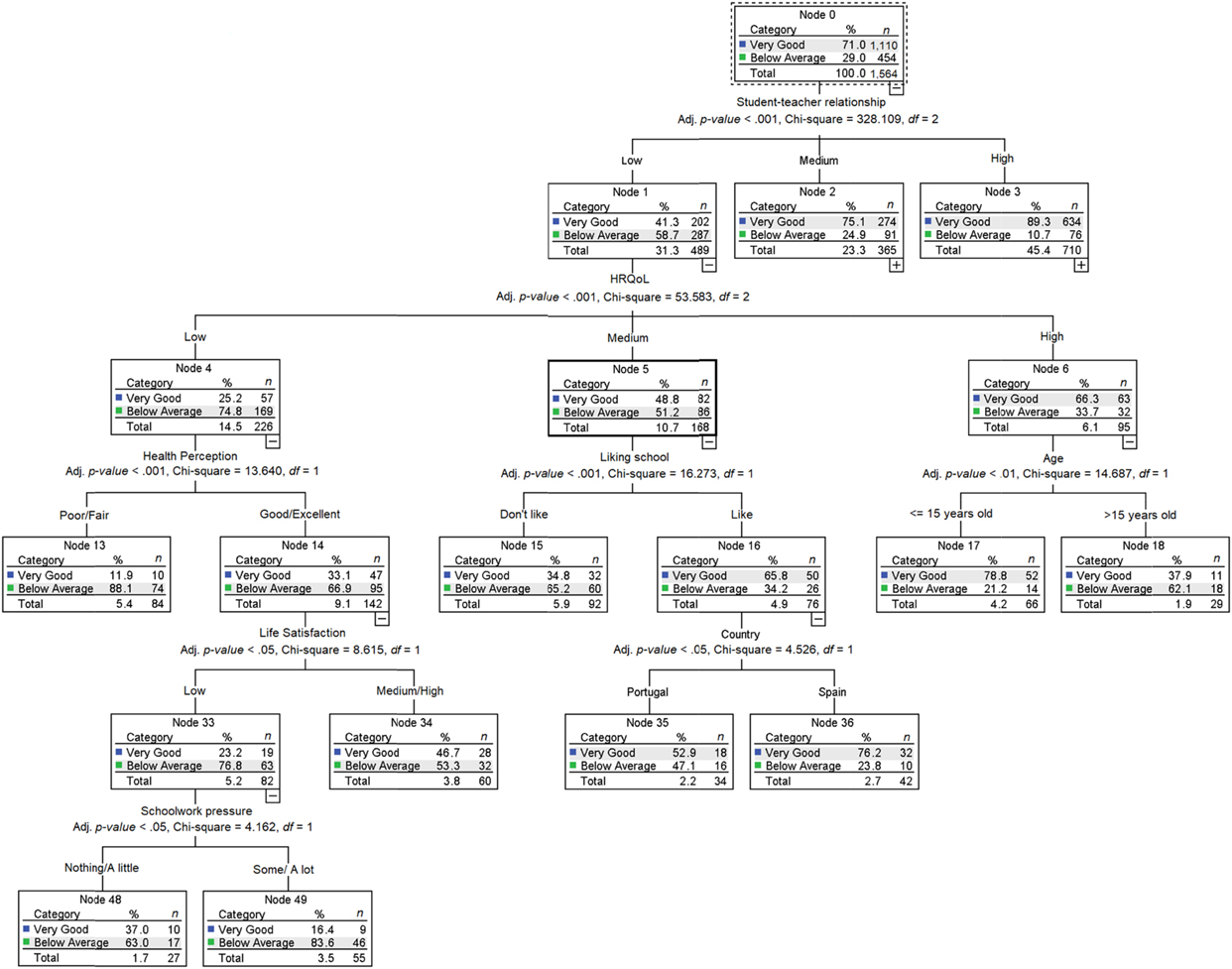
The low score student-teacher relationship branch will be described first (see Figure 1). This branch has a higher percentage of students with a performance below average (58.7%) and a lower percentage of students with a very good school performance (41.3%). The variable that produces the next split in this branch is health related-quality of life (HRQoL), χ2(2) = 53.58, p < .001, that, again, splits the branch in three: Low, medium and high levels of HRQoL. The percentage of students with low performance is higher within the students with low levels of HRQoL. This percentage increases in the next split, produced by the health perception variable, χ2(1) = 13.64, p < .001, to 88.1% within the students that report a poor or fair health (terminal node). For the students that report a good or very good health, the percentage of low achievers decreases to 66.9%. Nevertheless, this percentage increases again with the division of the good health perception group, produced by the life satisfaction variable, χ2(1) = 8.62, p < .05, which splits this branch in two: Low levels of life satisfaction and medium or high levels of life satisfaction. The low life satisfaction group presents a percentage of low achievers of 76.8%. Another split is produced at the final level of the tree, by schoolwork pressure, χ2(1) = 4.16, p < .05. This split produces two terminal nodes, having the one that includes the students who report feeling at least some pressure or a lot of pressure, due to schoolwork, 83.6% of low achievers. Moving up to the group that has medium levels of HRQoL, the percentages for low achievers and top performers are very similar. Nevertheless, these percentages change considerably within the two groups created in the next split determined by the liking school variable, χ2(1) = 16.27, p < .001. The group that reports not liking school (terminal node) represents 65.2% of low achievers and the group that refers liking the school represents 65.8% of top performers. Within this last group, a new split, that produces two terminal nodes is determined by the country variable, χ2(1) = 4.53, p < .05. Looking at the group with high levels of HRQoL, it is possible to find that most students within this group are top performers. This value increases in one of the two groups (terminal nodes) obtained through the split produced by the age variable, χ2(1) = 14.69, p < .01. Within the group of students below 15 years old, the percentage of top performers increases to 78.8%, while in the group of students above 15 years old this percentage decreases to 37.9%.
Decision Tree: Low Student-Teacher Relationship Branch.

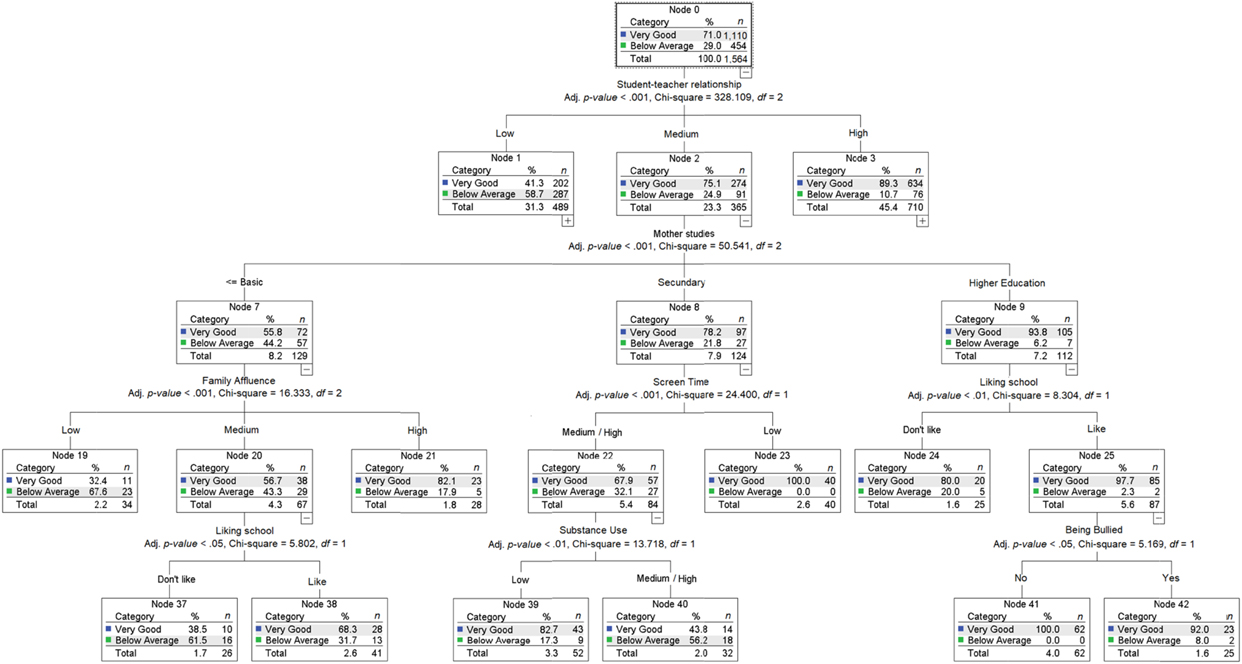
Next, it will be described the branch headed by the group with medium scores on the student-teacher variable (see Figure 2). This group presents 75.1% of top performers. In this branch, the variable that produces the next split is the mothers’ level of education, χ2(2) = 50.54, p < .001. This split creates three groups: Students whose mothers have no studies or basic studies, students whose mothers have secondary education, and students whose mothers have higher education. In the group of students whose mothers have no studies or basic studies, the percentage of top performers decreases to 55.8%. This group is divided again in three groups by the split produced by the family affluence variable χ2(2) = 16.33, p < .001. In the group with low family affluence most students have low achievement, while in the group with medium or high family affluence the majority of students are top performers. The group with medium levels of family affluence is divided again by the liking the school variable χ2(1) =5.80, p < .05. Within the students that do not like school, the percentage of top performers decreases to 38.5% (low achievers, 61.5%), while in the group that reports liking school the percentage of top performers is 68.3%. Looking now at the group of students whose mothers have secondary education, it is possible to find a percentage of top performers of 78.2%. The variable that produces the next split in two groups is screen time, χ2(1) = 24.40, p < .001. The group with low scores on screen time presents 100% of top performers, while the group that presents medium or high scores on screen time the percentage of top performers is 67.9%. A final split in this last group is produced by the substance use variable, χ2(1) = 13.72, p < .01. Within the group with low consumption levels the percentage of top performers increases to 82.7%, while in the group with medium or high levels of substance use this value decreases to 43.8% (56.2% of low achievers). Moving up to the group with mothers with higher education, it is possible to verify that the percentage of top performers is 93.8%. This group is divided in two groups by the liking the school variable, χ2(1) = 8.30, p <.01. In the group that refers not liking the school it is possible to verify a drop to 80.0% in the top performers, while in the group of students that like the school there is an increase to 97.7%. The last split produced in this branch is determined by the being bullied variable χ2(1) = 5.17, p < .05. In the group that referred not being a bullying victim, the percentage of top performers is 100%, while in the group that referred being bullied the percentage of top performers decreases to 92% (8% of low achievers).
Decision Tree: Medium Student-Teacher Relationship Branch.

Finally, it is presented the branch led by the group with high scores on the student-teacher relationship variable (see Figure 3). In this group, 89.3% are top performers and 10.7% are low achievers. This group is divided in three groups by HRQoL, χ2(2) = 68.86, p < .001, (low, medium and high scores). In the low HRQoL group, the percentage of top performers decreases to 63.6%. This group is divided again, in three groups (terminal nodes) through the intervention of the mothers’ level of education variable, χ2(2) =10,49, p < .05. Within these two groups, the percentage of top performers increases to 68.8% in the group of students with mothers with no studies or basic studies, and 80.0% in the group of students whose mothers have higher education and decreases to 38.5% in the group of students with mothers that have secondary education. In the medium HRQoL group, the percentage of top performers is 89.1%. Screen time is the variable that produces the next split in two groups, χ2(1) = 16.14, p < .001. In the group with high scores on screen time it is possible to verify a lower percentage of top performers, 71.4%, while in the group with medium or low scores on screen time this percentage increases to 95.6%. This group is split by the intervention of the family support variable, χ2(1) = 6.18, p < .05, that creates two groups. In the group with high scores in the family support variable, the percentage of top performers is 100%, whereas in the group with low or medium scores in these variables the percentage of top performers drops to 92.1%. In the high HRQoL group, the percentage of top performers is 94.9%. This group is divided by the liking the school variable in two groups, χ2(1) = 22.54, p < .001. In the group that reports not liking the school there is a drop of top performers to 81.2%, while in the group that likes the school there is a slight increase of top performers to 97.4%. This group is divided by the classmates’ support variable, χ2(2) = 9.06, p < .05, in three groups. The group with the lower level of classmates’ support presents the lowest percentage of top performers, while the group with medium levels presents the highest percentage of this kind of students (terminal nodes). The group with higher levels of classmates’ support (with 97.6% of top performers) is divided again by the age variable, χ2(1) = 16.68, p < .001. The group with students below 15 years old includes 99.5% of top performers, while in the group above 15 years old there is an expressive drop of top performers (83.3%).
Decision Tree: High Student-Teacher Relationship Branch.

Discussion
The results of this study show different paths and different influences of personal and social-contextual variables in school performance. Looking at the most relevant variables for school performance, based on the strength of the association, it is possible to see that the student-teacher relationship is the most important variable. As Hamre and Pianta (Reference Hamre, Pianta, Bear and Minke2006) stated, the student-teacher relationship is fundamental for students’ success, through its association with other important variables in this process, like security and feelings of competence or engagement. The results show that it is possible to find the highest percentages of low achievers in the group with lower scores on student-teacher relationship, and the highest percentages of top performers in the group with higher scores on student-teacher relationship.
Health-related quality of life (HRQoL) also appeared as an important variable for students with lower and higher scores on student-teacher relationship. Other important variables in this domain were health perception and life satisfaction, as pointed out by other authors (Chau et al., Reference Chau, Kabuth, Causin-Brice, Delacour, Richoux-Picard, Verdin and Chau2016), in this case with a significant impact for students with lower scores on the student-teacher relationship. For some of these variables, it seems that the negative side (poor health, low HRQoL) has a higher negative impact on school performance, comparatively to the positive effect of the positive side of these indicators (good health, high HRQoL).
Another influential variable, which appeared in the second and third levels of the tree, was the mothers’ level of education as an influential variable for the average and high student-teacher relationship groups. As other studies pointed out (Erola et al., Reference Erola, Jalonen and Lehti2016), these results also show that the mother’s level of education variable is positively associated with school performance. However, while for the average student-teacher relationship group this appears to be a linear association, for the high student-teacher relationship group it was possible to verify that the group that has mothers whose education included no formal studies or only basic studies, or the group that have mothers with higher education, present a higher percentage of top performers, compared to the group of students who have mothers with secondary education. Other variables in this scope, like family affluence (in the third level of the tree) and family support (in the fourth level) emerged as influential variables. As suggested in the literature (Inchley, et al., Reference Inchley, Currie, Young, Samdal, Torsheim, Augustson and Barnekow2016) these variables are positively associated with school performance, but, as found by Erola et al. (Reference Erola, Jalonen and Lehti2016), it seems that parental education is more influential than family income.
Liking the school was also an influential variable found in three branches of the tree (determined by the different student-teacher relationship scores). Although some studies highlight different results in this scope (Simões et al., Reference Simões, Matos, Tomé, Ferreira and Chaínho2010), this study points to a positive influence of liking the school in school performance, even with the power to invert the proportionality of top performers/low achievers in the groups with more risk factors (weak student-teacher relationship and medium HRQoL; average student-teacher relationship, mother with no studies or basic studies and low family affluence). Within the school domain, schoolwork pressure was also a significant variable for school performance in one the groups with several risk factors (weak student-teacher relationship, low HRQoL, and low life satisfaction). In this study, schoolwork pressure was positively related with low performance, possibly through its relationship with poor health indicators (Inchley et al., Reference Inchley, Currie, Young, Samdal, Torsheim, Augustson and Barnekow2016), or the negative attitude towards school (Ercan, et al., Reference Ercan, Erginoz, Alikasifoglu, Uysal, Yurtseven and Fiscina2017). Finally, in this context, classmates support also arises as an important variable, but only in the group headed by the strong student-teacher relationship group and in a path composed by a collection of protective variables (strong student-teacher relationship, high HRQoL, and liking the school). Positive relationships with classmates are referred in the literature as an important source of support, having, as well, a correlation with several positive school indicators (Danielsen et al., Reference Danielsen, Wiium, Wilhelmsen and Wold2010; Wentzel et al., Reference Wentzel, Battle, Russell and Looney2010). Again, it is possible to confirm that this relationship, like that with the mothers’ level of education, seems non-linear, since low levels of classmate’s support are associated with a decrease in top school performance while medium and high levels with an increase in the performance (but more expressive in medium levels comparatively to high levels).
In the third level of the tree, screen time appeared twice as an influential variable in the two branches headed by the average and high student-teacher relationship. It is possible to confirm that low levels of screen are associated with better outcomes and high levels of screen time to worse outcomes in what school performance is concerned. This is a pattern highlighted also in some studies (Jackson, et al., Reference Jackson, von Eye, Witt, Zhao and Fitzgerald2011), although there were some inconsistent results in these studies, possibly due to the multiplicity of devices, media channels and type of use. Other health-related variables, like substance use and being bullied appeared in the fourth level of the tree. As expected, these variables present a negative relationship with school performance, the impact of substance use being most relevant, inverting, as confirmed for other variables, the proportionality of the distribution between top performers and low achievers.
Age emerged as a significant and terminal splitting variable in the third and fifth level of the tree in the branches headed by a weak and strong student-teacher relationship, respectively. As suggested in the literature (Inchley et al., Reference Inchley, Currie, Young, Samdal, Torsheim, Augustson and Barnekow2016), age is negatively related to school performance. As it was verified for liking school or substance use variables, age has the strength to turn over the proportionality of top performers/low achievers in the groups with more risk factors (weak student-teacher relationship and medium HRQoL). Finally, it is necessary to mention the country variable. This variable appeared once, in the fourth level of the tree in the branch headed by the weak student-teacher relationship determining two terminal nodes. Following the path, it is possible to confirm that the students with weak student-teacher relationship, with medium HRQoL, that like school, represent a different school achievement pattern: in the case of the Portuguese students there is almost a balance between the two levels of performance (52.9% top performers vs 47.1% low achievers), while in the case of the Spanish students the percentage of top performers is much higher (76.2% vs 23.8% of low achievers).
Several variables were not included in this model, although they are referred in the literature as relevant variables for school achievement. This is the case of: gender, from the sociodemographic domain; multiple health complaints, from health and wellbeing domain; physical activity from health-related behaviors domain; family structure, fathers’ level of education, communication with parents and perceived family wealth, from the family domain; and, lastly, time spent with friends and bullying others from peers and friends context domain.
The analysis of the terminal nodes with the highest percentages of low achievers and top performers allows us to understand how the variables are integrated in different paths that characterize the two groups in study. In general, it is possible to confirm that top performers are better classified than low achievers. For the top performers, there are four nodes with 100% of top performers, while for the low achievers only two terminal nodes have more than 80% of the low achievement students. For each of these groups (nodes), different variables compose their paths. The four paths with highest percentage of top performers are characterized by: (1) Average student-teacher relationship, mother with secondary education and low screen time (100% of the cases); (2) average student-teacher relationship, mother with higher education, liking the school and not being bullied (100% of the cases); (3) strong student-teacher relationship, average HRQoL, low or average screen time and high family support (100% of the cases); (4) strong student-teacher relationship, high HRQoL, liking the school, and average classmates support (100% of the cases). For low achievers, the four groups with highest percentages have the following influential variables: (1) Weak student-teacher relationship, low HRQoL, and a poor health perception (88.1% of cases); (2) weak student-teacher relationship, low HRQoL, good health perception, low life satisfaction and some or a lot of pressure with schoolwork (83.6% of cases); (3) average student-teacher relationship, mother with no studies or basic studies and low family affluence (67.6% of cases); (4) weak student-teacher relationship, average HRQoL, and not liking the school (65.2% of cases). These results show the influence of some variables in different paths that lead to two different outcomes.
Perhaps most significantly, the student-teacher relationship appears as a key variable that is present in every path, since it was the variable that determined the first slip in the tree. When its scores are low it is more frequently associated to low performance, and the reverse is verified when the scores are high, but when its scores are in the medium range it is associated to both outcomes. Depending on the other variables in the path, whether these variables are negatively or positively associated to school performance, an average student-teacher relationship can be associated to low achievement or top performance, respectively. Three other variables stand out in these paths: HRQoL and mothers’ level of education in the second level of the tree and liking the school in the third level. The other variables that compose the more relevant paths for top performers or low achievers, are included in the health and wellbeing (like health perception, life satisfaction) and health-related behaviors domains (substance use, screen time), but also in the family (family support and family affluence), peers (being bullied), and school domains (classmates support and schoolwork pressure). As previously, the student-teacher relationship pattern is verified again for these variables. For instance, low levels of HRQoL are associated to low performance, while high levels are to top performance, and again, for medium levels, depending on the constellation of variables that follow, it can be associated to more positive or negative school performance.
These findings should be interpreted within the limitations of this study, which include its cross-sectional design, the potential error or bias from self-report. It is important to highlight that perceived school performance was used as a proxy of school performance and was assessed through a single self-report item. Despite these limitations, this study used a large sample of adolescents and the sampling procedures helped to ensure a nationally representative sample.
In sum, the study indicates that students with low performance more frequently have worse social-contextual and personal/health-related indicators, while the opposite is verified for top performers. The analysis of the decision tree allows to observe that across the paths different variables conglomerate to produce different outcomes and, depending on its risk or protective facet, an accentuation in the expression of a low achievement or top performance profile was verified. School-related variables, like students-teacher relationship or liking the school, as well as some health-related variables seem very important for school achievement. These variables are also quite important for emotional and behavioral well-being of the students, which generally declines during adolescence (Gutman & Vorhaus, Reference Gutman and Vorhaus2012; Inchley et al., Reference Inchley, Currie, Young, Samdal, Torsheim, Augustson and Barnekow2016). This highlights the need of the school to be attentive and intervene in this field. This is especially important for students that are confronted with cumulative risk in their lives since it is associated with a significant drop in academic achievement (Simões, Matos, Melo, & Antunes, Reference Simões, Matos, Melo, Antunes, Ionescu and Cace2014). Future studies, for instance including the use of structural equation modeling could give further information on the associations’ structure and strength in this context, as well as on countries differences and similarities, namely throughout multigroup comparisons.
Key Findings
Several personal and socio-contextual variables influence different school performance paths.
Students with low performance more frequently have worse social-contextual and personal/health-related indicators, while the opposite is verified for top performers.
Student-teacher relationship is the most influential variable on school performance paths.
Other important school related features such as liking the school, classmates support and stress related to schoolwork appeared in some of the paths.
Health related quality of life, health perception and life satisfaction appeared as important variables on the health and wellbeing domain, as well as substance use and screen time on the health-related behavior domain.
The family domain variables also entered in the model, with variables like mothers’ level of education, family support and affluence, and the peers and friends domain, namely with being bullied.