Implications
Belgian Blue double-muscled animals require a finishing diet with a high-energy density, because of their reduced intake capacity compared with non-double-muscled animals. They also are characterised by a very lean meat deposition. The energy content of potatoes is high in comparison with most other feeds. A higher energy intake due to a high-energy content in the diet is also desirable to ensure the deposition of intramuscular fat. Therefore, potatoes may meet both requirements. Potatoes either replaced maize silage or concentrate in the present study. The replacement of concentrate by potatoes slightly improved performance and may reduce feed costs of finishing double-muscled cows, with no detrimental effects on meat quality.
Introduction
Previous experiments showed a favourable effect of potatoes on performance of Belgian Blue finishing bulls (Boucqué et al., Reference Boucqué, Fiems, Cottyn, Casteels and Buysse1982 and Reference Boucqué, Fiems and Cottyn1994). Potatoes or potato by-products may be a profitable alternative feed in beef production (Drake et al., Reference Drake, Foster, Perry and Petritz1994). Potatoes have a high-energy value, mainly as a consequence of a high and constant digestibility of the organic matter (De Boever et al., Reference De Boever, Cottyn, Aerts, Vanacker and Buysse1983). Double-muscled animals are characterized by a lower feed intake capacity than non-double-muscled animals (Fiems et al., Reference Fiems, Cottyn, Boucqué, Bogaerts, Van Eenaeme and Vanacker1997) and potatoes resulted in an increased intake in Belgian Blue double-muscled (BBDM) finishing bulls (unpublished data). Intramuscular fat content in double-muscled animals is rather low (Fiems et al., Reference Fiems, De Campeneere, Van Caelenbergh, De Boever and Vanacker2003), even lower than 1% in some cases. The low fat content may result in a lack of flavour, as lipid degradation contributes to the aroma development (Mottram, Reference Mottram1998). The fat content in the carcass and the Longissimus thoracis muscle (LT) of BBDM cows was 127% and 209% higher, respectively, than in double-muscled bulls (Fiems et al., Reference Fiems, De Campeneere, Van Caelenbergh, De Boever and Vanacker2003). Potatoes may even be more valuable in double-muscled cattle than in non-double-muscled animals because of their high-energy content and their intake stimulating properties. In Belgium, cows represented 38% of the total cattle slaughtering in 2007 and 48% of the carcass weight (NIS, 2008). Beef cows represented 51% of the cow population in 2007 (NIS, 2008), so that they contribute largely to the beef production in Belgium. This report deals with the effect of replacing a proportion of dietary forage maize or concentrate with culled potatoes, on performance, and carcass and meat quality parameters in BBDM finishing cows.
Material and methods
Sixty BBDM cows, originating from the beef cow herd of the institute and that were no longer used for breeding purposes, were involved. Reasons for culling were: abortion; not pregnant within 9 months after calving; complications of the uterus (mainly adjustments); advanced age and the availability of replacement heifers. Parity of the cows varied between 1 and 7 (2.80 ± 1.48), while age at the start of the finishing period averaged 1689 ± 632 days. Cows, weighing initially 657.5 ± 88.8 kg, were divided into three similar groups based on initial live weight (LW), age, parity and body condition. The finishing diet of Group 1 (control) consisted of concentrate and maize silage (50/50 on a dry matter (DM) basis). Raw sliced potatoes were fed to cows of Groups 2 and 3, where they replaced 60% (DM basis) of the maize silage or 60% of the concentrate, respectively, so that the percentages of concentrate, maize silage and potatoes in the diet amounted to 50-20-30 and 20-50-30, respectively. There was a 2-week adaptation period before the cows were introduced in the experiment, during which the amounts of the feeds were gradually adjusted to the composition of the experimental diet.
Cull potatoes were purchased in the market. Variety was not known, but potatoes used in this experiment were discarded from human consumption because of size and quality (misshapen or damaged at harvest) and sometimes because of oversupply during parts of the year. Potatoes were cut into slices of maximum 2 cm thickness, to avoid choking of cattle, using a De Vleeschauwer Rapide SMD 10 mill (Geraardsbergen, Belgium).
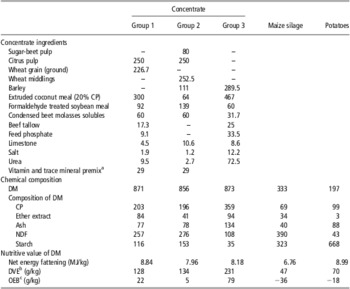
An appropriate concentrate, with regard to the required nutrients, was used for each group. Concentrate ingredients are shown in Table 1. Diets were formulated to be isonitrogenous and isocaloric and were fed ad libitum allowing about 5% orts. They were not provided as a TMR, but feeds were distributed separately once daily in the morning. Refusals were weighed back once a week. Drinking water was always freely available.
Ingredient composition of the concentrates (kg/tonne; as-fed basis), and chemical composition (g/kg) and nutritive value of the feeds

DM = dry matter.
a1 kg vitamin and trace mineral premix contained: 3.1 g Fe; 1.9 g Zn; 1.3 g Mn; 0.7 g Cu; 53 mg I; 15 mg Co; 8 mg Se; 689 000 IU vitamin A; 138 000 IU vitamin D3; 1000 IU vitamin E.
bDVE: true protein digested in the small intestine.
cOEB: rumen degradable protein balance.
Cows were housed in straw bedded tie stalls. Stall dimensions were: bed length from curb: 1.8 m, stall width 1.1 m, curb: 0.13 m wide and 0.18 m high, with a manger in front of the curb at the level of the bedding. Cows were slaughtered when their individual body condition score amounted to 4. Body condition was scored as described by Agabriel et al. (Reference Agabriel, Giraud and Petit1986). Prior to slaughter, feed was withdrawn for 20 h and water was withdrawn for 16 h.
Feeds were sampled monthly, dried in a ventilated oven at 65°C for 48 h and ground through a 2 mm screen in a knife-mill (Brabender, Duisburg, Germany), except concentrate, composited at the end of the experiment and ground through a 1 mm screen, and analysed for chemical composition. Chemical composition was determined according to the Weende analytical scheme, using European reference methods (ash: Anonymous, 1971a; moisture: Anonymous, 1971b; protein: Anonymous, 1972; fat: Anonymous, 1998). Neutral detergent fiber (NDF) was analysed after overnight incubation with α-amylase at 38°C and boiled with neutral detergent plus sodium sulfite and decalin in a Tecator apparatus (Tecator AB, Höganäs, Sweden); it was expressed on an ash-free base (Van Soest et al., Reference Van Soest, Robertson and Lewis1991). DM content and chemical composition of the silages were corrected for losses of volatile substances (acids and alcohols) during oven drying (Dulphy and Demarquilly, Reference Dulphy and Demarquilly1981). Volatile fatty acids and alcohols were determined by gas chromatography (Fussell and McCalley, Reference Fussell and McCalley1987), while d- and l-lactate was assayed with a commercial enzymatic kit (EnzytecTMd-/l-Lactic Acid Economic, Diffchamb AB, Gothenborg, Sweden; Gawehn, Reference Gawehn1984). Ammonia was determined according to the Kjeldahl principle. Net energy value for fattening (NEF; van Es, Reference van Es1978) of the feeds was determined as described by De Boever et al. (Reference De Boever, Cottyn, De Brabander, Vanacker and Boucqué1999), based on the content of fat and ash, and cellulase organic matter digestibility (De Boever et al., Reference De Boever, Cottyn, Buysse, Wainman and Vanacker1986). Protein values (DVE: true protein digested in the small intestine, and OEB: rumen degradable protein balance) of the feeds were calculated according to Tamminga et al. (Reference Tamminga, Van Straalen, Subnel, Meijer, Steg, Wever and Blok1994), based on chemical analyses, ingredient composition of the concentrates and tabular data for ruminal degradation and intestinal absorption of the protein. The physical structure value of the diets was calculated according to De Campeneere et al. (Reference De Campeneere, Fiems and De Brabander2004). The chemical composition and the nutritive value of the feeds are presented in Table 1.
At slaughter, carcasses were classified according to the European grading system (Anonymous, 1981). Carcass composition was estimated from the dissection of an eighth-rib cut (Verbeke and Van de Voorde, Reference Verbeke and Van de Voorde1978). Dressing was calculated as cold carcass weight before fat trimming divided by the non-fasted LW, measured on 2 consequent days before slaughter. Carcass gain and deposition of lean meat and fat in the carcass were calculated based on the final and the initial carcass composition. The initial carcass composition was estimated based on prediction equations from previous experiments (Fiems et al., Reference Fiems, Van Caelenbergh, Vanacker, De Campeneere and Seynaeve2005).
At 24 h post mortem, a sample of the LT was taken from the eighth rib interface of the right carcass half to investigate meat quality. Meat colour, myoglobin content and Warner–Bratzler shear force (SF) value were determined according to Boccard et al. (Reference Boccard, Buchter, Casteels, Cosentino, Dransfield, Hood, Joseph, MacDougall, Rhodes, Schön, Tinbergen and Touraille1981). Colour was measured immediately after sampling at 10° observer and illuminant D65 with a Hunterlab Lab-Scan II Colorimeter (Hunter Associates Laboratory Inc., Reston, VA, USA) and expressed in CIE values (L* (lightness), a* (redness) and b* (yellowness)). Ten cork-bore samples were taken per LT sample parallel to the fibre bundles using a metal borer with 1.25 cm diameter. SF value was determined perpendicular to the fibre direction with a Lloyd 1000S apparatus (Lloyd instruments, Southampton, UK) after an ageing period of 8 days at 4°C and a freezing period of a maximum of 3 months at –18°C. Water holding capacity was determined using a modification of the method of Grau and Hamm (Reference Grau and Hamm1957), and expressed in %, that is relative uptake of water by a filter paper. Drip loss was determined after the ageing period, while cooking loss was measured after heating in a warm water bath prior to the determination of the SF value. The final pH was determined 24 h post mortem (pH 24). Chemical composition of LT was analysed using the near infra-red reflectance spectroscopy technique (De Boever et al., Reference De Boever, Cottyn, Fiems and Boucqué1992).
Data were statistically analysed using one-way analysis of variance using the STATISTICA programme (StatSoft, 2009). Comparisons were made between the three treatments; there was also a comparison of the results obtained with diets containing potatoes (Groups 2 and 3) or not (Group 1).
Results
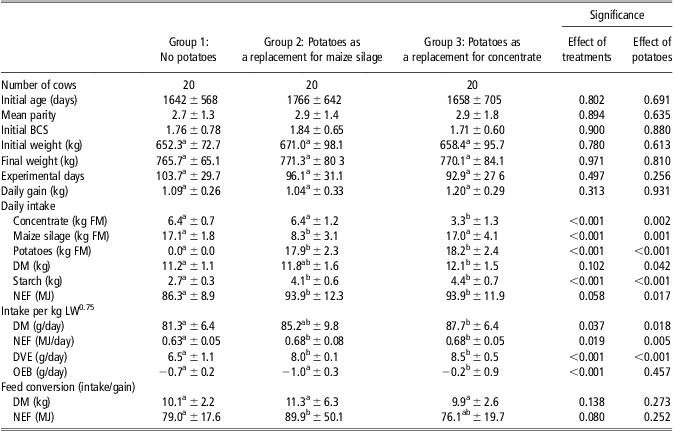
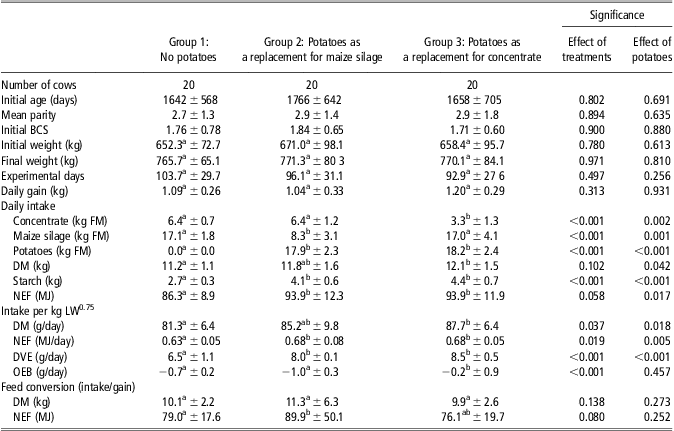
The whole diet contained 47.6%, 36.1% and 31.5% DM for Group 1 (no potatoes), 2 (potatoes in substitution for maize silage) and 3 (potatoes in substitution for concentrate), respectively. Dietary DM for the three groups consisted of 49.6%, 46.1% and 23.3% concentrate, respectively, 50.4%, 24.1% and 47.2% maize silage, and 0%, 29.8% and 29.5% potatoes. The respective physical structure values of the diets amounted to 1.00, 0.72 and 1.07. Potatoes (pooled data of Groups 2 and 3) did not affect daily gain (1.12 kg) in comparison with a diet without potatoes (Table 2).
Effect of potatoes on animal performance (mean ± s.d.)
BCS = body condition score; FM = fresh matter; DM = dry matter; NEF = Net energy value for fattening; LW = live weight; DVE = true protein digested in the small intestine; OEB = rumen degradable protein balance.
abcValues with a same letter are not significantly different (P > 0.05).
Daily consumption of potatoes averaged 17.9 and 18.2 kg, respectively, for Groups 2 and 3. Fresh potato intake averaged 2.5% of the mean BW. The incorporation of the potatoes in the diet resulted in a higher total DM intake (P = 0.042), with a different intake between Group 1 and Group 3. Daily starch intake was significantly increased when potatoes were fed (P < 0.001). Replacing concentrate by potatoes tended to increase starch intake by 7% in comparison with the diet where maize silage was replaced by potatoes (P = 0.153). Dietary starch content averaged 24.1%, 34.8% and 36.4% of the DM for the respective groups.
When expressed as g/kg W0.75, potatoes stimulated daily DM intake, rising to 86.5 g compared with 81.3 g for the control diet (P = 0.018). Because diets were nearly isocaloric, (7.71 to 7.97 MJ NEF/kg DM), daily NEF intake was also increased for diets with potatoes: 0.63 MJ v. 0.68 MJ NEF/kg W0.75, respectively (P = 0.005). Neither DM nor NEF intake was different within the groups of potato supplemented cows. Some straw intake from the bedding cannot be excluded. However, it was not measured, and it is supposed that the amount may be negligible because diets were fed ad libitum.
There was no uniform effect of potatoes on feed conversion. DM intake per kg gain was not affected by potatoes (P = 0.138), while there was a tendency for a worse feed conversion when expressed in terms of energy (P = 0.080). Comparing Group 2 with Group 1 resulted in a tendency (P = 0.075) for a higher DM intake and a higher (P = 0.046) NEF intake per kg gain, but feed conversion was similar for Group 1 and Group 3 (P > 0.10).
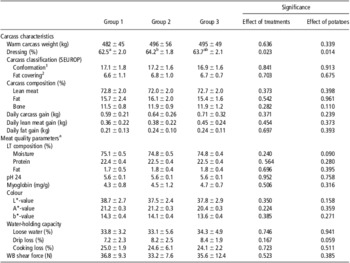
Feeding potatoes did not affect carcass parameters, except dressing percent, which was significantly higher (P = 0.009). Although dressing percent was increased by potatoes, daily carcass gain and lean meat and fat deposition were not affected (Table 3).
Effect of potatoes on carcass characteristics and meat quality parametersFootnote a (mean ± s.d.)

ab Values with a same letter are not significantly different (P > 0.05).
1 S = 18; E=15; U = 12; … ; O = 6; P = 3 points.
2 Class 1 (very lean) = 3 points, Class 2 = 6 points, …, Class 5 (very fat) = 15 points.
Meat quality parameters were not affected (P = 0.167 or higher) by the incorporation of potatoes in the finishing diet (Table 3). Investigating the effect of potatoes (Groups 2 and 3) revealed a tendency for a lower intramuscular moisture content (P = 0.090) and a tendency for a higher drip loss (P = 0.059) compared to Group 1.
Discussion
Potatoes are characterized by a high-energy content (Boucqué et al., Reference Boucqué, Fiems, Cottyn, Casteels and Buysse1982; De Boever et al., Reference De Boever, Cottyn, Aerts, Vanacker and Buysse1983). The chemical composition and the nutritive value corresponds well with data of De Boever et al. (Reference De Boever, Cottyn, Aerts, Vanacker and Buysse1983) and Lisińka and Leszczyński (Reference Lisińka and Leszczyński1989). Because of their constant high-energy value, they are interesting feeds for double-muscled animals with a reduced intake capacity (Fiems et al., Reference Fiems, Cottyn, Boucqué, Bogaerts, Van Eenaeme and Vanacker1997). Boucqué et al. (Reference Boucqué, Fiems, Cottyn, Casteels and Buysse1982) did not find an increased daily gain in dual-purpose Belgian Blue bulls when the finishing diet contained 40% culled potatoes as a substitute for maize silage. However, potatoes significantly stimulated intake. Hence, the increased intake in the present experiment is in agreement with the previous results, albeit potatoes only accounted for ∼30% of the total dietary DM intake. As a consequence of the higher moisture content of diets with potatoes, the intracellular water may contribute to the bulk of the diet, until it is released (Forbes, Reference Forbes1995). On the other hand, the physical limitations to feed intake is partially a function of rate of digestion. In sacco DM disappearance of potato products is high (Monteils et al., Reference Monteils, Jurjanz, Colin-Schoellen, Blanchart and Laurent2002); hence, the negative effect of the moisture content of the diet is counterbalanced by the high DM digestion. Beyer et al. (Reference Beyer, Jentsch, Wittenburg and Voigt1993) investigated the effect of diets with potatoes at 10%, 25% and 50% of energy intake in comparison with barley and maize. The diet with 50% potatoes yielded the highest concentration of volatile fatty acids in the rumen and the lowest ratio of acetic acid : propionic acid. These characteristics are beneficial for a high-energy supply and a favourable energy retention (Wolin, Reference Wolin1960). Furthermore, organic matter digestibility and starch digestibility at the highest incorporation level were 47% and 16% higher, respectively, for potatoes than for barley. These results confirm the nutritional properties of potatoes for ruminants.
Boucqué et al. (Reference Boucqué, Fiems and Cottyn1994) found that the effect of potatoes on growth rate depends on housing type. Loose-housed bulls responded favourably to the inclusion of potatoes, while daily gain was not modified in tie stalls. In the present study, confinement type may help to explain the absence of a significant effect, besides the fact that the culled cows involved in this experiment showed a large individual variation for initial LW, initial body condition and age. Large variations were also observed by Swingle et al. (Reference Swingle, Roubicek, Wooten, Marchello and Dryden1979), where daily gains of cull cows averaging 1.26 and 1.60 kg were not different. Moreover, because of the poor mobility of double-muscled animals compared with non-double-muscled animals (Gregory et al., Reference Gregory, Benson and Mason2009), the confinement type may be an extra reason for the suboptimal performance. Previous results showed a lower growth rate for beef bulls confined in tie stall compared with loose houses (Boucqué et al., Reference Boucqué, Fiems, Cottyn and Buysse1979).
The effect of potatoes on energy conversion depended on the replacement of concentrate or silage. The substitution of concentrate for potatoes did not worsen feed conversion. The increased feed intake and the numerically higher growth rate in Group 3 resulted in a similar feed conversion in comparison with cows of the control group. This is in contradiction with the results of Boucqué et al. (Reference Boucqué, Fiems, Cottyn, Casteels and Buysse1982) using non-double-muscled Belgian Blue bulls, where a higher carcass fatness was found. This discrepancy may be due to the genetic potential of double-muscled animals to use the dietary energy more efficiently (Hanset et al., Reference Hanset, Stasse and Michaux1987), owing to an increased lean meat deposition and a lower accretion of adipose tissue, associated with different endocrine regulations (Clinquart et al., Reference Clinquart, Van Eenaeme, Mayombo, Gauthier and Istasse1995).
A reduced daily gain and feed efficiency, observed for Group 2, may be indicators of a lack of fibre in the diet. Although the roughage content was lower than in the other diets, the dietary physical structure value (0.72) was still beyond the requirement of 0.6 derived for BBDM bulls (De Campeneere et al., Reference De Campeneere, Fiems and De Brabander2004). This finding may suggest that cows may have a higher requirement for physical structure than younger bulls involved in experiments of De Campeneere et al. (Reference De Campeneere, Fiems and De Brabander2004). However, this is not in accordance with De Brabander et al. (Reference De Brabander, De Boever, Vanacker and Geerts2002), who reported a lower requirement from the fourth lactation onwards in dairy cows. This age was not yet achieved by most cows in the current experiment. Furthermore, Eriksson and Murphy (Reference Eriksson and Murphy2004) found a similar rumen pH and a lower amount of carbohydrates fermented in 5 h for raw potatoes in comparison with silages. This was also confirmed by a lower degradation and a more stable rumen pH for diets with potato starch in comparison with wheat starch (Monteils et al., Reference Monteils, Jurjanz, Colin-Schoellen, Blanchart and Laurent2002). Feeds were administered separately in the present experiment, while De Campeneere et al. (Reference De Campeneere, Fiems and De Brabander2004) used total mixed rations. Separate feed distribution may have led to feed selection and a less stable rumen fermentation, and reduced performances as a consequence (Hall, Reference Hall2002). Calculating the structure requirement per kg DM for dairy cows (1 – 0.01/kg milk yield lower than 25 kg), as proposed by De Brabander et al. (Reference De Brabander, De Boever, Vanacker and Geerts2002), resulted in a value of 0.75 for dry cows, as involved in the present experiment, albeit that the genotype of the cows in the current experiment is different. This requirement may not be met for Group 2 (0.72).
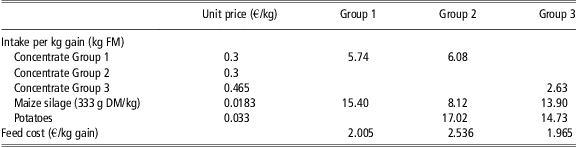
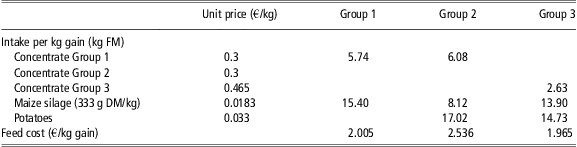
Potatoes may have a favourable effect on feed costs. Using the unit prices calculated for energy (0.023 €/MJ NEF) and protein (0.5 €/kg DVE) by Wageningen UR (www.livestockresearch.wur.nl/NL/onderzoek/Producten_en_diensten/Voederwaardeprijzen_rundvee/) and energy and protein concentrations given in Table 1 resulted in a price (€/kg DM) of 0.176 for maize silage, 0.238 for potatoes and 0.264, 0.247 and 0.291 for concentrate fed to cows of Groups 1, 2 and 3, respectively (Approach A). This means a financial value of potatoes amounting to 82% to 97% of the concentrates used. A second approach (Table 4; Approach B) was based on feed conversion. The feed cost per kg gain in Group 3 amounted to 0.98 of Group 1, using current prices of the feeds. This means that the potato price may rise 8% before potatoes are no longer competitive. If the value of potatoes from Approach A (0.238 €/kg DM at 197 g DM/kg makes 0.047 €/kg as such) was used in Approach B (0.047 instead of 0.033 €/kg), feed cost in Group 3 amounted to 2.169 instead of 1.965 €/kg LW gain (see Table 4), or 1.08 of Group 1. This means that Approach A slightly overestimates the economic value of potatoes. As a consequence of a less favourable feed conversion, the feed cost per kg gain in Group 2 amounted to 1.26 of Group 1. To be competitive with the diet of Group 1, potato price should decrease to only 8% of the current value.
Effect of potatoes on feed costs: comparative price based on feed intake per kg gain
FM = fresh matter; DM = dry matter.
Carcass traits were only numerically affected by the dietary inclusion of potatoes in the current experiment, except dressing percentage. Boucqué et al. (Reference Boucqué, Fiems, Cottyn, Casteels and Buysse1982) found a significant increase of the fat content in the carcasses of dual-purpose Belgian Blue bulls fed potatoes, but dressing percentage was not affected. The increased dressing percentage for cows fed potatoes is in agreement with previous results obtained with BBDM bulls (unpublished data). Most reports dealing with the effect of potato by-products did not mention significant differences for carcass characteristics (Nelson et al., Reference Nelson, Busboom, Cronrath, Falen and Blankenbaker2000; Radunz et al., Reference Radunz, Lardy, Bauer, Marchello, Loe and Berg2003). These authors also noted only small differences in meat composition and quality, owing to potato by-products. These results are in accordance with our findings. However, meat of dual-purpose Belgian Blue bulls fed potatoes was darker and had a higher pigment content (Boucqué et al., Reference Boucqué, Fiems, Cottyn, Casteels and Buysse1982). Unpublished data from our institute showed an increased intramuscular fat content in BBDM bulls, which is not confirmed by the present experiment. It cannot be excluded that the extra fat deposition owing to potatoes, may be reduced because the fat content normally observed in cows is already higher than in bulls (Fiems et al., Reference Fiems, De Campeneere, Van Caelenbergh, De Boever and Vanacker2003). Nevertheless, fat content found in this study (1.8%) was lower than 2.3%, previously reported for BBDM cull cows (Fiems et al., Reference Fiems, De Campeneere, Van Caelenbergh, De Boever and Vanacker2003). A similar explanation may be valid for the fact that potatoes did not result in a darker meat in this experiment, in contradiction with the results of Boucqué et al. (Reference Boucqué, Fiems, Cottyn, Casteels and Buysse1982). Meat colour (mean L*-value of 38.0) corresponded fairly good with values previously reported (Fiems et al., Reference Fiems, De Campeneere, Van Caelenbergh, De Boever and Vanacker2003). The similar visual score (L*-value) was confirmed by the myoglobin content, a biochemical parameter. The tendency for a higher moisture content of the meat and a higher drip loss does not agree with other experiments (Boucqué et al., Reference Boucqué, Fiems, Cottyn, Casteels and Buysse1982; Nelson et al., Reference Nelson, Busboom, Cronrath, Falen and Blankenbaker2000; Radunz et al., Reference Radunz, Lardy, Bauer, Marchello, Loe and Berg2003).
In conclusion, culled potatoes stimulated intake in finishing BBDM beef cows. The substitution of concentrate by potatoes resulted in a slightly higher growth rate, but a similar feed conversion, while the performances were negatively affected by the substitution of maize silage by potatoes. Potatoes had no important effects on carcass and meat quality traits. Dependent on feed prices, potatoes may be an interesting feed for finishing beef cows.
Acknowledgements
The authors greatly acknowledge Martine Martens and Lucia Baele for their skilled technical assistance.