Introduction
The term ‘thinness’ is understood as a weight deficiency in relation to body height. Thinness is frequently connected with body build type – leptosomic or ectomorphic – but excessive thinness means weight deficiency that can result from either illness disorders or unfavourable environmental conditions. Body weight and height are highly and positively correlated features, but the effect of environmental factors on weight variation is significantly greater than in the case of height. Moreover, the direction of developmental changes in both weight and height can be different: height in its progressive phase can change only in one direction (increase), while changes in weight can be in two directions. The complex character of the relationship between height and weight may be a cause of interpretation difficulties.
The prevalence of thinness in girls in a nationally representative sample of Polish children in the studies of Gurzkowska and colleagues (Reference Gurzkowska, Kułaga, Grajda, Góźdź, Wojtyło and Litwin2017) was found to be 13.6%. An analysis of changes in thinness prevalence in Łódź, central Poland, showed that between 1977 and 2004 thinness prevalence in boys increased from 7.4% to 12.1%, whereas in girls the increase was more significant – from 11% to 20.2% (Żądzińska et al., Reference Żądzińska, Rosset, Kozieł, Nawarycz, Borowska-Strugińska and Lorkiewicz2012). In eastern Poland thinness prevalence grew from 13.1% to 17.2% in 7- to 8-year-old girls between 1986 and 2006 (Wasiluk & Saczuk, Reference Wasiluk and Saczuk2015). This increase in thinness prevalence took place during a period of political transformation in Poland. The 1970s and 80s were a period of economy collapse in the country. In its final phase (1982–1985) some goods were rationed and access to certain food products was difficult (Łaska-Mierzejewska & Olszewska, Reference Łaska-Mierzejewska and Olszewska2006). Only in the years 2002–2005 did the economy start to grow and an intensive process of Westernization took place in the country, which was connected with the accession to the European Union.
Two studies of Polish rural girls have been conducted: the first in 1987, registering the biological effects of the economic crisis, and then repeated in 2001 during political transition in the country, with the closure of state-owned farms and the resulting dramatic increase in unemployment. These allowed the distribution and direction of changes in body mass deficiency in rural girls during these two disruptive periods in Poland to be assessed (Łaska-Mierzejewska & Olszewska, Reference Łaska-Mierzejewska and Olszewska2004).
The aim of this study was to assess the prevalence and extent of thinness among Polish rural girls in two distinct geographical locations and determine changes in intensity and direction over a 14-year period from 1987 to 2001.
Methods
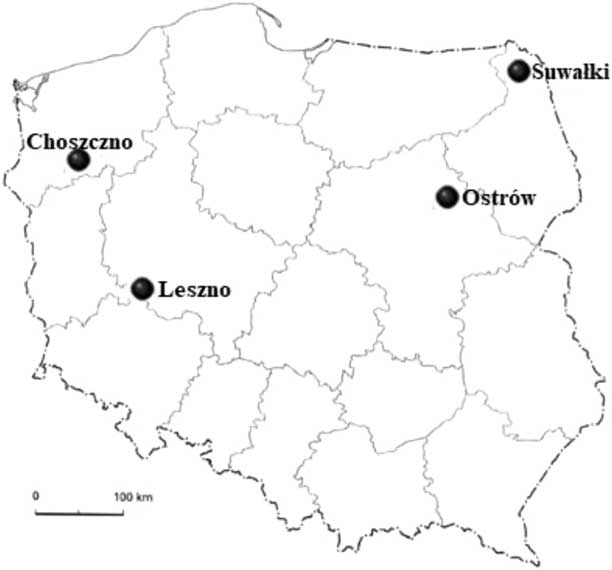
The study sample was taken from two series of cross-sectional studies conducted in rural Poland. The first, conducted in 1987, included anthropological and survey data for 7764 girls aged 9–18 years living in rural areas of Poland; the second, conducted in 2001, included 9431 such girls. The data were analysed by geographical location (Choszczno and Leszno in north-west Poland; Ostrów Mazowiecka and Suwałki in north-east Poland, see Fig. 1). Wherever possible, the study was conducted in the same schools in the two study years.
Map of Poland showing study regions.
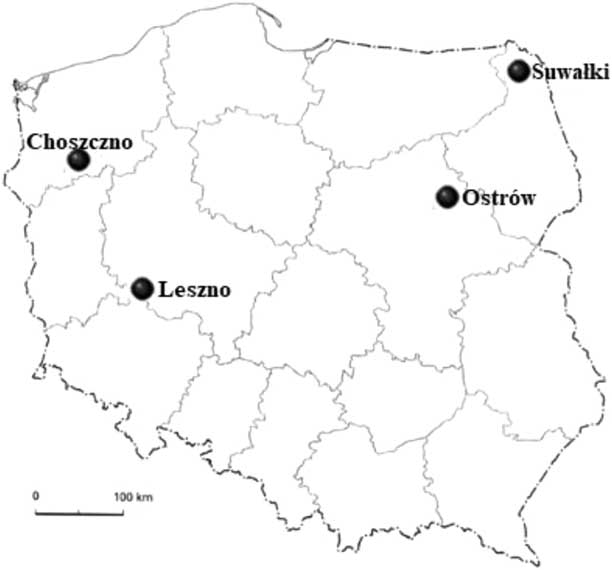
Study regions and their populations
Before the political and economic transition, in years 1978–1987, the poorest rural families were those whose family income was only from their farm, the richest were non-farming families, and in between were middle-income farm/working families. Farming families had lower education levels, higher numbers of children and worse households furnishing than rural non-farming families. Between 1988 and 2001, the political transition resulted in the elimination of state-owned farms and an increase in unemployment. The economic situation of non-farming families, whose members lost their jobs after closure of the state farms, became significantly worse (Łaska-Mierzejewska & Olszewska, Reference Łaska-Mierzejewska and Olszewska2004, Reference Łaska-Mierzejewska and Olszewska2006, Reference Łaska-Mierzejewska and Olszewska2007, Olszewska & Łaska-Mierzejewska, Reference Olszewska and Łaska-Mierzejewska2008).
Different regions of Poland responded differently to the economic changes of the 1980s and 90s; two distinct regions were compared in the 1987 and 2001 studies.
North-west region
In the study period, Choszczno was characterized by a high number of state farms, which occupied more than 50% of the farmland. For 18% of the region’s inhabitants the only source of income was their own farm. More than 60% did not own their own farm and most earned their living working on state farms. After the state farms were closed in 1992 the region was affected by the highest unemployment rate in Poland, amounting at 30%. In 2001 it decreased to 22% and 18% of non-farming girls had unemployed fathers (Łaska-Mierzejewska & Olszewska, Reference Łaska-Mierzejewska and Olszewska2004, Reference Łaska-Mierzejewska and Olszewska2006, Reference Łaska-Mierzejewska and Olszewska2007; Olszewska & Łaska-Mierzejewska, Reference Olszewska and Łaska-Mierzejewska2008).
Leszno, located in Wielkopolskie district, had a well-developed industry, a high level of agriculture and efficient communication. The state farms in this region were privatized instead of being closed down. The region featured the highest wealth as measured by household furnishing, the highest percentage of small families (1–2 children), the lowest percentage of numerous families (five or more children) and the lowest number of fathers with only primary education level, as well as the highest percentage of fathers with vocational education of all the examined regions.
North-east region
Ostrów Mazowiecka was characterized by the lowest GDP per capita. This was reflected in the amount of household furnishing and access to household appliances, which was the lowest among the examined regions. In 2001 the unemployment rate was 12%, and among the examined girls’ fathers it was 13%. The villages where the study was carried out were located about 40–60 km from Warsaw, which made finding a job easier than for the inhabitants of Suwałki or Choszczno.
Suwałki has a climate significantly more severe than in central Poland, with spring being delayed by 2–3 weeks, and a less-developed transport infrastructure. Weak industrialization made finding a job difficult. The region’s families had the lowest percentage of small families and the highest number of large families, as well as the highest percentage of parents with only primary education (Łaska-Mierzejewska & Olszewska, Reference Łaska-Mierzejewska and Olszewska2004, Reference Łaska-Mierzejewska and Olszewska2006, Reference Łaska-Mierzejewska and Olszewska2007; Olszewska & Łaska-Mierzejewska, Reference Olszewska and Łaska-Mierzejewska2008).
Study variables
Body height and weight were determined for all participants. Measurements were performed by qualified personnel who visited individual schools and also collected information on the participants’ socioeconomic status, living conditions and maturity (stage of development). The girls’ chronological age was determined based on the difference between the examination date and their date of birth. The girls were grouped according to their stage of development: childhood (9–10 years), early adolescence (11–13 years) and late adolescence (14–18 years) (Chrzanowska et al., Reference Chrzanowska, Kozieł and Ulijaszek2007). The average anthropometric features and level of biological development of the analysed cohorts have been described previously (see: Łaska-Mierzejewska & Olszewska, Reference Łaska-Mierzejewska and Olszewska2004, Reference Łaska-Mierzejewska and Olszewska2006, Reference Łaska-Mierzejewska and Olszewska2007; Olszewska & Łaska-Mierzejewska, Reference Olszewska and Łaska-Mierzejewska2008).
Analysis
The BMI of the participants was calculated as weight (kg)/height (m)2. International standards elaborated by Cole and Lobstein (Reference Cole and Lobstein2012) were used to assess thinness from the participants’ BMIs. The application of Cole standards ensured comparability of the analysed data both in time (between 1987 and 2001) and among regions. Frequencies that were significantly different from expected values (%) were compared in each age category using χ 2 goodness-of-fit test. To measure the extent of child thinness within the study sample the Extent of Overweight (EOW) index (Jolliffe, Reference Jolliffe2004) was adapted by the authors to produce an Extent of Thinness (EOT) index:
 $${\rm EOT\,index}{\equals}\left( {1\,/\,n} \right)\Sigma _{i} I\left( {BMI_{i} \,\lt\,f_{i} } \right)[(BMI_{i} {\minus}f_{i} )\,/\,f_{i} ]$$
where n is the sample size, i refers to the child, f is the cut-off point identifying who is thin and I is an indicator function that takes a value of 1 if the statement is true and 0 otherwise. The value of the indicator function is 1 if the child is thin and 0 if the child’s BMI is less than the cut-off point corresponding to the values of BMI<18.5 kg/m2 for adults, gender- and age-specific. An advantage of the EOT index is that it treats BMI as a continuous variable for the thin population, while ‘prevalence’ measures thinness as a dichotomous outcome. The index provides information on both the prevalence and the extent by which the thinness threshold is exceeded in children. Expressing deficiency of BMI as a proportion of the thinness threshold is particularly important for children since the threshold varies by age and sex (Jolliffe, Reference Jolliffe2004; Chrzanowska & Suder, Reference Chrzanowska and Suder2010).
Results
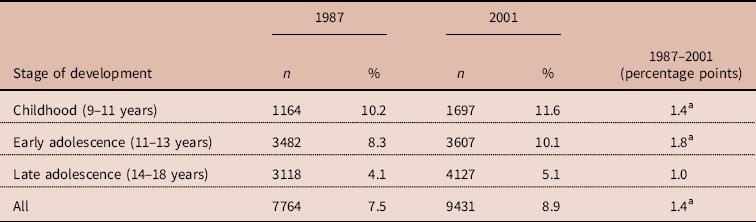
Girls’ thinness prevalence for the whole study sample was 7.5% in 1987 and 8.9% in 2001 (Table 1), and the increase over the 14-year period was significant. Analysis by stage of development (maturity) confirmed high levels of body weight deficiency in the childhood and early adolescence periods during the study period (Table 1).
Prevalence of thinness in rural Polish girls in 1987 and 2001 by their stage of development and percentage point change over time

a 2001 frequencies significantly different from 1987 frequencies at p<0.05.
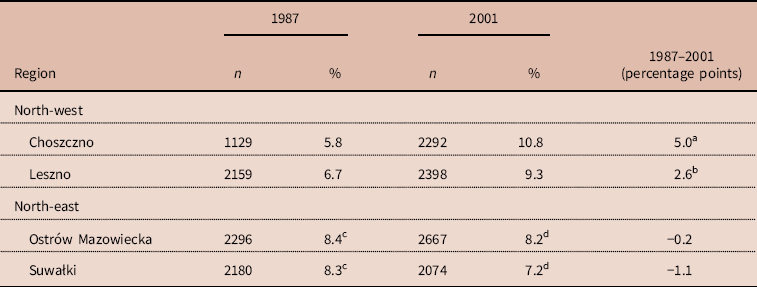
Significant differences in thinness prevalence were observed for girls from Choszczno and Leszno in north-west Poland in both 1987 and 2001 (Table 2). The thinness frequencies in the north-east regions of Ostrów Mazowiecka and Suwałki differed significantly from those of the Choszczno and Leszno regions in both years. In 1987 the highest thinness prevalence was registered in the north-west regions, i.e. Ostrów Mazowiecka (8.4 %) and Suwałki (8.3%), whereas the lowest thinness prevalence was observed in the north-east regions, i.e. Choszczno (5.8%) and Leszno (6.7%). In 2001 in the north-west region, a significant increase in thinness prevalence (from 6.25% to 10.0%) was noticed. In Ostrów Mazowiecka and Suwałki, the prevalence of thinness remained almost unchanged between 1987 and 2001, with only a slight decrease.
Prevalence of thinness in rural Polish girls in 1987 and 2001 by region and percentage point change over time
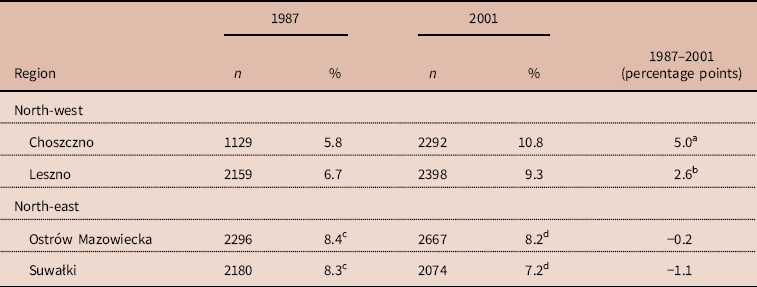
a Frequencies for 2001 significantly different from 1987: χ 2=22.124; df=1; p<0.001.
b Frequencies for 2001 significantly different from 1987: χ 2=10.520; df=1; p=0.0012.
c Frequencies for Ostrów Mazowiecka and Suwałki significantly different from Choszczno and Leszno: χ 2=9.7878; df=1; p=0.0018.
d Frequencies for Ostrów Mazowiecka and Suwałki significantly different from Choszczno and Leszno: χ 2=15.4275; df=1; p=0.0001.
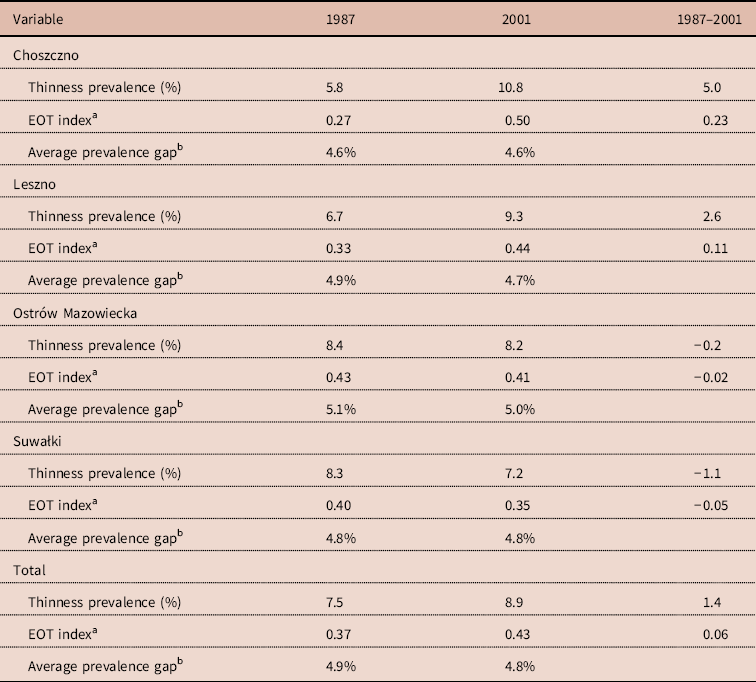
Between 1987 and 2001 the EOT index increased from 0.37 to 0.43 for the whole sample (Table 3). Differences in thinness extent were observed between the examined regions, which were similar to the differences in prevalence. In the Choszczno and Leszno regions in the north-west, increases in the EOT index from 0.27 to 0.50 and 0.33 to 0.44, respectively, were observed, as well as an increase of thinness prevalence. In north-east Poland, i.e. Ostrów Mazowiecka and Suwałki, the thinness prevalence decreased from 8.3% to 7.7% and the EOT index decreased from 0.43 and 0.40 to 0.41 and 0.35, respectively, which reflects a decrease in both the number of cases and the amount of thinness. The considerable differences between the regions found in 1987 decreased in 2001 (Table 3).
Thinness prevalence, extent of thinness (EOT index) and the average prevalence gap in rural Polish girls in 1987 and 2001 by region and change over time
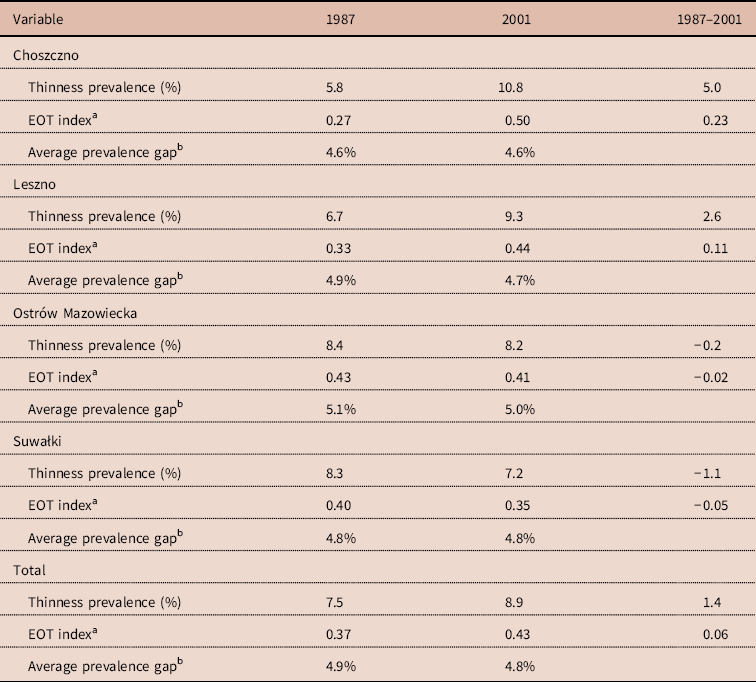
a The extent of thinness is measured as the average amount by which each child’s BMI exceeds their age and gender-specific thinness threshold, corresponding to the values of BMI <18.5 kg/m2 for adults.
b The ‘average prevalence gap’ is the average amount by which the thin population exceeds the thinness threshold, expressed as a percentage of the threshold.
Different results were found depending on whether the whole study sample was analysed or whether separate analyses were made by region. For the whole study sample, the total prevalence of thinness increased by 1.4 percentage points between 1987 and 2001, but the highest increases were registered in Choszczno (5 percentage points) and Leszno (2.6 percentage points) in north-west Poland. The EOT index generally increased by 0.06, but the highest increases were in Choszczno (0.23) and Leszno (0.11), confirming that both the number of cases and the amount of thinness had increased.
Discussion
Body weight deficiency as a symptom of so-called energetic homeostasis can result from undernutrition connected with the difficult economic status of the family or a lack of proper parental care. A sudden decrease in weight can indicate a dangerous illness, and particular attention should be paid to sudden inhibitions of weight growths in the periods when it should increase intensively, i.e. during early childhood and adolescence. Insufficient weight can also cause improper functioning of the reproductive system and delayed or cessation of menarche. Thus body weight deficiency in children and adolescents has been, and still is, the subject of much research (Rolland-Cachera et al., Reference Rolland-Cachera, Castetbon, Arnault, Bellisle, Romano and Lehingue2002; Wang et al., Reference Wang, Monteiro and Popkin2002; Cole et al., Reference Cole, Flegal, Nicholls and Jackson2007; Oblacińska et al., Reference Oblacińska, Tabak and Jodkowska2007; Chabros et al., Reference Chabros, Charzewska, Wajszczyk and Chwojnowska2011; Whitaker et al., Reference Whitaker, Jarvis, Boniface and Wardle2011, Wronka et al., Reference Wronka, Suliga and Pawlińska-Chmara2012; Lazzeri et al., Reference Lazzeri, Rossi, Kelly, Vereecken, Ahluwalia and Giacchi2014; Schönbeck et al., Reference Schönbeck, van Dommelen, HiraSing and van Buuren2015; Mason et al., Reference Mason, Rantanen, Kivimäki, Koivisto and Joronen2017).
A tendency towards an increased prevalence of thinness in girls in Poland, as observed in a population examined between 1987 and 2001, is not intensive but has been maintained, as confirmed by recent studies (Żądzińska et al. Reference Żądzińska, Rosset, Kozieł, Nawarycz, Borowska-Strugińska and Lorkiewicz2012; Wronka, Reference Wronka2014; Wasiluk & Saczuk, Reference Wasiluk and Saczuk2015). Recently, the prevalence of thinness in girls in a nationally representative sample of Polish children was found to be close to the prevalence of overweight and obesity and amounted to 13.6% (Gurzkowska et al., Reference Gurzkowska, Kułaga, Grajda, Góźdź, Wojtyło and Litwin2017).
However, as confirmed in this study, the direction of change in the thinness prevalence in the general Polish population is not always in accordance with the directions of change in regional populations. The rural girls examined here were from four regions in the north-west and north-east of Poland that, during the political transformation, underwent socioeconomic changes that had different biological effects on its population. In 1949 an agricultural reform was introduced in Poland aimed at nationalizing all farms bigger than 50 hectares in order to create state farms. These were closed down in 1992 after political and economic transformation. As a result, the Polish countryside during the study period was inhabited by people with different sources of income: 1) farming families living off their farms (37% in 1987 and 30% in 2001); 2) farming/working families, who had a farm but where at least one of the parents worked away from the farm (21% and 23% respectively); 3) country dwellers without their own land (41% and 47% respectively) (Łaska-Mierzejewska & Olszewska, Reference Łaska-Mierzejewska and Olszewska2006). In the north-west of Poland, dominated by farmless village dwellers, the prevalence of body weight deficiency was found to have increased over the study period. In the Choszczno region, which was distinguished by the highest concentration of state-owned land, the prevalence of body weight deficiency almost doubled. This might be attributed to the mass and long-term unemployment that resulted from the liquidation of state farms in 1992. At the same time, the regions were affected by a significant decrease in overweight and obesity prevalence (Chrzanowska et al., Reference Chrzanowska, Łaska-Mierzejewska and Suder2013).
During the period 1987–2001, the north-east of Poland was inhabited by farm and farm/working families whose economic situation after the political transformation was better than that of villagers who did not own land (Łaska-Mierzejewska & Olszewska, Reference Łaska-Mierzejewska and Olszewska2007). The two north-east regions examined in this study, Ostrów Mazowiecka and Suwałki, showed little change in the prevalence of body weight deficiency between 1987 and 2001, with only a slight decrease. Simultaneously, previous research has shown that the prevalence of overweight and obesity increased significantly in these two regions over the same period (Chrzanowska et al., Reference Chrzanowska, Łaska-Mierzejewska and Suder2013).
In conclusion, despite the fact that a general assessment of the changes in prevalence of body weight deficiency in this population of rural girls during the political transformation in Poland indicates an increase in insufficient body weight occurrence, the differentiation of economic conditions in individual regions has had different biological effects.
Ethical Approval
All procedures contributing to this work comply with the ethical standards of the relevant national and institutional committees on human experimentation and with the Helsinki Declaration of 1975, revised in 2008.
Conflicts of Interest
The authors have no conflicts of interest to declare.
Funding
This research received no specific grant from any funding agency, commercial entity or not-for-profit organization.