Biological control of European corn borer (ECB) (Ostrinia nubilalis Hübner) using Trichogramma ostriniae Pang et Chen has been successful in both field and sweet corn, as well as several solanaceous cropsReference Kuhar, Barlow, Hoffman, Fleischer, Groden, Gardner, Hazzard, Wright, Pitcher, Speese and Westgate1. ECB is the primary pest of bell peppers in Kentucky and is traditionally managed with insecticide sprays. Recently, T. ostriniae was introduced from China as part of an effort to establish natural enemies of O. nubilalis, as this wasp is a native egg parasitoid of the Asian corn borer, Ostrinia furnacalis (Guenee)Reference Kuhar, Barlow, Hoffman, Fleischer, Groden, Gardner, Hazzard, Wright, Pitcher, Speese and Westgate1–Reference Pang and Chen4. Studies investigating both inoculative and inundative releases of this wasp have resulted in 70–90% parasitism of ECB eggsReference Wang, Ferro and Hosmer2.
Pepper plants receive little harm from first-generation ECB which occurs prior to setting fruit, although some damage is occasionally reported to stems or branches when the first generation is very large. However, second-generation larvae of ECB emerge from eggs and may feed very briefly on leaves before tunneling into the fruit of the pepper plant. Entry holes may be difficult to see, but are often marked with brown excrement and typically only fruits that are larger than one inch in diameter are attacked. Once the larva bores into the fruit, it is no longer acceptable for market. The larvae also cause physical damage, which results in premature ripening and entry points for several pathogensReference Bessin, Welty, Sparks, Foster and Flood5.
Agricultural landscapes rarely provide adequate resources to fully utilize existing natural enemies as a result of frequent management disturbances (herbicides, tillage, etc.) and predominance of monocultures in much of commercial agricultureReference Landis, Wratten and Gurr6. The addition of key flowering plants to diversify a crop system is intended to provide supplemental resources to natural enemies through pollen and floral nectar, which contains sugars, proteins, amino acids, lipids, and other important nutritional substancesReference Vattala, Wratten, Phillips and Wackers7. Conservation practices, such as habitat modification to favor natural enemies of crop pests, can be implemented by integrating resources into the landscape in a way that is spatially and temporally favorable to natural enemies and practical for producers to implementReference Landis, Wratten and Gurr6, Reference Gurr and Wratten8. The goal of habitat modification is to create a more favorable environment for natural enemies by providing such resources as: food for adult natural enemies, alternative prey or hosts, nesting sites and shelter from adverse conditionsReference Landis, Wratten and Gurr6. Specifically, buckwheat has shown effectiveness in attracting beneficial insects into cropping systems implementing biological control practicesReference Berndt, Wratten and Hassan9.
Adult Trichogramma wasps require food as adultsReference Andow and Risch10 and the absence of specific nutrients can cause premature death and decrease the reproductive capacity of the waspsReference Hegazi, Khafagi and Hassan11. Nectar, honeydew, and host fluids are sources used by Trichogramma adults in the fieldReference Zhang, Zimmerman and Hassan12. Gurr et al.Reference Gurr, Wratten, van Emden and Barbosa13 believe that habitat manipulation, such as interplanting or use of groundcovers may introduce important ecological requirements for Trichogramma. The need for within-crop nectar sources for Trichogramma wasps may be of importance because of their small size and weak flight capabilities. Also, providing a food source may reduce the time in which adults are searching for food, thus increasing the amount of time available to search for hosts. Gurr and NicolReference Gurr and Nicol14 suggest that because Trichogramma are pro-ovigenic, food availability will not likely increase fecundity. They noted that by providing food during days 3–5 after first emergence, the lifespan of the wasps was increased from 8 to 13 days allowing them time to locate more host eggs to parasitize.
Releases of T. ostriniae for ECB control in bell peppers had been evaluated in 2002 and 2003; replicated trials were performed at several locations in and near Lexington, KY. Three releases at a rate of 370,000 T. ostriniae ha−1 were made in each release plot, resulting in significantly lower percentages of ECB infested fruits in release plots (1.5%) compared to non-release plots (5.2%)Reference Friley15. Trials in Virginia and Pennsylvania reported a 1.9% egg parasitism rate in non-release plots with 27.3% damaged fruit, compared to 48.7% egg parasitism and 8.7% damaged fruit in the release plots with four releases of 30,000–50,000 T. ostriniae/0.02 ha throughout the second-generation flight of ECBReference Kuhar, Barlow, Hoffman, Fleischer, Groden, Gardner, Hazzard, Wright, Pitcher, Speese and Westgate1.
Previous research has shown that T. ostriniae wasps tend to prefer to search in plant architecture similar to that of cornReference Kuhar, Barlow, Hoffman, Fleischer, Groden, Gardner, Hazzard, Wright, Pitcher, Speese and Westgate1. The possibility of dispersal to nearby plants and away from bell peppers provided the impetus for the specific plot design used in this study. Thus a mixed cropping system model, incorporating sweetcorn adjacent to peppers, was incorporated into the design of this experiment. This is very similar to many small vegetable farms in the mid-south and southern Midwest. The objective of this study was to evaluate the use of T. ostriniae for ECB control in bell peppers using inundative releases in combination with inter-plantings of a nectar source as a habitat modification in a mixed cropping system.
Materials and Methods
This study used a randomized complete block experimental design with a split-plot treatment arrangement. There were five replicates with two main-plot treatments per replicate and two split-plot treatments within each main plot. Blocks were pairs of experimental units or treatment plots, within a pair the distance was at least 1000 feet between each plot, with larger distances used among blocks for isolation. Locations for the study included both University of Kentucky research farms in Lexington, Kentucky. In 2005, the South Research Farm supported one replicate and the North Research Farm held the remaining four replicates. In 2006, all five replicates were located at the North Research Farm.
A bacterial-spot resistant bell pepper cultivar, ‘Aristotle’, was used for all plots for both years to reduce the need for bactericide sprays. Plants were started in the greenhouse at the South Farm and transplanted into raised beds with black plastic mulch and drip irrigation at each location. Beds were 1.8 m from center-to-center with two rows of 35 pepper plants each. Plants were set using a water-wheel setter with 30.5 cm spacing between plants and rows.
Main-plot treatments tested the effect of T. ostriniae releases, while habitat modification was evaluated in the subplots. Each main plot consisted of either a non-release or T. ostriniae wasp release treatment. Each main plot was divided into two subplots consisting of no habitat modification (peppers only) and habitat modification with buckwheat (Fagopyrum esculentum Moench) in addition to peppers. Main plots in each replicate are separated by at least 305 m to reduce wasp dispersal into non-release plots and release plots were located downwind from non-release plots when possible. In both years, one replicate at North Farm was separated by only 183 m due to spatial limitations.
Each main plot consisted of two pepper subplots separated by 16 rows of sweet corn in the center and bordered with four additional rows of sweetcorn on each end of the plot. The addition of sweet corn provides a model for increased crop diversity that is typical of small acreage and organic farms in Kentucky.
Each pepper subplot contained five beds of peppers with one subplot supplemented with flowering plants (habitat modification treatment) at end of each pepper row and the other subplot without the supplemental flowering plants. Buckwheat (F. esculentum Moench), the habitat modification, was planted at each end of each raised bed of pepper plants as a potential nectar source for T. ostriniae in release plots and to attract beneficial insects. Approximately ten buckwheat seeds were directly planted into each of the three empty holes left by the water-wheel setter immediately adjacent to the final pepper plants at each end of each row. The buckwheat was provided the same irrigation and fertigation applications as the pepper plants. The same numbers of pepper plants were used in subplots with and without the habitat modification treatment. The buckwheat flowered continuously from several weeks prior to T. ostriniae releases until several weeks after the final release, providing nectar resources throughout the release and post-release periods for T. ostriniae.
T. ostriniae used in the study were obtained from Cornell University, Ithaca, NY, USA. They were shipped overnight in parasitized Ephestia kuehniella Zeller (Lepidoptera: Pyralidae) eggs on cards divided for each subplot. Each card contained approximately 16,000 parasitized eggs and each subplot received one card per release. The release rate was approximately 1,160,000 T. ostriniae per hectare per release in both years with a total release of 4,640,000 T. ostriniae ha−1 for 2005 and 5,800,000 T. ostriniae ha−1 in 2006. Cards were placed in the center of the middle row of the subplots enclosed in 15 cm×2.5 cm Petri dish cages with 0.8 mm mesh to allow for emergence while protecting the T. ostriniae from predation. Release dates were established according to a degree-day model predicting egg laying of second-generation ECBReference Brown16. Initial releases began near the degree-day target for initiation of second-generation ECB egg laying. Additional releases were made in coordination with the degree-day target for 25 and 75% completion of egg laying, with an additional release to target egg laying by third-generation ECB.
Sentinel ECB egg masses were provided by the USDA Corn Insects and Crop Genetics Research Laboratory at Iowa State University. Ten egg masses on wax paper were stapled to the underside of pepper leaves at regular intervals on the border rows of each subplot in both the non-release and release plots. The egg masses were in place at the time of each T. ostriniae release and collected within 48–72 h. To check for residual parasitoid activity from 2005, egg masses were set out in 2006 prior to the first T. ostriniae release date. Sentinel egg masses were used to determine percent parasitism at each location, monitor for T. ostriniae movement to non-release plots, assess overwintering T. ostriniae success with a prerelease sample in the second year, and indicate if any other Trichogramma species were present. The egg masses were collected from the field and placed in gelatin capsules and stored for later observation. Percent parasitism was established for the sentinel eggs using a dissecting microscope to look for characteristic discoloration of parasitized eggs.
Yellow sticky card traps (Gemplers 6″×12″ Sticky Cards 2005. IPM Laboratories, Inc. Locke, NY, USA) were attached horizontally to a 1 m pole and placed in the center of each subplot to give an indication of what types of insects were present in each plot and to determine if the habitat modification treatment increased abundance of beneficial insects. Cards were placed in the plots for two-week intervals and replaced with new cards at the time of removal. Upon removal from the field, sticky cards were stored at room temperature and wrapped in wax paper for protection until evaluation. Cards were removed from wax paper for identifications to the family level.
Fruit were harvested at maturity multiple times from the inner three beds of each subplot. Peppers were separated into marketable and unmarketable fruits according to USDA grading standards of shape, size, and quality17. All fruit were examined for evidence of insect frass around the stem cap and insect tunneling in the walls. Those with signs of damage were kept separate and later dissected to determine if the damage was due to ECB. Both marketable and unmarketable fruits were weighed and only marketable fruits were counted and graded as medium, large, and extra-large fruits according to the USDA standards. Harvest dates varied by replication each year, due to fruit set, maturity differences, and the availability of labor, but all plots within a single replicate were harvested on the same day. Two harvests were made in each year of the study with approximately 4–6 weeks between harvests.
Percentages of infested fruits were compared to evaluate the effect of wasps and habitat modification, and the effect of combining wasps and habitat modification. The data were subjected to analysis of variance (ANOVA) tests and the arc sine of the square root transformation was used to analyze percentage of infested fruits (SAS Institute Inc., Cary, NC, USA). Sentinel egg parasitism was analyzed using ANOVA using the same transformation and a weight statement to adjust for the number of missing egg masses. Percent missing sentinel egg masses was evaluated using ANOVA. Data collected from the yellow sticky card traps were analyzed using ANOVA. Data were pooled across years due to the lack of significance when analyzed separately by individual years.
Results
ECB sentinel egg parasitism
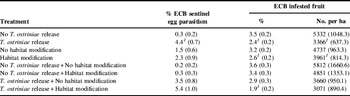
Combining data from both years, there were significantly more parasitized eggs found in release plots (4.4%) compared to non-release plots (0.3%) (F=276.3; df=1.9; P=<0.01). Egg parasitism was similar in plots with the habitat modification compared to those without (F=3.15; df=1.9; P=0.08), and there was no significant interaction of the two treatments (F=2.4; df=1.9; P=0.13). The combination of the two treatments resulted in 5.4% parasitized eggs compared to 0.2% for those without either treatment applied (Table 1). A large number of missing egg masses occurred throughout the study due to predation and rainfall. Percentage of missing egg masses was accounted for by using a weighted analysis for percent parasitism using the number of remaining eggs as the weighting factor.
Average yields, percent ECB infested fruit and average number of ECB infested fruit (SEM), 2005–2006.

1 ANOVA indicated significant differences for T. ostriniae releases versus no releases for the percentage of ECB sentinel egg parasitism (P⩽0.05). ANOVA indicated significant differences due to T. ostriniae releases and habitat modification for percent ECB infested fruit ha−1 and number of ECB infested fruit ha−1. Significant differences were indicated for T. ostriniae and habitat modification interaction for percentage of ECB infested fruits (P⩽0.05).
Predator insect densities
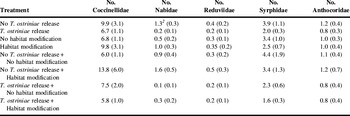
An array of insects were recorded from the yellow sticky cards, but only those predators with host feeding strategies associated with Ostrinia nubilialis were used in the statistical analysis. Families evaluated included: Coccinellidae, Nabidae, Reduviidae, Syrphidae and Anthocoridae. All families are predaceous on ECB eggs, whereas Syrphidae and Anthocoridae may also feed on early instar larvaeReference Wang, Ferro and Hosmer2. The sticky card trap counts were analyzed across the two-year study due to low insect densities when analyzed independently for each year. No statistical differences were found among insects evaluated for the habitat modification treatment compared to the no habitat modification treatment. A significant treatment effect was found for Nabidae in non-release plots (1.3 insects per card) compared to release plots (0.2 insects per card) (F=8.8; df=1.9; P=0.02). Means for all insects evaluated, except Syrphids, tended to be higher in habitat modification plots compared to no habitat modification plots, although not significantly higher (Table 2). This significant treatment effect is likely due to a Type 1 statistical error.
Predaceous insect trapping: average number of insects per family on yellow sticky cards (SEM), 2005–2006Footnote 1.

1 Traps in place for two-week periods—2005: (26 August–23 September); 2006: (17 August–14 September).
2 ANOVA indicated significant differences for number of Nabidae in T. ostriniae release versus non-release plots (P⩽0.05).
Percentage of ECB infested fruit
When data were combined across the two-year study, a significantly lower percentage of infested fruit was found in T. ostriniae release plots (2.4%) compared to non-release plots [3.5% (F=5.2; df=1.9; P=0.05)], and in habitat modification plots (2.6%) compared to non-habitat modification plots [3.2% (F=10.4; df=1.9; P=0.01)], and a significant interaction observed, with 1.9% damaged fruit with the treatment combination compared to 3.6% with no treatments applied [F=4.8; df=1,9; P=0.06 (Table 1)].
Discussion
ECB sentinel eggs
Significant differences in parasitism of sentinel eggs in plots with T. ostriniae releases were expected compared to those not receiving T. ostriniae releases. The effect of habitat modification was not significant for a treatment effect or a treatment interaction when data were analyzed with the study years combined. This may have been due to the sentinel eggs being left in the field for only 2–3 days, just after the wasp releases. If the buckwheat in the habitat modification and wasp release treatment combination was providing a needed food source to extend the life span of adult wasps, it is unlikely that the sentinel egg parasitism levels would have differed significantly from that of the wasp release only treatment, as T. ostriniae wasps should survive the duration of the sentinel egg placement periods without supplemental nutrition. Due to the length of time the sentinels were in the field, the benefit of habitat modification on T. ostriniae parasitism or lifespan would not be detected unless an additional set of sentinel eggs were in place after the initial set.
The percentages of ECB sentinel eggs parasitized by T. ostriniae in this study were lower than those reported in previous studies. An average parasitism rate between 4 and 6% when the treatments were combined is considerably lower than those reported in trials by Kuhar et al.Reference Kuhar, Barlow, Hoffman, Fleischer, Groden, Gardner, Hazzard, Wright, Pitcher, Speese and Westgate1 (48.7%) and FrileyReference Friley15 (14.9–15.3%). It is likely the reduction in sentinel parasitism is a result of dispersal away from the peppers and into the adjacent corn, as well as using slightly lower release rates than the Kuhar et al.Reference Kuhar, Barlow, Hoffman, Fleischer, Groden, Gardner, Hazzard, Wright, Pitcher, Speese and Westgate1 study. It has been established in the previous work that T. ostriniae prefers to search in corn rather than peppers for ECB eggsReference Kuhar, Barlow, Hoffman, Fleischer, Groden, Gardner, Hazzard, Wright, Pitcher, Speese and Westgate1. Although parasitism is lower in this study, the levels observed in this study may be more representative of bell pepper crops that are located on farms displaying high crop diversity.
The sentinels were placed in the field on a wax paper substrate and attached to the plant using staples. These egg masses were approximately 2 days old when placed in the field and remained in the field for a relatively short (48–72 h) period. Sentinel eggs were not protected by mesh as this may have lowered the parasitism by T. ostriniae, however, it did expose the eggs to predation. The artificial nature of the sentinel egg mass placement is likely to underestimate the actual level of T. ostriniae parasitism of wild ECB egg for several reasons. T. ostriniae may preferentially parasitize ECB egg masses oviposited on plants that appear more natural and/or fresher. Fresher egg masses may have higher release rates of volatile chemicals to attract T. ostriniae and other natural enemies. The wasps also have less time to encounter the sentinel egg masses prior to removal from the field compared to wild ECB eggs. However, the value of the sentinel egg mass data is to provide a relative index to measure differences and compare T. ostriniae activity among treatments, rather than providing a measure of actual parasitism levels by T. ostriniae.
Predator insect densities
The insect density data obtained from the sticky card traps may not have been statistically significant, but the means show consistently higher numerical natural enemy densities in plots with the habitat modification treatment compared to those without habitat modification. This method of data collection is not suitable for adequately gauging the population levels of these insect taxa throughout the entire plot, only in the center of the plot, the greatest distance from the buckwheat plants. The results of the sentinel egg mass data, combined with the reduction in percentage of infested fruits in plots with buckwheat, indirectly indicate the habitat modification treatment likely aids in attracting and retaining predatory insect populations. Increased replications of sticky card traps, used in conjunction with other sampling techniques throughout the season or placement closer to the buckwheat plants, would be expected to indicate higher population levels in both the habitat modification alone treatment and those plots containing the treatment combination, based on fruit damage data. It is also possible that the buckwheat affected other natural enemies that are not readily sampled through the use of yellow sticky cards.
Additionally, the habitat modification treatment was applied to the border of the research plots at the ends of the double rows of peppers. Based on the numbers of beneficial insects found within the plots, an alternate amount and arrangement of buckwheat may be superior to that used here. Further research into the optimal arrangement of habitat modification is suggested, as well as the examination of other potential flowering plants that may benefit the T. ostriniae as a food source and refuge and attract beneficial insects into the cropping system. It is possible that interspersing the flowers throughout the field will have the greatest benefit to the wasps and likely disperse natural enemies more efficiently.
ECB infested fruit
The percentage of ECB infested fruit followed similar trends for both treatments and the treatment combinations and will be combined for discussion. When the data were combined across the two-year study, both treatments and the treatment interaction had a significant effect on the reduction of ECB infested fruit. There was 5% less infested fruit per hectare with just the habitat modification treatment applied, a 19% reduction of ECB percent infested fruit using only T. ostriniae releases, and a 47% reduction when the treatments were combined (Table 1). The 5% reduction can be attributed to the effect of other natural enemies attracted to the habitat modification plots in the absence of T. ostriniae. These results indicate the tactics are compatible with one another and that the T. ostriniae and habitat modification treatments are interacting synergistically when combined to reduce ECB damage. The large synergistic reduction in damaged fruit observed when habitat modification is combined with T. ostriniae releases is likely due to enhancement of the wasps by the buckwheat.
When comparing this study to other published studies using T. ostriniae for ECB control in bell peppers, the reductions presented here are considerably lower. FrileyReference Friley15 demonstrated a 71% reduction in ECB infested fruit and Kuhar et al.Reference Kuhar, Barlow, Hoffman, Fleischer, Groden, Gardner, Hazzard, Wright, Pitcher, Speese and Westgate1 a 68% reduction. This study utilized sweetcorn to isolate plots and simulate more diverse cropping systems; the previous studies were more typical of monoculture production systems. The results of this study are likely to be more applicable to small acreage and organic operations in which a diversity of cropping systems would be located adjacent to one another in a polyculture arrangement. Previous research has shown that T. ostriniae wasps tend to prefer plant architecture similar to that of cornReference Kuhar, Barlow, Hoffman, Fleischer, Groden, Gardner, Hazzard, Wright, Pitcher, Speese and Westgate1. The 19% reduction of ECB infested fruit using T. ostriniae wasp releases alone and then a 47% reduction when combined with the habitat modification suggests that dispersal of T. ostriniae away from the bell peppers may be occurring without habitat modification, particularly in consideration of higher parasitism levels observed in previous studiesReference Kuhar, Barlow, Hoffman, Fleischer, Groden, Gardner, Hazzard, Wright, Pitcher, Speese and Westgate1, Reference Friley15. The percent reduction of infested fruits was significant with the treatments combined and may hold promise as a feasible management tactic for operations exhibiting high plant diversity. However, the success of these tactics has not been thoroughly examined under a variety of field conditions or landscape designs. This study utilized a design with spacing of buckwheat at regular intervals between every 35 pepper plants, but it is unknown if a better arrangement around or in pepper fields exists. Future research could focus on the arrangement of flowering plants to optimize the control exhibited by T. ostriniae in an attempt to negate any loss of control due to preferential dispersal away from peppers in a mixed cropping system. Furthermore, this study may be used as an example for other agro-ecosystems that have the potential to utilize conservation biological control on a landscape level as an alternative to pesticide-based management practices. Tscharntke et al.Reference Tscharntke, Bommarco, Clough, Crist, Kleijn, Rand, Tylianakis, Nouhuys and Vidal18 point out that enemy communities in managed systems are less diverse than those in natural systems, thus emphasizing the importance of plant diversity on enemy populations. The addition of nectar resources to the crop system is just a single example of the benefits that can be attained by converting a managed system to a more diverse landscape, thus promoting a more diverse population of natural enemies in pest suppression.
Acknowledgements
The authors would like to recognize Darrell Slone, Katie Bale, and the South Farm seasonal workers for their help with the field work for this research, as well as Kenneth Yeargan and John Obrycki for their revisions and comments on this paper. This study was funded with a grant through a USDA Initiative for Future Agricultural and Food Systems grant. This paper is no. 07-08-051 of the University of Kentucky Agricultural Experiment Station.