Introduction
Research on young language learners (YLLs) has shown a great deal of variability in their development of second language (L2) skills. Various factors have been suggested to account for such variability: child-specific factors (often characterized as child-internal factors), which comprise properties inherent to the learner such as age of onset (i.e., the age at which L2 learning begins), and environmental factors (often characterized as child-external factors), which comprise aspects of the learner's learning context such as input quantity and quality. Research conducted in L2 naturalistic contexts has shown a greater role for child-specific factors (e.g., Paradis, Reference Paradis2011) while research conducted in foreign language (FL) instructed contexts has shown a greater role for environmental factors (Sun et al., Reference Sun, Steinkrauss, Tendeiro and de Bot2016). This discrepancy has been attributed to different input conditions in the two contexts, with children in naturalistic settings being exposed to a higher amount of L2 English input than children in instructed settings.
The present study contributes to existing research by exploring the role of child-specific vs. environmental factors in a context, i.e., Denmark, where the distinction between a second and FL context is somewhat blurred due to the easy access to English in everyday life (Hannibal Jensen, Reference Jensen2017; Muñoz, Cadierno & Casas, Reference Muñoz, Cadierno and Casas2018). Thus, children learning English in Denmark do not encounter the typical FL teaching situation – namely, a situation where the exposure to the L2 is restricted to the classroom context, and thus is limited in terms of its source (mainly the teacher), quantity, and quality (Muñoz, Reference Muñoz2008).
The study includes factors that have previously been identified as having an impact on children's acquisition of L2 English skills. The child-specific factors comprised age of onset (e.g., Jaekel, Schurig, Florian & Ritter, Reference Jaekel, Schurig, Florian and Ritter2017; Unsworth, Persson, Prins & de Bot, Reference Unsworth, Persson, Prins and de Bot2015), language aptitude (e.g., Tellier & Roehr-Brackin, Reference Tellier and Roehr-Brackin2013; Unsworth et al., Reference Unsworth, Persson, Prins and de Bot2015), gender (e.g., Jaekel et al., Reference Jaekel, Schurig, Florian and Ritter2017; Sylvén & Sundqvist, Reference Sylvén and Sundqvist2012) and psychological factors such as learners’ foreign language competence beliefs (e.g., Courtney, Graham, Tonkyn & Marinis, Reference Courtney, Graham, Tonkyn and Marinis2017; Mihaljević Djigunović & Lopriore, Reference Mihaljević Djigunović, Lopriore and Enever2011), foreign language classroom anxiety (e.g., Fenyvesi, Hansen & Cadierno, Reference Fenyvesi, Hansen and Cadierno2020; Gürsoy & Akin, Reference Gürsoy and Akin2013), learners’ motivation and attitudes (e.g., Enever, Reference Enever2011; Mihaljević Djigunović & Nikolov, Reference Djigunović, Nikolov, Lamb, Csizér, Henry and Ryan2019), and learners’ mindset (e.g., Fenyvesi et al., Reference Fenyvesi, Hansen and Cadierno2020; Mercer & Ryan, Reference Mercer and Ryan2010). The environmental factors comprised children's contact with English outside the classroom (e.g., Lindgren & Muñoz, Reference Lindgren and Muñoz2013; Sylvén & Sundqvist, Reference Sylvén and Sundqvist2012) and socio-economic status (e.g., Goldberg, Paradis & Crago, Reference Goldberg, Paradis and Crago2008; Hoff, Reference Hoff2013), parents’ knowledge of English, and their use of English in their daily lives (e.g., Hewitt, Reference Hewitt and Navarro Coll2009; Muñoz & Lindgren, Reference Muñoz, Lindgren and Enever2011).
Furthermore, while previous research has mostly been cross-sectional, the present study examined the influence of the different factors on English L2 learning with proficiency data collected longitudinally (see also Unsworth et al., Reference Unsworth, Persson, Prins and de Bot2015).
The present study is part of a larger project that followed two groups of children who started learning English in school in the same year (2014): an early starter group (ES) who began in the first grade (7-8 years old) and a late starter group (LS) who began in the third grade (9-10 years old). An earlier study (Cadierno, Hansen, Lauridsen, Eskildsen, Fenyvesi, Hannibal Jensen & aus der Wieschen, Reference Cadierno, Hansen, Lauridsen, Eskildsen, Fenyvesi, Hannibal Jensen and aus der Wieschen2020) compared the learning rate and short-term proficiency of the ES vs. LS across three years. The results showed a rate advantage of the LS over the ES for receptive vocabulary and grammar and a gender difference: boys achieved higher levels of L2 proficiency and showed faster learning rates than girls. The present study adds to our earlier work by examining not only the role of age of onset and gender in children's English proficiency but, as described above, exploring the combined influence of a range of other child-specific factors as well as environmental factors on children's L2 skills.
Furthermore, for the present study, only proficiency data from the last two waves were included as the instruments measuring the other factors mentioned above were administered between these two rounds of proficiency data collection (see below). This ensured a close link between the data collection points for proficiency data and the predictors motivated by claims about long-term instability of individual factors in second language acquisition (SLA; e.g., Kormos, Reference Kormos, Granena and Long2013). For the sake of exposition, we will refer to the last two waves as waves 1 and 2 from hereon.
Background
Child-specific factors
Age of onset of formal instruction is controversial in the field of (child) L2 acquisition. Research conducted in naturalistic contexts has shown a rate advantage for older learners but an ultimate attainment advantage for younger learners (e.g., Blom & Bosma, Reference Blom and Bosma2016; Goldberg et al., Reference Goldberg, Paradis and Crago2008; Unsworth, Argyri, Cornips, Hulk, Sorace, and Tsimpli, Reference Unsworth, Argyri, Cornips, Hulk, Sorace and Tsimpli2014), thus supporting “the younger, the better” view. Research conducted in instructional contexts has also shown a rate advantage for older learners (e.g., Cadierno et al., Reference Cadierno, Hansen, Lauridsen, Eskildsen, Fenyvesi, Hannibal Jensen and aus der Wieschen2020; García Mayo & García Lecumberri, Reference Mayo, P and García Lecumberri2003; Muñoz, Reference Muñoz and Muñoz2006; Pfenninger & Singleton, Reference Pfenninger and Singleton2017) but has failed to provide support for the ultimate attainment advantage of younger learners (e.g., Muñoz, Reference Muñoz2011). The different results obtained in naturalistic vs. instructional settings may be due to the asymmetries found in the two contexts, mainly concerning the amount of exposure to the target language, which is more restricted in instructional settings, and the different status of ultimate attainment in the two learning contexts. Whereas research in naturalistic contexts compares younger and older starters in terms of the final product of the L2 learning process bounded by a minimum length of time (i.e., at least 10 years of residence), studies in instructional settings compare the gains of younger and older learners after a given number of instructional hours as specified in their educational system (Muñoz, Reference Muñoz2008).
Language aptitude, defined as “the individual's initial state of readiness and capacity for learning a foreign language” (Carroll, Reference Carroll and Diller1981, p. 86), is another child-specific factor thought to predict success in young learners (e.g., Kiss & Nikolov, Reference Kiss and Nikolov2005; Tellier & Roehr-Brackin, Reference Tellier and Roehr-Brackin2013). Even though language aptitude has predominantly been conceptualized as consisting of components such as phonetic coding ability (e.g., Carroll, Reference Carroll and Diller1981), several researchers have advocated including general working memory and phonological short-term memory capacity as central components of language aptitude (e.g., Alexiou, Reference Alexiou and Nikolov2009; Robinson, Reference Robinson2005), with some studies showing correlations between working memory tests (e.g., the backward digit span test) and traditional aptitude scores (e.g., Sáfár & Kormos, Reference Sáfár and Kormos2008).
In relation to gender, there is a widespread belief that females tend to be better L2 learners than males (Saville-Troike, Reference Saville-Troike2006), and, in fact, studies conducted in L2 and FL contexts have confirmed this belief (e.g., Courtney et al., Reference Courtney, Graham, Tonkyn and Marinis2017; Jaekel et al., Reference Jaekel, Schurig, Florian and Ritter2017). However, recent research conducted in the Nordic countries with YLLs has shown an advantage of boys over girls (e.g., Cadierno et al., Reference Cadierno, Hansen, Lauridsen, Eskildsen, Fenyvesi, Hannibal Jensen and aus der Wieschen2020; Sylvén & Sundqvist, Reference Sylvén and Sundqvist2012). Boys’ superior L2 skills have been explained in terms of their higher amount of time spent on gaming outside the classroom (e.g., Hannibal Jensen, Reference Jensen2017; Sylvén & Sundqvist, Reference Sylvén and Sundqvist2012; but see De Wilde & Eyckmans, Reference De Wilde and Eyckmans2017).
The role of foreign language competence beliefs, understood as learners’ evaluations of their own FL-competence, is an individual factor that has recently attracted attention in SLA research (Mihaljević Djigunović, Reference Djigunović, Mihaljević Djigunović and Medved Krajnović2015). YLLs often perceive themselves as being good at languages but, as they grow older, they make more realistic judgements of their own abilities as a function of their increased language learning experience (e.g., Mihaljević Djigunović & Lopriore, Reference Mihaljević Djigunović, Lopriore and Enever2011). Additionally, several studies have found a positive impact of positive language competence beliefs on L2 proficiency, both for younger and older learners (e.g., Courtney et al., Reference Courtney, Graham, Tonkyn and Marinis2017; Fenyvesi et al., Reference Fenyvesi, Hansen and Cadierno2020; Mihaljević Djigunović & Lopriore, Reference Mihaljević Djigunović, Lopriore and Enever2011).
Foreign language classroom anxiety (FLCA) is seen as a unique form of anxiety that learners experience when learning and/or using a foreign language (Horwitz, Horwitz & Cope, Reference Horwitz, Horwitz and Cope1986). Research on YLLs has shown a negative impact of FLCA on L2 achievement on various language measures (e.g., Abu-Rabia, Reference Abu-Rabia2004; Lu & Liu, Reference Lu and Liu2011) and a tendency for YLLs to experience negative emotions like anxiety when speaking, especially in front of their peers (e.g., Kang, Reference Kang2005; Lyons, Reference Lyons, Csizér and Magid2014). Additionally, studies have found that younger students are less anxious about FL learning than older students (e.g., Fenyvesi et al., Reference Fenyvesi, Hansen and Cadierno2020; Gürsoy & Akin, Reference Gürsoy and Akin2013). Interestingly, FLCA has also been found to be related to children's achievement-related self-concepts, i.e., their foreign language competence beliefs. Fenyvesi et al. (Reference Fenyvesi, Hansen and Cadierno2020) found that in relation to the proficiency gains in receptive vocabulary by LS children (9-10 years-old), FLCA only impacted proficiency gains if the students had low ECB. If the students had high ECB, their level of FLCA did not impact their proficiency gains.
Motivation and attitudes are among the individual factors that have attracted most attention in SLA. We target two motivational constructs. (1) The difference between intrinsic (driven by an enjoyment or interest in an activity) and extrinsic motivation (driven by external forces such as parents’ opinions; Noels, Pelletier, Clement & Vallerand, Reference Noels, Pelletier, Clement and Vallerand2000). Previous research has shown that the nature of motivation tends to change with age. For example, Fenyvesi et al. (Reference Fenyvesi, Hansen and Cadierno2020) found that 10-year-old Danish children's motivation towards EFL was less extrinsic-oriented (i.e., dependent on external authorities such as parents and teachers) than that of 8-year-olds.
(2) The ideal L2 self, which refers to the learners’ imagined ideal future self as an L2 speaker and is part of Dörnyei's (Reference Dörnyei, Dörnyei and Ushioda2009) “L2 Motivational Self System.” Studies with adolescents have confirmed the important role of learners’ ideal L2 self on their intended learning efforts (e.g., Csizér & Kormos, Reference Csizér, Kormos, Dörnyei and Ushioda2009), although studies of the relationship between the ideal L2 self and learners’ actual L2 achievement have produced mixed results (e.g., Dörnyei & Chan, Reference Dörnyei and Chan2013; Kim & Kim, Reference Kim and Kim2011). In relation to younger children, it has been suggested that children who have not yet reached adolescence are unlikely to have possible selves that would influence their L2 performance (Zentner & Renaud, Reference Zentner and Renaud2007). However, Muñoz and Tragant (Reference Muñoz and Tragant2015) identified certain precursors to ideal L2 self in a 7-year longitudinal study with two children (aged 6/7-12/13) in which the parents were shown to be facilitators of their children's ideal L2 selves.
Previous studies have generally found a positive relationship between young learners’ motivation and attitudes and different measures of L2 proficiency (e.g., Mihaljević Djigunović & Lopriore, Reference Mihaljević Djigunović, Lopriore and Enever2011; Muñoz & Tragant, Reference Muñoz and Tragant2001). However, Fenyvesi et al. (Reference Fenyvesi, Hansen and Cadierno2020) found that L2 proficiency was not predicted by young Danish learners’ attitudes towards English lessons, towards different activities in the classroom, and towards the English language; nor precursors to their ideal L2 selves. Finally, previous research has emphasized the role of English as a lingua franca (e.g., Enever, Reference Enever2011), of significant others such as parents and teachers (e.g., Lindgren & Muñoz, Reference Lindgren and Muñoz2013) and of learners’ attitudes towards FL lessons (e.g., Enever, Reference Enever2011) in children's L2 acquisition.
Learners’ mindset is a factor that has only recently been studied in relation to L2 acquisition. This line of research, based on Dweck (Reference Dweck2000), distinguishes a fixed mindset (the belief that intelligence or ability is a fixed entity that people are born with and cannot change much) from an incremental mindset (the belief that intelligence or ability is malleable and can be developed through effort). Following Mercer and Ryan's (Reference Mercer and Ryan2010) argument that the same distinction applies within the domain of language learning, research on L2 learning by young children has shown that older children (aged 9 to 10 years) tend to have a more incremental mindset (aged 7 to 8 years), and that children with a more incremental mindset achieve higher levels of receptive vocabulary and grammar skills (Fenyvesi et al., Reference Fenyvesi, Hansen and Cadierno2020).
Environmental factors
Young learners’ out-of-classroom contact with the FL and its influence on L2 learning has attracted a great deal of research attention in the last decades (see Sundqvist & Sylvén, Reference Sundqvist and Sylvén2016). Research has shown that engagement with extramural English activities increases with age (e.g., Muñoz, Reference Muñoz2020a) and that boys and girls prefer different types of out-of-classroom activities, with boys spending more time on gaming and girls spending more time on watching films or on online communities such as Facebook (Hannibal Jensen, Reference Jensen2017; Muñoz, Reference Muñoz2020a; Sundqvist & Sylvén, Reference Sundqvist and Sylvén2016). Additionally, research conducted with YLLs has shown a positive effect of out-of-classroom contact on different measures of children's L2 proficiency (e.g., Azzolini, Campregher & Madia, Reference Azzolini, Campregher and Madia2020; Hannibal Jensen, Reference Jensen2017; Lindgren & Muñoz, Reference Lindgren and Muñoz2013; Muñoz et al., Reference Muñoz, Cadierno and Casas2018; Sylvén & Sundqvist, Reference Sylvén and Sundqvist2012) even before they start formal instruction (e.g., De Wilde, Brysbaert & Eyckmans, Reference De Wilde, Brysbaert and Eyckmans2020; Puimège & Peters, Reference Puimège and Peters2019).
The role of out-of-classroom contact in L2 learning can be explained by usage-based approaches which view language development as rooted in repeated language use and shaped by the particular language patterns that learners are exposed to (for an overview, see Cadierno & Eskildsen, Reference Cadierno and Eskildsen2015). Accordingly, classroom learners who are in contact with the target language beyond the classroom context can potentially benefit from the implicit learning mechanisms that are characteristic of L1 and naturalistic L2 acquisition (Muñoz et al., Reference Muñoz, Cadierno and Casas2018).
Family socio-economic status (SES) has been found to impact both L1 and L2 child language acquisition (e.g., Butler & Le, Reference Butler and Le2018; Goldberg et al., Reference Goldberg, Paradis and Crago2008; Hoff, Reference Hoff2013). Even though there is disagreement about what SES represents, “there is near a universal agreement that higher SES children have access to more of the resources needed to support their positive development than do lower SES children” (Bornstein & Bradley, Reference Bornstein and Bradley2003, p. 1). SES may impact children's L2 (lexical) development because higher order verbal interaction associated with high SES is crucial and may be quantitatively and qualitatively reduced in a low SES environment (Goldberg et al., Reference Goldberg, Paradis and Crago2008).
Finally, parents’ knowledge of English and their use of English at work predicts children's L2 achievement (e.g., Hewitt, Reference Hewitt and Navarro Coll2009; Muñoz & Lindgren, Reference Muñoz, Lindgren and Enever2011). Highly knowledgeable parents who are used to employing English in their daily lives may be able to help the child with English homework or they may make the TL country the destination for family holidays, thus creating opportunities for exposure to the L2.
Research on young learners from a multi-factor perspective
In addition to the above review, a few studies have adopted a more comprehensive multi-factor perspective by including several internal and external factors in their design and examining their relative impact on different language domains. In a study of direct relevance to the present investigation, Sun et al. (Reference Sun, Steinkrauss, Tendeiro and de Bot2016) examined the acquisition of English (receptive and productive vocabulary and grammar) by a group of pre-school Chinese learners. The results of the study showed that both internal and external factors played an important role in children's L2 acquisition, but external factors explained more of the variance than internal factors. This finding, which contradicted results from previous studies conducted in naturalistic settings (e.g., Paradis, Reference Paradis2011), is probably due to the different input environments, with children in FL settings having less English exposure than those in naturalistic settings. In other words, the relative role of internal vs. external factors in child second language acquisition seems to be dependent on children's learning context, and more specifically, on their degree of exposure to the L2 input. On the basis of the relative weight hypothesis, Sun, Yin, Amsah, and O'Brien (Reference Sun, Yin, Amsah and O'Brien2018) have likewise argued that input-rich contexts allow child-specific resources to manifest themselves whereas input-poor contexts suppress them.
Aim and research questions
While previous studies have investigated the role of child-specific vs. environmental factors in more clear-cut naturalistic vs. instructed settings, the present study examined the impact of the two types of factors on the acquisition of English in a context where the dichotomy between the naturalistic vs. instructed setting is blurred due to the pervasive access to English in everyday life (see also Unsworth et al., Reference Unsworth, Argyri, Cornips, Hulk, Sorace and Tsimpli2014; Kuppens, Reference Kuppens2010, for studies conducted in similar contexts, i.e., the Netherlands and Flanders). Specifically, the study, which was exploratory in nature, investigated the impact of child-specific and environmental factors on the development of receptive vocabulary and grammar by two groups of Danish primary school children who started learning English in Grade 1 (7-years-old) or in Grade 3 (9-years-old). The following research questions were asked:
(1) What is the role of the following set of factors in children's development of receptive vocabulary and grammar: (a) child-specific factors: age of onset, gender, language aptitude, learners’ motivation, ECB, FLCA and learners’ mindset; and (b) environmental factors, including children's contact with English outside the classroom, parental SES, parents’ knowledge of English and their use of English in their daily lives?
(2) Is the role of the different factors the same for receptive vocabulary and receptive grammar?
Method
Participants
A total of 276 children (139 boys, 137 girls; 111 ES, 165 LS) participated in the study. However, due to different response rates for the various instruments, especially regarding the environmental factors, the number of participants varied between analyses. Each table below specifies the number of participants in the particular analysis. An overview of all the variables and response rates (including descriptive statistics) can be found in Table S1. All children began formal English instruction in 2014 but differed as to whether they started learning English in the first grade (ES; aged 7-8 years) or in the third grade (LS; aged 9 to 10 years). The children came from 6 elementary schools in the Southern region of Denmark (see Cadierno et al., Reference Cadierno, Hansen, Lauridsen, Eskildsen, Fenyvesi, Hannibal Jensen and aus der Wieschen2020, for details).
All schools followed the same curriculum guidelines set forth by the Ministry of Education, i.e., all children have to reach the same objectives by the end of the 4th, 7th and 9th grade. For example, by 4th grade, children should be able to participate in short and simple conversations, understand and write frequent words, expressions, and short texts in English on everyday topics. The quite broad learning objectives for the 4th grade apply nation-wide and teachers in Denmark are free to choose how to fulfill them. With YLLs, the Ministry's pedagogical recommendations include oral and playful activities, English as the medium of instruction, and teachers’ use of gestures and body language to facilitate understanding (see aus der Wieschen, Reference aus der Wieschen2017).
From qualitative classroom observations, we know that teachers often sang and played with the children and used picture-books and age-appropriate textbooks, the latter mostly with the LS. Regarding the language(s) of instruction, most teachers used both English and Danish to varying degrees.
Schools varied with respect to the amount of English instruction hours they offered per week (1 or 2 weekly lessons) – therefore, the number of instruction hours was entered as a factor in the statistical analyses. School principals agreed to participate in the project and parents’ passive consent was obtained through the schools’ intranet.
Instruments and procedure
English tests
Two standardized tests were used to measure children's English receptive skills resulting from both formal and informal exposure to English: The Peabody Picture Vocabulary Test, Fourth Edition (PPVT-4; Dunn & Dunn, Reference Dunn and Dunn2007) and the Test for Reception of Grammar, TROG-2 (Bishop, Reference Bishop2003). Although not developed for testing EFL, the two tests have been used for that purpose and are useful with children for whom L2 productive abilities are expected to be limited (e.g., Sun et al., Reference Sun, Steinkrauss, Tendeiro and de Bot2016; Unsworth et al., Reference Unsworth, Persson, Prins and de Bot2015). Both tests consist of a picture-selection task where children were asked to select one picture out of four which best corresponded to the stimulus word (PPVT) or sentence (TROG). The PPVT-4 has 228 items and exists in two forms, A and B, that were used in alternating years. To allow comparison of scores achieved on PPVT forms A and B, respectively, raw scores were converted to Growth Score Values (GSV), a non-normative system for measuring vocabulary development (Dunn & Dunn, Reference Dunn and Dunn2007). The maximum GSV score for form A is 270 and for form B 271, both corresponding to a raw score of 228. For the TROG, the same form with 80 items was used each year. We present the results in terms of total single items correct (e.g., Unsworth et al., Reference Unsworth, Persson, Prins and de Bot2015).
Children were tested individually at their school as part of a multi-day test program (see Cadierno & Eskildsen, Reference Cadierno and Eskildsen2018). For both tests, instructions following the respective test manuals were given in Danish. The only modification was that the PPVT was always given starting from the first item, independently of age (as in Cadierno et al., Reference Cadierno, Hansen, Lauridsen, Eskildsen, Fenyvesi, Hannibal Jensen and aus der Wieschen2020; Unsworth et al., Reference Unsworth, Persson, Prins and de Bot2015). Test items were presented via tape recordings by an expert English speaker. The PPVT was always administered before the TROG within the same collection session. Both tests were administered in the two data collection waves. Wave 1 took place when the ES and LS, respectively, had started their second and fourth years of English classes in 2015 and wave 2 took place 1 year later.
Instruments eliciting information about child and environmental factors
With respect to child-specific factors, data on the memory component of language aptitude were elicited by means of two tests that were individually administered to the children in their L1 Danish: (1) The digit forward and backward repetition test (sub-tests of the Clinical Evaluation of Language Fundamentals (CELF-4); Semel, Wiig & Secord, Reference Semel, Wiig and Secord2013) were given as measures of phonological short-term memory and working-memory, respectively. Children heard a sequence of numerical digits and were asked to recall the sequence correctly, with increasingly longer sequences being tested in each trial – both forward (16 items) and backward (14 items). Children received 1 point for correct answers and 0 for incorrect or no answers. (2) A Danish adaptation of the Modern Language Aptitude Test, Elementary Part 4 - Number learning (MLAT-E; Carroll & Sapon, Reference Carroll and Sapon1967). The test, which was adapted to Danish in terms of phonological and phonetic structure, measures auditory and rote memory abilities associated with sound-meaning relationships. Children learned the names of numbers in a new language, and they were then asked to write these numbers in numerals after hearing them spoken aloud. Children received 1 point for correct answers and 0 points for incorrect or no answers. The range of potential scores was from 0 to 25. The instructions and the oral stimuli used in both tests had been recorded by a Danish native speaker. The two language aptitude tests were administered at wave 2.
Data on psychological factors (i.e., learners’ motivation and attitudes, ECB, FLCA and learners’ mindset) were collected by means of an oral questionnaire administered to the children during their regular English classes (see Table S2). The questionnaire was completed by the children in Danish, their L1. The questions were read aloud by one of the researchers, and the children responded by marking the smiley or dot/rectangle of their choice on a 5-point Likert scale (see Fenyvesi et al., Reference Fenyvesi, Hansen and Cadierno2020, for details). After filling in the first half of the questionnaire, the classes were given a short break where they sang an English song with the researcher and did some physical exercise. In half of the classes, the first and the second halves of the questionnaire were administered in reverse order to avoid order effects.
The reliability of the questionnaire was calculated using Cronbach's alpha. The average coefficient across all the scales was .69 (FLCA: .77; ECB: .83; reliance on external authorities: .63; precursors to ideal L2 self: .64; English as a lingua franca: .67; attitudes towards English lessons: .79; attitudes towards different activities in English lessons: .66; attitudes towards English language: .67; mindset: .55). These values are considered acceptable as young children tend to produce less internal consistent responses on scales, with an average coefficient alpha of .65 (Borgers, de Leeuw & Hox, Reference Borgers, de Leeuw and Hox2000).
Data on environmental factors were collected by means of a take-home questionnaire which the parents completed together with their child in children's L1, Danish. The questionnaire was adapted from one used in previous research (e.g., Muñoz, Reference Muñoz2020a; Muñoz et al., Reference Muñoz, Cadierno and Casas2018) and had undergone a two-part validation process consisting of colleagues’ suggestions and pilot-testing with learners in the same age range as the one included in the present study.
Regarding extramural English, the questionnaire included questions about the frequency of out-of-school contact and language use at home. The various types of activities were grouped into the following factors: (a) Films: watching audiovisual material (films, video clips) in English with, respectively, L1 subtitles, L2 subtitles, and no subtitles on, e.g., TV, YouTube, Netflix and cinema; (b) Games: playing videogames with, respectively, English oral input, English written input, and English oral and written input on, e.g., computer, tablet or other electronic media such a telephone, Nintendo, and PlayStation; (c) Listening: music in English; (d) Reading: English books, cartoons, magazines or internet webpages; (e) Speaking in English: e.g., with family, friends or on skype; and (f) Writing: e.g., chats, stories and mails; songs in English. Answer options were half-hour intervals from 0 to 6 hours and above 6 hours. For factors (a) and (b), respectively, the scores of the three subtypes of activities were averaged (e.g., films with L1, L2, and no subtitles). Additionally, the questionnaire included questions about parents’ SES, operationalized as total yearly income of the child's caregiver(s) and highest level of household education attained, and their self-evaluation of English skills and their frequency of English use in their daily lives. The two questionnaires (viz., about child-specific factors and environmental factors) were administered between the first and the second data collection waves.
Data analysis
Data from the two waves as described below were stacked and analyzed with a mixed effects model, i.e., a generalized linear regression model with wave as a repeated measure and a random effect for subject (e.g., Linck & Cunnings, Reference Linck and Cunnings2015), assuming a normal distribution of the outcome measures (the module MEGLM in Stata). Fixed effects were implemented as indicator variables for wave (wave 2 versus wave 1), gender (boy versus girl), and starting grade (ES vs. LS). A number of other explanatory variables (see Table S1) were included and interaction terms between the above-mentioned effects and these variables were examined. To arrive at the best fitting model, we took as our starting point the fitted model from our previous study of the influence of several child-specific factors on receptive vocabulary and grammar scores (Fenyvesi et al., Reference Fenyvesi, Hansen and Cadierno2020). The previous study concerned the first two waves of data collection (Fall of 2014 and 2015) whereas the present study concerned the last two waves (Fall of 2015 and 2016) – referred to here as waves 1 and 2 as mentioned above. For the current study, we added new child-specific factors, i.e., the memory components of language aptitude (digit span and number learning) and the environmental factors, including potential interactions with starting grade and gender. We proceeded by manual backward elimination, i.e., by repeated elimination of non-significant interaction terms and then non-significant main effects. The choice of individual variables to be considered for elimination from one model to the next was based on significance-level. Non-significance was assessed by p > .10 to avoid being too conservative, as is typically done in the case of model-fitting in exploratory studies (Fisher, Reference Fisher1925). Lower-order terms and main effects that were part of a significant interaction effect were kept regardless of significance level. The final variables in the fitted models are described in Table S1. Table S3 shows the correlations between the included predictors. No correlations exceeded .51.
Results
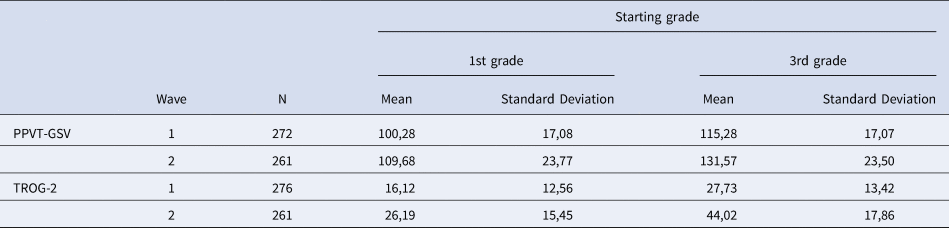
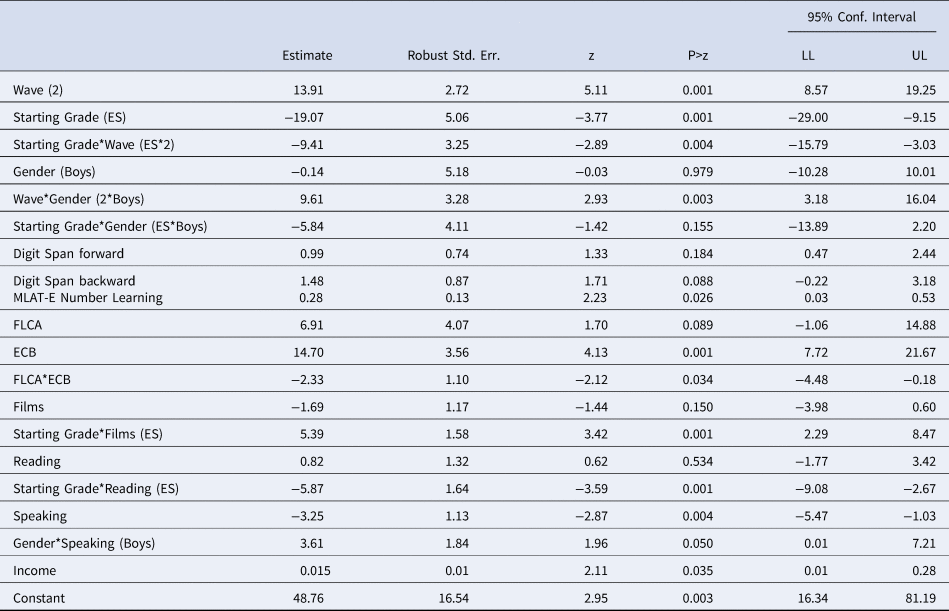
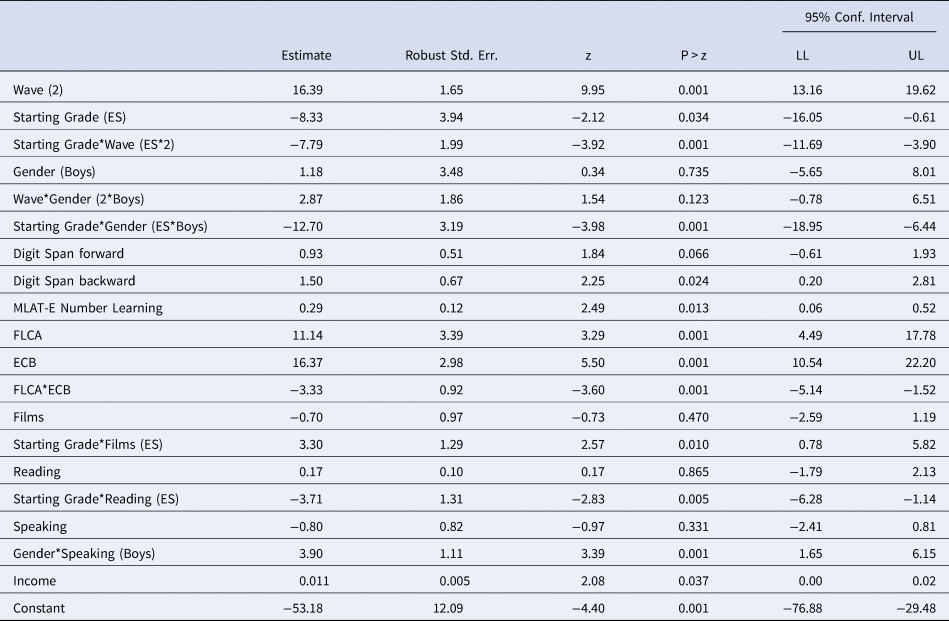
Table 1 reports the raw scores at waves 1 and 2 for the PPVT and TROG. The pattern of results for the two outcome measures bore close resemblance so we present them concurrently. In the following sections, we report the results in terms of raw scores together with estimates and their significance levels as obtained from the fitted models. Tables 2 and 3 show the estimated statistical models for the PPVT and TROG outcome measures, respectively. Note that these are the results of the model fitting process described above where a number of the factors included did not reach our criterion for significance. Among these was, for example, the total number of hours of instruction, as described above, which varied between schools. We refer the reader to Fenyvesi et al. (Reference Fenyvesi, Hansen and Cadierno2020) for a discussion.
Raw scores for PPVT-GSV and TROG-2 by starting grade and wave.

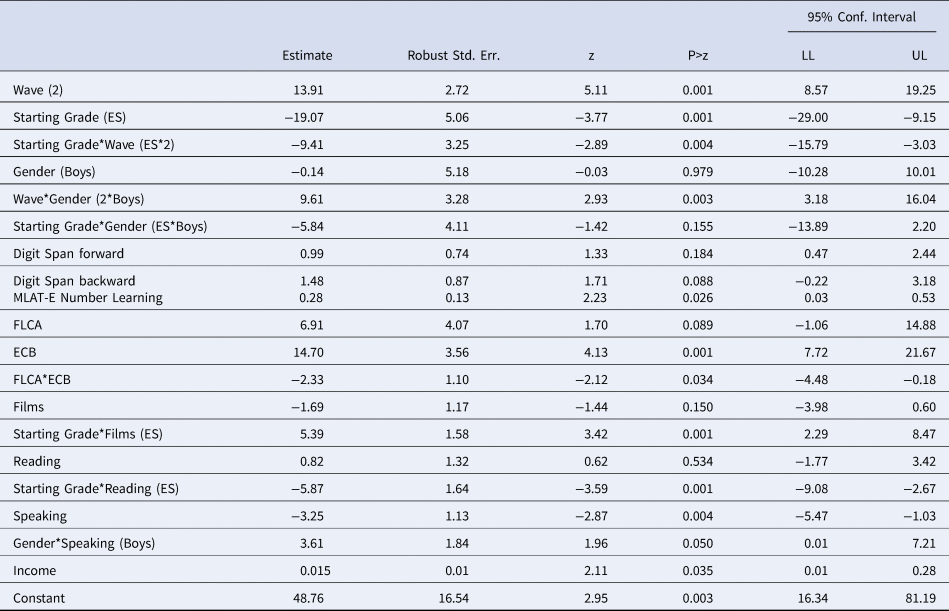
Results of fitted mixed effects repeated measures model for receptive vocabulary scores (PPVT-GSV Scores, with reference levels in parentheses). N = 324 (162 in each wave).
Note. ES = early starters; FLCA = foreign language classroom anxiety; ECB = English competence beliefs; MLAT-E = Modern Language Aptitude Test, Elementary.
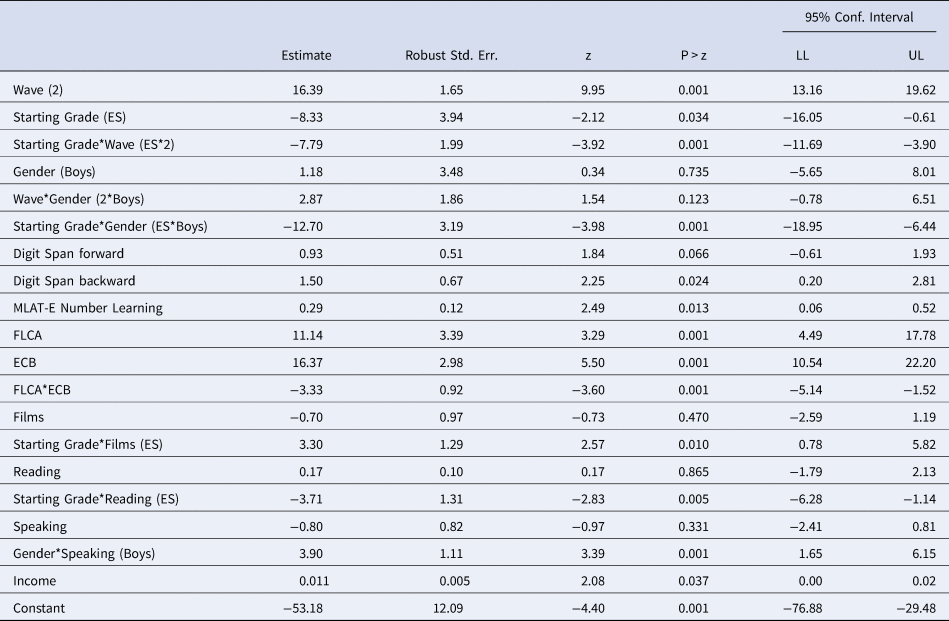
Results of fitted mixed effects repeated measures model for receptive grammar scores (TROG-2 total items passed, with reference levels in parentheses). N = 324 (162 in each wave).
Note. ES = early starters; FLCA = foreign language classroom anxiety; ECB = English competence beliefs; MLAT-E = Modern Language Aptitude Test, Elementary.
Child-specific factors
In relation to child-specific factors, we first noted that the models indicated a difference in receptive vocabulary depending on the starting grade. Both for the PPVT and TROG, the scores of all participants increased from Wave 1 to 2. There was also a main effect of starting grade: LS scored significantly better than the ES. For both measures, the main effects were moderated by a significant interaction between starting grade and wave. As shown in Table 2, for the PPVT the difference between ES and LS was 15.00 points at Wave 1 but 21.89 points at wave 2, thus the LS' scores increased by 6.89 points more than the ES' scores (estimate: −9.41, z = −2.89, p = .004). The same pattern was found for the TROG. The difference between ES and LS was 11.61 points at Wave 1 but 17.83 points at wave 2, thus the LS' scores increased by 6.22 points more than the ES' scores (estimate: −7.79, z = −3.92, p < .001).
Overall, there was no significant main effect of gender for either of the measures. However, for the PPVT, there was a significant interaction between gender and wave: The boys' scores increased significantly more than girls from Wave 1 to 2 overall, by an estimated difference of 9.61, z = 2.93, p = .003). For the TROG, in contrast to the PPVT, the interaction between wave and gender did not reach significance (estimate: 2.87, z = 1.54, p = .123), although the difference was in the same direction, i.e., an estimated difference of 2.87 points in favour of the boys. In contrast to the PPVT, there was a significant interaction between gender and starting grade (estimate: -12.70, z = −3.98, p < .001), indicating that LS boys regardless of wave had a 12-point advantage over ES boys; a bigger difference than that found for LS vs. ES girls. For a more detailed analysis, see Cadierno et al. (Reference Cadierno, Hansen, Lauridsen, Eskildsen, Fenyvesi, Hannibal Jensen and aus der Wieschen2020).
We now turn to the memory components underlying language aptitude, i.e., the digit span tests (forward and backward) and the number learning subtest of the MLAT-E. For forward digit span, for each step of increase in these scores, children's PPVT scores rose by 0.99 points (z = 1.33, p = .184) and their TROG scores rose by 0.93 (z = 1.84, p = .066). For backward digit span, the increase was 1.48 (z = 1.71, p = .088) for the PPVT and 1.50 (z = 2.25, p = .024) for the TROG. Despite some measures not meeting conventional statistical significance levels, we note in particular that the size and direction of the coefficients were quite similar for both outcome measures. For number learning, the increase was 0.28 points (z = 2.23, p = .026) on the PPVT and 0.29 (z = 2.49, p = .013) on the TROG.
Of the various affective and motivational variables, two rose to our cut-off significance-level in the fitted models. For FLCA, there was a significant main effect for the TROG and a tendency towards conventional statistical significance for the PPVT (PPVT: estimate: 6.91, z = 1.70, p = .089, TROG: estimate: 11.14, z = 3.29, p < .001). For ECB, there was a significant main effect for both outcome measures (PPVT: estimate: 14.70, z = 4.13, p < .001; TROG: estimate: 16.37, z = 5.50, p < .001). However, the effects of FLCA and ECB were moderated by a significant interaction between them (PPVT: estimate: -2.33, z = −2.12, p = .034; TROG: estimate: −3.33, z = −3.60, p < .001). There were no other interactions involving these two factors.
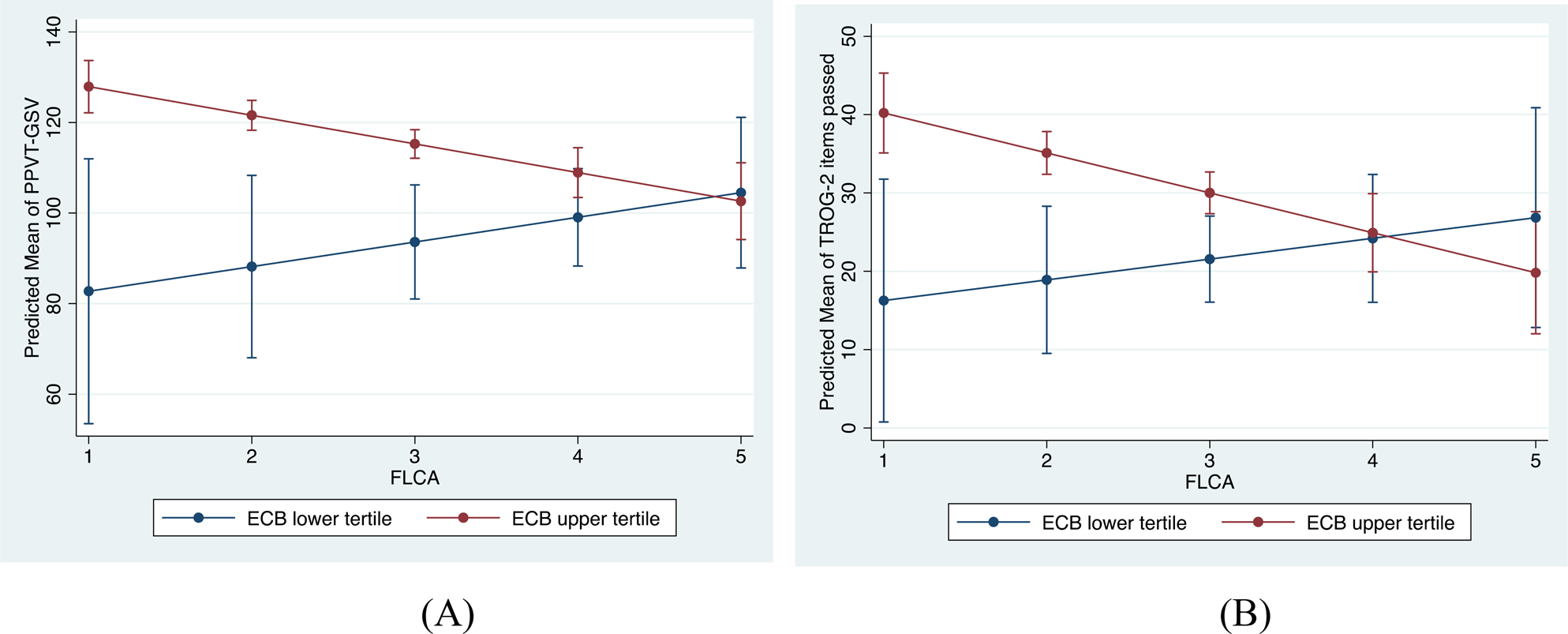
The differential impact of ECB depending on the level of FCLA for both PPVT and TROG is illustrated in Figures 1A and 1B. For students with high scores on the ECB items, i.e., the red line showing the upper tertile of ECB scores, and low levels of FLCA, the ECB scores corresponded roughly to high PPVT and TROG scores, i.e., a strong belief in one's self-competence in English corresponded to high proficiency scores. However, students with high ECB who also scored high on the FLCA items tended to obtain lower proficiency scores regardless of their high beliefs in their own competences. In contrast, for students with low ECB (i.e., the blue line showing the lower tertile of ECB scores), their proficiency scores were lower than the students with high ECB overall. The level of FLCA had little estimated impact on their proficiency scores. As can be seen by the confidence intervals shown on the slope of the different levels of FLCA for students with low ECB, the estimated points may overlap, indicating uncertainty whether the slope in fact rises or is flat.
Estimated means on the PPVT (A) and TROG (B), as a function of Foreign language classroom anxiety (FLCA) at two different levels of English competence beliefs (ECB; upper and lower tertiles of scores with 95% confidence intervals).

Environmental factors
Regarding children's contact with English outside the classroom, three factors had an impact on children's proficiency scores. First, the composite score of exposure to English language audiovisual media (Films) interacted significantly with starting grade. We have illustrated the differences, dichotomizing the actual scores into 1 hour or less and more than 1 hour of watching films in Figures S1 A and B. Relative to the other factors in the model, watching audiovisual material only had a significant impact on the ES. On the PPVT, the difference in raw scores was 13.52 points for the ES, and 1.93 points for the LS (estimate: 5.39, z = 3.42, p < .001). On the TROG, the difference was 12.37 points for the ES and 6.02 points for the LS (estimate: 3.30, z = 2.57, p = .010). There was no main effect of films for either outcome measure, but recall from the presentation of the model that there was a significant effect of starting grade.
Second, the amount of time spent reading in English out of school interacted significantly with starting grade. Figures S2 A and B illustrate the difference in the two outcome measures in actual scores for those not reading at all outside the classroom compared to those reading more than 30 minutes per week outside the classroom. On the PPVT, while the scores of the ES were relatively uninfluenced by the amount of time spent reading outside the classroom (the difference in actual scores was −2.57 points), for the LS, those reading more than 30 minutes per week outside the classroom had an advantage of 5.05 points compared to those who read less than 30 minutes per week (estimate: −5.87, z = −3.59, p < .001). For the TROG, the pattern was the same. While the ES showed a minor difference of -1.47 between reading less than 30 minutes vs. more, the LS showed a difference of 5.00 points in actual scores (estimate: −3.71, z = −2.83, p = .005). There were no main effects of reading.
The third environmental factor that met our cut-off criterion was the amount of time spent speaking English outside the classroom, which showed a significant interaction with gender. The interaction, as well as a main effect in the case of the PPVT, is illustrated in actual scores in Figures S3 A and B. For the PPVT everybody benefited from speaking English outside the classroom regardless of gender (estimate: −3.25, z = −2.87, p = .004). In addition, boys that spoke English more than 1 hour outside the classroom obtained 4.54 points more on the PPVT in actual scores relative to those speaking less than 1 hour compared to girls for whom the increase was 1.47 points (estimate: 3.61, z = −0.9, p = .050). For the TROG, there was no main effect of speaking English outside the classroom (estimate: −.80, z = −.97, p = .331) – however, it was still the case that boys benefited more than girls from this activity. Boys speaking more than 1 hour obtained 6.54 points more on the TROG than those speaking less than hour per week. For girls, the increase was 2.51 points on the TROG (estimate: 3.90, z = 3.39, p < .001).
Regarding the remaining environmental factors, only the total yearly income of the child's caregivers was significant in the fitted model. Income was reported in units of 1000s of Danish kroner. The results showed that for every increase in income of 15,000 Danish kroner per year (roughly equal to 2000 euros), students' PPVT score increased by 1 point (estimate: 0.015, z = 2.11, p = .035). For the TROG, the corresponding figure was an increase in 11,000 Danish kroner per year (roughly equal to 1500 euros; estimate: 0.011, z = 2.08, p = .037).
Finally, we examined the relative influence of child-specific vs. environmental factors in predicting proficiency (see Sun et al., Reference Sun, Steinkrauss, Tendeiro and de Bot2016). To obtain the percentage of the variance explained by these two blocks of factors, we used the same two statistical models as previously, leaving out the random factor, to calculate the change in R 2 between the full models (PPVT: R 2 = .55; TROG: R 2 = .65) and versions of the models without the block of environmental factors (PPVT: R 2 = .42; TROG: R 2 = .53) and basic models that included just the factor Wave, which was a feature of the design (PPVT: R 2 = .06; TROG: R 2 = .12). The environmental factors, then, explained 13% of the total variance for the PPVT and 12% for the TROG. The child-specific factors explained 36% of the total variance for the PPVT and 41% for the TROG.
Discussion
The present study examined the role of two sets of factors in Danish children's development of L2 English receptive vocabulary and grammar skills: (a) child-specific factors and (b) environmental factors, the latter comprising children's contact with English outside the classroom and parental SES, parents’ knowledge of English, and their use of English in their daily lives. In addition, the study asked whether the role of the various factors was the same for the two language measures.
Child-specific factors
Regarding the child-specific factors, age of onset, gender, the memory components of language aptitude, FL competence beliefs and FL classroom anxiety had the biggest impact on the outcome measures. That is, the various measures of learners’ motivation and mindset did not reach our criterion for significance relative to the other factors. Concerning age of onset, for both measures, LS scored significantly higher than ES. In addition, the significant interaction between age of onset and wave indicated that the advantage of the LS increased over time (after one year of instruction). This is evidence of a rate advantage for the LS over the ES with respect to receptive vocabulary and grammar skills. A similar pattern was present in the analyses of a part of the same data reported by Cadierno et al. (Reference Cadierno, Hansen, Lauridsen, Eskildsen, Fenyvesi, Hannibal Jensen and aus der Wieschen2020), although for receptive vocabulary, it only approached statistical significance whereas in the present study it was significant when other factors were included in the model. Our results support a consistent finding in previous research conducted in instructed settings – namely, the faster rate of learning of older learners in several language dimensions, including vocabulary (Muñoz, Reference Muñoz, Bardel and Sánchez2020b; Pfenninger & Singleton, Reference Pfenninger and Singleton2017) and grammar-related tasks (e.g., Jaekel et al., Reference Jaekel, Schurig, Florian and Ritter2017; Pfenninger & Singleton, Reference Pfenninger and Singleton2017). The older learners’ rate advantage may be due to their more advanced level of cognitive development and increased use of explicit learning mechanisms which develop with age (see Muñoz, Reference Muñoz and Muñoz2006).
As for gender, there was a general advantage of boys compared to girls. For receptive vocabulary, the significant interaction between gender and wave indicates that boys’ scores increased significantly more than those of the girls. For receptive grammar, the significant interaction between gender and starting grade suggests that, regardless of wave, LS boys obtained significantly higher scores than ES boys relative to the difference between LS and ES girls. These results are in line with those of Cadierno et al. (Reference Cadierno, Hansen, Lauridsen, Eskildsen, Fenyvesi, Hannibal Jensen and aus der Wieschen2020), and a study conducted in Sweden by Sylvén and Sundqvist (Reference Sylvén and Sundqvist2012) who found that boys outperformed girls regarding L2 English vocabulary. They suggest that this advantage may be due to more time spent on gaming, a connection also made by Hannibal Jensen (Reference Jensen2017), as discussed further below.
Regarding the memory components of language aptitude, there was some indication of an influence of the digit span tests and the MLAT-E measures, suggesting that various aspects of memory as measured by these tests (phonological short-term and working memory and rote learning abilities) play a role in the development of children's English receptive skills. Our findings are in line with previous studies showing that language aptitude including its memory components is a significant predictor of children's L2 development both in classroom and naturalistic contexts, and for different language dimensions such as vocabulary and grammar (e.g., Muñoz, Reference Muñoz, Pawlak and Aronin2014; Paradis, Reference Paradis2011; Unsworth et al., Reference Unsworth, Persson, Prins and de Bot2015).
FLCA had a negative impact on both outcome measures (although more so for receptive grammar). To some extent, this result mirrors previous research showing that the higher the FLCA, the lower the L2 learning outcome (see Botes, Dewaele & Greiff, Reference Botes, Dewaele and Greiff2020, for a recent meta-analysis). However, the above effects were moderated by a significant interaction between FLCA and ECB for both outcomes. That FLCA is closely related to children's achievement-related self-concept has also been shown by Heinzmann (Reference Heinzmann2013).Footnote 1 The results of the present study support that finding but crucially relate it to outcome scores both for TROG and PPVT: ECB scores were a significant predictor of both language outcomes, but this was only the case for children with low FLCA. In the case of high FLCA, even children with strong beliefs in their own competences in English obtained lower outcome scores (see Figures 1A and B). Thus, high ECB was overridden by high FLCA.
The paradox of having high ECB yet obtaining low proficiency scores could be seen in the light of recent calls for the need to think of child-specific factors not as independent factors but as dynamic characteristics that interact with each other in multiple ways (Dewaele & Pavelescu, Reference Dewaele and Pavelescu2019; MacIntyre, Reference MacIntyre, Gkonou, Daubney and Dewaele2017). For students with high ECB but a low score in actual L2 proficiency, high FLCA (e.g., being afraid of speaking up in class and of being corrected) may shield them from receiving feedback that could lower their competence beliefs. Thus, they are able to maintain a self-image as being competent in English by not getting evidence to the contrary. However, they may then not receive the necessary feedback to develop their L2 skills (for a discussion of the role of feedback on L2 proficiency, see Lyster & Saito, Reference Lyster and Saito2010).
Environmental factors
In relation to the environmental factors, the results of the study showed that of all the factors dealing with the effects of extramural English, watching English audiovisual material, reading, and speaking in English were significant factors in explaining receptive vocabulary and grammatical proficiency. With respect to the former, the significant interaction between this factor and starting grade (age of onset) for both language measures suggests that viewing audiovisual input was mainly beneficial for the ES. A beneficial effect of watching audiovisual material on L2 learning has been widely documented in previous research conducted with younger and older learners (e.g., d'Ydewalle & Van de Poel, Reference Ydewalle and Van de Poel1999; Lindgren & Muñoz, Reference Lindgren and Muñoz2013; Muñoz et al., Reference Muñoz, Cadierno and Casas2018). Our results do not suggest that watching films is not beneficial for the LS, only that relative to the other significant factors in the model, this factor is more important for the ES, cf. the reverse pattern below for reading. This finding emphasizes the important role of watching audiovisual input from the early stages of L2 learning.
With regard to extramural reading in English, our results suggest that relative to all the other factors, this type of activity was mainly beneficial for the LS group. As noted by De Wilde et al. (Reference De Wilde, Brysbaert and Eyckmans2020), the beneficial effect of informal extramural reading on children's acquisition of English has been quite limited. The results of our study suggest that a beneficial effect may be linked to the learners’ level of L1 literacy and L2 proficiency. Presumably, the reading skills of the ES group were not advanced enough to take advantage of reading in an L2. In fact, several researchers have claimed that L2 reading is aided by the transference of knowledge and skills (e.g., metacognitive knowledge and reading strategies) acquired from L1 reading (e.g., Carrell, Reference Carrell1991; Cummins, Reference Cummins and Bialystok1991). In relation to the level of L2 proficiency, the ES group, which exhibited lower levels of English receptive vocabulary and grammar than their LS counterparts, may not have had sufficient L2 proficiency to profit from informal reading. In fact, the interplay between readers’ L1 literacy skills and L2 knowledge resources in successful L2 reading has been stressed by contemporary approaches to L2 reading (e.g., Bernhardt, Reference Bernhardt2011; Grabe, Reference Grabe2009). A combined effect of the ES's poorer L1 reading skills and lack of sufficient L2 knowledge would explain why informal reading outside the classroom was only a significant predictor for the LS group, who had higher L2 proficiency and who were presumably more proficient readers.
The interaction of extramural speaking in English and gender for both outcome measures suggests that speaking English outside the classroom context was beneficial for boys rather than girls. A possible explanation for this finding may be related to the higher amount of time spent on gaming by boys vis-à-vis girls (e.g., Hannibal Jensen, Reference Jensen2017). According to Sundqvist (Reference Sundqvist, Farr and Murray2016), this pattern may be due to gender-role stereotyping (i.e., gaming being associated with masculine culture) and a lack of female characters available in games. It may also be due to the relationship between gender and type of games. In a survey conducted in Denmark, Thorhauge and Gregersen (Reference Thorhauge and Gregersen2015) found that boys played multi-player games significantly more often than girls who tended to play single-player games. Research has shown that when playing multi-player online games, learners often practice the language through interaction with native or more fluent speakers as they use the audio-chat functions afforded by these types of games (e.g., Rama, Black, van Es & Warschauer, Reference Rama, Black, van Es and Warschauer2012; Sylvén & Sundqvist, Reference Sylvén and Sundqvist2012). However, the gaming measures did not rise to significance in the current study relative to the other factors (but see Hannibal Jensen, Reference Jensen2017).
All in all, the findings of this study regarding contact with English outside the classroom support usage-based accounts of L2 learning. It can be argued that watching audiovisual material provided Danish learners with ample opportunities to experience high token frequencies of particular linguistic items (both at the lexical and grammatical level) and high type frequencies of various linguistic material in given constructions, thus facilitating the implicit learning of the L2 (see Muñoz et al., Reference Muñoz, Cadierno and Casas2018, for a similar explanation).
Regarding the remaining environmental factors, the results of the present study showed that only total yearly caregiver income played a significant role as an indicator of SES. This finding supports previous studies which have identified SES as an important predictor in L2 acquisition (e.g., Butler & Le, Reference Butler and Le2018; Goldberg et al., Reference Goldberg, Paradis and Crago2008). Even though most research has operationalized SES in terms of maternal education and have found this to be a significant predictor in learners’ language development (e.g., Bornstein & Bradley, Reference Bornstein and Bradley2003), the results of the present study suggest that even in a country like Denmark, with one of the lowest degrees of income inequality in the world (OECD, 2016), SES as measured by income may still be a factor in predicting L2 learning.
Role of child-specific vs. environmental factors
Finally, when comparing the relative weight of the child-specific and environmental factors on Danish children's receptive vocabulary and grammar, the results of the present study showed that child-specific factors explained more of the variance in English proficiency than environmental factors. Previous research on the relative weight of internal vs. external factors on L2 learning has found different results for L2 learning in naturalistic input-rich environments vs. instructed settings, with a bigger role for internal factors in the former type of setting (e.g., Paradis, Reference Paradis2011; Sun, Bornstein & Esposito, Reference Sun, Bornstein and Esposito2021) and external factors in the latter (e.g., Sun et al., Reference Sun, Steinkrauss, Tendeiro and de Bot2016). Notwithstanding differences in design and factors included, in our study, conducted in an instructed setting but with a high presence of English in society, internal factors were found to play a more important role than external factors. This finding provides support for claims made in the literature concerning the special status of English in some European countries like the Netherlands or the Nordic countries (Cadierno et al., Reference Cadierno, Hansen, Lauridsen, Eskildsen, Fenyvesi, Hannibal Jensen and aus der Wieschen2020; de Bot, Reference de Bot2014).
Additionally, this finding may be interpreted as providing support for the relative weight hypothesis (Sun et al., Reference Sun, Yin, Amsah and O'Brien2018), according to which input-rich contexts would allow learners’ internal resources to manifest themselves, and likewise, for the critical mass hypothesis (e.g., Gathercole & Hoff, Reference Gathercole, Hoff, Hoff and Shatz2007), according to which learners need to be exposed to ample L2 input for other factors to be able to contribute to language learning. As argued by Sun et al. (Reference Sun, Yin, Amsah and O'Brien2018), in naturalistic input-rich environments, children are exposed to ample L2 input that provides “the requisite amount and quality of input for internal mechanisms to contribute to language learning” (p. 389). In contrast, in traditional FL environments with limited access to L2 input, “the outcome of language learning then is determined primarily by the quantity and quality of input at the initial period” (p. 389). As children in Denmark are exposed to a considerable amount of English outside the classroom, their L2 input level may arguably have exceeded the requisite amount of input threshold that is needed for internal factors to gain a more prominent role, thus explaining the similar pattern found in the present study and in studies conducted in naturalistic L2 contexts.
In relation to the second research question about the differential impact of the predictors on the two outcome measures, i.e., receptive vocabulary and grammar, the results revealed that the role of the different factors was very similar. This finding is in line with previous studies (e.g., Paradis, Reference Paradis2011; Sun et al., Reference Sun, Steinkrauss, Tendeiro and de Bot2016; but see, e.g., Chondrogianni & Marinis, Reference Chondrogianni and Marinis2011, for a different result) where the same patterns were largely found for lexical and morphosyntactic development, and supports usage-based accounts of L2 learning (e.g., Bybee, Reference Bybee, Robinson and Ellis2008; Cadierno & Eskildsen, Reference Cadierno and Eskildsen2015) where no rigid division is posited between lexis and grammar (Langacker, Reference Langacker1987).
Conclusion
The present study adopted a multi-factor perspective on the study of English language learning by young Danish children. A distinguishing feature was its longitudinal design. Potential predictors of gains in receptive vocabulary and grammar were studied over time in relation to a series of factors divided into child-specific and environmental factors.
Regarding child-specific factors, the LS had better scores and additionally exhibited a rate advantage for both outcomes. Furthermore, better outcomes for boys over girls could be seen in two ways: (1) For receptive vocabulary, boys' scores increased more than girls' scores (an additional rate advantage). (2) For receptive grammar, the difference between LS boys and ES boys was significantly bigger than the difference between LS and ES girls, regardless of wave. Language aptitude as measured by tests of digit-span and the number learning subtest of the MLAT-E predicted both outcome measures. Children's beliefs in their own competence in English positively predicted their proficiency. However, this was only the case for children with low FLCA, as the results once again showed the detrimental influence of high FLCA: even a strong belief in one's English competence was overridden by high FLCA. With regard to environmental factors, viewing audiovisual material in English outside of the classroom was beneficial for the ES, whereas reading in English outside the classroom was beneficial for the LS. Speaking English outside school was beneficial for boys. Increase in SES as measured by household income also predicted both language measures.
The results showed that child-specific factors explained more of the variance than environmental factors. This has important implications for research on child L2 learning and bilingualism: It points to the need to go beyond the categorical distinction between naturalistic and instructed settings when examining the role of child-specific vs. environmental factors in child L2 acquisition/bilingualism research. As we detail below when outlining the pedagogical implications of our study, adopting a less categorical perspective which takes into account the specific aspects of the learning context as well as child-specific factors has important consequences for supporting L2 development in children.
The study has some limitations. Although longitudinal, it spanned only 1 year, so we can only speak to short-term proficiency, as measured by picture selection tests. Future research may determine if the LS starter advantage (and advantage of boys) holds up over time when using other types of tests. In relation to the psychological constructs studied, the limited number of items for each construct in the questionnaire may entail a less rich operationalization of the constructs than would be feasible in a questionnaire for adults. In addition, retrospective self-reported answers, which were used for the environmental factors, may not have been fine-grained enough to capture all of children's daily English-related activities. The lack of quantitative data on classroom language use by the teachers and the children is also a limitation of the present study. Some of the differences in children's linguistic outcomes might be explained by teachers’ aims and pedagogical choices, as shown by Unsworth et al. (Reference Unsworth, Argyri, Cornips, Hulk, Sorace and Tsimpli2014). Finally, children's Danish proficiency was not integrated in the analyses.
With these caveats in mind, the findings of the present study point to several pedagogical implications. In relation to child-specific factors, the results are in line with previous research indicating little advantage of introducing English earlier in primary school. In addition, they once again point to the need to promote a low anxiety classroom environment that fosters low evaluative pressure (MacIntyre, Reference MacIntyre and Young1999). In relation to the environmental factors, the results point to the importance of increasing teachers' awareness of the facilitative role of watching material from the beginning of English instruction as well as promoting reading in the L2 once children have reached a more advanced level of L1 literacy. Our results also support previous claims in the literature about the importance of raising children's and parents' awareness of the opportunities for language learning outside the schools and of integrating these out-of-classroom activities into the FL classroom (e.g., Muñoz & Lindgren, Reference Muñoz, Lindgren and Enever2011; Muñoz et al., Reference Muñoz, Cadierno and Casas2018).
Acknowledgements
We thank the Danish Council for Independent Research, Humanities for funding (DFF-4001-00046). Also, we thank Thomas O. Madsen for assistance with adapting the number learning subtest of the MLAT-E into Danish, and school principals, teachers, parents, students and research assistants for their participation in the study.
Competing interests
The authors declare none.
Data availability
Data are available from the authors subject to permission from the participants.
Supplementary Material
For supplementary material accompanying this paper, visit http://dx.doi.org/10.1017/S1366728921001085
Table S1: Description of the variables included in the statistical models.
Table S2: List of psychological factors included in the children's questionnaire.
Table S3: Correlations of the predictors in the fitted model.
Figure S1: PPVT (A) and TROG (B) scores by time watching films and other audiovisual material. in English outside of school, dichotomized into 1 hour and less and more than 1 hour.
Figure S2. PPVT (A) and TROG (B) scores by time spent reading in English outside of school, dichotomized into not reading vs. reading more than half hour per week.
Figure S3. PPVT (A) and TROG (B) scores by time spent speaking in English outside of school and gender, dichotomized into speaking for 1 hour or less and more than 1 hour.