Reciprocal effects between parent and child behavior were posited in Bell's (Reference Bell1968) seminal theoretical paper and Sameroff and Chandler's (Reference Sameroff, Chandler, Horowitz, Hetherington, Scarr-Salapatek and Siegel1975) broader transactional perspective. Although a transactional perspective has been accepted as “culturally normative” at a theoretical level by researchers in the field of developmental psychopathology and as reflected by the focus of this Special Issue, there are relatively few actual studies testing transactional models of parent–child interaction over time. For notable exceptions, see the Special Issue in the Journal of Abnormal Child Psychology (2008) and a volume edited by Sameroff (Reference Sameroff and Sameroff2009). Beyond examining transactional models between parenting practices and child problem behavior, attention has been turned recently to substituting parental depression for direct caregiving practices for reasons described below (Gross, Shaw, & Moilanen, Reference Gross, Shaw and Moilanen2008; Gross, Shaw, Moilanen, Dishion, & Wilson, Reference Gross, Shaw, Burwell and Nagin2008). Implicit as well in a developmental psychopathology perspective is the notion that children and families are influenced by their larger ecological context (Bronfenbrenner, Reference Bronfenbrenner2009), especially as children move from spending more time outside of the home environment from early to middle childhood. Such an ecological perspective posits that community factors, specifically the quality of one's immediate neighborhood environment, might influence child problem directly through interactions the child has outside of the home with peers and adults, and indirectly through compromised parental functioning associated with the stressors of living in a high-risk neighborhood.
The current study sought to extend prior research on transactional models between maternal depression and child conduct problems (CP) by also incorporating repeated assessments of neighborhood deprivation. We used two independent samples of low-income children followed prospectively from the toddler period through late childhood or early adolescence. This work was inspired by the plethora of research examining only unidirectional associations between maternal depression and multiple types of child outcomes, the relative dearth of research examining bidirectional associations, and the possibility that the family's broader neighborhood quality might provide a more complete picture of evolving transactional processes on young children's emerging conduct problems.
The term maternal depression will be used to describe both clinical depression and subclinical depressive symptoms, because both are found to be prognostic of child maladjustment (Cummings, Keller, & Davies, Reference Cummings, Keller and Davies2005; Farmer, McGuffin, & Williams, Reference Farmer, McGuffin and Williams2002; Shaw, Hyde, & Brennan, Reference Shaw, Hyde and Brennan2012). Similarly, the term CP will be used to describe a range of heterotypically similar externalizing symptoms during early and middle childhood, focused primarily on overt and disruptive oppositional and aggressive behavior. We then use the term antisocial behavior to refer to more serious and typically more covert forms of aggressive behavior commonly demonstrated by older children and adolescents.
Maternal Depression and Child CP
Several types of parental psychopathology have been associated with increased risk of child psychopathology (Connell & Goodman, Reference Connell and Goodman2002; DelBello & Geller, Reference DelBello and Geller2001; Goodman & Brumley, Reference Goodman and Brumley1990; Lapalme, Hodgins, & LaRoche, Reference Lapalme, Hodgins and LaRoche1997); however, the link between maternal depression and child adjustment is perhaps the most carefully examined. Because women more often serve as primary caregivers compared to men, and the incidence of depression is quite high among females beginning during adolescence, the focus on depression versus other types of maternal psychopathology is not surprising (Shaw, Dishion, Connell, Wilson, & Gardner, Reference Shaw, Dishion, Connell, Wilson and Gardner2009). The extant literature provides substantial evidence for a relation between maternal depression and negative child outcomes across development stages of childhood and adolescence, including both CP and emotional problem behaviors (for a recent review of this literature, see Goodman et al., Reference Goodman, Rouse, Connell, Broth, Hall and Heyward2011). These associations have been found to be particularly robust during early childhood when mothers and children spend more time together than at later ages (Marchand, Hock, & Widaman, Reference Marchand, Hock and Widaman2002; Shaw, Vondra, Dowdell Hommerding, Keenan, & Dunn, Reference Shaw, Vondra, Dowdell Hommerding, Keenan and Dunn1994; Shaw, Winslow, Owens, & Hood, Reference Shaw, Winslow, Owens and Hood1998), and especially prevalent during the “terrible twos” when parents, primarily mothers, struggle with children's increasing mobility coupled without concomitant cognitive appreciation for the consequences of their behavior (Shaw & Bell, Reference Shaw and Bell1993).
Maternal Depression and Child CP in the Context of Poverty
Another reason we chose to focus on maternal depression rather than parenting or other indices of parental psychological resources is because both of the current samples were recruited, at least partially, on the basis of low family income; both samples were recruited from Women, Infants, and Children Nutritional Supplement Programs (WIC). A substantial body of research has linked lower income to higher levels of maternal depression (Goodman & Gotlib, Reference Goodman and Gotlib1999; Shaw, Gross, & Moilanen, Reference Shaw, Gross, Moilanen and Sameroff2009; Shaw & Shelleby, Reference Shaw and Shelleby2014). Further, while an estimated 17% of mothers of young children demonstrate elevated depressive symptoms (Horwitz, Briggs-Gowan, Storfer-Isser, & Carter, Reference Horwitz, Briggs-Gowan, Storfer-Isser and Carter2007), in the context of low socioeconomic status (SES), researchers have found that this percentage increases to nearly 50% (Ertel, Rich-Edwards, & Koenen, Reference Ertel, Rich-Edwards and Koenen2011; Hall, Williams, & Greenberg, Reference Hall, Williams and Greenberg1985).
Consistent with the higher rates of maternal depression among mothers living in poverty, maternal depression has also been associated with underclass neighborhood mobility. Using data from one of the two current data sets, the Pitt Mother & Child Project (PMCP), after accounting for such factors as race, parental criminality, family income, and educational and occupational attainment, maternal depression independently predicted downward mobility among residents of nonunderclass neighborhoods (i.e., to project neighborhoods) and remaining versus leaving project neighborhoods (Winslow, Shaw, Yaggi, & Doughtery, Reference Winslow, Shaw, Yaggi and Dougherty1999). In turn, living in project neighborhoods was related to a more persistent and high versus high-desisting course of child CP from ages 2 to 6 (Winslow & Shaw, Reference Winslow and Shaw2007). This greater exposure to stressors complements and expands the perspective of Evans (Reference Evans2004), who in characterizing the daily environmental stressors experienced by low-income children has noted their greater exposure to structural deficits in the quality of their housing (e.g., leaky roofs, rodent infestation, and poor heating), higher levels of air pollution, and neighborhood levels of crime, including shootings (Evans, Reference Evans, Baum, Revenson and Singer2001, Reference Evans2004). Exposure to these stressors would also be expected to be amplified for low-income children living with a depressed parent, who would likely place young children in more vulnerable contexts than nondepressed mothers living in poverty.
Furthermore, in addition to risk of child CP being transmitted from depressed mothers to offspring through compromised caregiving quality (e.g., higher rates of hostile, rejecting, and inconsistent caregiving; sparse positive reinforcement; and higher rates of acrimonious, coercive interaction) and genetic factors (see section on child effects below), especially relevant to families living in poverty is the established covariation between exposure to stress and depression among adults (Shaw & Shelleby, Reference Shaw and Shelleby2014). Specifically, Hammen (Reference Hammen1991) has suggested that many of the negative life events experienced by depressed adults, including parents, may represent a consequence rather than a cause of their depression (Goodman & Gotlib, Reference Goodman and Gotlib1999). This notion may be particularly relevant for children living in poverty, who already are exposed to high levels of stressful events in their daily lives. For example, mothers prone to depression may generate more stressful interactions in the immediate family environment. Hammen (Reference Hammen1991) found that depressed mothers reported higher levels of stress in the domains of marital and social relationships, finances, and employment than mothers who were medically ill or were physically well. Among these domains, perhaps the most consistent stressor for which children of depressed mothers are exposed is marital conflict, which in turn has been identified as a consistent predictor of child problem behavior, including CP (Gotlib, Lewinsohn, & Seeley, Reference Gotlib, Lewinsohn and Seeley1998).
Child Effects on Parents and Reciprocal Models
Child effects models emphasize the influence of children's attributes and behaviors on their parents (Shaw, Dishion, et al., Reference Shaw, Dishion, Connell, Wilson and Gardner2009) that are presumably mediated by genetic influences and prenatal insults (Bell, Reference Bell1968), as well as interactions with caregivers, the latter particularly during early childhood (Shaw & Bell, Reference Shaw and Bell1993). For example, child attributes such as negative emotionality (Plomin & McLearn, Reference Plomin and McLearn1993) and irritability (Goldsmith, Buss, & Lemery, Reference Goldsmith, Buss and Lemery1997), both of which have been shown to be moderately heritable, would be expected to increase parental distress and depressive mood, particularly in early childhood when interactions between mothers and children are at a premium. The literature on parenting is replete with theoretical and empirical evidence of child effects on parents. Belsky's (Reference Belsky1984) landmark paper on the determinants of parenting provides a foundation for reciprocal parenting models by positing that characteristics of both the parent and the child contribute to adaptive and dysfunctional parenting. This idea is expanded in Patterson's coercive model of parenting (Reference Patterson1982), in which a cycle of negative reinforcement is established when child noncompliance is reinforced by the parent. Accordingly, parents unwittingly reinforce child's disruptive behavior by paying more attention to it than to child's prosocial behavior (Eddy, Leve, & Fagot, Reference Eddy, Leve and Fagot2001; Prinzie et al., Reference Prinzie, Onghena, Hellinckx, Grietens, Ghesquiére and Colpin2004). These types of coercive parenting practices have been linked back to long-term difficulties for children, particularly in rates of CP (Campbell, Shaw, & Gilliom, Reference Campbell, Shaw and Gilliom2000; Dishion & Patterson, Reference Dishion and Patterson1997).
Just as child behaviors are thought to influence parenting, a number of studies have found evidence for child effects on other adult behaviors, including marital quality (Cui, Donnellan, & Conger, Reference Cui, Donnellan and Conger2007; Leve, Scaramella, & Fagot, Reference Leve, Scaramella and Fagot2001), alcohol consumption (Pelham et al., Reference Pelham, Lang, Atkeson, Murphy, Gnagy and Greiner1997), social life (Donenberg & Baker, Reference Donenberg and Baker1993), parenting self-efficacy (Cutrona & Trouman, Reference Cutrona and Trouman1986; Teti & Gelfand, Reference Teti and Gelfand1991), and stress (Baker & Heller, Reference Baker and Heller1996; Feske et al., Reference Feske, Shear, Anderson, Cyranowski, Strassburger and Matty2001). Moreover, there is a growing body of research on child effects and maternal depression (Gross, Shaw, Burwell, & Nagin, Reference Gross, Shaw, Burwell and Nagin2009; Gross et al., Reference Gross, Shaw, Moilanen, Dishion and Wilson2008; Shaw, Dishion, et al., Reference Shaw, Gross, Moilanen and Sameroff2009). Coyne's interpersonal model of depression provides a theoretical basis for bidirectional effects when describing how depressed adults elicit negative reactions from others that intensify their unhappiness and negativity in a cycle of mutual distress (Coyne, Kahn, & Gotlib, Reference Coyne, Kahn, Gotlib and Jacob1987). Nelson, Hammen, Brennan, and Ullman (Reference Nelson, Hammen, Brennan and Ullman2003) speculate that maternal depression may create dysfunctions in the early parent–child relationship and elicit problems in the child, which would, in turn, maintain negative maternal attitudes.
Studies that show higher rates of maternal depression in clinic-referred versus normal children (Brown, Borden, Clingerman, & Jenkins, Reference Brown, Borden, Clingerman and Jenkins1988; Fergusson, Lynskey, & Horwood, Reference Fergusson, Lynskey and Horwood1993) and in mothers whose children have high levels of behavioral or emotional problems (Civic & Holt, Reference Civic and Holt2000) are consistent with a child effects hypothesis. One study has addressed the methodological limitations of relying on correlational studies to examine child effects by utilizing an experimental design. Pelham et al. (Reference Pelham, Lang, Atkeson, Murphy, Gnagy and Greiner1997) asked married couples and single mothers to interact with 5- to 12-year-old boys who were trained to behave in either a normal or defiant manner. While waiting to have a second interaction with the same boy, the adults completed questionnaires, including one assessing depressive symptoms. Those who had interacted with the defiant boys reported significantly higher levels of depressive symptoms than those interacting with nondefiant children. These findings experimentally corroborate the personal distress associated with difficult child management situations.
Neighborhood Deprivation and Child CP
In several studies, consistent associations have been documented between neighborhood deprivation and different types of child CP, including aggressive behavior and more covert forms of antisocial behavior, with associations becoming stronger as children move into the school-age period and adolescence (Beyers, Bates, Pettit, & Dodge, Reference Beyers, Bates, Pettit and Dodge2003; Brooks-Gunn, Duncan, & Aber, Reference Brooks-Gunn, Duncan, Aber, Brooks-Gunn, Duncan and Aber1997; Coley, Morris, & Hernandez, Reference Coley, Morris and Hernandez2004). However, in the most disadvantaged urban environments in the United States, direct associations between neighborhood deprivation and children's CP have been found for children as young as age 3 to 4 (Kohen, Brooks-Gunn, Leventhal, & Hertzman, Reference Kohen, Brooks-Gunn, Leventhal and Hertzman2002; Supplee, Unikel, & Shaw, Reference Supplee, Unikel and Shaw2007; Xue, Leventhal, Brooks-Gunn, & Earls, Reference Xue, Leventhal, Brooks-Gunn and Earls2005). Studies suggest that neighborhood risk factors may directly impact early initiation and growth of child CP (Ingoldsby et al., Reference Ingoldsby, Shaw, Winslow, Schonberg, Gilliom and Criss2006; Wikstrom & Loeber, Reference Wikstrom and Loeber1999; Xue et al., Reference Xue, Leventhal, Brooks-Gunn and Earls2005), especially in the context of family and child risk.
How might neighborhood factors be associated with child CP? Sampson and Morenoff (Reference Sampson, Morenoff, Goodchild and Janelle2004) have described community-level structural factors thought to impede systemic social organization, including residential mobility, population instability, family disruption, housing density, and resource deprivation. These suboptimal structural factors are believed to compromise the density of acquaintanceships and informal intergenerational kinship ties and the quality of collective supervision in neighborhoods, ultimately compromising community support of child well-being (Sampson, Reference Sampson, Crouter and Booth2001). In addition to structural characteristics, social aspects of the neighborhood (e.g., presence of gangs or deviant peers, and perceptions of danger) have been posited as potential factors in the development and maintenance, and especially the progression, of antisocial patterns through adulthood (Dishion & Patterson, Reference Dishion, Patterson and Cicchettiin press; Seidman et al., Reference Seidman, Yoshikawa, Roberts, Chesir-Teran, Allen and Friedman1998). In addition to children's exposure to antisocial activities by peers, older youth, and adults, residents in these neighborhoods feel less trusting toward neighbors, describe lower levels of cohesion and support, and report more parenting challenges (Furstenburg, Reference Furstenberg and Wilson1993; Sampson, Reference Sampson and Wilson1993).
As noted above, most researchers suggest that during early childhood the effects of neighborhood deprivation on child functioning would be mediated by compromises in parent psychological functioning (Chazan-Cohen et al., Reference Chazan-Cohen, Raikes, Brooks-Gunn, Ayoub, Pan and Kisker2009; Mistry, Vandewater, Huston, & McLoyd, Reference Mistry, Vandewater, Huston and McLoyd2002; Shaw & Shelleby, Reference Shaw and Shelleby2014) and/or caregiving practices. For example, proponents of the family stress model (Conger & Elder, Reference Conger and Elder1994; Conger, Ge, Elder, Lorenz, & Simons, Reference Conger, Ge, Elder, Lorenz and Simons1994; McLoyd, Jayaratne, Ceballo, & Borquez, Reference McLoyd, Jayaratne, Ceballo and Borquez1994) posit that the cumulative effects associated with poverty take a toll on parent functioning, leading to higher levels of distress, anxiety, depression, and substance use, which in turn compromise parenting quality and child functioning (Brody, Murry, Kim, & Brown, Reference Brody, Murry, Kim and Brown2002; McLeod & Shanahan, Reference McLeod and Shanahan1993; Shaw & Shelleby, Reference Shaw and Shelleby2014). We were interested in testing both direct effects of neighborhood deprivation on emerging child CP and paths from neighborhood deprivation to maternal depression.
Timing of Effects and Children's Developmental Status
The extant literature provides both theoretical and empirical support for transactional effects model among maternal depression, neighborhood deprivation, and child CP (Choe, Shaw, Brennan, Dishion, & Wilson, Reference Choe, Shaw, Brennan, Dishion and Wilson2014; Ingoldsby & Shaw, Reference Ingoldsby and Shaw2002; Leventhal & Brooks-Gunn, Reference Leventhal and Brooks-Gunn2000); nevertheless, there are reasons for hypothesizing that the timing of transactional effects might vary in magnitude based on the child's developmental status. From the perspectives of physical and social maturation, both early childhood and early adolescence are times of major transition in such domains as hormonal changes and social expectations (Dahl, Reference Dahl2001), which theoretically could be made more challenging by the presence of maternal depression and/or neighborhood deprivation. Much attention has been devoted to pointing out the multiple biological and social challenges associated with the transition to puberty (Dahl, Reference Dahl2004). Such challenges have been found to elicit greater conflict in parent–child relationships relative to the school-age period (Laursen, Coy, & Collins, Reference Laursen, Coy and Collins1998; Steinberg & Silk, Reference Steinberg, Silk and Bornstein2002), and theoretically could lead to increases in depressive symptoms among parents. Similarly, the toddler period has been thought and found to be particularly challenging for parents based on children's rapid increase in physical mobility that is not accompanied by concomitant increases in cognitive appreciation for the consequences of their behavior or their own and other's safety (Keenan & Shaw, Reference Keenan, Shaw and McCord1995; Martin, Reference Martin1981; Shaw & Bell, Reference Shaw and Bell1993; Shaw, Keenan, & Vondra, Reference Shaw, Keenan and Vondra1994; Shaw et al., Reference Shaw, Winslow, Owens, Vondra, Cohn and Bell1998). Consistent with this increasing challenge in parent's ability to manage their young children from infancy to the toddler period, parental pleasure in childrearing has been found to be significantly higher at 12 versus 18 months (Fagot & Kavanagh, Reference Fagot and Kavanagh1993). Consequently, one would expect both child and parent effects to be prominent between ages 2 and 3 in reporting on maternal well-being and child CP during the past 6 to 12 months (Choe et al., Reference Choe, Shaw, Brennan, Dishion and Wilson2014; Gelfand & Teti, Reference Gelfand and Teti1990; Gross et al., Reference Gross, Shaw, Burwell and Nagin2009).
In the two samples included in the current study, both short-term and longer term effects of child disruptive behavior have been demonstrated on maternal depression (Choe et al., Reference Choe, Shaw, Brennan, Dishion and Wilson2014; Gross et al., Reference Gross, Shaw, Burwell and Nagin2009). Using data from the PMCP, Gross et al. (Reference Gross, Shaw, Burwell and Nagin2009) found that toddler-age observations of child noncompliance were linked to persistently higher trajectories of maternal depressive symptoms during middle childhood, which in turn were linked to both youth and teacher reports of youth antisocial behavior between ages 11 to 13. Using data from the Early Steps Multisite Study (ESMS), Choe et al. (Reference Choe, Shaw, Brennan, Dishion and Wilson2014) identified several transactional effects between maternal depression and both maternal and alternative caregiver reports of child oppositional behavior from ages 2 to 5, with child inhibitory control mediating some of the associations between maternal depression and child CP.
In addition to early childhood, the transition to school, although marked by less pronounced physiological (Rimm-Kaufman & Pianta, Reference Rimm-Kaufman and Pianta2000) or cognitive (Nelson, Reference Nelson, Sameroff and Haith1996) maturation, is a time of social transition for children, particularly in the area of social networks. At formal school entry, children transition from networks composed primarily of adults to ones with primarily other children (Rimm-Kaufman & Pianta, Reference Rimm-Kaufman and Pianta2000). Parents typically become less familiar with peers and adults their children spend most of their day with and have less control over their children's activities (Pianta, Cox, Taylor, & Early, Reference Pianta, Cox, Taylor and Early1999). Accordingly, we expected to see direct effects of neighborhood deprivation on child CP during the transition to formal schooling.
The Current Study
The current study examined parallel growth and cross-lagged models involving maternal depression, neighborhood deprivation, and child CP across two unique samples of indigent families from the toddler period through middle childhood and adolescence. Study 1, the PMCP, is an all-male, ethnically diverse, low-income sample of 310 boys and mothers from a large urban context followed from age 1.5 through age 15 using parent, teacher, and youth reports, as well as census data to assess neighborhood deprivation. Study 2, the ESMS, provides a larger cohort of 731 ethnically diverse, low-income boys and girls from urban, rural, and suburban communities. In addition, the ESMS also includes mother and alternative caregiver (i.e., typically fathers) reports of early child CP, teacher and youth reports of child CP and antisocial behavior, as well as census-based data on neighborhood deprivation. Both cohorts were recruited from WIC clinics, with the ESMS sample recruited approximately 10 years later than families in the PMCP.
We hypothesized that bidirectional patterns between maternal depression and child CP would be more evident during the toddler period (ages 1.5 to 3) and the transition to school (ages 5 to 7), respectively. In addition, we expected to see associations between neighborhood deprivation and both maternal depression and child CP beginning during the preschool period. Because parenting has been theorized and found to partially mediate associations between maternal depression and child CP, we accounted for the contribution of early rejecting parenting or coercive parent–child interaction in both samples using observational data. In addition, by including results from two independent samples, we sought to identify areas of convergence and divergence across cohorts, informants of child CP/antisocial behavior, and child race and gender. The current study also sought to improve on the methodological limitations of previous work in this area, much of which has been limited by the use of small samples, retrospective reports, and short-term follow-ups (Campbell, Matestic, von Stauffenberg, Mohan, & Kirchner, Reference Campbell, Matestic, von Stauffenberg, Mohan and Kirchner2007; Connell & Goodman, Reference Connell and Goodman2002; Goodman & Gotlib, Reference Goodman and Gotlib1999).
Methods
Participants and procedures
Study 1
Study one utilized data from the PMCP, a longitudinal study examining vulnerability and resilience in boys from low-SES backgrounds. Participants were recruited from the Allegheny County WIC program in the Pittsburgh Metropolitan area when boys were 1.5 years of age (Shaw, Gilliom, Ingoldsby, & Nagin, Reference Shaw, Gilliom, Ingoldsby and Nagin2003). Because the original intent of the study was to examine precursors of antisocial behavior, the study was restricted to boys. A sample of 310 families participated in the study. Fifty-three percent of the target children in the sample were European American, 36% were African American, 5% were biracial, and 6% were of other races or ethnicities (e.g., Hispanic American or Asian American). At the initial assessment when boys were 18 months old, the age of mothers ranged from 17 to 43 years (M = 27.82, SD = 5.33) and two-thirds of mothers in the sample had 12 years of education or fewer. When the boys were 18 months, 44% of the mothers indicated that they were married; 21% were living together; and the remaining 35% were single, separated, or divorced. The mean per capita income was $241 per month ($2,892), and the mean Hollingshead SES score was 24.5, indicative of impoverished to working class.
For the current study, data from assessments at ages 1.5, 2, 3.5, 5, 6, 10, 12, and 15 were utilized. Retention rates have been generally high at each time point (e.g., 97% at age 2, 91% at age 3.5, 89% at age 5, and 83% at age 15). Families that failed to complete assessments at later ages did not differ on variables included in the study from those whom complete data were available. Therefore, all 310 families were included in the final analyses.
For the current study, target children and their mothers were seen in the home and/or the lab for 2- to 3-hr visits. During these assessments, mothers completed questionnaires regarding sociodemographic characteristics, family issues (e.g., parenting, family members’ relationship quality, and maternal well-being), and child behavior. At ages 12 and 15, the target child also completed questionnaires regarding their behavior. In addition, when the boys were 6 and 10, classroom teachers also completed behavioral questionnaires (81% response rate at age 6, 70% response rate at age 10).
Study 2
The second study utilized data from the ESMS, which included 731 caregiver–child dyads recruited between 2002 and 2003 from WIC programs in and around Pittsburgh, Pennsylvania; Eugene, Oregon; and Charlottesville, Virginia (Dishion et al., Reference Dishion, Shaw, Connell, Wilson, Gardner and Weaver2008). Families were invited to participate if they had a child between 2 years, 0 months and 2 years, 11 months and if they met the study criteria of having a family, child, and/or socioeconomic risk factors for future behavior problems. To be deemed eligible for inclusion, families had to score at least one standard deviation above the normative mean in two of the three domains of risk: familial (maternal depression and stress), child (conduct problems and high conflict relationships with adults), and sociodemographic (e.g., poverty or teen parent status). Hence, relative to families in the PMCP, the more stringent eligibility criteria resulted in a sample that included higher levels of both maternal depressive symptoms and child CP (see Tables 1 and 2).
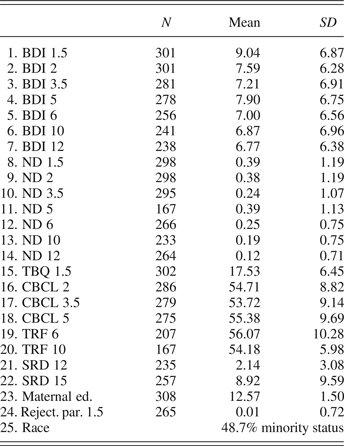
Descriptive statistics for Pitt Mother & Child Project (Study 1)

Note: We provide t scores in presenting descriptive statistics for the Child Behavior Checklist (CBCL) externalizing, although raw scores were used for testing hypotheses in models to avoid potential age and gender corrections. BDI, Beck Depression Inventory; ND, neighborhood deprivation; TBQ, aggression subscale from the Toddler Behavior Questionnaire; CBCL, externalizing subscale from the CBCL; TRF, externalizing subscale from the Teacher Report Form; SRD, self-report of delinquency; Reject. par., rejecting parenting.
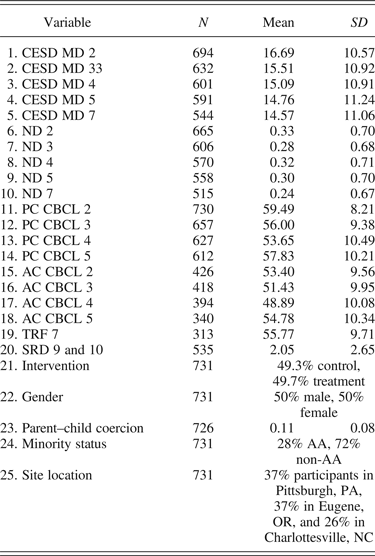
Descriptive statistics for Early Steps Multisite Study (Study 2)
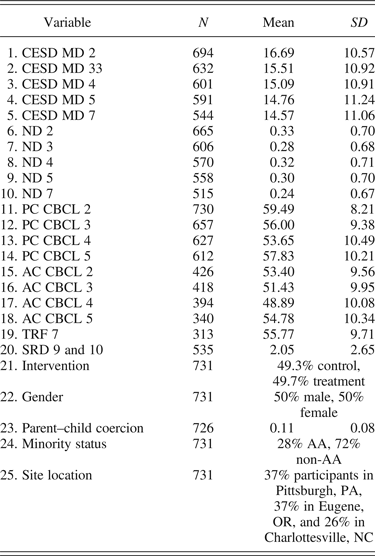
Note: We provide t scores in presenting descriptive statistics for the Child Behavior Checklist (CBCL) externalizing, although raw scores were used for testing hypotheses in models to avoid potential age and gender corrections. CESD, Center for Epidemiological Studies Depression Scale; MD, maternal depression; ND, neighborhood deprivation; PC, primary caregiver; CBCL, CBCL T-scores for the externalizing subscale; AC, alternative caregiver; TRF, Teacher Report Form externalizing subscale; SRD, self-report of delinquency; AA, African American.
At the time of the first assessment, the children (49% female) had a mean age of 29.9 months (SD = 3.2). Of the 731 families, 272 (37%) participants were recruited in Pittsburgh, 271 (37%) in Eugene, and 188 (26%) in Charlottesville. Across sites, primary caregivers self-identified as belonging to the following racial groups: 50% European American, 28% African American, 13% biracial, and 9% other groups (e.g., American Indian or Native Hawaiian). Thirteen percent of the sample reported being Hispanic. During the initial screening, more than two-thirds of the families enrolled in the project had an annual income of less than $20,000, and the average number of families members per household was 4.5 (SD = 1.63). Forty-one percent of the sample had a high school diploma or general education diploma, and an additional 32% had 1–2 years of post–high school training.
For the current study, data from assessments at ages 2, 3, 4, 5, 7.5, 9.5, and 10.5 were utilized. All assessments were conducted in the home with primary caregivers (PCs), children, and alternate caregivers (ACs), when available. PCs and ACs completed behavioral questionnaires at each visit, and data were also collected from teachers at age 7.5. In addition, the children completed behavioral questionnaires at ages 9.5 and 10.5. For a more detailed description of the home visit procedures, please see Dishion et al. (Reference Dishion, Shaw, Connell, Wilson, Gardner and Weaver2008). Following the baseline assessment at age 2, half the sample was randomly assigned to receive the Family Check-Up (FCU) intervention, a brief family intervention (see Dishion et al., Reference Dishion, Shaw, Connell, Wilson, Gardner and Weaver2008); intervention status was subsequently used as a covariate in analyses.
Of the 731 families who initially participated, 659 (90%) were available at the age 3 follow-up, 619 (85%) participated at the age 4 follow-up, 621 (85%) participated at the age 5 follow-up, 560 (77%) participated at age 7.5 follow-up, 585 (80%) participated at the age 9.5 follow-up, and 574 (78.5%) participated at the age 10.5 follow-up. Based on our interest in maternal depression, for purposes of the present study, we limited the sample to PC who were biological mothers of target children (96% of PC at age 2, 86% of PC at age 3, 80% of PC at age 4, 79% of PC at age 5, and 75% of PC at age 7.5). Data were also collected from AC when available at ages 2, 3, 4, and 5 (58% response rate at age 2, 57% at age 3, 62% at age 4, and 47% at age 5), and teacher reports of children's behavior were utilized at ages 7.5 (43% response rate at age 7.5). At ages 9.5 and 10.5, the target child also completed questionnaires regarding their behavior (70% available at age 9.5; 68% available at age 10.5). Because of high levels of missing child self-reports (70% available at age 9.5; 68% available at age 10.5), either report was used as the outcome when only 1 year was available. A mean of the two scores was used when data were available at both time points. This approach yielded 560 available cases (77%). Selective attrition analyses revealed no significant differences in project site, children's race or gender, levels of maternal depression, parent's report of children's externalizing behavior, or intervention status.
Measures
Mothers’ depressive symptomatology
Study 1
For the PMCP study, mothers completed the Beck Depression Inventory (BDI; Beck, Steer, & Garbin, Reference Beck, Steer and Garbin1988), a widely used measure of depressive states, during study assessments when their sons were 1.5, 2, 3.5, 5, 6, 10, and 12 years. Mothers rated the intensity of 21 symptoms and characteristics of depression on a 4-point Likert scale ranging from 0 (no symptomatology) to 3 (severe symptomatology). Responses were summed so that higher scores reflect higher levels of depressive symptoms (αs range = 0.83 to 0.90).
Study 2
For the ESMS study, at ages 2, 3, 4, 5, and 7.5 mothers completed the Center for Epidemiological Studies on Depression Scale (CES-D; Radloff, Reference Radloff1977), a well-established and widely used 20-item measure of depressive symptoms that was administered to mothers at each home assessment. Participants report how frequently they have experienced a list of depressive symptoms during the past week on a scale from 0 (less than a day) to 3 (5–7 days). Items are summed to create an overall depressive symptoms score (α range = 0.74 to 0.92).
Neighborhood deprivation (Studies 1 and 2)
For both studies one and two families’ residential addresses were geocoded to US Bureau of Census data at the block group level, which is the smallest unit for which the Census Bureau has available. The following census block group level variables were used to create a neighborhood disadvantage factor: median family income, % families below poverty, % households on public assistance, % unemployed, % single-mother households, and % bachelor degree or higher. Using all census block groups in the metropolitan area, variables were standardized and averaged (after reverse-scoring median family income and % bachelor degree; PMCP α = 0.88 and ESMS α = 0.85); the composite was then standardized (for more information see Winslow & Shaw, Reference Winslow and Shaw2007) such that higher scores reflect higher levels of neighborhood deprivation.
Problem behavior
Study 1
When the boys were 1.5 years of age, mothers completed the 103-item Toddler Behavior Checklist (Larzelere, Martin, & Amberson, Reference Larzelere, Martin and Amberson1989) to assess disruptive and emotional problem behavior. Mothers rated boys’ behavior in the past month on a 4-point scale. The Toddler Behavior Checklist does not include a broadband externalizing factor; therefore, the 14-item physical aggression subscale was used for these analyses (α = 0.75; sample items include “bites or kicks other children” and “jumps on furniture”).
Mothers completed the Child Behavior Checklist 2–3 (CBCL/2–3; Achenbach, Reference Achenbach1992) during study visits when their sons were 2 and 3.5 years of age and the CBCL/4–18 (Achenbach, Reference Achenbach1991a) when their son was 5 years of age. The broadband externalizing factor was used for the present study. The CBCL is a widely used parent-report measure of child adjustment problems in which parents of preschool-age children respond to items regarding their child's behavior within the past 2 months using a 3-point Likert scale ranging from 0 (not true at all) to 2 (very true or often true). Cronbach α for the externalizing factor at ages 2, 3.5, and 5 ranged from 0.85 to 0.88.
To minimize informant bias and to capture problem behaviors outside of the home context, the broadband externalizing factor of the Teacher Report Form (TRF; Achenbach, Reference Achenbach1991b) was used at ages 6 and 10 (αs = 0.96 and 0.95, respectively). The TRF is a widely used teacher-report measure of problem behavior that is completed by the classroom teacher and assesses the same factors of the CBCL in the classroom setting.
Finally, when boys were 12 years of age, they completed a modified version of the Self-Report of Delinquency (SRD; Eilliot, Huizinga, & Ageton, Reference Elliot, Huizinga and Ageton1985) that included 30 items to assess antisocial activity (α = 0.82). At age 15, boys completed the full SRD (62 items; α = 0.90). Both measures required boys to indicate the frequency in which they engaged in antisocial behaviors in the past year on a 3-point Likert scale (0 = never, 1= once or twice, 2 = more often). Sample items included “In the past year, have you have you gone into a building or tried to go into a building to steal something?” and “In the past year have you smoked marijuana?” At each age, a sum score was computed such that higher scores reflected more engagement in antisocial behavior.
Study 2
The CBCL for Ages 1.5–5 (CBCL; Achenbach & Rescorla, Reference Achenbach and Rescorla2001) was administered to PCs and ACs at ages 2, 3, 4, and 5. As with Study 1, the broadband externalizing factor was used for Study 2. The α values for PC reports ranged from 0.86 to 0.91 and for AC reports ranged from 0.87 to 0.91. Teachers completed the previously discussed TRF (Achenbach, Reference Achenbach1991b) at ages 7.5 (α = 0.86). The broadband externalizing factor was used for this study. Finally, when children were 9.5 and 10.5 years of age, they completed the previously discussed SRD (αs = 0.82 and 0.67 at ages 9.5 and 10.5, respectively).
Covariates
Study 1
Mother's self-report of educational attainment 1.5 years of age was included as a covariate. Target's minority status was dummy coded with European American = 0 and other races/ethnicities = 1. Finally, although the intention of this paper was not to examine parenting, parenting behaviors during early childhood have been found to be associated with maternal depression and children's problem behavior (Goodman et al., Reference Goodman, Rouse, Connell, Broth, Hall and Heyward2011). Therefore, rejecting parenting at 1.5 years was included as a covariate in the analyses. Maternal rejecting parenting was measured using the Early Parenting Coding System, which was designed to measure a range of parenting behavior typically exhibited in interactions with young children. The Early Parenting Coding System is an observational coding system consisting of nine categories of parenting strategies coded molecularly and also including six global ratings (Winslow & Shaw, Reference Winslow and Shaw1995). Molecular and global ratings were coded from videotaped mother–child interactions during a structured cleanup task at the 1.5-year lab assessment. For the purposes of the present study, only molecular and global ratings relevant to rejecting parenting were employed. These included two molecular ratings, verbal/physical approval and critical statement, and three global ratings, hostility, warmth, and punitiveness. For more detailed on the rejecting parenting variable, see Shaw et al. (Reference Shaw, Winslow, Owens and Hood1998).
Study 2
Study two included dummy coded covariates for child's gender (female = 1), minority status (European American = 0 and other races/ethnicities = 1), intervention status (control = 0, FCU = 1), site location (Eugene was reference group), and parent–child coercion at age 2. Parent–child coercion was generated using the affect coding system, which was calculated as the duration of time either parent or child being negatively engaged or directive, and the other member of the dyad responding by not talking, ignoring, negatively engaged, or directive divided that time by the overall session time to get a duration proportion score. Reliability coefficients were in the “good” to “excellent” range with overall κ scores of 0.93, and 93% agreement at age 2 (for more detail, see Sitnick et al., Reference Sitnick, Shaw, Gill, Dishion, Winter and Wallerin press).
Data analysis plan
Mplus 5.2 (Muthén & Muthén, Reference Muthén and Muthén2009) was utilized to conduct the structural equation modeling (SEM) for all analyses. Prior to testing SEM models, log transformations were conducted on any skewed variables to correct for their nonnormal distribution (i.e., problem behavior in Study 1 and neighborhood deprivation in Study 2). Missing data were determined to be missing at random as per recommendations by Shafer and Graham (Reference Shafer and Graham2002) for both studies.
For both studies, when testing the structural models, fully saturated SEM were tested initially that included direct pathways from all upstream variables to all downstream variables. Next, the hypothesized restricted models were tested such that pathways from children's behavior and mother's depression to neighborhood deprivation were not included. All models in Study 1 and Study 2 included within-time correlations of residual covariances among constructs. For instance, the correlations between the residual covariances among child CP, mother's depressive symptoms, and neighborhood deprivation at 2 years of age were freely estimated. In addition, all models included the previously discussed covariates for each study.
To accommodate missing and any skewed data, a maximum likelihood estimation with robust standard errors was used to estimate the structural models. To evaluate the fit of the structural models, several fit indices were used, including the chi-square goodness of fit statistic, the root mean square error of approximation (RMSEA; Browne & Cudeck, Reference Browne, Cudeck, Bollen and Long1992), and the comparative fit index (CFI; Bentler, Reference Bentler1990), all of which have been typically used as indices of practical fit. Finally, to test for indirect effects, the paths from the independent variables (neighborhood deprivation, mothers’ depression, and aggression) at Time 1 (age 1.5 for PMCP and age 2 for ESMS) were freed and estimated. Bootstrapping was used to test for indirect effects (Mackinnon, Lockwood, & Williams, Reference Mackinnon, Lockwood and Williams2004).
Results
Study 1: PMCP
Tables 1 and 2 provide descriptive data for all study variables for the PMCP and ESMS, respectively. Because eligibility criteria included elevated rates of maternal depressive symptoms (or history of substance use problems) and child CP, we anticipated that rates of these variables would be higher in the ESMS than the PMCP. Although different scales were used to assess maternal depressive symptoms (i.e., BDI in PMCP vs. CES-D in ESMS), as cut scores are reasonably comparable (i.e., 16 for CES-D and 16–20 for the BDI for clinical cut points), scores were appreciably higher at baseline and thereafter for mothers in the ESMS relative to those in the PMCP (e.g., M = 16.75 at age 2 and 14.56 at age 7.5 in ESMS vs. M = 7.59 at age 2 and 7.00 at age 6 in PMCP). Neighborhood deprivation scores were more comparable across samples, because both cohorts were recruited from WIC based on their financial criteria. The t scores are presented for the CBCL and TRF externalizing scores to better evaluate their comparability across studies. As expected based on study inclusion criteria, mothers in the ESMS rated children higher on the externalizing scale than mothers in the PMCP (M t score at age 2 for ESMS = 59.49 vs. 54.71 in PMCP). However, by age 5 the gap between the two samples was narrower (M = 57.83 in ESMS vs. 55.38), perhaps reflecting the all-male sample of the PMCP (sex differences emerge around age 4; Keenan & Shaw, Reference Keenan and Shaw1997) and their exclusive urban location. It is also worth noting that CBCL externalizing scale scores at age 2 were lower for alternative caregivers in the ESMS sample than both maternal ratings in the ESMS and the PMCP (i.e., M = 53.40 at age 2), but more comparable to both by age 5 (M = 54.78). During middle childhood, teacher and youth reports of CP (TRF externalizing) and more covert antisocial behavior (SRD) were comparable across samples (M for TRF externalizing t score = 56.07 at age 6 for PMCP vs. 55.68 at age 7 for ESMS; M = 2.14 for SRD at age 10 in PMCP vs. 2.04 at ages 9.5/10.5 in ESMS).
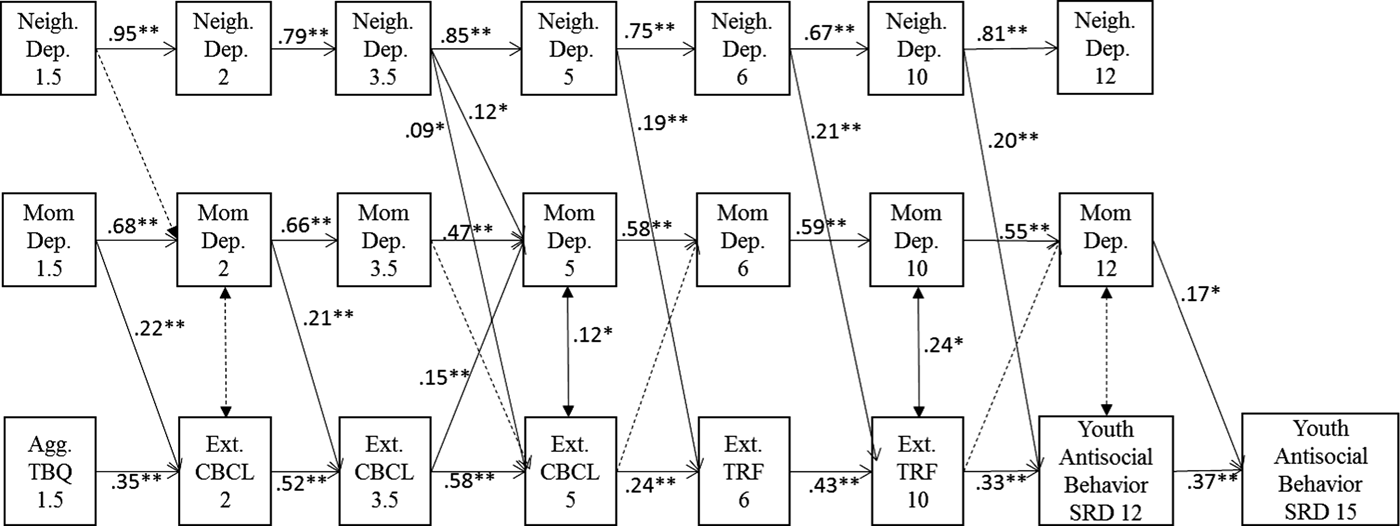
The final structural model for the PMCP data is presented in Figure 1. Fit statistics indicated an acceptable fit to the data (i.e., CFI = 0.91, RMSEA = 0.06). Pathways from the early neighborhood deprivation variable to subsequent neighborhood variables were significant and positive (βs = 0.64–0.95, p < .01) as were pathways from earlier mother's depressive symptoms to subsequent maternal depressive symptoms (βs = 0.47–0.68, p < .01). Likewise, pathways from early child CP to subsequent CP were positive and significant (βs = 0.24–0.58, p < .01) even when pathways were to a new informant (i.e., parent's report of child CP at age 5 to teacher report on TRF CP at age 6 and teacher report of TRF CP at age 10 to youth report of antisocial behavior at age 12). Further, significant positive pathways were evident from mother's depressive symptoms at age 1.5 to child CP at 2 years (β = 0.22, p < .01), from mother's depressive symptoms at age 2 to CP at age 3.5 (β = 0.21, p < .01), and from mother's symptoms at age 12 to youth report of antisocial behavior at age 15 (β = 0.17, p < .05). Significant positive pathways were also evident from neighborhood deprivation at age 3.5 to mother's report of CP at age 5 (β = 0.09, p < .05), from neighborhood deprivation at age 5 to teacher report of CP at age 6 (β = 0.19, p < .05), neighborhood deprivation at age 6 to teacher report of CP at age 10 (β = 0.21, p < .01), and neighborhood deprivation at age 10 to youth report of antisocial behavior at age 12 (β = 0.19, p < .05). Child effects of CP at age 3.5 on mother's depressive symptoms at 5 were also evident (β = 0.15, p < .05) as were effects on neighborhood deprivation at age 3.5 to maternal depression at age 5 (β = 0.12, p < .05).
Transactional effects between neighborhood deprivation, maternal depression, and child disruptive behaviors in Study 1. Only significant and trend-level pathways are shown for visual simplicity (including concurrent correlations). Nonstandardized beta weights are shown. Neigh. Dep., Neighborhood deprivation; Mom Dep., mother's depressive symptomatology; Agg. TBQ, aggression subscale from the Toddler Behavior Questionnaire; Ext. CBCL, externalizing subscale from the Child Behavior Checklist; Ext. TRF, externalizing subscale from the Teacher Report Form; SRD, self-report of delinquency. Covariates rejecting parenting at 1.5, mother's education, and minority status are included in the analyses. Dashed lines indicate p < .10. *p < .05. **p < .01.

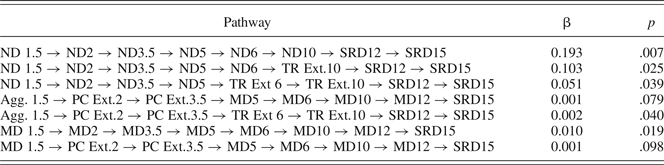
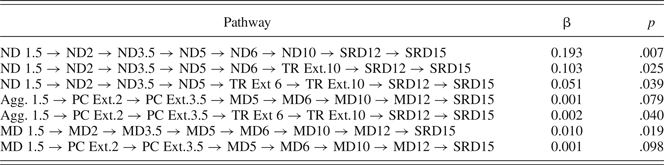
Analyses of indirect effects are shown in Table 3. Significant indirect effects were evident for mother's depressive symptoms (β = 0.010, p < .05), neighborhood deprivation (β = 0.193, p < .01), and boy's CP (β = 0.002, p < .05) at age 1.5.
Analyses of indirect effects for Pitt Mother and Child Project (Study 1)
Note: ND, Neighborhood deprivation; SRD, self-report of delinquency; TR, teacher report; Agg., aggression; Ext., externalizing; PC, primary caregiver report; MD, maternal depression.
Study 2: ESMS
Bivariate correlations among all study variables suggested moderate to high stability of each longitudinal study construct. The adjacent scores of maternal depressive symptoms (rs = .42–.56) and neighborhood deprivation (rs = .71–.84) were positively and significantly correlated with one another. Primary caregiver reports of child CP (age 2, 3, 4, and 5) were positively and significantly correlated with one another (rs = .60–.69, p < .01). In addition, maternal reports of child CP at age 5 were positively and significantly correlated with teacher reports of CP at age 7.5 (r = .40, p < .01); teacher reports of child CP at age 7.5 were positively and significantly correlated with youth reports of antisocial behavior at ages 9.5 and 10.5 (r = .30, p < .01). There was also evidence of cross-lagged pathways. Maternal depressive symptoms were positively correlated with subsequent maternal reports of child CP (rs = .23–.32) and maternal reports of CP were positively correlated with subsequent maternal depressive symptoms (rs = .25–.32). Finally, neighborhood deprivation at age 7.5 was positively correlated with youth reports of antisocial behavior at ages 9.5 and 10.5 (r = .15, p < .05).
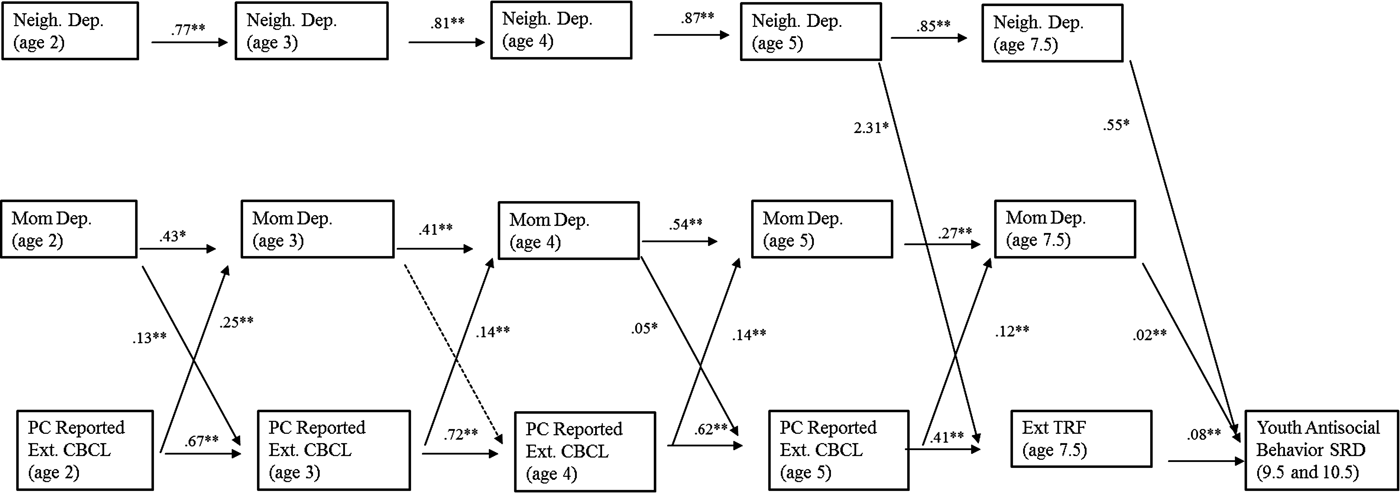
The final structural model is presented in Figure 2. Fit statistics indicated a good fit to the data (i.e., CFI = 0.96, RMSEA = 0.05). Pathways from early to later indices of neighborhood deprivation were significant and positive (βs = 0.77–0.87, p < .01) as were pathways from earlier to subsequent assessments of mother's depressive symptoms (βs = 0.27–0.54, p < .01). Likewise, pathways from early child to later CP/antisocial behavior were significant (βs = 0.08–0.72, p < .01), even when pathways were to a new informant (i.e., teacher and youth reports).
Transactional effects among neighborhood deprivation, maternal depression, and primary caregiver reported child disruptive behaviors in Study 2. Only significant and trend-level pathways are shown for visual simplicity (including concurrent correlations). Nonstandardized beta weights are shown. Neigh. Dep., Neighborhood deprivation; Mom Dep., mother's depressive symptomatology; PC Reported Ext. CBCL, primary caregiver reported externalizing subscale from the Child Behavior Checklist; Ext. TRF, externalizing subscale from the Teacher Report Form; SRD, self-report of delinquency. Covariates intervention, gender, parent–child coercion, minority status, and site location were included in all analyses. *p < .05. **p < .01.

Transactional relations between maternal depression and maternal reports of child CP were modest over time. However, significant positive pathways were evident from mother's depressive symptoms at age 2 to child CP at 3 years (β = 0.13, p < .01), from mother's depressive symptoms at age 4 to child CP at age 5 (β = 0.05, p < .05), and from mother's depressive symptoms at age 7.5 to youth reports of antisocial behavior at ages 9.5 and 10.5 (β = 0.02, p < .01). Further, significant positive pathways were evident from maternal reports of child CP at age 2 to mother's depressive symptoms at age 3 (β = 0.25, p < .01), from child CP at age 3 to mother's depressive symptoms at age 4 (β = 0.14, p < .01), from child CP at age 4 to mother's depressive symptoms at age 5 (β = 0.14, p < .01), and from child CP at 5 to mother's depressive symptoms at 7.5 (β = 0.12, p < .01).
Transactional relations between neighborhood deprivation and child CP and antisocial behavior were evident once children reached school age. There were significant positive pathways from neighborhood deprivation at age 5 to teacher reports of child CP at age 7.5 (β = 2.31, p < .05), and from neighborhood deprivation at age 7.5 to youth reports of antisocial behavior at ages 9.5 and 10.5 (β = 0.55, p < .05).
Significant effects were also evident between covariates and the three primary variables of interest in the model. Although not a focus of the study, we identified one consistent intervention effect. Consistent with a previously published paper using our data set (Shaw, Dishion, et al., Reference Shaw, Gross, Moilanen and Sameroff2009), assignment to the FCU intervention significantly predicted fewer maternal depressive symptoms at age 3 (β = 0.62, p < .05). In addition, at age 2 African American children were more likely to live in areas with higher levels of neighborhood deprivation (β = 0.15, p < .05). Consistent with prior research showing that parenting behaviors during early childhood have been found to be associated with maternal depression, parent–child coercion at age 2 was positively related to maternal depressive symptoms at age 3 (β = 13.69, p < .05). Finally, being female was a significant predictor of lower levels of teacher reports of child CP at age 7.5 (β = –4.30, p < .05) and youth reports of antisocial behavior at ages 9.5 and 10.5 (β = –0.54, p < .05).
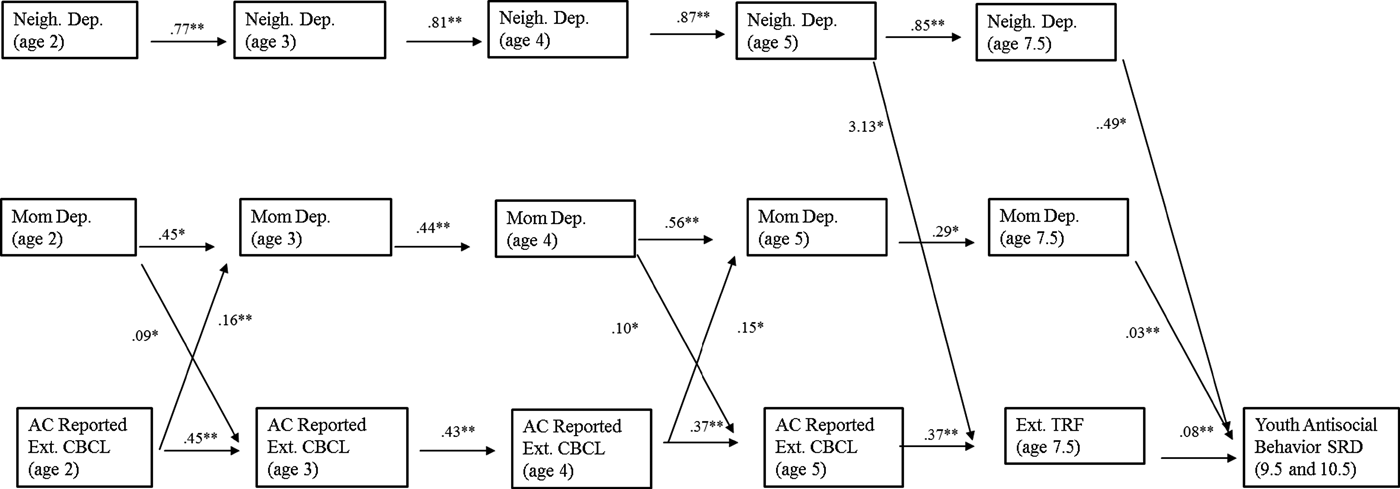
To minimize the potential for informant bias (Fergusson et al., Reference Fergusson, Lynskey and Horwood1993), the models were recomputed using alternative caregiver's reports of child CP at ages 2, 3, 4, and 5. The final structural model for the analyses using alternative caregiver reports of child CP suggested lower but moderately high stability of child CP over time for alternative caregiver reports of CP (βs = 0.37–0.45 for alternative caregiver reports on CBCL externalizing vs. 0.62–0.72 for mothers; βs = 0.37 vs. 0.41 between alternative caregiver vs. maternal reports of CP to teacher reports of CP from ages 5 to 7.5). The lower stabilities from ages 2 to 5 likely reflect the higher degree of change in informant among alternative caregivers versus maternal ratings.
There were fewer transactional relations between maternal depression and child CP in models using alternative caregiver reports of child CP than in models using maternal reports (Figure 3). Significant positive pathways were evident from mother's depressive symptoms at age 2 to alternative caregiver reports of CP at 3 years (β = 0.09, p < .01), from mother's depressive symptoms at age 4 to alternative caregiver reports of CP at age 5 (β = 0.10, p < .01), and from mother's symptoms at age 7.5 to youth reports of antisocial behavior at ages 9.5 and 10.5 (β = 0.03, p < .01). Further, significant positive pathways were evident from alternative caregiver reports of child CP at age 2 to mother's depressive symptoms at age 3 (β = 0.16, p < .01) and from alternative caregiver reports of child CP at age 4 to mother's depressive symptoms at age 5 (β = 0.15, p < .01).
Transactional effects among neighborhood deprivation, maternal depression, and alternative caregiver reported child disruptive behaviors in Study 2. Only significant and trend-level pathways are shown for visual simplicity (including concurrent correlations). Nonstandardized beta weights are shown. Neigh. Dep., Neighborhood deprivation; Mom Dep., mother's depressive symptomatology; AC Reported Ext. CBCL, alternative caregiver reported externalizing subscale from the Child Behavior Checklist; Ext. TRF, externalizing subscale from the Teacher Report Form; SRD, self-report of delinquency. Covariates intervention, gender, parent–child coercion, minority status, and site location were included in all analyses. *p < .05. **p < .01.

Transactional relations between neighborhood deprivation and alternative caregiver reports of child CP were similar to the models using maternal reports; there were no significant findings.
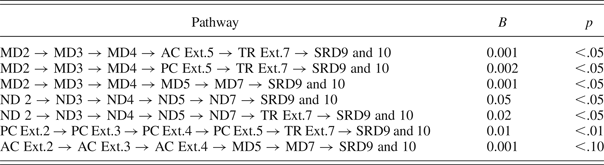
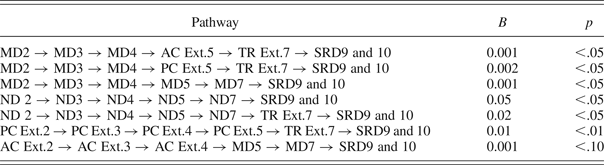
Analyses of indirect effects for models with AC and PC reports of child CP are shown in Table 4. Significant or trend-level indirect effects were evident for mother's depressive symptoms (β = 0.001, p < .05), neighborhood deprivation (β = 0.05, p < .05), AC reports of child CP (β = 0.001, p = .07) at age 2, and PC reports of child CP (β = 0.01, p < .01).
Analyses of indirect effects for Early Steps Multisite Study (Study 2)
Note: MD, Maternal depression; AC, alternative caregiver; Ext., externalizing; TR, teacher report; SRD, self-report of delinquency; PC, primary caregiver report; ND, neighborhood deprivation.
Discussion
The current study extends past research on transactional processes between maternal depression and early-emerging child CP and antisocial behavior by including neighborhood deprivation as measured from early childhood through early adolescence. We used two samples of predominantly low-income families, for whom rates of maternal depressive symptoms and child CP have been found to be higher than in higher SES families beginning during early childhood. Overall, there was some support for hypotheses on the predicted timing of transactional associations among maternal depression, neighborhood deprivation, and child CP/antisocial behavior across the two samples.
In the PMCP, consistent with hypotheses and theoretical expectations (Goodman & Gotlib, Reference Goodman, Rouse, Connell, Broth, Hall and Heyward2011; Shaw & Shelleby, Reference Shaw and Shelleby2014), evidence of associations between maternal depressive symptoms and the next assessment of child CP was found repeatedly during the toddler period and during early adolescence, with some corroboration of these effects when either teacher or youth reports of CP/antisocial behavior were used at ages 10 and 15. Longitudinal child effects on maternal depression were only seen during early childhood from age 3.5 to age 5, with concurrent effects at ages 2, 5, and 10, and longitudinal trends from 3.5 to 5 and 10 to 12. Only one statistically reliable association was found between neighborhood deprivation and subsequent maternal depression (although a marginal trend was also identified from ages 1.5 to 2), during the preschool period where it is possible that mothers living in an urban context might begin to feel more “trapped” with their sons because of safety concerns about spending more time in the neighborhood with offspring. However, beginning at age 3.5 and continuing at ages 5, 6, and 10, statistically reliable cross-lagged effects were evident between neighborhood deprivation and later child CP/antisocial behavior across teacher and youth reports.
The findings from the ESMS were used to extend the findings to girls and to rural and suburban communities, as well as to minimize potential reporter informant bias by having alternative caregivers report on child CP during early childhood. At a broad level, many of the findings from the PMCP were replicated, with some important differences largely in the consistency of the covariation between maternal reports of early child CP and later maternal depression. Once again, maternal depression was associated with subsequent child CP at two time points in early childhood and beginning in the toddler period. Somewhat consistent with the findings from the PMCP as well, a later assessment of maternal depression was linked to youth reports of antisocial behavior at ages 9.5/10.5. Extending findings from the PMCP, maternal depression effects on later child CP were corroborated by alternative caregiver reports of child CP during early childhood. Conversely, while child effects on maternal depression were found on four occasions in the ESMS using maternal reports of child CP from early to middle childhood, only two of these four transactional associations were evident when alternative caregiver reports of child CP were used, perhaps reflecting the influence of maternal reporting bias and the high level of maternal depressive symptoms in the ESMS (i.e., mothers would be more affected by their own vs. the alternative caregiver's perceptions of child CP; see Fergusson et al., Reference Fergusson, Lynskey and Horwood1993). Finally, replicating the pattern of findings in the PMCP, neighborhood effects on subsequent child CP and antisocial behavior were consistently found in the ESMS beginning at age 5 across teacher and youth reports. However, unlike the PMCP, no evidence emerged linking neighborhood deprivation to later maternal depressive symptoms. More closely following up on the association found from ages 3.5 to 5 in the PMCP, we also explored the possibility that the relation between neighborhood deprivation and subsequent maternal depression would be found only in the ESMS Pittsburgh subsample or only among boys in the ESMS Pittsburgh sample; however, neither path was significant. Thus, within the ESMS sample, including the Pittsburgh subsample, no gender effects were evident.
Transactional associations between maternal depression and child problem behavior
Despite accounting for the influence of early rejecting/coercive parenting, parent education, minority status, and in the ESMS, both site and intervention status, as well as using an analytic design in which earlier autoregressive and cross-lagged paths are accounted for in the model, some convergent patterns emerged across the two samples. With respect to covariation between maternal depressive symptoms and child CP/antisocial behavior, in both studies significant paths were identified at both the initial and final assessment of maternal depression. The initial association found between maternal depression and later child CP was not surprising, because both studies were initiated during the “terrible twos” (Shaw & Bell, Reference Shaw and Bell1993). However, it should be noted that in both studies such an effect was present after accounting for concurrent observations of negative parent–child interaction. Furthermore, the association from maternal depression to subsequent child CP continued to be present in the ESMS when alternative caregiver reports of child CP were used, suggesting the validity of maternal reports of child CP in the ESMS and possibly the PMCP.
That the final assessment of maternal depression was also associated with later youth reports of more covert types of antisocial behavior is also intriguing, in part based on the model's conservatism, which accounted for four to six previous assessments of maternal depression and child CP in the studies. Because the final assessment of maternal depression occurred at age 12 in the PMCP, it was not surprising to see relations with boys’ antisocial behavior at age 15, based on the challenges for youth and parents during adolescence and how compromises in maternal well-being might adversely impact parental monitoring of youth activity and important decisions parents make for offspring well-being during this period (Dahl, Reference Dahl2001; Dishion & McMahon, Reference Dishion and McMahon1998; Shaw & Shellby, Reference Shaw and Shelleby2014). The link to youth antisocial behavior during adolescence might be particularly salient for depressed mothers and boys living in impoverished urban settings. Based on earlier reports from the PMCP, we know that during early childhood, depressed mothers were more likely to move into or remain in higher risk neighborhoods, placing offspring in higher risk contexts (Winslow & Shaw, Reference Winslow and Shaw2007). We also suspect that depressed mothers are less active in monitoring their children's activities with peers. A related issue is whether children who live with a depressed parent and live in a high-risk neighborhood are uniquely at risk for an early-starting antisocial trajectory, an issue we intend to examine in both samples in future reports.
Despite the last assessment of maternal depression occurring much earlier in the ESMS (age 7.5 vs. age 12 in PMCP), associations between maternal depression and youth reports of covert antisocial behavior were also evident at ages 9.5 and 10.5, at least 4 years earlier than found in the PMCP. We suspect that the earlier “arrival” of the association between maternal depression and child antisocial behavior in the ESMS might reflect the higher risk status of children and mothers. Although differences in rates of child CP dissipated from early to middle childhood across samples, levels of maternal depression continued to remain higher in the ESMS. Based on the 10-year difference in when the samples were recruited and the increasing disparities between middle and lower income families in the United States during this period, it is also possible that cohort effects were operative, increasing the likelihood of earlier antisocial behavior in the ESMS sample. The earlier onset of later associations between maternal depression and child antisocial behavior was also consistent with the greater consistency of seeing child effects on maternal depression in the ESMS relative to the PMCP when maternal reports of child problem behavior were used in the ESMS. Again, we suspect that this occurred because of the higher levels of maternal depression and child CP (and greater variability in scores) reported on by mothers in the ESMS during early childhood.
In addition to replicating past work demonstrating associations between maternal depression and later child CP (Cummings et al., Reference Cummings, Keller and Davies2005; Goodman & Gotlib, Reference Goodman and Gotlib1999; Gross et al., Reference Gross, Shaw, Burwell and Nagin2009; Kouros & Garber, Reference Kouros and Garber2010; Weinfield, Ingerski, & Moreau, Reference Weinfeld, Ingerski and Moreau2009), the current findings from both samples are also in accord with prior research suggesting that there are child effects on later maternal depressive symptoms (Gross et al., Reference Gross, Shaw, Moilanen, Dishion and Wilson2008; Nicholson, Deboeck, Farris, Boker, & Borkowski, Reference Nicholson, Deboeck, Farris, Boker and Borkowski2011; Raposa, Hammen, & Brennan, Reference Raposa, Hammen and Brennan2011; Shaw, Gross, et al., Reference Shaw, Gross, Moilanen and Sameroff2009). In terms of developmental timing, the findings also are consistent with theory and prior research indicating the vulnerabilities toddlers have for developing CP in the context of maternal depression (Connell & Goodman, Reference Connell and Goodman2002; Cummings & Davies, Reference Cummings and Davies1994; Shaw, Bell, & Gilliom, Reference Shaw, Bell and Gilliom2000), and the influence toddlers have in increasing subsequent levels of maternal depressive symptoms (Shaw & Bell, Reference Shaw and Bell1993; Goodman & Gotlib, Reference Goodman and Gotlib1999). It should be noted that across studies, child effects on maternal depression were more consistently evident during the preschool period (and across informant of child CP in the ESMS), perhaps reflecting the higher levels of CP and maternal depression in the ESMS, and the exclusive focus on boys living in an urban location in the PMCP. Note neighborhood effects on maternal depression were also found in the PMCP from ages 3.5 to 5.
Neighborhood deprivation and parent and child behavior
Perhaps the most consistent finding across the two studies was the independent associations between census-derived indices of neighborhood deprivation and both teacher and youth reports of CP and antisocial behavior beginning at age 5 in the ESMS and age 3.5 in the PMCP. In both studies, despite accounting for autoregressive effects and prior cross-lagged effects, neighborhood deprivation at subsequent time points continued to account for unique variance in predicting subsequent child CP and antisocial behavior. The timing and consistency of these effects are quite consistent with previous research in this area (Beyers et al., Reference Beyers, Bates, Pettit and Dodge2003; Brooks-Gunn et al. Reference Brooks-Gunn, Duncan, Aber, Brooks-Gunn, Duncan and Aber1997; Coley et al., Reference Coley, Morris and Hernandez2004; Ingoldsby et al., Reference Ingoldsby, Shaw, Winslow, Schonberg, Gilliom and Criss2006; Wikstrom & Loeber, Reference Wikstrom and Loeber1999; Xue et al., Reference Xue, Leventhal, Brooks-Gunn and Earls2005), including research indicating an earlier independent association appearing in high-risk, urban communities (Kohen et al., Reference Kohen, Brooks-Gunn, Leventhal and Hertzman2002; Supplee et al., Reference Supplee, Unikel and Shaw2007; Xue et al., Reference Xue, Leventhal, Brooks-Gunn and Earls2005). The consistent pattern of neighborhood to CP/antisocial behavior findings have critical implications for prevention and intervention efforts. Although we cannot unpack the precise mechanisms underlying such associations based on the multiple acute and chronic stressors associated with living in lower income communities (e.g., higher rate of exposure to deviant peers and adults, poorer school and community resources, and greater exposure to environmental toxins), the current results suggest that independent of parent adjustment and child CP, as well as very early measures of parenting, parental education, and community type, living in deprived neighborhoods provides an independent source of variance in predicting CP and more covert and serious types of antisocial behavior during middle childhood and adolescence. Moreover, neighborhood deprivation at subsequent ages continues to account for independent variance in children's later CP/antisocial behavior after accounting for prior levels of family, child, and neighborhood risk. Specifically, findings suggest that interventions that seek to prevent and or treat child CP and antisocial behavior in low-income communities by targeting family process issues, such as parenting management or parent adjustment, also may wish to account for the family's neighborhood context. As an example, using the current ESMS, Shaw et al. (Reference Shaw, Sitnick, Brennan, Choe, Dishion and Wilsonin press) recently found that intervention effects of the FCU on child CP at ages 9.5 were moderated by neighborhood deprivation, with intention-to-treat effects only evident for the two thirds of families living in lower income but not the most extremely deprived communities. However, among families randomly assigned to the intervention group who demonstrated improvements in positive parent–child interaction between ages 2 and 3, indirect effects on child CP were found. These results suggest not only the importance of family's neighborhood context but also the potential malleability and longer term potential of modifying family dynamics in early childhood. Intervention programs that are tailored to family's specific contextual needs, especially those families living in poverty, such as multisystemic family therapy (Henggeler, Schoenwald, Borduin, Rowland, & Cunningham, Reference Henggeler, Schoenwald, Borduin, Rowland and Cunningham1998) and the FCU (Dishion & Stormshack, Reference Dishion and Stormshak2007), are recommended.
Limitations
Although the current study offers several methodological strengths, including the focus on two samples of low-income families with a substantial number of mothers and children with clinically meaningful levels of maternal depression and/or child CP, prospective longitudinal designs spanning 8.5 to 13.5 years, the use of multiple methods and informants, as well as comparable measurement of critical variables across studies, it also includes a few important methodological limitations. First, whereas both samples were ethnically and racially diverse, with the ESMS including male and female children, the generalizability of the findings could be limited to low-income families living in urban, rural, and suburban communities. The current findings will need to be replicated among higher SES populations before firmer conclusions about their validity across SES can be drawn.
Second, the current study focused exclusively on maternal depression versus other aspects of the home environment (e.g., marital quality or parental social support) or paternal depression. Regarding the latter, it is quite possible that a different picture might emerge in examining associations between maternal depression and neighborhood deprivation and child CP/antisocial behavior after incorporating paternal well-being into analyses. Unfortunately, paternal assessments of depressive symptoms were not included in the PMCP, and although we attempted to obtain such data in the ESMS, data on paternal depression and those of other alternative caregivers were only available for a minority of families. As recent studies suggest the independent contribution of paternal depression in relation to child CP during early childhood (Ramchandani et al., Reference Ramchandani, Domoney, Sethna, Psychogiou, Vlachos and Murray2013; Taraban et al., Reference Taraban, Shaw, Reiss, Neiderhiser, Leve and Conger2015), future research should account for both maternal and paternal depression in studying risk factors for early child CP. A related point is that although we did account for initial levels of rejecting or coercive parenting in modeling transactional processes in both samples, it is likely that a complementary story unfolds among parental depression, parenting (i.e., coercive parent–child interaction), and emerging child CP. Although this issue is beyond the scope of the current paper, results from an ongoing study using data from the ESMS sample suggest similar transactional patterns across these three factors across early childhood, with early parent–child coercion leading to increases in maternal depression, which in turn lead to increases in both parent–child coercion and child CP (Reuben, Dishion, Wilson, Gardner, & Shaw, Reference Reuben, Dishion, Wilson, Gardner and Shaw2015).
Third, while maternal and alternative caregiver reports on child CP were available during early childhood in the ESMS, and teacher and youth reports of problem behavior were used in middle childhood and adolescence in both studies, we relied solely on maternal reports of child CP in the PMCP during early childhood. Some corroboration of findings was found across informant of child CP in the ESMS during early childhood; nevertheless, the current results from the ESMS and extant research (Burt et al., Reference Burt, Van Dulmen, Carlivati, Egeland, Sroufe and Forman2005; Goodman et al., Reference Goodman, Rouse, Connell, Broth, Hall and Heyward2011) suggest that relying on the same informant (and method) to assess maternal depression and child CP in the PMCP likely inflated the magnitude of associations.
Fourth, a related limitation was the use of different measures to assess child CP and antisocial behavior across developmental periods. Although it was deemed critical to assess developmentally relevant child behavior and hence use developmentally appropriate instruments for toddlers, preschoolers, school-age children, and adolescents, it is possible that our age-specific findings were influenced by the use of different instruments and different informants (i.e., mothers, alternative caregivers, teachers, and youth) to assess child CP and antisocial behavior (e.g., CBCL, TRF, and SRD), as well as the different contexts in which child behavior was evaluated. For example, although consistent associations were found between neighborhood deprivation and both teacher and youth report of CP/antisocial behavior after age 5 across samples, it is possible that such age effects were also influenced by the use of a different measure, informant (i.e., mothers vs. alternative caregivers), and context (i.e., home vs. school). Because teacher reports of child behavior were based on a very similar set of items as parents, using the externalizing factor of the TRF and CBCL, respectively, and were corroborated by youth reports of antisocial behavior, we tend to think that such age differences are valid, albeit still impacted by the child's context.
Fifth, although we utilized census-based data to assess neighborhood deprivation to minimize maternal reporting and method bias, utilizing parent perceptions of neighborhood deprivation or other neighborhood factors likely to impact maternal well-being (e.g., perceived dangerousness) likely would have resulted in stronger associations between neighborhood risk and maternal depression. We intend to investigate this issue in future work with both samples.
Conclusions
Despite these important caveats, the current study extends our understanding of transactional processes among maternal depression, neighborhood deprivation, and child CP/antisocial behavior from early childhood through early adolescence. After accounting for initial levels of negative parenting, independent and reciprocal effects between maternal depressive symptoms and child CP/antisocial behavior were evident across two samples of low-income children beginning in early childhood and continuing through middle childhood and adolescence. In addition, neighborhood effects were consistently seen in both samples after children reached age 5, with earlier neighborhood effects on child CP and maternal depression in the exclusively urban sample of mother–son dyads. The results confirm prior research on the independent contribution of maternal depression and child CP to the maintenance of both problem behaviors, and also suggest the need to account for family's broader ecological context when designing and implementing interventions to address emerging child CP in low-income populations.