Introduction
In the absence of partisan ownership of an issue, what factors shape public preferences for federal, state and local policy responses to a public problem? Much prior research has examined citizen policy preferences for federal, state and local action in a variety of policy areas (Cantril and Cantril Reference Chang1999; Schneider and Jacoby Reference Schneider, Jacoby and Lewis2003; Brewer Reference Bulman-Pozen2004; Cole and Kincaid Reference Dredze, Broniatowski and Hilyard2006; Konisky Reference Mechanic2011). However, many of these studies examine policy areas in which partisan ownership of certain policy responses is fairly well established. The Zika virus is a relatively new threat to the mainland United States (US), and is a public problem for which the two major parties have not claimed partisan ownership over certain policy tools. In addition, policy actors are in the early stages of crafting potential responses to the Zika virus, yet we have little knowledge of public preferences regarding Zika policy. Specifically, which policy actors do citizens want to take responsibility for protecting the public from the spread of the Zika virus, and which policy tools should they use to do this?
The Zika virus is characterised by mostly mild symptoms; most people with the virus are unaware that they have been infected. Nonetheless, the virus is a noteworthy public health threat given that expectant mothers can spread the virus to their fetuses causing serious neurological birth defects, most significantly microcephaly. Currently, there is no vaccine, nor a known cure, for the Zika virus. In early 2016, the virus spread rapidly through South America, and during that summer the US Centers for Disease Control confirmed the first local transmissions of the virus within the mainland US in Miami, FL. In 2016, there were nearly 42,000 cases of Zika reported in the US and US Territories.Footnote 1 Given the significant threat to human health, the federal, state and local governments have scrambled to develop policy responses to protect the public from the spread of Zika.
The Zika virus and any policy responses to it offer a unique opportunity to study public preferences for policymaking, especially in the absence of partisan ownership of the issue. On the one hand, the Zika virus could be viewed as a standard public health issue – a new virus has developed and begun to spread that threatens public health, especially the health of pregnant women and the unborn. On the other hand, the Zika virus has some similarities to environmental problems in that the disease is highly mobile and has cross-jurisdictional effects. Many of the policy responses to Zika [such as the use of insecticides or genetically modified mosquitoes (GMMs)] have both environmental and public health repercussions.
In the fall of 2016, protestors took to Capitol Hill to express their concern over the lack of Congressional action to fund Zika prevention efforts (Rosen Reference Schneider and Jacoby2016). After several months of consideration and public calls for action, the federal government allocated $1.1 billion in Zika prevention and research funds.
State governments have largely focused on conducting research and public education campaigns. For example, in 2017, the Florida Department of Health funded 34 different research projects through the Zika Research Grant Initiative (Chang Reference Clinton and Grissom2017). The Texas Department of State Health Services tracks mosquito borne illness in the state and has released posters, fact sheets, and television and radio advertisements to educate citizens on how to prevent the spread of the virus (Texas Health and Human Services Reference Uslaner2018).
Local governments’ policy responses to the Zika virus include mosquito abatement activities and public education. However, these policy responses have not been without public controversy. After the first local transmissions, Miami-Dade County and the City of Miami instituted aerial spraying of the insecticide naled. Protesters repeatedly interrupted a subsequent Miami Beach city council meeting to express their anger over its use (Fox Reference Fox2016, Viglucci Reference Wlezien2016). In the Florida Keys, local governing bodies considered introducing FDA approved GMMs, intended to mate with and destroy the mosquitoes that spread Zika.Footnote 2 However, many Key West residents opposed the release of GMMs (Glenza 2016). Taken aback by the degree of resident pushback, the Florida Keys Mosquito Control District Board (FKMCDB) placed the issue on the November 2016 ballot as a nonbinding referendum seeking more information on public preferences.Footnote 3
Even though public officials fighting Zika are largely focussed on protecting public health,Footnote 4 public controversy arose over both the nature of some of the proposals (i.e. GMMs, aerial spraying, vaccines) and the speed at which policymakers took action to prevent a public health crisis (e.g. Congress took seven months to allocate funds for the Zika virus). While there has been some public controversy over proposed Zika policy responses, it is not clear if the public’s preferences for Zika policy action, specifically their assignment of policy responsibility to different levels of government, are shaped by partisanship or by other factors. Neither political party has claimed clear partisan ownership over specific Zika policy responses, making Zika an interesting case through which to examine how partisanship and other individual level factors influence public support for specific policy responses at various levels of government. We seek to examine three key research questions: (1) Which specific Zika policy responses do the public support? (2) Which level of government do citizens believe should bear the responsibility for protecting the public from the Zika virus, (3) and what explains that attribution of responsibility?
Building on prior studies that examine citizen preferences for various policy approaches to addressing specific public problems, we analyse survey data from the 2016 Cooperative Congressional Election Study (CCES) on which we included an extensive battery of questions to measure public attitudes toward Zika policy options, and the level(s) of government people hold responsible for instituting each of the options. The results show that the most popular policy responses to the Zika virus are information based policy responses, such as educating the public, travel warnings and research funding. In addition, the federal government is the most popular level of government to take policy action in response to the Zika virus. We also find that in the absence of elite partisan cues, individual partisanship has little impact on public preferences for one level of government (federal, state or local) to take policy action to address the Zika virus. Further, we find that preferences for one level of government over the others are not universal or consistent across a set of different policy proposals to address a single public problem, such as the Zika virus.
Public attitudes towards government and policy responsibility
For decades, the public’s policy preferences have interested scholars of policy, politics, public administration and mass opinion (Taylor-Gooby 1982; Jacoby Reference Kam and Mikos1988; Brewer Reference Bulman-Pozen2004; Schneider and Jacoby Reference Segall2013; Clinton and Grissom Reference Clinton and Grissom2015; Jennings and Wlezien Reference Kata2015; Reher Reference Rosen2016; Wlezien 2017; Broockman and Butler Reference Cahn2017; Oehl et al. 2017). Some scholars suggest that public opinion is largely a reflection of partisan elite opinions (Reference ZallerZaller 1992; Cavari and Freedman Reference Chanley, Rudolph and Rahn2019). Other scholars have found that individuals’ opinions may deviate from their party’s position if they are exposed to compelling policy information (Boudreau and MacKenzie Reference Broockman and Butler2014). However, in the absence of partisan ownership of an issue, it is unclear how a variety of factors, partisanship being one of them, impacts public attitudes towards policy options and policy responsibility at different levels of government. We examine this enduring debate in the context of Zika, an especially interesting case because in the absence of partisan ownership of particular policy responses to public problems it is unclear what factors impact how citizens assign policy responsibility to particular levels of government.
Numerous studies have examined which level of government the American public believes should be responsible for policy action in general, and in a variety of specific policy areas. Many scholars have concluded that citizens are rarely able to make meaningful distinctions between different levels of government; rather, they support or oppose certain policies regardless of the level of government implementing the policy (Soroka and Wlezien Reference Soroka and Wlezien2010; Jacobs Reference Jennings and Wlezien2017), perhaps lending support to the theory that partisan cues drive public preferences, rather than principled beliefs about federalism. Others have found that citizens prefer different levels of government to take on different roles (Conlan Reference Enns1993; Roeder Reference Salmon, Moulton, Omer, deHart, Stokley and Halsey1994; Konisky Reference Mechanic2011, Schneider et al. Reference Sharma, Yadav, Yadav and Ferdinand2011), suggesting that citizens do make meaningful distinctions between the policy responsibilities of different levels of government.
Public confidence in the federal, state and local governments has fluctuated over time; beginning in the early 1990s, more people said that local governments make better use of tax dollars than does the federal government (Shaw and Reinhart Reference Stimson, MacKuen and Erikson2001). Conlan (Reference Enns1993) finds that the public expresses the highest levels of confidence in the federal government when it comes to fighting drugs and addressing air pollution, though overall confidence in the federal government is declining over time. Conlan (Reference Enns1993) also finds that the public has more confidence in state and local governments (as opposed to the federal government) to improve schools and recycle trash, but he concludes that the public is “both ambivalent and divided over issues of federalism” (p. 5). Surveys in the early 2000s suggested the public has the highest level of confidence in the federal government, followed by state governments and local governments (Arceneaux Reference Bennett and Bennett2005).
Bennett and Bennett (1990) suggest that Americans have largely come to accept the ever-increasing role of the federal government in a variety of policy areas. Many scholars conclude that it is difficult to pinpoint preferred levels of government for defined policy areas. Schneider and Jacoby (Reference Schneider, Jacoby and Lewis2003) find that the public prefers national government action to state action by relatively close margins across a wide range of specific policy areas, and they conclude that public preference for policy action by the different levels of government depends on the issue (Schneider and Jacoby Reference Schneider and Jacoby2008). In his examination of nine different policy areas and public preferences for level of government action, Jacobs concludes “although citizens do not have any clear preference for government policymaking in many specific areas, they nevertheless want to see government policymaking” (Reference Jennings and Wlezien2017, 22).
However, others suggest that Americans do distinguish between different levels of government that should have the primary responsibility for specific policy areas (Roeder Reference Salmon, Moulton, Omer, deHart, Stokley and Halsey1994; Schneider et al. Reference Sharma, Yadav, Yadav and Ferdinand2011). The level of government that citizens prefer take policy responsibility can vary even within one specific policy area. For instance, in the realm of education policy, Cantril and Cantril (Reference Chang1999) find that citizens want the day-to-day operations of schools to be within the purview of local governments, but at the same time, they believe that states should make policy regarding teacher certification and financial assistance to schools. Examining public preferences for the level of government responsible for environmental policy action, Konisky (Reference Mechanic2011) finds variation in public support for various levels of government within the area of environmental policy.
In short, the previous literature strongly suggests that asking citizens which level of government they prefer in general or even within broad policy areas may not capture the nuance in public preferences for policy assignment that exists within policy areas. It is therefore imperative to understand the public’s views not only on whether they support particular policy approaches, but also on which level of government they believe should carry out those policies and the factors that shape those views. This may be doubly true in the case of Zika, in which the public health threat is both new and evolving, policy proposals are controversial, parties have not claimed ownership of the issue, and there is considerable uncertainty about how the disease will progress and spread in the future.
Much of the prior research on public preferences for government policy action examines only one level of government or a broad policy area, but not specific individual policy options available to multiple levels of government. As Konisky (Reference Mechanic2011) argues, studies that ask about broad policy areas (such as “environmental policy”) shed little light on how citizens’ views on specific policies can vary within a given policy area. For example, a citizen may support recycling programs but oppose a carbon tax, or may oppose a federal recycling program but support a local one. Asking citizens to identify support for broad policy areas does not closely mirror realistic policy debates in which legislators and regulators within specific levels of government consider specific policy proposals. For example, in the case of the Zika virus, if a citizen who supports funding for Zika research but strongly opposes the use of insecticides were asked whether she supports “policies to prevent the spread of Zika”, her response to this broader question would mask her true policy preferences for the policy proposals under consideration by lawmakers.
Past surveys often do not inquire into citizens’ preferences for which level of government they think should be responsible for each specific policy proposal that they support. Schneider and Jacoby (2012, 3013) argue that individuals may not use the term “federalism” but they do think intuitively about how policy responsibilities should be divided between different governments. Jacobs, however, argues that while citizens “do not appear to make any fine-grain distinctions between their various governments nor allocate responsibility among them” they do want to see some policymaking, regardless of policy actor (Reference Jennings and Wlezien2017, 592).
Our approach allows us to consider preferences for specific policy proposals rather than broad policy responsibility for one public problem more generally. We examine several different types of policies, including the use of regulations/fines, the use of education/informational campaigns, the funding of research and direct government provision of mosquito abatement services. Given the prior literature, we expect that there may be variations in support across these different policy actions, however, there is also reason to expect, especially given Jacob’s (Reference Jacobs2017) recent work, that citizens may not make meaningful distinctions when assigning responsibility for these different policies to different levels of government. Therefore, as the prior literature is divided, we have no expectation one way or the other as to which specific Zika abatement policies citizens will support and assign to each of the three levels of government.
We designed our survey questions to unambiguously examine the gradation in public support for a number of specific Zika policy responses across all three levels of government and to examine the factors that impact public preferences for Zika policy. In our analysis, we ask respondents about attitudes towards a broad range of policy options to address Zika and their attitudes about responsibility including both government and nongovernmental actors as potential responding parties.Footnote 5 These data contribute to the broader literature in political science and public policy by allowing us to examine the degree to which citizens make meaningful attributions of policy responsibility between the different levels of government and what individual characteristics shape those attributions. More specifically, given that much of the prior literature suggests that citizens support policies without much regard for the level of government responsible for that policy, examining this question in the case of a new public problem – the Zika virus – is a unique case to study.
To the degree that citizens express a preference for policy action by one level of government over another, the extant literature is primarily centered on partisan affiliation. Previous literature suggests that Republicans have a tendency to have more confidence in governments that they perceive as closer to the people, and thus are more likely to select local and state government to take policy action (Uslaner Reference Welsh and Pringle2001). Partisanship increasingly frames the debate over federal versus state action as these levels of government promote distinct partisan positions, leaving Americans to weigh their support of each level of government dependent on party affiliation, and those whose party is out of power in Washington are more likely to identify with state governments (Bulman-Pozen Reference Cantril and Cantril2013). With regard to the impact of ideology on the types of programs and policies an individual supports, research has suggested that liberals tend to favor higher levels of spending on social programs, including public health and hospitals, than conservatives (Feather Reference Gilens and Page1985; Kluegel and Smith Reference Kluegel and Smith2017; Kluegel Reference Konisky1990). Therefore, we expect that partisanship may impact overall support levels for these policies since they are all designed to improve and protect the public health.
While it is often assumed that the president is a proxy for federal government partisanship due to the president’s agenda setting and veto powers, there was divided government in 2016 with one party in control of the legislature and another the executive branch. This suggests that partisanship may have less of an impact on support for federal versus state or local action than we would expect during a period of unified partisan control of the federal government. Considering the prior research findings and that our survey data were collected in 2016, during which time President Obama, a Democrat, was in the White House, we still expect that Republicans are more likely to support state and local policy action to address the Zika virus, while Democrats are more likely to support federal government action.
Prior work in public health has shown that there has been a recent trend of decreasing public trust in health systems (Segall Reference Shaw and Reinhart2000; Mechanic Reference Mishler and Sheehan2001; Welsh and Pringle Reference Wlezien2001) which is problematic for policymakers and public health officials seeking to protect the public from viruses such as Zika because effective health care requires cooperation between the patient (or the public more broadly) and public health officials or health systems agents (Alford Reference Alford1993; Cahn Reference Cavari and Freedman1997). Level of trust in government and health care professionals is negatively associated with one’s likelihood of giving his or her child vaccines (Salmon et al. Reference Schneider and Jacoby2005) Trust in government also affects individuals’ preference for which level of government should take specific policy action (Schneider and Jacoby Reference Schneider, Jacoby and Lewis2003; Arceneaux Reference Bennett and Bennett2005; Kam and Mikos Reference Kelleher and Wolak2007; Mikos Reference Mikos2007). In general, trust is positively associated with a desire for government to take policy action (Hetherington and Nugent Reference Jacobs2001; Kelleher and Wolak Reference Kluegel and Smith2007). Lower levels of trust in government leads to lower levels of support for government committing public resources to achieve policy goals (Chanley et al. Reference Chanley, Rudolph and Rahn2000). As citizens grow increasingly distrustful of government, they exhibit increased support for the devolution of decisionmaking from the national to state governments (Hetherington and Nugent Reference Jacobs2001). Therefore, we expect that trust in government (measured as agreement with the statement that the government can be trusted most of the time) will be positively associated with both support for Zika policy action and support for policy action at the national level.
Data
We use data from the 2016 CCES Survey (Ansolabehere and Schaffner Reference Ansolabehere and Schaffner2017).Footnote 6 The survey was performed using a matched sampling technique, and the data are weighted to be nationally representative.Footnote 7 Each respondent answered questions regarding his or her overall concern about the Zika virus and his or her thoughts on different policy proposals designed to address it through policy action by different levels of government. Respondents were also asked questions to gather demographic information, including but not limited to partisanship, religiosity, education, age, race and gender. A table of descriptive statistics for all variables is included in the Appendix (Table A1).
Dependent variables
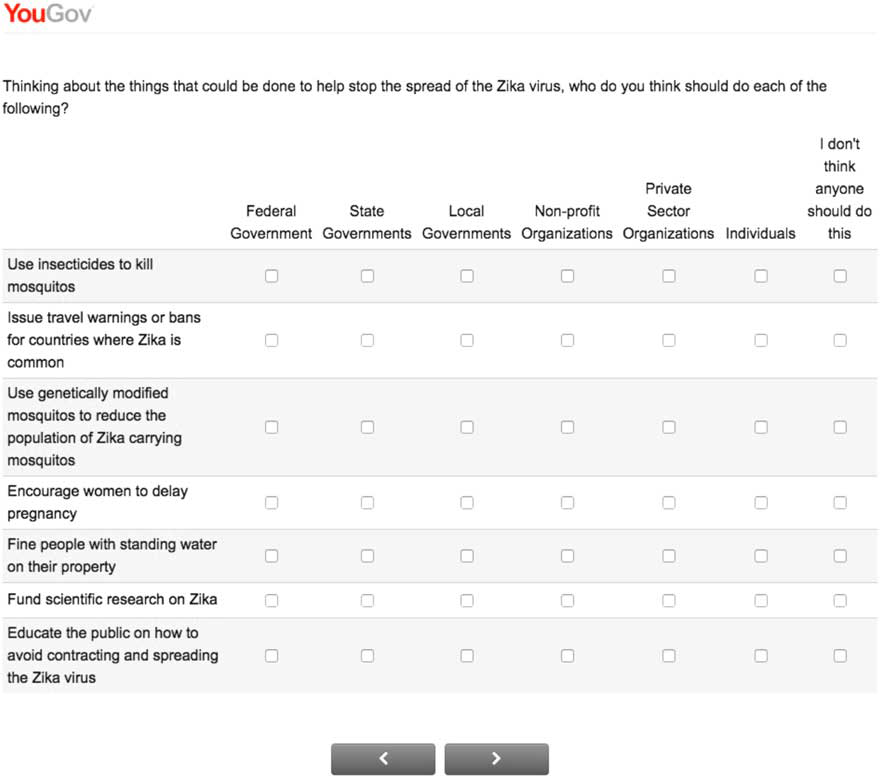
To measure support for Zika policy proposals we asked respondents the following question: “Thinking about the things that could be done to help stop the spread of the Zika virus, who do you think should do each of the following?” Respondents were presented with a seven-by-seven grid (Figure 1), where they were allowed to indicate whether they supported seven potential Zika abatement policy options by seven potential policy implementers. The policy options included:
-
∙ Educate the public on how to avoid contracting and spreading the Zika virus.
-
∙ Use insecticides to kill mosquitoes.
-
∙ Fine people with standing water on their property.
-
∙ Encourage women to delay pregnancy.
-
∙ Issue travel warnings or bans for countries where Zika is common.
-
∙ Fund scientific research on Zika.
-
∙ Use GMMs to reduce the population of Zika carrying mosquitoes.
Cooperative Congressional Election Study survey question on support for Zika policy action.
Note: The ordering of the columns (i.e. the policy actors) was not randomised, but the order of the rows (i.e. the policy options) was. Respondents were allowed to “check all that apply” (i.e. as many policy options and actors as they wished).

The policy implementers included:
-
∙ Federal government
-
∙ State governments
-
∙ Local governments
-
∙ Nonprofit organisations
-
∙ Private sector organisations
-
∙ Individuals
-
∙ “I don’t think anyone should do this”
Respondents were allowed to “check all that apply” (i.e. as many policy options and actors as they wished). As an improvement over previous designs, respondents could choose from the three levels of government, nongovernmental actors, choose that no one should carry out such policies, or select multiple policy actors for a given policy proposal. For instance, a respondent could select both the federal government and state governments as the actors he/she believes should “fund scientific research on Zika”, and then select state governments, local governments and nonprofit organisations as the actors he/she believes should “educate the public on how to avoid contracting and spreading the Zika virus”. This “check all that apply” design does not force respondents to select a preference for only one level of government where perhaps they may have no such preference. Rather, respondents that truly wish to see multiple levels of government take responsibility for a policy could indicate that in the “check all that apply” design, while respondents who do have a strong preference for one level of government and one level only could also indicate that in the “check all that apply” design.Footnote 8
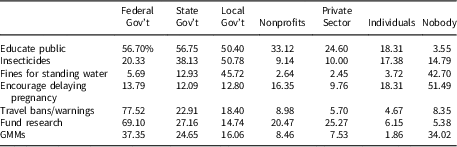
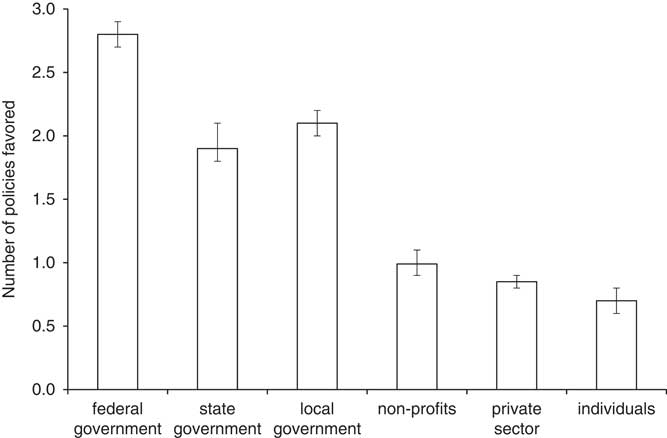
This questionnaire design allows us to measure which policy responses have the highest level of public support both by level of government (or nongovernment) actor and also without regard to specific policy actor. We can parse out whether the public prefers federal, state or local action, with regard to each Zika policy proposal. In addition, with the inclusion of the “I don’t think anyone should do this” response option, this questionnaire design also allows us to understand whether citizens support specific policy proposals at all, or if they are wholly opposed to some policy proposals regardless of which policy actor might take responsibility for that policy (e.g. a respondent might not be in favor of the use of GMMs by any policy actor). Table 1 shows an overall summary of the public’s level of support for the various policies and policy actors, specifically the percent of respondents who indicated that they do support the given policy actor implementing the policy in question.
Support for Zika abatement policies by policy source

Note: Cell entries are the per cent of respondents agreeing to the policy proposal by the source of the policy.
GMMs=genetically modified mosquitoes.
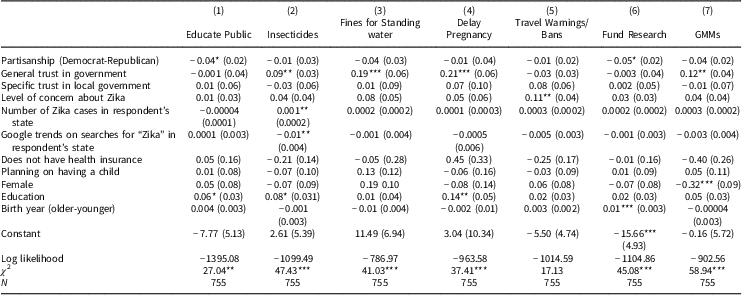
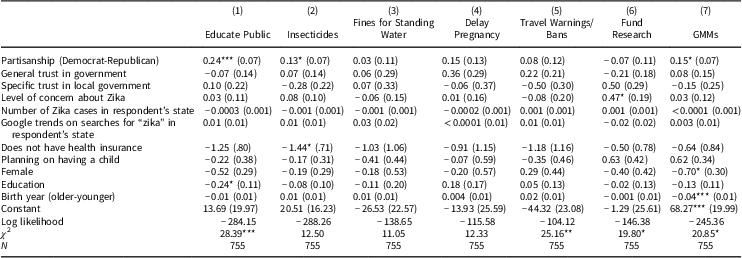
In addition to examining basic descriptive statistics from the response grid (summarised in Table 1), we develop a number of dependent variables to examine the factors that impact support for Zika policy action at various levels of government. Our first set of dependent variables examines whether respondents support a given policy option without regard to policy actor. We create one count variable for each of the seven possible policy options. This count variable measures the number of policy actors that a respondent selected he or she would like to see implement the given policy proposal. For example, a respondent who selected “no one should do this” for the proposed policy of educating the public would be coded a “0” while a respondent who indicated that the federal government, state governments and local governments (but no other actors) should educate the public would be coded a “3” on this measure. Each of the subsequent measures for the policies of using insecticides, fines for standing water, messages to delay pregnancy, travel warnings/bans, funding research and using GMMs are coded in the same manner. Table 2 displays the correlates of the number of policy actors that a respondent believes should implement a given policy proposal.
Correlates of desired number of policy actors to abate Zika by type of policy (multivariate regression analyses)
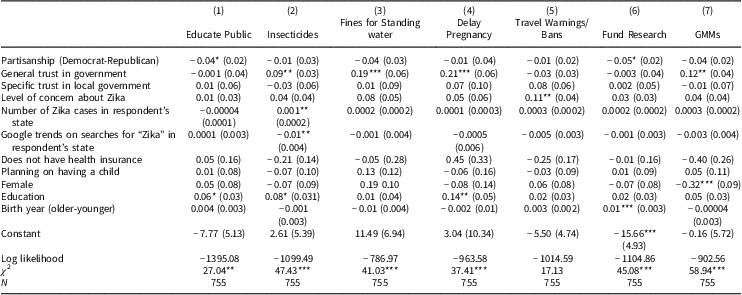
Note: Cases with missing data were excluded using listwise deletion. Robust standard errors in parentheses. A robustness check, using negative binomial regression, is presented in the Appendix (Table A2).
Model type: Poisson regression.
GMMs=genetically modified mosquitoes.
*p⩽0.05, **p⩽0.01, ***p⩽0.001.
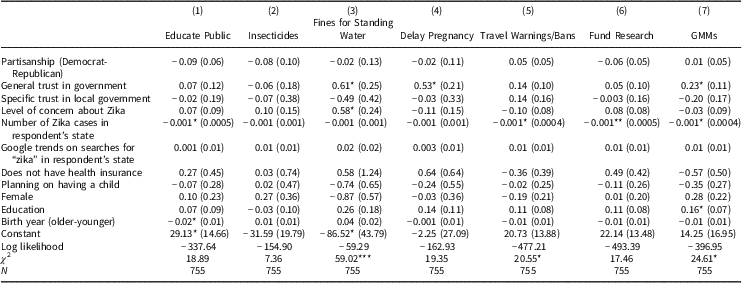
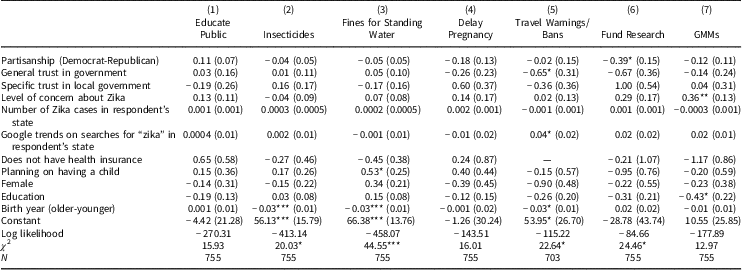
Moving beyond our examination of support for policies without regard to which specific policy actors are supported, we consider whether Americans express a preference for one level of government to take action over the others when it comes to Zika policy responses. In order to create measures that indicate a respondent’s preference for federal government action but not state or local government action we first create seven binary variables (1=yes, 0=no), one for each of the seven potential policy responses. For each of these seven binary variables a respondent is coded as a “1” if he or she indicated that (a) he or she does support the federal government implementing the given policy and (b) he or she did not select the state or local government as levels of government to implement the policy. In other words for each of the seven potential policy options, a respondent is only coded a “1” for preference for federal action on a particular policy option if he or she selected the federal government while also choosing not to select the state government or local government as implementers for that same policy option. If a respondent indicated support for federal government education of the public but did not indicate support for state or local government education of the public, this respondent would be coded a “1” for the “only federal educate the public” variable. On the other hand, if a respondent indicated support for federal government education of the public and also indicated support for state or local government education of the public, this respondent would be coded a “0” for the “only federal educate the public” because this respondent supported some level of government take this policy action other than just the federal government. With this construction, this set of binary variables indicates true preference for the federal government over state or local governments. These seven newly created DVs are examined in Table 3.
Correlates of support for federal government only to abate Zika by type of policy (multivariate regression analyses)
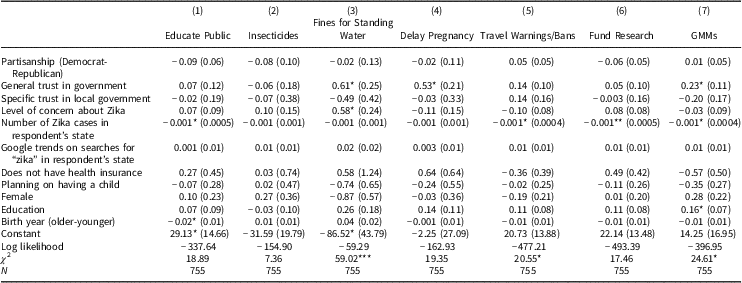
Note: Cases with missing data were excluded using listwise deletion. Robust standard errors in parentheses. The data above account for the preference of respondents for federal action to the exclusion of action by state and local government.
Model type: Logistic regression.
GMMs=genetically modified mosquitoes.
*p⩽0.05, **p⩽0.01, ***p⩽0.001.
Similarly, the next set of seven dependent variables measure preference for state action, but not federal or local action. For these seven dependent variables (one for each of the seven possible policy options) a respondent was coded as a “1” if he or she indicated that he or she does want the state government to implement the given policy and he or she did not select the federal or local governments as levels of government to implement the policy. This set of variables indicates a true preference for the state government over federal or local governments for each of the seven policy options. These dependent variables examining preference for state action are used in the models presented in Table 4.
Correlates of support for state government only to abate Zika by type of policy (multivariate regression analyses)
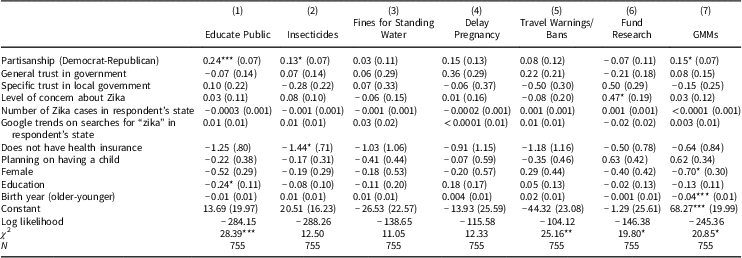
Note: Cases with missing data were excluded using listwise deletion. Robust standard errors in parentheses. The data above account for the preference of respondents for state action to the exclusion of action by federal and local government.
Model type: Logistic regression.
GMMs=genetically modified mosquitoes.
*p⩽0.05, **p⩽0.01, ***p⩽0.001.
Along the same line, the next set of seven dependent variables measures preference for local action, but not federal or state action. For these seven dependent variables (one for each of the seven possible policy options) a respondent was coded as a “1” if he or she indicated that he or she does want local governments to implement the given policy and he or she did not select the federal or state governments as levels of government that should implement the policy. In other words, the respondent is coded as a “1” only if he or she selects local government as the only level of government that should implement the policy in question. These dependent variables examining preference for local government action are used in the model presented in Table 5. Each of these three sets of seven dependent variables indicates a true preference for one level of government over the others with regard to each of the seven proposed policy options.
Correlates of support for local government only to abate Zika by type of policy (multivariate regression analyses)
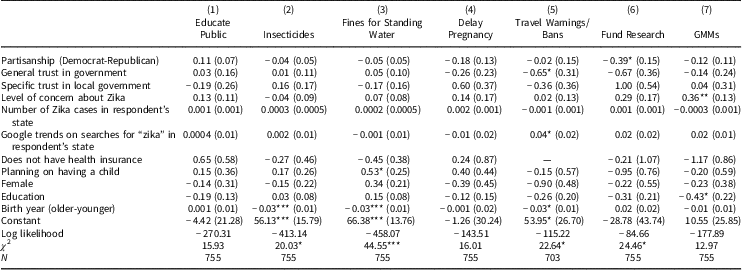
Note: Cases with missing data were excluded using listwise deletion (e.g. there were no cases of individuals without health insurance in Column 5). Robust standard errors in parentheses. The data above account for the preference of respondents for local action to the exclusion of action by federal and state government.
Model type: Logistic regression.
GMMs=genetically modified mosquitoes.
*p⩽0.05, **p⩽0.01, ***p⩽0.001.
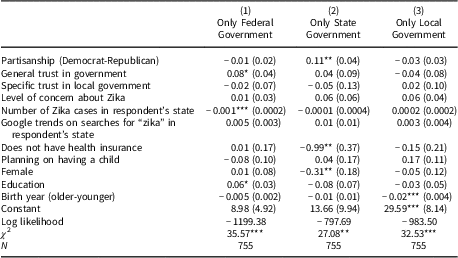
Finally, we then aggregate each set of these dependent variables into three general outcome variables – one variable for federal government preference, one variable for state government preference, and one variable for local government preference. First, we have the “federal government preference” variable which ranges from 0 to 7 and indicates the number of times (out of a possible seven) that the respondent selected the federal government as a desired actor for the given policy option but did not select either of the other two levels of government (state and local). For example, a respondent who never selected only the federal government without also selecting either the state and/or local government is coded a 0 for this variable. A respondent who selected the federal government but not the state and/or local government for all of the seven proposed policy options would be coded a “7”.
The “state government preference” variable also ranges from 0 to 7 and indicates the number of times (out of a possible seven) that the respondent selected the state government as a desired policy actor but did not select the federal and/or local governments as a desired policy actor. Finally, we create a “local government preference” variable that also ranges from 0 to 7 and indicates the number of times (out of a possible seven) that the respondent selected the local government as a desired policy actor but did not select the federal and/or state governments as a desired policy actor.
Each of these last three variables indicates the degree to which each respondent has a preference for one level of government to take action on Zika over the other levels of government. These final three dependent variables are used in the model presented in Table 6.
(POISSON) Correlates of support for policy actors to abate Zika by level of government (multivariate regression analyses)
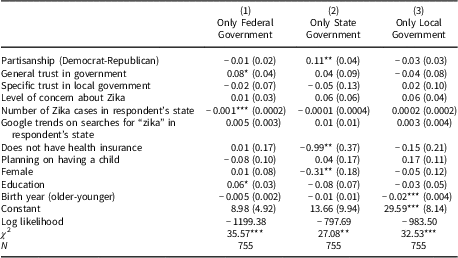
Note: Cases with missing data were excluded using listwise deletion. Robust standard errors in parentheses.
Model type: Poisson regression.
GMMs=genetically modified mosquitoes.
*p⩽0.05, **p⩽0.01, ***p⩽0.001.
Independent variables
We use multivariate regression analysis to assess variation in the dependent variables described above. Our first key independent variable is an ordinal measure of political partisanship (1=“Strong Democrat”, 7=“Strong Republican”). Our second key independent variable is an ordinal five-point scale of general trust in government (i.e. how strongly the respondent agrees with the statement that “the government can be trusted most of the time”) ranging from low to high. Our final key independent variable is a three-point ordinal measure of trust in local government ranging from “not at all” to “most of the time”. We include both general trust in government and trust in local government because we are assessing the public’s opinions on action by multiple levels of government, and while prior research has examined the impact of general trust in government on general policy mood, less is known about the impact of trust in local government on policy preferences by level of government. General trust in government and trust in local government are correlated significantly (r=0.25, p<0.001), though the magnitude of the correlation is not high relatively, such that we believe the two variables are measuring distinct attitudes.
Control variables
The analysis includes a five-point scale of level of concern over the Zika virus in order to account for the possibility that individuals who are more concerned about Zika, generally, may be more likely to support any policy suggested as a response to the Zika virus. More specifically, in order to measure concern about Zika, respondents were asked the following question prior to being asked their opinion on policy proposals to combat Zika:
Zika is a disease that is spread to people primarily through the bite of an infected mosquito. It may also be sexually transmitted. The most common symptoms of Zika are fever, rash, joint pain, and conjunctivitis (red eyes). The symptoms are usually mild, and many people do not know they have been infected. However, Zika infection during pregnancy can cause serious birth defects. How concerned are you about a Zika outbreak in your community?
Respondents were asked to indicate their concern about Zika using a five-point scale ranging from “not at all concerned” to “very concerned”.
Given that the spread and threat of the Zika virus may be more salient for those in areas where the Zika virus is more prevalent, we control for both the number of US Center for Disease Control reported cases of Zika in the respondent’s state as of 03/09/2017 (cdc.gov/zika), and the 0-to-100 Google Trend score on the search term “Zika” in the respondent’s state during the month of November 2016 while the CCES survey was being conducted.
In order to control for other factors that could impact an individual’s assessment of the “urgency” of government taking action to address Zika, more generally, we include several additional control variables in our analysis. First, those without health insurance or those actively trying to have children may have a heightened level of concern about the spread of Zika. Therefore, we include an indicator of health insurance (whether the respondent does or does not have health insurance) and an indicator of whether the respondent or “someone close to them” was planning on having a child in “the next few years”. In this same vein, it is also possible that men and women view Zika differently. As such, we also control for respondent sex (0=male, 1=female). Finally, we control for an individual’s level of education (1=no high school, 6=post graduate degree) and birth year, as education and age may impact views regarding government policy interventions and public opinion more broadly (e.g. Verba et al. Reference Verba, Schlozman and Brady1995).
Method
The unit of analysis is the survey respondent. All analyses were conducted using Stata/SE version 14.2. For the multivariate analysis, the substantive meaning of the regression coefficients was assessed using the “margins” command in Stata, a procedure that estimates the predicted value of the dependent variable based on the values of the independent variables in the regression model. These values were calculated by varying the value of the independent variable of interest while holding all other independent variables in the model at their means.
Results
Support for specific Zika abatement policies
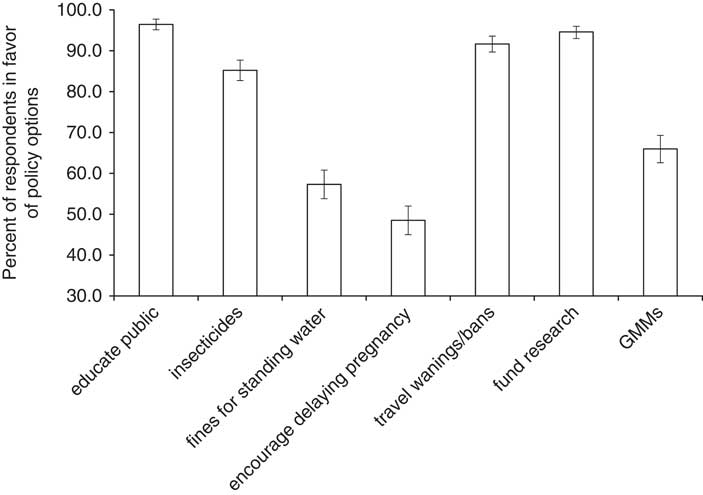
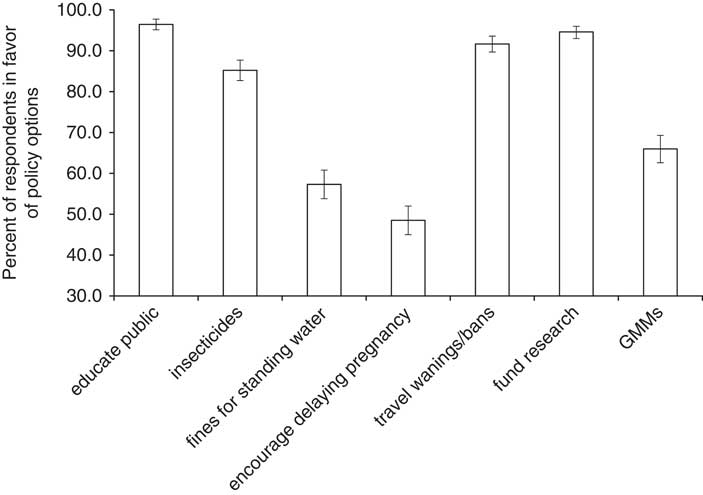
The American public is generally supportive of several policy options (Figure 2). In total, without regard to which level of government would be the policy implementer, 96% of the public supports at least one policy actor educating the public about the Zika virus, 85% support use of insecticides to abate mosquitoes, 92% support issuing travel warnings/bans and 95% support funding research. The public is less supportive of issuing fines for standing water (57% support) or of encouraging women to delay pregnancy (49%). The public is also relatively skeptical of the use of GMMs; this finding is in line with the public’s more general fears of genetically modified organisms (Goertzel Reference Hetherington and Nugent2010).
Public support for Zika abatement policy options (without regard to policy actor).
Note: Error bars represent 95% confidence intervals. GMMs=genetically modified mosquitoes.
The results of the multivariate regression analysis of the American public’s preferences on the number of policy actions to be taken, by policy type, are presented in Table 2. The data show that support for educating the public (See Table 2, Column 1) is stronger among Democrats and the better educated. Strong Democrats are estimated to be in favor of 2.67 education-related policy actions (out of a possible six) compared to 2.04 among strong Republicans. In other words, strong Democrats, on average, indicated that they would like more policy actors to implement this policy than strong Republicans did. Individuals with a high school level education are estimated to be in favor of 2.17 education-related policy actions compared to 2.63 among those with a four-year college degree, suggesting that compared to those with lower levels of education, those with higher levels of education generally wish to see more policy actors educate the public.
The second column of Table 2 indicates that support for the use of insecticides is stronger among those with trust in government, stronger as the number of Zika cases in the respondent’s state increases, weaker as the number of Google trends on searches on the word “Zika” increase, and stronger among the better educated. That Google searches of the word Zika are associated with less support for the use of insecticides is, admittedly, a puzzling finding. It is possible that people who are more concerned about the policy proposals being suggested to fight Zika are more likely to then seek out more information on Google. On the other hand, it is also possible that as Google searches on Zika increase, people may be exposed to more misinformation suggesting that the use of insecticides is harmful for humans (Dredze et al. Reference Feather2016; Sharma, et al. Reference Soroka and Wlezien2017). For the level of the Zika outbreak in the survey respondent’s state, the model predicts that a person living in a state with an average number of cases (n=260) is estimated to be in favour of 1.42 insecticide policy actions compared to 2.38 for a person living in the state with the most documented cases (i.e. Florida, n=1083 at the time this study was conducted). In the case of Google searches, the model predicts that respondents living in states with an average number of searches on the term “Zika” will be in favour of 1.45 insecticide policy actions compared to 0.82 for people living in the state with the maximum level of searches. For trust in government, respondents who are very trustful of government (i.e. the maximum on the scale) are predicted to be in favour of 1.76 insecticide policy actions compared to 1.25 among those who are very distrustful of government (i.e. the minimum on the scale). For education, individuals with a high school level education are estimated to be in favour of 1.29 insecticide policy actions compared to 1.63 among those with a four-year college degree. These results suggest that the more Zika cases in an individual’s state, the fewer Google searches for the term “Zika” in a person’s state, higher levels of individual general trust in government and higher levels of education are all associated with more support for the use of insecticides.
Americans’ support for travel warnings/bans is positively associated with the public’s level of concern about the Zika virus (See Table 2, Column 3). Americans who are very concerned about the virus (i.e. the maximum on the scale) are estimated to be in favour of 1.69 travel warning/ban policy actions compared to 1.11 among those who are not at all concerned (i.e. the minimum on the scale).
In general, support for funding research to combat the Zika virus is stronger among Democrats and younger Americans (See Table 2, Column 4). For partisanship, Strong Democrats are estimated to be in favour of 1.86 research-related policy actions compared to 1.35 among Strong Republicans. In the case of age, a 49-year old (i.e. the sample mean) is in favour of 1.67 research-related policy actions compared to 2.14 for an 18-year old (i.e. the sample minimum).
Our results suggest that support for fining individuals with standing water on their property is stronger among individuals who are more trusting of the government (See Table 2, Column 5). Respondents who are very trustful of government (i.e. the maximum on the scale) are estimated to be in favour of 1.09 policies that levy fines for standing water compared to 0.52 among those who are very distrustful of government (i.e. the minimum on the scale).
Support for policies that encourage women to delay pregnancy is stronger among individuals with higher levels of trust in government and the better educated. In the case of trust in government, respondents who are very trustful of government (i.e. the maximum on the scale) are estimated to be in favour of 1.29 policies that encourage women to delay having a child compared to 0.56 among those who are very distrustful of government (i.e. the minimum on the scale). For education, individuals with a high school level education are estimated to be in favour of 0.65 pregnancy-related policy actions compared to 0.99 among those with a four-year college degree (see Table 2, Column 6).
Support for the use of GMMs is stronger among those with higher levels of trust in government, and weaker among women (see Table 2, Column 7). For trust in government, respondents who are very trustful of government (i.e. the maximum on the scale) are estimated to be in favor of 1.24 policies that use GMMs compared to 0.76 among those who are very distrustful of government (i.e. the minimum on the scale). In the case of gender, women are estimated to be in favour of 0.80 policies that use GMMs compared to 1.10 among men.
Support for Zika abatement policies by federal, state and local governments
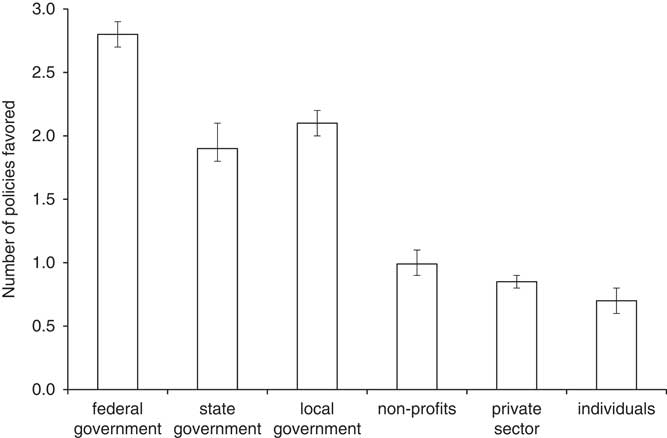
First, we examine support for federal government action, but not state or local government action (see Table 3). We find that in the case of educating the public, the higher the number of Zika cases in a respondent’s state and the younger a respondent, the less likely they are to indicate a preference for a federal government policy of educating the public. In the case of insecticides, none of our independent or control variables are associated with a preference for the federal government to take responsibility for insecticides. In terms of fines for standing water, the higher the level of general trust in government and the greater the concern about Zika, the more likely a respondent is to express a preference for the federal government to issue fines for standing water. In terms of delaying pregnancy, the higher the level of general trust in government the more likely a respondent is to prefer federal government action. In terms of both travel bans/warnings and funding research, as the number of Zika cases in a respondent’s state increases, the less likely a respondent is to desire federal government travel bans/warnings or federal government research funding. Finally, for the policy of using GMMs, the higher the trust in government, the higher the number of Zika cases in a respondent’s state, and the more educated the respondent, the more likely he or she is to express a preference for a policy of using GMMs to be undertaken by the federal government (Figure 3).
Number of Zika abatement policy options favoured by policy actor.
Note: Error bars represent 95% confidence intervals.
Next, we turn to support for state, but not federal or local, government action to address Zika (see Table 4). In terms of partisanship, we find that Republicans are significantly more likely to express support for the state governments only to educate the public, spray insecticides and use GMMs. Individuals with a higher level of concern about Zika are significantly more likely to express a desire for state only action to fund research. Those without health insurance and younger respondents are significantly less likely to support state only action to spray insecticides. Female respondents are significantly less likely to support state only action to release GMMs. Finally, as education increases, respondents are significantly less likely to express support for state only action to educate the public on the Zika virus.
Table 5 presents the model of support for local government action only. The results suggest that none of our explanatory variables are significantly associated with a preference for local government only to educate the public or to encourage the delay of pregnancy. Younger respondents are significantly less likely to support local government only use of insecticides. Those planning on having a child in the next few years and older respondents are significantly more likely to support local government only fines for standing water. As general trust in government increases and as Google searches for Zika decrease, support for local only issuance of travel warnings/bans decreases. In addition, younger respondents are less likely to support local only travel warnings/bans. In terms of funding research, Republicans are significantly less likely to support local only action to fund research. Finally, in terms of GMMs, as level of concern about Zika increases and as education decreases, support for local only use of GMMs increases.
Turning to overall support for federal only, state only or local only action, we find that partisanship is significantly associated with a preference for state only action to address the Zika crisis (see Table 6). Specifically, Republicans selected state only action more often than did Democrats (out of a possible seven times). Our model predicts that being a Republican is associated with a 0.11 unit increase in the number of times a respondent indicates support for the state government as a policy actor while not supporting federal or local action, a small but significant relationship. However, partisanship is not significantly associated with support for federal only or local only policy action. In terms of support for solely state governments implementing policies to address Zika, we also find that those without health insurance and females are significantly less likely to express a preference for state only action. In terms of support for the federal government (but not state or local), we find that as general trust in government increases and as education increases, so too does the number of times a respondent selects federal only action. In addition, the number of cases of Zika in the state is negatively associated with support for federal only action, suggesting that those experiencing a Zika outbreak in their state are less likely to want the federal government to be the sole policy actor to respond to the public health threat of Zika. In terms of support for local government action only, we find that younger respondents are less likely to express a preference for local over state or federal action, but that no other explanatory variables are significantly related to support for local government action.
Discussion and conclusion
In this study, we asked which specific Zika policy responses Americans support, which level(s) of government (if any) they believe should be responsible for enacting these policies, and what factors shape their assignment of policy responsibility to different levels of government. Prior research has suggested that public opinion is largely a reflection of partisan elite cues (Reference ZallerZaller 1992), though scholars are divided on whether citizens make meaningful distinctions between which level of government should implement policy (e.g. Jacobs Reference Jennings and Wlezien2017). In this study, we seek to examine the factors that impact how Americans meaningfully distinguish between policy responsibility at various levels of government, if at all, in the absence of partisan ownership or partisan cues about a specific public issue. We examine this question in the context of the Zika virus, and our results, while mixed overall, do suggest that partisanship impacts support for state government policy action over federal or local government policy action. To be sure, we find this result in 2016 when Democrats controlled the executive branch of the federal government and Republicans controlled a majority of state governorships. It is possible that under different circumstances (such as unified Republican control of the federal government and more state governments controlled by Democrats) that these results may not hold.
When we dig deeper to examine support for specific policies by one level of government but not the others, we find that in many cases, partisanship has no impact on how Americans assign policy responsibility to the various levels of government. Partisanship did not impact preference for only federal government action for any of the seven possible policy options. Partisanship impacted preference for only local government action for just one out of the seven policies presented to respondents. Partisanship had the most influence on preference for state government action, impacting the assignment of policy responsibility exclusively to state governments for a minority (three out of seven) of the proposed policies. On the whole, these results suggest that while Republicans do express some preference for state government action over federal or local government action, in the absence of partisan elite ownership of the issue, individual partisanship alone does not appear to have a strong influence on how Americans think about and assign policy responsibility to the various levels of government for each of the seven policy proposals we examine. These results indicate that in the absence of cues from partisan elites, individual partisanship has a weak impact on public preferences for one level of government over the others, but that such preferences are not universal or consistent across policy proposals, even within the realm of a single policy area.
More specifically, when examining support for policy action by one level of government (regardless of support for other levels taking the same policy action), our results suggest that Americans generally support the federal and state governments taking on their traditional policy-making roles of funding research and educational efforts that support the public health, and they support local governments taking on their traditional policy-making roles for mosquito control (through aerial spraying) and enforcement of property codes. It is possible that individual respondents are supportive of policy action based on their knowledge of which levels of government typically take on which types of policy responsibilities (e.g. federal research funding versus local mosquito spraying), but even if that is the case, the results still suggest that partisanship is not the primary driver of these policy preferences.
Another possibility is that the public is more likely to support policy action by levels of government that they do not perceive to be “agents of causation” for the problem in the first place, as prior work has suggested that the public views “agents of causation” negatively and “agents of treatment responsibility’ positively (Iyengar Reference Jacoby1989). However, it is not clear from this study whether Americans view any particular level of government as playing a role in the spread of Zika or if they view it as a natural occurrence. Future research should seek to better understand the degree to which citizens blame their local state, or federal governments for the spread of Zika and are thus less likely to support that same level of government taking policy action to treat the Zika virus.
Prior to this study, in the absence of systematic empirical work examining public preferences for Zika policy action, policymakers have been left with few options to reliably gauge public opinion. At the local level, for instance, policymakers may believe that the public is opposed to certain Zika policy proposals if a vocal minority of residents attend public meetings to express their outrage at such a policy. However, those residents may or may not represent the wishes of the broader community, including nonvocal residents and those unable to attend public meetings. The results of this study provide policymakers at all levels of government with information on the Zika policy preferences of a representative random sample of Americans as well as information on which demographic characteristics are associated with support for various Zika policies. This is a significant step forward for researchers and policymakers alike.
While some might question the value of understanding public preferences for policymaking given that some work has suggested that the linkages between public preferences and policy outcomes is tenuous (Page Reference Reher1994; Gilens and Page Reference Gilens and Page2014; Achen and Bartels Reference Achen and Bartels2017), there is a long line of scholarship suggesting that policymakers do respond to public opinion, not just elite preferences (Mishler and Sheehan Reference Mishler and Sheehan1993; Stimson et al. Reference Stimson, MacKuen and Erikson1995; Wlezien Reference Zaller1995; Enns Reference Fox2015; Leighley and Oser Reference Mikos2017). Therefore, we believe that while this study contributes to the broader literature on how the public assigns policy responsibility to various levels of government, it is also valuable to policymakers who seek to address the Zika crisis and may wish to learn more about public preferences for policymaking in this area as there has been little systematic examination of public preferences for Zika policy to date.
In the future, scholars should further examine how public officials can effectively communicate with the public regarding policy options in the absence of partisan ownership of an issue. In fact, our results suggest that in the absence of partisan ownership of an issue, public officials may have an opening to communicate with and impact public support for various policy responses to a public health problem. Public health scholars have shown that the internet plays a significant role in spreading misinformation about vaccines (Kata Reference Kluegel2010) and our results show that the more Google searches for Zika in an individual’s state the less supportive they are of insecticide use. For these reasons, public officials should be cognizant of how information about public health threats, specifically the Zika virus, is disseminated to the public. It is important that officials roll out policies and messaging with the public’s attitudes in mind.
For future research, scholars should examine how best to communicate the science behind the most effective policy options so that officials can effectively encourage citizen engagement and compliance. The Zika outbreak provides an excellent opportunity to learn about public attitudes regarding public health issues and how government can best respond to those attitudes with a variety of policy options at a variety of levels of government. Zika is not the first public problem to become salient without clear partisan ownership of the issue, and it will not be the last. In the future, public officials and scholars alike should develop further strategies for how to understand public preferences for policy responsibility and how to respond to those public preferences under such uncertain and difficult circumstances.
Supplementary material
To view supplementary material for this article, please visit https://doi.org/10.1017/S0143814X19000011
Data Availability Statement
Replication materials are available in the Journal of Public Policy Dataverse at https://doi.org/10.7910/DVN/WFOVZZ
Acknowledgements
We wish to thank the Editors of the Journal of Public Policy and the anonymous reviewers for their valuable comments and suggestions.