Introduction
Tourette syndrome (TS) is a neurodevelopmental syndrome characterised by tics as a core symptom, which is commonly associated with other psychiatric comorbidities such as attention-deficit hyperactivity disorder (ADHD), obsessive–compulsive disorder (OCD) and impulse control disorders (Frank, Piedad, Rickards, & Cavanna, Reference Frank, Piedad, Rickards and Cavanna2011; Hirschtritt et al., Reference Hirschtritt, Lee, Pauls, Dion, Grados, Illmann and Mathews2015; Martino, Ganos, & Pringsheim, Reference Martino, Ganos and Pringsheim2017) as well as increased alcohol/drug consumption (Virtanen et al., Reference Virtanen, Sidorchuk, Fernández de la Cruz, Brander, Lichtenstein, Latvala and Mataix-Cols2021).
Several studies have suggested associations between TS and increased propensity for risky behaviour in everyday life. For instance, even if comorbidities might have a significant impact, individuals with TS were reported to exhibit a higher frequency of vehicle accidents (Mataix-Cols et al., Reference Mataix-Cols, Brander, Chang, Larsson, D'Onofrio, Lichtenstein and Fernández de la Cruz2021) and traumatic brain injury (Chen, Su, Wang, Hsu, & Shen, Reference Chen, Su, Wang, Hsu and Shen2019), overall leading to premature death (Fernández de la Cruz & Mataix-Cols, Reference Fernández de la Cruz and Mataix-Cols2020; Meier, Dalsgaard, Mortensen, Leckman, & Plessen, Reference Meier, Dalsgaard, Mortensen, Leckman and Plessen2017). It is still not clear whether the increased risk propensity of individuals with TS in real life translates into (or even stems from) a generally increased attitude towards risk and whether it is related to TS per se or comorbid conditions.
The layman notion of risk typically brings to mind uncertainty for adverse real-life outcomes, i.e. from undesirable and mildly inconvenient to dire and life-threatening. At a decision theory level, risk-taking is rather defined as a tendency to select risky outcomes over safer, sometimes more beneficial ones, in both positive and negative contexts (Byrnes, Miller, & Schafer, Reference Byrnes, Miller and Schafer1999; Howat-Rodrigues, Tokumaru, & Izar, Reference Howat-Rodrigues, Tokumaru and Izar2018). Closely related to the notion of risk and uncertainty is the concept of ambiguity. While risk relates to situations where outcome distributions are known (e.g. a lottery or documented health hazards like COVID infection risks), ambiguity refers to situations where the likelihood of different outcomes cannot be expressed with any mathematical precision (Tobler & Weber, Reference Tobler and Weber2014).
The most dominant model of decision under risk is prospect theory (Kahneman & Tversky, Reference Kahneman and Tversky1979); a common extension of it in the domain of decision under ambiguity (Levy, Snell, Nelson, Rustichini, & Glimcher, Reference Levy, Snell, Nelson, Rustichini and Glimcher2010) allows for quantitative evaluations of behaviour in a variety of decisional contexts. Prospect theory models decision-making under risk with (among other things) three core assumptions. First, decision-makers are risk averse over moderate probability gains and seek risk over losses, an attitude captured by a decreasing marginal utility over gains and losses, making value functions convex in loss domain and concave in gain domain. Second, decision-makers are much more sensitive to losses than gains of equal magnitude, an attitude captured by a loss aversion parameter. Finally, decision-makers overweight small probabilities and underweight high probabilities. Overall, with a limited and principled set of parameters, this model can account for complex patterns of behaviour, such that the same individual could have a risk averse behaviour in context of gain (i.e. preferring a small gain obtained with certainty than a higher gain with a lower degree of certainty) and risk seeking in context of loss (i.e. preferring a high loss with an undetermined probability of occurrence to a lower loss with a certain probability of occurrence). The extension of prospect theory to ambiguity aversion also accounts for why decision-makers typically prefer known risks over unknown risks. Overall, this model-based approach of decision-making under risk and ambiguity allows a summary of the history of participants’ choices as a small set of interpretable parameters (Huys, Maia, & Frank, Reference Huys, Maia and Frank2016; Montague, Dolan, Friston, & Dayan, Reference Montague, Dolan, Friston and Dayan2012).
In TS, previous experimental reports of decision-making in context of risk using different versions of gambling tasks showed no difference in performance compared to healthy controls (HC) (Crawford, Channon, & Robertson, Reference Crawford, Channon and Robertson2005; Goudriaan, Oosterlaan, de Beurs, & van den Brink, Reference Goudriaan, Oosterlaan, de Beurs and van den Brink2005). However, because these reports did not always account for frequent comorbidities or treatment with antipsychotics, their effects on risk-attitude in TS remain unclear. Similarly, studies of decisional processes under the risk of frequent comorbid conditions with tics showed discrepant results. For instance, ADHD patients without tics exhibit a deficit in general decisional process rather than making riskier decisions compared to HC (Dekkers et al., Reference Dekkers, Agelink van Rentergem, Huizenga, Raber, Shoham, Popma and Pollak2021, Reference Dekkers, Huizenga, Popma, Bexkens, Zadelaar and Jansen2020; Humphreys, Tottenham, & Lee, Reference Humphreys, Tottenham and Lee2018). Interestingly, ADHD patients without tics presented performances similar to HC in a context of decision-making under ambiguity (Norman et al., Reference Norman, Carlisi, Christakou, Murphy, Chantiluke, Giampietro and Rubia2018). OCD patients were also found to be similar to HC in a context of risk (Kim et al., Reference Kim, Kang, Namkoong, Jhung, Ha and Kim2015; Zhang et al., Reference Zhang, Dong, Ji, Zhu, Yu, Ma and Wang2015), and inconsistently similar (Norman et al., Reference Norman, Carlisi, Christakou, Murphy, Chantiluke, Giampietro and Rubia2018) or impaired (Kim et al., Reference Kim, Kang, Namkoong, Jhung, Ha and Kim2015; Zhang et al., Reference Zhang, Dong, Ji, Zhu, Yu, Ma and Wang2015) compared to controls regarding ambiguity evaluation. From a brain functioning level, risk-taking was related to catecholamine function. In particular, D2/D3 agonists such as pramipexole lead to an increase of risky behaviour in healthy individuals in a context of ambiguity, that is related to a change of activity of ventral striatum (Riba, Krämer, Heldmann, Richter, & Münte, Reference Riba, Krämer, Heldmann, Richter and Münte2008). Also, tryptophan supplementation presumably resulting in elevation of serotonin concentration leads to risk aversion under a condition of gain and risk seeking under a condition of loss (Murphy et al., Reference Murphy, Longhitano, Ayres, Cowen, Harmer and Rogers2009). Considering that TS is related to putative dopamine hyperactivity (Maia & Conceição, Reference Maia and Conceição2017, Reference Maia and Conceição2018; Palminteri et al., Reference Palminteri, Lebreton, Worbe, Grabli, Hartmann and Pessiglione2009, Reference Palminteri, Lebreton, Worbe, Hartmann, Lehéricy, Vidailhet and Pessiglione2011), individuals with TS might present a distorted risk evaluation, especially if not medicated.
Overall, these discrepant results call for a more systematic investigation of attitude towards risk and ambiguity in individuals with TS, as well as of the role of comorbidities and medication. This study thus aimed to systematically investigate behaviours of individuals with TS and matched HC following standard procedures in research and investigating decision-related processes under both risk and ambiguity (Ellsberg, Reference Ellsberg1961; Knight, Reference Knight1921). In addition, we aimed to manipulate valence values of potential outcomes to assess decision-making aspects specific to the relative processing of gains and losses.
Materials and methods
Subjects
Sixty-four adults with TS and 34 age- and gender-matched HC were recruited through the Tourette Reference Centre at the Pitié-Salpêtrière Hospital in Paris. All participants gave their written consent to participate in the study. For all participants, exclusion criteria were as follows: a lack of capacity or unwillingness to give consent for the study, evidence of either present or prior substance addiction (excluding nicotine and recreational use of cannabis), a past or present history of psychosis, neurological symptoms other than tics for TS, childhood tics and axis I psychiatric disorders for HC. The study was approved by the local ethics committee (CCP16163/C16-07) and preregistered on ClinicalTrial (https://clinicaltrials.gov/ct2/show/NCT02960698).
All participants were assessed for psychiatric disorders [Mini International Neuropsychiatric Interview, MINI (Sheehan et al., Reference Sheehan, Lecrubier, Sheehan, Amorim, Janavs, Weiller and Dunbar1998)], impulse-control disorders [Minnesota Impulse Disorders Interview, MIDI (Grant, Reference Grant2008)] and general impulsivity [using the Barratt Impulsivity scale, BIS-11 (Patton, Stanford, & Barratt, Reference Patton, Stanford and Barratt1995)]. Tic severity was assessed using the Yale Global Tic Severity Scale [YGTSS (Leckman et al., Reference Leckman, Riddle, Hardin, Ort, Swartz, Stevenson and Cohen1989)], and any presence of psychiatric comorbidities was evaluated from medical records and psychiatric evaluations prior to inclusion in the study.
Decision-making under risk
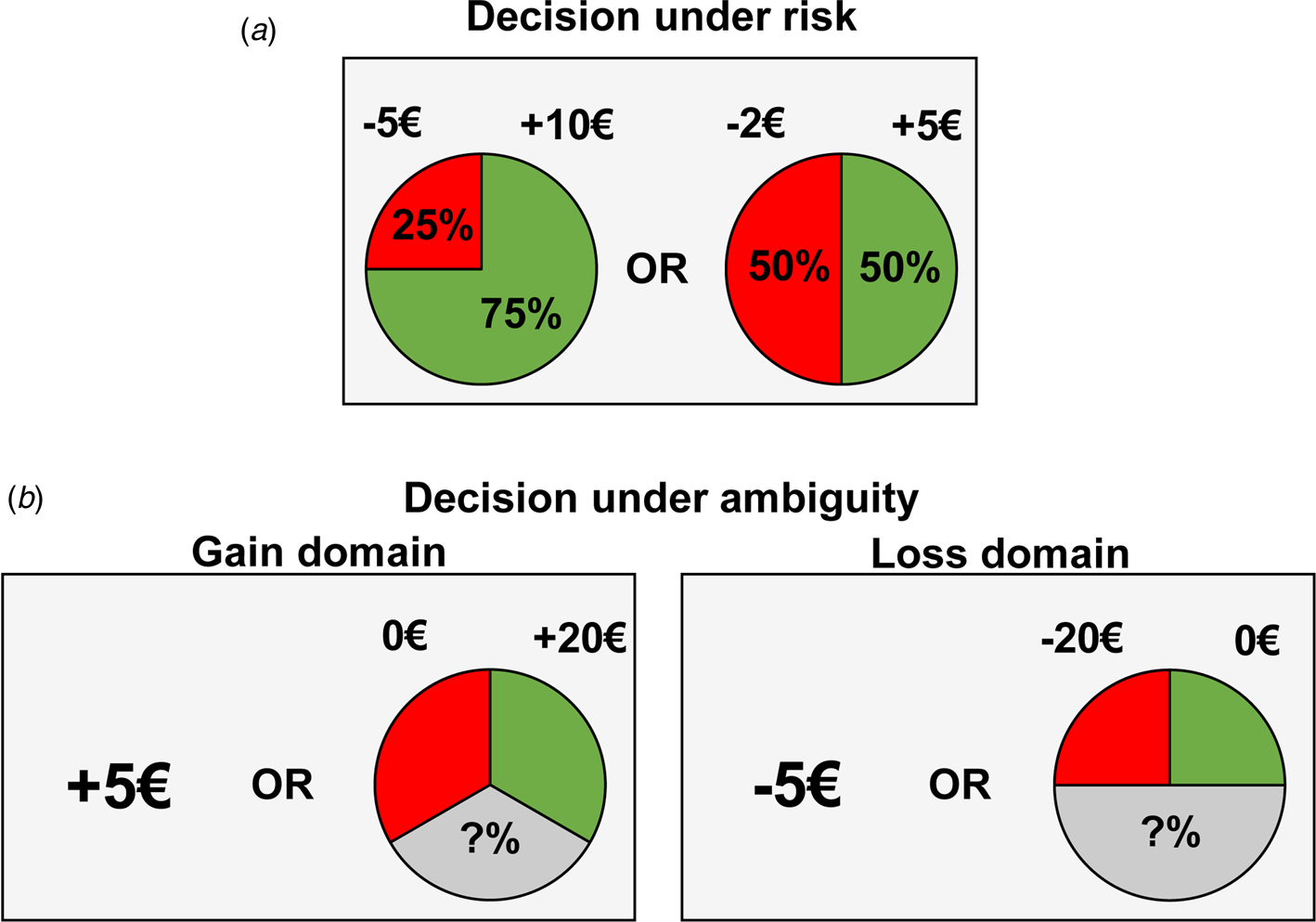
The task was programmed using Cogent in Matlab (Fig. 1a). A repeated binary decision-making task was designed based on mixed-outcomes probabilistic lotteries. For each trial, participants were presented with two wheels-of-fortune, which defined two options O k. Each O k option featured two potential outcomes: a potential gain G k with a probability of P k, and a potential loss L k with a probability of 1 − P k.
Experimental task for decision-making under risk (a) and ambiguity (b).

Option 1 was fixed for all trials, such that:


Option 2 was designed from the following set of features:


The task included 100 trials and followed an adaptive design (Daunizeau, Preuschoff, Friston, & Stephan, Reference Daunizeau, Preuschoff, Friston and Stephan2011) as implemented in the VBA toolbox (Daunizeau, Adam, & Rigoux, Reference Daunizeau, Adam and Rigoux2014). Briefly, we assumed that participants would use a simple version of prospect theory model to render their decisions (Kahneman & Tversky, Reference Kahneman and Tversky1979) (see below). On each trial, our adaptive algorithm selected option 2 to provide the best potential estimation of PT parameters, given the current estimation (i.e. selected option 2 that minimised traces of the variance–covariance matrix of the posterior parameters). Thereby, parameters were estimated online on a trial-by-trial basis. Analyses were performed with parameters estimated by this procedure on the last trial of the task (trial 100). In other words, each trial was based on the choice from the previous one in order to progressively estimate the parameters of the model.
Four free parameters were estimated (see online Supplementary method for details): r (utility curvature), λ (loss aversion), γ (probability distortion) and ω (choice inverse temperature).
These parameters could be interpreted as follows: r (utility curvature) is directly related to risk attitude so that risk-seeking profiles imply a high r value while risk-averse profiles are related to a lower r value; λ (loss aversion) describes a tendency to avoid losses than acquiring equivalent gains (high value); γ (probability distortion) relates to the overestimation of low-probability events and the underestimation of high-probability events; ω (choice inverse temperature) characterises a propensity to select high-valued options (high values) or to explore lower-valued options (low values).
Decision-making under ambiguity
The task was adapted from Levy et al. (Reference Levy, Snell, Nelson, Rustichini and Glimcher2010) programmed using Cogent in Matlab (Fig. 1b). Similarly to Tymula, Rosenberg Belmaker, Ruderman, Glimcher, and Levy (Reference Tymula, Rosenberg Belmaker, Ruderman, Glimcher and Levy2013), we designed two symmetrical valence conditions (in gains and loss domains). At each trial, participants were presented with two wheels-of-fortune which defined two options O k. Each option O k featured two potential outcomes based on a probability which was partly known (P k) and partly masked (Ak), so-called ambiguity parameter: a potential gain G k ≠0 or an absence of gain G k = 0.
Option 1 was fixed for all trials, such that G 1 = 5 for the gain condition and G 1 = −5 for the loss condition.
Option 2 was designed from the following set of features:


The task included 80 trials, 40 under each condition, all presented in random order.
The model features three free parameters: r (utility curvature), β (ambiguity aversion) and ω (choice inverse temperature). We estimated one set of parameters (r, β, ω) per valence condition (gains and losses), leading to a total of six free parameters (hereafter referred to as r G, β G, ω G, r L, β L, ω L).
This additional parameter (β, ambiguity aversion) could be interpreted as summarising the preference for situations where risks are known (high value).
Statistical analyses
All statistical analyses were performed using R (R Core Team, 2013) and Matlab (Matlab, 2018). Demographic and clinical comparisons between individuals with TS and HC participants were completed using two-sample t tests or χ2 and were confirmed using Bayesian analyses. We considered as significant any effect with p values ⩽ 0.05 and a Bayesian factor (bf) ⩾ 3.
Regarding the main parameters, our approach to systematically investigate decision-making under risk and ambiguity in TS followed three steps: (i) we assessed whether individuals with TS differed from HC on any of the decision-making parameters estimated from our computational model, independently (univariate analysis); (ii) we combined all decision-making parameters, and evaluated whether they can jointly account for differences between individuals with TS and HC (supervised multivariate analysis) and (iii) we used a data-driven approach to explore the potential presence of sub-groups, and the role of comorbidities (unsupervised multivariate analysis).
Univariate analysis: t tests and correlations
First, we compared parameter values between HC and TS patients and TS subgroups (i.e. TS with ADHD v. TS without ADHD, TS with OCD v. TS without OCD, TS under medication v. TS unmedicated). These comparisons were achieved by using two-sample t tests and Bayesian t tests. In addition, correlations between tic severity (YGTSS/50) were performed for all individuals with TS using correlations and Bayesian correlations. We considered as significant any effect with p values ⩽ 0.05 and a bf ⩾ 3.
Supervised multivariate analysis: random forest
Subsequently, we performed a supervised multivariate classification using a random forest algorithm (Cutler, Cutler, & Stevens, Reference Cutler, Cutler, Stevens, Zhang and Ma2012; Tin Kam Ho, 1995) (5000 decision trees) with permutations (n = 1000) between HC and TS groups and between TS subgroups (i.e. TS with ADHD v. TS without ADHD, TS with OCD v. TS without OCD, TS under medication v. TS unmedicated). Random forest algorithms first divide the whole dataset into several subsets (called ‘bagging’), then produce various decision trees (5000 in our case) and finally combine the vote of each tree. This approach utilises several predictors simultaneously, which is more appropriate than simple decision trees. Here, implementing the permutation approach allows us to produce a null distribution by permuting the response variable and then to calculate a p value for the importance of each predictor in the classification. This importance corresponds to the loss of model accuracy (so-called ‘mean decreased accuracy’ and is expressed as percentage) if a predictor is removed from the analysis. For results, we reported the mean decreased accuracy of each predictor and their p values and the general accuracy of the model and its p value. We considered significant any p values ⩽ 0.05. This second approach identifies group differences by taking all parameters into account simultaneously. In other words, while we can find no difference by taking our parameters one by one, the association of several parameters taken together could reinforce the ability to find differences between our groups.
Unsupervised multivariate analysis: hierarchical clustering
Lastly, we performed an unsupervised multivariate classification using agglomerative hierarchical clustering on principal component analysis (Maimon & Rokach, Reference Maimon and Rokach2010). This clustering technique involved building a principal component analysis which is a method to simplify data complexity by reducing it into fewer dimensions. Next, the agglomerative hierarchical clustering builds several clusters of participants whose number is selected by a method called ‘higher relative loss of inertia’. This criterion selects the number of clusters with the smaller within-class variability (i.e. individuals in the same cluster are close to each other) and the larger between-class variability (i.e. individuals in different clusters are far from each other). After this classification, we compare participants of each cluster regarding their groups (HC, TS, with ADHD, with OCD, medicated), their demographic and clinical characteristics, and their computational parameters by using inferential (analysis of variance and χ2) and Bayesian analyses. We considered as significant any effect with p values ⩽ 0.05 and a bf ⩾ 3. This third approach can identify possible subgroups of patients with abnormal behaviours. In other words, it can reveal if an absence of difference between groups is because abnormal behaviours are only related to a subgroup of patients, which is masked by other subgroup(s) with expected behaviours.
Results
Demographic results
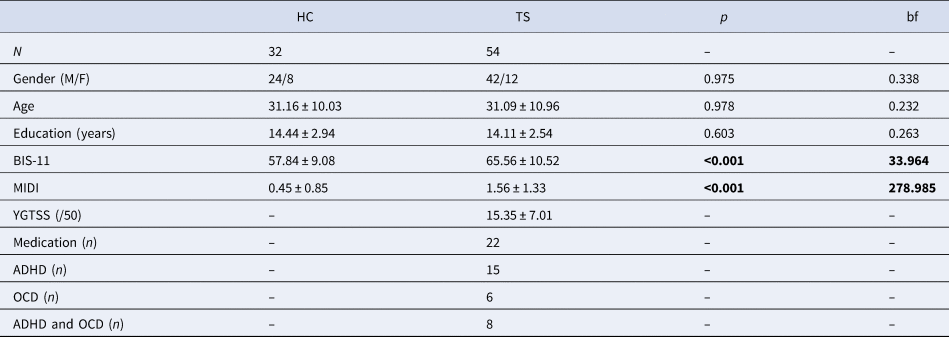
Ten individuals with TS and two HC were excluded from our final analyses due to incomplete data. The final sample involved 54 individuals with TS and 32 HC participants (Table 1).
Demographics and clinical characteristics of the participants

ADHD, attention deficit/hyperactivity disorder; bf, Bayesian factor; BIS, Barratt Impulsiveness Scale; F, female; HC, healthy control participants; M, male; MIDI, Minnesota Impulse Disorders Interview; OCD, obsessive–compulsive disorder; TS, Tourette syndrome participants; YGTSS, Yale Global Tic Severity Scale. Bold corresponds to significant effects.
No significant differences were found between subgroups of TS patients and HC participants regarding demographic variables (p > 0.6; bf < 0.34). TS patients showed higher general impulsivity as measured by the BIS-11 (p < 0.001; bf = 33.964); and a higher number of impulsive behaviours as measured by the MIDI (p < 0.001; bf = 278.985).
Approach 1: univariate analysis
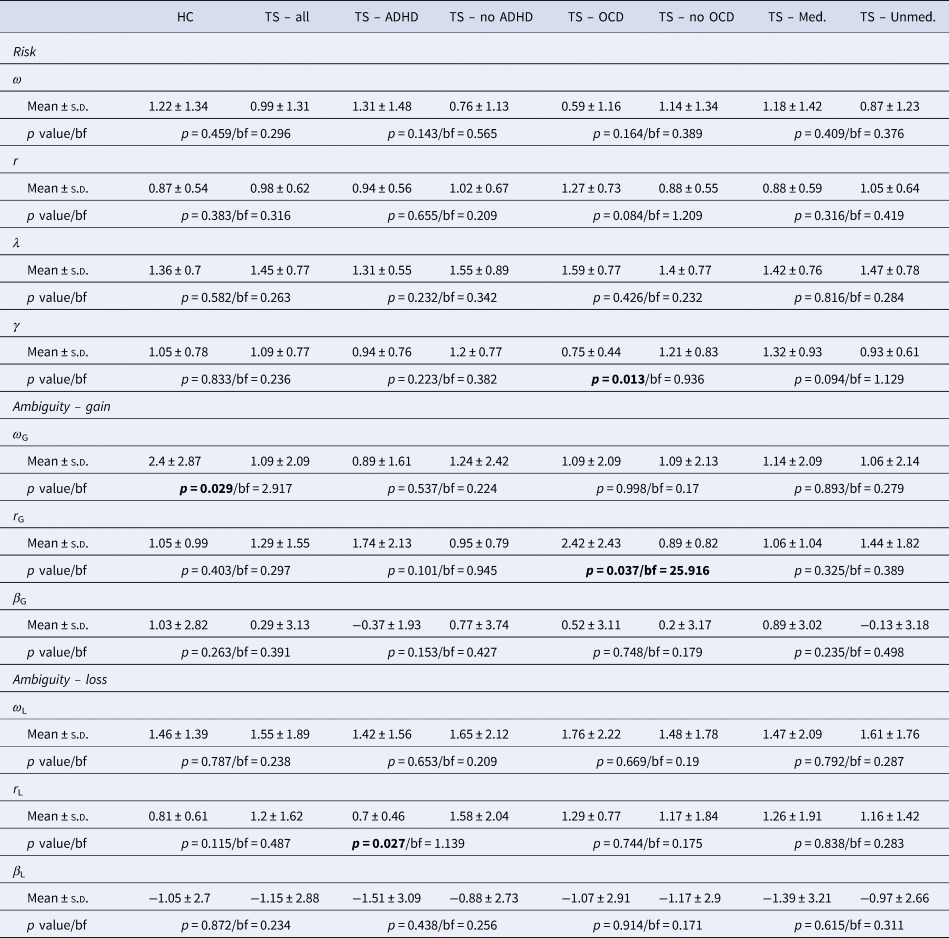
Regarding the models' parameters (Table 2), we found only one difference between HC and TS on the ω parameters during the task of ambiguity gain (p = 0.029). However, this effect was not supported by the Bayesian analysis (bf = 2.917).
Means and standard deviations for each parameter of the tasks and groups in comparison with inferential and Bayesian t tests

ω, choice inverse temperature; r, utility curvature; λ, loss aversion; γ, probability distortion; β, ambiguity aversion; ADHD, attention deficit/hyperactivity disorder; bf, Bayesian factor; HC, healthy control participants; OCD, obsessive–compulsive disorder; s.d., standard deviation; TS, Tourette syndrome participants; YGTSS, Yale Global Tic Severity Scale. Bold corresponds to significant effects.
TS subgroup analyses revealed only one difference supported by two analyses: the r G parameter (i.e. the utility curvature estimated during the task of ambiguity in gain domain) between individuals with TS with and without OCD (p = 0.037, bf = 25.916). Two other effects were found, which were only supported by classical t tests (r L between TS with and without ADHD: p = 0.027, bf = 1.139; γ between TS with and without OCD: p = 0.013, bf = 0.936). No significant difference was found between medicated and unmedicated patients.
There were no significant correlations between any parameter and tic severity (YGTSS/50; p > 0.097; bf < 1.076; online Supplementary Table S1).
Approach 2: supervised multivariate analysis
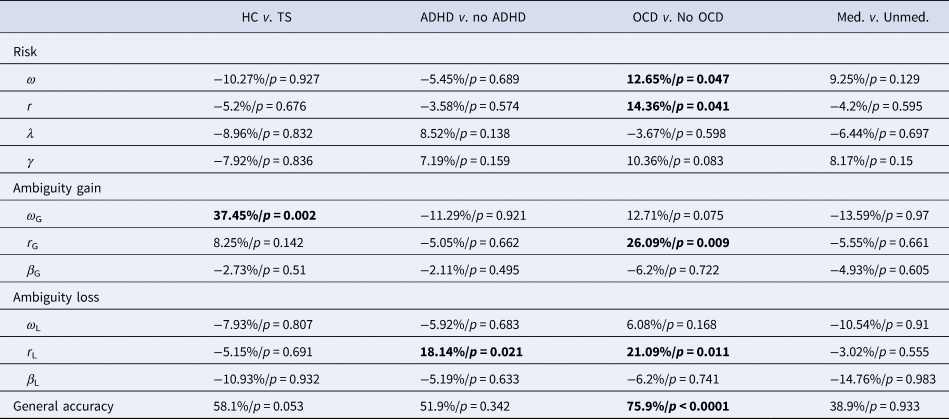
The random forest model between HC and TS did not lead to a satisfying accuracy (58.1%, p = 0.053) even if one parameter seems relevant (ω G: mean decreased accuracy = 37.45%, p = 0.002; Table 3). The model which compared individuals with TS with and without OCD was the only one with significant accuracy (75.9%, p < 0.0001) in contrast to models focused on ADHD (accuracy = 51.9%, p = 0.342) and on medication (accuracy = 38.9%, p = 0.933). On the OCD model, the r parameter had significant importance in all three tasks (p < 0.041) associated with ω during the risk task (p = 0.047).
Random forest models' results showing the mean decreasing accuracy, the p values (computed following permutations) and the general accuracy

ω, choice inverse temperature; r, utility curvature; λ, loss aversion; γ, probability distortion; β, ambiguity aversion; ADHD, attention deficit/hyperactivity disorder; HC, healthy control participants; OCD, obsessive–compulsive disorder; TS, Tourette syndrome participants. Bold corresponds to significant effects.
Approach 3: unsupervised multivariate analysis
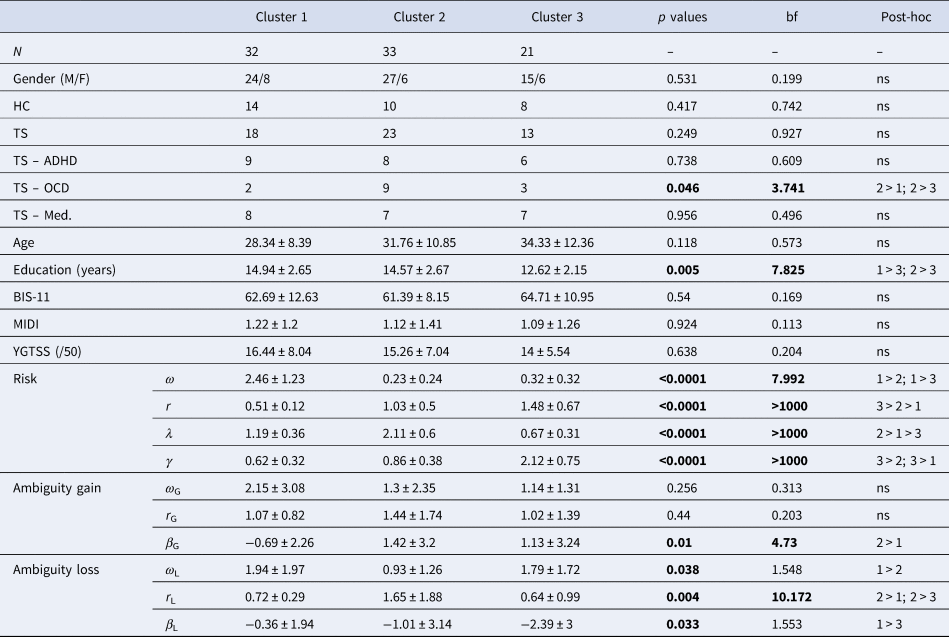
The hierarchical clustering algorithm determined that the optimal number of clusters is 3. The clusters obtained differentiate on all parameters of the risk task (p < 0.0001, bf > 7.992), on β G (p = 0.01, bf = 4.73), r L (p = 0.004, bf = 10.172) and partially on ω L (p = 0.038, bf = 1.548) and β L (p = 0.033, bf = 1.553; Table 4) parameters. Regarding the demographic and clinical differences between all three clusters, we found an over-representation of TS patients with OCD in cluster 2 (p = 0.046, bf = 3.741) and a lower education level in cluster 3 (p = 0.005, bf = 7.825). No difference was found regarding the distribution of HC, all TS, TS with ADHD or medicated TS. Additionally, we report no difference in age, BIS-11, MIDI and YGTSS/50.
Demographics and clinical characteristics of the three clusters obtained with the hierarchical clustering

ω, choice inverse temperature; r, utility curvature; λ, loss aversion; γ, probability distortion; β, ambiguity aversion; ADHD, attention deficit/hyperactivity disorder; bf, Bayesian factor; BIS, Barratt Impulsiveness Scale; F, female; HC, healthy control participants; M, male; MIDI, Minnesota Impulse Disorders Interview; OCD, obsessive–compulsive disorder; TS, Tourette syndrome participants; YGTSS, Yale Global Tic Severity Scale. Bold corresponds to significant effects.
In detail, the first cluster could be characterised as more aversive to risk and ambiguity in a context of loss (higher ω, ω L and β L; lower r and β G). The second cluster corresponded more to a profile aversive to loss, thus with a risk-taking behaviour aiming to decrease a potential loss (higher λ and r L; lower ω, ω L and γ). The third cluster is characterised by a higher propensity to play in a context of risk, but not of ambiguity, especially when it involves a potential loss (higher r and γ; lower ω, λ, r L and β L).
Discussion
We found no overall risk-taking behaviour in TS compared to controls, using dedicated risk and ambiguity decision-making tasks. Of note, individuals with TS have noisier decisions (i.e. less consistent), likely reflecting response inconsistencies or tendency for exploration. Distortion of the decision-making process in this context was rather related to comorbidities, such as OCD or ADHD, than to TS per se. Our findings are important for clinical practice, as they may indicate management of risk-taking issues in everyday life of individuals with TS should focus on treating comorbidities.
TS have noisier decisions in context of ambiguity for a gain
We found that individuals with TS, in comparison with HC, had a lower inverse temperature parameter (ω) in context of ambiguity for a gain, which reflected a higher selection in TS of non-maximal expected values, corresponding to a higher response inconsistency. As this parameter tends to increase with age and brain maturation (Palminteri, Kilford, Coricelli, & Blakemore, Reference Palminteri, Kilford, Coricelli and Blakemore2016), a decrease of this parameter might reflect brain immaturity at a behavioural level as was previously suggested in adults with TS at a brain network level (Nielsen et al., Reference Nielsen, Gratton, Church, Dosenbach, Black, Petersen and Greene2020; Worbe et al., Reference Worbe, Marrakchi-Kacem, Lecomte, Valabregue, Poupon, Guevara and Poupon2015). Alternatively, a lower inverse temperature parameter (ω) could reflect exploratory behaviour in TS. Brain imaging studies reported that this tendency to explore environment could be associated with an increased dopamine tone within the prefrontal cortex (Badre, Doll, Long, & Frank, Reference Badre, Doll, Long and Frank2012; Frank, Doll, Oas-Terpstra, & Moreno, Reference Frank, Doll, Oas-Terpstra and Moreno2009), a key alteration in TS pathogenesis (Maia & Conceição, Reference Maia and Conceição2017, Reference Maia and Conceição2018; Palminteri et al., Reference Palminteri, Lebreton, Worbe, Grabli, Hartmann and Pessiglione2009, Reference Palminteri, Lebreton, Worbe, Hartmann, Lehéricy, Vidailhet and Pessiglione2011; Yoon, Gause, Leckman, & Singer, Reference Yoon, Gause, Leckman and Singer2007).
Risk-taking behaviours and experimental risk evaluation in TS
Our main result is that TS was not associated with abnormal decision-making behaviours in contexts of risk or ambiguity (i.e. no difference with HC, no correlation with tics severity and no medication effect).
Indeed, individuals with TS may not have risk or ambiguity valuation impairment. If no previous study was performed on this population, several studies on frequent TS-related comorbidities such as ADHD and OCD could support this hypothesis (Cavedini, Gorini, & Bellodi, Reference Cavedini, Gorini and Bellodi2006; Humphreys et al., Reference Humphreys, Tottenham and Lee2018; Kim et al., Reference Kim, Kang, Namkoong, Jhung, Ha and Kim2015; Norman et al., Reference Norman, Carlisi, Christakou, Murphy, Chantiluke, Giampietro and Rubia2018; Starcke, Tuschen-Caffier, Markowitsch, & Brand, Reference Starcke, Tuschen-Caffier, Markowitsch and Brand2009, Reference Starcke, Tuschen-Caffier, Markowitsch and Brand2010). However, this is unlikely since individuals with TS have a frequent involvement in real-life risky behaviours, as demonstrated by a higher probability of premature death (Fernández de la Cruz & Mataix-Cols, Reference Fernández de la Cruz and Mataix-Cols2020; Meier et al., Reference Meier, Dalsgaard, Mortensen, Leckman and Plessen2017).
One explanation could be that our task did not accurately capture risk and ambiguity valuation processes. Experimental tasks as used in this study measure traits and performance at the time of the study rather than their average over an extended time period meaning that risky and ambiguous behaviours are considered stable ‘traits’ (Palminteri & Chevallier, Reference Palminteri and Chevallier2018). Moreover, contextual factors (such as the nature of rewards) and task parameters (e.g. 2D v. 3D objects, time pressure, cognitive load) can modify preference for risk (Betsch, Haberstroh, Molter, & Glöckner, Reference Betsch, Haberstroh, Molter and Glöckner2004; De Petrillo et al., Reference De Petrillo, Paoletti, Bellagamba, Manzi, Paglieri and Addessi2020; Kocher & Sutter, Reference Kocher and Sutter2006; Wang, Feng, & Keller, Reference Wang, Feng and Keller2013). For example, it was reported that high risk-takers in recreational domains only express moderately risky behaviours when making financial decisions (Hanoch, Johnson, & Wilke, Reference Hanoch, Johnson and Wilke2006). Risk-taking in TS adolescents was associated with maladaptive behaviours in classroom settings but not in other public situations (Brandt, Kerner auch Koerner, & Palmer-Cooper, Reference Brandt, Kerner auch Koerner and Palmer-Cooper2019). Thus, risk-taking and ambiguity evaluation in TS as a group might not be affected in financial decision-making as assessed in this study. However, TS patients might still express a risk-taking attitude in some other domains such as, sensation or novelty seeking.
Involvement of individuals with TS in a risky situation might not depend on impairment of risk and ambiguity valuations per se but rather due to other factors that were not measured by our tasks. Indeed, a novel conceptualisation puts forth that risk propensity is rather a situation-specific trait. It is contingent upon the domain in which risks are presented and rely on personality traits (i.e. impulsiveness), thus refuting the idea that decision-making is a consistent pattern (Bran & Vaidis, Reference Bran and Vaidis2020; Howat-Rodrigues et al., Reference Howat-Rodrigues, Tokumaru and Izar2018; Peters, Västfjäll, Gärling, & Slovic, Reference Peters, Västfjäll, Gärling and Slovic2006). Therefore, involvement in a real-life risky situation might be contingent upon a need for arousal and sensation-seeking characterised by an attraction to novel experiences (Lauriola, Panno, Levin, & Lejuez, Reference Lauriola, Panno, Levin and Lejuez2014). For example, risky driving behaviours were strongly associated not with an impaired risk-valuation process but rather with sensation-seeking (Dahlen, Martin, Ragan, & Kuhlman, Reference Dahlen, Martin, Ragan and Kuhlman2005). In addition, it is worth noting that sensation-seeking is related to the mesolimbic and mesocortical dopaminergic pathways, both connecting the ventral tegmental area with respectively the ventral striatum and the prefrontal cortex (Romer, Reyna, & Satterthwaite, Reference Romer, Reyna and Satterthwaite2017). Both of these pathways suggested to be involved with tics expression (Atkinson-Clement et al., Reference Atkinson-Clement, Porte, de Liege, Klein, Delorme, Beranger and Worbe2020; Worbe et al., Reference Worbe, Sgambato-Faure, Epinat, Chaigneau, Tandé, François and Tremblay2013).
Alternatively, affective dysfunctions in TS might increase one's involvement in real-life risky situations. TS patients' emotional reactivity is significantly increased when processing social stimuli (Rae et al., Reference Rae, Polyanska, Gould van Praag, Parkinson, Bouyagoub, Nagai and Critchley2018) with a subsequent reduction in logical decision-making (Eddy & Cavanna, Reference Eddy and Cavanna2013). In fact, emotional processes are said to redirect attentional processes to other characteristics of the situation (Weber, Siebenmorgen, & Weber, Reference Weber, Siebenmorgen and Weber2005), change the subjective valuation of an outcome (Tversky & Kahneman, Reference Tversky and Kahneman1992) and influence choice processes itself (Figner & Weber, Reference Figner and Weber2011). TS patients might therefore express an affective response or arousal in response to a particular outcome but still might be able to ignore this response in favour of a more deliberate valuation of risk (Skagerlund, Forsblad, Slovic, & Västfjäll, Reference Skagerlund, Forsblad, Slovic and Västfjäll2020).
Unexpectedly, we found no difference between medicated and unmedicated TS. To our knowledge, no studies addressed the effect of aripiprazole – the most frequent medication in our group and one of the most frequently used drugs for TS (Cox & Cavanna, Reference Cox and Cavanna2021) – on risk-preference behaviours, despite several reports of onset of gambling disorder under treatment with this compound in various neuropsychiatric disorders (Etminan et al., Reference Etminan, Sodhi, Samii, Procyshyn, Guo and Carleton2017), putatively related to the alteration of risk-taking decision making (Schluter & Hodgins, Reference Schluter and Hodgins2021). However, one study using brexpiprazole, an antipsychotic close by action mechanism to aripiprazole, showed to reduce risk-preference in rodent models (Milienne-Petiot, Geyer, Arnt, & Young, Reference Milienne-Petiot, Geyer, Arnt and Young2017). Thus, further studies are required to elucidate the effects of partial dopaminergic agonists such as aripiprazole on decision-making processes under risk and ambiguity.
Based on this finding and our results, we speculate that tics and medication with aripiprazole had no effect on risk preference and that comorbidities are more likely to influence abnormal decision-making in risk and ambiguity contexts.
ADHD is associated with a lower risk-seeking to avoid losses in a context of ambiguity
Association of ADHD with TS induced a decreased utility curvature in context of ambiguity loss (r L) in comparison with patients without ADHD. This suggests that individuals with TS and ADHD were more risk-seeking in this context to decrease a potential loss (i.e. they choose the option that could lead to avoid a loss instead of choosing the option with a guaranteed small loss). Many factors such as how rewards were presented, age and even ADHD subtypes influence decision-making process under risk in ADHD free of tics (Groen, Gaastra, Lewis-Evans, & Tucha, Reference Groen, Gaastra, Lewis-Evans and Tucha2013). Overall, ADHD was suggested not to be associated with risk-taking as defined by behavioural economy theories (Pollak et al., Reference Pollak, Oz, Neventsal, Rabi, Kitrossky and Maeir2016; Schonberg, Fox, & Poldrack, Reference Schonberg, Fox and Poldrack2011) but more associated with suboptimal decisions when the outcomes chosen were not beneficial in terms of expected value (Pollak et al., Reference Pollak, Oz, Neventsal, Rabi, Kitrossky and Maeir2016). Indeed, while patients with severe ADHD symptoms tend to adopt riskier attitudes, it was not because of risk-seeking behaviours per se but rather because the perception of such behaviours were appealing to them (Pollak et al., Reference Pollak, Oz, Neventsal, Rabi, Kitrossky and Maeir2016; Shoham, Sonuga-Barke, Aloni, Yaniv, & Pollak, Reference Shoham, Sonuga-Barke, Aloni, Yaniv and Pollak2016). Further studies found that the perception of benefits and not risk perceptions explained associations between ADHD symptoms and risky behaviours (Shoham, Sonuga-Barke, Yaniv, & Pollak, Reference Shoham, Sonuga-Barke, Yaniv and Pollak2020).
OCD is associated with a higher risk-taking to increase gain in a context of ambiguity and a higher risk-aversion under conditions of loss under risk and ambiguity
TS patients with OCD showed more risk-taking behaviour in a context of ambiguity and gain. These patients' groups also showed more aversion to risk and ambiguity in the context of gain and less in the context of ambiguity for a loss. While previous research suggested that OCD was essentially associated with risk-aversion (Sip, Muratore, & Stern, Reference Sip, Muratore and Stern2016), they also found that patients with OCD have suboptimal decisions, especially in context of gain (George, Sheynin, Gonzalez, Liberzon, & Abelson, Reference George, Sheynin, Gonzalez, Liberzon and Abelson2019) likely due to altered values perception. This is in line with our results since our patients with comorbid OCD showed a propensity to risk-taking in order to increase a reward instead of assuring a lower one. They also showed risk-aversion in context of loss, as it was already described in OCD (Sip, Gonzalez, Taylor, & Stern, Reference Sip, Gonzalez, Taylor and Stern2018).
Limitations
The present study had some limitations. First, we based our hypothesis on several studies which reported an increased propensity for risky behaviour in everyday life related to TS leading to premature deaths (Chen et al., Reference Chen, Su, Wang, Hsu and Shen2019; Fernández de la Cruz & Mataix-Cols, Reference Fernández de la Cruz and Mataix-Cols2020; Mataix-Cols et al., Reference Mataix-Cols, Brander, Chang, Larsson, D'Onofrio, Lichtenstein and Fernández de la Cruz2021; Meier et al., Reference Meier, Dalsgaard, Mortensen, Leckman and Plessen2017). However, a population-based design of these studies, that favour a relatively small effect, can explain the discrepancy with the present results. Therefore, even if the sample size used in our study was relatively high and the statistical analyses were accurate, we cannot exclude that we missed an effect of very small amplitude. Second, our task captured the risk and ambiguity valuation processes in financial decision making. However, people with TS might express propensity to risky decisions in other domains such as sensation or novelty seeking. Third, OCD and ADHD comorbidities are phenomenologically at opposite ends of the behavioural spectrum and might be also with regards to the risk taking, which could affect our results. To further unravel the question of contribution of ADHD and OCD on decision under the risk and ambiguity, further studies comparing TS, ADHD and OCD are needed.
Supplementary material
The supplementary material for this article can be found at https://doi.org/10.1017/S0033291722002318
Acknowledgements
We are very grateful to the patients who agreed to participate in this study.
Financial support
This work was supported by the National Research Agency (ANR-18-CE37-0008-01), French Tourette Syndrome Association (AFSGT) and Fondation pour la Recherche Médicale (FRM).
Conflict of interest
None.
Ethical standards
The authors assert that all procedures contributing to this work comply with the ethical standards of the relevant national and institutional committees on human experimentation and with the Helsinki Declaration of 1975, as revised in 2008.