Central to the transformation of global mining in the late nineteenth century was a transnational elite of American engineers. Expertise, technology, and management techniques circulated mineral industries around the globe through the conduit of American engineers. This class of industrial professionals were also the agents of a form of inter-imperial collaboration between British financial capital and American expertise that transformed the management of global mining in formal and informal imperial contexts across the world.
The present discussion focuses on a group of expatriate American mining engineers in southern Africa as a testing ground for exploring the circulations inherent in late nineteenth-century inter-imperial exchange. In doing so it participates in a rich historiography on the flourishing world of transnational collaborations between empires in this period.Footnote 1 This scholarship reveals the remarkable variation in inter-imperial connections across colonial contexts that encompassed shared missionary endeavour, agricultural reform, and imperial subcontracting.Footnote 2 American engineers were part of a class of transnational specialists, which included professionals, army officers, and agricultural researchers, who collaborated in the subcontracting of colonial infrastructure projects in British and European empires worldwide.Footnote 3 These engineers were central to imperial projects in the Caribbean, Cuba, and Central America, where corporate expansion and strategies of racial control extended hand in hand.Footnote 4 Anglo-American inter-imperial connections were especially prominent. Transnational American engineers disseminated new industrial techniques and technologies around the world as they hitchhiked across the imperial pathways created by Britons before them. They joined the British engineering diaspora and built bridges in Uganda, Burma, and Sudan on behalf of the British Army, and installed railways and steam engines across the empire; in the process they allied American expertise with British corporate capital and financial power.Footnote 5
Taken as a whole, these works reveal the reciprocity of empires in the ‘first’ era of globalization. What follows connects the transnational histories of Anglo-American inter-imperial exchange and global industrial capitalism with the racial knowledge, strategies, and technologies central to the international mineral industry and the intellectual discussion of white colonial rule in the final third of the nineteenth century. The first section uncovers an overlooked American world of migrants, commodities, and culture in the burgeoning communities surrounding the diamond mines of Kimberley and on the gold fields of the Transvaal and Orange Free State. This self-described ‘colony’ rapidly extended the United States’ footprint in southern Africa by importing new technologies and commodities, but simultaneously anchored British rule in the region and the dominance of British industrial capitalists and financiers over its economy.
US engineers exerted a powerful influence over the transformation of racial labour regimes in South Africa, the subject of the second section. American engineers did not simply transplant US racial formations but viewed the racial segregation of labour in South Africa through the distorting lens of experiences in the western United States, where mine managers were responsible for deciding which ‘races’ could live in the ‘white man's’ camp; and through experiences managing racially segregated workers on the Caratel gold field of Venezuela.Footnote 6 A number of works examine the construction of white supremacy in the United States and South Africa from a comparative perspective.Footnote 7 In contrast, the present article focuses on the centrality of American engineers to an unfolding transnational dialogue on the techniques required to manage racially divided labour worldwide. These connections were assembled and sustained by a transnational elite of American mine engineers in motion between mineral industries around the world. After leaving the Rand, US engineers diffused across the globe, extending the collaborations of British financial capital and American mining expertise to areas of Anglo-American informal economic empire, explored in the closing section of this article. US mine management practices were deployed in Mexico and Central and South America, where they were adapted to suit local mineral industries, as discussed below.
In historiographic terms, the engineering of inter-imperialism explored here illuminates our view of global history in three ways. First, it casts light on the way in which imperial interconnections acted as a subspecies of late nineteenth-century globalization. On the Rand, specialist inter-imperial connections were mobilized by the mechanisms of imperial globalization and in turn prompted new forms of international cooperation. These included the power of international financial capital to mobilize transnational networks, the emergence of an international community of engineering experts to organize those networks, and the spread of scientific and technical knowledge between regions and empires. Second, it reveals the way in which culture travelled with and was transformed by industrial managers and technical expertise. Racial knowledge was interwoven with technological collaborations, connecting the vocabularies of ‘civilization’ and global whiteness. Finally, connecting British South Africa and the United States in this way further highlights the importance of viewing empires as reciprocal, overlapping entities. The British journalist William T. Stead described this reciprocity in 1902 as ‘the touch of nature which makes the whole world kin’, but in fact great asymmetries were inhered in these processes that shed intense light on the architecture of global connection and comparison.Footnote 8
Americans among the Uitlanders
As the new imperialism of the late nineteenth century aggressively absorbed distant territories into proliferating imperial systems, Britain's South African possessions were transformed from a colonial outpost to the ‘commercial dynamo’ of the region.Footnote 9 Huge mineral strikes – diamonds at Kimberley in 1867 and gold on the Rand in 1886 – ‘wrenched South Africa out of her agricultural slough and hustled her into the modern world’.Footnote 10 Diamond and gold strikes prompted a settler boom in the region, while imports through Cape Town more than doubled between 1871 and 1875, and by 1886 1,000 miles of new railway lines connected the centres of mineral extraction in the interior with the seaports of Cape Town, Port Elizabeth, East London, and Durban.Footnote 11 Further discoveries of gold on the Witwatersrand in 1886 and of coal in Natal further fuelled a mineral revolution and ‘led to the development of by far the most industrialized economy on the African Continent’.Footnote 12 By 1898 the Boer South African Republic had become the world's largest producer of gold, accounting for nearly 28% of output.Footnote 13
The mining community that migrated to British South Africa and the Boer republics in this period came from every continent. Thousands flocked from England, Europe, America, and the gold fields of Australia, seeking a living from alluvial deposits at the confluence of the Vaal and Orange rivers in Griqualand West, on the dry diggings located on the farms of Dorsfontein and Bulfontein in the Orange Free State, and on the veldts of the Transvaal in the Boer South African Republic. After the opening of the interior provinces of Basutoland and Zululand in the 1880s, this international Uitlander labour force joined African migrants, forced and free, from many different parts of southern Africa. By the eve of the twentieth century more than 100,000 white Uitlanders worked on the Rand, with even more black Africans.Footnote 14
American engineers were appointed to top managerial positions at the new mines – especially as British capitalists began consolidating disparate pegged claims into efficient deep-level enterprises. An upcoming generation of US engineers with technical and managerial expertise from newly established technical schools was in high demand. As global mining operations increased in complexity, engineers were expected to organize mines, supervise labour, manage finances, evaluate equipment, and oversee the technical decisions of a variety of specialist tasks. Beginning with the founding of the Columbia School of Mines in 1867, American engineers cemented a global reputation as highly trained engineers in both technical and managerial roles. By 1893 more than twenty US schools offered degrees in mining, including Georgia Tech, Harvard's Lawrence Scientific School, the Colorado School of Mines, and the University of California, Berkeley.Footnote 15 A high degree of broad technical education was combined with practical experience from placer mining in California and on the Comstock Lode in Nevada, and from mines in Mexico and Latin America, essential for the development of mines in the colony.Footnote 16 With decreasing opportunities in the Golden State, many Californians joined exploration companies that sent them overseas or were attracted to South Africa by lucrative contracts from British Randlords such as Barney Barnato and Cecil Rhodes.Footnote 17
Typically, American engineers were recruited through the London-based Exploration Company Ltd, a joint-stock operation founded by the American mine engineers Hamilton Smith and Edmund De Crano and funded by the Rothschilds. It was an agency that specialized in the gathering of detailed geological and technical knowledge of potential mines and that provided expert advice and risk assessment for investors.Footnote 18 It was also a vital conduit in the transfer of skilled personnel, specialist knowledge, and innovative technologies across the globe. Through the company the American Henry Cleveland Perkins was appointed first general manager of Rand Mines at Boksburg, Hennen Jennings became chief engineer of Jules Porges & Co., his brother Sydney took up the post of superintendent of the Willows Silver Mine near Pretoria, and Charles Butters was enticed to join Wernher Beit & Co. as their chlorination specialist.Footnote 19 Such a London connection was essential for an entrée into the mineral industry of the British empire and the immense capital that lay behind it. ‘I have made excellent connections here’, wrote William Hammond Hall to his wife during a prolonged visit in 1896, adding that he had been ‘advertised among the very best people to have known me, and will come here at least once a year for a month or two’.Footnote 20
Others found their way to the Rand without the aid of joint-stock syndicates. Typically, American consulting engineers would hire a squad of specialists from previous diggings. John Hays Hammond, for instance, took up work as a consultant for Barney Barnato's Diamond Exploration Co. and subsequently employed a team of eight Americans in top managerial and engineering posts.Footnote 21 Hammond encouraged his engineers to bring further specialists, who, when joined with his original managers, became known as the ‘Hammond Men’.Footnote 22 In May 1895, Richard A. Parker of Denver was enticed to South Africa with a salary of £2,000 a year. ‘In case you come I wish you would bring with you four first class shaft sinkers’, Hammond wrote in his invite, adding that he would also take ‘a dozen’ other miners to undertake miscellaneous tasks ‘if they are really good “hustlers” and understand their business’.Footnote 23 When Hammond left to work for Cecil Rhodes's Consolidated Gold Fields and the British South Africa Company (which held rights to the development of deep-level mines in Mashonoland and Matabeland), he took many of these engineers with him.Footnote 24 Through these avenues American mining engineers became the ‘backbone of the South African mineral industry’ and controlled, in one estimate, ‘nearly 90 percent of the technical management of the mining industry’.Footnote 25
American technical expertise was applied to deep reefs of diamonds and gold that extended in parallel outcrops for as much as 40 miles east to west. In places these reefs tilted upwards toward the surface, which they breached in large outcrops, but in others they extended as far as 1,500 feet below the ground.Footnote 26 As Roger Burt has forcefully demonstrated, American engineers did not drive technological innovation in mining and milling technologies but proved adept at adapting and finessing existing techniques to diverse gold seams.Footnote 27 It was this versatility that was most sought after on the Rand. US engineers were employed to systematize extraction from the outcrop mines, develop deep-level mines, and equip the surface with stamping and milling technologies. Specialist deep-level engineers such as Hammond and Leslie Simpson, a University of California graduate, rapidly sank deep shafts so that the mines’ underground organization could be completed. On the surface, they refined the extraction techniques developed by European engineers, including the chemical leaching of tailings and the MacArthur–Forrest cyanide process that made the processing of low-grade ores possible and ensured the long-term profitability of the mines. They also supervised the installation of enormous stamp batteries for crushing mineral deposits and engineered vast irrigation systems and reservoirs to provide the water necessary for cleaning and sorting the deposits.Footnote 28
These were the elite organizers of a wave of migrants who hitchhiked to imperial borderlands on the back of British capital. Engineers were joined by artisanal birds of passage who migrated between mineral booms to take on specialist roles as pitmen, dynamiters, and engine drivers.Footnote 29 In all, several thousand American hands worked along the gold seam by the mid 1890s.Footnote 30 The Uitlanders of the Witwatersrand included between 2,5000 and 3,000 Americans.Footnote 31 By contrast, in the Cape Colony there were just 249 US residents in 1890, though this had doubled by the time of the outbreak of the Second Anglo-Boer War.Footnote 32 In addition to the diggers, engineers, and professionals there was a transient population of both black and white American missionaries in South Africa. By the turn of the twentieth century the American Board of Commissioners for Foreign Missions had opened schools, seminaries, dispensaries, and hospitals in the region and had translated the Bible into Zulu.Footnote 33 Similarly, the African Methodist Episcopal Church expanded into South Africa during the 1890s, ordaining local African ministers and appointing its own bishop, the Reverend Levi Jenkins Coppin, in 1900.Footnote 34
‘Johannesburg, in the Transvaal is like an American city’, reflected the Mining and Engineering Journal.Footnote 35 American migrants felt that they belonged to an ‘American colony’ in southern Africa.Footnote 36 The most important members of the ‘colony’ were mining engineers resident in Johannesburg, but it also included a transient group of travelling sales agents, missionaries, and tourists. The offices of the US consuls to Cape Town, Pretoria, and Johannesburg provided an offshore centre for the spread of news and information between members. Cohesion was cemented by a social calendar that featured dinners hosted by the group's prominent members, such as Henry C. Webb and Hennen Jennings, and through annual Independence Day celebrations.Footnote 37 Finally, an ‘American Society’ was established on the Rand to acclimatize recent arrivals to life in the Transvaal, to assist them in finding accommodation, and to provide them with an entrée into the world of the American ‘colony’.Footnote 38
By the late 1890s, US engineers and entrepreneurs had joined the British South Africa Company's (BSAC) pioneer columns and had pushed north of the Limpopo river to Salisbury, Bulawayo, and Victoria in Matabeleland in search of new opportunities.Footnote 39 These columns were manned by American citizens. Frederick Russell Burnham was joined by Pete Ingram and William Harvey Brown, who transferred skills garnered in the United States’ Native American wars to the colonial borderlands of southern Africa. John Hays Hammond wrote to Dr Frederick Rutherfoord Harris, secretary of the BSAC, recommending Henry Butters as the man who could lead ‘the colonization of Mashonoland and Matabeleland by Americans’.Footnote 40 In the context of the Rhodesian colonial hinterland, the collaborative inter-imperial synergies of American technical expertise and British financial and geopolitical priorities are laid bare. US engineers and the technologies they transferred and adapted, in collaboration with British investors and merchants, increased the capacity of the colonial state's ability to produce, rule, and expand. These sub-imperial agents brought new managerial practices to the empire, but also utilized its technologies, institutions (in this case the BSAC), and state aid to advance their own commercial interests.Footnote 41
Trade followed in the wake of American migrants. Outposts of offshore America both constituted a market in themselves and manoeuvred US products into the settler colonial marketplace. American mine managers and engineers imported US-made equipment and informed American companies of germane investment opportunities on the Rand.Footnote 42 Between them, the Ingersoll Rock Drill Company, Milwaukee's Edward P. Allis Company, and Chicago's Fraser and Chalmers dominated the supply of steam engineering, mining drills, and pneumatic shovels.Footnote 43 Men and machinery were transported across the veldt on American rolling stock and mule trains and were taken below ground on lifts installed by the Otis Elevator Company, of Yonkers, New York.Footnote 44 These lifts were in turn powered by generators made by either the General Electric Company, operating under its subsidiary the South African General Electric Company, or the Westinghouse Electric Company of Pittsburgh.Footnote 45 Oregon pine and Portland cement supported the labyrinth of tunnels and shafts below the surface. McCormick's reapers, binders, and harvesters tilled South African farmland, which was itself enclosed by American-made barbed wire.Footnote 46
The success of US trade in the region owed a great deal to the British imperial transport infrastructure, benefiting especially from new Pacific steamship routes opened in the 1870s.Footnote 47 Improved communications facilitated the spread of knowledge about the region in the US, boosting American settlement in the area, which in turn acted as the mechanism for further market penetration. Additional advantages were gained through special legislation that allowed mining, railroad, and agricultural supplies to enter the Transvaal duty-free. American trade with South Africa mushroomed. By the turn of the century the United States was the largest supplier of heavy equipment to South Africa's gold mines and was the second largest of all importers – a position it would retain until 1907.Footnote 48 ‘Not only have America[n] brains had a great deal to do with the development of the new mines in the Transvaal’, bragged the Los Angeles Times, ‘but even American machinery is employed there in preference to the mining machinery of England, France, and Germany.’Footnote 49
This settler-commercial outpost did not pass unnoticed and was dubbed in one instance the ‘commercial romance of the century’.Footnote 50 A simmering discussion over the necessity of colonies as outlets for domestic industries in the United States prompted intense interest in global developments, but particularly in placing the United States within the processes of ‘civilization’. Americans took an abiding interest in the British empire's fate in South Africa because the processes of ‘civilization’ – innovative communication and transportation technologies, new flows of capital and commodities, and the unprecedented movement of migrants and indentured labourers – had seemingly converged there at a rapid pace. ‘The field is great and Africa holds out her hands for a share in the blessings of civilization’, wrote New York's Albion, while the city's Observer and Chronicle described it as an ‘Elysium’ for investors and entrepreneurs.Footnote 51 ‘The glittering spoil thus discovered’, added the New York Times in 1871, ‘will be the means of swiftly colonizing that magnificent country, and we may hope of bringing speedy enlightenment and civilization to the unfortunate millions that people the African continent.’Footnote 52
Markets would be the vessel from which civilization's alleged blessings of God, gold, and good government would pour. Mine engineers depicted themselves as the agents of civilization. ‘In the new gospel of industrial awakening’, wrote Charles Buxton Going, American editor of the Engineering Magazine, ‘the engineer is the missionary’. He was the ‘pioneer’ responsible for ‘the introduction of civilized living, stable and honest government, and wealth-making power’ that brought ‘enormous benefits to the new land, and at the same time afford enormous new markets, with all the advantages they imply, to the home country’. Race was central to this conception of market-driven civilization. ‘The most significant movement of the times’, Going continued, ‘is the infusion of occidental life, and especially of Anglo-Saxon vitality, into long dormant countries.’ Anglo-American inter-imperial connections would, therefore, guarantee the ‘fuller development of the most backward and least-contributing portions’.Footnote 53
What has been termed ‘engineering imperialism’ enhanced the infrastructure of the imperial state and by extension its capacity to deploy the technologies of rule and expansion, which had destabilizing effects upon recipient societies.Footnote 54 Alongside this, technological transfer was also essential in nurturing strategies of racial management. It was through migrant engineers that the concepts and strategies of racial management were circulated and refined. Plying a rich seam of popular anthropological and ethnographical knowledge, their observations joined a thriving transnational debate over the solution to the global ‘race problem’. Broadly conceived, they contributed to the creation of a body of allegedly specialist knowledge on racial characteristics and the global dimensions of regional race problems. This article now turns to the dense web of transnational discussions of race management among the non-state actors that created and sustained the technologies of global interconnection.
Race, labour, and civilization on the diamond and gold fields
The varied coalition of American travellers, engineers, and diggers sent back a stream of published travel accounts to the United States. British South Africa interested US readers for a variety of reasons, based primarily on the perceived similarity of the Californian and South African frontier experience. The temperate climate, mineral-rich geography, and deep-sea access to the Atlantic and Indian Oceans of the Cape Colony and Transvaal were all viewed as the root of its alleged suitability for migration and colonization.Footnote 55 ‘Here can be found all the natural conditions that made the U.S. what it is today’, wrote the American scout Frederick Russell Burnham to his family in Pasadena.Footnote 56 In its openness to colonization it was ‘the New England of Africa’, in the curious designation of the journalist Poultney Bigelow.Footnote 57
In spite of the ever-simmering brew of domestic Anglophobia, US citizens residing or sojourning in the Pax Britannica increasingly identified British rule as enlightened racial policy. In 1879, the New York Times applauded the ‘civilizing power’ of British rule and the ‘Christian Zeal’ of the British on behalf of ‘those dusky millions that still kow tow to wood and stone’.Footnote 58 This was especially the case as momentum gathered among US statesmen for a colonial outlet for US domestic manufactures. A decade later, in 1889, the Commercial and Financial Chronicle argued that America had a mission to bring education and religion to the black South Africans, since helping to elevate them would ‘add millions to the list of world consumers … Their improvement will be our gain.’Footnote 59 ‘The transformation of this country is indeed marvellous and a blessing’, concluded the American mining magnate John Hays Hammond, ‘not only for the whites, but for the natives as well. Here, as elsewhere, British colonizers have faithfully assumed the White Man's Burden.’Footnote 60
Race was central to these accounts. Technological transfer provided not only the tools for controlling large hinterlands and colonial peoples but also the avenue for collecting the racial knowledge used as a rationale for that control. Knowledge gathered in imperial contexts was essential to the supposed scientific discussion of inter-racial encounters and classification of races as labourers in the late nineteenth century. Indeed, as Michael Adas has argued, in imperial settings technological capacity was used to rank races along a continuum ranging from savagery to civilization: ‘scientific and technological achievements were frequently cited as gauges of racial capacity, and estimates of racial capacity determined the degree of technical and scientific education made available to different non-Western peoples’.Footnote 61 On the Rand, the technical choices made by US engineers were dictated by the nature of South African ore bodies and their estimation of the worth of black African workers to extract that ore. Sharp local variations in the regularity of the Transvaal's gold reefs made companies wary of large capital investment in new extraction machinery and highly vulnerable to upward movements in the wage bill, driving them towards the creation of institutions to control African labour.
US engineers encountered a complex racially segregated labour system in the South African mineral industries. Unskilled black Africans working underground in the Rand's gold mines fluctuated between 40,000 and 90,000 as wages and political circumstances dictated, in addition to 5,000 in coal mines at Boksburg and a further 15,000 in Johannesburg and along the reef – more than six times the number of white workers working underground.Footnote 62 Labourers were controlled through a legislated colour bar and a repressive system of closed compounds.Footnote 63 Described by the Californian Gardner Williams, chief operating engineer of Rhodes's De Beers Corporation at Kimberley, as a ‘monastery of labour’, closed compounding offered total control over black workers through their incarceration in walled and guarded institutions where theft could be prevented and labour disciplined.Footnote 64 What began on the diamond fields as a measure for labour discipline and the prevention of illicit diamond smuggling was transported to the gold fields as a model of labour management.Footnote 65 ‘This is slavery, and is several times worse than was the American slavery which used to pain England so much’, observed Mark Twain wryly.Footnote 66
Similar practices were deployed in mines across the world. In Brazil, Venezuela, and Mexico, US and British miners relied heavily on racially segregated labour forces and styled themselves as experts in the strategies required to lift them to the levels of productivity of an idealized white worker. British engineers managing the deep-level Brazilian mine Morro Velho oversaw an elaborate system of rewards that placed slaves demonstrating ‘exemplary’ behaviour on a probation list that culminated in emancipation for a select group who had been on the list for five to ten years. Profit guided the choice of candidates for emancipation: before the rise of Brazilian abolitionism in the 1870s the elderly and unproductive predominated; thereafter the company made selections based on those likely to remain and work as free labourers.Footnote 67 South African observers drew parallels between the Brazilian model and the open compound system of South Africa's diamond fields. The British mine inspector T. Collingwood Kitto, for instance, concluded in a report of 1879 that ‘the natives of South Africa, under good European supervision, are capable of being made almost – if not quite – as good as the blacks of Brazil, provided they are dealt with in the same manner’.Footnote 68 US engineers adapted similar systems regulating the behaviour of native labourers to Korean mines, where the Oriental Consolidated Mining Company's manager Henry Cleveland Perkins, formerly manager of Rand mines, barred liquor from the mining district and enforced harsh punishments in an attempt to control almost one hundred Japanese, seven hundred Chinese, and two thousand native Korean miners.Footnote 69
Self-proclaimed race experts interested in the transnational interconnections of race viewed the problem of inter-racial governance as one engendered by the inevitable spread of civilization. ‘Civilization and commerce go hand in hand’, wrote Edgar Mels in the Scientific American, but he warned of the delicate balance trod by Briton and Boer in keeping down ‘a rising of natives compared with which the Indian mutiny will be insignificant’.Footnote 70 Writing in the Engineering Magazine, Casper L. Redfield, an expert on biological heredity, placed engineering at the forefront of evolution in an article considering the ‘Industrial ascendancy of the Anglo-American peoples’. Redfield argued that ‘Modern civilization rests upon modern engineering, which, by their superiority in education and culture and their skilled use of new technologies, the Anglo-American peoples were supposedly congenitally equipped to spread across the globe’.Footnote 71 His conclusion was that ‘It follows that territorial expansion not only means industrial expansion but it means the bringing within the pale of civilization those who have been within the pale of barbarism.’Footnote 72
Transnational comparison was utilized by many US engineers in their assessment of the problem of racial industrial management.Footnote 73 The Kentucky-born engineer Hennen Jennings, for instance, cast himself as an adroit observer of global race relations, drawing comparisons of segregation on gold fields across the globe. He was a protégé of the Californian Hamilton Smith and spent the first ten years of his career in Californian gold and quicksilver mines, before cementing his reputation as consulting engineer at Venezuela's El Callao mine between 1887 and 1889. El Callao sat thirty miles south of the Orinoco river on the Caratel gold field and was famed in the late 1880s as ‘the nest from whence the American engineers flew when called upon to institute the development of the gold mines of the Witwatersrand’.Footnote 74 Under Jennings’ direction, imported West Indian labourers were given canucos or garden plots to cultivate crops, in lieu of high wages. He believed that, through agriculture, West Indian workers would acquire the civilized habits of white workers. Meanwhile, El Callao's West Indian workers were supervised by white foremen whose wages were more than four times higher than those of black workers (£35 and £8 per month respectively). Henry Cleveland Perkins, Hamilton Smith, Thomas Mein, George Poore, Louis Seymour, and George Webber were just a handful of the mine engineers with experience of the racial segregation of El Callao who would go on to ply seams in South Africa.
Resigning his post at the El Callao Mining Company in 1889, Jennings moved to South Africa, where he became the consulting engineer for Rand Mines Ltd and was responsible for the introduction of the MacArthur–Forrest cyanide process to the Rand and was credited by his peers as being the chief expert there. In 1897 he provided three days of detailed statistical testimony to the Witwatersrand Chamber of Mines’ Industrial Commission of Inquiry, which convened in the aftermath of the Jameson Raid. Through the commission, Jennings and his American colleagues directed the trajectory of South African statehood in their persistent appeals for state aid in the regulation of native labour.Footnote 75 His testimony was based on ‘the well-known evolution of the negro in America since the abolition of slavery’ and his ‘experience in dealing with the West Indian negro in Venezuela’.Footnote 76 To break the ‘indolence’ of native labourers, the Kentuckian recommended the introduction of El Callao's system of canucos as the incentive they needed to leave their kraals and to settle around the Rand's gold mines, which would increase efficiency ‘two-fold’. Local settlement and long-term contracts, he argued, would also stimulate the ‘latent possibility in them for learning’.Footnote 77
Jennings reasoned by analogy. In making his case he invoked the commonly held belief that southern slavery provided a form of industrial and agricultural training for African Americans. He suggested that the South's vocational education could be transformed into an effective colonial pedagogy. ‘The negro of the Southern States is not the same as the kaffir’, Jennings conceded, but suggested that what was true of Southern race relations could also be true for South Africa since it was ‘from being in contact with the white race for so many years [that the Southern black person] has developed more’. It was through this benign influence that ‘the latent possibilities of the black race’ would be stimulated. Nonetheless, he continued, there remained ‘a social race distinction in America, as there should be, and in the South they recognise their inferiority … we have no trouble keeping them in their place’.Footnote 78 To that end, Jennings, and several other American witnesses, recommended a strengthening of the Rand's Pass System, which, in the words of his brother Sydney, would enable ‘complete control over our Kaffir labourers’.Footnote 79 The vocabulary of uplift used here emphasized a cultural understanding of racial difference in which non-white races progressed along a continuum of development, that is, a qualified development sanctioned within politically defined limits.
Jennings’ view was also coloured by a rational economic calculation that demanded wages be kept low on the Rand's gold fields, which produced vast quantities of low-grade ore, rendering the industry dependent on a steady supply of cheap native labour. One observer wrote of the ‘native problem’ in the region that ‘The native alone has the power to cripple this powerful industry that supplies life to South Africa.’Footnote 80 An educated, but nonetheless politically powerless and exploitable, black African labourer could replace a highly paid white worker at one-fifth or less of the cost.Footnote 81 At the same industrial commission, William Hammond Hall, a hydraulic engineer for Gold Fields and Wernher, Beit, similarly testified that there should be ‘some system, of grading according to proficiency’, for native labourers. He argued further that wages should diminish if a labourer deserted a mine for another. ‘There are vast families of these children here, and they have as many fathers and mothers looking out for them as there are mine managers’, he said, adding that ‘each such pair of parents spoils these children for all the other fathers and mothers by taking the wayward runaways into their mines’.Footnote 82 To halt the problem of desertion, both Sydney and Hennen Jennings called for direct supervision of the Transvaal's Liquor Law by the mines, emphasizing their view of the industry as the mechanism for policing native behaviour.Footnote 83
American expert opinion on the development of South African mines was interwoven with the long-term trajectory of social control in the region that extended back to the Cape Colony's post-emancipation ‘apprenticeship’ system of 1834–38.Footnote 84 Beyond that, American engineers incorporated the Transvaal's mineral industries into a global discussion on the interaction between industrial capitalism, colonial development, and racial labour regimes in the late nineteenth century. Throughout this discussion it was taken as axiomatic that labour regimes could act as the mechanism though which industrial discipline and therefore racial uplift could be transmitted. John Hays Hammond, writing from London following his banishment for participation in the Jameson Raid, similarly found African labourers unresponsive to the economic incentives of ‘civilized’ labourers. ‘Scarcity of labour exists in spite of, or I should say, to use a paradox, because of, the high wages paid’, he informed transatlantic readers of the North American Review, which encouraged labourers to ‘purchase wives upon the fruit of whose labour he thenceforth lives in most congenial idleness’.Footnote 85 Since efforts at education had been, to Hammond's mind, a ‘lamentable failure’, the ‘best solution is by such legislation as will impose … upon the native the necessity of working’.Footnote 86
The inter-imperial comparisons made by the Rand's American engineers reveal the interplay between the diffusion of specialist knowledge, race-based labour formations, and the international dynamics of commercial and industrial capitalism. Such a dynamic continued after the Second Anglo-Boer War, when American engineers such as William Lincoln Honnold, G. A. Denny, and Herbert Hoover imported more than 63,000 Chinese indentured labourers to South Africa to make up for the post-war shortfall in unskilled labour.Footnote 87 Indentured Chinese workers were preferred by William Honnold over imported white European workers, who brought with them the threat of unionization, and African Americans, who would be ‘the worst thing that could be introduced’ because they would ‘awake a spirit of insubordination among the ordinary natives’.Footnote 88 In the post-war science of American mine management known as ‘generalization’, the employment of Chinese workers would divest the mines of the craft-like specializations of white workers and, if allied with new technologies such as tube mills, reduce the overall working costs of the mines.
American engineers were at the forefront of a class of transnational experts spreading new mining techniques that transformed economies and environments worldwide. The ‘rush that never ended’ in Australia, gold placers in the Klondike, gold mines on the Gold Coast of West Africa, and the Mexican mineral industries, to name just a handful, were connected by this class of American transnational engineers. Their international prominence derived from superior technical education, a willingness to apply practical experience in diverse locales, and their embrace and adaptation of new technologies and techniques. In colonies of both formal and informal imperial rule, in developing nations, and in areas of inter-imperial connection, the extension of the global mineral industries, and the financial capital and industrial development allied with them, were dependent upon the expertise of the transnational American engineer.
Beyond the Rand: the transnational American engineer
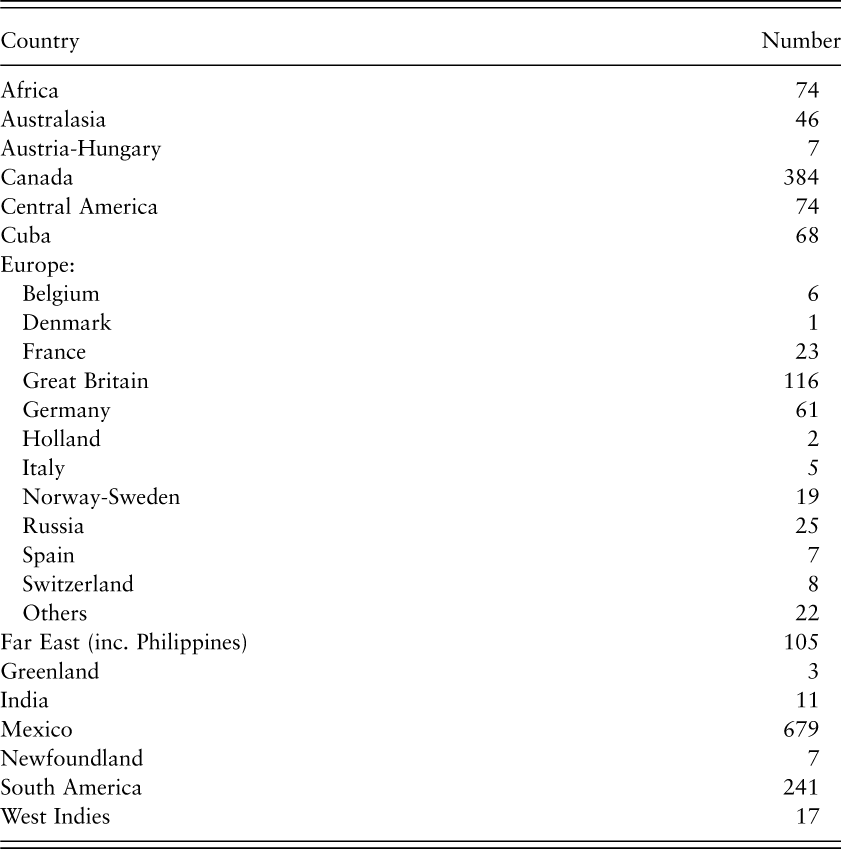
Even before arriving on the Rand, American engineers were diffused widely across the globe. As new transnational organizations and publications connected the world's mineral engineers, US specialists were recognized by their European counterparts as the world's pre-eminent and most versatile engineers. Their success, argued one commentator, was the result of ‘the rather American habit’ of ‘applying in one place ideas gathered from another’.Footnote 89 In part, this was driven by the specialization of the mineral industry, which demanded not only increasing knowledge of technical and scientific processes but also a specialized consulting engineer who possessed a wide knowledge of engineering, geology, and economics.Footnote 90 US engineers drove the growth of this class of specialist between 1895 and 1914, gathering experience overseas as an essential element of their technical education, as can be seen in data gathered by the US Bureau of Mines in Table 1.
Foreign experience of American mining engineers to 1917.

Source: Albert H. Fay, Preparedness census of mining engineers, Washington, DC: US Bureau of Mines, 1917, p. 11.
International mining is conventionally depicted as being dependent upon the vast industrial wealth of the London Stock Exchange and Wall Street. The industry was, in fact, dependent upon a professional class of American consulting engineers and mine managers whose on-site analysis and professional expertise had the power to persuade or dissuade London's financial power. In Australia, US engineers and metallurgists from the Rocky Mountain States of Arizona, Colorado, Montana, and Nevada drove a ‘technical awakening’ in the 1880s and 1890s.Footnote 91 Americans could be found on the gold fields of Coolgardie in Western Australia, at Broken Hill in New South Wales, and in the copper mines of Mount Lyell in Tasmania, usually employed on huge salaries by British investors. In 1900, American miners rushed to the Klondike after the discoveries of gold near Great Slave Lake and silver near Great Bear Lake, where they transformed the region through placer and gravel mining.Footnote 92 Such a pattern was repeated on gold fields, copper seams, and silver lodes throughout the world. ‘There are many hundreds of Americans in the employ of English concerns, and almost universally they are in executive positions’, wrote the most famous of all transnational American engineers, Herbert Hoover, whose career took in gold fields in Australia, Africa, Japan, and China. Although 75% of the world's gold output came from British-owned mines, the future president argued that the ‘whole of the gold mining industry practically is under the direction of American engineers’.Footnote 93
Anglo-American collaborations of this kind were also well developed in Mexico, including with a number of American engineers with experience working on the Rand. In Mexico, Anglo-American firms constructed a vast industrialized mining industry ‘similar in structure to the major industrial complexes of the United States’.Footnote 94 By the early twentieth century, Porfirian Mexico was the world's largest producer of silver, ranked second in copper production, and fifth in the world for gold.Footnote 95 In contrast to South Africa, US mine engineers in the region operated in the context of the US economic empire rather than British colonial rule. Transfusions of American capital, far ahead of European rivals, transformed the character of Mexican mining and infrastructure in the final third of the nineteenth century, such that by 1911 it had become ‘an economic satellite of the United States’.Footnote 96 Nonetheless, while American capital dominated the Mexican economy, the free flow of people and information that propelled the globalization of mining were reproduced in Mexico's mineral industries. A series of interlocking directorships, syndicates, and exploration companies were the architects of Mexico's mineral conquest. These groups depended upon the advice provided by transnational American engineers who directed the forces of global industrial capitalism to the most profitable areas.
Mexico's mineral industries started to take off even as US engineers poured onto the Rand. The first mining booms of the Díaz period began in the late 1870s and attracted American prospectors to the Sierra Mojada, a deserted corner of Coahuila, but the heyday of Mexican mining would arrive later in the century.Footnote 97 Proximity, aggressive promotion by American capitalists, and the Díaz regime's receptivity to foreign investment attracted US engineers in their thousands from the 1880s onwards. According to one promoter, Mexico was ‘one magnificent but undeveloped mine – our India in commercial importance – our Cuba and Brazil in tropical products’.Footnote 98 Writing from Mexico in 1892, the Durango-based miner Walter D. Beverly noted that the ‘American invasion was well underway’.Footnote 99 In 1884, American firms worked just 40 sites in Mexico; by 1904, aided by the Mexican government's decision to bequeath the title of any subsoil deposits to the property buyer, the number had risen to 13,696.Footnote 100 Many of these dotted the northern states of Chihuahua, Sonora, Sinaloa, and Durango, where US enterprise crossed the border and took advantage of access to new markets provided by new, American-financed railways.Footnote 101 With this expansion flowed further industrial investment in power plants, transportation, and smelting and refining industries. By 1901, American investment in Mexico had risen to more than US$500 million; a decade later it had reached US$1billion, 50% of all US foreign investment.Footnote 102
American investment in Mexico followed American migration, of which US engineers were a small but significant part. In contrast to Johannesburg, American miners in Mexico were a minority of the wider American population in the country, numbering 5,000 out of a total close to 75,000.Footnote 103 As in Johannesburg, elite engineers formed their own self-identifying colonies. At Batopilas on the Mexican Comstock, Americans who gathered around the silver mines of Alexander Robey Shepherd joined the exclusive Chihuahua Club, where they celebrated Thanksgiving and browsed copies of the colony's expatriate newspapers.Footnote 104 Mexico City was host to by far the largest American colony, which grew rapidly from 1,200 in 1898 to more than 10,000 in 1910.Footnote 105 The ‘colony’ consisted of bankers, railway entrepreneurs, miners, and small business owners, who established their own schools and hospitals in addition to a number of expatriate social institutions such as the Society of the American Colony and the American Women's Club.Footnote 106
In Mexico the colonial terminology took on added force, as Yankee enclaves became the symbols of what Mexican conservatives termed the invasión pacífica of US investment. The arrival of expatriate colonies was often accompanied by the language of economic ‘invasion’ as in Walter Beverly's remarks above. In the town of Santa Eulalia, Chihuahua, the ‘epoch’ of the ‘invasion of American capital’ began when ‘mining methods were revolutionized by the introduction of new machinery’ into the silver mines.Footnote 107 The ‘American invasion up to date is only a fore taste’, wrote one commentator, who, on observing the dominance of American companies in Mexican railways, industry, and agriculture, declared the ‘industrial naturalization of an entire people’.Footnote 108 Another American engineer wrote that ‘He is rapidly Americanizing Mexico, conquering not as Cortez did, but with those more peaceful arts which not only enrich the people of that country, but are awakening them from the sleep of serfdom and ignorance in which they have long dwelt.’Footnote 109 As in South Africa, race, economic expansion, and the quest to civilize were mixed in the self-conception of American engineers.
The so-called invasion was a highly orchestrated manoeuvre conducted by the new institutions and figures of transnational mining. In 1901, the American Institute of Mining Engineers held its annual convention in Mexico City, bringing in 165 engineers on two specially chartered trains. While there, they were taken on tours of Chihuahua City, Parral, Santa Eulalia, Zacatecas, Pachua, Guanajuato, Parral, Santa Eulalia, Monterrey, and their surrounding mineral districts. The meetings’ papers were devoted to studies of Mexican mining districts and the industry's organization and methods south of the Rio Grande.Footnote 110 Investment in Mexican copper and silver mines was overwhelmingly American in origin. Arizonan copper corporations simply followed copper seams across the border into Sonora and purchased mines in Nacozari, Cananea, and Naco.Footnote 111 The Phelps Dodge Corporation concentrated its operations at Moctezuma. Backed with capital from the New York industrial financiers William Rockefeller, James Stillman, and Henry Rogers, Phelps Dodge established an economy of scale to extract vast profits from modest ore that also spoke of the emergence of Wall Street in world economic affairs, but more particularly in Mexican industrial development.Footnote 112
In contrast to copper and silver, the Mexican gold industry benefited from the synergy of British capital and US engineering expertise that had developed on the Rand – and many of the same miners and institutions were involved. Mexico's largest gold mines were located in El Oro in the north-west of the State of Mexico. English interests were already well established in the region, but at the turn of the century they were aided by new collaborations with American capital and engineers. In the context of the informal American economic empire, British capitalists became allied with one of New York's wealthiest industrial capitalists, the Guggenheim family. Through Guggenex, the Guggenheims controlled the largest complex of mines, smelters, and railways in Mexico. The family's American Smelting and Refining Company enjoyed a near monopoly of smelting operations in north-central and north-east Mexico.Footnote 113 Alongside their highly profitable smelting interests, the Guggenheims exploited the extraordinarily profitable Esperanza gold seam, where they were reliant on the expertise of the transnational engineer John Hays Hammond.
After a brief exploration of Russian gold fields and some time working in London, Hammond returned to the United States, where he became a consulting engineer for the Union Pacific and Southern Pacific Railroads.Footnote 114 Soon after he became associated with the New York-based Guggenheim brothers. In 1903 the brothers appointed him consulting engineer for the Guggenheim Exploration Company. Mimicking the London Exploration Company, Hammond managed a scouting force of inspecting engineers for the Guggenheims between 1903 and 1907, which he despatched across Mexico. In a six-month period between 1902 and 1903 the Guggenheims, through Hammond's advice, paid US$16 million for six mines in Michoacan, Aguascalientes, San Luis Potosi, Coahuila, Chiahuahua, and Durrango, producing a steady flow of ore to their smelters.Footnote 115 The Guggenheims were particularly interested in the gold mines of El Oro and along the Esperanza seam in Mexico State, however.Footnote 116 Finding the El Oro owned by the London-based El Oro Mining Company, for whom he had acted as consulting engineer on his return from the Rand, Hammond instead hired Ross E. Browne, Hennen Jennings’ mentor and consulting engineer to the Corner House in Johannesburg, to examine the Esperanza's gold.Footnote 117 Despite Browne's unfavourable report, Hammond acted on his instincts and secured 51% of the mine's shares for the London Venture Corporation and convinced the Guggenheims to take on the remaining 49% of the stock. The risk proved lucrative. Between 1904 and 1910 the Esperanza paid an average yearly dividend of 68.8%, peaking in 1906 when shares paid 160% of their value.Footnote 118
Transnational alliances of capital and expertise proved pivotal to the development of the El Oro and the Esperanza. Through Hammond and the London Venture Corporation, the Guggenheims were interlocked with the powerful clique of American engineers and British capitalists who had turned their attention from the Rand to Mexico. The Exploration Company was active in many parts of Mexico, where it purchased new prospects that were then formed into new companies through the Venture Corporation. In Sonora, the Exploration Company collaborated with the Ohio-based Crestón Mining Company to buy out a host of small operators between Minas Prietas and La Colorada, introducing large-scale operations.Footnote 119 In time, the Exploration Company, now run by Smith and the Montanan Rawlinson Bayliss, became the dominant holder in the El Oro district despite the economic power of the Guggenheims in the region. In 1899 the company bought its closest competitor in the region, the American Mining Company. Three years later a new strike at Somera was bought for £125,000 and the Somera Gold Mining Co. was established to develop the section. In 1905 they purchased Mexico Mines of El Oro from the English engineers Weetman Pearson and Robert J. Price.Footnote 120 Finally, after the outbreak of violent revolution in 1910 the London Exploration Company offered a way out for the Guggenheims, who withdrew from their Esperanza mines in 1911 and allowed the Exploration Company's holdings to run the El Oro district.
Allied with British and American capital and equipped with technologies and expertise refined in the American West and on the Rand, US engineers transformed Mexican gold fields. Demonstrating the overlapping connections upon which transnational American engineers could draw, the ‘Hammond men’ followed the Californian to central Mexico. Pope Yeatman was employed as his assistant, Earnest A. Wiltsee as surveyor and ore expert, and Ross E. Browne as assayer. At El Oro, under the management of Wiltsee and Hammond, a 120-stamp mill and cyanide plant was constructed using technology designed and installed by Charles Butters.Footnote 121 Hennen Jennings soon joined his fellow travellers from the Rand, investing in properties at El Oro at the turn of the century.Footnote 122 US engineers with experience of the Rand invested heavily in Mexican mineral industries more broadly too, with some making the shift from gold to copper and silver. Butters’ London-based firm, Charles Butters & Co., tested ores across the country and installed numerous stamp mills, such as in the silver mines of Guanajuato.Footnote 123 Butters himself invested in a number of properties in Sinaloa, Mazatlan, and Sonora (including a property near Minas Prietas) through the Butters–Copala Syndicate, chartered in England but including investment from California. His companies processed almost 450 tons of ore per day in two vast milling and cyaniding plants.Footnote 124 Thomas Leggett, a witness at the Witwatersrand's Industrial Commission of Inquiry, migrated to northern Mexico, where he worked at the Batopilas copper mines.Footnote 125
Beyond investment and technological transfer, American mining and smelting operations were responsible for the ‘large-scale reorganization of Mexico's demography, settlement patterns, and labour relations’.Footnote 126 More than 300,000 people migrated from the central band of Mexican states to the northern states containing mining camps and boom towns linked with incoming American capital.Footnote 127 In addition to the transformation of older settlements, company towns were founded alongside some mines, a practice imported from south-western American copper belts. Company paternalism enforced a high degree of segregation between the Yankee mine manager and Mexican worker. Minas Prietas and La Colorada, two small towns servicing the Exploration Company's Grand Central mine, were home to more than 5,500 miners in 1895.Footnote 128 The mine's foreign managers, who accounted for less than 1% of the total population, lived in ornate brick houses away from the mines and maintained their own police force, schools, and library. Mexican labourers were pushed to the town's periphery and lived in haphazard jacals (rough, adobe-style housing) around the perimeter. On the settlement's outskirts a Yaquis shanty town emerged, overshadowed by the vast tailings surrounding the mine and a large multi-storey smelter and stamping plant.Footnote 129
At Minas Prietas’ Grand Central, the authority of American and British managers rested on racial hierarchy. Across the Mexican mineral frontier, Mexican workers performed the most dangerous tasks in the cyanide plants and stamp mills, while white Americans were employed as foremen and engineers.Footnote 130 The company paternalism of Yankee engineers in Mexico was indicative of widespread racial attitudes towards Mexican miners as an unsatisfactory source of labour that US management would slowly bring toward civility. Just as in South Africa, as American mine managers attempted to reduce production costs they invoked arguments that portrayed Mexican labourers as unresponsive to the same economic incentives as white miners.Footnote 131 ‘He works only to live’, argued E. A. H. Tays, an American engineer resident in Sinaloa; ‘if he earns enough in three days to keep him and his family from actual want for the rest of the week, he will work three days only’.Footnote 132 To Tays, the Mexican labourer was ‘improvident, superstitious and reckless, is in fact a fatalist’.Footnote 133 For that reason, according to another essayist in the Engineering and Mining Journal, ‘he should be worked under contract, piece work or task’ wherever possible.Footnote 134 As in mineral industries across the globe, American mine managers in Mexico adjusted the wages, opportunities, and living conditions of non-white workers from their self-proclaimed competence as race managers.
American engineers were an elite component of the migrant labour circuits that characterized global mining from the late nineteenth century onwards. As in Mexico and on the Rand, US managers in Honduras, for instance, benefited from the willingness of local leaders to institute severe labour regimes. President Luis Bogran instituted the manamiento press-gang labour system to meet the demands of American mining companies, whose ore was already exempt from export duties.Footnote 135 In 1888, the peak of Honduras’ boom period, there were fifty-seven working mines, including Thomas Lombard's Yuseman Mining Company, the Chicago Honduran Mining Company, and the Honduras Rosario Mining Company, which was later associated with the Guggenheims’ American Smelting and Refining Company.Footnote 136 The Guggenheims also initiated smelting operations in Chile in the 1890s at the Braden Copper Company and the Chuquicamata mines, managed by Hammond's right-hand man, Pope Yeatman.Footnote 137 In Peru, 80% of the gold was mined in the Puno district, where the American-owned Inca Mining Company was the largest enterprise; in El Salvador, Charles Butters owned and managed the 546 acres of Butters’ Salvador Mines Ltd.Footnote 138 In the Barima region of British Guiana, American miners hitchhiked the pathways charted by British imperialism and formed a significant part of the 12,000 registered gold miners in the colony.Footnote 139
Conclusion
The expansion of global mining in the late nineteenth century has been seen as the product of an intensified stage of finance capital, inter-imperial collaboration, and innovations in technology, management, and organization. All of these factors depended upon the diffusion of American mining engineers across the world. Often overlooked amid the manifold structural and economic changes taking place within the mineral industries in this period, US engineers rose to prominence thanks to their literacy in new engineering science and technology. Accompanying this specialized training was their experience mining diverse ore bodies in the Americas, vital connections with US-based mining equipment manufacturers and scientific institutions, and access to the rising strength of the New York banking world. As the vignettes explored above highlight, industrial empires depended on the ability of engineers to provide reliable on-site data to enable safe and confident investment in mining enterprise in South Africa, the American West, and Central and South America.
The movement of American engineers represented a form of elite migration that transmitted new global interactions in the late nineteenth century. American mine managers and consulting engineers in South Africa and Mexico formed self-described expatriate ‘colonies’ that included members from a cross-section of financial, mercantile, and diplomatic elites who coalesced around the burgeoning mineral industry. The American ‘colonies’ of Johannesburg, Mexico City, and Batopilas created their own social organizations to socialize and maintain national connections, but were also the way-stations of US commercial and technological expansion. In these offshore outposts, US engineers created demand for American-made machinery, markets for American products, and investment opportunities for the transportation, chemical, electrical, and smelting industries that supported the mines. In Johannesburg, the American ‘colony’ represented the inter-imperial collaboration of US technological expertise with British imperial and financial power; in Mexico, they were the outposts of the United States’ informal economic empire. These expatriate ‘colonies’ therefore reveal the avenues through which imperial globalization travelled. The transnational networks of expertise, technology, trade, and capital that converged in mines across the globe were facilitated and mediated by the inter-imperial collaborations of migrant mine engineers.Footnote 140
As transnational American engineers reflected on the management of mining labour systems based on worldwide experience, they transformed the racial formations of the regional and colonial contexts in which they operated. When Hennen Jennings argued that South African mining could benefit greatly if it ‘recall American experience’ with ‘the efficiency of the negro’, he echoed the cognitive strategies of a range of engineers who found insight and inspiration in connecting regimes of racial hierarchy from a transnational perspective.Footnote 141 Central to the self-conception of this class of American consulting engineers was not simply a faith in their technical expertise but a conception that they were expert race managers. In his 1909 work Principles of mining, Herbert Hoover devoted a whole chapter to the management of non-white labour. Underground work could be completed ‘after a fashion by absolutely unskilled and even unintelligent men’, which would require the ‘breaking-in of savages of low average mentality’.Footnote 142 Hoover speculated on the ratio of race and productivity between white and non-white labour. In tasks such as shovelling, ‘one white man equals from two to three of the colored races’, but in more skilled work that ratio extended to ‘one to seven, and in extreme cases even eleven’.Footnote 143 Like Jennings, Hoover claimed specialist knowledge of racial productivity based on a calculus of impression, experience, and measurement, which was viewed as the key to racial management.Footnote 144
This did not simply mean the projection or exportation of US racial formations into colonial contexts. Rather, through transnational analogy American engineers shaped the unfolding dialogue on the racial capacity of non-white races among intellectuals in Britain, the United States, and South Africa.Footnote 145 With its claims to have yielded scientifically valid laws, the racial knowledge created and shared by US engineers aided the scientific colonialism of the Rand's administrators and guided mine managers’ views of the relationship between race, productivity, and white management. In Mexico, US engineers claimed that ‘the quest for mineral wealth’ of ‘thousands’ of American engineers held together a fragile mixture of ‘tribes and races’ that had ‘never been satisfactorily welded’.Footnote 146 To American engineers, the management of mine labour provided a laboratory for applying ‘civilizing’ solutions to non-white races and the cognitive tools for diagnosing the ‘race problems’ of mines across the world.
Stephen Tuffnell is British Academy Postdoctoral Fellow at the University of Oxford, and specializes in the transnational history of the United States in the nineteenth century.