Introduction
Allergic rhinitis is a common manifestation of allergic disease, and affects approximately 10–25 per cent of the world population. A similar proportion of the Turkish population is affected.
Turkey is located between Asia and Europe, with coastline on the Mediterranean, Black and Aegean Seas. The most recent census (2007) indicated a population of 70 586 256. The country has various diverse climatic characteristics, due to being surrounded by sea on three sides and having a relatively large land mass.Reference Kurt, Metintaş, Başyiğit, Bulut, Çoskun and Dabak1 The types of clinical allergies encountered are partly related to regional climatic differences.
Ankara is situated at 39°55′N, 32°5′E in north-east Central Anatolia, at an altitude of 820 m above sea level. In general, the city has an Irano-Turanian vegetation type and semi-arid Mediterranean climate. The climate is hot and dry in summer and cold and snowy in winter.Reference Kaplan, Şakıyan and Pınar2
This study evaluated the sensitising allergens of patients with seasonal allergic rhinitis living in Ankara. The study also correlated these sensitising allergens with the profile and load of airborne allergens in Ankara.
Materials and methods
The study was conducted in a tertiary rhinitis clinic located in Ankara.
From January 2007 to July 2008, 43 patients were diagnosed with seasonal allergic rhinitis, using skin prick testing or in vitro analysis. Isolated mite, fungal and epithelial allergies were excluded. Concurrent perennial and seasonal allergies were included. We included patients who had suffered allergic rhinitis with moderate to severe symptomatology (i.e. rhinorrhoea, blockage, sneezing and itching) for at least three consecutive years, and who had lived in Ankara for at least 10 years. Patients' ages ranged from 16 to 63 years (mean ± standard error of the mean = 35.06 ± 1.650). There were 36 female and 17 male patients in the study group.
Eleven of the patients were diagnosed based on enzyme-linked immunosorbent assay, as skin testing was contraindicated.
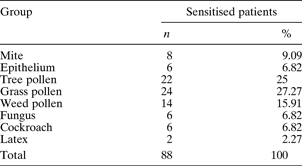
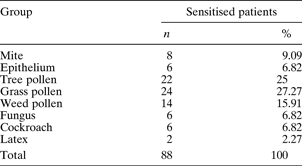
The allergens detected are presented in Table I. Skin prick testing was performed using Quanti Test apparatus (Alerkan Medical Firm, Ankara, Turkey). Test allergens were purchased from Star Allergens (Medical Firm, Ankara, Turkey). All patients underwent a detailed ENT examination, endoscopic investigation, acoustic rhinometric evaluation and computed tomography scanning to exclude or confirm the presence of other pathology. The skin prick test battery included positive and negative controls, Dermatophagoides pteronysinus, D farinae, storage mites, cat epithelia, dog epithelia, feathers mixture, betulaceae, fagaceae, oleaceae, salicaceae, tree pollens mixture, five-grass mixture, chenopodiaceae, compositae, cockroach, latex, aspergillus mixture, helminthosporium, alternaria, Mucor racemous, Rhizopus nigricans, Stemphylium botyrosum, alfalfa, hop, mugwort, nettle, plantago, ragweed, rape and Salsola kali (Stallargenes, Medical Firm, Ankara, Turkey).
Allergen groups detected
Verbal consent was obtained from all patients.
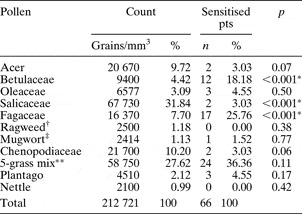
The airborne pollens detected in the Ankara region, and the sensitising pollens detected on allergy testing, are presented in Table II.
Comparison of pollen counts and allergic sensitivity results

* Statistically significant. †Ambrosia; ‡artemisia; **gramineae. Pts = patients
The creation of a regional ‘pollen map’ can be useful to indicate the diversity of airborne allergens present in a specific region, and to facilitate daily pollen count reports to aid allergic patients. However, such pollen maps may not correlate with the types of allergies encountered clinically. In order to assess the clinical importance of airborne allergens present in Ankara, 10-year pollen counts were compared with the results of allergy sensitisation testing for those pollens; findings and statistical significance are presented in Table II.
Statistical analysis
The Statistical Package for the Social Sciences version 16.0 for Windows software package was used for all calculations. A p value less than 0.05 was considered statistically significant.
Results
Table II presents a comparison of pollen counts and pollen sensitisation rates. The hypothesis test was used to compare the percentage of pollens found in Ankara with the percentage of clinical sensitivity for those pollens.
For betulaceae, salicaceae and fagaceae pollens, the clinical sensitisation rates were significantly different from the 10-year pollen loads (p < 0.001). Although betulaceae pollens formed only a minor proportion of the pollen load, approximately 18 per cent of patients were allergic to these pollens. On sensitivity testing, fagaceae pollens showed the second highest levels of positivity, after grass pollens; however, fagaceae pollens were not a major contributor to the pollen load. In contrast, salicacea pollens were the commonest airborne pollens; however, only two patients were clinically sensitive to these pollens.
In this study, the most commonly positive sensitisation allergen was five-grass mixture, followed by tree pollens mixture. Fagaceae was the most common tree pollen allergy, followed by betulaceae.
Discussion
In this study, we retrospectively evaluated the epidermal skin prick test and enzyme-linked immunosorbent assay results of patients who presented to our allergy and rhinitis out-patient clinic. We then assessed the ratios of sensitisation to aeroallergens, and correlated allergen sensitisations with allergen profiles and loads.
Previous trials have shown gramineae pollens to be a major cause of seasonal allergic rhinitis in Turkey, affecting 1.3–6.4 per cent of the population.Reference Çelik, Mungan, Bavbek, Sin, Ediger and Demirel3, Reference Bostancı, Türktaş and Türkyılmaz4 The regional pollen load has also been reported to have a major impact on the clinical presentation of seasonal respiratory allergies. For example, patients living in regions with an abundance of tree pollens have been found to have a high incidence of sensitisation to tree pollens as an important cause of allergic rhinitis, although it is generally believed that tree pollens are not as allergenic as grass pollens.Reference Wissenbach, Holm, van Neerven and Ipsen5 In the current study, sensitisation to grass pollens was found to be the leading cause of seasonal allergic rhinitis; these findings agree with those of Dursun et al. for a population also drawn from Ankara.Reference Dursun, Çelik, Alan, Pınar, Mungan and Mısırlıgil6 However, the role of tree pollens in clinical allergy sensitisation should not be underestimated. The regional tree pollen load makes a specific, important contribution to the clinical allergy sensitisation of patients living in Ankara, as do certain pollen species with low pollen counts. Furthermore, sensitisation rates did not appear to correlate with pollen counts, as tree pollens were responsible for higher clinical sensitisation rates, although they made up only a small proportion of the overall pollen load. The following paragraphs discuss this phenomenon.
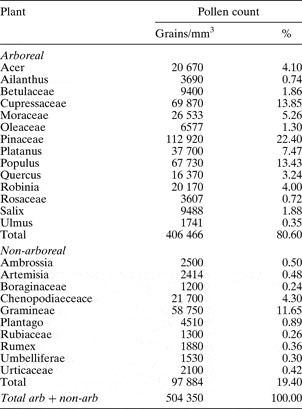
In Ankara, the clinically significant airborne pollen types are: pinaceae, cupressaceae, populus, gramineae, platanus, moraceae, chenopodiaaceaea, acer, robinia, quercus, betulaceae, salix, oleaceae, artemisia, plantago and urticaceae.Reference Tütüncü, Dane and Tütüncü7 A 10-year pollen count for important airborne allergenic pollens in Ankara is presented in Table III.Reference Kaplan, Şakıyan and Pınar2
10-year airborne pollen count in Ankara

Adapted with permission.2 Arb = arboreal; non-arb = non-arboreal
It is commonly believed that high concentrations of airborne pollens cause allergic diseases. However, this study demonstrated that the presence of a high concentration of an airborne pollen does not always lead to allergic sensitisation. Salix and populus, members of the salicaceae family, grow throughout Ankara in parks and gardens. While the most commonly seen airborne tree pollen type in Ankara was salicaceae, this was not the commonest cause of clinical tree pollen sensitivity. Furthermore, although betulacea and fagaceae pollens did not reach such high concentrations as salicacea, they were the commonest causes of clinical tree pollen sensitivity.
These findings may possibly be explained by the length of time these pollens are suspended in the air, or by their allergenic potential.
All the pollens assessed begin to increase in concentration in February, March and April, and reach their maximum levels in May (Figure 1).Reference Kaplan, Şakıyan and Pınar2 The overall pollen concentration is also high in June. Therefore, our study results cannot be explained by particular pollens' durations of suspension.
Ten-year pollen calendar for Ankara. Adapted with permission.8

Regarding allergenic potential, the Salicacea, Betulacea and Fagaceae pollen groups were found by Sin et al. to have almost equal allergenicity.Reference Sin, Pınar, Mısırlıgil, Çeter, Yıldız and Alan8 However, minor differences in allergenic potential may cause major variations in clinical sensitisation. This study clarified the role of tree pollens in seasonal allergy, as well as the effect of different tree pollen families on clinical presentation.
Olive tree pollens are known to be highly allergenic.Reference Solomon, Jelks and Kaplan9 There are no olive trees in Ankara, although they are very common in the southern and western parts of Turkey. Therefore, the detection of oleaceae sensitivity in some patients was an unexpected finding. This may be explained by cross-reactivity between oleaceae and fraxinus pollens, or by long distance, airborne transport from the source of pollen, or by sensitisation to olive pollen during time spent in other regions. The finding of olive tree pollen sensitivity emphasises the fact that, for definitive diagnosis of individual pollen sensitivity, skin prick test panels should include individual pollens, at least at the beginning of the testing process. (Subsequently, the test panel may be reorganised according to early findings, and clinically unimportant allergens may be excluded.)
• This study examined the ratios of sensitisation to airborne pollens, and the association between pollen sensitisation and pollen profile and load
• Patients attending an allergy and rhinitis out-patient clinic were evaluated using epidermal skin prick testing and enzyme-linked immunosorbent assay
• Tree pollens may be clinically more important for allergic sensitisation than previously estimated
• Higher pollen concentrations may not always result in a higher prevalence of allergic sensitisation to those pollens
In North America, weeds are generally believed to be important pollen sources with highly allergenic properties. In Turkey, weeds have been found to be important sources of allergenic pollens in the Mediterranean and Aegean Sea coastal regions.Reference Terzioğlu, Sin, Kokuludağ, Kirmaz, Erdem and Sebik10 The current study demonstrated the clinical importance of some additional weed pollens, such as plantago, chenopodiaeceae, compositea and Salsola kali (however, the last two pollens were not listed in our final data as they did not feature in the 10-year pollen count). Although ambrosia pollens are highly allergic and a major cause of allergic rhinitis in North America and Europe, they did not appear to be important in Ankara at the time of data collection. These findings may further emphasise the importance of doing skin testing on individual allergen bases once more time.Reference Sener, Kim, Ceylan, Ozanguç and Yoo11
The results of the current study provide important information about the association between regional pollen load and clinical sensitisation in patients with seasonal allergic rhinitis. The study also indicates that tree pollens may cause significant allergic sensitisation regardless of their airborne pollen counts. This information may be useful to guide the choice of species for new planting in parks, gardens and roadsides. In addition, in the current era of widespread international travel, such information may also be valuable for allergic patients needing to travel to Ankara and its surroundings.
Conclusion
Tree pollens may be more significant sources of clinical allergic sensitisation than previously thought. A higher concentration of airborne pollens may not always result in higher rates of allergic sensitisation to these pollens.