INTRODUCTION
The risk of developing dementia in Parkinson’s disease (PD) is sixfold higher than in the general population. About 80% of PD patients are diagnosed with PD dementia (PDD) within the disease course, especially in late stages of PD (Aarsland & Kurz, Reference Aarsland and Kurz2010). PDD is often related to loss of quality of life, nursing home placement, caregiver burden, and mortality (Aarsland, Larsen, Tandberg, & Laake, Reference Aarsland, Larsen, Tandberg and Laake2000; de Lau, Verbaan, Marinus, & van Hilten, Reference de Lau, Verbaan, Marinus and van Hilten2014; Leroi, McDonald, Pantula, & Harbishettar, Reference Leroi, McDonald, Pantula and Harbishettar2012). Therefore, a valid assessment of first signs of PDD is crucial for an early intervention. About 27% of non-demented PD patients already show signs of mild cognitive impairment (PD-MCI) (Litvan et al., Reference Litvan, Aarsland, Adler, Goldman, Kulisevsky, Mollenhauer, Rodriguez-Oroz and Weintraub2011), and PD-MCI diagnosis characterizes a potential transitional stage toward PDD. However, the progression of cognitive impairment within a short time is difficult to predict, as PD-MCI is a very heterogeneous phenomenon. As a result, the identification of a risk group among patients with PD-MCI based on the individual cognitive performance is difficult. This is especially important as not all PD-MCI patients’ cognitive status worsens within a short time period. Pedersen, Larsen, Tysnes, and Alves (Reference Pedersen, Larsen, Tysnes and Alves2017) showed that, over the course of 5 years, 44% of PD-MCI patients develop PDD, and 27% regress to a normal, age-appropriate cognitive function. In a time period of 3 years, Lawson et al. (Reference Lawson, Yarnall, Duncan, Breen, Khoo, Williams-Gray, Barker and Burn2017) found that 27% of PD-MCI patients were cognitively stable, 33% declined, 14% improved, and 8% developed PDD. A main characteristic of PDD is difficulty in handling activities of daily living (ADL) primarily caused by cognitive worsening. ADL function is usually categorized into two subtypes: (1) basic ADL (bADL) describe ADL function necessary for self-care, such as body hygiene, dressing, and self-feeding; (2) instrumental ADL (iADL) concern more complex, challenging tasks which are not fundamental for self-care but make it possible to live independently. This includes tasks such as managing finances, preparing meals, shopping, and medication intake. In PD, Pirogovsky et al. (Reference Pirogovsky, Schiehser, Obtera, Burke, Lessig, Song, Litvan and Filoteo2014) showed that some PD-MCI patients already show difficulties in iADL, while bADL function is sustained. One main challenge in identifying ADL dysfunction in PD is to differentiate whether difficulties in ADL, both instrumental and basic, are caused by cognitive impairment or by motor dysfunctions (Cheon, Park, & Kim, Reference Cheon, Park and Kim2015).
In clinical practice, iADL function is often quantified with standardized interviews or through questionnaires completed either by the patients themselves, their relatives, or caregivers. Even though assessing iADL function with questionnaires is easy and time-economical, there are some downsides to this method. PD patients tend to underestimate their disabilities (Shulman et al., Reference Shulman, Pretzer-Aboff, Anderson, Stevenson, Vaughan, Gruber-Baldini, Reich and Weiner2006) and their reports are often influenced by mood and motor dysfunctions (Kempen, Steverink, Ormel, & Deeg, Reference Kempen, Steverink, Ormel and Deeg1996). Therefore, performance-based tests can be an unbiased objective alternative to assess iADL function in PD, even in the clinical daily routine. A range of performance-based tests already exist and some of them have been used in PD cohorts. However, they are either time-consuming in either assessment and/or scoring [Direct Assessment of Functional Status (Brennan et al., Reference Brennan, Siderowf, Rubright, Rick, Dahodwala, Duda, Hurtig, Stern, Xie, Rennert and Karlawish2016; Deck et al., Reference Deck, Xie, Choi, Rick, Siderowf, Rudovsky, Chen-Plotkin, Duda, Morley, Dahodwala and Trojanowski2019); Older Americans Resources and Services scale (Shulman et al., Reference Shulman, Pretzer-Aboff, Anderson, Stevenson, Vaughan, Gruber-Baldini, Reich and Weiner2006); Naturalistic Action Test (Roll, Giovannetti, Libon, & Eppig, Reference Roll, Giovannetti, Libon and Eppig2019); Financial capacity instrument (FCI) (Martin et al., Reference Martin, Triebel, Kennedy, Nicholas, Watts, Stover, Brandon and Marson2013); Medication Management Ability Assessment (Pirogovsky et al., Reference Pirogovsky, Martinez-Hannon, Schiehser, Lessig, Song, Litvan and Filoteo2013); Multiple Object Test (MOT) (Beyle et al., Reference Beyle, Glonnegger, Cerff, Gräber, Berg and Liepelt-Scarfone2018; Glonnegger et al., Reference Glonnegger, Beyle, Cerff, Gräber, Csoti, Berg and Liepelt-Scarfone2016)], need extraordinary materials [Six activities task (Fellows & Schmitter-Edgecombe, Reference Fellows and Schmitter-Edgecombe2019)], are assessed in a domestic environment [Performance Assessment of Self-Care Skills, (Foster, Reference Foster2014)], correlate with PD-related motor symptoms [University of California San Diego Performance-Based Skills Assessment, UPSA (Holden et al., Reference Holden, Medina, Hoyt, Sillau, Berman, Goldman, Weintraub and Kluger2018)], or motor influences on the performance-based test have not been examined in PD studies yet [Timed Instrumental Activities of Daily Living scale (Higginson, Lanni, Sigvardt, & Disbrow, Reference Higginson, Lanni, Sigvardt and Disbrow2013)]. In Alzheimer’s disease research, a performance-based test for mild cognitive impairment (MCI) and early dementia was recently developed: the Erlangen Test of Activities of Daily Living in Persons with Mild Dementia and Mild Cognitive Impairment (ETAM). It is easy and fast to administer, and provides good reliability and validity for iADL impairment related to cognitive dysfunction, even when administered in social centers and nursing homes (Luttenberger, Reppermund, Schmiedeberg-Sohn, Book, & Graessel, Reference Luttenberger, Reppermund, Schmiedeberg-Sohn, Book and Graessel2016; Schmiedeberg-Sohn, Graessel, & Luttenberger, Reference Schmiedeberg-Sohn, Graessel and Luttenberger2015). The aim of this study was to adapt and evaluate the ability of the ETAM for the identification of early cognitive-driven iADL impairment in PD. We hypothesized that PD-MCI patients show in average a lower test performance on the ETAM than PD patients with normal cognition (PD-NC). In contrast, performance of PD-NC patients should not differ from healthy controls (HC), to verify that the ETAM is not affected by PD-related motor impairment. In a post hoc analysis, we explored whether the ETAM is a sensitive measure for assessment of cognitive-driven iADL impairment in patients with PD-MCI. We expected that PD-MCI patients with low performance in the ETAM would have more severe cognitive impairment, which might be an indication for a potential subgroup at higher risk for PDD.
METHODS
Participants
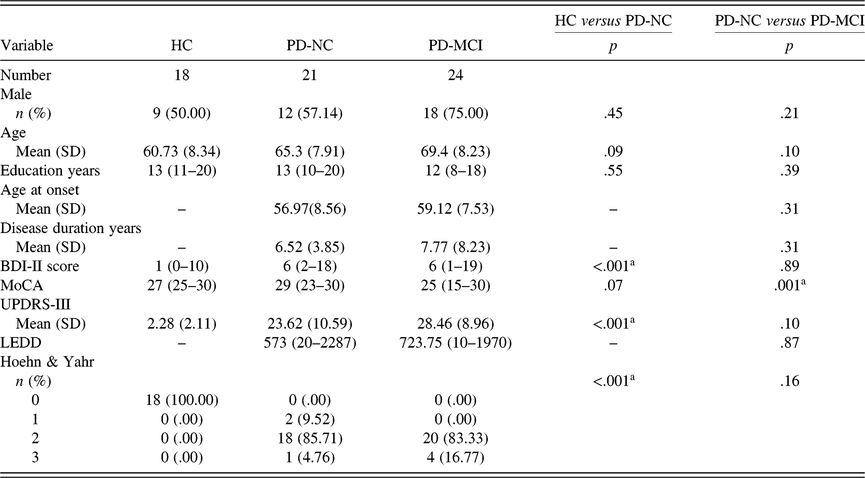
In this study, 45 patients with idiopathic PD according to the United Kingdom Brain Bank criteria (Hughes, Daniel, Kilford, & Lees, Reference Hughes, Daniel, Kilford and Lees1992) and 22 HC were recruited. All PD patients were recruited from the neurology outpatient clinic of the University Hospital in Tübingen. HC were not statistically different in age, sex, and educational level to PD patients (see Table 1) and were either relatives of the patients or other volunteers. The inclusion criteria for all study participants were older than 50 years of age, ability to understand and communicate with the investigator, and give written informed consent. Participants with neurological diseases other than PD, history of brain surgery including deep brain stimulation, current diagnosis of major depression and acute psychosis, as well as a history of drug abuse (except for nicotine) were excluded. Furthermore, four participants of the HC group were excluded based on their neuropsychological test profile which was indicative of MCI (at least two tests equal or below -1.5 standard values of the population mean in cognitive tests applied, see below for details). The study was approved by the local Ethics Committee of the medical faculty, University of Tübingen (251/2017BO2). All participants gave written consent for study participation. All study procedures were in accordance with the ethical standards of the institutional and/or national research committee and with the 1964 Helsinki declaration and its later amendments or comparable ethical standards.
Demographic and clinical data

Note. If not otherwise indicated, values are given as Median (range). SD = standard deviation; UPDRS-III = Unified Parkinson’s Disease Rating Scale part III; BDI-II = Beck Depression Inventory-II; MoCA = Montreal Cognitive Assessment; ETAM = Erlangen Test of Activities of Daily Living in Mild Dementia and Mild Cognitive Impairment; HC = healthy controls; PD-NC = Parkinson’s disease with normal cognition; PD-MCI = Parkinson’s disease with mild cognitive impairment.
a p < .01.
Group Classification
Classification of PD-MCI was made according to Movement Disorder Society Level-II criteria, referring to test performance on tests mentioned below (Litvan et al., Reference Litvan, Goldman, Tröster, Schmand, Weintraub, Petersen, Mollenhauer, Adler, Marder, Williams-Gray and Aarsland2012). A standard deviation (SD) of -1.5 or lower than the population mean in at least two tests either in one or two domains (executive function, attention, language, memory, or visuospatial function) was required for the PD-MCI diagnosis. For PD patients, the pill questionnaire was conducted to screen for ADL problems indicative of PDD (Christ et al., Reference Christ, Berger, Riedl, Prakash, Csoti, Molt, Gräber, Brockmann, Berg and Liepelt-Scarfone2013; Martinez-Martin, Reference Martinez-Martin2013). Only those patients with normal performance on the pill questionnaire and whose informants did not report impairment in everyday functioning were included in the study.
Assessments
Demographics and motor performance
Demographic characteristics of participants and medication status were assessed. To rate the severity of PD-related motor symptoms, the Unified Parkinson’s Disease Rating Scale part III (UPDRS-III) and the Hoehn & Yahr Stage (H&Y) were applied. Levodopa equivalent daily dose (LEDD) was also determined (Tomlinson et al., Reference Tomlinson, Stowe, Patel, Rick, Gray and Clarke2010).
Erlangen Test of Activities of Daily Living in Mild Dementia and Mild Cognitive Impairment
The ETAM is a performance-based test, originally developed to detect difficulties in iADL in early-stage dementia or MCI (Luttenberger et al., Reference Luttenberger, Reppermund, Schmiedeberg-Sohn, Book and Graessel2016; Schmiedeberg-Sohn et al., Reference Schmiedeberg-Sohn, Graessel and Luttenberger2015). It contains six subtests assessed in the following order: preparing medication (6 points), making a cup of tea (3 points), evaluating traffic situations (6 points, containing six individual and independent tasks), reading and changing the time on an alarm clock (3 points), handling finances (6 points), and making a phone call (6 points). A maximum total score of 30 is obtainable; implementation of the test takes approximately 15 min. In agreement with the development team of the ETAM, the following test materials were adapted to facilitate usage by PD patients with more severe motor symptoms: (1) blister packaging replaced by little medication jars and (2) alarm clock with a bigger adjustment knob.
Instructions for each task were standardized and provided verbally and additionally in written form throughout the task, to minimize load on memory function. The instruction of the item ‘medication indication’ was to sort the daily dose of three pills out of medication jars into a pill organizer according to an unfamiliar, written medication plan. The correct number of pills at each requested time of intake was scored. For ‘tea making’, an electric kettle, a bottle of water, a cup, and a selection of tea bags in a box were displayed in front of the participant with the instruction to boil water for one cup and prepare the tea. The third item contained six individual and independent traffic situations, presented as pictures. Participants were asked to answer a specific question for each traffic situation and give reasons for their answers. In the ‘alarm clock’ task, participants were handed a fixed alarm clock with a clockface and instructed to read the current time (10:30 hr) and set a specific time (13:45 hr) using the adjustment knob. In the item ‘finances’, a shopping situation was simulated where participants had to (1) identify target items, (2) select the best offer out of different price options, (3) calculate the total price of all target items on a shopping list, and (4) pick out the exact change due from a pile of coins that included distractors. In the ‘phone call’ task, participants were provided with a phone, a list with telephone numbers, a pen, and a sheet of paper with the assignment to call a fake doctors’ answering machine and write down the regular consultation hours for one specific day (Tuesday).
Ratings were performed according to a rating system provided by the development team. The ETAM was conducted by a trained psychologist and rated by two independent raters based on a video.
Scales to assess activities of daily living function
Participants’ iADL function was also assessed using the Pfeffer Functional Activities Questionnaire (FAQ) (Pfeffer, Kurosaki, Harrah Jr, Chance, & Filos, Reference Pfeffer, Kurosaki, Harrah, Chance and Filos1982) and the Bayer Activities of Daily Living scale (B-ADL) (Hindmarch, Lehfeld, de Jongh, & Erzigkeit, Reference Hindmarch, Lehfeld, de Jongh and Erzigkeit1998). Both scales were completed by an informant. In addition, participants’ self-perceived iADL function was assessed with the FAQ.
Assessment of cognitive function
Besides the assessment of the Montreal Cognitive Assessment (MoCA) (Nasreddine et al., Reference Nasreddine, Phillips, Bédirian, Charbonneau, Whitehead, Collin, Cummings and Chertkow2005), a comprehensive neuropsychological test battery was applied. To assess memory performance in the California Verbal Learning Test (Niemann, Sturm, Thöne-Otto, & Willmes, Reference Niemann, Sturm, Thöne-Otto and Willmes2008), and the Rey–Osterrieth Complex Figure (ROCF) (Osterrieth, Reference Osterrieth1944; Rey, Reference Rey1941) were used. Attention and working memory were tested with the d2-Revision (Brickenkamp, Schmidt-Atzert, & Liepmann, Reference Brickenkamp, Schmidt-Atzert and Liepmann2010), and Letter–Number-Sequencing of the Wechsler-Intelligenztest für Erwachsene (WIE, Wechsler adult intelligence scale) (von Aster, Neubauer, & Horn, Reference von Aster, Neubauer and Horn2006). The ROCF Copy and the Benton Line Orientation (Benton, Hamsher, Varney, & Spreen, Reference Benton, Hamsher, Varney and Spreen1983) were applied to examine visuospatial function. Executive function was assessed with the Regensburger word fluency test (Aschenbrenner, Tucha, & Lange, Reference Aschenbrenner, Tucha and Lange2000) including semantic, and phonematic fluency as well as the Modified Wisconsin Card Sorting Test (Nelson, Reference Nelson1976). Finally, language was tested with the auditory speech comprehension subtest of the Aphasie-Check-List (ACL) (Kalbe, Reference Kalbe2002), and the 15-item version of the Boston Naming Test (Mack, Freed, Williams, & Henderson, Reference Mack, Freed, Williams and Henderson1992). For more details, see Supplementary Table S1.
For all tests, standard scores (z-scores) provided in the test handbooks were included into data analysis, except for the ACL where a value below 17 (out of 18) marks impairment (Kalbe, Reference Kalbe2002). Cognitive domain scores were provided through the mean of the z-values of the assigned neuropsychological tests.
Non-motor symptom assessment
The Beck Depression Inventory-II (BDI-II) was applied to screen for occurrence and severity of depressive symptoms (Beck, Steer, & Brown, Reference Beck, Steer and Brown1996), with a total score of 20 and above indicating signs of major depression.
Statistical Analysis
Data were collected and managed using REDCap electronic data capture (Harris et al., Reference Harris, Taylor, Thielke, Payne, Gonzalez and Conde2009) hosted at the Hertie Institute for Clinical Brain Research; analyses were performed with the statistical program IBM SPSS (Version 25, SPSS Inc., Chicago, IL, USA). Results of the Shapiro–Wilk test showed that only age, age at onset, disease duration, and UPDRS-III scores were normally distributed. Between-group comparisons refer to either parameters of the HC versus PD-NC (motor influence on ETAM performance) or PD-NC versus PD-MCI (cognitive influence on ETAM performance) groups. The Mann–Whitney U-test and Chi-Square test were applied when appropriate; for parametric data, t tests were performed. Inter-rater reliability (IRR) of the ETAM was calculated using the intraclass correlation coefficient (r) except for the items ‘tea making’ and ‘alarm clock’ where Cramer’s V was used due to low variability of item scores. To further evaluate reliability, item discrimination using Spearman’s rank correlation (r s) and item difficulty (P i) according to Woodcock and Dahl (Reference Woodcock and Dahl1971) were analyzed. Cronbach’s alpha was used to determine internal consistency of the ETAM.
Construct validity in the PD cohort was evaluated with Spearman’s rank correlation. ETAM total and single items were correlated to other iADL questionnaires, cognitive measurements, motor, and depression scores. Furthermore, analyses of the individual tasks of the ‘traffic situation’ item were conducted with the Pearson’s bivariate correlation coefficient. Negative and positive correlation coefficients were interpreted as follows: 0 ≤ r ≤ .29, negligible correlation; .30 ≤ r ≤ .49, weak correlation; .50 ≤ r ≤ .69, moderate correlation; .70 ≤ r ≤ .89, strong correlation (Hinkle, Wiersma, & Jurs, Reference Hinkle, Wiersma and Jurs1988).
Explorative post hoc comparisons pertain to the cognitive subgroup performance of PD-MCI patients with and without mild iADL dysfunction in the ETAM (total score < 27 points as cutoff, see Results section). Cohen’s d was used to calculate effect sizes with the following interpretation: |d| < .2, no effect; |d| < .5, small effect; |d| < .8, medium effect; |d| ≥ .8, large effect (Cohen, Reference Cohen1988).
RESULTS
Demographic and clinical data of the three groups are displayed in Table 1. As expected, PD-NC patients had higher scores on motor-related scales (p < .001) but also higher values on the BDI-II indicating more depressive symptoms compared to the HC group. Comparing the PD-MCI and PD-NC group, only the MoCA was statistically different, verifying more pronounced cognitive dysfunctions in the PD-MCI group (p = .001). In the PD-MCI group, one person had impairments in a single domain (4.35%), while all others were classified as multidomain PD-MCI (95.65%). Group differences in neuropsychological test performances between the PD-NC and PD-MCI group are reported in Supplementary Table S1.
Reliability
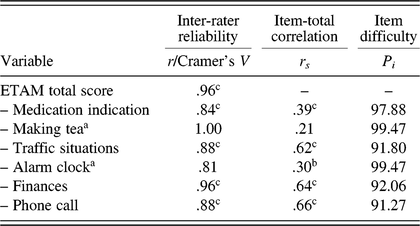
A strong IRR for the ETAM total score and single items (r = .79–.96, V = .81–1.00) were found (for more details, see Table 2). Analysis of item-total correlation revealed three items (traffic situations, finances, and phone call) with a high influence (r s = .62–.66) on the ETAM total score, while the items ‘medication indication’, ‘making tea’, and ‘alarm clock’ showed little overlap. Internal consistency of the ETAM was borderline high (α = .65). Difficulty scores were high for all items (P i ≥ 91.27), indicating that they are all able to be performed by PD patients.
Inter-rater reliability, item-total correlation and item difficulty

Note. ETAM = Erlangen Test of Activities of Daily Living in Mild Dementia and Mild Cognitive Impairment.
a Inter-rater reliability was calculated with Cramer’s V.
b p < .05.
c p < .01.
Associations Between ETAM Scores and iADL, Cognition, Motor Symptoms, and Mood
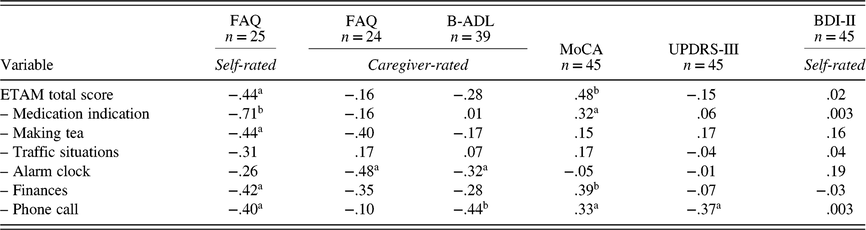
Results of the correlation analysis between the ETAM scores and clinical variables are displayed in Table 3 and 4. Significant correlations between some ETAM items and the self-rated FAQ (−.40 ≤ r ≤ −.44) were revealed; the item ‘medication indication’ was highly correlated (r = −.71) with the self-rated FAQ score, whereas the item ‘alarm clock’ showed a negligible correlation (r = −.21). As an informant-based measure, the FAQ correlated significantly with the item ‘alarm clock’ to a weak extent. The B-ADL correlations with the ETAM total and item scores were not significant (r ≤ −.28, p > .05), except for the items ‘alarm clock’ and ’phone call’ (r = −.32 and −.44, respectively). The associations between the ETAM and MoCA scores were also significant (.32 ≤ r ≤ .39), except for the items ‘making tea’, ‘traffic situations’, and ‘alarm clock’ (p > .05). Subsequent analyses of the individual tasks of the ‘traffic situations’ item showed negligible correlations for three tasks (1, 5, and 6; −.001 ≤ r ≤ .11; p ≥ .41), while the other three tasks correlated significantly with the MoCA (2, 3, and 4; .29 ≤ r ≤ .39; p ≤ .02).
Construct validity between the ETAM and cognitive, motor, mood, and other activities of daily living measurements in the Parkinson’s disease group

Note. Spearman’s rho correlation was applied. ETAM = Erlangen Test of Activities of Daily Living in Mild Dementia and Mild Cognitive Impairment; MoCA = Montreal Cognitive Assessment; UPDRS-III = Unified Parkinson’s Disease Rating Scale part III; BDI-II = Beck Depression Inventory-II; FAQ = Pfeffer’s Functional Activities Questionnaire; B-ADL = the Bayer Activities of Daily Living Scale.
a p < .05.
b p < .01.
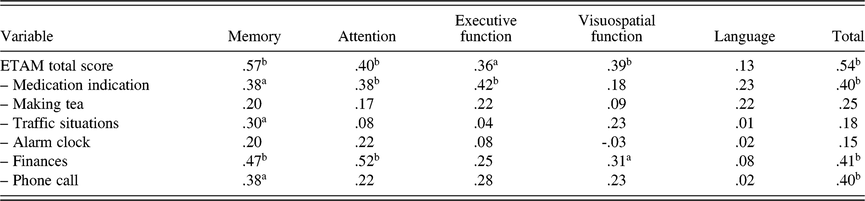
Spearman’s rank correlation coefficients between the ETAM total score and items and cognitive domains in the Parkinson’s disease group

Note. ETAM = Erlangen Test of Activities of Daily Living in Mild Dementia and Mild Cognitive Impairment.
a p < .05.
b p < .01.
As part of the construct validity, associations between the ETAM and cognitive assessments revealed that ETAM performance was associated with the global cognitive status as well as memory, attention, executive, and visuospatial function (.36 ≤ r ≤ .57; see Table 4 for details). No association of the ETAM scores to performance on neuropsychological tests assessing language could be identified. The BDI-II was not significantly linked to the ETAM performance, and the UPDRS-III only correlated significantly with the ETAM item ‘phone call’ (r = −.37).
ETAM Performance of Study Groups
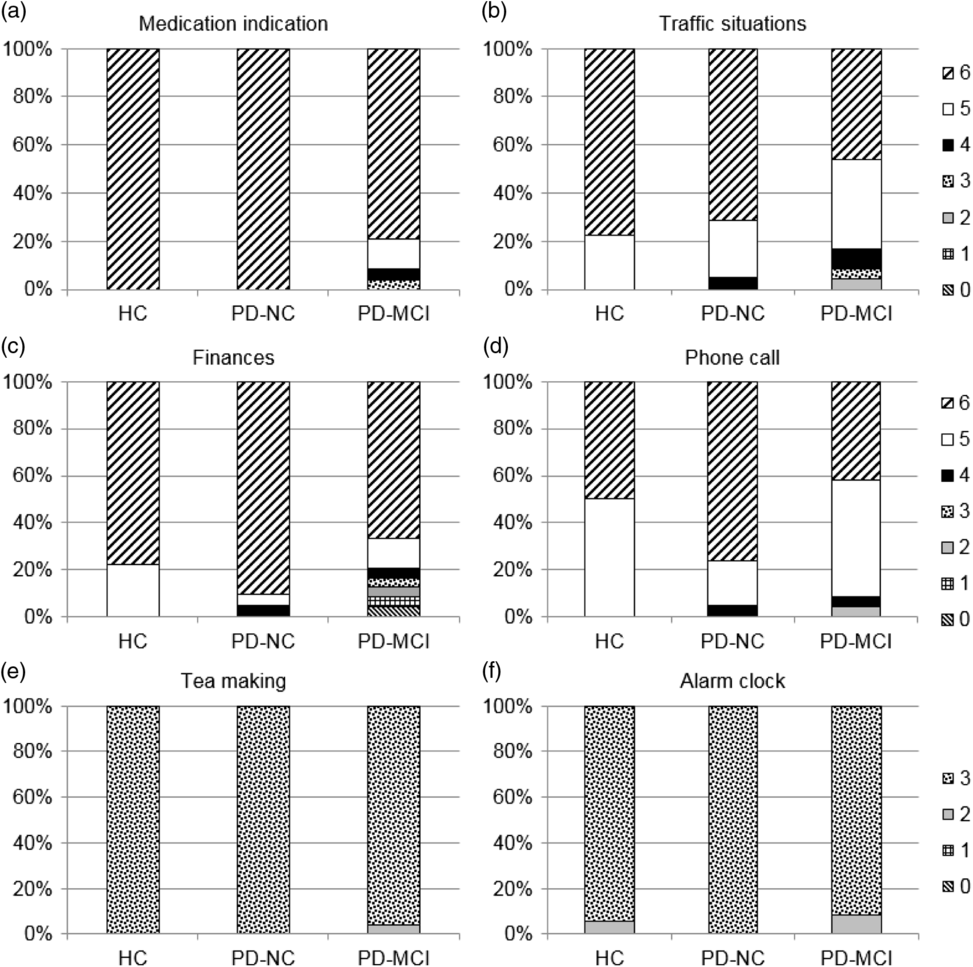
Comparing the ETAM performances, HC and PD-NC group did not differ significantly on either single item level (see Figure 1) or the total score (Median = 29, range = 27–30 vs. 30, 27–30, p = .28, d = .35). In contrast, a significantly lower test performance of the PD-MCI group (28, 15–30) compared to the PD-NC group was shown in the ETAM total score (p = .002, d = 1.03). On the single item level, PD-MCI patients scored lower on the following tasks: ‘medication indication’ (p = .03, d = .36), ‘finances’ (p = .05, d = .44), and ‘phone call’ (p = .03, d = .61). Performance on ‘making tea’, ‘traffic situations’, and ‘alarm clock’ items did not statistically differ between PD-NC and PD-MCI patients. For distribution of ETAM item scores between groups, see Figure 1.
Stacked bars showing frequency distribution of obtained scores for each ETAM item for all participant groups. In items (a) to (d), a maximum score of 6 points and in items (e) and (f) a maximum score of 3 points was attainable.

An ETAM cutoff of 27 was chosen based on the lowest achieved ETAM total score in the HC group. No PD-NC patients scored below the cutoff, but 29.2% of patients in the PD-MCI group scored below and 70.8% above the defined cutoff (χ² = 7.25, p = .007).
Post hoc Comparison of PD-MCI Subgroups
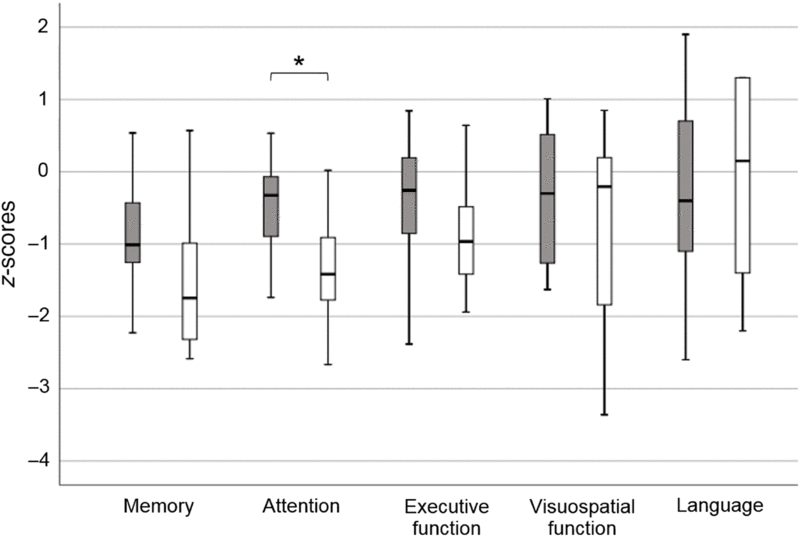
Comparing the characterization of PD-MCI subgroups (ETAM total score above and below the cutoff), we found a significant difference in the cognitive domain attention (p = .04). All other domains did not distinguish significantly between the PD-MCI subgroups; however, for the domains memory and executive function PD-MCI patients with mild iADL dysfunction had lower median scores than PD-MCI without iADL dysfunction. The comparisons of the mean z-scores of the PD-MCI patients with and without mild iADL dysfunction are displayed in Figure 2. Cohen’s d was large for the domain attention (d = −1.11, 95% confidence interval (CI) = −2.04 to −.18); all other domains showed small effects sizes (d < .5) except for memory which had a medium effect size of d = −.74 (95% CI = −1.69 to .22). BDI-II, UPDRS-III, gender, age, age at onset, disease duration, and education did not differ between subgroups (p > .05). Descriptively, PD-MCI patients with mild iADL dysfunction took longer (time in seconds) to finish the ETAM than those without; however, this difference was not statistically significant [Median = 1230 (range = 660–1800) vs. 900 (540–2280), p = .19].
Clustered boxplots for all cognitive domains for Parkinson’s disease patients with mild cognitive impairment above (gray) and below (white) the ETAM cutoff of 27. *p < .05.

DISCUSSION
Assessing cognitive-driven iADL dysfunction in PD is challenging as motor symptoms often influence ratings on questionnaires and performance-based tests. We evaluated the ETAM to determine whether it is a suitable performance-based test for assessing iADL function in PD, independent of PD-related motor symptoms.
Reliability and Item-Validity of the ETAM
Strong IRR correlations and high Cramer’s V values indicate that the ETAM is easily evaluated with minimal discrepancy between raters, which was also found in the original validation study (Luttenberger et al., Reference Luttenberger, Reppermund, Schmiedeberg-Sohn, Book and Graessel2016). Furthermore, we found that the ETAM items correlate significantly with the total score, except for the item ‘tea making’. Hence, we assume that most of the ETAM items contribute to the final outcome of the test as they correlated significantly with the total score; only the item ‘tea making’ does not have additional benefit for the whole test performance or influence the main outcome of the ETAM. Still we cannot rule out the possibility that these results might be different in a larger cohort. Two items showed high item difficulty values (Pi > 99%) indicating that they are too easy to capture any iADL dysfunction in our sample. In general, item difficulty of the ETAM was low, indicating that only 8% of all patients make mistakes on at least one item of the test. This imbalance and heterogeneity of the ETAM items is also supported by the borderline Cronbach’s alpha (α = .65) score. These findings indicate that the ETAM includes reliable items and is easy to administer. To further shorten the test and for that reason make it even more applicable in clinical daily routine, the items ‘tea making’ and ‘alarm clock’ could be cut out as they have little effect on the ETAM outcome. These iADL tasks seem to be too easy to identify early iADL dysfunction in PD and might represent more bADL functions that are usually preserved until mild dementia. However, this is a first study to test the feasibility of the ETAM in the PD field. Shortening the ETAM should only be considered when these findings have been confirmed in larger and heterogenic PD samples, which also include patients with early-stage PDD. As the ETAM was designed for detection of early cognitive-driven iADL impairment, the efficiency and discriminant ability in PDD patients need further exploration. In our non-demented PD sample, the ETAM took about 15 min to assess. With a shortened version, it would be possible to make it even more time-efficient and easier to apply in clinical environment.
Associations Between ETAM Scores and iADL, Cognition, Motor Symptoms, and Mood
One of the main challenges in performance-based testing in PD is that motor symptoms are often unintentionally represented in the results. Holden et al. (Reference Holden, Medina, Hoyt, Sillau, Berman, Goldman, Weintraub and Kluger2018) showed that the UPSA correlates with cognition; however, they also found correlations with the UPDRS-III indicating that this performance-based test might be partly affected by motor symptoms in PD. In our study, the UPDRS-III was not significantly correlated with the ETAM total and item scores, except for the item ‘phone call’, where motor symptoms most likely affected patients’ ability to press the buttons while dialing. However, no group differences between HC and PD-NC patients in the ETAM total and item scores could be verified in our sample. Therefore, we assume that motor symptoms seem to have a minimal influence on the iADL dysfunction assessed using the ETAM. As one of our main aims was to show that the ETAM performance is cognitive-driven, our results confirm significant associations of the ETAM outcome with the MoCA. Specifically, significant correlations were found for the items ‘medication indication’ and ‘finances’ confirming a cognitive relation between these ETAM items and cognitive performance. ‘Tea making’ and ‘alarm clock’ did not show any correlations with the MoCA, nor did the item ‘traffic situations’. However, when examining the individual tasks of the latter item, we found that three tasks were not associated with the MoCA, while the other three correlated significantly with the MoCA. It seems that the uncorrelated tasks do not contribute to the ‘traffic situations’ outcome, as almost all participants were able to solve them independent of their cognitive performance. Therefore, it might also be possible to shorten the ‘traffic situations’ item, making the ETAM even more time-economical; however, this finding first has to be confirmed by further revalidation studies with a larger cohort.
The MoCA was the only independent cognitive assessment not used for the Level-II diagnosis of PD-MCI, which is based on the results of a comprehensive neuropsychological test battery (for details, see Methods section ‘Assessment of cognitive function’). Correlation analyses between the ETAM and domain-specific z-scores showed that each cognitive function was also associated with the ETAM, except for the domain language. This further underlines our findings that the performance in the ETAM is dependent on cognitive functions and its tasks require attention, memory, executive, and visuospatial functions. These results are consistent with other studies (Becker et al., Reference Becker, Bäumer, Maetzler, Nussbaum, Timmers, Van Nueten, Salvadore, Zaunbrecher, Roeben, Brockmann and Brockmann2018; Bronnick et al., Reference Bronnick, Ehrt, Emre, De Deyn, Wesnes, Tekin and Aarsland2006; Cahn et al., Reference Cahn, Sullivan, Shear, Pfefferbaum, Heit and Silverberg1998; Higginson et al., Reference Higginson, Lanni, Sigvardt and Disbrow2013; Maeshima, Itakura, Nakagawa, Nakai, & Komai, Reference Maeshima, Itakura, Nakagawa, Nakai and Komai1997; Pirogovsky, Woods, Filoteo, & Gilbert, Reference Pirogovsky, Woods, Filoteo and Gilbert2012). Regarding the individual items, only ‘tea making’ and ‘alarm clock’ are not related to cognitive dysfunction, further indicating that these items are not cognitively demanding enough to detect early signs of iADL impairment. Based on our data, we assume that the ETAM is able to identify cognitive-driven iADL dysfunction without significant motor interference in PD.
In addition, the ETAM performance is unbiased by the severity of depressive symptoms. However, with regard to other iADL measurements, the ETAM total score correlates significantly with the self-rated FAQ, confirming iADL dysfunction reported by patients themselves. The low association between informant-rated iADL measurements and the ETAM scores might indicate a differing perception of patients’ iADL function between the patients themselves and their informants or caregivers. It is possible that early signs of cognitive-related ADL dysfunction are not as easily identified by informants compared to the patients or that it is more difficult for informants to differentiate motor-related from cognitive-related ADL impairment. Other studies have shown that patients’ and informants’ perception is not always accurate (Benge & Balsis, Reference Benge and Balsis2016; Shulman et al., Reference Shulman, Pretzer-Aboff, Anderson, Stevenson, Vaughan, Gruber-Baldini, Reich and Weiner2006). Our results indicate the ETAM might be more sensitive for assessing early iADL impairment and superior to informant-based iADL questionnaires, where caregivers and informants cannot differentiate cognitive from motor influences on iADL in PD.
ETAM Sensitivity for iADL Impairment Associated with PD-MCI
Concerning diagnostic value, PD-NC patients and HC did not differ significantly in the ETAM, further underlining that this performance-based test is not prone to PD-related motor symptoms. In contrast, PD-MCI patients scored significantly lower on the ETAM than PD-NC patients, indicating that some PD-MCI patients already show iADL dysfunction to a certain degree. PD-MCI patients’ ETAM score ranged from 15 to 30, presenting a heterogeneous test performance. While most PD-MCI patients scored on the same level as PD-NC patients and HC, 29.2% scored significantly lower in the ETAM. Other studies showed that about 30% of PD-MCI patients are already impaired in iADL function (Becker et al., Reference Becker, Bäumer, Maetzler, Nussbaum, Timmers, Van Nueten, Salvadore, Zaunbrecher, Roeben, Brockmann and Brockmann2018; Glonnegger et al., Reference Glonnegger, Beyle, Cerff, Gräber, Csoti, Berg and Liepelt-Scarfone2016); therefore, the ETAM has a similar detection rate. However, it is an objective iADL test with a standardized scoring system, which can be easily applied in the clinical daily routine. Previous studies with performance-based tests also identified PD-MCI patients with some impairment in iADL function [50% with the FCI (Martin et al., Reference Martin, Triebel, Kennedy, Nicholas, Watts, Stover, Brandon and Marson2013), 30% with the MOT (Glonnegger et al., Reference Glonnegger, Beyle, Cerff, Gräber, Csoti, Berg and Liepelt-Scarfone2016)]. Nevertheless, studies were not able to verify if those patients differ in their cognitive performance from PD-MCI patients without iADL impairment. As cognitive performance was lower in PD-MCI patients with an ETAM total score below 27, we argue that the ETAM is a valuable performance-based test to identify cognitive-driven iADL impairment in a subgroup of PD-MCI patients we assume are at a higher risk for PDD development. Especially, as iADL dysfunction has been associated with decline in attention, memory, executive, and visuospatial function (Bronnick et al., Reference Bronnick, Ehrt, Emre, De Deyn, Wesnes, Tekin and Aarsland2006; Cahn et al., Reference Cahn, Sullivan, Shear, Pfefferbaum, Heit and Silverberg1998; Fellows & Schmitter-Edgecombe, Reference Fellows and Schmitter-Edgecombe2019; Higginson et al., Reference Higginson, Lanni, Sigvardt and Disbrow2013; Maeshima et al., Reference Maeshima, Itakura, Nakagawa, Nakai and Komai1997; Pirogovsky et al., Reference Pirogovsky, Woods, Filoteo and Gilbert2012). These cognitive domains also showed high associations to the ETAM scores in our study. Other studies have demonstrated that about one-third of PD-MCI patients at least decline cognitively (Lawson et al., Reference Lawson, Yarnall, Duncan, Breen, Khoo, Williams-Gray, Barker and Burn2017) or even develop PDD (Pedersen, Larsen, Tysnes, & Alves, Reference Pedersen, Larsen, Tysnes and Alves2013), which corresponds to our subgroup size and might strengthen the assumption of a greater risk for PDD. However, this hypothesis needs to be confirmed in longitudinal studies.
Looking further into clinical characteristics of the PD-MCI patients with mild iADL dysfunctions, we found an increased deficit in neuropsychological tests concerning attention compared to the PD-MCI patients without iADL dysfunction. We suggest that mild iADL impairment is closely associated with attention deficits. This finding is supported by other studies linking attentional deficits with iADL (Becker et al., Reference Becker, Bäumer, Maetzler, Nussbaum, Timmers, Van Nueten, Salvadore, Zaunbrecher, Roeben, Brockmann and Brockmann2018; Bronnick et al., Reference Bronnick, Ehrt, Emre, De Deyn, Wesnes, Tekin and Aarsland2006). Other cognitive domains did not differ between the PD-MCI patients with a lowered and those with a high ETAM total score. Still, we cannot rule out that memory also plays a role in iADL dysfunction. We found a medium effect size for the comparison of the z-scores and, in the whole PD cohort, a significant correlation between the memory domain and the ETAM total score. To avoid a high load of memory performance on the ETAM instruction, it was provided in written form during each task. Therefore, we conclude that both domains are associated with iADL function in PD. Moreover, demographic characteristics, motor, and depressive symptoms were also comparable between groups; hence, we can only ascribe the ETAM differences to the attentional and possibly memory deficits. However, we are aware that sample size in this study is rather small and higher sample sizes are needed to confirm our findings.
LIMITATIONS
Even though these results are promising for the practicability of the ETAM in assessing mild iADL impairment, the study design shows some limitations. It is not known whether the ETAM is more suitable for detecting mild iADL dysfunction in PD-MCI patients than other performance-based tests, as we did not apply other tests in this study. Another limitation is that measurements were not always assessed by the same neuropsychologist and we cannot preclude investigator bias. Longitudinal studies are needed to further investigate the prognostic value of the ETAM for PDD.
CONCLUSION
These results confirm the ETAM is a beneficial performance-based test for iADL, as it is economical in time, easy to administer, and independent of PD-related motor symptoms. However, it is debatable whether all items of the ETAM are needed to identify early signs of iADL dysfunction and we propose a shortened version of the ETAM.
Using the ETAM, we were also able to detect a subgroup of PD-MCI patients who already showed mild iADL impairment and we assume that these patients might have a higher risk to develop PDD, which needs to be confirmed in further studies. As this subgroup showed greater cognitive deficits concerning attention, it is possible that early dysfunction in iADL tasks are related to attentional difficulties.
ACKNOWLEDGMENTS
No special project funding was received.
CONFLICT OF INTEREST
None of the authors have any conflict of interest to disclose.
SUPPLEMENTARY MATERIAL
To view supplementary material for this article, please visit https://doi.org/10.1017/S1355617719001322