


INTRODUCTION
A sustained and widespread interest is currently documented for low velocity ion slowing down (LVISD) in binary ionic mixtures (BIM) (Tashev et al., Reference Tashev, Baimbetov, Deutsch and Fromy2008; Fromy et al., Reference Fromy, Tashev and Deutsch2010) fully neutralized by an electron fluid jellium (Leger & Deutsch, 1988a, 1988b, Reference Leger and Deutsch1992).
We pay specific attention to the hydrogen-helium strongly coupled mixture of sustained astrophysical concern (Stevenson, Reference Stevenson1975; Stevenson & Salpeter, Reference Stevenson and Salpeter1977; Vorberger et al., Reference Vorberger, Tamblyn, Militzer and Bonev2007; Lorenzen et al., Reference Lorenzen, Holst and Redmer2009). Up to now, most of these studies were conducted through, a weakly coupled BIM immersed into a classical high temperature electron background taken in a dielectric Fried-Conte description (Fried & Conte, Reference Fried and Conte1961; Arista & Brandt, Reference Arista and Brandt1981). Specifying BIM ion coupling on species i (i = 1, 2) with charge Zi one has

where a i = ((4π/3) ni)−1/3 with temperature T = T e = T i. Here, we stress strongly coupled BIM with Γi ≫ 1, able to display a critical de-mixing process (2, 4).
Pertaining thermodynamic and hydrodynamic features have already been investigated at length (Leger & Deutsch, 1988a, 1988b, Reference Leger and Deutsch1992). In this context, a critical de-mixing behavior is observed on the ion-ion structure factor S αβ(q) in the long-wavelength q → 0 limit. As usual, LVISD amounts to evaluating low velocity ion stopping with neglected intra-beam scattering and in-flight correlation, in a low velocity regime V p ≪ V the target electron thermal velocity. On the other hand, the opposite V p > V the situation is now rather well documented in the so-called standard stopping model (Deutsch, Reference Deutsch1986; Deutsch et al., Reference Deutsch, Maynard, Bimbot, Gardes, DellaNegra, Dumail, Kubica, Richard, Rivet, Servajean, Fleurier, Sanba, Hoffmann, Weyrich and Wahl1989) where most of the ion projectile stopping arises from its interaction with target electron fluid. To the contrary, LVISD is essentially monitored by the projectile interaction with target ions. A foremost motivation for the present undertaking is a possible involment of LVISD in BIM in probing and testing the ion de-mixing process. In the past, some of us (Leger & Deutsch, 1988a, 1988b, Reference Leger and Deutsch1992) have already investigated a critical BIM de-mixing signature on target electrical resistivity. Within a dielectric framework for target particles, the nonrelativistic ion stopping thus reads as (Arista & Brandt, Reference Arista and Brandt1981).

which can be straightforwardly re-expressed in terms of the ion charge-ion charge structure factor when switching to very low

with V thi, thermal velocity and C i, relative concentration of ion i.
Incoming ion projectile could then be able to probe every available ion fluid fluctuations in target by restricting the global dielectrics expression ɛ(q,ω) to its i-component. Such a picture highlights the BIM electron background following the ionic fluctuations, within a polarization concept.
Energy exchange between ion projectile and thermalized medium is expressed in terms of emission and absorption processes, according to the protocol (Pines, Reference Pines1964)

yielding, up to the first order in the interaction, a quarter involving only spontaneous emission. The present approach stands at variance with the so-called T-matrix one (Gericke et al., Reference Gericke, Schlanges and Kraeft1996; Gericke & Schlanges, Reference Gericke and Schlanges1999) advocating a strong binary interaction between incoming ion projectile and one target electron thus probing mostly short wavelength modes with q → ∞. Then,

where N(ω)−1 = eβħω − 1, β = (kBT)−1 allow to put Eq. (2) under the form

with the usual electron ɛ(q,ω) now extended to the ion components building up the BIM, and the charge-charge structure factor

where C1 + C2 = 1. Ci refers to concentration of species i within a BIM built on target ion charges Z1 and Z2.
Focusing attention on the slow and long wavelength hydromodes ω → 0, q → 0 monitoring BIM de-mixing, one can safely restrict Eq. (4) to its static limit ω → 0

in-terms of 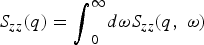 Eq. (6) also highlights the expected LVISD linear Vp − dependence ≤
 Eq. (6) implies an average over every ω-fluctuation, available to
 .
CRITICAL Szz(q)
Mean field classical description of BIM de-mixing could be rather straightforwardly explained with the static charge-charge structure factor (De Gennes & Friedel, Reference De Gennes and Friedel1958; Fisher & Langer, Reference Fisher and Langer1968),

where t = (T − Tc/Tc), Tc = critical temperature, γ = 1, and ξ = ion-ion correlation length featuring  .
 = C1Z1 + C2Z2 and
 = C1Γ1 + C2Γ2. ∑ denotes a constant normalizing factor accessed through the sum rule (q in āi−1)(where āi = C1a1 + C2a2)

where  .
Eq. (7) mostly emphasizes long distance hydromodes, of significance at critical de-mixing.
Paying attention first to non-polarizable BIM with a fixed and rigid electron background (Leger & Deutsch, 1988a, 1988b), the correlation length reads as

where D I and DR, respectively, denote the q → 0 limit of

and

in terms of

 denotes the partial direct correlation function, viewed in the Ornstein-Zernikc (OZ) equations

The right-hand side of Eq. (12) also features the dimensionless and screened Coulomb potential

with the dimensionless static electron fluid dielectric function ɛ(q). Close to criticality, one expects a characteristic diverging behavior of the correlation length, so that

with ν = 0.5, in a standard mean field OZ approximation.
SUPERELASTIC LVISD
The introduction of Eq. (7) into Eq. (6), thus yields for q āi ≤ 1

demonstrating that ξ-diverging behavior (Eq. (15)) is compensated by that in Eq. (7).
Now we pay attention to correlation length (Eq. (9)) estimates by solving simultaneously (Leger & Deutsch, 1988a, 1988b) OZ Eq. (13) with the Hypernetted Chain (HNC) equations

valid for any Γi values.
Lindhard screening (Lindhard, Reference Lindhard1954) involves (cf. Fig. 1)

where kTF = (6πnee2/EF)1/2 denotes the Thomas-Fermi wave vector and the function gL(x) depends only on the dimensionless variable x = k/2kF, with

and kF = (3π2ne)1/3, Fermi wave number in terms of electron density ne, while EF = ħ F2kF2/2me. Moreover, Hubbard screening (Hubbard, Reference Hubbard1966) with

where 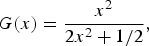 includes exchange-correlation contributions into the jellium background.
Plot of the reduced squared correlation length (ξ/a1)2 in terms of r s along a critical and vertical line (34% He, Γ = 60) with Lindhard screening. There ξ2 remains negative.

Present critical conditions are now significantly different. In Figure 2, critical de-mixing occurs at C2 = 0.75 in lieu of C2 = 0.34 in Figure 1 for the same Γ = 60. More importantly, ξ2 is now allowed to increase positive on the largest rs range side.
PBIM model B with Hubbard screening. Plot of the reduced squared correlation length (ξ/a1)2 as a function of rs along a critical and vertical line (75% He at Γ = 60) ξ2 is now allowed to change sign for rs ≥ rs 0.

The resulting correlation length is now rising strongly when ∣t∣→ 0, up to the standard means field behavior (ξ/a1)2 ≫ 1.
The given LVISD is now negative featuring a super elastic interaction between the low velocity incoming ion projectile and the PBIMB target.
It can also be appreciated that before turning negative, LVISD (16) vanishes for (ξ/a1)2 ~ 1.65. The prefactor ∑ in Eq. (16) is then straightforwardly derived from the sum rule (8) under the alternative forms,

in terms of BIM thermodynamics and also (cf. Eq. (15))

FINAL REMARKS
The present developments highlight for the first time the intriguing interplay of a first order de-mixing process in a strongly coupled and binary ionic mixture with a low velocity incoming ion beam. The latter may be envisioned for diagnostics purposes or target conditioning in the subfields of ICF and warm dense matter, for instance.
Within a fundamental statistical physics perspective, it should be appreciated that the above results document unambiguously the potentialities of probing collective very long wavelength phenomena occurring in a plasma target with low velocity ion beams via the evaluation of a transport coefficient, featured in the present context by a stopping power mechanism.
As far as a super elastic projectile-target interaction is witnessed at very low V p, it should be noticed that it also can appear in the T-matrix approach (Gericke et al., 1996).
ACKNOWLEDGMENT
We thank the referee for very significant and constructive remarks.



