Aim
To determine if consumption of wheat germ grass has a detrimental effect if taken along with radiotherapy and if its antioxidant properties nullifies or reduces the tumoricidal effect of radiation.
Introduction
Nutraceuticals are the products derived from both plants as well as animal species, which have some beneficial effects as dietary components.Reference Das, Bhaumik, Raychaudhuri and Chakraborty 1 Thousands of biologically active compounds have been identified from vegetables and fruits.Reference Lampe 2
A diet rich in vegetables and fruits provides protection against cardiovascular and other chronic diseases originating from oxidative stress.Reference Lampe 2 , Reference Marx 3 Suitable antioxidant therapies to control oxidative damage have already attracted the worldwide attention in recent years. Extensive studies on phytochemicals in cell culture system and animal models have provided a wealth of information on the mechanism by which such nutraceuticals show their beneficial effect.Reference Godsey and Grundmann 4 – Reference Greenlee, Hershman and Jacobson 7
Nutraceuticals include plant-derived factors (phytochemicals) and factors derived from animal sources as well as from microbial sources.Reference Doughari, Human, Bennade and Ndakidemi 8 The activities of nutraceuticals are broad and include antioxidation, modulation of enzyme activity and modification of natural hormonal activity (agonist or antagonist) to act as a precursor for one or more beneficial molecules. Some of the recognised nutraceuticals are flavonoids, carotenoids, allyl compounds, protease inhibitors, saponins, licorice, fibres, omega 3 and omega 6 polyunsaturated fatty acids.Reference Milner 9 Use of herbal medicines for cancer treatment, alleviation of treatment related effects and to prevent cancer has increased significantly over the last few years.Reference Eisenberg, Davis and Ettner 10 – Reference Tindle, Davis, Phillip and Eisenberg 12
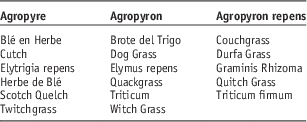
Wheat grass, one such neutraceutical, with the scientific name: Triticum aestivum, is prepared by sprouting wheat seeds in water for 7–10 days before harvesting the leaves (Table 1).
Different names of wheat grass

The notion that wheatgrass can benefit serious disease sufferers was conceived by Ann Wigmore, a Boston area resident. The common observation that dogs and cats nibble on the grass, presumably when they feel ill, also strengthened Wigmore’s belief in the healing power of grass.Reference Wigmore 13 Wigmore theorised that rotting food in the intestine forms toxins that circulate in the bloodstream (also known as the intestinal toxicity theory) and cause cancer.Reference Cassileth 14
Wheatgrass is prepared by sprouting wheat berries and growing them until they form chlorophyll. The fact that grass-eating animals are not spared from cancer, despite their large intake of fresh chlorophyll, seems to have been lost on Wigmore. In fact, chlorophyll cannot ‘detoxify the body’ since it is not absorbedReference Bidlack and Meskin 15 through the human intestines.
Proponents believe the enzymes responsible for detoxifying the body are deactivated by the cooking process. Wheat grass is also marketed as a nutritional supplement in powder form.
The juice form has been claimed to neutralise toxins and carcinogens in the body, prevent tooth decay, reduce high blood pressure, and aid in the treatment and prevention of cancer and AIDS.Reference Jirathitikal 16 , Reference Mujoriya and Bodla 17 It is also used to improve digestion, prevent hair from graying, for common colds, cough, rheumatic pain, chronic fatigue syndrome, ulcers and skin conditions.Reference Mujoriya and Bodla 17
Wheat grass proponents also equate its major constituent chlorophyll to haemoglobin, and believe that wheat grass consumption can increase oxygenation in the body. However, these concepts are not supported by current scientific understanding.
THE HYPOTHESIS
Wheat germ grass is being taken by patients during cancer therapy and as well as by normal population with various proposed notions.Reference Cassileth and Brown 18
In studies by Shukhla et al., Kulkarni et al. and Gerristen et al.,Reference Eisenberg, Davis and Ettner 10 – Reference Tindle, Davis, Phillip and Eisenberg 12 , the antioxidant properties of wheat grass was evaluated. Kulkarni et al., concluded that wheat grass has higher Oxygen Radical Absorbance Capacity (ORAC) compared with other neutraceuticals and vegetables. This along with the fact that wheat grass is widely consumed in conjunction with radiotherapy underlines the need to further explore the possibility of wheat grass (over the other neutraceuticals) nullifying the effect of radiation.
Antioxidants scavenge free radicals that cause cell damageReference Fang, Yang and Wu 19 Antioxidant consumption during radiotherapy and its effects are still controversial. Some studies suggest that antioxidant supplementation during chemotherapy or radiotherapy may be beneficial and some, harmful.Reference Block, Koch, Mead, Tothy, Newman and Gyllenhaal 20 – Reference Conklin 22 . Wheat grass is rich in superoxide dismutase, an antioxidant enzyme.Reference Mates, Jimenez and Fransisca 23 Radiotherapy causes tumour cell kill via activation of reactive oxygen species, specifically by the hydroxyl radical and needs the reactive species for effective tumour control.Reference Hall and Giaccia 24 Wheat grass which is rich in free radical scavengers can interfere with reactive oxygen species generated by radiation for tumour cell kill and can be detrimental to the therapy per se.
EVALUATION OF HYPOTHESIS
Animal models suggest that wheat grass may have hypolipidemicReference Kothari, Jain and Mehta 25 and antioxidantReference Sethi, Yadav and Dahiya 26 effects. Wheat grass supplementation reduced plasma lipid peroxidation levels in healthy volunteers engaged in regular exercise.Reference Shyam, Singh and Vats 27 A small study and systematic review indicate that wheat grass juice may be helpful for ulcerative colitis.Reference Ben-Arye, Goldin and Wengrower 28 , Reference Ng, Lam and Tsoi 29
Other studies are mixed on whether wheatgrass can reduce the need for transfusions in patients with Thalassemia major.Reference Marawaha, Bansal and Kaur 30 – Reference Singh, Pannu and Singh 32 The prospective matched control study, on patients with breast carcinoma receiving chemotherapy, to evaluate the beneficial effect of wheat grass juice revealed that when taken during FAC (5-fluorouracil, doxorubicin and cyclophospamide) chemotherapy it may reduce myelo-toxicity, helps in dose reduction and need for granulocyte colony stimulating factors support, without diminishing efficacy of chemotherapy.Reference Bar-Sela, Tsalic and Fried 33
The clinical studies conducted on patients of transfusion dependent myelodysplastic syndrome (preleukemia) have revealed that wheat grass juice is an effective iron chelator. Henceforth, its use in reducing serum ferritin should be encouraged in myelodysplastic syndrome and other diseases where repeated blood transfusion is required.Reference Mukhopadhyay 34
In another study, Dey et al. found that wheat grass juice helped to improve the health status and lifespan in terminally ill cancer patients.Reference Dey, Sarkar and Ghosh 35 The extract of wheat grass when applied to known chemical mutagens, decreased their cancer causing ability by up to 99%Reference Lai, Dabney and Shaw 36 – Reference Lai 37 which suggests that wheat grass may have cancer preventing property. These studies were primarily in vitro and its extrapolation into in vivo situations are needed to make more conclusive statements.
THE CONCEPT OF CHLOROPHYLLIN
Most of the clinical studies conducted on breast cancer patients have shown that chlorophyllin, a compound that is similar to chlorophyll produced synthetically, has the capability to reduce the risk of breast cancer.Reference Chiu, Kong and Ooi 38 Furthermore, chlorophyll derivatives have also been found to provide beneficial effect in patients suffering from liver, colon, stomach and gastrointestinal cancers.Reference Egner, Wang and Zhu 39 – Reference Sarkar, Sharma and Talukder 42
In vitro studies with chlorophyllin on animal model have shown that it is an inhibitor of the cytochrome P-450 liver enzymes.Reference Tachino, Guo, Dashwood, Yamane, Larsen and Dashwood 43 All in vivo (whole animal) studies where cytochrome P-450 enzyme activity is reduced resulted in lower cancer rates and longer lifespan.Reference Guengerich, Kim and Iwasaki 44
Finch et al.Reference Finch and Tanzi 45 observed that in stage 2 liver detoxification, glutathione transferase enzyme plays a major role because glutathione to react with the carcinogens formed from cytochrome P-450 activity to produce harmless additional products, but this process is not very efficient. The Chlorophyllin, however, makes this conversion more efficient by lowering cytochrome P-450 enzyme activity in the first place and by reacting with carcinogens to produce harmless complexes, just as the glutathione transferase do. Thus, chlorophyllin is not an inducer of glutathione transferases but mimics glutathione transferase activity. The studies have shown that the beneficial effect of wheat grass might be due to antioxidant activity preventing oxidative damage to deoxyribonucleic acid (DNA) and lipid peroxidation, stimulation of gap junction communication, effect on cell transformation and differentiation, inhibition of cell proliferation and oncogene expression, effects on immune function and inhibition of endogenous formation of carcinogens.Reference Wheat and Currie 46 , Reference Mates, Jimenez and Fransisca 47 A supernatant extract from wheat grass has been shown to reduce the production of carcinogenic, aromatic hydrocarbon (Benzopyerene) derivative, to inhibit benzopyerene mutagenecity with non-chlorophyll-containing wheat sprout extract which suggests that chlorophyll is not the main compound responsible for anticancer activity.Reference Peryty, Szmczyk and Lesca 48 Larger studies are needed to evaluate these findings.
RADIOTHERAPY AND FREE RADICAL BASED DNA DAMAGE
If any form of radiation—x- or γ-rays, charged or uncharged particles—is absorbed in biologic material, there is a possibility that it will interact directly with the critical targets in the cells.Reference Zirkle 49 The atoms of the target itself may be ionised or excited, thus initiating the chain of events that leads to a biologic change. This is called direct action of radiation and it is the dominant process if radiations with high linear energy transfer, such as neutrons or α-particles, are considered.Reference Zirkle 49 , Reference Hunter and Muirhead 50
Alternatively, indirect action of radiation is when the radiation may interact with other atoms or molecules in the cell (particularly water) to produce free radicals that are able to diffuse far enough to reach and damage the critical targets. About 80% of a cell in a tissue is composed of water. As a result of the interaction with a photon of x- or γ-rays or a charged particle, such as an electron or proton, the water molecule may become ionised. This may be expressed as
 $${\rm H}_{{\rm 2}} {\rm O}\to{\rm H}_{{\rm 2}} {\rm O}^{{\plus}} {\plus}{\rm e}^{{\minus}} $$
H2O+is an ion radical. An ion is an atom or molecule that is electrically charged because it has lost an electron. A free radical contains an unpaired electron in the outer shell, making it highly reactive. H2O+is charged and has an unpaired electron; consequently, it is both an ion and a free radical. They decay to form free radicals, which are not charged but still have an unpaired electron. In the case of water, the ion radical reacts with another water molecule to form the highly reactive hydroxyl radical (OH·):
 $${\rm H}_{{\rm 2}} {\rm O}^{{\rm {\plus}}} {\plus}{\rm H}_{{\rm 2}} {\rm O}\to{\rm H}_{{\rm 3}} {\rm O}^{{\rm {\plus}}} {\plus}{\rm OH} \cdot $$
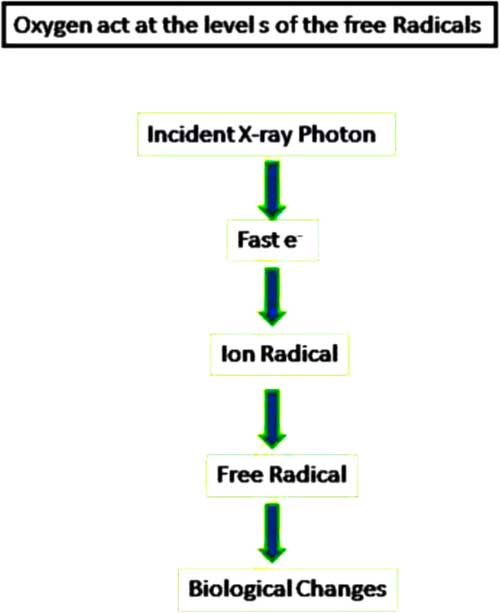
The hydroxyl radical is a highly reactive free radical and can diffuse a short distance to reach a critical target in a cell. It is estimated that about two thirds of the x-ray damage to DNA in mammalian cells is caused by the hydroxyl radical.Reference Fridovich 51 The best evidence for this estimate comes from experiments using free-radical scavengers, which can reduce the biologic effect of sparsely ionising radiations, such as x-rays, by a factor of close to 3. For the indirect action of x-rays, the chain of events, from the absorption of the incident photon to the final observed biologic change, may be described as follows:
Incident x-ray photon --> Fast electron (e-) --> Ion radical --> Free radical --> Chemical changes from the breakage of bonds --> Biologic effects (Figure 1)Reference Mates, Jimenez and Fransisca 23
Radiotherapy and free radical generation.

Thus, when the cells are ionised, free radicals and reactive oxygen species (ROS) form. Free radicals are simply atoms, molecules or ions with unpaired electrons, and ROS is a subset of free radicals that involve oxygen. These agents are very chemically reactive due to their free electron.Reference Greenlee, Hershman and Jacobson 7 Due to this high reactivity, free radicals and ROS are likely to attack the covalent bonds of the DNA and other cells they encounter, and these reactions typically occur in chains. Enough injury in the cell will result in apoptosis, or programmed cell death. At the same time, if enough DNA is damaged, the cells will be unable to replicate. Thus, when the radiation targets the tumour cells, the affected cells will die or be unable to proliferate, effectively reducing or eliminating the cancer.Reference Brooker 52
CONSEQUENCES OF HYPOTHESIS
Antioxidant supplementation during conventional chemotherapy and radiation therapy is a controversial subject. As per some studies, it is possible that taking antioxidant supplements during treatment can protect normal tissues from the damaging side effects of treatments, and may improve tumour response and patient survival.Reference Block, Koch, Mead, Tothy, Newman and Gyllenhaal 20 – Reference Conklin 22
On the other hand, some studies indicate that taking antioxidant supplements may interfere with chemotherapy and radiation therapy, by reducing their effectiveness.Reference Lawenda, Kelly, Ladas, Sagar, Vickers and Blumberg 53 It is possible that antioxidants may protect tumour cells, in addition to healthy cells, from the oxidative damage intentionally caused by conventional treatments. This, in turn, may reduce the effectiveness of the treatments.Reference Norman, Butrum and Feldman 5 , Reference Bairati, Meyer and Jobin 6 , Reference Lawenda, Kelly, Ladas, Sagar, Vickers and Blumberg 53 , Reference Ladas and Kelly 54
Hence, the antioxidant properties of wheat grass could influence tumour activity, the effects of radiation therapy on tumour cells can be nullified when wheat grass is taken during radiotherapy.
The purpose of this article was to hypothesise the possible detrimental effect of wheat grass when taken along with radiotherapy. There needs to be more studies to definitively settle the question of whether taking antioxidant rich products like wheat grass during cancer treatment is harmful or helpful. It is very likely that antioxidants during cancer treatment may be beneficial for some people, yet harmful for others.Reference Greenlee, Kwan and Kushi 55 Clear guidelines as to who would benefit and who should refrain from neutraceuticals like wheat grass would be an exciting area to explore.
Acknowledgement
None.
Funding
None.
Conflicts of Interest
None.