Introduction
Some institutions use a prone treatment setup for breast, rectal, and anal cancer, to provide enhanced normal tissue sparing. However, many have reported that supine orientation demonstrates better setup reproducibility.Reference Kim, Karotki and Presutti1 Radiotherapy for head and neck cancers (HNC) is typically delivered with the patient in supine position due to reproducibility and comfort, with a thermoplastic mass for head and shoulder immobilisation.Reference Merlotti, Alterio and Vigna-Taglianti2,Reference Hunt, Zelefsky and Wolden3 It is not uncommon, however, to have a patient who cannot tolerate this position because of pooling of secretions, which can lead to aspiration, anxiety, and subsequent issues during setup and treatment, and at times, patient noncompliance with treatment—all of which can lead to adverse patient outcomes.
In the past, we have occasionally had to treat such patients under daily anaesthesia for airway management. Daily anaesthesia is commonly used in paediatric patients and is reported useful in uncooperative adult patients.Reference Tsang, Solow, Ananthanarayan and Haley4 However, anaesthesia is not without its risks, including Propofol tolerance, airway issues, and cardiac complications, which can be compounded by individual patient comorbidities.Reference Anghelescu, Burgoyne and Liu5 With one such patient recently, we opted instead of using anaesthesia to perform prone setup and treatment, hypothesising that with modern image guidance and immobilisation, reproducibility would be of similar robustness to supine treatment and that the patient would be less bothered by secretions and better able to tolerate treatment. Here, we describe our experience and, to our knowledge, the first reported prone treatment setup and delivery in a HNC patient with increased secretions who could not tolerate supine positioning.
Clinical History
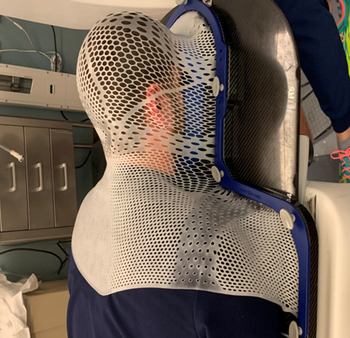
We report on the treatment of a 68-year-old male with inoperable locally advanced, T4aN0M0, squamous cell carcinoma of the maxillary sinus. The patient was initially started on neoadjuvant chemotherapy consisting of two cycles of carboplatin/docetaxel, due to extent of disease. Unfortunately, his disease was still considered to be unresectable even after completing neoadjuvant chemotherapy. Due to significant sinus congestion as a result of mucous production by his tumour, the patient was unable to tolerate supine position at the time of simulation. We then opted for a prone position, with a thermoplastic mask over the back of his head and shoulders as shown in Figure 1.
Prone setup.

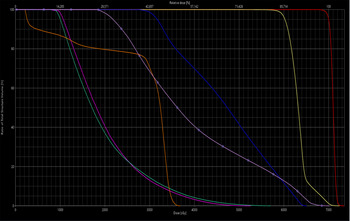
Primary disease and regional nodes were treated with volumetric-modulated arc therapy. Primary disease was treated to a prescription dose of 70 Gy, and regional lymph nodes were treated to 59·4 Gy, delivered in 35 fractions along with concurrent chemotherapy. Dosimetric evaluation demonstrated good tumour coverage as well as normal tissue sparing as shown in Figure 2. Planning target volume (PTV) V100 is 95·5%. The mean dose to the oral tongue was 39 Gy and of the right and left parotid glands was 20 Gy and 19·7 Gy, respectively. Accuracy of treatment setup was confirmed with daily 6D X-ray image guidance and weekly cone beam computed tomography and deemed acceptable by the treating physician within 3–5 mm PTV margin for head and neck intensity-modulated radiation therapy (IMRT). The patient completed treatment in 75 days with some treatment delays due to hospitalisation for myocardial infarction, breaks due to dehydration, and IV fluid replacement. The patient did not require any breaks related to the inability to manage secretions or intolerance of prone treatments. This study is approved by a broad-based institutional review board dosimetric study.
A typical dose–volume histogram for tumour and normal tissues. PTV 7000 (red), PTV 5940 (yellow), mandible (blue), oral tongue (lilac), spinal cord (orange), right parotid (magenta), and left parotid (light green) are shown. Horizontal scale is 0–7000 cGy, Vertical scale is 0–100% volume.

Discussion
Several studies have demonstrated that prone positioning provides enhanced normal tissue sparing in certain clinical scenarios.Reference Mulliez, Speleers and Madani6–Reference Gonzalez, Hullett and Burt8 Mullinez et al.Reference Mulliez, Speleers and Madani6 conducted a study in 18 early-stage breast cancer patients who were undergoing whole-breast irradiation after having breast-conserving surgery. Dosimetric evaluation of plans for 6 patients comparing tangential wedge fields, tangential field IMRT, and multi-beam IMRT was performed in supine and prone for each patient. This demonstrated enhanced ipsilateral lung sparing with prone treatment setup compared to supine. Improved heart dose was also achieved with prone positioning. Further evaluation showed enhanced heart sparing using prone planning in patients with PTV≥ 600 cc; however, comparable or even worse heart doses were seen with prone compared to supine in patients with PTV < 600 cc,Reference Mulliez, Speleers and Madani6 indicating that best setup is not always ‘one size that fits all’.
Prone positioning for the treatment of pelvic cancers, including anal and rectal cancer, has been reported by several institutions with mixed results. Yang et al.Reference Anghelescu, Burgoyne and Liu5 evaluated small bowel sparing with prone treatment compared to supine in 24 postoperative rectal cancer patients. Trends towards diminished clinical target volume (CTV) and PTV coverage were seen but were not statistically significant. The lower reported CTV coverage rate was 84·09%, and PTV for the same patient was 77·10%, and this was attributed to difficulty with setup reproducibility and positioning. The prone positioning did, however, significantly reduce the small bowel dose V5 and V10 volumes.Reference Anghelescu, Burgoyne and Liu5
Ten patients undergoing pelvic radiation therapy were evaluated with both prone and supine treatment plans by Gonzales et al.Reference Gonzalez, Hullett and Burt8 to compare small bowel dose. They found that prone positioning resulted in a lower volume of small bowel receiving irradiation.Reference Gonzalez, Hullett and Burt8 Kim et al.Reference Kim, Karotki and Presutti1 also reported on the prone positioning for sparing of small bowel. They too found that prone positioning resulted in reduced reproducibility with patient setup and concluded that the small, non-significant change in bowel and bladder dose did not warrant decreased reproducibility of prone positioning.Reference Kim, Karotki and Presutti1
Based on a review of the literature and our current report, prone treatment positioning can be of benefit on a case-by-case basis for breast and pelvic malignancies, and we prove feasibility here for use in head and neck cancer. As always, the ability to achieve a reproducible position and assess daily treatment setup with a high level of certainty as well as achieve adequate tumour volume coverage should be considered. It is standard of care at this time for patients with HNC to be simulated and treated in the supine position. Definitive radiation therapy in the supine position was not a feasible option for this particular patient given his significant congestion and thick secretions. Prone treatment was a suitable option for him that allowed him to avoid daily anaesthesia, and this should be considered in other such cases as an appropriate alternative to supine setup.
Conclusion
We have successfully demonstrated, and are the first to report on, the feasibility of a prone treatment position for patients with HNC who are unable to tolerate supine position.Reference Henson9 As this allowed us to avoid the use of daily anaesthesia, it theoretically would decrease the risk of aspiration pneumonia, anxiety, noncompliance, and intra-fractional break and avoids the risk and costs of general daily anaesthesia. Current National Surgical Adjuvant Breast and Bowel Project, The Radiation Therapy Oncology Group, and the Gynecologic Oncology Group (NRG) head and neck protocols stipulate that patients should be planned and treated supine.10 Reconsideration should be given to this policy under select circumstances.
Acknowledgements
None.