Introduction
Thompson and Grime (Reference Thompson and Grime1979) first mentioned that plant species with small and rounded seeds tend to persist longer than those with large and elongated or flat seeds in British floras. However, their results on the relationship between seed mass, shape and persistence were unrecognized by other seed ecologists for a long time, until Thompson et al. (Reference Thompson, Band and Hodgson1993) conducted a study on the relationship between seed size, shape and persistence and proposed that there is a tendency for species with persistent seed-banks to have smaller seeds than those with transient seed-banks. This question then became a focus of interest of seed ecologists. This relationship has been found in a range of floras, such as grasslands in north-western Europe (Thompson et al., Reference Thompson, Band and Hodgson1993; Bakker et al., Reference Bakker, Poschlod, Strykstra, Bekker and Thompson1996; McDonald et al., Reference McDonald, Bakker and Vegelin1996; Bekker et al., Reference Bekker, Bakker, Grandin, Kalamees, Milberg, Poschlod, Thompson and Willems1998), grasslands in central Argentina (Funes et al., Reference Funes, Basconcelo, Diaz and Cabido1999), and a wide range of habitats in Italy (Cerabolini et al., Reference Cerabolini, Ceriani, Caccianiga, Andreis and Raimondi2003). As a characteristic of a species, persistence means the ability of the species to persist in the soil seed-bank (Csontos and Tamás, Reference Csontos and Tamás2003; Fenner and Thompson, Reference Fenner and Thompson2005; Yu et al., Reference Yu, Sternberg, Kutiel and Chen2007). It has become customary for seed banks to be simply divided into transient and persistent types (Thompson and Grime, Reference Thompson and Grime1979). A soil seed-bank is classified as persistent if seeds remain viable for more than 1 year. The persistent seed-banks play an important role in the conservation and restoration of destroyed or degraded plant communities, since the persistence in the soil of plant species would be a ‘memory’ of the original plant community (Bakker et al., Reference Bakker, Poschlod, Strykstra, Bekker and Thompson1996). Therefore, the seed persistence characteristic of plant species is also essential to predict restoration success (Bossuyt et al., Reference Bossuyt, Stichelmans, Hoffmann, Herrier, Mees, Salman, Seys, Nieuwenhuyse and Van den Dobbelaere2005).
The basis of this relationship proposed by Thompson et al. (Reference Thompson, Band and Hodgson1993) is ease of burial, since small and rounded seeds are buried more easily and incorporated more quickly into the soil than large and flattened or elongated seeds; hence they have much less chance of germination and more easily escape post-dispersal predation. However, this relationship does not seem to be universal in all floras and vegetation types. Leishman and Westoby (Reference Leishman and Westoby1998) found no apparent relationships between seed mass, shape and persistence across 83 species from semiarid woodlands in Australia, which cast some doubt on the generality of the pattern formalized by Thompson et al. (Reference Thompson, Band and Hodgson1993). Some studies on the relationship of seed mass and seed persistence in soil have been done in lowland forest (Moles et al., Reference Moles, Hodson and Webb2000), Iranian grassland, scrub and woodland (Thompson et al., Reference Thompson, Jalili, Hodgson, Hamzeh'ee, Asri, Shaw, Shirvany, Yazdani, Khoshnevia, Zarrinkamar, Ghahramani and Safavi2001), Mediterranean grass and scrubland (Peco et al., Reference Peco, Traba, Levasor, Sánchez and Azcánteran2003), and Israeli coastal sand dune flora (Yu et al., Reference Yu, Sternberg, Kutiel and Chen2007). Most of these studies reported that seed mass was negatively related to seed persistence in soil. Conversely, Yu et al. (Reference Yu, Sternberg, Kutiel and Chen2007) found that species with bigger seeds appeared to persist longer in the soil relative to those with smaller seeds across 54 species. However, seed shape was found to be a good predictor of seed persistence (Schwienbacher et al., Reference Schwienbacher, Marcante and Erschbamer2010). There is little information on the relationship of seed shape and seed persistence in soil, especially in sandy grassland communities. Therefore, the question of whether and how seed mass and shape are associated with persistence in the soil should be further studied, preferably in arid or semi-arid ecosystems.
It remains unclear which relationship pattern applies in sandy grassland communities, and what is the main mechanism underlying the pattern. Therefore, it seems clear that this topic should be examined in sandy floras of China, to contribute further information to the debate. The re-analysis work in this paper will play an important role in the conservation and restoration of the species in soil seed-banks in sandy grassland communities.
Data sources and methods
The flora in the study region includes species with a wide range of families and almost all life forms. Species are herbaceous (forbs, grasses and sedges) and shrubs, belonging to a range of ecological types including steppe, meadow, psammophytes and weeds. The grassland region covers an area of approximately 43,000 km2, and the elevation is 180–650 m. The region is characterized by a semi-arid continental monsoonal climate. Average annual rainfall is 343 mm (1978–2003), most of which falls during the summer months. Nearly 70–80% of the rainfall concentrates in the July–September period, and rainfall in spring (March–May) accounts for only 12% of annual precipitation. The average annual temperature is 6.5°C, and the coldest and hottest monthly mean temperatures are − 13.1°C in January and 23.7°C in July. The prevailing winds during this period were generally north-westerly and westerly, but there is high inter-annual variation in wind regimes (Zhang et al., Reference Zhang, Li, Li and Fu2004). Wind has an important effect on the dynamics of vegetation. Annual mean wind velocity ranges from 3.0 to 4.4 m s− 1, and the number of gale days (>16 m s− 1) is 21–80 per year. The major wind, occurring in March–May, is north-west, and the secondary wind, occurring in June–September, is south-east. The soils are sandy, loose in texture and are very susceptible to wind erosion (Li et al., Reference Li, Zhang, Zhang and Shirato2003). The surface sand deposits in this region are 20–120 m thick. The landscape is characterized by mobile, semi-stabilized and stabilized dunes.
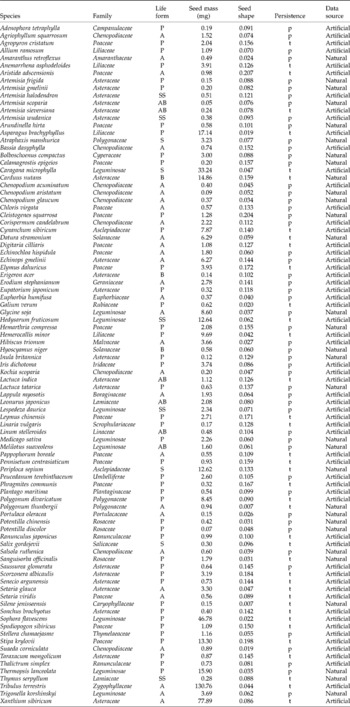
All the data on seed size and shape (see Table 1) of all species in this paper were taken from the bibliography and literature (Liu et al., Reference Liu, Li and Li2003, Reference Liu, Li and Li2004; Yan et al., Reference Yan, Liu, Luo and Wang2004) which has aggregated from three pre-existing published Horqin steppe species databases on seed mass and seed shape (Liu et al., Reference Liu, Li and Li2003, Reference Liu, Li and Li2004; Yan et al., Reference Yan, Liu, Luo and Wang2004). A total of 141 species (116 genera, 38 families) was contained in the Horqin sandy land area (118°35′–123°30′E, 42°41′–45°45′N) in eastern Inner Mongolia province, China. From all of these, data were obtained on seeds and indehiscent, single-seeded fruits. Five replicates were employed, and 100 air-dried diaspores per replicate to quantify mass. They measured the diaspore with all its permanent attached structures. Most grass caryopses were measured with the persistent lemmas and awns, and the achenes of Asteraceae with pappus. The shape of diaspores index was captured by the variance of three dimensions (length, width, height), following the method put forward by Thompson et al. (Reference Thompson, Band and Hodgson1993). In this way, the shape becomes dimensionless and can vary between 0 and 0.33. A variance close to zero represents perfectly spherical seeds, while the variance increases to a maximum of 0.33 for elongated or flat seeds.
Seed mass (mg), seed shape (variance of diaspore dimensions) and persistence in the soil for 91 species in the Horqin sandy land, northern China

Life form classes: A, annual herbs; AB, annual-biennial herbs; B, biennial herbs; P, perennial herbs; S, shrubs; SS, semi-shrubs. Persistence classes: p, seeds persist in the soil for more than 1 year; t, seeds persist in the soil for less than 1 year. Artificial means persistence data collected from artificial burial experiments; natural means persistence data collected from soil cores (germination or extraction). Nomenclature follows Liu (1985, 1987, Reference Liu1992) and Liu et al. (Reference Liu, Zhao and Zhao1996) for Chinese species.
The database of relevant information on soil seed persistence was gathered from the China National Knowledge Infrastructure database for papers published in journals in Chinese, and Elsevier Science Direct database for papers published in journals in English, between 1981 and 2010. Literature data were treated according to the protocol by Thompson et al. (Reference Thompson, Bakker and Bekker1997). The information on persistence was derived from the references (e.g. Zhao and Bai, Reference Zhao and Bai2001; Zhao and Li, Reference Zhao and Li2003a, Reference Zhao and Lib; Jiang et al., Reference Jiang, Li, Liu and Yan2004; Zhao et al., Reference Zhao, Li, Zhang and Wang2004; Li et al., Reference Li, Han, Zong, Li and Jiang2007; Yan et al., Reference Yan, Liu, Li and Ma2007; Zhai et al., Reference Zhai, Liu and Yan2009). Data from these studies were used to classify species as persistent (seeds persist in the soil for more than 1 year) or transient (seeds persist in the soil for less than 1 year) (Thompson, Reference Thompson, Hendry and Grime1993; Thompson et al., Reference Thompson, Bakker, Bekker and Hodgson1998; Csontos and Tamás, Reference Csontos and Tamás2003; Fenner and Thompson, Reference Fenner and Thompson2005). If a species is detected to survive in the soil for less than 1 year in artificial burial experiments, it is probably safe to say that this species has a transient seed-bank in the soil by the method of Bakker et al. (Reference Bakker, Poschlod, Strykstra, Bekker and Thompson1996). Species persisting for more than 1 year in artificial burial experiments but surviving in naturally buried experiments for less than 1 year are considered to be species with transient seed-banks (Thompson, Reference Thompson, Hendry and Grime1993; Csontos and Tamás, Reference Csontos and Tamás2003; Fenner and Thompson, Reference Fenner and Thompson2005), because artificial burial would circumvent the natural processes of seed burial and has a high probability of overestimating persistence of seeds in the soil (Thompson et al., Reference Thompson, Ceriani, Bakker and Bekker2003). Other valuable but indirect evidence can be achieved by sampling soil cores and using seed germination or seed extraction methods to identify species. We adopted several conservative criteria proposed by Thompson (Reference Thompson, Hendry and Grime1993) and Thompson et al. (Reference Thompson, Bakker and Bekker1997) to distinguish species with persistent seed-banks from those with transient seed-banks. These criteria were only applied to naturally buried seed data of the references.
The relationship between seed mass and seed shape was analysed by Pearson correlation analysis. For the difference in seed mass and shape between transient and persistent species, we used the t-test to evaluate after seed mass was logarithmically transformed to achieve normality. For all the above analyses, we employed the software package SPSS Version 16.0 package (SPSS Inc., Chicago, Illinois, USA).
Results
In the dataset 52 species of this area were classified as having persistent seed-banks, 39 were classified as having transient seed-banks, and 50 could not be determined, mainly owing to conflicting or insufficient information. Fifty-seven per cent of species had persistent seed-banks in this region, which is higher than in a Mediterranean sand dune community (Yu et al., Reference Yu, Sternberg, Kutiel and Chen2007). Seed mass ranged from 0.01 mg (Orobanche coerulescens) (not shown in Table 1) to 130.76 mg (Tribulus terrestris), almost exactly the same as that in the Mediterranean sand dune community, but narrower than that recorded in New Zealand (Moles et al., Reference Moles, Hodson and Webb2000) or Iran (Thompson et al., Reference Thompson, Jalili, Hodgson, Hamzeh'ee, Asri, Shaw, Shirvany, Yazdani, Khoshnevia, Zarrinkamar, Ghahramani and Safavi2001). Seed shape ranged from 0.007 (Silene jenisseensis) to 0.207 (Aristida adscensionis), which was narrower than other studies on dry Mediterranean sand dune communities (Table 1).
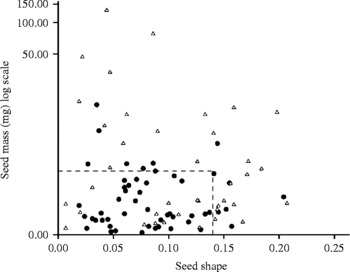
Log seed mass was non-significantly negatively related to deviations from isodiametric seed shape (r = − 0.097, P = 0.255) for 141 species. Species with persistent seeds had significantly smaller seeds than those with transient seeds (one-tailed t-test = 3.39, n = 91, P < 0.01), and species with persistent seeds yielded significantly more spherical shape than those with transient seeds (one-tailed t-test = 1.94, n = 91, P = 0.028). The relationship between seed mass, shape and persistence is shown in Fig. 1. The 91 species in this area were widely scattered across the mass–shape space. Forty-one species with persistent seed-banks had seed mass < 3 mg and seed shape < 0.14, and accounted for 78.8% of all persistent species. However, there was no obvious threshold of seed mass (3 mg) and seed shape (0.14) as established by Thompson et al. (Reference Thompson, Band and Hodgson1993) to distinguish persistent from transient species.
Relationship between seed mass (log scale), shape and persistence for 91 species in the Horqin sandy land, northern China. ●, Species with persistent seed-banks; △, species with transient seed-banks. The dashed line denotes the threshold of seed mass (3 mg) and seed shape (0.14) established by Thompson et al. (Reference Thompson, Band and Hodgson1993) to distinguish persistent from transient species.

Discussion
Our results show that seed mass and seed shape are both significantly and negatively related to seed persistence in the soil. In other words, small and rounded seeds tend to persist longer in the soil than large and elongated or flattened ones. The results further confirmed the pattern formalized by Thompson et al. (Reference Thompson, Band and Hodgson1993), and are consistent with results in other floras around the world, such as Argentinia (Funes et al., Reference Funes, Basconcelo, Diaz and Cabido1999), Iran (Thompson et al., Reference Thompson, Jalili, Hodgson, Hamzeh'ee, Asri, Shaw, Shirvany, Yazdani, Khoshnevia, Zarrinkamar, Ghahramani and Safavi2001) and Italy (Cerabolini et al., Reference Cerabolini, Ceriani, Caccianiga, Andreis and Raimondi2003), but different from the results of Australian (Leishman and Westoby, Reference Leishman and Westoby1998), New Zealand (Moles et al., Reference Moles, Hodson and Webb2000) and Israeli floras (Yu et al., Reference Yu, Sternberg, Kutiel and Chen2007).
The results show that seed mass influenced persistence in the soil more than seed shape, that is to say, seed mass is a better predictor of persistence in soil relative to seed shape in the Horqin sandy land, in north-eastern China. However, there is no clear threshold, established by Thompson et al. (Reference Thompson, Band and Hodgson1993), for species to predict persistence, as detected by other authors (Cerabolini et al., Reference Cerabolini, Ceriani, Caccianiga, Andreis and Raimondi2003; Peco et al., Reference Peco, Traba, Levasor, Sánchez and Azcánteran2003). The relationship between seed mass, shape and persistence identified in Horqin sandy land may be less clear (or even absent) in floras with a high proportion of legumes. Legume seeds typically have a greater seed mass, are well known to require more time to break the testa, and persist in the soil longer. In the Israeli coastal sand dune flora, Yu et al. (Reference Yu, Sternberg, Kutiel and Chen2007) detected no obvious relationship between seed mass, shape and persistence, and indicated that this result was probably due to the composition and structure of the vegetation, since legume seeds accounted for 76.0% of the total persistent soil seed-banks in this ecosystem. Especially in the Australian flora, the main reason why there is no close relationship between seed mass, shape and persistence is that persistence is wrongly inferred from dormancy, since there is no close relationship between seed dormancy and the formation or the accumulation of a persistent seed-bank (Thompson et al., Reference Thompson, Ceriani, Bakker and Bekker2003; Honda, Reference Honda2008). However, our study contained species with a range of growth forms from a wide range of families (species of Asteraceae and Poaceae were dominant in this study site). In this ecosystem, Leguminosae only accounted for 6.3% of all species, and legume seeds were 11.5% of the total persistent soil seed-bank. The percentage was much lower relative to the Mediterannean coastal sand dune ecosystem.
Why do seed mass and shape negatively and significantly relate to persistence in the Horqin sandy land? Ease of seed burial, proposed by Thompson et al. (Reference Thompson, Band and Hodgson1993) is likely to be the main underlying mechanism of patterns observed in this region. The Horqin sandy land is an area of aeolian sandy soil (texture coarse and loosely structured), and seeds seem to be more easily buried in sand ecosystems than in others. So, seeds may indeed be more easily buried in open, loose, sandy soils and have a deep burial position, which restrains seed germination, seedling emergence and establishment (X.W. Zhu et al., Reference Zhu, Huang, Chu, Zhang, Liu and Dong2004; Li et al., Reference Li, Zhao and Fang2006; Su et al., Reference Su, Li, Jia and Feng2007; Ma and Liu, Reference Ma and Liu2008; Y.J. Zhu et al., Reference Zhu, Dong and Huang2009), and then transform into a persistent seed-bank. In addition, it is often assumed that small seeds have a lower germination rate, seed emergence percentage and require a longer time for germination relative to large seeds, thus they are more likely to persist longer in the soil if they become buried, mainly because small seeds have a greater light requirement for germination (Milberg et al., Reference Milberg, Andersson and Thompson2000).
In summary, not only seed mass, but also seed shape, is a key trait in determining seed fate and seed persistence in a sandy soil. Seed mass and seed shape could be robust indicators to predict the ability of seed persistence in soil for a species in this region. Although many factors affect the relationships between seed mass, shape and persistence in soil seed-banks, as mentioned above, ease of burial appears to be the main potential interpretation.
Acknowledgements
Appreciation is due to Professor Emilio A. Laca for improving the written English of this paper, and to Dr Ken Thompson and two anonymous referees for their valuable suggestions and comments. This study was part of the National High Technology Investigation and Development ‘973’ Item Project (No. 2007CB106803), the National Natural Science Foundation of China (No. 40730631), the Special Fund for Desertification Supervision of the National Forest State and the Foundation of State Key Laboratory of Soil Erosion and Dryland Farming on the Loess Plateau (10502-Z8, Z8-5).