
Law is everywhere.Footnote 1 We are exposed to multifarious forms of legality, which permeate ever more realms of our social lives. In this extensively juridified world, quasi-legal or “soft law” schemes occupy an important place. Quasi-legal schemes can be found in such diverse fields as transnational environmental governance,Footnote 2 administrative best practice guidelines,Footnote 3 corporate codes of conduct,Footnote 4 ethical clinical codes,Footnote 5 and the regulation of academic life.Footnote 6 The prevalence of these multiple quasi-legal structures poses a challenge for legal theory. What exactly is the nature of the norms elaborated in these quasi-legal environments? How should we conceptualize the priority relations between soft legal norms and non-legal reasons, and between competing soft legal norms? What is the dynamic of deliberation or argumentation in social contexts involving quasi-legal norms? Traditional legal theory has failed to produce a theory that adequately captures the structure and dynamics of quasi-legal systems. To a large extent, this failure reflects traditional legal theory’s continued commitment to a binary conception of law which views the phenomenon of law through the binary frames of lawlessness and complete legality (lawlessness/lawfulness). The article responds to this challenge by developing a theory of quasi-legality which I term “fuzzy law.”
A concrete example illustrates the scope of the soft law dilemma. In January 2014 I visited Barcelona for a conference.Footnote 7 After the conference, I took a walk in the beautiful area around the Cathedral Basilica. This area is one of the most popular tourist sites in Barcelona, and for that reason it attracts many street musicians. At one of the street corners, a street musician was playing the violin, and his violin case was open to allow people to toss in coins. At some point a middle aged tourist took a picture of the musician, who became upset, abruptly stopped playing, and shouted at the tourist “I play for money not for photo.” The tourist answered: “I was going to give you money,” and left. The incident was quickly over and the musician continued to play. The dispute can be viewed either as a product of ethical ambiguity about the conditions that give rise to an obligation to pay street musicians, or as a disagreement about the proper timing of payment. In either case, it is safe to assume that neither party thought law had a role in this dispute.
Consider a different scenario. The concert is now being held, not at a street corner, but at the Palau de la Música Catalana, with the Barcelona Symphony and Catalonia National Orchestra (OBC) playing. The dispute described above could not have arisen in this hypothetical scenario. The tourist would not have been able to hear the OBC or take pictures without holding a ticket. Entering the Palau de la Música Catalana without a ticket would be considered a clear case of trespass, governed by property law, the law of torts, and criminal law.Footnote 8 This is not merely a question of physical constraints (who holds the key to the doors) but also one of normative expectations.
Consider a third scenario. Imagine that the association of street musicians in Barcelona has published a code regulating street performance (busking).Footnote 9 The hypothetical Barcelona Busking Code regulates various aspects of street performance and includes provisions regarding where, when, and how loud musicians can play, as well as regarding passersby’s expected behaviour.Footnote 10 In particular, the code includes provisions regarding the sensitive issue of payment. One hypothetical provision states that observing a musician for more than two minutes or taking a picture requires payment, and provides a payment schedule of 1-5 Euros. The code may include soft enforcement mechanisms, such as volunteers handing a copy of the code to those who fail to pay in the appropriate circumstances.
Legal-like structures that, like the imaginary Barcelona Busking Code hypothetical code, lie between the poles of lawlessness and complete legality represent an increasingly prevalent phenomenon, which challenges the either/or approach of legal positivism.Footnote 11 The article addresses this conceptual challenge by developing a theory of fuzzy law. The model embraces two critiques of the binary framework of traditional legal theory. The first critique is conceptual: drawing on the extensive philosophical study of the notion of vagueness,Footnote 12 the article argues that more consideration should be given to the possibility of reinterpreting the fundamental concepts of legal theory (e.g., validity, bindingness) in a nuanced fashion. The second critique is empirical: the article argues that the binary model fails to satisfactorily account for the deliberative and institutional dynamics underlying the diverse legal-like phenomena documented by the soft law literature. The model of fuzzy law replaces the either/or framework that has dominated traditional legal theory with a dynamic framework based on a degree-theoretic interpretation of legal normativity. The model is built on three theoretical pillars: the theory of complementary pairs (TCP), developed by Scott Kelso and David Engstrom; fuzzy-set theory; and the concept of defeasible reasoning.Footnote 13 Although the question of legal vagueness has been explored in the legal literature, most of the writings in this area considered it from the perspective of the semantic content of legal statements, neglecting the potential implications of vagueness for the concept of legality itself.Footnote 14 This neglected path is pursued here.
The article proceeds as follows. Part I explores the binary underpinnings of traditional legal theory, focusing on the writings of three key scholars: John Langshaw Austin, H.L.A. Hart, and Joseph Raz. Part II examines the theoretical and empirical challenges facing the binary account of law. Parts III and IV develop the model of fuzzy law. My argument proceeds in three steps. First, I outline a theoretical framework that allows us to conceive legal normativity (or bindingness) as a fuzzy predicate that can be realized in degrees (Part III, sections A and B). Second, I analyze the meaning of nuanced bindingness in a deliberative setting, linking the fuzzy law model with the literature on defeasible reasoning (Part III, section C). Finally, I consider the sociological implications of the model based on an analysis of the coordination dynamics of quasi-legal systems (drawing on the theory of complementary pairs) (Part IV). Part V concludes the discussion.
I. The Binary Underpinnings of Traditional Legal Theory: John Langshaw Austin, H.L.A. Hart, and Joseph Raz
In this section I want to expose the binary underpinnings of traditional legal thought, focusing on the writings of three key legal and philosophical theorists: J.L. Austin, H.L.A. Hart and Joseph Raz. I will start with the writings of J. L. Austin,Footnote 15 focusing especially on the doctrine of infelicities, which he introduced in his book How to Do Things with Words. The doctrine plays a critical role in Austin’s distinction between constatives and performatives. The term “constatives” is used to depict statements of fact that can be true or false; “performatives” refers to sentences that do not describe, report, or constate anything but their utterance “is, or is a part of, the doing of an action”.Footnote 16 The doctrine of infelicities refers to those types of cases in which something goes wrong in the execution of the performative, leading, in Austin’s terminology, to the utterance being “unhappy” or infelicitous.Footnote 17 My focus is not on the exact details of Austin’s taxonomy of infelicities but on the way in which he conceptualizes the consequences of the infelicitous execution of a performative.Footnote 18 Austin views these consequences in a binary fashion, which assumes that a performative can either succeed or fail completely: “When the utterance is a misfire,” Austin explains, “the procedure which we purport to invoke is disallowed or is botched: and our act (marrying, etc.) is void or without effect…”Footnote 19 An example of misfire is when I say “I appoint you,” when I am not entitled to appoint, or when I try to name a ship but I am not a proper person (do not have the capacity) to do so. In both cases, the action is void.Footnote 20 In short, the algebra of performatives is Boolean: it is binary or crisp and not fuzzy.Footnote 21
Austin ultimately replaces the distinction between constatives and performatives with a more general framework, which distinguishes between locutionary, illocutionary, and perlocutionary acts.Footnote 22 My argument about the binary nature of infelicities continues to hold, however, even within this more general framework, as attested to by Austin’s argument that the “happiness/unhappiness” distinction applies to all utterances that possess some illocutionary force (that is, to both constatives and performatives).Footnote 23
Austin’s work is located at the intersection of philosophy of language and pragmatics,Footnote 24 and it is not part of the classical corpus of works on jurisprudence. However, there are close links between his ideas and the works of Hart and Raz, as both share Austin’s binary thinking. Hart’s theory of law is based on the thesis that the rule of recognition simultaneously establishes the validity of all the primary legal rules and determines the membership (or content) of a particular legal system.Footnote 25 Hart’s analysis of the rule of recognition can serve as the foundation for a “set-theoretic” model of law, drawing a sharp distinction between members and non-members of a particular legal system.Footnote 26 The notion of “law as set” assumes that the content of a particular legal system SL can be depicted by using some predicate formula that captures the criteria articulated by the rule of recognition (enumerating in this fashion all the system norms).Footnote 27 There is no place under this account for vagueness or for borderline cases as far as the question of membership is concerned.Footnote 28
Raz’s argument regarding the content-independence and preemptive force of legal reasons similarly depends on a crisp understanding of legal authority and legal validity. Raz argues that to the extent that a legal regime meets the requirements of what he calls the normal justification thesis (NJT), legal rules provide their subjects with protected reasons for complying with the prescriptions of the law.Footnote 29 There are two features that qualify legal reasons as protected reasons. First, a legal norm provides a content-independent reason for complying with the rule. Content independence means that the law displaces the reasons that it is meant to reflect: “law, when it is binding, pre-empts the reasons which it should have reflected, and whether it successfully reflects them or not it displaces them, and is now a new source of duties.”Footnote 30 Philip Selznick has captured this quality of law by noting that “[p]ositive law invokes a suspension of personal preference and judgment with regard to the specific issue.”Footnote 31 In this context, John Searle argues that deontic powers give us “desire-independent reasons for action.”Footnote 32 In addition to being a content-independent reason for complying with a rule, the law also provides an exclusionary reason for not following reasons that conflict with the rule: it overrides “our inclination to follow reasons on the losing side of the argument.”Footnote 33
II. A Critique of the Binary Conception of Law
TCP and fuzzy-set theory raise doubts about the binary underpinnings of Austin’s, Hart’s, and Raz’s accounts of law and of illocutionary acts in general. In the case of Austin, TCP and fuzzy-set theory question the idea that illocutionary acts are governed, in general, by a binary framework of happiness/unhappiness. TCP and fuzzy-set theory provide the theoretical framework for hypothesizing a third dimension that takes place between these opposite poles. In the case of Hart, TCP and fuzzy-set theory question the thesis that the rule of recognition allows us to determine unequivocally the identity of the legal system and clearly demarcate between what is legal and what is non-legal. The concept of fuzziness suggests that we should at least consider the possibility that applying the rule of recognition to a particular norm does not produce a binary output (valid/invalid) but an intermediate measure, lying somewhere in between these poles. To give a non-legal example: consider the set of all jazz pieces ever performed.Footnote 34 Is the music of George Gershwin part of this set? Or should it be assigned with some partial measure of membership owing to its affinity with classical music?Footnote 35 TCP and fuzzy-set theory suggest that we should be sympathetic to the possibility of developing a degree-theoretic concept of legal normativity.Footnote 36
A degree-theoretic understanding of legal normativity also questions Raz’s either/or distinction between legal and non-legal reasons. Fuzzy-set theory points out the possibility of fuzzifying this distinction, opening up new possibilities for modelling the function of (fuzzy) legal norms in practical reasoning. Because Raz does not recognize the possibility of partial validity, he does not explore this path.
The foregoing argument suggests that conventional legal theory misses some important modelling options by disregarding the nuanced interpretative choices pointed out by TCP and fuzzy-set theory. There is strong empirical support for exploring these degree-theoretic options. There is extensive body of research that shows that soft legal instruments—that is, legal-like schemes that do not satisfy the conventional criteria of legal validity—have considerable success in changing social reality across a wide range of variables.Footnote 37 Studies of soft legal schemes also demonstrate that these systems, at least in some cases, are gaining significant autonomy, reflected by unique institutional dynamics decoupled from corporate, economic, and political rationalities.Footnote 38 The binary vocabulary of legal positivism, which takes these multiple legal schemes as either fully valid or fully invalid, does not offer a convincing explanation of this widely documented reality. The empirical literature seems to contradict the approach of positivistic writers, such as Jan Klabbers, who consider the idea of soft law as a logical embarrassment. According to Klabbers, law cannot be “more or less binding.”Footnote 39 Klabbers’ approach seems problematic given the empirical evidence on the prevalence of non-conventional legal forms. If soft law does not have some independent normative weight (as suggested by Klabbers), why do people bother producing it?
A different approach to the question of legality, which is close in spirit to the degree-theoretic framework proposed in this article, is offered by Abbott, Keohane, Moravcsik, Slaughter, and Snidal (2000) in their article on the concept of legalization.Footnote 40 Abbott and colleagues explicitly embrace the theoretical possibility of graded normativity. They define hard law as a collage of three dimensions: precision, obligation, and delegation, and soft law as those legal-like social structures that do not rank high on one of these parameters. There are two key problems with the account of Abbott et al. The first difficulty lies in the element of precision. Incorporating this element into the model of graded normativity forces us to treat vague norms that are part of state law as partially valid, although state law constitutes the prototype of crisp legality.Footnote 41 Second, the authors do not develop an explicit model of the argumentative dynamics associated with soft legal norms.
III. Fuzzy Law: A Theory of Quasi-Legality
I develop the model of “fuzzy law” in three steps. First, I outline a theoretical framework that allows us to conceive the bindingness of legal norms as a fuzzy (nuanced) predicate that can be realized in degrees (sections A and B). The intuition underlying this argument is that legal norms usually need to satisfy several criteria in order to be considered valid or authoritative.Footnote 42 In contrast to Austin, I argue that a failure to satisfy one or more of these conditions does not necessarily lead to a complete voidance of the legal act. Rather, it opens the possibility for a fuzzy interpretation of the normative force of such imperfect legal act. Second, I analyze the meaning of nuanced normativity in a deliberative setting, linking the fuzzy model with the literature on defeasible reasoning (section C). Finally, in Part IV I consider the sociological implications of this model in an analysis of the coordination dynamics of quasi-legal systems (drawing on the theory of complementary pairs).
My argument brings together three theoretical frameworks: the theory of complementary pairs (TCP), fuzzy-set theory and the concept of defeasible reasoning. The theory of complementary pairs, developed by Scott Kelso and David Engstrom, provides an overarching critique of the either/or framework that dominates the field of jurisprudence. TCP recognizes the central role that contraries play in our life. But TCP argues that understanding how contraries operate requires us to replace the binary frames through which contraries are usually conceptualized (either/or, dualism, or monism) with a dynamic framework that seeks to reconcile these three basic framesFootnote 43 by treating them as “equally valid dynamical modes, tendencies, or dispositions of the complementary pair.”Footnote 44 As Kelso and Engstrom note, this line of inquiry faces serious hurdles. They argue that one of the main stumbling blocks to progress in discovering a general principle of complementarity of contraries is “the tenacious human habit of dichotomizing life into contraries in the first place. Once human beings have fragmented life into dichotomies, contraries and opposites, they have a tough time putting them back together again.”Footnote 45
TCP seeks to uncover the dynamic nature of complementary pairs.Footnote 46 To emphasize this feature of complementary pairs, Kelso and Engstrom propose to denote them using the tilde symbol (∼) instead of the more common forward slash (/). To have a complementary pair, a system must be minimally capable of producing both sides of the pair (e.g., legal∼illegal, science∼pseudo-science, segregation∼integration, whole∼part, valid∼invalid, soft law∼hard law). In exploring the dynamics of complementary pairs, we should recognize that complementary aspects can behave both as “tendencies” or “dispositions” and as well-defined states.Footnote 47 In many systems, contrary tendencies coexist simultaneously, exhibiting what Kelso and Engstrom term as metastability. The science of coordination dynamics seeks to unfold the mechanisms generating this metastability.Footnote 48
Applying the abstract vision of TCP to the realm of law requires the development of a new vocabulary that would allow us to analyze the coordination dynamics of law as a non-crisp phenomenon, that is, to reach beyond the conventional thinking that considers law through mutually exclusive, either/or dichotomies (e.g., legal/illegal; valid/invalid; soft law/hard law).Footnote 49 This vocabulary can be found in the fields of fuzzy-set theory and of defeasible reasoning. Fuzzy-set theory, which was pioneered by Lotfi A. Zadeh in 1965, constitutes an extension to classical set theory.Footnote 50 In classical set theory the membership of elements in a set is assessed in binary terms according to a bivalent condition: an element either belongs or does not belong to the set. By contrast, in fuzzy-set theory membership can be gradual or partial. This is described with the aid of a membership function valued in the real unit interval [0, 1]. Fuzzy-set theory provides a strict modeling language for studying vague phenomena.Footnote 51 The modeling language of fuzzy set theory provides a conceptual framework for reframing the idea of legal normativity as a fuzzy predicate that can be realized in degrees.Footnote 52
Defeasible reasoning is a branch of logic that deals with dialectic reasoning. It develops a formal understanding of the way in which reasons and norms can overcome conflicting reasons and norms or be defeated by them. In particular, what distinguishes defeasible arguments from deductive ones is that they are not foolproof. Whereas in deductive argumentation an argument is valid if the truth of its premises guarantees the truth of its conclusion, defeasible arguments can be defeated by counter arguments. In other words, the addition of information can dictate the retraction of the conclusion of a defeasible argument without mandating the retraction of any of the premises from which the retracted conclusion was inferred (drawing on exception-permitting generalizations).Footnote 53 Defeasible reasoning consists therefore of “constructing arguments, of attacking these arguments with counter-arguments, and of adjudicating between conflicting arguments on grounds that are appropriate to the conflict at hand.”Footnote 54 Combining the fuzzy-inspired idea of graded normativity with the notion of defeasible reasoning provides a framework for studying the deliberative dynamics of fuzzy legal systems.
A. Two Types of Legal Vagueness: Atomic and Institutionally-Generated Vagueness
In thinking about the notion of fuzzy law, it is useful to distinguish between “atomic vagueness” and “institutionally-generated vagueness.” Most of the discussion in the legal literature has focused on the first type of legal vagueness.Footnote 55 Atomic vagueness refers to the inexact nature of the terms and concepts used in legal statements, or what Hart has described as the problem of legal “penumbra.”Footnote 56 The terms vagueness and fuzziness refer to notions that have imprecise boundaries. The relationship between such vague terms and the objects they refer to is not crisp and can yield borderline cases in which the correctness of the application of the term is in doubt.Footnote 57 Fuzziness in this sense is a property of predicates such as “tall” or “rich” and of general concepts such as “income” or “periphery.”Footnote 58 In the legal context, fuzziness is often associated with the use of evaluative predicates (reasonableness, good faith). Fuzzy terms are often used in conjunction with gradual predicates designating a degree (e.g., “substantial,” “very,” “quite,” “almost not”).Footnote 59 A good example is the British Copyright Designs and Patents Act (1988), which states that the copyright given to the maker of an original art work is infringed only if another person copies the whole work or a “substantial part” of it.Footnote 60
A distinctive feature of atomic vagueness is that it can be dissipated by the relevant legal institutions. The law has a built-in institutional mechanism for dissipating vagueness: legal decisions. Andrei Marmor notes that in most cases court decisions do not constitute an “instance of applying the law but of extending it or narrowing it, that is, adding a precification that goes beyond what the statute actually asserts.”Footnote 61 The recent U.S. Supreme Court case of Skilling v. U.S., which focused on the void-for-vagueness doctrine, provides a vivid example of this institutional capacity.Footnote 62 Skilling was convicted of conspiracy to commit “honest-services” wire fraud (18 U. S. C. §§ 371, 1343, 1346).Footnote 63 Skilling argued that §1346 is unconstitutionally vague and thus should be invalidated. The text of §1346 prohibits any “scheme or artifice to defraud,” which was defined to include “a scheme or artifice to deprive another of the intangible right of honest services.”Footnote 64 Justice Ginsburg emphasized that “[i]t has long been our practice, however, before striking a federal statute as impermissibly vague, to consider whether the prescription is amenable to a limiting construction.”Footnote 65 In view of this general observation, the Court produced a limiting interpretation of §1346:
In view of this history there is no doubt that Congress intended §1346 to reach at least bribes and kickbacks. Reading the statute to proscribe a wider range of offensive conduct, we acknowledge, would raise the due process concerns underlying the vagueness doctrine. To preserve the statute without transgressing constitutional limitations, we now hold that §1346 criminalizes only the bribe and-kickback core of the pre-McNally case law.Footnote 66
The intrinsic vagueness of §1346 did not therefore leave the court paralyzed or helpless.Footnote 67
A second form of legal inexactness, which I term “institutionally-generated vagueness,” is a product of the institutional environment in which the legal communication arises. It is on this form of legal inexactness that my argument focuses. Unlike atomic vagueness, institutionally-generated vagueness cannot be dissipated by the legal institutions associated with the legal communication. The literature on soft law has tended to confuse these two sources of legal vagueness.Footnote 68 Underlying the notion of institutionally-generated vaguenessFootnote 69 is the thesis that the meaning of legal-like (deontic) sentencesFootnote 70 is a function not merely of their (deontic) syntax and semantic content but also of their level of bindingness (or validity). The bindingness of deontic sentences is a function of the institutional setting in which they were promulgated. We cannot therefore determine whether and to what degree deontic sentences constitute legal communication without collecting further data about the institutional context in which they were generated.Footnote 71 To make this argument in a somewhat different form, consider a text structured according to the deontic syntax (using, for example, the prohibitive form) but stripped of any contextual cues (time, place, participants’ profile, and institutional background). Such text is not fully intelligible without further data about the institutional environment in which it was promulgated, because it is only through this data that we can determine what demands the text makes, i.e., its level of bindingness.Footnote 72
Some clarification is in order regarding my use of the concept of bindingness. In talking about the bindingness of a rule I refer to the normative force that second order observersFootnote 73 would expect first order (involved) agents to attribute to the rule, given the institutional structure in which the rule is invoked. It is a reflection therefore of mutual social expectations. This attributed normative force does not necessarily capture the psychological or behavioural force of a particular norm. For example, while an agent may recognize a certain norm as binding (and thus as constituting a desire independent reason for action) he may nevertheless decide not to do what the norm obligates him to do, or to do what the norm prohibits him from doing.Footnote 74 The normative force of a rule does not therefore necessarily reflect its ultimate psychological effect or its ultimate behavioural consequences. Norms promulgated in different institutional settings can have varied claims for bindingness. Consider the difference between the Supreme Court of Canada and judges in a moot court trial. The rulings of the Supreme Court of Canada are fully binding in the sense articulated above. This claim remains intact even if it can be demonstrated that some Supreme Court rulings have not been implemented. In contrast, the ruling of a judge in a moot court trial has no valid claim for bindingness.Footnote 75 Demonstrating that some people attribute legal authority to such a tribunal does not change our view of its authority; rather, it reflects a mismatch between these agents’ beliefs and prevalent social conventions.
B. A Model of Fuzzy Legality
The bindingness of deontic statements is a function of the social and institutional context in which such statements arise. Linking the meaning of deontic sentences to this social-institutional context opens up the possibility of conceptualizing the normative force (or bindingness) of a rule as a fuzzy predicate. It allows us to interpret legal normativity along a continuum bounded by the ideal types of “non-law” at one end and by “crisp (or absolute) law” at the other. What is at stake here is not the psychological or behavioural force of the norm but its proclaimed bindingness, as it is reflected in the mutual expectations of the relevant community.Footnote 76
The idea of fuzzy sets, defined as sets that can have partial members, provides a theoretical framework for formalizing the notion of legal bindingness as a non-crisp predicate. In particular, the model of membership function provides an exact framework for interpreting the notion of legal bindingness in degree-theoretic terms. It is possible to construct a fuzzy membership function that receives as input data about the institutional structure associated with a particular legal-like sentence and produces a value that represents the relative bindingness of this sentence. This value represents the level of bindingness of the norms of the quasi-legal system,Footnote 77 relative to the norms of a hypothetical perfect legal system. Before I provide a more formal elaboration of this argument, a few more words about the meaning of the proposed fuzzy membership function are in order.
First, note that the proposed fuzzy membership function does not measure the membership of a certain rule in the fuzzy legal system itself (a certain corporate social responsibility (CSR) regime) based on some membership criteria.Footnote 78 Rather, it provides a measure of the relative bindingness of the norms of the fuzzy system, which is a function of the extent to which the structure of this system fails to satisfy some projected criteria of perfect legality. The relative bindingness of a norm constitutes a first step in determining the priority relations between the fuzzy norm and non-legal reasons, as well as between the fuzzy norm and perfect legal norms, and between the fuzzy norm and competing fuzzy norms. The idea of fuzzy legality therefore raises two meta-questions: (a) what is the structure of the fuzzy membership function associated with the system? and (b) what are the priority relations between the fuzzy norms and competing non-legal, quasi-legal, and fully-fledged legal reasons?Footnote 79
Second, the structure of the fuzzy membership function would usually not be determined explicitly by the constitutive texts of the quasi-legal regime (e.g., the constitutive texts of the CSR regime) or by an external legal source (e.g., the company bylaws). Rather, the rule of recognition that simultaneously determines the structure of the fuzzy membership function and the priority relations is an emergent social constructFootnote 80 that takes shape through the continuous invocation of fuzzy rules in multiple social interactions. In this context, fuzzy legal systems differ from conventional ones. In the paradigmatic case of state law, the priority relations between rules of the system are internally controlled: law regulates the resolution of its own indeterminacies.Footnote 81 In fuzzy legal regimes, however, there is no clear authority structure or meta-rulebook that resolves these questions. Rather, the fuzzy membership function and the priority relations emerge implicitly through the coordination dynamics of the particular fuzzy regime, which depends on the external legal-social environment in which the regime is embedded.Footnote 82
Below I develop this argument formally. I start with an analysis of the shape of the proposed fuzzy membership function. I then move to discuss the question of priority relations (section C). Readers who do not wish to engage with the technicalities of fuzzy set theory can skip the following text.
Fuzzy membership functions are constructed using five elements:Footnote 83
(a) A set of elements x ∈ X (e.g., a resident of Tel-Aviv);
(b) A linguistic variable V in a set of linguistic variables (e.g., the height of residents of Tel-Aviv), which serves as a label for an attribute of the elements in X;
(c) A linguistic term A (an adjective or an adverb) in a set of linguistic terms associated with the linguistic variable V (e.g., a tall or short resident of Tel-Aviv);
(d) A measurable numeric assignment interval Z ∈ [-∞,∞] that constitutes a referential set for the particular attribute label V (e.g., height) of the set of elements x ∈ X (e.g., [0, 2.40] for the height of residents of Tel Aviv);
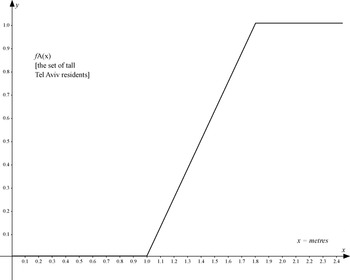
(e) A fuzzy membership function fA(x) of the fuzzy set A (e.g., the set of tall Tel-Aviv residents) in the space of points X (Tel-Aviv residents), is a function that maps each point in X onto the real interval [0, 1]. The value of fA(x) at x represents the “grade of membership” of x (a particular Tel-Aviv resident) in A (the set of tall Tel-Aviv residents). The grade of membership increases with fA(x).Footnote 84
A possible membership function for the set of tall Tel-Aviv residents could have the following form:
f(x) = 0 (for 0 ≤ x ≤ 1);
f(x) = 5x/4 – 5/4 (for 1 < x ≤ 1.80);
f(x) = 1 (for 1.80 < x ≤ 2.40)
Membership function of the set of tall Tel-Aviv residents

Applying this formalism to the law requires a proper interpretation of the above constructs.
(a') The elements x ∈ X represent a stream of rule-like sentences (structured according to the deontic syntax) that occur in some social setting and can be linked to a particular norm-producing institution.
(b') The concept of bindingness serves as a label (V) for an attribute of the elements in X (rule-like sentences) (it substitutes “height” in the above example).
(c') The extent of the bindingness of a norm (ranging between the poles of complete and null bindingness) constitutes the linguistic term A associated with V (it substitutes “tall” or “short” in the above example).
(d') Providing a measurable numeric assignment interval Z ∈ [-∞, ∞] as a referential set for bindingness (the particular attribute label V) is not appropriate for the legal context. I argue that Z should be conceptualized as a set of criteria that enumerates the attributes of perfect legal institutions, BL-perfect (z1…zi). This set is context-specific and likely to change across cultures and time. The intuition underlying this argument is that a failure to satisfy one or more of these criteria does not necessarily lead to a complete failure of the legal authority (or the legal act).
(e') Given this conceptual structure, what would be the structure of a fuzzy membership function for legal-like sentences that arise within a particular legal system, AL? The model I propose produces a membership value for a particular normative sentence, x, that arises in the domain of AL, by examining the extent to which AL satisfies a list of criteria that characterize a hypothetical perfect legal system, BL-perfect , whose norms are completely binding. The membership function measures the “grade of membership” of a particular rule-like sentence x that emerges in the discourse universe of AL in BL-perfect. In other words, it measures the degree with which the use of the term “perfect legality” is compatible with the institutional attributes of this system (AL). This degree reflects the level of bindingness of the rules of AL. This interpretation can be represented in the following format:
(1) fAL (x, AL, BL-perfect)
Unlike simple predicates such as “tall”and “bald”, which are defined based on a single variable (height, hair density), the proposed membership function is based on a rather complicated aggregation function that compares the institutional attributes vector of AL with an attributes vector representing perfect legality (BL-perfect), producing a single membership value for x.Footnote 85 Constructing such a membership function requires us to decompose our understanding of a perfect legal system (BL-perfect) into a vector of institutional attributes (including both hierarchical and procedural rules), such as the existence of a multi-level judicial system, the extent of the courts’ independence, indicators of institutional reflexivity (e.g., the existence of an appeal procedure), enforcement procedures of court rulings, and more.Footnote 86 An aggregation function could be defined on this vector, given a designated range for each attribute (e.g., the extent of judicial independence), to produce a single measure of legality, ranging from a perfect legal institution to one lacking any legal powers (mapped onto the real interval [0, 1]). The fuzzy membership function linking the vector of institutional attributes to a scale of bindingness is a socially contingent meta-norm. There are no universal truths that establish a priori the structure of that function and the way in which it translates into measures of graded normativity.
Another way to construct a fuzzy membership function is to draw on prototypical understanding of absolute and void legality [-PZ, +PZ]:
(2) fAL(x, PAL, -PZ, +PZ)
This function produces a membership value for a particular normative statement, x, relative to BL-perfect, but based on the distance between some salient feature(s) of the institutional setting in which x is embedded (PAL) and prototypical exemplars of absolute or void legality (-PZ, +PZ). An example of such a salient feature is the existence of a body responsible for resolving disputes. Two exemplars, representing full and void legality, are the Supreme Court of Canada and a moot court tribunal.Footnote 87
It may be argued that the proposed application of fuzzy-set theory is unreasonable because the precision it imposes through the instrument of membership function is inconsistent with the idea of vagueness.Footnote 88 Although this argument presents a valid concern, I believe that the case for using fuzzy-set theory to model soft law is sound, subject to some qualifications.Footnote 89
First, the primary goal of the above model is not to generate numeric values that represent actual degrees of bindingness. Rather, the foregoing model can be used to produce an ordinal scale of degrees of bindingness. This point was emphasized by Jospeh Goguen in his pivotal study on the logic of inexact concepts:
We certainly do not want to claim there is some absolute [fuzzy] set representing “short”… Probably we should not expect particular numerical values of shortness to be meaningful (except 0 and 1), but rather their ordering. Competent observers will agree on whether one man is shorter than another, but it is possible that frequencies of their use of “short” will never stabilize… Degree of membership may be measured by an ordinal scale. More technically we might say that the scale of measurement is determined only up to an order (and perhaps 0 and 1) preserving transformation.Footnote 90
What is critical about the assignments produced by the fuzzy membership functions presented above is the relative ordering of the values assigned—not their numeric value.Footnote 91 The ordinal view is better served by constructing the output of the fuzzy function using linguistic variables. The musical notation for distinguishing the loudness or softness of music offers an insightful analogy. The basic distinction is between p or piano for “soft” and ƒ or forte for “loud.” Adding m before p/f generates mp (“mezzo-piano”) meaning “moderately soft” or mƒ (“mezzo-forte”) for “moderately loud.” It is also possible to reiterate p and f, creating pp (“pianissimo”) for “very soft” and ƒƒ (“fortissimo”) for “very loud,” and so on.Footnote 92
A second point is that the model of fuzzy law developed here is based on the idea of fuzzy “plurivaluationism,” which argues that fuzzy sets are not governed by a single membership function but by a multiplicity of functions, which produce multiple and competing assignments for assertions of the type “x is F.”Footnote 93 The structure of the fuzzy membership function that provides the best characterization of a particular quasi-legal system emerges through an implicit and reflexive process of contestation. This reciprocal and perpetually renewed process of meaning formation reflects, as Kelso and Engstrom argue, the dynamic of the complementary pair: legal∼non-legal. Finally, the fuzzy framework developed above does not attempt to provide an accurate description of the socio-legal reality associated with quasi-legal systems, but rather seeks to provide a model or theoretical framework for thinking about the structure of quasi-legal systems.Footnote 94
C. The Deliberative Dynamics of Quasi-Legal Systems
(1) The Priority Relations between Norms in Quasi-Legal Settings
In this part, I develop a model of legal argumentation in a fuzzy legal environment and link the argument with the broader question of the dynamics and reflexive structure of quasi-legal systems. Consider the hypothetical Barcelona Busking Code or a real-life corporate social responsibility code. What exactly is the role of fuzzy norms, such as those included in the busking code or in a CSR code, in social deliberations? The question can arise in the context of a conflict between quasi-legal norms (potentially of different regimes), non-legal reasons, and fully-fledged legal norms. In examining this question, I first focus on Raz’s model of legal norms as exclusionary reasons. This model implies that a fully valid norm P trumps any (non-legal) reason that could be invoked to defeat it, irrespective of the strength of the substantive reasons that were used to support P when it was originally enacted or of the strength of any opposing, non-legal reason. P can be defeated only through the invocation of legally valid reasons. One cannot acquire a right to enter the Palau de la Música Catalana simply by quoting one’s deep love of classical music. This moral-cultural reason cannot override the property law rules that govern the right of the owners of the Palau de la Música Catalana to allow entry only to ticket holders. Similarly, one cannot defeat an argument for tort liability by arguing that the tortfeasor is poor and that it would therefore be unjust to find him liable. Such culture and morality-based arguments can succeed only if they are transformed into legally valid reasons.Footnote 95 For example, one can argue that the Palau de la Música Catalana has a legal obligation to allow free entry to young musicians,Footnote 96 or that in general, the standard of liability in torts is a function of the tortfeasor’s socio-economic status.Footnote 97 Naturally, our music lover could try to sneak into the Palau without paying, but this would not change the legal status of her actions.
A conflict between two or more valid legal reasons is usually determined by applying higher-order (legal) comparative principles. These may include hierarchical ordering, scope or time-oriented principles (lex specialis derogat legi generali or lex posterior derogat legi priori) or other balancing criteria (e.g., cost-benefit calculus).Footnote 98 The legal status of P is determined by legal reasons alone. An argument for not(P) can succeed only if its supporting legal reasons defeat the legal reasons that support P according to the applicable higher-order principles. The strength of the non-legal reasons supporting either P or not(P) is irrelevant to the success of the argument. Note that this model does not purport to capture the cognitive processes that an agent experiences when reasoning in a legal situation.Footnote 99 Rather, it describes the imaginary argumentative structure that is presupposed by the crisp (or absolute) model of law.
What happens when a norm can no longer be treated as fully valid because of the institutional framework in which it was created? According to Austin, Hart, and Raz, in such circumstances the norm loses its normative authority completely and has no content-independent normative power. Under this account, the norms included in the Barcelona Busking Code or in some CSR code have no independent normative force; their force depends exclusively and fully on their non-legal justification (ethical, economic, or other). An obvious implication of the positivistic model is that a conflict between two fuzzy norms (e.g., competing norms of two CSR codes that a firm has subscribed to) should be resolved strictly based on the strength of their underlying reasons and not on arguments that invoke their degree of bindingness.
The idea of fuzzy norms suggests a different dialectic. It asks us to imagine a reality in which norms such as those contained in CSR Codes, administrative best practice guidelines or clinical ethical codes possess partial normative power. What would be the argumentative structure when deliberating with fuzzy norms? I suggest two potential models of deliberation that capture the idea that fuzzy norms possess partial normative force: “threshold deontology” and “deliberative coherence.” According to threshold deontology, certain acts “cannot be justified by their consequences unless those consequences reach or surpass some threshold point of compellingness.”Footnote 100 Applying this idea to the fuzzy context has three implications. First, in a conflict between fuzzy norms and non-legal reasons, fuzzy norms maintain their exclusionary force up to a certain threshold point of persuasiveness in which the competing non-legal reasons have the upper hand.Footnote 101 This construction can be incorporated into the fuzzy formalism presented above by postulating a function that maps the bindingness of a fuzzy normative statement onto a scale of thresholds. As the fuzzy value of a norm comes closer to 1, the value of the threshold increases. Take f t to represent the threshold function. Its structure is:
(3) ft(fAL(x))
The threshold function reflects collective expectations regarding the deliberative force of the norm. It is therefore a function of the level of the norm’s bindingness, as determined by fAL.Footnote 102
Interpreting bindingness in degree-theoretic terms has two further implications for potential conflicts between fuzzy norms and fully-fledged legal norms, and between fuzzy norms associated with distinct regimes. In the former case, a fully-fledged norm always prevails over a fuzzy norm because its bindingness level is taken to be 1. The latter case is more interesting. Attributing partial normative force to fuzzy norms means that a conflict between fuzzy norms is not resolved merely according to the force of their underlying reasons but also according to their relative degrees of bindingness. A potential meta-rule for resolving such conflicts could determine that a norm with a higher degree of bindingness always defeats a norm with a lower degree of bindingness.
Although the foregoing model is analytically coherent, there is tension between the rigidity of the threshold concept and the fluid nature of legal deliberation. Particularly problematic is the assumption of the model that beyond the threshold point the fuzzy norm loses entirely its normative force. The idea of deliberative coherence, developed by Paul Thagard,Footnote 103 provides an alternative conceptual framework for studying the dynamics of reasoning in fuzzy legal environments, which may be more compatible with this fluidity. Deliberative coherence is based on the thesis that human cognitive processes are marked by a propensity for consistency,Footnote 104 and that coherence is part of a suite of cognitive mechanisms that humans have developed for epistemic vigilance.Footnote 105
Deliberative coherence depicts the process of deliberation in fuzzy legal environments as one of attainment of consistency. In contrast to the threshold model, fuzzy norms function as contingent constraints and not as rigid thresholds. The fuzzy norm constitutes a non-absolute constraint that must cohere with the other reasons offered in the discussion (e.g., non-legal reasons, conflicting quasi-legal norms, and possibly even fully-fledged legal norms). The invocation of a fuzzy norm in a deliberative interaction generates a coherence dilemma that requires the interlocutors to look for a solution that can restore the coherence of the deliberation, taking into account the graded validity/bindingness level of the fuzzy norm, as determined by fAL.
(2) The Deliberative Dynamics of Quasi-Legal Systems: the Case of CSR Codes
To illustrate the foregoing model in a concrete environment, consider the case of CSR codes such as the Walmart Standards for Suppliers, the ISO 14001 environmental management system, the SA 8000 (Social Accountability) standard, or the FTSE4Good sustainability index. CSR codes commonly contain various prescriptions that may conflict both with the economic concerns of the firm and with each other. Institutionally, such conflicts are likely to surface in deliberations within the decision-making bodies of the firm. According to the model of fuzzy law, such potential conflicts may be resolved through two different dynamics. First, according to the threshold model, the fuzzy norm (the code prescription) may be used against economic arguments up to a certain threshold. In the context of ISO 14001 or FTSE4Good regimes, such dynamics can occur, for example, in an argument for the purchase of green technology, the introduction of costly organizational procedures, or in an argument to cut some environmental expenses because of financial problems. Second, a conflict between two quasi-legal norms, associated with different CSR codes, may be resolved by developing a meta-rule (e.g., lex posterior).
Deliberative coherence models the dynamics of CSR norms somewhat differently. According to this view, the fuzzy norm acts as a constraint on the deliberative processes that take place within the firm. In the context of ISO 14001, for example, this means that the interaction between ISO 14001 and corporate culture is one of continuous, bi-directional co-adaptation.Footnote 106 Conflicts are not resolved through the logic of the threshold but by introducing distinctions that seek to retain coherence. For example, if implementing one of the requirements of ISO 14001 becomes too costly because of unforeseen economic contingencies, the board can decide to delay implementation to the next year rather than fully reject the fuzzy obligation. In this way, the firm recognizes the normative validity of the CSR code but gives some prominence to its conflicting economic commitments.
As already noted, the priority relations between fuzzy norms and conflicting legal or non-legal reasons are rarely fixed in advance (e.g., in some meta-rulebook). It would be futile, for example, to look for a resolution of the kind of conflict described above in the CSR code, in the corporation bylaws, or in the corporate law of the state in which the corporation is registered. Although corporate law and the corporation’s bylaws are clearly relevant to such conflicts and provide the legal infrastructure that enables corporations to subscribe to a particular private code, they do not provide a detailed scheme for the resolution of normative conflicts involving fuzzy norms.Footnote 107
Both the threshold model and the deliberative coherence model assume that fuzzy legal norms carry some normative force, which is independent of the reasons that were used to justify the adoption of the code in the first place (e.g., the potential contribution of a CSR code to the reputation of the firm). This intrinsic normative force is captured by the fuzzy membership function fAL.Footnote 108
IV. The Social Dynamics of Quasi-Legal Systems: Reinforcing Loops and Meta-stability
The model of quasi-legality developed above provides a more refined vocabulary for thinking about soft law than does the conventional positivistic model. A key challenge for this model concerns the specification of the social and institutional conditions necessary for the emergence and continuing operation of quasi-legal systems.
Note in this context, first, that the fuzzy law model makes no a priori assumptions about the institutional matrix that is necessary for the emergence of a quasi-legal system, or about the relation between that matrix and the projected bindingness of the fuzzy legal norms produced by it. This pluralistic approach is consistent with the literature on soft law, which pointed out the multiplicity of institutional structures associated with soft law schemes.Footnote 109 Second, the fuzzy law model is not deterministic. The socially contingent nature of the fuzzy membership function associated with grades of bindingness means that there is no necessary linkage between the existence of certain institutional components and the emergence of quasi-legal communication. Rather, the linkage should be viewed, following TCP, as a potentiality, which under certain social conditions can lead to the emergence of a sustainable quasi-legal structure.Footnote 110
The fuzzy law model highlights two key aspects of the coordination dynamics of quasi-legal systems. First, the emergence of a sustainable quasi-legal system depends on the existence of reinforcing communicative loops. Thus, to use the example of the hypothetical Barcelona Busking Code or the case of clinical ethics committees, the establishment of a partial legal-institutional structure does not guarantee, in itself, the emergence of self-sustaining legal communication. For this to happen, fuzzy norms must be chosen by interlocutors as themes for communication. This occurs only if fuzzy norms are perceived to be carrying some intrinsic, content-independent normative force. In other words, they must be able to generate normative expectations.Footnote 111 There is a potential self-enhancing relation between the invocation of fuzzy norms in communicative interactions and their projected normative force. Fuzzy norms are invoked by interlocutors only if they are considered to have some degree of normative force. But such invocation, by itself, can facilitate further legal communication by signalling the existence of collective belief in the normative force of fuzzy rules, thus encouraging other interlocutors to rely on them in future interactions.Footnote 112 There is, therefore, a necessary linkage between the dialectic of reasoning with fuzzy norms and the sustainability of fuzzy legal systems as partially autonomous structures.Footnote 113
But there is also something mysterious and uncertain about the emergence of these self-enforcing loops which ultimately determine the priority relations between fuzzy norms and non-legal reasons. Similar mysteries characterize other collective goods, such as trust and public participation. Eric Uslaner has noted, for example, that although trust is “the chicken soup of social life,” facilitating all sorts of good things, “it appears to work somewhat mysteriously. It might seem that we can only develop trust in people we know. Yet, trust’s benefits come when we put faith in strangers.”Footnote 114 The emergence of collaborative knowledge production in online contexts raises similar puzzles. What are the distinctive social features that have turned Wikipedia into a success story, but caused the failure of its online competitor Citizendium? In retrospect, scholars have suggested various explanations, but these explanations have not been clear ex ante and remain somewhat incomplete even now, leaving the success of Wikipedia somewhat baffling.Footnote 115
The second key aspect of quasi-legal systems, as predicted by the theory of complementary pairs, is their intrinsic instability. Fuzzy legal structures are potentially unstable in the sense that they have to cope with competing pressures that pull in different directions. The first tendency is toward the complete denial of the authority of the relevant institution to produce binding norms, leading potentially to the breakdown of the fuzzy legal system. The second tendency is toward the transformation of the fuzzy legal system into a crisp one through a series of institutional changes associated with fully binding norms. One of the key lessons of TCP is that social systems can cope with such conflicting and co-existing tendencies through the mechanism of meta-stability, that is, by continuously exploring potential social mechanisms through which such tensions can be resolved or attenuated, even if only temporarily.
A good example of this dynamic comes from the evolving field of clinical ethics committees. Medical practitioners commonly encounter ethical dilemmas in their daily practice. The perceived need to ensure that decisions are ethically and clinically defensible has led to the development of a system of clinical ethics committees (CECs).Footnote 116 CECs found in various jurisdictions, most notably in the U.K., U.S., and other European countries,Footnote 117 have a variety of functions: educating, developing policies and guidelines within institutions, providing advice in particular cases, and participating in matters relating to organizational ethics (for example, policies on eligibility for treatment or on the management of waiting lists). Among the issues CECs must address are the refusal of life-saving treatment, end of life issues, and the retention of organs.Footnote 118 CECs work in different ways and hold different positions within the organizations they serve. They may meet formally and regularly or be convened ad hoc. They may provide only non-urgent advice, but some may have a rapid-response facility. Membership and the range of expertise also vary.Footnote 119
The role of CECs has been traditionally understood as providing advice rather than serving as a proxy decision maker. But some scholars argue that over the last decade CECs have acquired significant authority over treatment decisions.Footnote 120 As more and more hospitals have established CECs,Footnote 121 concerns about their structure and function have started to emerge, generating unstable dynamics. Some authors have argued that CECs constitute a due process wasteland, and that greater effort must be made to encourage and foster accountability and transparency in ethics support services.Footnote 122 Others have questioned the core competencies needed for CECs, arguing that they must acquire not only knowledge of basic concepts of ethical theory and clinical terminology but also basic legal knowledge, which includes relevant professional codes of ethics and statutory law (e.g., healthcare legislation, torts).Footnote 123 These concerns have led to polarizing dynamics involving at one end a de facto disregard of CECs as a source of authority and at the other end calls for the full integration of CECs into the formal legal system.Footnote 124
This instability also presents an opportunity for social innovation. Thaddeus Mason Pope, for example, argues that the current model of intramural CEC should be replaced by a multi-institutional CEC that serves several healthcare institutions. In his opinion, this could alleviate some of the tensions generated by the intramural model, because its detachment from any single institution would guarantee that it is more independent, and because its ability to reflect a diversity of voices and perspectives would addresses the problem of biased decision making and of lack of competence that characterize some intramural CECs.Footnote 125 Others, such as the ASBH Core Competencies Update Task Force, argue that CECs should maintain their hybrid structure but call for greater standardization in their structure and operation, focusing, for example, on the questions of CEC core competencies and working procedures (e.g., how to conduct and document case consultations).Footnote 126
By highlighting this polarizing dynamic of quasi-legal systems, the model of fuzzy law also offers a way of thinking about the question of the beginning∼end of law, articulating the dynamics by which systems of law can move between the states of void∼perfect legality.
V. Conclusions
The model of quasi-legality elaborated above sought to provide an alternative conceptual framework for thinking about soft law. Understanding normative phenomena requires sensitivity to the space between legality and non-legality, which remains unaccounted for in the traditional jurisprudence literature. In thinking about the dynamics of this in-between space we are still facing significant theoretical and empirical challenges. Theoretically, more work needs to be done on the reflexive structure of fuzzy legal systems and in particular on the question of the priority relations between fuzzy norms and non-legal reasons. I argued above that the priority question could be resolved by two distinct deliberative dynamics, based on the ideas of threshold deontology and deliberative coherence. But more work can be done, for example, on the relation between these models. Another related direction concerns the potential conflict between overlapping fuzzy regimes. This direction seems particularly intriguing given the increasing number of firms that subscribe to multiple CSR codes.Footnote 127
Empirically, more work is needed to uncover the institutional dynamics of quasi-legal systems. The fuzzy model points out the possibility for the emergence of legal communication based on institutional infrastructure that is less developed than the legal infrastructure of the modern state, or of treaty-based international institutions such as the World Trade Organization. But the question of the fuzzy dynamics of systems such as FTSE4Good, the Walmart Standards for Suppliers, and Ethical Clinical Codes cannot be resolved simply by analysing the associated texts. Resolving this question requires a sociological analysis of the institutional apparatus in which such quasi-legal schemes are embedded and the communicative dynamics associated with it. A great deal of the work in the area of soft law, especially in the field of CSR codes, is based on econometric studies and panel data.Footnote 128 Such studies do not shed light on the sociological and psychological processes underlying these quasi-legal environments, especially the processes that take place within firms that adopt CSR codes or within the institutions in which these codes are created. To understand these dynamics, studies are needed that would explore the inner workings of the institutions and agents associated with these fuzzy legal structures. Such studies could follow various paths. One path could be based on “thick” examination of organizations that have subscribed to CSR codes such as ISO 14001, based on in-depth interviews and observations.Footnote 129 Another path could take an experimental approach, relying, for example, on the method of comparative surveys and using vignettes. Such an approach may be used to study a multi-instrument regulatory environment by exposing subjects to various environments.Footnote 130