In 1951, Great Britain hosted the Festival of Britain to commemorate the centenary of the Great Exhibition of 1851. Whereas the Great Exhibition had been privately funded, encompassed international participation, and took as its theme the arts and industry of all nations, the 1951 festival was state sponsored, publicly funded, and focused solely on “British Contributions to World Civilization in the Arts of Peace.” Running from May to October, the festival was based mainly in London. On the south bank of the Thames, twenty-seven pavilions housed exhibits featuring British achievements in science, culture, arts, and industry. A permanent structure, the Royal Festival Hall, was built to accommodate cultural events. More frivolous entertainment, such as amusement rides and nightly dancing, was centered at the specially constructed Festival Gardens in Battersea Park. It was also a national event; local areas were encouraged to arrange their own “spontaneous and ubiquitous” festivities, and numerous cities were designated as official festival centers.Footnote 1 Traveling exhibitions by both land and sea took the festival message around the United Kingdom.Footnote 2 Yet, if the focus of the celebrations was entirely national, the festival also served an important international function. In showcasing Britain's recovery from the Second World War, it was also intended to draw tourists to the country and, in so doing, help to facilitate further economic growth.Footnote 3 For this reason, considerable attention was focused on winning the interest and support of Americans in particular. Yet this was no easy feat, given both the state of the country and the complex relationship existing between Britain and the United States in the immediate postwar years.
Britain was a war-ravaged country when the festival idea was launched in 1946–47. Shortages existed in everything from housing and transport to clothing and basic foodstuffs. The country was in debt, and it had been receiving financial aid from the United States. The Labour government was committed to a reconstruction policy dependent on austerity, belt tightening, and rationing. The postwar affluence and consumerism of the 1950s, so associated with the return to power of the Conservative Party, was not yet on the horizon. In 1951, Britons were not yet being told, “You’ve never had it so good.” Yet, in 1951, the Labour government spent £11.5 million of taxpayer money on a festival. This included expenditure of approximately half a million pounds on advertising and public relations to promote the festival and its events both at home and abroad. How did a government that was restricting access to bread justify funding a circus?
In a 1963 article, Michael Frayn, a noted journalist and writer, observed that the festival was rationalized on a number of grounds:
It was intended partly to fulfil the abstract but curiously compelling task of marking the mid-century and the 1851 centenary; partly to be a sort of national prestige advertisement; partly as an attraction for tourists. Under attack, Gerald Barry, [the] Director-General, sometimes tried to justify it on the purely materialistic grounds … that it would make people work harder. … [Cabinet Minister Herbert] Morrison probably made the closest guess afterwards when he described it as “the people giving themselves a pat on the back.” After five years of war, and a disillusioning peace which had brought nothing but continued austerity, continued restrictions, and the threat of war again, the nation craved a brilliant holiday, as some sort of tangible reward for its labours and sufferings.Footnote 4
This view that the festival was a mere party, not meant to have much of a lasting legacy, quickly became the accepted wisdom.Footnote 5 The celebratory aspect of the event was certainly important. Fred Leventhal has noted that the festival served as a real tonic to a nation weary of austerity; it attracted over 8 million visitors and proved very popular with the British people.Footnote 6 Other historians have noted the importance of the event in both reflecting and influencing postwar tastes in architecture and the arts. More recently, in a comprehensive study of the origins and nature of the festival, Becky Conekin has shown that, while the celebratory aspect was indeed important, it was much more than just a party; the festival had profound cultural and social implications. In particular, it both reflected and shaped Britain's national identity in the wake of the Second World War.Footnote 7 This is a point on which other scholars have concurred.Footnote 8
Yet, to date, little has been written about the way in which the festival also highlights new forays in state responsibility. With the Festival of Britain, the government was actively promoting not just a certain image of Britain but also the very idea of Britain as a place worth celebrating and knowing better. In short, it was selling Britain as a tourist destination. As this article will make clear, the festival was justified on economic grounds, including its dollar-earning capacity, and much of the publicity planning for the festival centered on the important role it could play in drawing in foreign visitors, in particular “dollar-tourists” from the United States of America. Indeed, a case study of the way in which the festival was “sold” provides considerable insight into the way in which the postwar Labour government was coming to realize both the significant part foreign tourism could play in Britain's economic recovery and the crucial function government could play in promoting and facilitating tourism. At the same time, a study of the conceptualization, content, and execution of the publicity campaign also highlights the enormous difficulties Britain was facing in recovering from the war. Putting on a festival of this nature was problematic. Given the complexity of Britain's postwar relationship with the United States, Britain wanted to present itself to Americans as a nation in recovery, worthy and worthwhile to visit; the country needed the influx of dollars tourists would bring. Yet this very fact also necessitated that the country not overstate its level of recovery, lest this preclude further American economic aid.
The idea that Great Britain should view and promote itself as a tourist destination was hardly novel to the post-1945 era, but direct government involvement in encouraging foreign tourism was a relatively recent development, and one that was expanding rapidly in the period leading up to the Festival of Britain. Although interest was by no means confined to North America, many of the early discussions that took place in official circles centered on the question of how to attract visitors from the United States. As early as 1928, high-ranking members of government, looking to increase the amount of American money spent in Britain, were asking leaders of the tourist industry to direct more attention to publicizing Britain abroad.Footnote 9 These discussions culminated in the 1929 creation of the Travel Association of Great Britain and Ireland. As its name suggests, this body was envisaged as an umbrella organization for travel agencies and other commercial groups engaged in tourism. Using subscriptions from its members, the association was to undertake general publicity on behalf of all. The Treasury sanctioned a small government grant-in-aid of £5,000 to help the organization get established. This was supposed to be the extent of government involvement. In other words, the impetus might have come from Whitehall, but the Travel Association was created to be an industry-controlled and directed organization.Footnote 10 The onset of depression and war hindered the growth of the association and led to the suspension of its activities. The notion that tourism could serve as a major source of national income was temporarily dropped. Nonetheless, the whole question resurfaced late in the war, when the passage of the Catering Wages Act of 1943 engendered discussion in Whitehall about reconstruction plans for the catering industry. Without “exploring the question of ministerial responsibility” in 1945, the catering wages commission recommended the creation of a new statutory “National Travel, Holiday, and Catering Board.”Footnote 11 This body was envisaged as exercising a broad controlling mandate over all aspects of domestic tourism. Discussion of this issue within official circles led eventually to the creation, under public auspices, of a British Tourist and Holidays Board (BTHB) in January 1947.Footnote 12 With coordinating assistance from the Board of Trade, it was supposed to “foster and develop the tourist, catering, and holiday services.”Footnote 13
This new, government-backed initiative was greeted warily by the trade, in particular by the Travel Association, whose head, Lord Hacking, was jealous of any potential rival. Hacking also feared that the creation of the new board was but the first step toward nationalization of the tourist industry, something he steadfastly opposed. Hacking had enjoyed a long career as a Conservative MP and had served as chairman of the Conservative Party organization between 1936 and 1942. Although he opined publicly that “tourism is above all party politics and party manoeuvres,” Hacking was clearly suspicious of further incursion into the free market by the Labour government.Footnote 14 While the BTHB was still in the planning stages, Hacking and the Travel Association had again begun lobbying for government funding, on the assumption that the travel trade would resume its prewar mandate of promoting British tourism. Citing probable economic benefits from continued activity in this sector, the Board of Trade and the Department of Overseas Trade both backed a Travel Association initiative to secure new government funding. Thus, even as the BTHB was being created, the Travel Association was still very much in the picture.
The Treasury balked at the funding figures being suggested by the Travel Association, and the chancellor of the exchequer refused to receive a deputation of its members, sticking to the “plain line that the Travel Association is not a Government service, however sympathetic the Government may be towards its objects, and the fundamental principle must be that the industries concerned in attracting tourists to the country should help themselves first.”Footnote 15 Because the plans for the BTHB were still in the works, and the organization was not likely to be up and running for at least another year, the Board of Trade did press the Treasury to approve limited funding for the Travel Association for 1946. The Treasury finally agreed, although most of the new grant of £65,000 was only to be payable if the Travel Association could raise matching funds. As this suggests, responsibility for promoting tourism was still seen to rest largely with market forces. That said, in the postwar years the Attlee government increasingly came to view tourism as a serious business in which government might take a legitimate part.
Most of the money the Travel Association raised went to publicity. Throughout the postwar years the principal activity of the association was that of “projecting Britain's tourist attractions overseas.” Most of this work centered on the United States; in 1948–49, for example, 47 percent of the organization's publicity resources were allocated to American publicity alone.Footnote 16 The United States was viewed as a viable market and as a crucial source of potential tourists, given the need for dollar currency. Indeed, the goal of attracting more visitors from the United States seemed attainable in the postwar era, given the increasing affluence of the American middle class and the projected expansion of transatlantic travel by ship and, increasingly, airplane.Footnote 17 Thus, as early as November 1945, the Attlee cabinet agreed that “it would be advantageous to encourage American visitors to come to this country during the summer of 1946” and directed the Department of Overseas Trade to convene a tourist accommodation committee to investigate what kind of special arrangements could be made to use government hostels, universities, and public schools to house visitors from the United States. Although this committee reported that there “should not be any Government sponsorship of tourist traffic in 1946, in view of the lack of suitable accommodation and other facilities,” its findings did lead to repeated discussions, at the cabinet level, of measures that might be adopted to provide new and better hotels for tourist accommodation.Footnote 18
Increased government interest and involvement in tourism was also manifested in other initiatives. Although the plan was not realized, in the autumn of 1946, the minister of housing and local government spearheaded an investigation into the possibility of creating a new town that would be a holiday resort; by 1949, he was also suggesting that when considering development of further new towns, the ministry should bear in mind the possibility of developing a new town as a national and international conference center.Footnote 19 That the new Labour government clearly saw a direct link between tourism and postwar economic recovery is also demonstrated by the creation, in October 1948, of a Board of Trade–chaired, interdepartmental committee on tourism. It was mandated to investigate ways of increasing tourist traffic—especially from dollar countries, such as the United States.Footnote 20 This committee spent a great deal of its time and energy trying to sort out what by 1948 were very hostile relations between the BTHB and the Travel Association, still led by Lord Hacking. Hacking was a huge thorn in the side of government officials, because he resisted any attempts to secure greater amalgamation of the two bodies. He zealously, publicly, and vociferously opposed any measures he thought smacked of government interference in the marketplace. Internal squabbles notwithstanding, the obstacles facing the British tourist industry in the postwar years were momentous. This becomes abundantly clear if one examines the way in which the Festival of Britain was promoted.
As Becky Conekin has noted, the origins of the festival scheme did not lie with the postwar Labour administration. As early as 1942, the wartime coalition government had begun to consider mounting an international exhibition after the cessation of hostilities to aid postwar economic recovery.Footnote 21 Thus, in 1943 the Board of Trade was responsive to exploring a proposal from the Royal Society of Arts to commemorate the centenary of the Great Exhibition of 1851.Footnote 22 In 1945, Gerald Barry, a newspaper editor, challenged the new Labour government to adopt the suggestion, drawing the discussion into the public eye.Footnote 23 Stafford Cripps, the president of the Board of Trade, appointed a committee, which enthusiastically endorsed the idea of holding a commemorative international exhibition.Footnote 24 It recommended that the focus in 1951 be on Britain's recovery from the war.Footnote 25 This decision was announced in Parliament in April 1946.Footnote 26 However, once actual planning started, Cripps balked at the projected cost and the diversion of labor required. By late 1946, he wanted to scrap the exhibition as incompatible with the government's austerity program and overall plans for reconstruction.Footnote 27 Herbert Morrison, the lord president of the council and the minister responsible for the government information services, defended the scheme. Morrison turned Cripps's arguments around, claiming that if a national, as opposed to international, exhibition was held, it would serve as an important component of recovery. Indeed, Morrison said it would aid the export drive by improving morale and productivity among British workers. It would also expose foreign visitors to British products.Footnote 28 In short, it would show both the country and the world that Britain was back on track. For Morrison, austerity required the festival. He prevailed and, in December 1947, informed Parliament of new plans for a national festival to be held in 1951 to celebrate recovery.Footnote 29
To avoid controversy, royal patronage was quickly secured, and a nonpartisan festival council was appointed under the chairmanship of Lord Ismay, a retired army general with close ties to Winston Churchill. Yet, while it had some input, Ismay's council acted mainly as a rubber stamp for plans formulated by government officials. Ismay repeatedly threatened to resign on the grounds that his council was being held publicly responsible for the festival project yet lacked real control over the process.Footnote 30 Outside experts were brought in as advisers, but the festival organization was a government department. An executive committee under Gerald Barry supervised the entire undertaking and reported directly to Morrison. Dubbed “Lord Festival” by a Tory critic, Morrison was quite involved in the entire planning process.Footnote 31 This was despite his busy schedule as one of the chief ministers involved in implementing the government's domestic policies. Morrison was also the festival's staunchest supporter on the many occasions when it was suggested the event should be canceled.Footnote 32
The festival needed near-constant defending, mainly because the timing of the scheme appeared inauspicious.Footnote 33 The year 1947 had begun with one of the coldest winters in living memory; energy reserves were strained, and food supplies were low. That summer, under the terms of the postwar American loan, the British pound had become convertible with the American dollar, leading to a run on the pound, an increase in rationing, the eventual suspension of convertibility, and a belt-tightening emergency budget. Thus, at the very time the festival idea was being unveiled, Britain was in need of additional American economic help. This came in the form of promised Marshall Plan aid, distributed through the Economic Cooperation Administration (ECA). Another major economic crisis in 1949 led to devaluation of the pound, more government spending cuts, and renewed discussion about the viability of holding the festival. To make matters even worse, escalation in the cold war, culminating in the mid-1950 Korean crisis, meant that this festival celebrating British contributions to the arts of peace was held during a war. Furthermore, it was held during a war that had been cited as justification for funding cuts to the National Health Service. This all gave critics plenty of ammunition. They found a platform in the anti-Labour Beaverbrook press. In particular, the Daily Express and Evening Standard newspapers launched frequent diatribes against what they viewed as a frivolous waste of money, not to mention building materials and labor, at a time when many people lacked access to basic housing.Footnote 34
From the very outset, then, members of the festival organization were conscious of the need for a strong publicity campaign that would not just promote events and venues but also explain and justify the very concept of a festival. In a blueprint for publicity planning prepared in 1948, Paul Wright, the festival's director of public relations, stressed the need to “indoctrinate” people about the idea.Footnote 35 Gerald Barry concurred; Barry viewed promotion of the event as being as much a part of the festival as the actual exhibitions, telling officials “that publicity work is necessarily an integral part of the whole Festival programme.”Footnote 36 In keeping with a long-established tradition in official publicity campaigns, organizers hoped to secure the cooperation of the press and unofficial bodies in gaining as much free publicity as possible for the festival.Footnote 37 Still, the committee appointed in 1948 to oversee promotional arrangements also projected spending in the area of seven hundred thousand pounds on advertising and public relations.Footnote 38
Devising a suitable “Approach to the Country” campaign was a chief priority in the early days of planning. After months of preparation, the lord mayor of London was invited to host a meeting at the Guildhall on 8 June 1949 to introduce the festival and solicit local assistance.Footnote 39 Here, Morrison, Barry, and other speakers made it clear that the festival organization could not promise much in the way of funding for local activities. This did, however, fit into the broader plan of billing the festival as the “People's show,” something the great British public was doing for itself.Footnote 40 Local communities were invited to organize activities and celebrations to coincide with the London exhibition. They were urged to enlist the aid of voluntary organizations and be creative. The festival organization did, however, maintain a watching brief, sending out directives regarding the appropriateness of local plans.Footnote 41 Of necessity, they tended to applaud the most modest attempts to mount festivities on a shoestring budget—no matter how humble, mundane, or “twee.”Footnote 42 Thus, at the lord mayor's meeting, the festival was also promoted as a vehicle through which to improve local infrastructure and public life and, by so doing, also make local areas more attractive to visitors. Suggestions ranged from expediting building projects already underway, so that some new structures could be ready for dedication by 1951, to cleaning up war-damaged areas, building park grounds, or even putting up new bus shelters emblazoned with the festival emblem.Footnote 43 The bus shelter scheme was popular because it was cheap and would not require a large depletion of already scarce building supplies.Footnote 44 As had been the case during the war, the country was urged to “make do and mend.” To facilitate the process, the festival organization offered to assist local councils by seeking exemptions from bureaucratic red tape and, where possible, small grants-in-aid. Tidying up the countryside was also deemed essential because in 1951 Britain was expecting to be both “on show” and “at home” to the rest of the world. Indeed, the country was being encouraged to view itself as being open to an influx of visitors, with every locality putting out a welcome mat.
The analogy was mirrored in the publicity sent abroad. The festival organization made extensive use of publicity, public relations, and paid advertising aimed at attracting overseas visitors. A broad-ranging campaign encompassed Europe, the Empire/Commonwealth, Asia, and the United States. Despite the existence of both the Travel Association and the BTHB, the festival organization had its own infrastructure in charge of crafting a campaign to attract overseas visitors. This was deemed necessary from a conceptual point of view. The festival organization cited the type of argument long common within Whitehall publicity departments that only those fully acquainted with the specifics of a policy were sufficiently well placed to translate that policy to the public.Footnote 45 In other words, they deemed internal knowledge more important than practical experience of publicity and tourism matters. Moreover, although both the BTHB and Travel Association were thought to be good sources of information and advice, from the very outset they became embroiled in a lengthy conflict over representation within the festival organization, a situation that undermined the respect they could generate from festival planners. Festival organizers were understandably reluctant to have their event serve as yet another battleground between Lord Hacking and the BTHB.Footnote 46 Thus, overseas publicity for the Festival of Britain was directed by a central committee representative of a broad range of government departments, with subcommittees taking on responsibility for different parts of the world. Festival publicity was intended to be global in scope, but from the very beginning, the United States was singled out as the crucial market worth reaching. As this was the case, the discussion that follows will use the U.S. campaign as its primary focus.
In the documents on publicity planning for the festival, the United States is repeatedly cited as meriting extra and specific attention. For example, in a 1948 document outlining the main lines for press and publicity planning, America was cited as a “special case”:
Assuming no important change in the political situation, we shall be up against special circumstances which will not apply elsewhere. In particular, E.R.P. [the American funded Economic Recovery Programme] will loom large in the U.S. minds, Britain thus taking on the character of a dependancy [sic]. Honesty is usually the best policy on these occasions and I think we should be thoroughly business-like in our approach, and not be afraid of admitting our hope of improved trade and a good tourist trade. More than ever must we convince America that our eyes are on the future, for any conscious, “half-timbered” appeal will only prove a boomerang.Footnote 47
At its first meeting, the group organizing publicity planning broke down the world by regions, the United States being the only country accorded its own category.Footnote 48 Further, they assumed the United States would merit a brochure about the festival tailored specifically to an American audience, but no other country, even in the Commonwealth/Empire, was given such specific publicity.Footnote 49 References to the festival in the American press were closely monitored. Particular interest was paid to newspapers felt to have an anti-British bias in their editorials and articles; thus, for example, Morrison was quite interested in any festival coverage appearing in the Chicago Tribune.Footnote 50 American opinion was also monitored in other ways. For example, early in 1950 the foreign office was asked to survey a range of British information sources about American attitudes toward the festival.Footnote 51 The foreign office reported back that a “popular misconception” existed that the festival lacked national support and was a “Socialist party exhibition.”Footnote 52 Worry over American views about the festival convinced Morrison to authorize trips to the United States by the director of public relations, Paul Wright, in mid-1950 and by Gerald Barry in January 1951. Wright visited New York, Washington, Chicago, and Boston, while Barry went to New York and Washington.Footnote 53 Aside from a brief visit Wright made to Paris, this was the only overseas travel undertaken in aid of festival publicity. It is also worth noting that Morrison sanctioned these two trips at the very same time that he was making very public spending cuts at home, on both government publicity in general and advertising for the festival.Footnote 54 Barry also traveled to the United States at the specific request of the British ambassador to Washington, Sir Oliver Franks.Footnote 55
Barry's trip was approved in the wake of the arrival on Morrison's desk of reports indicating that prominent Americans in Britain (including the director of the Economic Cooperation Act, who was responsible for overseeing Marshall Aid in Britain) did not know about the festival.Footnote 56 Morrison was also taking note of letters from concerned Americans, such as a Catherine Slocum of Philadelphia, who wrote to Stafford Cripps in October 1950 protesting the monies being wasted on frivolities designed to glorify the Labour party.Footnote 57 Morrison also took a personal interest in helping to guide American opinion, giving talks to American newspaper editors visiting Britain in the winter of 1950–51.Footnote 58 The importance attached to the American audience was also mirrored in budgeting considerations. One-third of total publicity expenditure on the festival (£131,000 to be exact) went to overseas press advertising, 40 percent of which was spent on American publications. Footnote 59
In terms of the American campaigns, the priority attached to each goal shifted with changing circumstances. From 1947–49, the economic aspects of selling Americans on the festival were clearly deemed the most important to those concerned with drafting a publicity scheme geared specifically at deflecting criticism at home and winning over an American audience. In this period, publicity planning focused on the question of how to justify holding this festival in light of austerity, recurrent economic crises, and then finally Marshall Plan assistance.Footnote 60 The overseas publicity campaign also had to be justified at home, given Britain's financial indebtedness to the United States. The advent of the Marshall Plan further complicated the matter. Although Marshall Plan monies did not have to be repaid, the British were benefiting from American funding and thereby amassing a debt of gratitude to the United States.Footnote 61 That Britain might be wasting “American” money and sending the wrong message abroad was certainly on the minds of British critics of the festival. In parliament in October 1949, a Conservative MP pointedly asked Morrison, “How can we expect continued help from America if, when good dollars are sent to us to relieve us from four and a half years of socialist government, they are squandered in this way?” Morrison retorted that “dollars” were not being spent on the festival. Such dissembling aside, the government was clearly sensitive on the issue, constantly playing up the festival as a way to spur recovery.Footnote 62 That festival organizers found they had to resort to using some American-made fun-fair rides at the Battersea Park location further fueled the flames and kept Morrison on the defensive.Footnote 63 As the world situation deteriorated, he cautioned Barry and his staff to play down the fun-fair aspects of the festival.Footnote 64
In mid-1949 officials envisioned having King George VI make specific reference to American economic aid in his official opening speech to the festival. This plan did not come to fruition. Neither did a scheme to place plaques on prominent “buildings and places with links with the United States and of interest to the United States visitors [sic].”Footnote 65 This was probably because, by late 1950, foreign policy implications were the greater concern of festival planners; the chief question became, are we going to look frivolous and irresponsible holding a national celebration during a war?Footnote 66 The foreign office concluded that the festival should go on despite the outbreak of the war but that it would be a “political mistake” to wage an “‘all out’ campaign” in its favor in the United States in light of evidence that Americans felt their allies were not doing enough in Korea.Footnote 67
Initially, the festival organization had hoped to launch a multifaceted campaign in the United States. There were plans to send a special “festival train” to travel across America advertising the festival message far afield.Footnote 68 Documentary films, detailing the theme and progress on the building of festival venues, were also proposed.Footnote 69 Most of the early plans fell by the wayside in 1949, when the entire publicity budget was cut to £490,000 because of the national economy drive.Footnote 70 As a result, it was decided that the majority of the money available for use in the United States be allocated to one set of large-scale paid press advertisements. These were to have appeared in the autumn of 1950.Footnote 71 However, because of the Korean crisis, official advertising was delayed until January 1951, when a four-page color spread appeared in Life magazine.Footnote 72 This was followed by a series of smaller advertisements in other large-circulation national magazines, such as Time, Newsweek, and the New Yorker, and the travel sections of leading American newspapers.Footnote 73 The publications were chosen on the advice of British officials in New York and an American advertising company. Life magazine received the bulk of the contract because it reached an estimated readership of 25 million and because it was perceived to be a prestigious journal read by the type of people able to afford a foreign vacation.Footnote 74 The British were not alone in this assumption; France also pitched its 1951 celebration of the two-thousandth birthday of Paris in the same American publications.Footnote 75
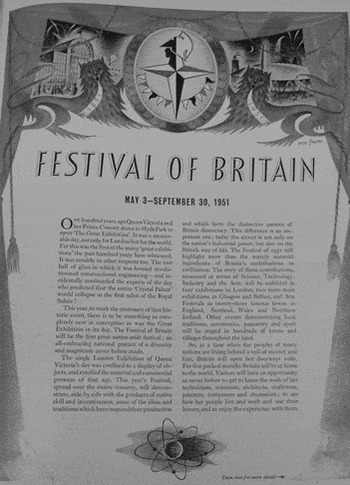
The festival's keynote advertisement in Life magazine was prepared in close consultation with the foreign office and the British ambassador to the United States, with the “international situation very much in mind.”Footnote 76 The advertisement (see fig. 1) focused on the festival as a national event concerned not simply with exhibits of material products but rather with exalting “the British way of life.” It was headed by a drawing of the festival symbol flanked by the main exhibition venues in 1851 and 1951, respectively, the Crystal Palace and the Dome of Discovery. This picture was in turn framed by open curtains. As the text made clear, this was designed to provide a deliberate contrast to the closed or iron curtain around other parts of Europe: “So, at a time when the peoples of many nations are living behind a veil of secrecy and fear, Britain will open her doorways wide. For five packed months Britain will be at home to the world.”Footnote 77 There was little subtlety here; the message was that democracies were not afraid to put themselves on show. Morrison had in fact made this very point in the House of Commons when defending the decision to go ahead with the festival despite the outbreak of the Korean War.Footnote 78 Lest anyone in America miss it, this theme was also hammered home that same month by Barry on his thirteen-day public-relations junket to Washington, New York, and Philadelphia. Meeting with and addressing business executives, journalists, publishers, and American politicians and bureaucrats, he took the line that the festival “would be a valuable demonstration at this time (i) to our own people of the values of the way of life which we are once again called upon to defend, and (ii) to our Allies of our resilience, confidence and dependability.”Footnote 79 Barry reported that he had not personally encountered any hostility or criticism. He told Morrison “indeed at times I detected more than a hint of admiration that a nation that had recently endured so much should have summoned up the courage and will to lay deliberate emphasis on the creative aspects of democracy in the midst of a period of violence and destruction.”Footnote 80
Festival organizers also solicited editorial publicity, and the BBC arranged newsworthy broadcasts and lectures.Footnote 81 Prominent individuals paying visits to the United States were asked to talk up the festival, and large companies and voluntary bodies
Advertisement, Life, 22 January 1951, 17.

were invited to provide free publicity wherever and whenever possible.Footnote 82 Publicity planning was a complicated process, mainly because the festival organization was trying to achieve several goals, some of which were contradictory.
This festival was supposed to show the world Britain's historic past and promising future, a serious business.Footnote 83 Conveying this message to all Americans was deemed essential given the world situation, Britain's sense of indebtedness to the United States, and the impossibility for most Americans to come see for themselves. Transatlantic travel remained expensive, and the space available on ships was still relatively limited.Footnote 84 Yet Britain was going to be at home to the world in 1951. This was supposed to be a year of “gaiety and fun,” to quote Gerald Barry.Footnote 85 To attract tourists, emphasizing this aspect of the festival was also important. How were they to balance the two objectives? Would it be irresponsible to emphasize the “fun and games” side of the festival, given the Korean crisis? Morrison thought so; by July 1950 the lord president's office was telling Barry to “play down” that side of the festival, especially in the United States in light of “the present world condition.”Footnote 86 And to what class of tourists ought the pitch be directed? Should a socialist government focus solely on attracting the wealthy? As already noted, this was, after all, supposed to be the people's show. Students might not have many dollars to spend, but would it not be good public relations to promote their attendance? Barry asked Morrison this question in June 1950, suggesting that if thousands of American students could be brought over, it would not “primarily be tourism in its material sense but it would reflect the true spirit of the Festival.” Adding that there should be “no need to emphasize the importance of making friends for Britain among young people,” Barry proposed the Admiralty lend an aircraft carrier as transport. He was confident this was an “imaginative idea sure to appeal to American sentiment.”Footnote 87 Morrison agreed, and the feasibility of the project was seriously investigated. However, the Korean crisis and impending war made it impossible for a suitable ship to be borrowed.Footnote 88
Ideals aside, the festival was justified publicly as a way to draw in dollars, by attracting well-heeled tourists. The chief problem the planners faced here was that Britain did not necessarily have much to offer visitors. Food rationing, for instance, presented a number of obstacles. The Board of Trade's interdepartmental committee on tourism noted that some Americans seemed reluctant to come to Britain lest their presence deprive ordinary Britons of food. Some assumed that they would have to bring their own food, soap, towels, and bed linen with them on holiday.Footnote 89 A proposal to help tourists avoid rationing measures met with skepticism, lest special treatment backfire and unleash British hostility to foreigners. Officials were also concerned that “the effect on tourists, particularly Americans, might be to produce skepticism about the need for further American aid, rather than satisfaction at our attention to their gastronomic needs.”Footnote 90 Thus, festival organizers concentrated on securing an end to those aspects of the program most likely to inconvenience visitors, such as restrictions limiting the size of restaurant meals.Footnote 91 Even then, the best catering companies were reluctant to bid for restaurant sites on festival grounds because of the short-term nature of the contract, uncertainty over the availability of labor, and the “strict continuance of rationing.”Footnote 92 A member of the committee planning the festival pleasure grounds thought a projected shortage in eating establishments was a minor issue because, “in these days,” people liked to bring their own food with them.Footnote 93 But where were all these prospective picnickers going to stay?
Providing adequate accommodations for tourists was a vexing problem. By 1947, 95 percent of hotels taken over for wartime use had been decommissioned, but most needed refurbishing. Other building priorities and shortages of supplies meant new ones were not being constructed.Footnote 94 The problem was so acute the cabinet actually debated whether the government should enter the hotel business itself to rectify the problem in time for the festival.Footnote 95 The Treasury objected to any such measures, on the rather interesting grounds that, if the state stepped in to manage and build new hotels, private industry would lack incentive to solve the shortages caused by its own inability to build hotels.Footnote 96 As it was, the Board of Trade was already exploring the issue of providing special subsidies to hotels, in particular those that could prove they were popular with dollar-tourists. This scheme proved exceedingly difficult to formulate and bring into effect: it opened up a huge and many-faceted debate over the appropriate role of the state vis-à-vis service industries; it engendered howls of opposition from within the trade, on the grounds of unfair favoritism; and more than one civil servant deemed it impossible to administer.Footnote 97 The subject was debated for years.Footnote 98 Desperate festival organizers eventually began to investigate the possibility of using almost any available public buildings as hostels. They even considered housing tourists in a makeshift floating hotel aboard a boat they did not yet have but hoped to “borrow” and moor at Greenwich.Footnote 99 That did not happen, but plans to use wartime air-raid shelters did come to fruition. In total, 111,000 nights’ shelter was provided for three shillings a night at the Clapham Deep underground shelter and at a camp site at the Crystal Palace.Footnote 100 Arrangements were made to block London hotel rooms for American use, and a scheme was developed to offer rooms in private houses.Footnote 101 Citing soap rationing and the scarcity of new towels “and other elementary amenities” that transatlantic visitors, in particular, would expect, Morrison told the cabinet in mid-1950 that it might “well be that many of our visitors who are accommodated in private homes will fare better and enjoy themselves more than some who have to brave the rigors of some of our hotels.”Footnote 102
The festival organization knew that the prevailing culture of austerity was not conducive to attracting tourists. The director of public relations, Paul Wright, even opined that festival publicity in the United States had to “aim at scotching the rumor that standards of comfort in Britain are little better than a concentration camp.”Footnote 103 Tasteless as it is, this comment merits quotation, as it highlights a problem central to the entire festival endeavor. The country was still grappling with the economic consequences of the war. Britain was recovering in a manner that the government viewed worthy of celebration, but that recovery was an ongoing process and an uphill struggle. In a plethora of ways, the festival exemplified the conundrum. For instance, the scarcity of hotel rooms points to a lack of basic building materials, in particular timber and steel.Footnote 104 This created elementary problems; the planners had to show a great deal of ingenuity in putting together the exhibition structures needed for the South Bank show. They commissioned studies on the use of alternative construction materials. Shortages of canvas meant consideration was given to building tented structures out of aluminum, plastics, and balloon fabrics.Footnote 105
Similar and equally serious difficulties arose over the very exhibits destined for display. For example, by 1950 the North British Locomotive Company was meeting numerous orders from abroad for a new type of WG class steam locomotive that was on the cutting edge in terms of engineering skill and design. The new machine was a British success story, which typified one of the major messages of the Festival of Britain. Naturally, then, the exhibition planners viewed this locomotive as a perfect centerpiece for the transport and communications section of the South Bank scheme. There was only one problem. The company did not have a spare locomotive to put on display for six months. Every one it made was going to the export trade, which, it bears remembering, was the chief economic priority of the Labour government. In order to exhibit a prototype locomotive at the festival, the planners had to ask a foreign customer to lend them one. After the Australian government refused, the high commissioner for India was enlisted to get the Indian Railway Board on side.Footnote 106 This is just one example, but it speaks volumes. So too does the fact that, in formulating plans to make the country look pleasant and appealing in 1951, festival organizers were in 1949 keeping an eye on linseed negotiations with Argentina. The outcome of the deliberations would determine whether there would be sufficient supplies of paint available to justify an extensive “spruce up” Britain campaign in advance of the festival.Footnote 107 Even this was a double-edged sword; tidying up might help attract tourists, but what if the place started to seem too attractive? What if Americans were given the idea conditions were marvelous in Britain and then arrived and felt cheated? The British had already earned a reputation in the United States for being sly propagandists who had been tricking Americans as far back as World War I.Footnote 108 Moreover, if the publicity was too successful, Americans in general (particularly the great majority who would not be coming over to see for themselves) might start thinking Britain was fully recovered from the war. In other words, Americans might conclude Britain would not require any further economic aid. Equally, Americans might think the British had adopted a carefree approach to the future. The British ambassador to Washington, Oliver Franks, who had helped negotiate American economic aid, was livid about a full-page advertisement in U.S. magazines in January 1951 that, under the heading “Come to Britain in Festival Year,” read:
Whenever you come to Britain this year, you’ll sense a gala spirit in the air. For this is “Festival of Britain Year.” You’ll find, too, abounding comfort in Britain now … with food (including famous British delicacies) plentiful in restaurants hotels and inns … with gasoline unrationed and with shops well-stocked with treasures old and new. You’ll be delighted to see how far your dollar goes in this land of “fair value” and favourable exchange … giving you a real holiday from high prices! … So don’t delay! Start planning early … to come to friendly, hospitable Britain in Festival Year for a welcome you’ll never forget and the time of your life!Footnote 109
Franks sent Morrison the following telegram: “This [advertisement] must surely run entirely contrary to the earnest endeavor and considerable sacrifices which Britain is making to re-establish her economic position and to re-arm. It is agreed on all sides that it is most important that America should have full confidence in the British programme and that anything that undermines that confidence will only add to the difficulties with which we are faced.”Footnote 110 The predicament was, in a nutshell, how to present equally important but mutually contradictory impressions at the same time. Ironically, the advertisement in question had not been put out by the festival organization. It was the work of the newly created British Travel and Holidays Association, recently constituted as a compromise solution to the long-standing animosity between the Travel Association and the BTHB.Footnote 111 The problem, of course, was that the festival organization was not the only body responsible for, or active in, trying to project the image of Britain as an attractive tourist destination.
In the end, the predicament of selling contradictory impressions was probably more perceived than real. Britons seem to have been more preoccupied with these issues than Americans. Taken as a whole, American government officials supported the festival, both as a dollar earner and a sign of British recovery.Footnote 112 Why would they not? Here was marvelous evidence of the success of the Marshall Plan, which, as Dean Acheson had stressed at its inception in 1947, had as its objective “not relief ” but “the revival of industry, agriculture, and trade.”Footnote 113 Ironically, the festival organization ignored this perfect plum. Given Morrison's sensitivity to any notion that dollars were being spent on the festival, coupled with shifting perceptions about American concerns, perhaps it is not all that surprising. It may also have had something to do with the Marshall Plan itself and with British reluctance to bow to American pressure on the issue of greater European economic cooperation. It is worth noting, for example, that while the festival was being planned, the Organization for European Economic Cooperation (OEEC) was carrying on parallel discussions about the role that American tourism could play in the Marshall Plan and the economic recovery of Europe as a whole.Footnote 114 Britain was represented on the OEEC committee on tourism established in October 1948, but British officials perceived a conflict of interest of sorts between the country's own efforts to increase its visitor traffic and efforts to attract people to Europe in general. From the British perspective, national interest had to come first, and this seemed to preclude the successful working of a common European scheme. In other words, the British recognized the economic benefits of promoting tourism and wanted to promote tourism but were not desirous of having to share the spotlight with the rest of Europe, lest British tourism suffer from the competition.Footnote 115
They might have had some cause for concern. Promoting Britain as a tourist destination for Americans did prove difficult in the postwar years. This was certainly evident in the way in which the U.S. audience responded to the Festival of Britain. If the cover stories and letters to the editor in major U.S. publications are any gauge, politically savvy Americans were more concerned about the international situation in the spring of 1951 than they were with expensive British pageantry.Footnote 116 Coverage of the festival virtually acknowledged this fact: the 28 May 1951 cover of Newsweek featured a picture of a Tower of London Beefeater over the headline “Festival of Britain: Bright Note in a Dark Europe.” The accompanying article noted the criticisms leveled against the exhibition as “an incongruity in a world threatened by war” but noted that since opening the festival had “gleamed like a beacon of light for an austerity- and crisis-weary British public.” While citing the general lack of hotel rooms and the outrageous cost of a cup of tea, the article went on to note the scope and variety of exhibits and the types of special measures taken to gratify tourists, especially those from the United States: “To insure no American tastes bad English coffee (to most Americans, all English coffee is bad) coffee tasters plan monthly check-ups. … Mrs. William Batt, wife of the head of the ECA mission in Britain, is one of the tasters. Far-sighted festival authorities even thought of ice water, although one has to ask for it.”Footnote 117Newsweek thought the show “was clearly destined for success in terms of British pride and appreciation” but added, “Whether it was worth it in terms of hard cash in hard times was something else again.”Footnote 118Time magazine devoted a small column in its foreign news section to the festival opening. Despite the fact that Britain's “greatness had become constricted; her riches were dwindling; her military and commercial power, like the steam that once drove here once-commanding machine, had been fearsomely diminished,” it was said to be “Joyful for a Season.” Hardly a stirring commendation, yet the article did note that “where bombed-out slums once sprawled, [visitors] … could goggle at the vast ‘Dome of Discovery,’ with its 74-inch-lens telescope, at the ‘Telekinema’ with its three-dimensional sound pictures,” implying that for a nation whose greatness had diminished, things were not all bad.Footnote 119 Favorable articles also appeared in the Christian Science Monitor, the Wall Street Journal, the Baltimore Sun, and the Cincinnati Times Star.Footnote 120 That said, the American media did not devote extensive coverage to the Festival of Britain.
Perhaps this is why, regardless of the positive comments that were published, hordes of Americans did not attend the festival. The number of U.S. visitors to Britain in 1951 was calculated to be 170,000, a mere 4 percent increase over 1950.Footnote 121 This would seem to suggest that the Festival of Britain had not been a major drawing point. Why so few Americans came is not easy to determine. Certainly there were still major obstacles to large-scale transatlantic travel, including limitations on space; none of the projected schemes for low-cost student travel had materialized, and the era of charter airline flights had not yet begun. Festival organizers blamed the Korean War and the charged international situation.Footnote 122 At the same time, they expressed some relief that more Americans had not made the journey; hotel space was, after all, at a premium.Footnote 123 In and of itself, the festival did not initially appear to have been a major dollar earner, although its defenders hastened to add that the exact economic benefits were too difficult to gauge accurately. That said, the festival planners could declare truthfully that the year 1951 was, to date, “the most successful that the British tourist industry has ever enjoyed.”Footnote 124 Earnings from tourism were estimated at £67 million in 1951, as compared to £28 million prewar, £21 million in 1947, and £58 million in 1950.Footnote 125 This was not a bad legacy for the festival,Footnote 126 when one considers that by 1949 the Board of Trade had concluded that tourism was the number one dollar-earning industry for Great Britain.Footnote 127 Economic recovery, it seems, required tourism and that government take tourism seriously.
The Festival of Britain, with all its multifaceted and seemingly contradictory messages, points to an important way in which Britain was coming to terms with its economic and international position by the 1950s. In particular, it provides insightful perspective into the way in which Britain was approaching the United States. The festival was much more than just a “brilliant holiday” for an austerity-weary nation or a venue through which it could celebrate and craft national identity. It could be seen as a prelude to the age of discretionary income, conspicuous consumption, and a burgeoning tourist industry. As Max Nicholson of the lord president's office observed in October 1951, “The Festival has not only secured greater additional publicity for our tourist industry, but has pointed the way to profitable opportunities of further development.”Footnote 128 This conclusion seems prescient. The selling of the nation and of particular views of national identity hardly stopped with the end of the festival. The coronation of 1953, the royal weddings, and the Millennium Dome all come to mind, as does the popularity of the so-called heritage industries, which have grown up in recent decades with the aim of protecting the nation's past.Footnote 129 Thus, I concur with Richard Weight's conclusion that the Festival of Britain set an important precedent for future endeavors to attract tourists.Footnote 130
The Festival of Britain might not have attracted a lot of American tourists and Yankee dollars to Britain in 1951; its tangible results were perhaps not great. Yet, it did provide an early opportunity for the British to become more aware of the way in which the nation could sell itself abroad in an era of increasing affluence, mass media, and broadening opportunities for travel. It also highlights the problems and questions that arose as the state began to make forays into an arena previously deemed the responsibility of private enterprise. Understanding such issues is important because, success or failure, the festival did not in any way dampen state involvement in tourism. Even after the Conservatives returned to power in the 1950s, there was a growing acceptance that government had a valid and necessary part to play in the promotion of Britain as a travel destination.