Introduction
Fundamentally rooted in the time-reversibility of microscopic processes,Reference Casimir1 Lorentz reciprocity requires that, in most circumstances, signals travel from point A to point B, and back from B to A, with the same transmission properties. The implications of this symmetry relation are ubiquitous in our day-to-day life, and the needs for technologies that can break it have been steadily growing in the past decades. The radio frequency (RF)/millimeter-wave/THz frequency range is especially important in this context, since continuous-wave radar systems, from military to automotive and civil applications, operate by discriminating outgoing and incoming signals at the same frequency in a single antenna, an operation that can be performed only by breaking reciprocity. Similarly, there is strong interest in full-duplex cellular and WiFi communication systems that can transmit and receive at the same time over the same frequency channel;Reference Bharadia, McMilin and Katti2,Reference Zhou, Reiskarimian, Diakonikolas, Dinc, Chen, Zussman and Krishnaswamy3 again, an operation that inherently requires isolation and nonreciprocal responses.
The most common approach to build a nonreciprocal device involves breaking time-reversal symmetry by relying on magneto-optical phenomena:Reference Freiser4 a DC magnetic bias in gyrotropic materials, such as ferrites, forces left- and right-handed polarizations to propagate at different speeds, a symmetry breaking that depends on the direction of the magnetic bias, not on the direction of propagation, therefore enabling nonreciprocity. This basic phenomenon can be exploited to realize isolators, circulators, nonreciprocal phase shifters, and other nonreciprocal systems. However, strong magneto-optical effects require rare, lossy, and expensive materials, such as iron garnets or ferrites, which cannot be straightforwardly integrated in complementary metal oxide semiconductor (CMOS) technology, and therefore lead to bulky, expensive, and often impractical components.
For this reason, there has long been interest in developing magnetless approaches to nonreciprocity, especially focused on the low-frequency end of the spectrum, for which some alternatives to magnetic approaches have been devised in the past decades. A basic example is provided by the use of nonlinear materials, as highlighted in the article by Chen et al.Reference Chen, Leykam, Chong and Yang5 in this issue. Nonlinear phenomena, when combined with geometrical asymmetries, can break reciprocity, since the signal itself, as it travels through a nonlinear material, can bias it and break time reversibility. However, this approach works only for signals of sufficiently high intensities, inherently leads to nonlinear signal distortions, and is hampered by interference with other signals, and therefore, it generally works only for incident signals from one port at a time.Reference Aleahmad, Khajavikhan, Christodoulides and LiKamWa6,Reference Shi, Yu and Fan7 Another alternative, as discussed in the following section, is offered by a DC current bias, which can also break time-reversal symmetry. At MHz, GHz, and even millimeter-wave frequencies, transistor-based devicesReference Tanaka, Shimimura and Ohtake8 and artificial materials using transistors and other active devices as their building blocks have been explored through the yearsReference Kodera, Sounas and Caloz9–Reference Wang, Wang, Wang, Zhang, Huangfu, Joannopoulos, Soljačić and Ran11 as a useful alternative to magnetic bias. However, these systems are limited in terms of operational frequency to the range of frequencies where transistors can operate, and their active nature imposes drastic challenges in terms of noise performance, linearity, and power handling.
Another general opportunity to break reciprocity is offered by time modulation,Reference Sounas and Alù12 as recognized decades ago in the microwave community.Reference Kamal13–Reference Brenner16 Mixers, switches, and variable capacitors are excellent tools in this frequency range to impart suitably tailored spatiotemporal modulation schemes that break time reversibility and reciprocity. Early approaches in this context, typically based on diodes or parametric devices, had not gained significant attention in the past decades due to practical challenges in the efficient realization of time modulation. The recent growing need for integration, together with rapidly improving technology in the context of switches and modulated circuit elements have brought this approach to nonreciprocity back to the forefront. Synthetic momentum bias based on spatiotemporal modulation schemes and commutated switching schemes have led to important breakthroughs for nonreciprocal RF/millimeter-wave/THz technology in this context. In the following, we review the most relevant magnet-free approaches to nonreciprocity at GHz-to-THz frequencies, and we provide an outlook for future opportunities in artificial materials based on this advancing field of research.
Active-transistor-based approaches
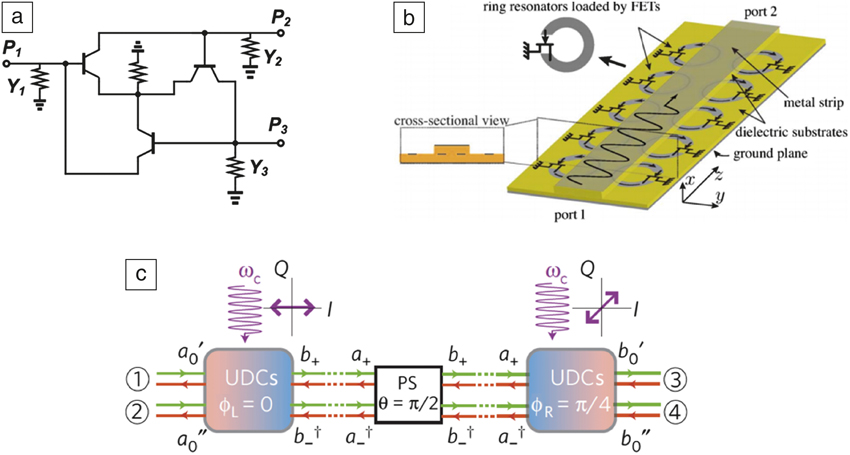
Transistors biased in an active region of operation with a DC bias current are inherently nonreciprocal, offering gain in the forward direction and isolation in the reverse direction. As early as 50 years ago,Reference Tanaka, Shimimura and Ohtake8 active transistors were used to realize three-port circulators (Figure 1a), and such approaches have been pursued ever since, over frequency ranges at which transistors can provide active gain, including RF and millimeter waves. Active transistors embedded in metamaterials to realize nonreciprocal metamaterials have also been exploredReference Kodera, Sounas and Caloz9–Reference Wang, Wang, Wang, Zhang, Huangfu, Joannopoulos, Soljačić and Ran11 (Figure 1b).
(a) Active transistor circulator, (b) nonmagnetic transistor-loaded metamaterial structure (field-effect transistor [FET]), and (c) time-modulation-based four-port circulator based on parametric up-down converters (UDCs) and a phase shifter (PS) in between. (a) Reprinted with permission from Reference Reference Casimir1. © 1945 American Physical Society. (b) Reprinted with permission from Reference Reference Kodera, Sounas and Caloz10. © 2013 IEEE. (c) Reprinted with permission from Reference Reference Kamal, Clarke and Devoret20. © 2011 Nature Publishing Group. Note: ωc, pump frequency; a and b, forward and reverse traveling waves at the various interfaces.

However, the DC biasing current of an active transistor is associated with the addition of noise. Active transistors are also limited in their linearity and power handling, exhibiting nonlinear distortion when the signal level becomes comparable with the DC bias. As a result, active-transistor-based nonreciprocal devices are rarely used in applications with stringent linearity and noise requirements, such as the front end of communication radios.Reference Carchon and Nanwelaers17
Discrete spatiotemporal modulation: Mixer-based approaches
A basic time-modulation-based approach to achieve nonreciprocity involves two mixers (i.e., elements that perform frequency conversion by multiplying the signal being processed with a time-modulation [pump] signal) driven by phase-shifted (typically 90°) pump or local oscillator signals with a transmission-line or waveguide delay between them (typically one-quarter-wavelength long at the pump frequency) (Figure 1c). As the signal propagates through the structure, the first mixer performs a frequency conversion with the pump or local oscillator signal to produce intermodulation signals, which then travel down the delay line. At the other end, the second mixer recovers or undoes the frequency conversion to move the signal back to the original frequency, but with a phase shift due to the shifted pump signal. In the reverse direction, the behavior is the same, but the opposite phase shift is imparted to the signal, resulting in a nonreciprocal phase response. Other configurations with different delay line lengths and pump signal phase shifts are possible in order to realize other nonreciprocal responses, such as isolation.
There exists a direct tradeoff between size and modulation speed requirements—the higher the pump frequency, the smaller the size of the structure, because of the quarter-wave delay. This concept was explored in the microwave domain as early as 50 years agoReference Kamal13 to realize a nonreciprocal phase shifter and a circulator, and more recently, has been explored both in the opticalReference Tzuang, Fang, Nussenzveig, Fan and Lipson18,Reference Doerr, Chen and Vermeulen19 as well as in the microwave domainsReference Kamal, Clarke and Devoret20 (Figure 1c). This approach can be thought of as discrete spatiotemporal modulation, as the two mixers perform temporal modulation at two discrete points in space on either side of a delay.
Distributed spatiotemporal modulation: Momentum bias
In addition to DC, linear and angular momenta are quantities that are odd-symmetric under time reversal, and therefore they can be used to break reciprocity. A mechanical momentum bias can indeed break reciprocity,Reference Fleury, Sounas, Sieck, Haberman and Alù21 but this solution may not be practical in most electromagnetic systems. Yet, momentum can be effectively synthesized using distributed spatiotemporal modulation. Photonic transitions, which support nonreciprocal transmission, are enabled by synthetic linear momentum imparted with a traveling modulation wave.Reference Yu and Fan22 A recent implementation in a transmission-line loaded with variable capacitors has been also presented in the GHz range.Reference Qin, Xu and Wang23 These solutions typically require electrically large devices, since the applied momentum is rather weak, and the coherence length of the associated nonreciprocal transitions is many wavelengths long. Here, we discuss the recent exploration of synthetic momentum bias to realize GHz and THz devices and artificial materials with large nonreciprocal responses in compact systems based on resonant structures.
A synthetic angular momentum can be imparted to an azimuthally symmetric ring resonator by modulating the substrate permittivity with a rotating wave in the form
 $${\rm{\varepsilon }}(r,{\rm{\varphi }},z,t) = {{\rm{\varepsilon }}_{{\rm{static}}}}(r,z) + \Delta {\rm{\varepsilon }}(r,z)\cos ({{\rm{\omega }}_m}t - 2l{\rm{\varphi }}),$$
where Δε is the modulation amplitude of the permittivity, ωm is the modulation frequency, εstatic is the nonmodulated substrate permittivity, and 2l is the angular momentum of the modulation wave.Reference Sounas, Caloz and Alù24,Reference Sounas and Alù25 The modulation efficiently couples resonant modes with opposite angular momenta ±l, leading to the analogue of Zeeman splittingReference Sounas, Caloz and Alù24 in magneto-optical materials, but without requiring a static magnetic bias. The associated nonreciprocity enables compact integrated isolators and circulators, as schematically depicted in Figure 2a,Reference Sounas and Alù25 and it can be extended to a discrete number of resonators modulated independently with staggered phases, as schematically shown in Figure 2b. A rotating modulation phase across the resonators enables an effective spin of the circuit, which breaks reciprocity. Based on this implementation, various radio-frequency circulators have been realized, with large isolation, good linearity and forward transmission. The overall metrics of performance of these devices have been rapidly improving.Reference Estep, Sounas, Soric and Alù26–Reference Kerckhoff, Lalumière, Chapman, Blais and Lehnert28 These elements can also be combined in arrays to realize artificial materials with strong nonreciprocal response. In this context, an array of double-ring resonators loaded with variable capacitors modulated by a rotating wave has been shown to enable large Faraday rotation for plane waves impinging on the metasurface, despite the fact that it is not magnetically biased.Reference Sounas and Alù25 Metasurfaces supporting a synthetic linear momentum have also been envisioned as a means to realizing free-space isolation.Reference Hadad, Sounas and Alù29,Reference Shaltout, Kildishev and Shalaev30
(a) Nonreciprocal magnet-free optical isolator based on a modulated microring resonator in Si photonic technology.Reference Sounas and Alù25 (b) Nonreciprocal magnet-free three-port circulator based on modulated resonators synthesizing an angular momentum bias.Reference Estep, Sounas, Soric and Alù26 (c) Nonreciprocal antenna based on linear-momentum bias, and (d) measured radiation patterns in transmission (TX) and reception (RX); θ defines the radiation angle. (e) Nonreciprocal THz antenna based on a momentum-biased graphene metasurface. The yellow bars represent the voltage gates, with applied voltages, V, that modulate the graphene ribbons (black), with conductivity σ1, σ2. The green and blue regions represent dielectric materials with relative permittivity  ${{\rm{\varepsilon }}_{r1}},\,\,{{\rm{\varepsilon }}_{r2}}$.

Synthetic momenta can also be used to break reciprocity for radiation and thermal emission, which is particularly relevant for GHz and THz technology. Reciprocity poses severe restrictions in radio communications—wireless systems and antennas are bound by reciprocity to transmit and receive in the same direction (i.e., the transmission and reception patterns of a conventional antenna systems are identical). This poses challenges in complex environments in which a directive antenna is forced to listen to jamming signals or its reflected echo, and an antenna cannot be designed to transmit in one direction and selectively receive from another. Recently it was shownReference Hadad, Soric and Alù31,Reference Taravati and Caloz32 that time modulation and synthetic momentum bias can be used to realize antennas that overcome this limit, defeating jamming and unwanted echoes, by making sure that transmission and reception patterns are drastically different. A transmission line radiating in free space and loaded with variable capacitors (Figure 2c), in which temporal modulation was used to impart a synthetic linear momentum to the impinging signal, showed a measured performance (Figure 2d) with around 15 dB of isolation.
At higher frequencies, in the THz range, these concepts are of major relevance in the context of thermal emission and thermal management. Reciprocity also fundamentally challenges the efficiency of absorbing structures, as they are bound to follow Kirchhoff’s Law of thermal radiation, and act as good emitters in the same spectral range in which they absorb, therefore emitting a significant portion of the absorbed energy in the form of thermal infrared emission toward the source, inherently limiting the efficiency. Similarly, relevant challenges arise in heat dissipation and thermal management in several other engineering contexts, especially in the aerospace industry, connected with fundamental reciprocity limitations.Reference Zhu and Fan33,Reference Green34 Time-modulated metasurfaces for thermal emission may break this bound,Reference Hadad, Soric and Alù31 with important implications for thermal management and harvesting.
In this context, a modulated metasurface based on graphene ribbons was proposedReference Correas-Serrano, Gomez-Diaz, Sounas, Hadad, Alvarez-Melcon and Alù35 to break reciprocity for THz radiation, with geometry shown in Figure 2e. The graphene ribbons (black lines in the figure) can be gated independently and modulated with a traveling wave, which synthesizes the required momentum to break time-reversal symmetry. In this or similar setups, the fast modulation offered by graphene-on-insulator technologyReference Phare, Lee, Cardenas and Lipson36 through gating may provide an ideal platform to realize these effects in practical systems and in artificial THz materials.
Integrated spatiotemporal conductivity modulation using switches
The approaches reviewed thus far exploiting spatiotemporal modulation to break reciprocity have leveraged permittivity as the material parameter being modulated, specifically using varactors in GHz-range RF circuits. A critical significance of these magnet-less spatiotemporal modulation approaches is their compatibility with integrated-circuit fabrication processes. However, permittivity modulation is, in general, a weak process across different substrates and frequency ranges, and is commonly associated with loss, since it is usually achieved through carrier injection. In a CMOS process, varactors typically exhibit maximum-to-minimum capacitance ratios (C max/C min) of only 2–4, and losses that severely increase as operating frequencies enter the millimeter-wave range. This results in large sizes for permittivity-modulated nonreciprocal components, reduced bandwidth if resonances are used to miniaturize the size, and high loss levels. However, conductivity can be modulated over orders-of-magnitude range in semiconductors, with passive (reciprocal) CMOS transistor switches exhibiting ON-OFF conductance ratios as high as 103–105. Leveraging this concept, the first CMOS passive nonreciprocal components have recently been demonstrated.Reference Reiskarimian and Krishnaswamy37–Reference Dinc, Nagulu and Krishnaswamy40
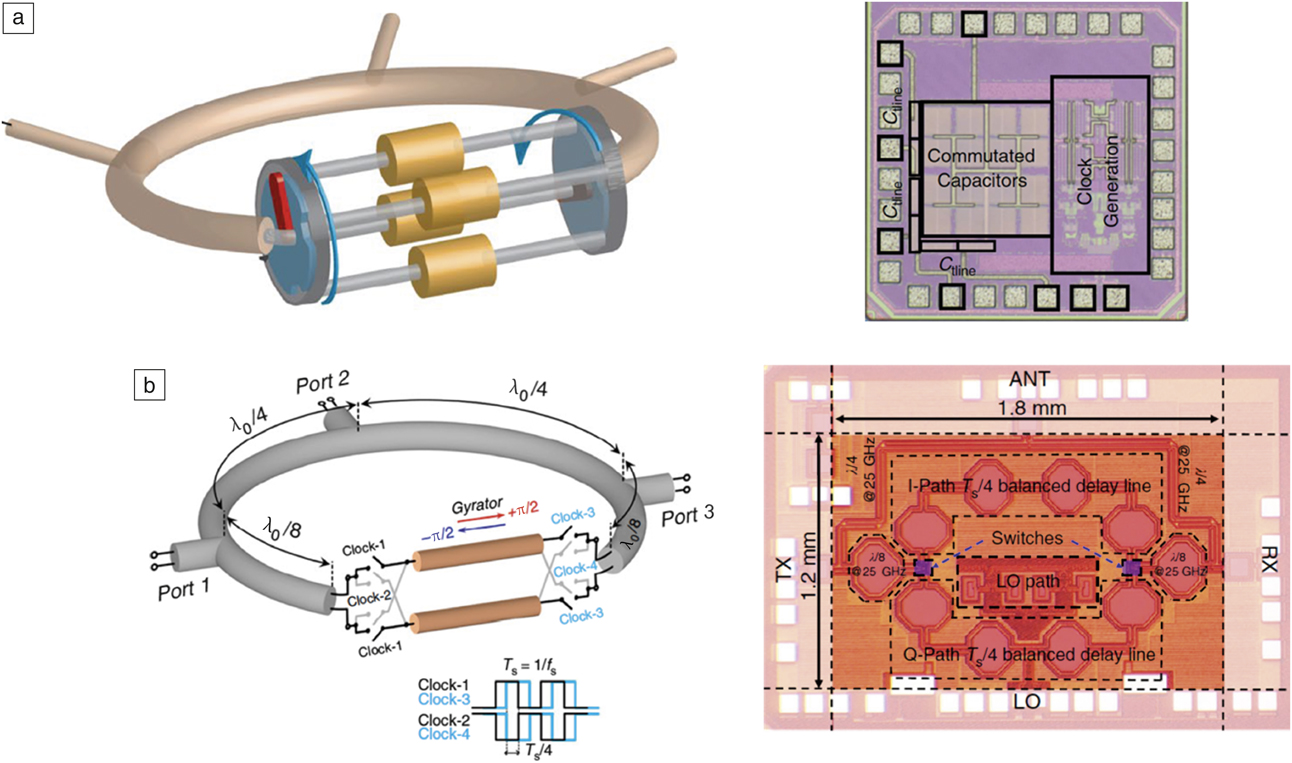
Transistor switches in 65-nm CMOS technology are used to commutate the signal across a bank of N capacitors in a configuration called the “N-path filter.”Reference Reiskarimian and Krishnaswamy37,Reference Reiskarimian, Zhou and Krishnaswamy38 N-path filters were first explored in the 1950s using mechanical commutation to realize tunable high-quality comb filters around harmonics of the (tunable) commutation frequency without the use of inductors.Reference Busignies and Dishal41,Reference LePage, Cahn and Brown42 More recently, N-path filters have drawn tremendous research interest in the radio-frequency integrated-circuit (RFIC) community due to the ability to perform commutation at GHz frequencies using high-speed transistor switches, therefore realizing inductor-less, tunable, high-Q RF filters on chip for the first time.Reference Ghaffari, Klumperink, Soer and Nauta43 It was shown that staggering the commutation (i.e., phase shifting the clock signals controlling the switches) on either side of the capacitor bank results in a nonreciprocal phase response, essentially realizing an electrically infinitesimal gyrator.Reference Reiskarimian, Zhou, Chuang and Krishnaswamy44 A gyrator is a nonreciprocal component that exhibits perfect transmission in both directions but with a 180° nonreciprocal phase, and can therefore be used as a fundamental building block in nonreciprocal networks. This N-path gyrator was used to realize the first CMOS nonreciprocal passive circulator (Figure 3a).Reference Reiskarimian and Krishnaswamy37,Reference Reiskarimian, Zhou and Krishnaswamy38
(a) N-path filter-based staggered-commutation circulator concept and implementation as a 750-MHz integrated circuit (IC) based on a 65-nm complementary metal oxide semiconductor (CMOS).Reference Reiskarimian and Krishnaswamy37 (b) Broadband circulator based on staggered commutation across transmission lines, and implementation as a 45-nm silicon-on-insulator CMOS 25 GHz (millimeter-wave) IC.Reference Dinc, Tymchenko, Nagulu, Sounas, Alù and Krishnaswamy39 Note: ANT, antenna port; LO, local oscillator port; RX, receiver port; TX, transmitter port, and the local oscillator port of the chip.

A challenge with the N-path filter is the need for multiphase local oscillator signals at the operating frequency, resulting in increased power consumption in the modulation circuitry and preventing the approach from being used at higher (millimeter-wave) frequencies, since multiple phases are increasingly challenging to generate at higher frequencies. A second challenge is that the high-quality filtering inherent in an N-path filter limits the bandwidth of the realized nonreciprocal component. In order to circumvent these challenges, various nonreciprocal functionalities were demonstrated by replacing the capacitors with transmission lines.Reference Dinc, Tymchenko, Nagulu, Sounas, Alù and Krishnaswamy39,Reference Dinc, Nagulu and Krishnaswamy40 The structure reduces to two sets of four-phase commutating switches on either end of transmission line delays, with the two switch sets staggered in phase. In this regard, the structure once again resembles the mixer-delay-mixer approach described earlier, with the distinction that conductivity modulation essentially introduces time-periodic transmissive and reflective boundary conditions that offer new degrees of freedom to realize new functionalities. Based on different phase relationships between the modulating clocks, transmission-line delays and conductivity modulation depths, different forms of nonreciprocal functionalities were shown, including gyration, isolation, and circulation. Common to all configurations is the ability to use modulation frequencies that are substantially lower than the operating frequency, and achievement of nonreciprocity over broad bandwidths (theoretically infinite in some configurations). The former benefit enabled the implementation of the first millimeter-wave (25 GHz) nonreciprocal passive circulator in a 45-nm silicon-on-insulator (SOI) CMOS process (Figure 3b). Even more recently, current results appear to show that a lower modulation frequency can be used to enhance linearity (as opposed to operating frequency), resulting in a 1 GHz circulator in 180-nm SOI CMOS with >1 W maximum supported transmitter power.Reference Nagulu, Alù and Krishnaswamy45
Another interesting aspect of the proposed configurations is that the use of balanced (0/180°) signaling (i.e., two signals that are equal in magnitude, but 180° out of phase, also called differential signaling) results in structures that exhibit no frequency conversion at the external ports (i.e., no intermodulation products). This implies that the structures appear to be time invariant from the outside, while internally being time varying, and therefore able to break reciprocity and other time-reversal symmetry bounds.Reference Sounas and Alù46 Similar opportunities of intermodulation cancellation and pseudo-time invariant devices arise also in the angular-momentum bias approach, when multiple elements are combined in a differential configuration.Reference Kord, Sounas and Alù47
Artificial materials and electromagnetic topological insulators
The technologies discussed in this article are ideal building blocks at GHz-to-THz frequencies to realize artificial materials and metasurfaces with highly nonreciprocal response, yet without requiring magnetic bias. They open up exciting opportunities to realize the analogues of magnetized two-dimensional materials and topological insulators for GHz-to-THz photons. Photonic topological insulators have attracted significant attention in recent years, due to their unusually robust signal transportReference Lu, Joannopoulos and Soljačić48 supported by the nontrivial topology of their band diagram. Their features are analogous to those of electronic topological insulators,Reference Raghu and Haldane49 and when the topological nature is induced by nonreciprocity, they enable robust one-way transport over the entire topologically nontrivial bandgap.
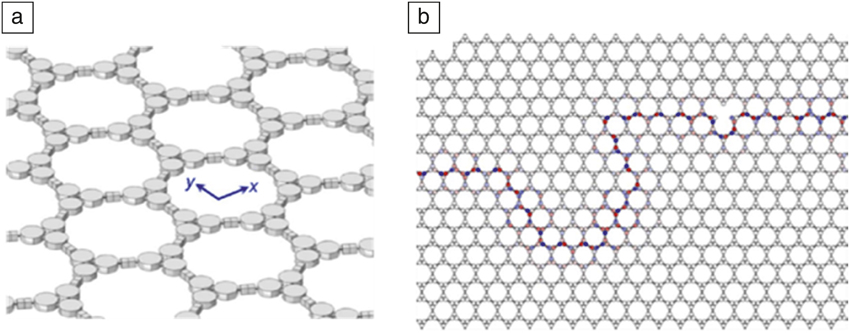
A popular example of a photonic topological insulator consists of a hexagonal lattice of resonators, as shown in Figure 4a.Reference Fleury, Khanikaev and Alù50 Due to symmetry, the lattice supports a Dirac point in the reciprocal space. With a suitable form of spatiotemporal modulation of the resonators, which mimics the rotating modulation waves previously described (Figure 2b), it is possible to break time-reversal symmetry, open a nontrivial topological bandgap around the Dirac point location, and enable one-way propagation along the edge of the lattice throughout the range of frequencies in the bandgap. The photon transport becomes analogous to that of electrons in a topological insulator. These topologically robust edge states can propagate around corners or other defects without reflection, and are inherently robust to disorder (Figure 4b shows the case of signal transport along a domain wall between two domains with opposite topological properties). Challenges in imparting the required modulation schemes over large networks of resonators may be overcome with optomechanical effects,Reference Schmidt, Kessler, Peano, Painter and Marquardt51,Reference Peano, Brendel, Schmidt and Marquardt52 opening exciting opportunities to realize artificial materials with largely unusual signal transport at GHz-to-THz frequencies.
(a) Topological insulator based on a hexagonal lattice of modulated resonators. (b) Topological protection of the edge states supported by the lattice in the bandgap.Reference Fleury, Khanikaev and Alù50

Conclusions
Breaking reciprocity is fundamental in modern radio communication and radar systems, but it currently requires the use of gyrotropic materials with associated technological challenges. In this article, we reviewed a few approaches to break reciprocity without relying on magneto-optical phenomena, which lead to the realization of nonmagnetic artificial materials and metamaterials with strongly nonreciprocal properties.
DC current bias and spatiotemporal modulation schemes appear ideally suited to realizing new material platforms with unusual transport properties, ideal for integration in modern radar and communication systems. The most recent realizations in this area have provided pseudo-time invariant devices that mimic ferrite materials without the need of a magnetic bias, with rapidly improving performance. Advances in microfabrication, the implementation of recent technological progress in the context of integrated circuitry and highly tunable materials, and new architectures are opportunities for future research, and may provide new breakthroughs to bring these recent research advances to full fruition.
Power handling and power consumption appear to be the most crucial aspects in this technology that need to be improved. Indeed, rather than trying to match the performance of ferrite nonreciprocal components, the strongest impact of this research may be seen in new architectures and functionalities that are possible through the co-integration of the circulator with the rest of the transceiver on the same integrated circuit.Reference Reiskarimian, Dastjerdi, Zhou and Krishnaswamy53 These include co-design and co-optimization, reconfigurability across frequency bands and standards, integrated antenna impedance tuning, and calibration of nonidealities and imperfections. It can also be seen in the use of this technology in applications for which ferrite components are just not viable, including ones that are extremely size- or cost-constrained or cannot support the use of a biasing magnetic field.
In addition, in considering the realization of artificial materials relying on these phenomena, the need for suitably tailored large-area modulation schemes is apparent. In this context, advances in optomechanics and acousto-electric technology may play a fundamental role to translate single devices into arrays, artificial materials and synthetic topological insulators for GHz-to-THz technology.
Acknowledgments
We acknowledge support from the DARPA SPAR Program, the US Air Force Office of Scientific Research, and the National Science Foundation EFRI Program.

Andrea Alù is the founding director and Einstein Professor at the Photonics Initiative, Advanced Science Research Center, The City University of New York. He received his Laurea degree in 2001 and his PhD degree in 2007, both from the University of Roma Tre, Italy. He was the Temple Foundation Endowed Professor at The University of Texas at Austin until 2017. His current research interests include metamaterials and plasmonics, electromagnetics, nano-optics, photonics, and acoustics. He is a Fellow of the IEEE, The Optical Society, American Physical Society, and SPIE. His awards include the ICO Prize in Optics (2016), the NSF Alan T. Waterman Award (2015), the OSA Adolph Lomb Medal (2013), and the URSI Issac Koga Gold Medal (2011). Alù can be reached by email at aalu@gc.cuny.edu.

Harish Krishnaswamy is an associate professor of electrical engineering at Columbia University. He received his BTech degree in 2001, and his MS and PhD degrees in 2003 and 2009 in electrical engineering from the Indian Institute of Technology, Madras, and the University of Southern California, respectively. His current research interests include integrated devices, circuits, and systems for radio frequency; and millimeter-wave, terahertz, and optical applications in communication, radar, and sensing. He received the DARPA Young Faculty Award in 2011, the 2014 IBM Faculty Award, and the 2015 IEEE Radio Frequency Integrated Circuits Symposium Best Student Paper Award. He currently serves as a distinguished lecturer for the IEEE Solid-State Circuits Society and as a member of the DARPA Microelectronics Exploratory Council. Krishnaswamy can be reached by email at hk2532@columbia.edu.