Rennet coagulation of milk is the basis of the cheesemaking process. There is general agreement that casein micelles, destabilized by the action of the proteolytic enzyme chymosin, aggregate to form strands that further associate to develop a three-dimensional continuous network (Zoon et al. Reference Zoon, van Vliet and Walstra1988). Chymosin cleaves the flexible moieties of κ-casein on the surface of the casein micelles, reducing their surface charge and removing the steric stabilizing layer. When a sufficient amount of κ-casein has been hydrolyzed, the secondary phase of the coagulation occurs and a gel network of caseins is formed (Dalgleish, Reference Dalgleish and Fox1992).
The viscoelastic properties of the final gel are mainly governed by the number and strength of cross-links between the casein chains (van Kleef et al. Reference van Kleef, Boskamp and Van den Tempel1978). In addition to the casein micelles, the presence of milk fat also contributes to the rheological characteristics of rennet gels. Native milk fat globules have a broad size distribution (from less than 0·5 μm up to 20 μm in diameter, with an average ~3·5 μm) and are enrobed with a protective layer that provides overall negative charge to their surface (the ζ-potential is estimated to be ~−13·5 mV) (Michalski et al. Reference Michalski, Cariou and Garnier2002a, Reference Michalski, Michel, Sainmont and Briard2000b). It is widely accepted that native milk fat globules do not participate in the building of the gel network, and thus act as inert fillers, occupying the voids within the casein strands (van Vliet, Reference van Vliet1988).
It has been reported that the rheological properties of both acid- and rennet-induced milk gels strongly depend on the type and size of the fat globules present in the matrix (Tosh & Dalgleish, Reference Tosh and Dalgleish1998; Michalski et al. Reference Michalski, Michel, Sainmont and Briard2002b). Native fat globules smaller than the gel pore size do not affect the formation of the gel matrix, whereas bigger fat globules may prevent the connection of casein strands and weaken the gel structure (Guinee et al. Reference Guinee, Gorry, O'Callaghan, O'Kennedy, O'Brien and Fenelon1997).
During processing, milk is subjected to various treatments, leading to changes in the interfacial composition of fat globules. Homogenization, or to some extent, shear, causes rupture of the native membrane of the fat globule and skim milk-derived proteins adsorb onto the newly formed interfaces. These modifications convert native milk fat globules from the so-called ‘inert’ to ‘active’ fillers, i.e. they contribute, together with casein micelles (and in some cases whey proteins) to the development of the gel matrix (van Vliet & Dentener-Kikkert, Reference van Vliet and Dentener-Kikkert1982). Michalski (Reference Michalski, Cariou and Garnier2002a) estimated that more than 40% of the native milk fat globule membrane needs to be covered by caseins and whey proteins to obtain a significant increase in storage modulus in both acid- and rennet-induced milk gels; however, a change in surface usually is accompanied with a change in size of the droplets, and these two factors can not be distinguished in these experiments.
There are a number of studies on the properties of various dairy proteins (sodium caseinate (NaCas), whey proteins, skim milk powder (SMP) or milk protein concentrates) as emulsifying agents (Mulvihill & Murphy, Reference Mulvihill and Murphy1991; Wong et al. Reference Wong, Camirand and Pavlath1996; Euston & Hirst, Reference Euston and Hirst1999). All of these systems are well characterized in terms of adsorption behaviour of the proteins, composition of the newly created surface, protein load, etc. It is generally thought that depending on the affinity of the protein interfacial layer to interact with casein micelles, the role of the fat globules in the development of gel structure can vary significantly. Van Vliet & Dentener-Kikkert (Reference van Vliet and Dentener-Kikkert1982) demonstrated that while native milk fat globules act as passive fillers in acid gels, fat globules emulsified with skim milk enhance the gel matrix. It has also been reported that in acid-induced gels, fat globules stabilized by SMP, NaCas, and heated whey protein concentrate (WPC) (i.e. interacting materials) reinforce the gel structure resulting in a higher elastic modulus (G' values), compared with gels containing fat globules stabilized by non-interacting materials (unheated WPC or Tween 60) (Cho et al. Reference Cho, Lucey and Singh1999).
Although much research has been carried out on the effect of the droplet's interfacial surface on the gelation properties of milk, most work has focused on acid-induced gelation, and much less is understood about this effect in rennet gels. The present study investigated the influence of the emulsion droplet type on the rheological characteristics and microstructure of rennet gels from reconstituted milk.
Materials and methods
Materials
Low-heat skim milk powder (SMP) was obtained from Parmalat Foods Inc. (London, Canada) and contained 34·7% protein, 52·7% carbohydrates, 0·9% milk fat (as stated by the manufacturer). Sodium caseinate (NaCas) (92·7% protein, 0·7% fat, 3·6% lactose) was donated by New Zealand Dairy Products (Alanate 180, New Zealand Milk Products, Lemoyne, PA, USA). Whey protein isolate (WPI) (92% protein, 1·6% lactose, 0·4% fat) was received from Land O'Lakes (St. Paul, MN, USA). Anhydrous milk fat (AMF) was obtained from Parmalat Food Inc. (London, Canada). All chemicals used in this study were purchased either from Fisher Scientific (Whitby, ON, Canada) or Sigma Chemical Company (St. Louis, MO, USA), unless stated otherwise.
Preparation of recombined milks
Protein solutions were prepared by dissolving appropriate amounts of protein (NaCas, WPI, or SMP) into Milli-Q water containing 0·02% NaN3. Solutions were stirred for 2 h at room temperature and then stored overnight at 4°C. After the addition of AMF (12·5% w/w) the mixture was heated to 45°C and pre-homogenized for 1 min using a high-speed blender (PowerGen 125, Fisher Scientific, Mississauga, ON, Canada). These coarse emulsions were passed four times through a high-pressure homogenizer (Emulsiflex C5, Avestin, Ottawa, Canada) at a pressure of 350 bar maintaining the surrounding temperature of 45°C by immersing the homogenizer in a water bath. The protein concentrations were varied to achieve comparable fat globule sizes. Final protein concentrations ranged from 0·1–0·5% (w/w) for emulsions stabilized by NaCas or WPI and 0·5% to 3·0% (w/w) for SMP-stabilized emulsions. Emulsions containing 0·5% (w/w) of Tween 20 were also prepared as control fat globules not containing protein. Reconstituted SMP was prepared by dissolving SMP (15% w/w) in Milli-Q water containing 0·02% NaN3, stirred for 2 h at room temperature and stored at 4°C for 24 h. Recombined milk was prepared by dispersing emulsions (0·4% (NaCas or WPI) or 2·5% (SMP) protein and 12·5% AMF) into reconstituted SMP (~5·5% (w/w) protein) to give a final composition of ~3·3% (w/w) protein from SMP and ~5% (w/w) oil from the emulsion.
Characterization of emulsions
The particle size distribution of the emulsions was measured within 1 h after the homogenization by static light scattering using a Mastersizer 2000 (Malvern Instruments, Malvern, UK). The refractive index contrast used in the measurements, i.e. ratio between the refractive index of fat globules (1·46) and that of the continuous phase (1·33), was 1·098. The average fat globule size was reported as De Brouckere mean diameter (D4,3=Σnidi4/Σnidi3, where ni is the number of fat globules with diameter di).
Rheological Characterization
Rheological experiments were carried out using a stress-controlled rheometer (AR 1000, TA Instruments Ltd., New Castle, USA). Rennet coagulation was measured at 30°C using an external water bath (Isotemp 3016, Fisher Scientific, Whitby, Canada) connected to the rheometer to ensure constant temperature during the experiments. Rheological measurements were conducted using a conical concentric cylinder geometry with the following specifications: 5920 μm fixed gap, 15 mm radius, 14 mm rotor outer radius and 42 mm cylinder immersed height. The samples were subjected to a time sweep test with 0·01 strain, 0·1 Hz and an initial oscillation stress of 0·0018 Pa for 180 min. Immediately after the time sweep, a frequency sweep test was conducted in the range from 0·005 Hz to 10 Hz at an oscillation stress of 0·5 Pa. Stress sweep tests were conducted on the gels to ensure that the parameters applied during the frequency sweep step were within the linear viscoelastic region. Recombined milks (25 ml) were equilibrated at 30°C, before adding CaCl2 (250 μl 0·1 m-CaCl2) and rennet (165 μl 5% freshly prepared enzyme solution, Chymostar Single Strength (Rhodia, Cranbury, USA)). The samples were stirred for 30 s and then 20 ml aliquots were placed in the cylinder of the rheometer. The gelation point was determined as the time needed to reach the cross-over of G′/G′′.
Confocal Laser Scanning Microscopy (CLSM)
The proteins and milk fat of recombined milks (25 ml) were stained by FITC (50 μl 0·5% water solution) and Nile Red (100 μl 0·01% 1,2-propanediol solution), respectively. After addition of the two fluorescent dyes, the mixtures were stirred for 5 min, and CaCl2 and rennet were added (see above). A few drops of stained and renneted milks were immediately transferred to microscope slides with concave cavities and a coverslip was sealed over the sample to prevent evaporation. The samples were then placed in an oven at 30°C for 180 min. Renneted samples were imaged by a Leica TCS SP2 CLSM (Leica Microsystems, Germany) using 63× /1·32–0·6 oil-immersion objective. Observations were conducted at λ=543 nm for Nile Red, and λ=488 nm for FITC. Nile red fluorescence emission was monitored from 575 nm to 640 nm, while FITC emission was recorded from 510 nm to 525 nm (Michalski et al. Reference Michalski, Cariou and Garnier2002a). Typical pictures (512×512 pixel slice) for each sample were acquired.
Statistical Analysis
All experiments were carried out in triplicate. Analysis of variance (General linear model procedure) was performed to determine significant differences between the treatments. Pairwise comparison tests (Least square means and Duncan) were also carried out if significant differences were shown. Statistical analyses were conducted using SAS version 8.2 (SAS Cary, NC) at 95% confidence level.
Results
Emulsion characterization
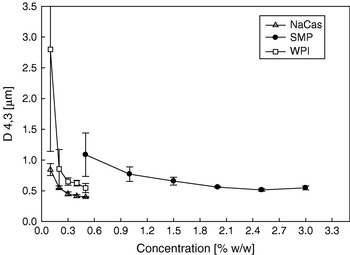
Figure 1 shows that increasing the amount of protein (irrespective of the type of protein) led to a gradual reduction of the average droplet size until a plateau value was reached. However, the amount of protein required to achieve the minimum diameter depended on the type of protein used, in agreement with previous research (Xiong & Kinsella, Reference Xiong and Kinsella1991; Euston & Hirst, Reference Euston and Hirst1999; Dickinson, Reference Dickinson2006). NaCas is a very effective emulsifier, ensuring the stability of the emulsion by means of steric hindrance and charge repulsion (Dalgleish, Reference Dalgleish2006). Whey proteins, although characterized by structures not as flexible as caseins, also effectively stabilize the oil droplets (mostly by providing electrostatic stability) (Dalgleish, Reference Dalgleish2006). The effect of protein concentration on the average droplet size was similar for WPI- and NaCas-stabilized emulsions. In contrast, SMP-stabilized emulsions, in agreement with Euston & Hirst (Reference Euston and Hirst1999), required much more protein to obtain similar droplet sizes. This is because most of the caseins in SMP emulsions are adsorbed at the interface in micellar form, therefore higher surface loads are required to stabilize this emulsion (Fang & Dalgleish, Reference Fang and Dalgleish1993; Euston & Hirst, Reference Euston and Hirst1999).
Fat globule size (D4,3) as a function of protein concentration for emulsions (12·5% AMF) stabilized with NaCas, WPI, SMP.

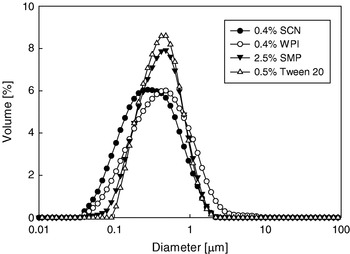
In addition to the fat globule size, the amount of non-adsorbed proteins present in the serum phase of the emulsions may also affect the rheological behaviour of the recombined milks. For this reason, the protein concentration in the emulsions was limited to the amount required to reach the minimum average droplet size. It was then reasonable to assume that most of the protein was adsorbed on the interface and that the contribution of the non-adsorbed protein to the formation of the network was negligible. SDS-PAGE (data not shown) confirmed that most of the protein was adsorbed at the oil interface, because only a small fraction of the total proteins was recovered in the serum phase. As shown in Fig. 1, 0·4% NaCas and WPI, and 2·5% SMP-containing emulsions were chosen for carrying out the renneting experiments on the recombined milks. The fat globule size (D4,3) for these emulsions varied from 0·42±0·02 μm to 0·62±0·05 μm. All emulsions showed a monomodal distribution of droplet sizes as measured by integrated light scattering (Fig. 2).
Particle size distribution profiles of emulsions (12·5% AMF) containing 0·4% NaCas, and WPI, 0·5% Tween 20, and 2·5% SMP.

Rheology
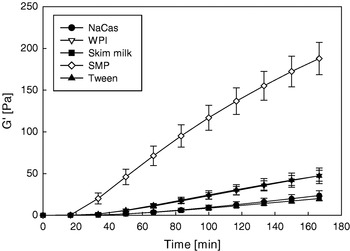
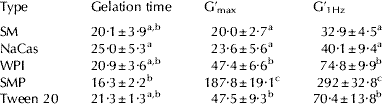
The evolution of the storage modulus (G′) as a function of time after the addition of rennet for recombined milks containing fat globules stabilized with NaCas, WPI, SMP or Tween 20 is shown in Fig. 3. The data is compared with the rheological behaviour of skim milk with no fat globules added. The gelation times determined by the cross-over of G′/G′′ (Table 1) varied from 16·3±2·2 min to 25·0±5·3 min. Statistical analysis (ANOVA) demonstrated that the type of emulsion droplets present in the gel did not have a significant effect on the gelation time (P<0·05). However, the differences in the average gel points of recombined milk containing NaCas- and SMP-stabilized droplets, suggest that NaCas-stabilized droplets may increase the gelation time of recombined milks.
Storage modulus as a function of time for rennet-induced gels containing fat globules stabilized by NaCas (•), WPI (▿), SMP (◊), or Tween 20 (▴). G′ values for skim milk control with no oil droplets (▪) also presented.

Parameters measured during rheology experiments of skim milk (SM) and skim milk with added emulsion droplets stabilized by NaCas, WPI, SMP or Tween 20. Gelation time was determined as a cross-over between G′ and G′′ values; G′max was identified at 160 min from renneting addition; G′1Hz was measured during frequency sweep testing at 180 min at 1 Hz. Results shown are the average of three independent experiments, within the same column, different letters indicate a significant difference at P<0·05
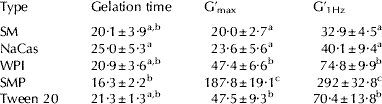
There was a significant difference in the development of gel structure (increase of G′) as well as the final G′ value (G′max) of recombined milks depending on the type of fat globules present (Table 1). SMP-stabilized emulsion droplets caused the highest gel stiffness among the treatments tested. These oil droplets are characterized by an interfacial surface consisting mainly of caseins (in aggregated, micellar form) and small amounts of whey proteins (Sharma et al. Reference Sharma, Singh and Taylor1996). This seems to confirm that SMP-covered fat globules interact with rennet-altered casein micelles, thus enhancing the gel stiffness (Michalski et al. Reference Michalski, Cariou and Garnier2002a). However, the addition of SMP-stabilized emulsion contributes additional protein and enough soluble calcium (Bringe & Kinsella, Reference Bringe and Kinsella1986) to recombined milk to significantly alter the gel stiffness. Therefore, the increase in G′ shown by the SMP sample is caused not only by the ‘active’ contribution of the fat globules' interfacial layer, but also the higher amount of protein and the additional calcium.
While recombined milk containing SMP-stabilized emulsions could not be fully compared with the other treatments, it is important to note that milk with WPI- or Tween 20-stabilized fat globules showed significantly higher G′ values compared with those of the control skim milk with no oil droplets. On the other hand, recombined skim milk containing NaCas-stabilized emulsion droplets showed G′ values comparable to those of the reconstituted skim milk control and lower values than those of recombined milk with WPI- or Tween 20-covered emulsions, suggesting that NaCas-stabilized oil droplets have a negative impact on rennet-induced aggregation. These results have been recently confirmed in a controlled study using NaCas-stabilized oil droplets recombined in fresh, untreated milk (Gaygadzhiev et al. Reference Gaygadzhiev, Alexander and Corredig2009). There was little frequency dependence of all the gels with a slope (log-log scale) ranging from 0·14 to 0·17, suggesting that the overall nature of all gels was similar, and that the gels were formed mainly by casein interactions.
Microstructure
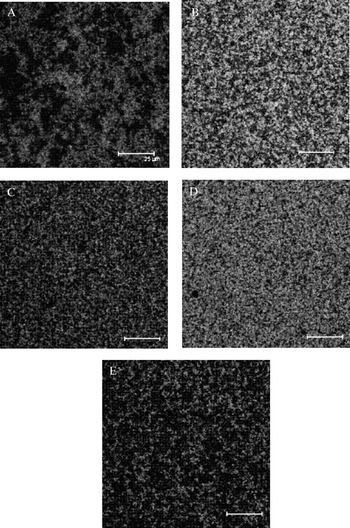
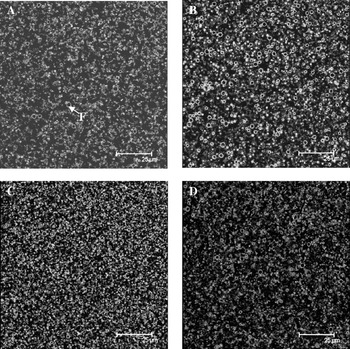
Confocal micrographs of rennet gels containing different recombined milks are shown in Figs 4 & 5. In confirmation of the rheological data of Fig. 3, gels containing SMP-stabilized oil droplets had a very tight gel network, relative to all the other treatments (Fig. 4). The images also suggest that gels containing WPI- or Tween 20-stabilized emulsion droplets had larger pore sizes then gels formed from control milk without added emulsion. When not only the protein network, but also the contribution of the oil droplets was examined (Fig. 5), it appears that WPI- and Tween 20-stabilized fat globules exhibit some degree of flocculation. In contrast, NaCas-stabilized fat globules are more homogeneously distributed within the gel network, relative to all the other treatments. No samples showed phase separation.
Confocal micrographs (casein network stained by FITC is shown) of rennet-induced gels containing fat globules stabilized by NaCas (B), WPI (C), SMP (D), or Tween 20 (E). Confocal micrograph of skim milk control (A) also shown.

Confocal micrographs (casein network and fat globules stained by FITC and Nile Red, respectively) of rennet-induced gels containing fat globules stabilized by NaCas(A), WPI (B), SMP (C), or Tween 20 (D). Confocal micrographs were converted to grayscale mode after replacing the original colour of fat globules with the background colour of the images. F=fat globule.

Discussion
During rennet coagulation, destabilized casein micelles interact with one another and eventually form a continuous network, involving hydrophobic interactions, calcium bridges, and van der Waals attractive forces (Walstra, Reference Walstra1990; Lucey, Reference Lucey2002). Further, there is a positive relationship between the number of cross links in a protein gel and its elastic modulus (G′) at equilibrium (van Kleef et al. Reference van Kleef, Boskamp and Van den Tempel1978). In recombined milk made from reconstituted skim milk powder, the onset of the second phase of rennet coagulation was independent of the type of oil droplets present. The G′max value in the reconstituted skim milk control represents the overall contribution of casein micelles to the viscoelastic properties of the rennet gels. The presence of fat globules in addition to casein micelles will lead to different rheological properties of the resulting gels, depending on how these dispersed particles participate in the casein micelle network.
Xiong & Kinsella (Reference Xiong and Kinsella1991) reported that fat globules stabilized by the non-ionic surfactant Tween 20 are passive fillers and do not interact with the casein micelles. The current rheological experiments, however, demonstrated that Tween 20- and WPI-stabilized fat globules significantly increased G′ compared with the skim milk sample. A possible explanation of the observed higher G′ values may be found in the state of oil droplets in these systems. This speculation is supported by the results of Sala et al. (Reference Sala, Van Aken, Cohen Stuart and Van de Velde2006) on the contribution of droplet flocculation to the increase of G′ in milk gels. Confocal micrographs (Fig. 5) clearly demonstrate the presence of coalesced fat globules in gels containing Tween 20- and WPI- stabilized fat globules compared with the sample with NaCas-emulsified oil droplets.
On the other hand, the development of G′ of recombined milk containing NaCas-stabilized fat globules was comparable to that of skim milk with no added oil droplets. This behaviour is very different in rennet-gels compared with acid-induced gels (van Vliet & Dentener-Kikkert, Reference van Vliet and Dentener-Kikkert1982; Cho et al. Reference Cho, Lucey and Singh1999). The gelation process was inhibited by the presence of NaCas (Gaygadzhiev et al. Reference Gaygadzhiev, Alexander and Corredig2009). The adsorbed caseins could provide additional stabilization to the oil droplets and hinder the aggregation of casein micelles and the onset of gelation. It is also important to note that the presence of NaCas may alter the ionic equilibrium of recombined milk, and a smaller amount of free calcium present in the recombined milk may affect the stiffness of the gel network.
In addition, rearrangements of the interfacial material when the emulsion droplets are mixed with milk may also need to be considered, as displacement or co-adsorption may occur on the oil droplets, changing the interactions between oil droplets and caseins.
In contrast to NaCas-stabilized emulsion, SMP-stabilized oil droplets strongly affected the gelation characteristics of the recombined milk. During homogenization, milk fat globules are enrobed by the proteins present in the reconstituted skim milk powder. The resulting surface layer on the fat globules consists mostly of casein micelles or micellar fragments, and whey proteins (Sharma et al. Reference Sharma, Singh and Taylor1996; Tosh & Dalgleish, Reference Tosh and Dalgleish1998). Thus, ‘interfacial’ casein micelles would be attracted to each other and to other destabilized casein micelles. The resultant gel would also be strengthened by the higher ionic strength in recombined milk containing SMP-stabilized fat globules compared with the other treatments. These findings are in agreement with previous reports that SMP-stabilized oil globules could participate in the network formation of both rennet- and acid- induced milk gels (Cho et al. Reference Cho, Lucey and Singh1999; Michalski et al. Reference Michalski, Cariou and Garnier2002a).
Conclusions
This paper describes the impact of various emulsion droplet types on the viscoelastic properties of rennet gels made from recombined milk. Previous research has attributed the differences in the rheological and microstructural properties of filled gels to the affinity of fat globules' interfacial layer to contribute to the formation of the gel matrix. The present results clearly demonstrate that in addition to the fat globules interfacial properties, the colloidal state of the fat globules as well as the ionic equilibrium in recombined milk should also be considered.
This work has been partly funded by the Ontario Dairy Council and the Natural Sciences and Engineering Research Council of Canada (Industry Research Chair program in dairy technology).