An upheaval in excess of perspective
‘What is the “Object” of archaeology?’ (Hodder Reference Hodder1999, 9). ‘What actions in the past created the residues which I see before me today?’ (Barrett Reference Barrett1994, 4). ‘Is the past “knowable” or is its study just “do-able”?’ (Bintliff Reference Bintliff and Bintliff2006, 397). Around the turn of this century, such questions were met with a range of answers that, in retrospect, we now recognize to have been part of the problem, but for increasingly diverse reasons. Did their tenets rest upon a prefabricated bifurcation of past and present, or of thinking and doing, as if this distinction constituted a fundamental ontological rift? Was the creative power of humanity assumed to lie behind those residues from antiquity, or was this simply held to be the highest possible expression of those fragments’ integrity? Was the object of archaeology something that only existed within a ‘tradition of inquiry’, or could that ‘object’ serve as a common concern for diverse practitioners otherwise immured within their own specialist bubbles? Whatever the answer, none could qualify as truly ‘posthuman’—the adopted concept which this special section aims to debate—so long as it failed to recognize how it is that non-humans stubbornly rebuff human assertions more often than they abide them.
Well before turn of the century, it had become apparent that archaeology's ambition to study the past had developed, true to the modern project, into a pretext for a deeper desire to fabricate its objects. Material culture, materiality, the material past, material residues and, yes, heritage—the objects of processual and interpretive or post-processual archaeology could only be characterized as a continuation of this modern project. By apprehending what had become of causewayed enclosures, abandoned surfaces, or buried mudbrick walls as monuments from antiquity, as vestiges of social action, as conduits to past practices, as sites of knowledge construction in advance, archaeology ensured that its objects were fashioned to revolve around the discipline, rather than the discipline around its objects. Any gestures to ring ditches, earthen floors, or mudbricks in their own right proved to be but half-measures, for whatever special qualities such objects may have possessed could only have been accorded to them by people, whether archaeologists or those billions of anonymous strangers who have passed into thin air. Architectures were canvases invested with past meanings; monuments were receptacles saturated with social memories; figures in rock art were representative expressions of anything other than themselves—archaeology's objects were considered to be ‘of the past’ from the start, and any concern with their reality as actual entities here in the present proved to be secondary, at best. Patent was an asymmetry between a past that was active and an archaeological record which is passive.
Certainly, there were those within the interpretive camps of archaeology who challenged the firm separation between the past, taken to be those lived moments, those day-to-day practices akin to res gestae [things done], that with every passing instant receded deeper into that dark abyss, and the present, where archaeologists worked on the material residues of those increasingly distant erstwhile practices (e.g. Barrett Reference Barrett1994, 96). The archaeological past was, to be sure, encountered in the present (Shanks Reference Shanks1992). Yet it was not enough to call out an onto-taxonomy of past and present with its Platonic rendering of archaeological objects as shadow figures cast on the cave wall, for the telos of archaeological work continued to be confused with the beginning (Witmore Reference Witmore, Mircan and van Gerven Oei2015; Reference Witmore, Blaising, Driessen, Legendre and Olivier2017a; Reference Witmore2018). Thus, while elsewhere archaeologists maintained the image of a luminous past set apart from the present, those who recognized the past as scenarios explained or imagined, stories told, memories, whether voluntary or involuntary, held by abandoned surfaces, what has become of walls, ruins and forms encased in earth, firmly set within the present, nonetheless reduced these things to a past, to an aspect of memory, as if they had gained their reality from elsewhere. Between these two extremes, archaeology's objects were maintained foremost as conduits to human behaviours, intermediaries to community practices, liaisons to social action, and non-humans were left without a stake in this operation. With the realization that our objects, which upheld the very possibility of the past, had been marginalized and forgotten (Olsen Reference Olsen2003), deep cracks began to form at the foundations of archaeology and new problems began to make themselves known.
Even the most casual survey of archaeological examples from before and after the year 2000 will turn up marked differences between this older, telocentric archaeology and what now emerges, among other ‘posthumanist’ perspectives, as a more object-oriented disposition. For all our concern with archaeological fieldwork, as one recalls, we continued to turn our attention back upon the ‘knowing subject’ by reflexively sorting through the interpretive baggage that archaeologists brought to the encounter, whether along the path or at the trowel's edge (Andrews et al. Reference Andrews, Barrett and Lewis2000; Hodder Reference Hodder1999; Thomas Reference Thomas and Bintliff2004). By locking the archaeological process into the realm of epistemology, as one recalls, we inadvertently continued to exaggerate a ‘discrepancy between self-representation and practice’ (Latour Reference Latour2003, 38), firmly within the human-world correlate. And yet what we needed was viable examples of how archaeology is about more than the construction of knowledge. We needed to change the composition of a dramaturgy that remained distorted and oversimplified with its limited cast of talkative protagonists. Thus, after the turn of the century, we began to develop not only a more sophisticated understanding of what it is that archaeologists do, but also a deeper appreciation of the roles played by non-human things, with a way of apprehending archaeological labour that recognized what all mediators, human and otherwise, had to offer. In the course of whittling away at what amounted to a ‘thing-blindness’ on the part of archaeologists—who ironically spent so much of their time purportedly studying ‘things’—an intellectual kinship was forged with science studies and new insights into archaeological work began to enrich the picture of disciplinary achievements (Webmoor Reference Webmoor, Graves-Brown, Harrison and Piccini2013). Maps showed themselves to make a difference in what we see and how we see (Witmore Reference Witmore2006; also Gillings et al. Reference Gillings, Hacıgüzeller and Lock2018). Cameras and photo matting revealed their contributions to the introduction of hygienic practices in excavation (Olsen et al. Reference Olsen, Shanks, Webmoor and Witmore2012, 50–53). By sorting objects into rooms, galleries, corridors and cases, museums continued to uphold linear itineraries through time, whether or not anyone acknowledged it (Olsen et al. Reference Olsen, Shanks, Webmoor and Witmore2012, 43–7; Witmore Reference Witmore2020a, 305–13).
In the nearly two decades that have passed since the call for a more symmetrical archaeology (Olsen Reference Olsen2003), non-human objects have gained increasing shares as disciplinary actors. It no longer sounds strange in 2007 to state how Roman ditches not only hold memory but also imprint their form onto the French countryside (Chouquer Reference Chouquer2007; Olivier Reference Olivier and Greenspan2011). It no longer rings with controversy to assert how the columned hall is just as decisive in sustaining Achaemenid sovereignty as are political power-brokers of the human kind (Khatchadourian Reference Khatchadourian2016). One need not enter into a digression on Kant, Deleuze, or Whitehead, to understand how olive roots maintain the form of a terrace long after it has relinquished its girdle of stone or how the buried foundations of temples to gods yet to be renamed press upwards from below an early monastery in old Corinth (Witmore Reference Witmore2020a, 37–53). By acknowledging how non-human things make a difference, which is a baseline definition of agency (Olsen & Witmore Reference Olsen and Witmore2015), we recognize how they do something here and now. Still, this was but a start. As with any science, archaeology must struggle to define what it holds to be fundamental entities. Such a commitment obliges its practitioners to build some consideration of how those entities exist into their scrutiny of them. This is what establishes archaeology's groundwork. Still, giving our objects their due is more than an exercise in switching vocabularies or expanding awareness, for by confronting how things are the very media that make the past possible, we come to recognize how an erstwhile cause is an effect of the object that is present, not the other way round. It is from here that we work towards the possibility of other pasts. It would not be inappropriate to describe this inversion as an upheaval in excess of all former archaeological perspectives.
Agile approaches alongside things
Among the most distinctive features of recent object-oriented approaches in archaeology (those, often erroneously, grouped together under the broad label of ‘symmetrical’),Footnote 1 notwithstanding differences of ontology and metaphysical commitment, is the positive weakness of their theory (Lucas & Witmore Reference Lucas and Witmoreforthcoming; Pétursdóttir & Olsen Reference Pétursdóttir and Olsen2018). This feature stands in contrast to those theories, so familiar within post-processual archaeology, where the configuration of a given situation is set out in advance. With such ‘strong’ theories, the ingredients needed to make sense of an archaeological example are supplied at the outset, for through application one gains the advantage of what is, in effect, a preordained picture as to what comes next. Because these theories subsume the idiosyncrasies and differences of a given situation to their own excesses, they are appropriately labelled as ‘strong’ (see Pétursdóttir & Olsen Reference Pétursdóttir and Olsen2018, 9–10). Yet, for archaeologists who place trust in things to open thought in their direction, who are willing to relinquish their motives and preconceptions in the face of things, theory cannot predetermine what comes next. If one is to articulate something of the past alongside things, then one must approach each step with an agnostic disposition, with a strategic naïveté, aided by pliant cues that offer minimum resistance. Thus, at variance with strong theories of application, weak theory operates with but soft guidelines, for the aim is to be as subtle as the situation at hand (also see Latour Reference Latour2005). Given the importance of these cues for attuning one to how things open the possibility of the past, their past, let us briefly enumerate some of them here, keeping in mind that, given the constraints exacted by a short article, this list is far from exhaustive.
First, one should not infer the meaning of ‘thing’ or ‘object’ equipped with old Cartesian definitions. Neither term has an opposite. While embracing things has always been a matter of recomposition, what initially began with mixtures over subjects and objects held in radical opposition was part of a reassessment of the taxonomic tendency to sort entities into two separate realms before the hard work of understanding even began (Witmore Reference Witmore and Smith2020b). Recomposition is not a matter of extension, as if formerly buried surfaces, ruined aqueducts, emptied tombs are now permitted human-like qualities they formerly lacked; it involves a radical reconceptualization of things as any entities with a composite reality that draws upon a variety of occasions, and yet exceeds any and all of them. Likewise, an object may take on the Latin sense of objectum as an obstruction, as that which is exposed, thrown, or cast before anything else, but an object also eclipses this action. Both terms, thing and object, serve to evoke, in the vein of Object-Oriented Ontology, any autonomous entity that cannot be broken down into its parts or reduced to its effects (Harman Reference Harman2018). Notwithstanding the conventional sense of archaeological objects as megaliths, middens, or media, one must also be prepared to regard the goddess Aphrodite, marsh vapours, or psycho-political commitments to the polis as things, for to elevate the former over the latter is to presume an ontological rift between praxis and theory, doing and thinking. Why? Because there is no reason to assume that practical exploits will bring archaeologists any closer to things than theoretical concerns. Reading Pausanias's description of Hermion is no less a way of dealing with the ancient polis than cataloguing remains on the Bisti; of course, to challenge this fallacious reflex of metaphysical taxonomy is not to deny the otherwise substantial differences between reading a text and surveying a wooded headland.
If the first principle of symmetry sought to treat truth and falsity in the same terms, then the generalized version aspired to do the same with society and nature (Callon Reference Callon1984). No longer would actors only be of the human variety, for one would now ask what cameras, theodolites and maps, what polygonal walls, concrete bunkers, or bits of ceramic contribute to the archaeological project. Symmetry simply reminds one not impulsively to allot a disproportionate share to some entities at the expense of others without first putting in the requisite work to determine whether it is warranted. This also holds for the presumption of idiosyncratic being over interactions with other entities, or vice versa. What some commentators have described as a second wave of symmetrical archaeology (Harris & Cipolla Reference Harris and Cipolla2017, 187) is actually a fuller realization of symmetry, as one does not assume relational interactions to hold unifying primacy over the integrities of objects (Witmore Reference Witmore and Smith2020b).
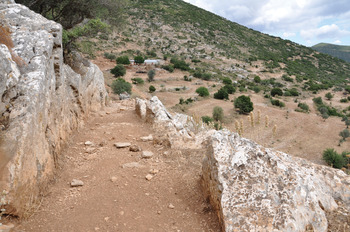
Thirdly, if both relations and integrities are held in symmetry, then things are neither reducible down to their components, nor up to their effects (Harman Reference Harman2018, 43). The historical aqueduct is irreducible to its source on the southwest slopes of Ziria, its rock-cut tunnels, mortar-lined specus, bricks, those water molecules that rush along its 81 km course, or the sum of these things, for it reorients the flow of waters from the gulf of Argolis to the Sea of Corinth (Witmore Reference Witmore2020a, 123–33). The historical aqueduct exceeds how it was expressed in the moment of delivering waters to Roman Corinth or the patronage of the emperor Hadrian, for it also offers itself to those farmers who may have illicitly tapped into its line in the Platani Valley, and their crops. Likewise, the ruins of the Hadrianic aqueduct are irreducible to their pasts, for in upholding the paths of shepherds and sheep they teem with a surplus in excess of how archaeologists or historians encounter them (Fig. 1).Footnote 2 Irreduction reminds one how things must be more than what they are for other entities; more than what they might have been in their past.
Shepherds’ path and section of the former Hadrianic Aqueduct, Ntourmiza, Greece, June 2010. (Photograph: Author.)

One can infer from the emphasis on how things give rise to their own idiosyncratic pasts a very different manner of causation, for if the things present are what make pasts, including processes, possible, then the past is not situated as an authentic and privileged bedrock in a resultant, causal relation to what is present. Causation, therefore, is emergent (Witmore Reference Witmore, Knodell and Leppard2017b). Emergence specifies how objects, whether a Roman cavalry fort on Dere Street, an altar dedicated to Fortuna Redux, or the veteran Eltaominus, exceed the components that gave rise to them. Once formed through mergers with other objects, forts, altars and veterans retroactively define their ingredients, as well as their own morphogenetic histories (see DeLanda Reference DeLanda2006; also Crellin Reference Crellin2020). After leather sandals are fully consumed by bacteria, new soils emerge and enter into their own chthonic adventures with those iron hobnails that remain. No longer derivative of intentional humans, historical processes, or heterogeneous entanglements, stone altars, buried rooms, or accumulated lenses of fill now share the stage as generative components in the articulation of pasts.
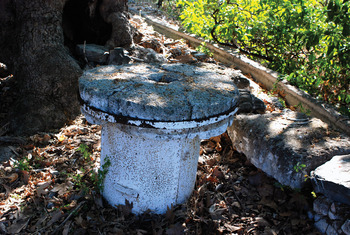
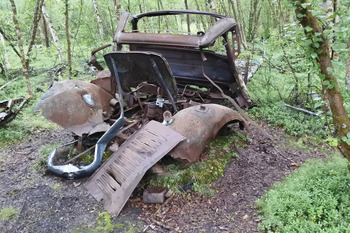
Still, how is it that some things call to archaeologists and not others? Archaeologists do not confront the world without the literature, education, or experience that serve to precondition an encounter. It may be in the context of a larger project of regional synthesis that a grinding stone raised as a table stands out from its background by a ruined mill in Troizen (Fig. 2). It may be in the course of visiting an abandoned German field hospital that the rusted shell of a German cargo truck calls out from the forest near Skoganvarre, Porsanger (Fig. 3). Strangeness is not a difference brought to these things by the archaeologist, but an aspect of the objects confronted, for the grinding-stone table and the rusting chassis bring their own idiosyncratic otherness and alien aspects to the encounter (Pétursdóttir Reference Pétursdóttir, Olsen and Péturdóttir2014). Strangeness may accrue when a watermill is left to its own self-maintenance, when a grinding stone outlasts the miller's tendance, or when a rusty chassis keeps on in radical variance with the forest of its repose. Though mill, table-top and chassis are without their former completions, they nonetheless linger. They perturb because they are feral, because they do not fit, because they are unburdened by the weight of value or purpose (Farstadvoll Reference Farstadvoll2019). The fact that such things are here stands as proof that they surpass those powers they formerly upheld.
Grinding-stone table, Troizen, Greece, July 2008. (Photograph: Author.)

German cargo-truck chassis, Skoganvarre, Porsanger, Norway, August 2017. (Photograph: Author.)

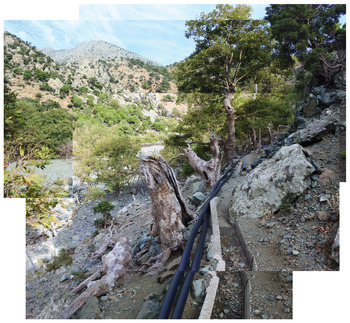
It should be somewhat evident, from the foregoing soft hints and guidelines, how object-oriented approaches regard the encounter with, alongside and between objects as the grounds of archaeology. Whether one observes with or without direct intervention, a key question remains: how does one move with individual objects into considerations of their pasts? Objects may hint at their former lives, through a combination of suggestions, positive differences and involuntary memories. Suggestions refer to how things may nudge one into course of action, which is framed within a zone where one is disposed to observe certain angles over others (Olsen & Witmore Reference Olsen and Witmore2015, 194; Witmore Reference Witmore and Smith2020b). Whereas the stone-lined terrace, the ancient plane trees and derelict stretches of water conduit at Xiropotamos beckon an archaeologist, they may simply provide path, shade, or obstacle for a hiker whose attention wavers between secure footing and Samothracian scenery (Fig. 4). Positive differences serve to remind one of the sheer specificity of things (Olsen Reference Olsen2010, 156). For example, the positive difference that a mortar-lined conduit makes for conveying water means that it cannot be replaced by an earthen trench. While the full expanse of the watercourse's past is never to be grasped in its entirety, for it forgets as much as it retains, the watercourse nevertheless holds involuntary memories (Olivier Reference Olivier and Greenspan2011). Plane trees growing along the channel hold memories of an erstwhile mutualism, where the old conduits supplied water to the benefit of the trees while they shored the channel against erosion and slope creep. These enumerated cues hardly scratch the surface of archaeology's engagements with its vast range of objects, but they are perhaps just enough to give one a sense of their contrast to strong theoretical programmes, which tend to skirt over or around the intrinsic attributes of an object (form, material, etc.) in order to flush out extrinsic connections (effects, ends, etc.).
Water conduits at Xiropotamos, Samothrace, July 2019. (Photograph: Author.)

Posthuman pasts as achievements
If, after the long drift in archaeology's object from the past to the material past to things in the present (Harrison Reference Harrison2011), there is to be a viable archaeology (one that exists in more than in name only),Footnote 3 then it is because in beginning with things the field remains committed to the telos of the endeavour—the articulation of pasts (archaioi, the plural form of archaios) that are in service to life. Such an archaeology takes its objects seriously as the very media that make pasts possible. Such an archaeology remains committed to a path where, with each and every step, a practitioner is prepared to hesitate, to place their expectations at risk in light of what their objects suggest, to accept redirection and the possibility of dead ends. Such an archaeology recognizes how arduous, how audacious is the task of trying to explain any object in terms of another. Here, any claims to truth will continue to rest on the recognition that archaeology's practices are grounded in the present encounter; they also will be bound up with questions of fidelity to any given object and to the traceability of the steps taken to arrive at a telos that opens towards literature, film, archives, exhibitions, archaeological sites, exposed, exhibited, consolidated, or left to their own. To what end?
With the modern project of accumulation, the accelerating train of knowledge advances with ever more detail in order to generate a comprehensive picture of the past. Whatever we now make of the necessity of this endeavour, it can bring us no closer to our objects, which will always exceed our attempts to come to terms with them. Thus, the cumulative project demands its complement, which is a connective project whose relevance arises in its service to the lives we are learning to live. It is here that archaeology both maintains its long-standing rationale and, following in the vein of object-oriented approaches, aspires to more idiosyncratic, more creative, more compelling compositions that develop out of the archaeological encounter (Farstadvoll Reference Farstadvoll2019; Pétursdóttir Reference Pétursdóttir, Olsen and Péturdóttir2014; Witmore Reference Witmore2020a). While it is certainly the case that decidedly more original archaeological narratives lie before us—as they do not appear as another case study in the application of theory X—archaeologists have long produced more than descriptive accounts, more than catalogues, more than literary prose surfaces. Imaginative digital exhibitions may arise through the juxtaposition of photos historical and contemporary to connect with descendant communities. Vibrant visual displays of chthonic underworlds may ensue from geophysical engagements with subterranean forms to arouse wonder in those who routinely walk those grounds. Marvelous megalithic information henges may be raised to draw other-than-recreational communities to follow formerly forgotten indigenous paths through the understories of Pisgah National Forest. An exhibition of drift matter may evolve out of a survey of beaches in Arctic Norway to inform the public about what becomes of plastic waste. An open-air museum may become another stage in the metamorphosis of a pasture turned dump turned Roman bathhouse at Binchester in order to draw out the lessons of change. With every example one may aspire to stay with, to struggle alongside, their objects and work creatively towards exposing the utter specificities of each unique situation and its relevance to life.
Are we to label emerging object-oriented approaches as ‘posthumanist’? If Posthumanism is taken less as a blurring of the unified human subject into cyborgs or holobionts and more as a pluralization of the ways entities non-human and human apprehend the world (Bryant Reference Bryant2012), then the answer is clearly, yes.Footnote 4 They could be construed as forms of Posthumanism on the grounds that they no longer privilege human modes of engaging and observing the world, but rather endeavour to explore those legion other rapports among and between non-human entities. They could be construed as posthumanist through their radicalization of not merely agency, but also perspective, with the pluralist recognition that each and every entity, whether human or non-human, encounters the world in its own unique way (Farstadvoll Reference Farstadvoll2019). From this angle, the litmus test for whether or not an archaeologist is a card-carrying posthumanist is therefore fairly straightforward, for it comes down to whether or not one is as comfortable articulating how the roots of plane trees maintain the form of a water conduit as they are discussing the labours of those masons who constructed the concrete channel in 2000; whether or not one is as confident elaborating the post-abandonment of a cargo truck as they are the circumstances of its use; whether or not one is as concerned with the post history of a millstone as they are with its maker(s); whether or not one is as interested in exploring the breakdown of an aqueduct through the unmitigated turbulence of waters as they are illicit tappings by agrarians.