Introduction
Attention-deficit/hyperactivity disorder (ADHD) is among the most common psychiatric disorders of childhood (Polanczyk et al. Reference Polanczyk, de Lima, Horta, Biederman and Rohde2007) and is associated with increased risk for subsequent drug use and drug abuse (DA) (Kessler et al. Reference Kessler, Adler, Barkley, Biederman, Conners, Demler, Faraone, Greenhill, Howes, Secnik, Spencer, Ustun, Walters and Zaslavsky2006; Faraone & Wilens, Reference Faraone and Wilens2007). These results are consistent with evidence that behavioral disinhibition and/or impulsivity, common symptoms in individuals with ADHD, are themselves important risk factors for future DA (Iacono et al. Reference Iacono, Carlson, Taylor, Elkins and McGue1999; Kollins et al. Reference Kollins, McClernon and Fuemmeler2005; Elkins et al. Reference Elkins, McGue and Iacono2007; Urcelay & Dalley, Reference Urcelay and Dalley2012).
Both ADHD (Levy et al. Reference Levy, Hay, McStephen, Wood and Waldman1997; Nadder et al. Reference Nadder, Silberg, Eaves, Maes and Meyer1998; Polderman et al. Reference Polderman, Derks, Hudziak, Verhulst, Posthuma and Boomsma2007; Asherson & Gurling, Reference Asherson and Gurling2012; Larsson et al. Reference Larsson, Chang, D'Onofrio and Lichtenstein2014) and DA (Tsuang et al. Reference Tsuang, Lyons, Eisen, Goldberg, True, Lin, Meyer, Toomey, Faraone and Eaves1996; Merikangas et al. Reference Merikangas, Stolar, Stevens, Goulet, Preisig, Fenton, Zhang, O'Malley and Rounsaville1998; Kendler et al. Reference Kendler, Karkowski, Neale and Prescott2000) are strongly familial with a large proportion of the familial aggregation resulting from genetic factors. Prior twin studies have suggested a sharing of genetic risk factors between ADHD traits, and drug use and DA (Young et al. Reference Young, Stallings, Corley, Krauter and Hewitt2000; Hicks et al. Reference Hicks, Iacono and McGue2012; Kendler & Myers, Reference Kendler and Myers2013). Of note, studies in Sweden have suggested that twin and sibling resemblance for DA is a result of both strong genetic effects as well as important shared environmental influences (Kendler et al. Reference Kendler, Maes, Sundquist, Ohlsson and Sundquist2013a , Reference Kendler, Ohlsson, Sundquist and Sundquist b , Reference Kendler, Ohlsson, Sundquist and Sundquist c ), while ADHD has been shown to be highly heritable with no significant familial–environmental effects (Larsson et al. Reference Larsson, Chang, D'Onofrio and Lichtenstein2014). Furthermore, cannabis and other drug dependence in parents is associated with a substantially increased risk of ADHD in offspring (Marmorstein et al. Reference Marmorstein, Iacono and McGue2009).
We have shown, using both a standard adoption design (Kendler et al. Reference Kendler, Sundquist, Ohlsson, Palmer, Maes, Winkleby and Sundquist2012) and extended adoption-like samples of not-lived-with parents, step-parents, and triparental families (Kendler et al. Reference Kendler, Ohlsson, Sundquist and Sundquist2015a , Reference Kendler, Ohlsson, Sundquist and Sundquist b ), that the risk for DA is transmitted across generations as a result of both genetic and rearing effects. That is, the risk for DA is increased in the offspring both of biological parents with DA who do not rear their children and of adoptive or step-parents with DA.
In this report, we follow-up on earlier within-generation twin studies of DA and ADHD to examine, for the first time to our knowledge, the cross-generational transmission for DA in parents to ADHD in their children and to determine the degree to which this arises from genetic v. rearing effects. Given prior evidence from twin designs, we predict that we will find evidence for cross-generational genetic transmission from DA in parents to ADHD in their offspring. Our expectations are less clear for cross-generational rearing effects. The absence of shared environmental effects for ADHD in Sweden (Larsson et al. Reference Larsson, Chang, D'Onofrio and Lichtenstein2014) might suggest that being reared by a parent with DA would not produce an increased risk for ADHD. However, such an effect is plausible because DA in parents may increase the risk for marital dysfunction and divorce which in turn is associated with the probability of ADHD in offspring (Modesto-Lowe et al. Reference Modesto-Lowe, Danforth and Brooks2008; Wymbs et al. Reference Wymbs, Pelham, Molina, Gnagy, Wilson and Greenhouse2008).
Method
We collected information on individuals from Swedish population-based registers with national coverage, and registers were linked using each person's unique personal identification number. In order to preserve confidentiality this ID number was replaced by Statistics Sweden by a serial number. Several sources were used to create the database: the Total Population Register; the Multi-Generation Register; Swedish Hospital Discharge Register; Swedish Prescribed Drug Register; Outpatient Care Register; Primary Health Care Register; Swedish Crime Register; Swedish Suspicion Register; Swedish Mortality Register; and the Population and Housing Censuses. We secured ethical approval for this study from the Regional Ethical Review Board of Lund University (no. 2008/409).
The outcome variable of interest, ADHD, was identified in the Hospital Discharge Register and the Outpatient Care Register by International Classification of Diseases (ICD) codes (ICD-8: 308.3; ICD-9: 314; ICD-10: F90). ADHD was also identified in individuals in the Prescribed Drug Register who had picked up any prescription for stimulants [Anatomical Therapeutic Chemical (ATC) Classification System codes N06BA01, N06BA02, N06BA04 and N06BA09]. The ADHD diagnosis could be registered at any time.
DA was identified in the Swedish medical and mortality registries by ICD codes [ICD8: drug dependence (304); ICD9: drug psychoses (292) and drug dependence (304), non-dependent abuse of drugs (305; excluding 305.0); ICD10: mental and behavioral disorders due to psychoactive substance use (F10–F19), except those due to alcohol (F10) or tobacco (F17)]; in the Suspicion Register by codes 3070, 5010, 5011 and 5012, that reflect crimes related to DA; and in the Crime Register by references to laws covering narcotics (law 1968:64, paragraph 1, point 6) and drug-related driving offenses (law 1951:649, paragraph 4, subsection 2 and paragraph 4A, subsection 2). DA was identified in individuals (excluding those suffering from cancer) in the Prescribed Drug Register who had retrieved (on average) more than four defined daily doses per day for 12 months from either of hypnotics and sedatives (ATC Classification System N05C and N05BA), or opioids (ATC: N02A).
Sample
The database was created by entering all individuals in the Swedish population born in Sweden between 1980 and 1995 (N = 1 671 354). Furthermore, we required that the individual was living in Sweden at the age of 15 years and had both parents registered in the Multi-Generation Register. From this database, we defined seven kinds of families: (1) intact families: individuals who, during ages 0–15 years, were residing 15 years in the same household as mother and father; (2) triparental father families: individuals who, during ages 0–15 years, were residing ⩾15 years in the same household as their mother, never residing in the same geographical area as their father, and residing at least 10 years in the same household as their stepfather; (3) not-lived-with father families: individuals who, during ages 0–15 years, were residing ⩾15 years in the same household as their mother and never resided in the same household or geographical area as their father, and the family could not be included in the triparental family sample; (4) not-lived-with mother families: individuals who, during ages 0–15 years, were residing ⩾15 years in the same household as their father and never resided in the same household or small area as their mother; (5) stepfather families: individuals who, during ages 0–15 years, were residing ⩾15 years in the same household as their mother and had a stepfather residing ⩾10 years in the same household, and the family could not be included in the triparental family sample; (6) stepmother families: individuals who, during ages 0–15 years, were residing ⩾15 years in the same household as their father and had a stepmother residing ⩾10 years in the same household; (7) adoptive families: individuals who had been adopted prior to the age of 10 years, with information available on both adoptive parents and at least one biological parent. Individuals adopted by biological relatives or by an adoptive parent living with a biological parent were excluded. We do not know exactly the time of placement in the adoptive family.
Household was defined as follows. For 1980 and 1985 we used householdID from the Population and Housing Census. The householdID includes all individuals living in the same dwelling. For the years (1981–1984) we did not have information, we approximated the householdID with the information from the year closest in time. From 1986 and onwards (every year) we used the FamilyID from the Total Population Register. The FamilyID is defined by individuals that are related or married, and who are registered at the same property (a person can only be part of one family). In addition, adults who are registered at the same property and have common children, but are not married, are registered in the same family. Geographical area was defined as Small Areas for Market Statistics (SAMS) that are small geographical units defined by Statistics Sweden, the Swedish government-owned statistics bureau. There are approximately 9200 SAMS throughout Sweden, their average population being about 1000.
Stepfathers or -mothers were defined as an individual 18 to 50 years older than the offspring who lived in the same household as the offspring and was not a first-, second- or third-degree biological relative. This means that, from 1986 and onwards, for an offspring living with his/her mother (father), we only capture the stepfather (mother) if he (she) is either married with the mother (father) of the offspring and/or has a common child together with the mother (father) of the offspring.
In the first approach we used Cox proportional hazards models to investigate the future risk for ADHD in offspring as a function of presence of DA in the three types of parents (rearing + biological, biological only and rearing only). Robust standard errors were used to adjust the 95% confidence intervals (CIs) as there were some full-sibling pairs included in the analysis. Follow-up time in number of years was measured from year of birth of the child until year of first registration for ADHD, death, emigration or end of follow-up (year 2011), whichever came first. In all models the proportionality assumption was met. All statistical analyses were performed using SAS 9.3 (USA).
We then, to each of the family types, fitted a path model, in which we modeled unidirectional paths (single-headed arrows) from each of the different parental figures in the families to the offspring and also the correlation between the parental figures in each family [double-headed arrow(s)]. ADHD was treated as a dichotomous variable with the assumption of an underlying normal liability distribution, and since each family was treated separately different thresholds were used. Of note, we include the biological father in the stepfather families for completeness so as to correctly model the spousal resemblance but do not include results from that relationship in our analyses because such fathers would have had variable rearing relationships with their offspring. The same would be true for biological mothers in stepmother families and the step-parents that were sometimes present in the not-lived-with father and mother families.
As a family could consist of several offspring from the same parents, each family was treated as a cluster in the analysis. We present the standardized path-coefficient for each of the unidirectional paths (equivalent to a tetrachoric correlation) and the estimated correlations between the different parental figures. Model fitting was done using Mplus version 7.2 with the theta parameterization and the weighted least squares mean and variance adjusted (WLSMV) as the fit function.
In order to combine the results from the different samples, we used the Mantel–Haenszel meta-analysis method. We calculated the combined correlations and the p values for the heterogeneity tests.
Results
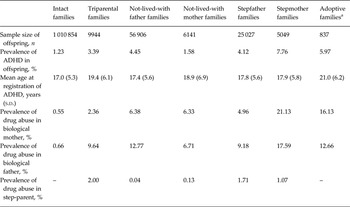
The sample size and prevalence rates for DA in parents and ADHD in offspring from our six family types as well as from intact families (shown here for comparison purposes only) can be seen in Table 1. The largest sample sizes (aside from intact families) were seen with not-lived-with father and stepfather families. In the offspring generation, rates of ADHD differed nearly five-fold across family types, being lowest in intact and not-lived-with mother families, and highest in the stepmother and adoptive families. Rates of DA in the parental generation differed over 20-fold in both biological mothers and fathers, with the highest rates seen in stepmother and adoptive families, and much lower rates in the intact families. Rates for DA were consistently low in step- and adoptive-parents.
Sample size and prevalence rates for drug abuse in parents and ADHD in offspring from seven family types

ADHD, Attention-deficit/hyperactivity disorder; s.d., standard deviation.
a Number of adoptive fathers = 754 and adoptive mothers = 754. Prevalence of drug abuse in the adoptive parents was 0.96% in adoptive fathers and 0.84% in adoptive mothers.
Tetrachoric correlations for DA among the parents of the non-adoptive and adoptive family types can be seen in Appendix Tables A1 and A2. The correlations were widely variable and were generally higher between biological parents than between biological and step-parents. In the adoptive families, correlations were relatively high in biological mothers and fathers and adoptive mothers and fathers, and considerably lower between biological and adoptive parents.
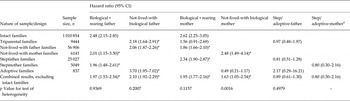
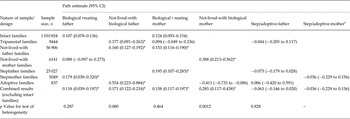
We analysed the association between DA in parents and ADHD in children in two ways. First, in Table 2, we examined hazard ratios (HRs) assessed using Cox regression models. Second, in Table 3, we utilized path analysis. In both tables we present, for comparison only, results in intact families. Results are then presented for each of our six informative family types individually, and then we combined results across the family types and provide a heterogeneity test.
Hazard ratios from Cox regression analysis for ADHD in offspring as a function of drug abuse in biological and step-parents

ADHD, Attention-deficit/hyperactivity disorder; CI, confidence interval.
a There were too few adoptive mothers with drug abuse to obtain meaningful estimates.
* Significant effects in special familie (p < 0.05).
Path estimates for the transmission of liability to ADHD in offspring from drug abuse in parents from seven different family types in a Swedish national sample

ADHD, Attention-deficit/hyperactivity disorder; CI, confidence interval.
a There were too few adoptive mothers with drug abuse to obtain meaningful estimates.
* Significant effects in special families (p < 0.05).
Using Cox models (Table 2), the risk for ADHD is significantly increased in the offspring of all categories of biological parents. More specifically, the HR for ADHD is approximately doubled in the offspring of fathers with DA and was slightly higher in not-lived-with v. biological + rearing fathers. The results were slightly less robust in mothers and here transmission was slightly stronger from the biological + rearing v. not-lived-with mothers. Of the five heterogeneity tests across family types, only one was significant – driven by the anomalous finding that DA in biological mothers in the adoption sample non-significantly reduces offspring risk for ADHD.
Of note, risk for ADHD from non-rearing biological fathers was modestly greater than that seen from non-rearing biological mothers. However, the most striking findings were the lack of evidence for increased risk for ADHD in offspring of step/adoptive parents with DA.
The analyses presented in Table 2 were re-run correcting for parental education and sex with only modest changes, typically a slight attenuation of the observed HR.
When we utilized path analysis which included in the model spousal resemblance (Table 3), the broad pattern of results was similar except that now in both mothers and fathers, the combined results suggested that DA → ADHD transmission is slightly stronger from not-lived-with than from biological + rearing parents. Again, we find no evidence for significant transmission of DA in step/adoptive parents to ADHD in offspring. However, one finding differs substantially from that seen using Cox models. Although known quite imprecisely, the aggregate path estimate from DA in parent to ADHD in offspring is now greater from non-rearing biological mothers than from non-rearing biological fathers. This led us to test statistically whether the DA → ADHD transmission from non-rearing biological mothers and fathers differed. We could reject this hypothesis using both Cox (p = 0.27) and path models (p = 0.20).
Discussion
In a prior study using the same set of informative families, we showed that the cross-generational transmission of DA involved both genetic and rearing effects (Kendler et al. Reference Kendler, Ohlsson, Sundquist and Sundquist2015b ). Evidence for rearing effects was demonstrated in two ways. First, parent–offspring resemblance for DA was stronger for parents who provided both rearing and genes than those who provided genes only. Second, and more directly, we found evidence for significant cross-generational transmission of risk for DA from adoptive and step-parents.
In this paper, we utilized the same design to examine the nature and causes of the cross-generational transmission of DA in parents to ADHD in their offspring. Prior within-generation twin studies had suggested that the co-morbidity between drug use and/or DA and ADHD diagnosis or traits was substantially influenced by genetic factors (Young et al. Reference Young, Stallings, Corley, Krauter and Hewitt2000; Hicks et al. Reference Hicks, Iacono and McGue2012; Kendler & Myers, Reference Kendler and Myers2013). In our intact families, we replicated prior evidence that DA in parents is associated with an increased risk for ADHD in offspring (Marmorstein et al. Reference Marmorstein, Iacono and McGue2009). As predicted from prior twin study results, we also observed clear evidence for genetic transmission across generations from DA to ADHD. Risk for ADHD was substantially elevated in the offspring of not-lived-with and biological parents with DA. Thus the cross-generational and within-generation designs produce consistent results.
While twin and sibling studies of DA including those performed in Sweden have frequently shown shared environmental effects (Tsuang et al. Reference Tsuang, Lyons, Eisen, Goldberg, True, Lin, Meyer, Toomey, Faraone and Eaves1996; Kendler et al. Reference Kendler, Karkowski, Neale and Prescott2000, Reference Kendler, Maes, Sundquist, Ohlsson and Sundquist2013a , Reference Kendler, Ohlsson, Sundquist and Sundquist b , Reference Kendler, Ohlsson, Sundquist and Sundquist c ), this has generally not been seen for ADHD where twin resemblance appears to be due entirely to genetic effects (Levy et al. Reference Levy, Hay, McStephen, Wood and Waldman1997; Nadder et al. Reference Nadder, Silberg, Eaves, Maes and Meyer1998; Polderman et al. Reference Polderman, Derks, Hudziak, Verhulst, Posthuma and Boomsma2007; Larsson et al. Reference Larsson, Chang, D'Onofrio and Lichtenstein2014). In our cross-generational design, we found no evidence for environmental transmission for DA in parents to ADHD in offspring. That is, rates of ADHD were not elevated in offspring of adoptive or step-parents with DA. Furthermore, we did not find evidence that DA → ADHD transmission was consistently stronger from parents who provided both rearing and genes v. those who provided genes only. Although the kind of shared environment assessed in twin studies is not the same as that assessed in cross-generational designs, in this case the results were congruent. While parental behavior, either directly via mechanisms such as social learning (Bandura, Reference Bandura1986) or indirectly via parental DA causing family or marital dysfunction, can transmit DA environmentally across generations, our results suggest that parental behavior of this sort is not relevant to the risk for ADHD. These results suggest that ADHD is more constitutional in nature and less sensitive to environmental effects than DA.
Parent–offspring transmission of DA to ADHD could arise from maternal intra-uterine drug exposure (including nicotine) (Langley et al. Reference Langley, Rice, van den Bree and Thapar2005). If such a process were important, it should produce stronger parent–offspring DA → ADHD transmission from biological mothers than from biological fathers. Our two statistical models surprisingly produce apparently different results with regard to this question. Using Cox models (Table 2), HRs for DA → ADHD transmission are stronger both for biological + rearing and only biological fathers v. mothers. However, for our path models, the results are reversed. However, CIs are wide and specific statistical comparisons indicate that the degree of DA → ADHD transmission does not significantly differ from biological fathers v. mothers. While our sample size and hence power are limited, our results do not support the hypothesis that intra-uterine drug exposure is a major contributor to parent–offspring DA → ADHD transmission.
Our results can be profitably compared with those obtained by the most comparable prior study by Knopik et al. (Reference Knopik, Heath, Jacob, Slutske, Bucholz, Madden, Waldron and Martin2006). The investigators utilized a twin-family design to explore the cross-generational transmission from alcohol use disorders (AUD) in mothers to ADHD in offspring. Consistent with our findings, they found evidence for genetic transmission in that the risk for ADHD was elevated both in the offspring of twins with AUD and in the offspring of unaffected monozygotic twins whose co-twin had AUD. Also congruent with our results, they did not find evidence for rearing effects. In the female–female monozygotic twin pairs discordant for AUD, the risk for ADHD was actually slightly higher in the offspring of the unaffected than the affected twin. The adjusted odds ratios they found for AUD and parent and ADHD in children – 2.47 – was modestly stronger than what we observed. While using different designs and different forms of substance misuse, the broad patterns of our findings and those of Knopik et al. (Reference Knopik, Heath, Jacob, Slutske, Bucholz, Madden, Waldron and Martin2006) are reassuringly similar.
Limitations
Our results should be interpreted in the context of five potential methodological limitations. First, we detected subjects with DA from medical, legal and pharmacy records, and ADHD from medical and pharmacy records. This method has an important advantage in not requiring cooperation or precise respondent recall and reporting. However, it certainly produces some proportion of false-negative and false-positive diagnoses. We cannot precisely estimate these biases as no large epidemiological study of DA has been done in Sweden. However, such a survey was conducted in another Scandinavian country, Norway, which has similar rates of drug use and DA as in this study (Kraus et al. Reference Kraus, Augustin, Frischer, Kummler, Uhl and Wiessing2003; Hibell et al. Reference Hibell, Guttormsson, Ahlstrom, Balakireva, Bjarnason, Kokkevi and Kraus2007). The lifetime prevalence rates of Statistical Manual of Mental Disorders, revised 3rd edition (DSM-III-R; American Psychiatric Association, 1987) DA and dependence in Norway were estimated at 3.4% (Kringlen et al. Reference Kringlen, Torgersen and Cramer2001), relatively close to the 2.7% we detected in all of Sweden. For ADHD, by focusing only on treated cases, we are probably undersampling individuals from the milder end of the spectrum.
Second, our decision to include as ADHD cases those with only stimulant medication might be questioned. However, these medications are exclusively prescribed for a diagnosis of ADHD and only specialists in child psychiatry are allowed to prescribe stimulants in Sweden. We previously validated this decision by showing a substantial correlation within twin pairs between ADHD in one sibling that was treated with stimulants and stimulant treatment without a recorded ADHD diagnosis in the other (Sundquist et al. Reference Sundquist, Ohlsson, Sundquist and Kendler2015). Furthermore, we repeated all the main analyses presented in this report eliminating the cases who only received an ADHD diagnosis through prescription of stimulants. The patterns of findings did not appreciably change.
Third, it would have been a stronger design to be able to study the degree to which ADHD mediates the transmission of DA from parents to offspring. This was not possible for practical reasons. Appreciable numbers of diagnoses of ADHD are found in the Swedish registries only after 1980 and a 15-year birth cohort is the minimum needed for adequate power. However, given our current data on DA is up to 2011, with a median age at first registration for DA of 20 years, our birth cohort would have insufficient years of exposure for DA.
Fourth, our mean age at first registration for ADHD (17–21 years across groups) is probably biased upward by left truncation. Our sample was born 1980–1995 but most cases of ADHD were ascertained from 2001 onward in the out-patient register with registration assessed up through 2011. Therefore, many cases, especially those born in the early 1980s were already in the mid- to late teens before they had a chance to be captured in the out-patient register. Their true age at onset of ADHD was likely to be much younger.
Finally, our study would have been methodologically stronger if we were able to determine which of the parents with DA had ADHD. Unfortunately, most of the parents in this sample were themselves children and adolescents before appreciable numbers of diagnoses of ADHD were available in the Swedish registry data.
Supplementary material
To view supplementary material for this article, please visit http://dx.doi.org/10.1017/S0033291715002846.
Acknowledgements
This project was supported by grant RO1 DA030005 from the National Institute of Drug Abuse, the Ellison Medical Foundation, the Swedish Research Council to K.S. (K2012-70X-15428-08-3), the Swedish Research Council for Health, Working Life and Welfare (in Swedish: FORTE; reg. no: 2013-1836) to K.S., the Swedish Research Council (2012-2378; 2014-10134) and FORTE (2014-0804) to J.S. as well as ALF funding from Region Skåne awarded to J.S. and K.S.
Declaration of Interest
None.