Pulmonary arterial hypertension can present at any age from infancy to adulthood. However, the clinical manifestations and aetiologies of pulmonary arterial hypertension in children differ from those in adults. Reference Barst, McGoon, Elliott, Foreman, Miller and Ivy1–Reference Badesch, Raskob and Elliott3 Although pulmonary arterial hypertension treatment strategies in children have dramatically improved their prognosis over the past decade since the introduction of new therapeutic agents, most vasodilator therapies are based on experience or expert opinions. Reference Barst, Ertel, Beghetti and Ivy4,Reference Haarman, Lévy and Roofthooft5 Without appropriate treatment, the event-free survival rate after diagnosis of children with idiopathic pulmonary arterial hypertension may be worse than that in adults. Reference Barst, McGoon, Elliott, Foreman, Miller and Ivy1,Reference Berger, Beghetti and Humpl2,Reference D’Alonzo, Barst and Ayres6 Previous studies have demonstrated that paediatric pulmonary arterial hypertension remains distinct from that in adults, and there are limited published studies evaluating a direct comparison between children and adults. The aim of this head-to-head study was to compare the sex balance, haemodynamic parameters, and prognosis between paediatric and adult pulmonary arterial hypertension.
Methods
We retrospectively assessed the clinical differences between 40 childhood-onset (under 20 years old) and 40 adult-onset patients with idiopathic pulmonary arterial hypertension and heritable pulmonary arterial hypertension who were diagnosed at two centres. All data were from the medical records of children and adults who had been followed up between January 2014 and December 2020 at the Toho University Omori Medical Center and the National Hospital Organization Okayama Medical Center, respectively. Patients were excluded if they had pulmonary arterial hypertension associated with CHD, left-sided obstructive lesions, or connective tissue disease. Pulmonary arterial hypertension was diagnosed based on echocardiographic findings, pulmonary function testing, and catheterisation. A diagnosis of heritable pulmonary arterial hypertension was confirmed by the presence of at least one family member with pulmonary arterial hypertension, and patients underwent genetic testing to screen for mutations in the type 2 bone morphogenetic protein receptor, activin A receptor-like type 1, endoglin, and Smad genes, except T-box transcription factor 4 gene. We retrospectively assessed plasma brain natriuretic peptide levels, cardiac catheterisation results, and New York Heart Association functional class at diagnosis. Right-heart catheterisation was performed using a Swan-Ganz catheter and systemic arterial line for monitoring. The mean right atrial pressure, mean pulmonary artery pressure, mean systemic blood pressure, and pulmonary capillary wedge pressure were measured. Accordingly, the cardiac output was obtained using thermodilution, and the cardiac index was calculated. Pulmonary vascular resistance was calculated as follows: (mean pulmonary artery pressure-mean pulmonary wedge pressure)/pulmonic blood flow. We evaluated the pulmonary vascular resistance index as (mean pulmonary artery pressure-mean pulmonary wedge pressure)/cardiac index. Additionally, the pulmonary vascular resistance-to-systemic vascular resistance ratio was calculated. The outcome was the composite of lung transplantation and all-cause mortality.
The study protocol was approved by the Ethics Committee of Toho University Omori Medical Center and the National Hospital Organization Okayama Medical Center (A19083 and 2020-004, respectively). Details regarding this study were disclosed on our website, and potential patients were given the opportunity to decline enrollment in the study (opt-out).
Statistical analysis
All results are expressed as percentages and continuous variables as medians and ranges. Comparisons of clinical variables between children and adults were performed using the unpaired t-test or Wilcoxon signed-rank test, as appropriate. A Fisher-exact test was used to evaluate differences between the two groups, such as treatment strategy, and New York Heart Association functional class. Kaplan–Meier curves were generated with time from diagnosis as the timescale, and groups were compared using the log-rank test. The level of statistical significance was defined as a p-value of 0.05. All analyses were performed using Statmate IV for Windows (Atoms Co., Tokyo, Japan).
Results
Patient characteristics
Table 1 shows the demographic data of the patients. The median age at diagnosis was 9 years (2–17 years) and 37 years (20–82 years) in children and adults, respectively. There was female predominance in adults (females/males, 4.0/1, p = 0.001), whereas there was no significant difference between females and males in children (females/males, 0.74/1). Heritable cases were identified in 22.5% of the children (n = 9) and 15% of the adults (n = 6) (p = 0.57).
Clinical variables in children and adults.

Disease severities
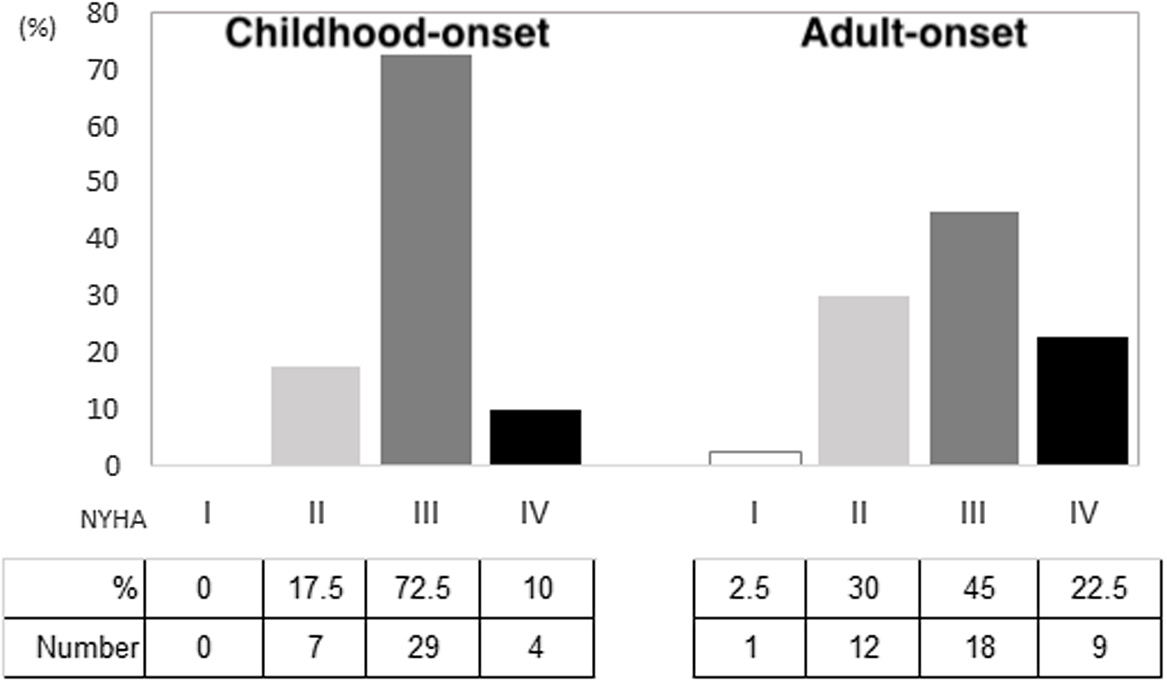
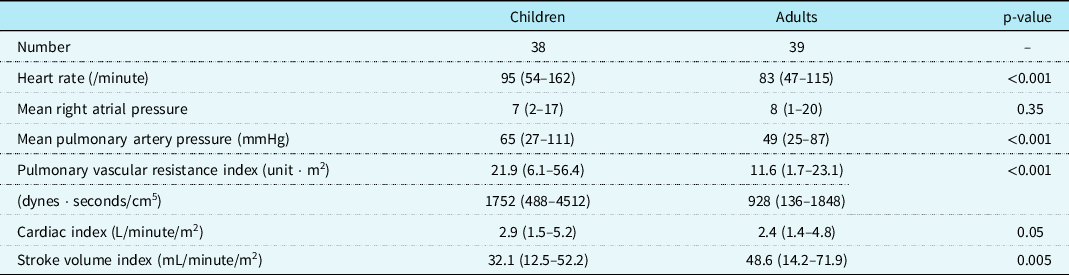
Syncopal events in children were significantly higher than those in adults (children n = 19 (47.5%), adults n = 9 (22.5%), p = 0.03). The percentage of New York Heart Association functional class was not significantly different between children and adults (p = 0.05), although the percentage of New York Heart Association functional class IV in adults was tended to be higher than that in children (22.5% vs. 10%) (Fig 1). Brain natriuretic peptide levels at diagnosis were not significantly different between children and adults (median and range: 125 pg/mL (5–2020 pg/mL) versus 104 pg/mL (6–1687 pg/mL), p = 0.76, respectively). The haemodynamic parameters of the initial right heart catheterisation in children and adults are shown in Table 2. Two children and one adult with New York Heart Association functional class IV did not undergo catheterisation at diagnosis. In children, heart rate, mean pulmonary artery pressure, and pulmonary vascular resistance index were significantly higher than those in adults (median: 95/minute vs. 83/minute, p < 0.001; 65 mmHg vs. 49 mmHg, p < 0.001, 21.9 unit · m2 versus 11.6 unit · m2, p < 0.001, respectively). The cardiac index did not differ between the two groups, but the stroke volume index in children was significantly lower than that in adults (median: 32.1 mL/minute/m2 versus 48.6 mL/minute/m2, p = 0.005).
NYHA functional class at diagnosis in children and adults. The number and percentage of children and adults in each NYHA FC group. The percentage of NYHA functional class IV in adults was significantly higher than in children (22.5% vs. 10%). White bar; NYHA FC II, grey bar; NYHA FC III, black bar; NYHA FC IV. NYHA FC=New York Heart Association functional class.

Haemodynamic parameters at diagnosis in children and adults.

All parameters show median and range.
Treatments and outcomes
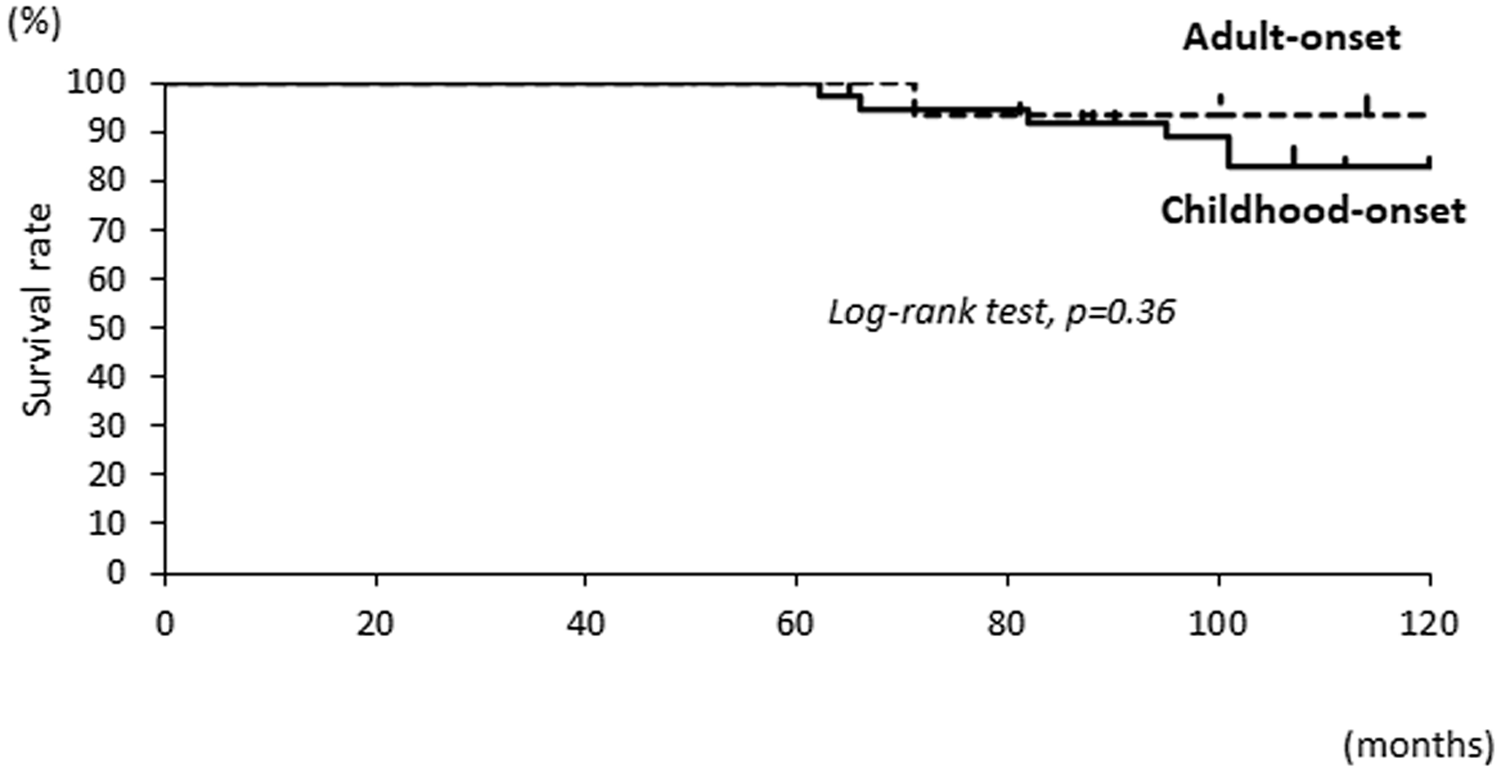
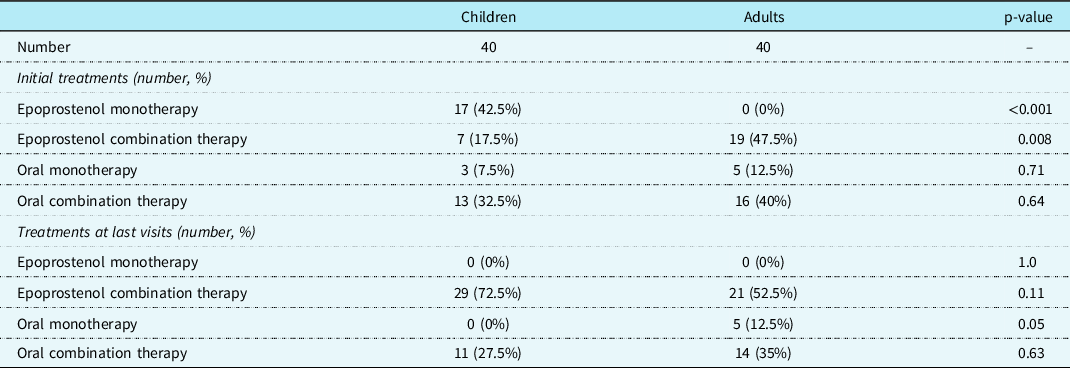
During the follow-up period (median, 96 months; range, 1–120 months), six childhood-onset patients (15%) and one adult patient (2.5%) achieved composite outcomes. Five children died from progressive heart failure and one child died after lung transplantation, whereas one adult died from cancer. The event-free survival rate was not significantly different between the children and adults (log-rank test, p = 0.36; Fig 2). Table 3 shows the pulmonary vasodilator treatments administered during the initial and last visits. At diagnosis, 60% of children were treated with epoprostenol mono and combination therapy, and 47.5% of adults were treated with epoprostenol combination therapy.
Event-free survival rate in children and adults. The incidence of adverse events, including all-cause mortality and lung transplantation, did not differ significantly between the two groups (p = 0.36, log-rank test).

Targeted therapies of pulmonary arterial hypertension in children and adults.

Discussion
There was a higher proportion of female patients with adult-onset pulmonary arterial hypertension. However, no female predominance was observed in patients with childhood-onset pulmonary arterial hypertension. Recent registries also demonstrated that females were more likely to have idiopathic pulmonary arterial hypertension and heritable pulmonary arterial hypertension in the adult population, but female preponderance was not observed in children. Reference Barst, McGoon, Elliott, Foreman, Miller and Ivy1,Reference Berger, Beghetti and Humpl2,Reference Frost, Badesch and Barst7,Reference Ling, Johnson and Kiely8 Previous studies have suggested that sex hormones, such as oestrogens, might have several key roles in pulmonary arterial hypertension development. Reference Orriols, Gomez-Puerto and Ten Dijke9,Reference Atkinson, Stewart and Upton10 Experimental studies have demonstrated both the protective and deleterious effects of oestrogens in pulmonary arterial hypertension. In the adult population, women are more likely than men to develop pulmonary arterial hypertension; however, men have worse outcomes than women. Reference Umar, Rabinovitch and Eghbali11,Reference Foderaro and Ventetuolo12 This so-called “sex paradox” has been studied in pathophysiology of pulmonary arterial hypertension. In contrast to adults, children are unlikely to have sex specificity, suggesting that in children, the oestrogen signalling pathway has less impact. The median age at diagnosis in children was 9 years in our study; thus, pubertal development had not yet been initiated in the majority of children with pulmonary arterial hypertension. The lack of female predominance in children with pulmonary arterial hypertension may be related to prepubertal growth.
Previous registries have reported that haemodynamic data regarding paediatric pulmonary arterial hypertension at diagnosis were characterised by higher pulmonary artery pressure and pulmonary vascular resistance with a preserved cardiac index. Reference Barst, McGoon, Elliott, Foreman, Miller and Ivy1,Reference Berger, Beghetti and Humpl2,Reference Beghetti, Schulze-Neick and Berger13 In our study, although the cardiac index in children and adults was similar, children had a lower stroke volume index and a higher heart rate than adults. Our results showed that an increase in heart rate was associated with preserved cardiac index in children.
Our results showed that children had worse haemodynamic parameters at diagnosis than adults; thus, children were more likely to have an increased risk of clinical deterioration. However, there was no significant difference in survival rate between children and adults. In addition, 60% of children treated with epoprostenol monotherapy and combination therapy at initial treatment, whereas 47.5% of adults received epoprostenol combination therapy. This may be explained by the better treatment response to targeted therapies in children because of the preserved pulmonary vasoreactivity.
In this study, children had more syncopal events than those in adults (47.5% versus 22.5%). In general, cardiac syncope results from insufficient cardiac output during exercise, which might be associated with disease severity. Although syncopal episodes during exercise are common, children may exhibit reversible pulmonary vascular changes at diagnosis. Reference Barst, McGoon, Elliott, Foreman, Miller and Ivy1,Reference Takatsuki, Yanai, Ikehara, Nakayama and Matsuura14 Histological study demonstrated that adults with pulmonary arterial hypertension often had severe intimal fibrosis and plexiform lesions, termed ‘‘fixed’’ irreversible pulmonary vascular changes. Reference Yamaki and Wagenvoort15,Reference Wagenvoort and Wagenvoort16 By contrast, children have more pulmonary vascular medial hypertrophy, less intimal fibrosis, and fewer plexiform lesions. Therefore, paediatric pulmonary arterial hypertension may allow greater reversal of pulmonary vascular injury with pulmonary vasodilator therapies despite having worse haemodynamics at diagnosis. Early treatment strategies for severe pulmonary arterial hypertension may be associated with improved haemodynamics and favourable outcomes in children with pulmonary arterial hypertension.
This study has several limitations. Our observational cohort study was limited by a small sample size from only two centres. Therefore, a larger study involving children is required to determine whether our results can be generalised to a larger population. In addition, follow-up period was relatively short in this study, and it may be associated with similar outcomes between children and adults. However, previous pulmonary arterial hypertension studies comparing adults and children included secondary pulmonary arterial hypertension, such as CHD, collagen disease, and left-sided heart disease. This study included only patients with idiopathic pulmonary arterial hypertension and heritable pulmonary arterial hypertension. The advantage of our study would be the lack of population heterogeneity in the study population.
Conclusions
Although paediatric pulmonary arterial hypertension has worse haemodynamic parameters at diagnosis than adult pulmonary arterial hypertension, children have the same survival outcomes as adults with appropriate therapeutic strategies.
Acknowledgements
The authors thank Tomotaka Nakayama, MD, Department of Pediatrics, Japanese Red Cross Kochi Hospital, for his advice regarding the design of this study.
Financial support
This research received no specific grants from any funding agency, commercial, or not-for-profit sectors.
Conflicts of interest
None.
Ethical standards
The authors assert that all procedures contributing to this work comply with the ethical standards of the Declaration of Helsinki and that they have been approved by the ethical review boards of Toho University Omori Medical Center and National Hospital Organization Okayama Medical Center (A19083 and 2020-004, respectively).