From 2010–2014, Colombia had more acid attacks per capita than any other country in the world, 80% of which affected women (Bielak Reference Bielak2013; ASTI 2018). The phenomenon is puzzling because acid attacks are not a time-honored Colombian tradition, but rather a recent development, with the first being registered only in 1996 (Chavez Reference Chavez2017). Nor are the attacks related to Colombia’s long-running armed conflict, which was already winding down by the time the attacks began escalating. None of the armed actors used or advocated the use of acid as a weapon of war, and the majority of attacks occurred in urban centers far from the dynamics of the armed conflict. Moreover, acid attacks suddenly increased at a time when all other forms of violent crime in Colombia were declining or holding steady. Acid attacks are not common anywhere else in the Western Hemisphere, including neighboring countries that exhibit much higher levels of both generalized insecurity and violence against women (VAW), and in England, the country with the highest number of acid attacks since 2015, men, not women, are the most common victims. What can account for this very unusual pattern of violence in Colombia?
Most studies of variations in violence have focused on either the overall decline in violent mortality since the introduction of the modern nation-state (Pinker Reference Pinker2011; Gat Reference Gat2012), or variations in violence during civil wars (Kalyvas Reference Kalyvas2006; Fujii Reference Fujii2009; Petersen Reference Petersen2001; Balcells Reference Balcells2017). Others have sought to explain sudden outbursts of deadly violence such as riots and lynchings (Varshney Reference Varshney2002; Godoy Reference Godoy2006). Significantly fewer studies analyze variations in non-lethal violence, particularly outside of armed conflict, resulting in a notable silence pertaining to VAW given that women are significantly less likely than men to die in armed conflict but more likely to experience other varieties of violence (Brysk Reference Brysk2018). Only in the last decade have scholars begun to notice and forge explanations for variations in sexual violence in armed conflict (Cohen Reference Cohen2013; Wood Reference Wood2006). Most VAW, however, is dismissed as either interpersonal or cultural, beyond the explanatory capacities of political science and outside the reach of the criminal justice system (MacKinnon Reference MacKinnon2006). Uma Narayan (Reference Narayan1997) refers to this phenomenon as “death by culture” in which a culture becomes defined by and reduced to a specific form of VAW such as honor killings that serves as a synecdoche for an ancient and immutable culture and is therefore not believed to require further explanation.
Why does Colombia suffer from such an unusual manifestation of violence? I argue that the sudden rise in acid attacks against women in Colombia was made possible by an “affective economy” generated by the nation-building campaign Colombia Is Passion (CIP) that (re)interpreted the violence plaguing the nation as the feeling of passion inspired in men by beautiful Colombian women (Anker Reference Anker2014, 2). Emotions are often thought to be private, individual matters, but they are also collective practices that inform “models of subjectivity, collectivity, and agency” (Ngai Reference Ngai2005, 25). Coherent and recognizable “emotional configurations” connect individual experiences to collective experiences, such that the national political sphere functions as a “scene for the orchestration of public feeling” (Jimeno Reference Jimeno2004, 48; Berlant Reference Berlant and Sarat2005, 47). Nation-building projects invest private passions with public purpose (Sommer Reference Sommer1991, 7), creating the imperative for social scientists to understand how nations “command such profound emotional legitimacy” (Anderson Reference Anderson1991, 4). Nevertheless, the role of emotion in structuring national identity and variations in violence outside armed conflict has remained decidedly understudied, even as “passions, such as amour propre,” hate, revenge, resentment, and fear have all figured prominently in explanations for variations of violence in civil wars (Petersen Reference Petersen2001, 11; Balcells Reference Balcells2017).
I explore how CIP used emotional repetition to overcome a moment of acute national crisis by establishing “felt legitimacy” for the state and consolidating national identity through the appropriation and resignification of existing icons and tropes (Ahmed Reference Ahmed2006, 12). I argue that the particular meaning and content of this newly constructed identity made acid attacks against women both logical and devastatingly effective in destroying the victim’s membership in the nation. According to Alison Brysk (2018, 7), social systems only sanction specific patterns of violence “by some people at some times,” yet “perpetrators are seldom able to articulate the precise structures informing their violence,” instead experiencing violence as “a socialized intuitive response.” Explaining variations in violence thus requires examinations into “practices of meaning-making through which social actors attempt to make their worlds coherent” (Wedeen Reference Wedeen2002, 719-720). I track the production of “intelligibility” by which acid attacks came to make sense as a possible form of VAW (Wedeen Reference Wedeen2002, 722) by identifying patterns of symbolic politics that shaped dominant cultural narratives of national identity (Fernandes Reference Fernandes2006). I do not argue that state-sponsored passion alone was responsible for the rise of acid attacks against women in Colombia. Numerous other social, political, and economic conditions allowed for the consolidation of acid attacks as a form of VAW in Colombia, including the accessibility of (primarily sulfuric) acid, existing sexism and intimate partner violence, and possibly most notably, rampant impunity that all but ensured that perpetrators would not be held accountable. Yet many countries have access to acid, sexism, and impunity and still do not experience this pattern of VAW. I argue that acid attacks against women in Colombia would not have been thinkable, imitated, tolerated, or sensible without the emergence of a particular national emotionalism that recast male violence toward women as a misunderstood violent but positive emotional response to women’s beauty: passion. By naturalizing, and nationalizing, male “passions” and including women in the nation solely on the basis of their beauty, this passionate emotional economy made acid attacks against women by their intimate partners uniquely intelligible and devastating.
In the next section, I present an original dataset that indicates a sudden spike in acid attacks in Colombia in 2010, shortly after the implementation of CIP. In the third section, I explore possible explanations for this variation in violence. In the fourth section, I conduct an interpretive analysis of the CIP campaign. Drawing on nineteen months of field research between 2006 and 2017, I argue that CIP made acid attacks against women intelligible by defining the nation as the violent passion men feel for beautiful women. In the fifth section, I detail contestations over national symbols and group membership as survivors of acid attacks lay claim to their own passions and continued beauty. I conclude by arguing that practices of violence are not manifestations of “individual pathologies,” but “patterned expressions of social logics” that, like the logics of violence in civil war, can and must be explained (Brysk Reference Brysk2018, 8). Interpretive studies of political culture and national emotion are one tool to do so.
Acid Attacks in Colombia
Acid attacks involve throwing a corrosive chemical on another person. Most victims survive, but the acid can melt off their skin, tissue, cartilage, and bone, leaving them permanently disabled, severely deformed, and in chronic pain. Victims commonly suffer from blindness, hearing loss, respiratory and eating problems, and permanent muscle, nerve, and skeletal damage that can lead to malnutrition and infection (ASTI 2018). Many survivors suffer from extreme poverty, unable to work and in need of on-going medical treatment. After an attack, victims are often bedridden for months and Colombian survivors have, on average, twenty-five operations at a cost of 6,000 USD each, none of which are covered by health insurance (Bielak Reference Bielak2013). Exacerbating these physical and economic challenges, most survivors speak of debilitating psychological effects including fear that they might be re-victimized or harassed in public, acute and post-traumatic stress disorders, depression, and social alienation (ASTI 2018).
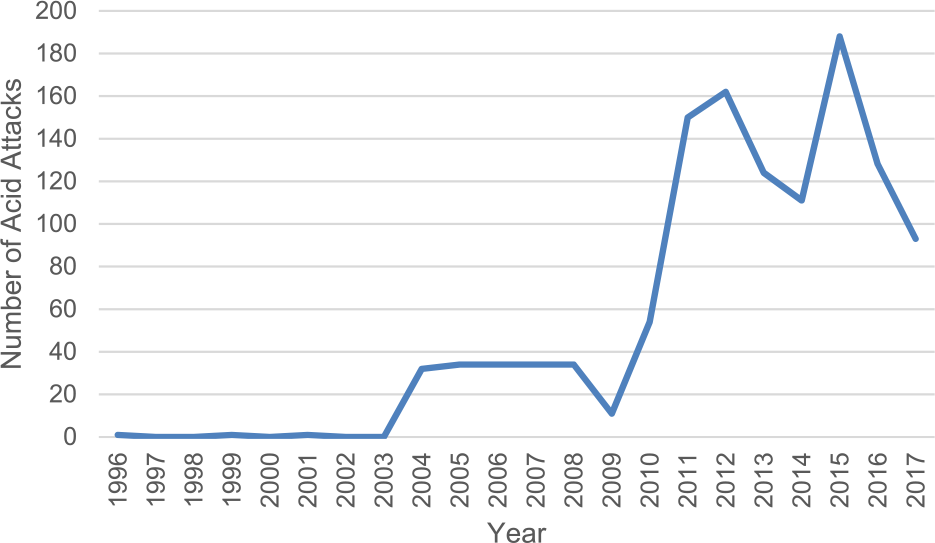
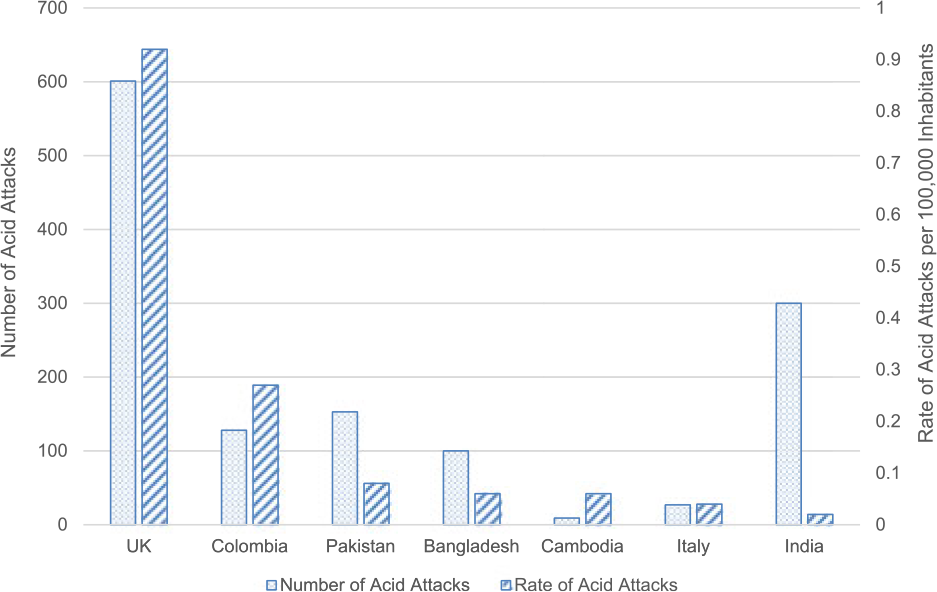
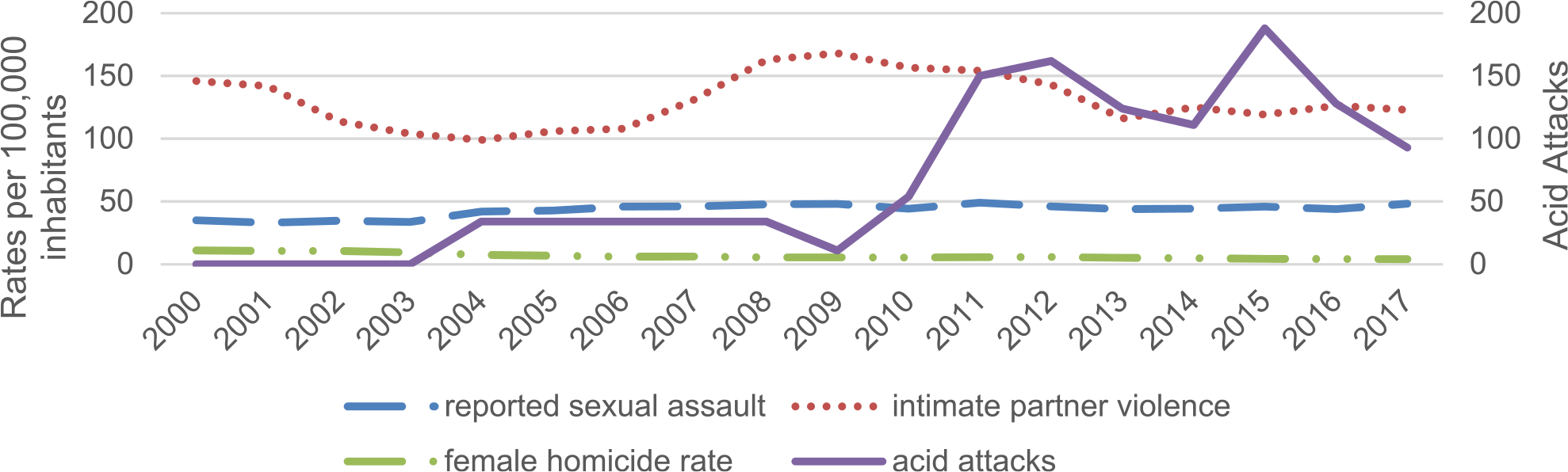
The first recorded acid attack in Colombia occurred in 1996 (Chavez Reference Chavez2017). Only a handful of attacks occurred until 2005, when this new form of violence began consolidating into a few dozen attacks a year. Starting in 2010, the number of acid attacks spiked sharply, peaking at 188 in 2015 as displayed in figure 1. Between 2010–2014, Colombia had more acid attacks per capita than any other country in the world (Vanguardia 2016; ASTI 2018). England overtook Colombia as the country with the highest rate of acid attacks in 2015, but of the approximately 1,500 acid attacks in the world each year, nearly 10% happen in Colombia (ASTI 2018; Chavez Reference Chavez2017; Barry Reference Barry2017; refer to figure 2).
Acid attacks in Colombia 1996–2017
Sources: Author’s dataset; refer to the online appendix for sources and coding.

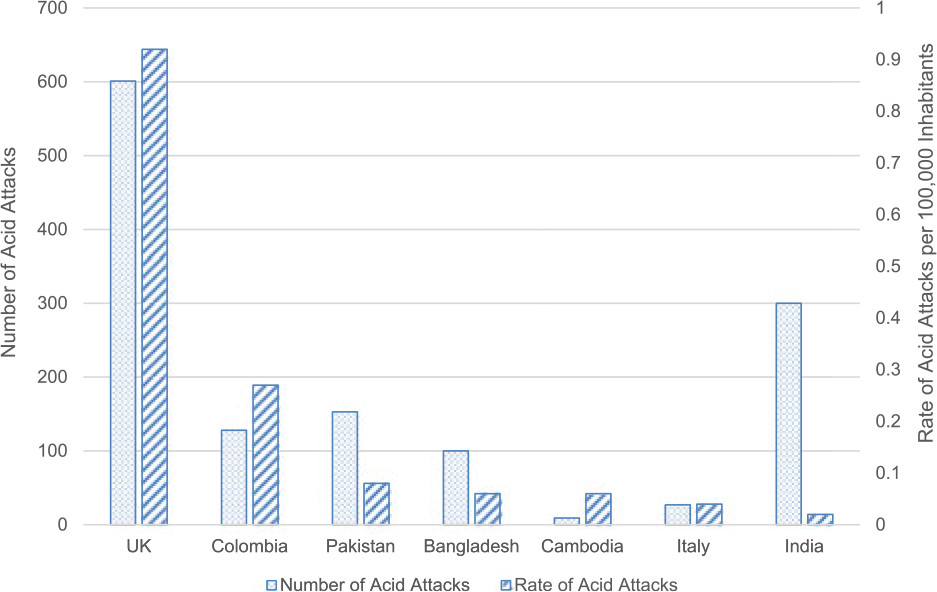
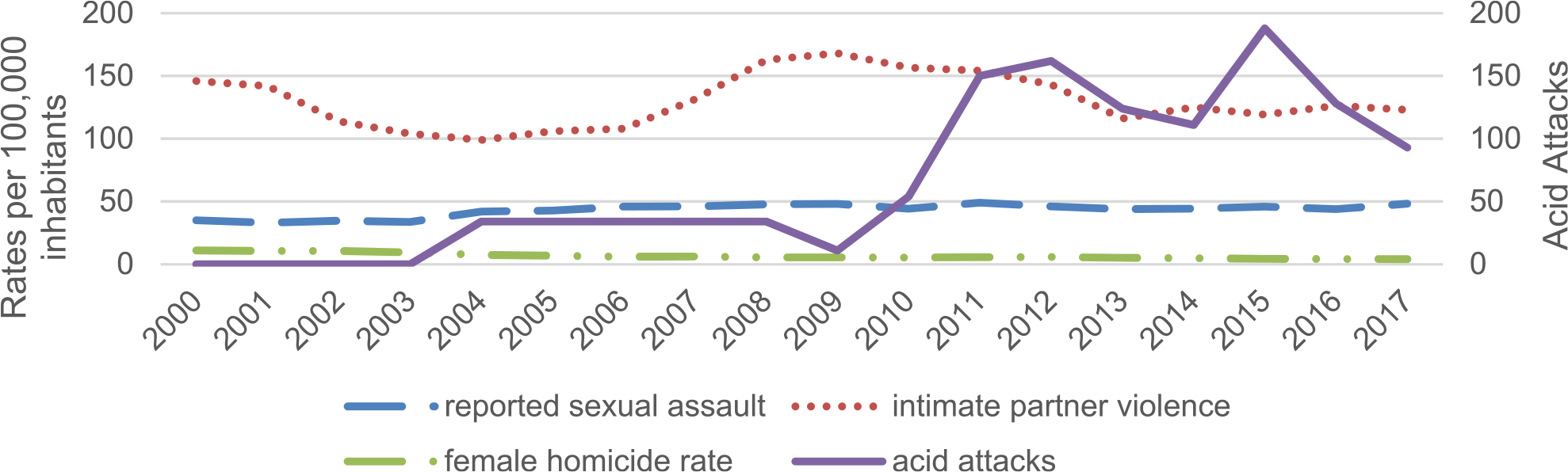
Like all violence, acid attacks are a form of “organized social action” with a specific pattern and logic (Fujii Reference Fujii2009). Contrary to common belief, acid attacks do not always target women. In England, the country with the most acid attacks since 2015, the majority of victims are men who are burned in gang-related conflict or armed robberies (Barry Reference Barry2017; ASTI 2018). In Colombia, the pattern and logic of acid attacks are very different: women constitute about 80% of victims while a similar percentage of perpetrators are men (Pardo Reference Pardo2014; Chavez Reference Chavez2017). Men who are burned with acid are largely attacked by male co-workers in work-related disputes (Malaver Reference Malaver2014a). Women, on the other hand, are typically targeted by current or former male partners who “are motivated by passion” or “sick with jealousy” (Pachón Reference Pachón2012; Semana 2012b). Describing acid attacks as a “crime of passion” is a way to exculpate this particular form of VAW, attenuating social and legal sanctions for the perpetrators who are believed to be rendered momentarily insane by the force of their violently intense emotion for the victim (Jimeno Reference Jimeno2004). Colombia is by no means the only country to dismiss VAW under the guise of passion; the practice is widespread around the world (Jimeno Reference Jimeno2004). Nor are acid attacks the most commonly reported crime of passion in Colombia. In 2016, 43,717 women reported being physically abused by their intimate partner, of which blunt force trauma was by far the most common cause of injury (INMLCF 2016, 311; 318). But that same year, 128 women were killed by their partners, about the same number that were attacked by acid (INMLCF 2016, 116). Like lethal domestic violence, 86% of acid attacks in Colombia are preceded by a long history of physical abuse and efforts by the woman to leave the relationship (Bielak Reference Bielak2013; Chavez Reference Chavez2017). “Acid attacks are associated with jealousy and infidelity, either by the man or woman, with rejection and/or women’s desire to separate from their partners, be they boyfriends or spouses, with masculine need to dominate and control women’s sexuality, and with women being physically attractive” (Malaver Reference Malaver2014a, emphasis added). Acid attacks are the only form of VAW to increase dramatically after the turn of the century; female homicides have fallen slightly, sexual assault has remained constant, and intimate partner violence has fluctuated modestly up and down (refer to figure 3).
Violence against women in Colombia
Source: INMLC Forensis, 2000–2017
Acid attacks are also the only VAW that is overtly associated with the victim’s beauty. Perpetrators of acid attacks are explicit that their passions are motivated by the victim’s beauty, and they use acid to destroy that beauty. Most acid attacks against Colombian women hit their head and face, leaving them with debilitating and visually shocking scars (Malaver Reference Malaver2014a). Approximately 11% of survivors in the country are left with “grave deformities” on the face and body (Chavez Reference Chavez2017). “That’s the motivation, because they leave a mark, they don’t assassinate the victim, but leave a mark so that she always remembers the aggressor and the message” (Chavez Reference Chavez2017). Men choose acid as a weapon to maximize the visibility of the victim’s injury, damaging her sense of self and place in society by diminishing her beauty (Semana 2012b). “That’s what you get for being so pretty!” said the man who threw acid on Gina Potes in 1996 (Semana 2012b). The perpetrator in the attack that dissolved one of María Cuervo’s eyelids and corroded her cranium announced nearly the same thing: “This is so that you don’t think you’re so pretty” (Pachón Reference Pachón2012). Another survivor’s husband noted that “You’re more beautiful every day” before pouring acid on her (Malaver Reference Malaver2014b).
The 2015 attack on Yenny Marsela Pardo, then 28, illustrates this particular logic in which a woman’s beauty conceivably incites male passion and becomes a target for that passion. Pardo was doused with acid while on break between classes at her university, resulting in second- and third-degree burns on more than a quarter of her body. Though no perpetrators were immediately identified, news outlets were quick to note that Pardo was a logical target because “She was a beautiful woman with blond hair, fine features and white skin” (Semana 2015a, emphasis added). The police eventually arrested 40-year old José Rodolfo Torres Hurtado for hiring Haiver Andrés Vásquez, 28, a convicted murderer recently released from prison, to commit the crime. Nevertheless, they could not identify a motive beyond her beauty, as neither man knew the victim. Lacking any connection between the perpetrators and the victim, one plausible explanation continued to surface: “The police have not ruled out passion as a motive” (Semana 2015b).
Upon learning that Torres had hired Vásquez to throw acid on his estranged partner who happened to study at the same university as Pardo and vaguely resembled her, the police discarded passion as a motive and categorized the crime as a “mistake,” as attacking just any woman without an intense emotional connection was senseless. Likewise, Vásquez was careful not to throw acid on the man Pardo was talking with at the time, as that, too, would have been a senseless “mistake” (Semana 2015b). Meanwhile, Torres’ estranged wife and intended victim, Leidy Grajales, went on television to beg for protection from Torres who had abused her for years. The interviewers responded to her pleas by suggesting Grajales was responsible for the mistake/crime and, evidently expecting an apology for inciting her estranged husband’s passion, asked her if she had anything to say to the (other) victim (Caracol 2016).
The ease and effectiveness of using acid to destroy a woman’s beauty and thereby her place in society is manifest in the experiences of survivors. Consuelo Cordoba’s husband threw acid on her in 2001 “in a fit of jealousy” (Silva Reference Silva2012). “In a few seconds, he changed my life forever,” she remarked, noting that she “constantly relives” the attack (Silva Reference Silva2012). With their newborn baby asleep in their bed, Cordoba’s husband stormed out after she refused his advances, euphemistically stating “a new broom sweeps better” (Silva Reference Silva2012). He returned shortly to throw acid on her while taking care to avoid harming the infant. By 2018, Cordoba had undergone eighty-seven different surgeries—one every ten weeks, on average—but is still severely disfigured. She walks with great difficulty, breathes through a plastic tube resembling a straw that keeps her nasal passage open, and wears a balaclava-style medical mask at all times to hide the damage and prevent infection. She does not have lips or a nose, as they are expensive to reconstruct. She is unable to work and her only income is from mendicancy. She cannot access medical treatment beyond charity care, and still owes money on the emergency surgeries she underwent right after her attack. Cordoba suffers from intense social isolation and discrimination. People openly call her a monster, and her daily activities are riddled with stigma: “The worst part is that buses won’t stop to let me board because I horrify them. Not even taxi drivers pick me up, when I have enough money for a taxi. Many times I’ve looked for over two hours for a bus or taxi; sometimes the police help me, stopping the vehicles and forcing them to take me” (Silva Reference Silva2012). She used to dream of restoring her beauty and appearing on television before her husband: “I want him to see me, but after I’ve finished the last operation. He’ll see me on television, so that he’ll see that I have recovered my beauty, that I am pretty again. Because I am a beautiful woman” (Silva Reference Silva2012). The frequent surgeries, immune-suppressing medications, open wounds, and poverty left Cordoba susceptible to infection, however, and she contracted a life-threatening brain infection, cerebral toxoplasmosis. Severely disabled, impoverished, isolated, and depressed, Cordoba began making arrangements to be euthanized at the end of 2017, although she desisted after meeting Pope Francis during his visit to Colombia that year (Vos 2018).
Survivor Gloria Piamba echoes a similar sense of futility: “Sometimes, you think that he burned your face to make you useless” (Bielak Reference Bielak2013). Piamba was burned by her former boyfriend in 2010 when she was twenty-four years old. “He said to me, ‘Remember this well: I’m going to shit on your face and wipe my ass with the law’” (Semana 2012b). After the attack Piamba rarely left the house: “I stayed inside. I would only get up to bathe and then go back to bed. Sometimes, I didn’t know if it was Monday, Tuesday, or Wednesday” (Bielak Reference Bielak2013). Piamba now speaks with difficulty and wears a surgical mask to hide her missing eyes, nose, and chin. Unable to work, she is impoverished and depressed. Flor María, attacked in 1999 by her husband, was still suicidal fifteen years after the attack, routinely attempting to take her own life. She lives in so much fear of her husband, who spent just a year in jail, that she uses a pseudonym and won’t identify where she lives for fear he’ll find her (Malaver Reference Malaver2014b). Flor María’s fear and depression are compounded by social isolation: “People called me a monster, they discriminated against me,” she reports. She, too, begs for money and her only medical care is donated by doctors and nurses (Malaver Reference Malaver2014b). Yenny Pardo, the woman “mistakenly” burned, was initially so depressed that “she didn’t want to speak” (El Tiempo 2015). She was left with an incapacitating fear of public spaces (La Noche 2016). María Cuervo had suicidal thoughts after seeing herself in a mirror for the first time after her attack, even after spending a year in a medically induced coma and six months in therapy. She receives phone calls threatening her with “another burn” and lives in constant fear. “Do you want what happened to your mother to happen to you?” a caller once asked her daughter (Pachón Reference Pachón2012).
The spectacular, enduring visibility of acid attacks makes them uniquely effective at establishing what Miriam Jimeno (2004, 52) refers to as “proximity,” such that every woman knows a survivor, is aware of the threat, and is fearful that it can happen “to any one of them” at any time. According to Kellyn Duarte, a liaison between survivors and the state, acid attacks “are a way to control women, to sanction them for not complying with socially established roles” (Chavez Reference Chavez2017). More so than other “passionate” crimes, acid attacks almost always occur in public and victims rarely die, leaving the survivor as a hypervisible, constant reminder to herself and others of the dangers of challenging men’s authority, rejecting male passion, or undermining national sentiment. In 2015, 64.4% of women in Bogota reported feeling “very unsafe” in the city; 34.9% limited excursions out, and 86.8% avoided mass transit because of safety concerns (Bernal Reference Bernal2017). Certainly acid attacks were just one type of VAW that informed this climate of fear. Yet the spectacular nature of acid attacks serves to control women’s bodies and movements, structuring their relation to the nation by humiliating victims and using them to send a constant visible message to other women, filling them with fear and reminding them of the consequences of challenging national gendered hierarchies (Fujii Reference Fujii2009).
Explaining Variations of Violence
No scholarly studies have sought to explain why Colombia experienced such a sudden increase in acid attacks against women. Casual observers often assume that Colombia must be an unusually sexist society and look for “historic markers of the country’s patriarchal culture” such as late female enfranchisement, a “lack” of feminism, the dominant Catholic faith, a lack of reproductive rights, or the like (Tegel Reference Tegel2016; see also Sampathkumar Reference Sampathkumar2015; Weis Reference Weis2014). The problem is that Colombia’s female enfranchisement (1954) wasn’t unusually late, Catholicism is hardly unique to Colombia, and the country has both a vibrant feminist community and relatively progressive reproductive rights, including the right to “interrupt” a pregnancy for any broadly construed threat to the mother’s health and a notable absence of prosecuting women for feticide relative to other countries in the region (McNeil and Symmes Reference McNeil and Cobb2016). Moreover, none of those variables changed around the turn of the century, making it unclear how they would inform this new pattern of violence.
This is not to say that Colombia does not suffer from sexism or gender inequality; as Andrés Casas (Reference Casas2017) points out, they are global epidemics. Yet evidence indicates that Colombia suffers from average, not extreme, sexism and gender inequality, and that they have been declining, not increasing. The World Economic Forum’s Global Gender Gap Index (2018) ranks Colombia 40 out of 149 countries—with number 1 being most equal—on measures of disparate treatment of men and women in economic participation and opportunity, educational attainment, health and survival, and political empowerment. On a 0–1 scale where 1 is parity, Colombia’s overall score is .729, better than the average score of .68. In two submeasures—educational attainment and health and survival—Colombia has achieved gender parity. It also scores significantly better than most other countries that suffer from acid attacks against women, like India (rank 108; score .665) and Pakistan (rank 148; score .550).
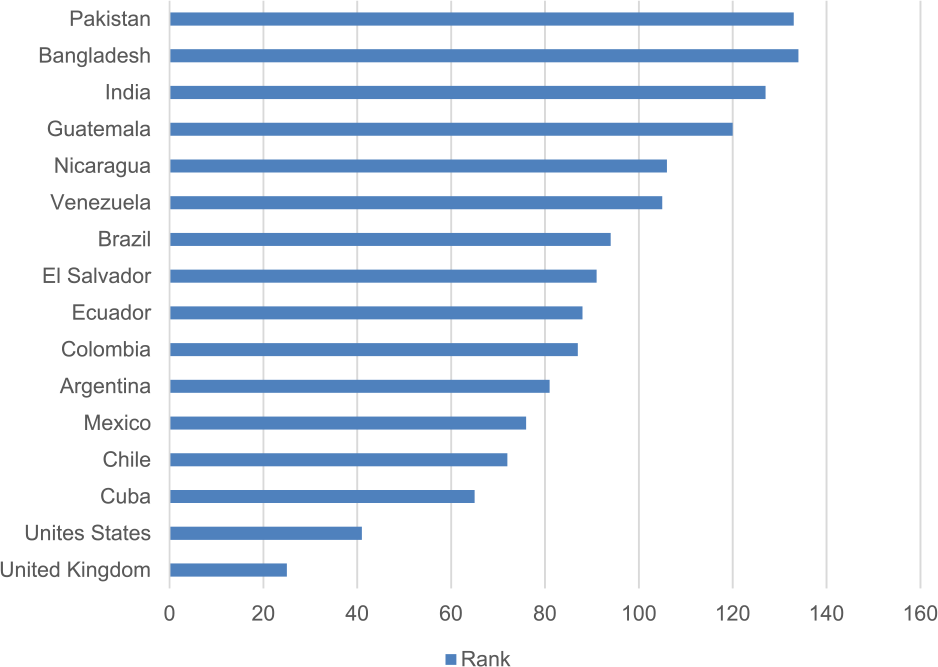
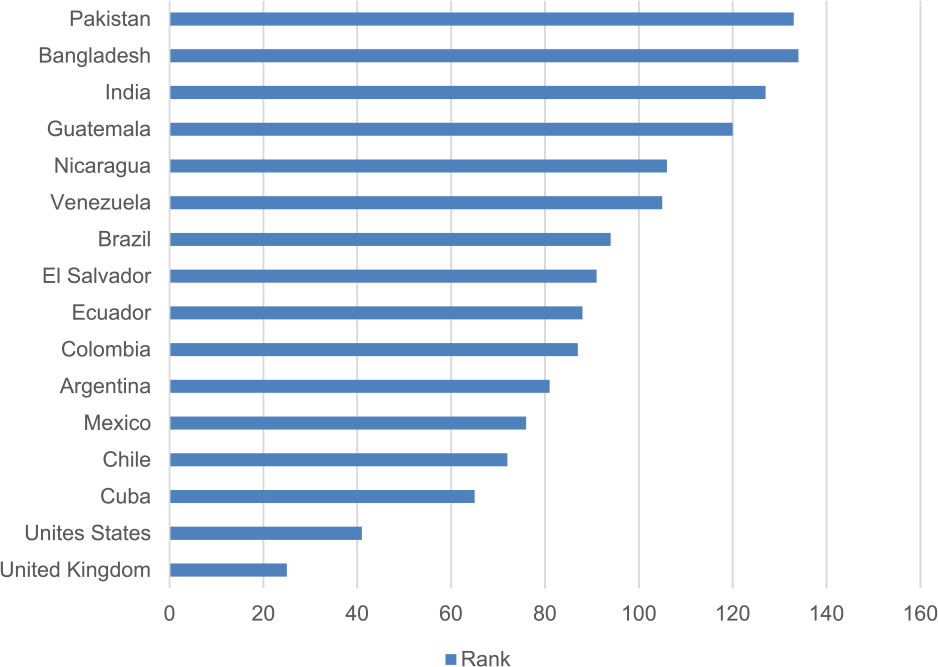
The United Nations Development Program’s Gender Inequality Index (2018) also indicates that Colombia is preponderately average in its levels of gender (in)equality. In 2018 Colombia ranked 87 out of 160 countries on overall levels of gender inequality, earning .383 on a 0–1 scale with 0 being most equal (refer to figure 4). It was followed by Ecuador at number 88, and ranked notably better than other countries in the region, including Brazil (94), Venezuela (105), and Panama (109). By every measure—share of parliamentary seats, maternal mortality, adolescent birth rate, access to education, and labor force participation—Colombia’s gender inequality is consummately average, with significant room for improvement but comparable to or better than many neighbors, none of whom suffer from this unique pattern of VAW. If there is something unique about sexism in Colombia that is causing acid attacks against women, it is not the quantity but the content and quality of sexism, aspects that might well fall outside of survey codings and statistical measurements and may require interpretive explorations into local meanings and cultural practices in order to analyze and explain (Fernandes Reference Fernandes2006).
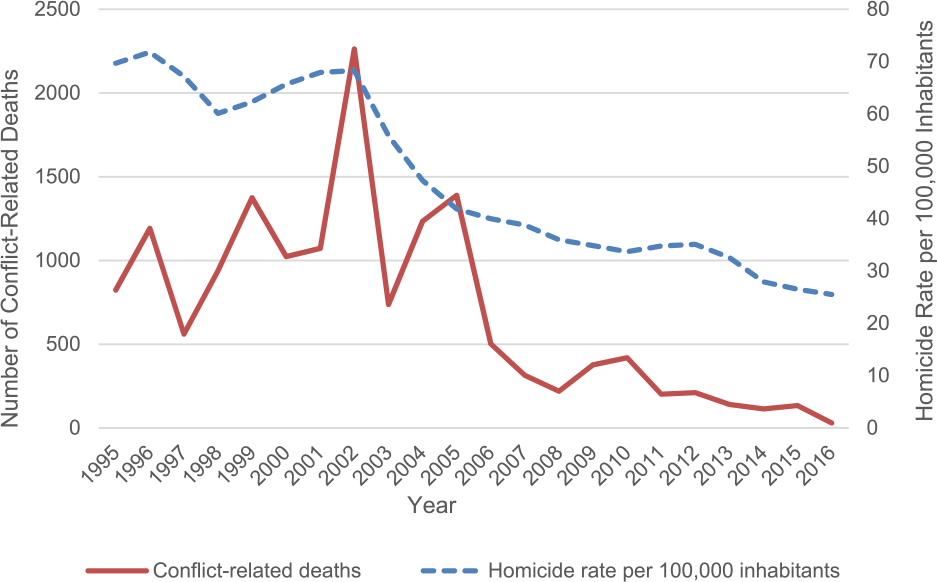
Others argue that Colombia’s enduring armed conflict somehow inspired acid attacks against women by normalizing extreme public VAW (Sampathkumar Reference Sampathkumar2015; Tegel Reference Tegel2016). There is no existing evidence to support this argument, however. None of the armed actors used or advocated the use of acid as a weapon of war, which was largely fought in the countryside, far from urban centers where the majority of acid attacks take place. The armed conflict undoubtedly had a deleterious effect on the state’s capacity to provide security and justice, which led to high levels of criminality and impunity generally, but so too did Guatemala, El Salvador, and Nicaragua suffer through vicious and extended civil conflicts that left enduring legacies of impunity and criminal violence long after the signing of peace agreements, yet none of these countries suffer from acid attacks against women. Moreover, the armed conflict was winding down in 2010 when acid attacks against women began escalating, with battle deaths and homicides falling since 2002 (refer to figure 5), paramilitary fighters demobilizing in 2006, and the FARC, severely debilitated, prepared to follow suit in 2016. It is unclear how an armed conflict that raged for over sixty years would suddenly inspire this form of violence even as the conflict was drawing to a close and all other forms of violence were falling.
Violence in Colombia 1995–2016
Sources: Uppsala Conflict Data Program and UNODC

The National Commission of Reparation and Reconciliation’s Historic Memory Group found that neither the FARC nor the paramilitaries used VAW in “the attainment of military or strategic objectives” (Historic Memory 2013, 82). With an estimated 35%–40% female fighters, strict military discipline, and a need to maintain good relations with local peoples, the FARC did not target civilians generally or women specifically, prioritizing instead extortion, kidnapping, landmines, fighting the military, and “shadow states” to govern the local population (Gutiérrez Reference Gutiérrez Sanín2008; Hunt Reference Hunt2006). As a loose affiliation of disparate warlords largely devoid of female fighters and internal discipline or command, paramilitary troops were driven by “selective incentives,” engaging in widespread sexual VAW in territories they controlled, including rape, forced prostitution and domestic labor, and sexual slavery, with some top commanders organizing virtual harems (Sisma 2009; Gutiérrez Reference Gutiérrez Sanín2008; Historic Memory 2013, 82). While paramilitary forces understood rape to be a bounty of war, it was not a “strategy of social and territorial control” (Historic Memory 2013, 83). Instead, paramilitary forces focused on massacring and displacing local populations in order to acquire their land, destroying homes, property, and infrastructure to prevent the displaced from returning (Meertens Reference Meertens2012). The Colombian conflict was a territorial one, marked by the need to control illicit economies and their trafficking routes and a high degree of “instrumentalism in which eliminating the maternity or humiliating the sexual honor of the enemy lost importance in favor of appropriation of lands and occupation of territory” (Meertens Reference Meertens and Stoller2001, 133-4). By the time the paramilitaries demobilized in 2006, they had killed 7,160 people in 1,166 massacres, displaced four million people, and stolen eight million hectares of land (Historic Memory 2013, 36, 48, 76). Women made up a small minority of those killed, and like men, they were targeted for being social leaders who opposed paramilitary control, not because of their gender (Historic Memory 2010). VAW such as rape was not commonly part of the spectacle of violence deployed in massacres that routinely involved quartering, strangulation, stabbing with bayonets, and dismemberment; instead, women were tortured and killed in largely the same way as men (Historic Memory 2010, 88). In the notorious Salado massacre, for example, only two rapes were reported during a week-long ordeal in which an estimated 450 paramilitary troops occupied the town and killed dozens, and neither was part of the organized spectacle of torture in the town’s square (Historic Memory 2009). Paramilitary troops were notorious for cutting up victims with chainsaws, and they did cut women’s breasts off, though in a context where victims were so thoroughly dismembered that forensic investigators often cannot determine the number or identity of victims, one cannot say that breasts were uniquely targeted (Historic Memory 2010). In at least one instance a woman who was slated for death was exempted from harm when it was discovered that she was pregnant (Historic Memory 2009).
The conflict did affect men and women differently, with men constituting 90% of all violent deaths while women were more likely to flee their land and suffer a “continuum of violence” in displacement (Meertens Reference Meertens2012; Sisma Mujer Reference Mujer2009). Yet because VAW was selective rather than systematic, only 7.2% of displaced women reported suffering sexual violence, and just 17.6% of women who lived under the control of armed actors between 2001–2009 reported experiencing gender-based violence during that time (Meertens Reference Meertens2012, 9). While certainly subject to local variation and underreporting, these crime victimization surveys compare favorably to other settings such as U.S. college campuses where 28% of female students report being sexually assaulted, but acid attacks are not commonly deployed against women (Mellins et al. Reference Mellins, Walsh, Sarvet, Wall, Gilbert, Santelli, Thompson, Wilson, Khan, Benson, Bah, Kaufman, Reardon and Hirsch2017).
Paramilitary troops did commit at least one act of sexualized torture—impalement—that could have served as a model for VAW if the armed conflict had somehow informed a uniquely virulent and spectacular form of misogyny. During the 2000 Salado massacre, paramilitary forces broke a woman’s neck because she dated a FARC combatant, then inserted sticks through her vagina, leaving the desecrated body along with twenty-seven others in the town’s central park where everyone had been gathered to witness the massacre (Historic Memory 2009). Rosa Elvira Cely was later impaled in a central park in Bogota in 2012 by a man she had previously dated, at precisely the time when acid attacks were sharply escalating (Semana 2012a). Cely’s agonizing last hours, documented through repetitive calls to the city’s emergency line and brief testimony to investigators before dying from her injuries, were a national spectacle, this time with historical resonance, that could have set off a wave of impalements if the armed conflict had somehow normalized spectacular displays of VAW. Yet the impalement of Cely was not comprehensible, tolerated, or imitated by Colombians. The crime was never referred to as a crime of passion, but as “savage” and “abominable,” “like something from the middle ages” (Semana 2012a). Protests against VAW proliferated around the country in widespread repudiation of the act, the perpetrator was quickly found guilty and sentenced to forty-seven years in prison, and a new law bearing Cely’s name was passed in 2015 that stiffened penalties for VAW and defined femicide as a crime for the first time (Semana 2012a; Colombian Law 1761 of 2015).
Why did acid attacks against women in Colombia surge while other forms of violence declined or remained constant? Why were impalements rejected as a form of VAW while acid attacks gained traction as a plausible manifestation of passion? Though state capacity, existing sexism, rates of impunity, and legal norms all played a role, I argue that explaining this pattern of violence requires exploring the evolution of the meaning and content of Colombian nationalism. “[Acid] attacks against women continue evincing a cultural component in which their attackers demonstrate an interest in controlling their [victims’] bodies, [it’s] a way of subordinating them to their desires or of taking revenge in the case of rejection” (Malaver Reference Malaver2014a). Instead of attributing acid attacks to static, essentialist notions of “death by culture” or refusing to engage questions of culture and identity at all, I conduct an interpretive study into the construction, meaning, and transformation of Colombian nationalism. I argue that the emergence of a passionate affective economy naturalized male violence in response to women’s beauty and made acid attacks “intelligible” as a form of domestic violence in Colombia (Wedeen Reference Wedeen2002).
Colombia Is Passion: The Only Risk Is Wanting to Stay
CIP was a nation-building campaign that functioned from 2005–2011 to overcome a national crisis by reinterpreting Colombia’s notorious violence as misunderstood passion for beauty (Zaharna Reference Zaharna, Fisher and Lucas2011). A prolonged armed conflict involving leftist guerrillas, paramilitary death squads, drug trafficking organizations, and state forces had left millions of people dead, internally displaced or seeking refuge abroad (González Reference González2002). Homicides and conflict-related deaths soared throughout the 1990s, and a powerful economic recession began in 1998, throwing over half the population into poverty amid widespread unemployment (Tate Reference Tate2007; refer to figure 5). By the turn of the century, Colombia was widely considered a failed state (Hunt Reference Hunt2006).
Álvaro Uribe Vélez was elected President of Colombia in 2002 on a populist law-and-order platform with a dual mandate to restore the economy and security by militarily defeating rebel forces (Viveros Reference Viveros Vigoya2013). Uribe’s policies were controversial among rights groups, but he was extremely popular, becoming the first presidential candidate to win in the first round of voting (Viveros Reference Viveros Vigoya2013). Within two years the economy was growing again and violence had decreased significantly, paving the way for Uribe to modify the Constitution to allow for his own re-election in 2006 (Sanín Reference Sanín, Volcic and Andrejevic2016; refer to figure 5). Nevertheless, Colombians continued to experience acute levels of violence and inequality in their daily lives, and after two decades of bloodshed, they largely blamed themselves, engaging in what Eduardo Posada Carbó has described as ritual “exercises in self-degradation” in which Colombians attributed the violence to their own “collective barbarity” or “characteristic aggression” (2006, 31-39). Uribe knew this “low national self-esteem” (Posada Reference Posada Carbó2006, 31) was a problem for his populist project, and changing it became a “priority of the Uribe government” (Sanín Reference Sanín, Volcic and Andrejevic2016, 60). According to Uribe’s administration, there was a “gap” between the popular perception of Colombia as a failed state and the country’s “reality” since he took office, which, in the administration’s opinion, consisted of “obvious economic, social and security improvements” (Plata Reference Plata2010; Moffett Reference Moffett2008). Immediately upon taking office, Uribe’s wife established the Country Image Project and hired marketing consultant David Lightle to devise a campaign “to consolidate national values and identity in order to strengthen the internal market and make every Colombian feel secure in their safety, their potential, and in Colombia” (El Tiempo 2008).
Lightle designed the Colombia Is Passion campaign to generate a “singular identity” “around common elements of national identity that are already widely recognized” (Restrepo, Rosker, Echeverri Reference Restrepo, Rosker and María Echeverri2008, 6). In surveys Lightle conducted, the vast majority of Colombians felt that berraquera was the most quintessential Colombian trait. Berraquera encapsulates the porous line between blind anger and misguided aggression on one hand, and admirable spirit and determination on the other. According to Winnifred Tate (2007, 21), berraquera is the defiant courage necessary to navigate the ever-present continuum of violence in Colombia. Lightle’s campaign sought to capitalize on this sentiment, erasing the negative connotations of berraquera while reinforcing its positive characteristics such as tenacity, drive, and audacity. A 2006 article introducing CIP to Colombians started by explaining the relationship between berraquera and “passion,” which had no particular local connotation: “The private sector is promoting Colombian ‘berraquera’ as an export product,” the headline proclaimed, “but it’s such a Colombian word that it had to be changed for ‘passion’ so that everyone in the world can understand our message” (Semana 2006). Grounding the campaign in this quintessential Colombian trait was the “linchpin” that ensured domestic stakeholder buy-in (Zaharna Reference Zaharna, Fisher and Lucas2011, 214).
Eliminating the violence associated with berraquera and reframing it as passion required gender and sexuality. Only beautiful women/country—conflated into one—could inspire in men an emotion so strong it could be confused for violence. The campaign drew on Colombia’s “most common metaphor” comparing women to beautiful landscapes and natural resources (Nasser Reference Nasser2012, 17). As far back as 1965 the prominent fashion magazine Cromos famously claimed that “There is no doubt that the most beautiful thing in nature is a beautiful woman” (Nasser Reference Nasser2012, 18). More recently, the director of People and Earth, an NGO working to address climate change, argued that “environmental management is a love affair between men and nature, with only one difference: there is only one girlfriend for all of us” (Semana 2017, 53). This trope was reiterated in each of the five commercials that inaugurated the campaign, introducing the feeling of passion to Colombians. In one video, “Deafmutes” (Marca Colombia 2006a), a man uses sign language to say: “Look at that blue sky. That is Colombia. She’s beautiful. I love her.” His female companion responds: “Yes, the people [are wonderful], the food is delicious and its landscapes are beautiful.” “Yes, Colombia is beautiful … like you,” the man concludes, equating the beauty of Colombia and his female partner, and identifying that beauty as the source of his love. In another commercial, “Traffic” (Marca Colombia 2005), two women in a car are stopped at a red light next to a taxi driver. He leans out the window coquettishly, smiling and offering a flirtatious comment that likens the beauty of Colombian women to its natural landscapes: “Mountains as pretty and vistas as beautiful as you, my loves, don’t exist in any other part of the world. This is definitely Colombia.” The two women are not offended by the unsolicited compliment, exclaiming “Oh, how sweet!” In other publicity materials, “beautiful women” are included in long lists of the country’s natural resources, such as “exquisite coffee, countless beautiful women and orchids” (Marca Colombia 2008). Elsewhere, the campaign urges listeners to: “Take the risk of enjoying Colombian’s kindness and hospitality, their customs, their foods, their passions, and the beauty of their women” (Marca Colombia 2007).
The campaign relied on gender and sexuality to turn existing national symbols into signs of passion. Lightle determined that Colombians “visualize” passion as “bright flashy colors, such as red; flowers; flames; and a woman’s curves,” and contracted a firm to design a logo that incorporated those components (Sanín Reference Sanín, Volcic and Andrejevic2016, 51). The result was a deep red, slightly lopsided heart reminiscent of a woman putting her weight on one foot and thrusting a very voluptuous hip to one side (figure 6). The image also resembled Colombia’s namesake, the Sacred Heart of Jesus, itself a representation of the passion of Christ. “In this way, the logo refers to a specific religiosity and national icon that guarantees an assured assimilation of the logo and brand in the bulk of the population” (Vega Reference Vega Rodríguez2011, 17). The flaming heart-hips won the American Graphic Design Award in 2006 and became a ubiquitous symbol for Colombia (Moffett Reference Moffett2008).

CIP sought to reframe the dominant narrative about Colombia, seen as a dangerous country troubled by guerrillas, death squads, and drug cartels, by replacing it with a positive emotional response: passion (Moffett Reference Moffett2008). It claimed to present “the reality of a country which, despite its many problems, is different today from the erroneous international perception, which denies the country various opportunities for tourism, foreign investment, and exporting” (Nasser Reference Nasser2012, 16). The campaign had two phases. In August 2005, the domestic nation-building campaign Show Your Passion was launched with a minute of “passion” before a national soccer game. Striving to get Colombians to “live the brand” by assuming passion as part of their own identity, this domestic stage lasted over three years (Sanín Reference Sanín, Volcic and Andrejevic2016, 47). The second, international phase began at the end of 2008 to increase tourism, exports, and investment in the country by daring foreign men to experience Colombia’s passion.
The domestic stage started with five short videos that argued that what is commonly seen by Colombians as violence is actually the passion Colombian men feel for their beautiful women/nation. Every video in the domestic series starts in black and white, with no sound, depicting what appears to be people fighting. As the camera zooms in and the clip assumes sound and color, viewers realize that what they thought was a violent confrontation was misunderstood passion for beautiful women who somatized the country. The first several seconds of “Deafmutes” picture the man and woman described earlier in black and white, aggressively gesturing, putting their forefingers to their foreheads with their thumbs “cocked,” mimicking the act of shooting someone in the head. Only when the video zooms in and assumes color and captions do viewers “realize” they are not fighting, but agreeing that Colombia is “mind blowingly” beautiful (Marca Colombia 2006a). The video “Traffic” also starts in black and white with the taxi driver appearing to threaten the women stopped next to him, gesticulating aggressively out his window. When the video assumes color and sound, viewers realize they have mistaken the man’s passion for Colombian beauty with violence (Marca Colombia 2005).
The videos also repurpose objects and places with violent connotations, presenting them as passionate rather than violent. In “Taxi,” a motorbike comes between the two cars as the taxi driver starts recommending places to eat traditional Colombian food. The motorbike driver joins in, nodding and smiling, repurposing the image of infamous motorcycle assassins that undertook killings for hire in the 1980s and 1990s (Nasser Reference Nasser2012, 20). Another video entitled “Colombia: Would you take the risk?” attempts to portray notoriously violent soccer mobs as passionate sports enthusiasts, showing an Argentine man celebrating peacefully in a sea of Colombians, despite recurrent violence among fans of opposing teams (Nasser Reference Nasser2012, 21). Elsewhere the campaign argues that concerns about personal safety in Colombia are based on factual error that conflate the “real” Colombia with “Columbia” as imagined by Hollywood and the U.S. government (Marca Colombia 2007). The “truth” about Colombia is that “99% [of Colombians] are nice, hardworking, and honest, and don’t grow marijuana or cocaine or poppy” (Marca Colombia 2007). Young narrators conveying authenticity argue that Colombians are “good people, many many good people” united by “Passion. Passion for life. For family. For nature. And passion for peace … Colombia is passion” (Marca Colombia 2008).
The essence of the nation as beautiful women/territory inspiring male passions was reiterated in the campaign’s official song “We are Passion.” Featuring fifteen popular Colombian artists, the song and accompanying video sought “to demonstrate to the world the country’s beautiful things” and revive “Colombian’s essential values like happiness in life, confidence in the future, and the determination to work” by reminding every Colombian that they needed to contribute “a grain of sand, at least speaking well of the country” (Caracol 2006).
“We are Passion”
They say that after making Earth
God hid between two oceans
A treasure of emeralds and springs
Where He happily laid down to rest
I am Colombian
I am from there; I am from Colombia
A country of faith and coffee by the ton
That leaves hearts wide open
Upon discovering its beauty
… .
This is my land, the land that gave me life
This is the beauty of my country
This is Colombia, the one (female) I carry in my heart
The one (woman) I love
Show your passion when you speak about Colombia
… .
Never stop loving this land that witnessed your birth
Aye, Colombia is ours and we must believe in her
… .
Show your passion.
The song lyrics return to the metaphor that Colombia is a woman and, in this case, mother who “witnessed your birth” and “gave me life.” This progeny is divine, as God himself laid down with the beautiful land/woman to produce the national offspring. The beautiful seductress renders “hearts wide open.” She is “the one I carry in my heart … . the one (woman) I love” and the listeners are instructed to “Show your passion when you speak about Colombia” (Marca Colombia 2006b).
The video for the song emphasizes Colombian nationalism as both the horizontal fraternity described by Benedict Anderson (Reference Anderson1991) and the deeply gendered hierarchy described by Anne McClintock (Reference McClintock1991) in which women’s belonging is contingent upon their beauty while men’s membership is premised on their ability to display violent emotion—passion—in response to that beauty. The video starts with several images of women in swimsuits walking on the beach, smiling at the camera, and touching themselves sensuously, to which a large group of male performers responds by placing their hands over their hearts and grabbing their chests, suggesting that Colombia or the beautiful women are giving them a heartache, stirring their passion. Throughout the video groups of male singers are shown together, pining for Colombia. Women are displayed alone, beckoning male viewers, or accompanied by a man. Female singers are shown in alternating screen shots with male singers, effectively “pairing” them with a man. In this way, the video avoids displaying groups of women and constructs women’s importance through their relationships to men. The video ends with a bikini-clad woman on the beach stretching out her hand to the viewer, inviting him to “show your passion” (Marca Colombia 2006b).
Colombia Is Passion poster

CIP had twenty employees, an annual budget of over two million dollars, a professional cycling team, two stores in Bogota, and pop up stands around the country that featured hundreds of different products emblazoned with the flaming-heart logo (Moffett Reference Moffett2008; El Tiempo 2008). Over 300 businesses licensed the logo to use in their own marketing (Restrepo, Rosker, Echeverri Reference Restrepo, Rosker and María Echeverri2008). The telltale red heart adorned the tail of Avianca airplanes, the inside lining of boxes of roses, Juan Valdéz coffee, and Shakira’s tour bus. Kokoriko, a Colombian roasted chicken chain, offered a Colombia Is Passion meal, gave out CDs tied to the campaign, and adopted “passion made into flavor” as its slogan (Plata Reference Plata2010; Moffett Reference Moffett2008). Large international companies like Frito Lay, Renault, and Carrefour licensed the logo and created special “passion” lines of everything from potato chips to cars in order to resonate with Colombian consumers, 91.8% of whom preferred products carrying the CIP logo (Sanín Reference Sanín, Volcic and Andrejevic2016, 58).
CIP aggressively dominated press coverage, inviting news outlets to a steady stream of publicity events ranging from truck races to fashion shows and generating millions of dollars of free press coverage (El Tiempo 2008). It conferred CIP Awards, handed out directly by President Uribe, to prominent figures like former U.S. President Bill Clinton (El Tiempo 2008). The campaign had an active online presence with a website (www.colombiaespasion.com), blog, YouTube channel, and Facebook page, garnering millions of followers, in addition to monthly press releases and a free newsletter that highlighted the country’s positive achievements (Sanín Reference Sanín, Volcic and Andrejevic2016). CIP started a lecture series in public schools to turn children into “guardians of Colombia’s passion,” and organized workshops for taxi drivers and shoe shiners “to prepare them to reflect their passion” (Sanín Reference Sanín, Volcic and Andrejevic2016).
For six years, CIP powerfully shaped “feelings in public,” consolidating state power in a moment of crisis and creating “continuity with the pre-crisis world” by using gender and sexuality to turn existing symbols, metaphors, and tropes such as berraquera and the Sacred Heart of Jesus into a new national sentiment: passion (Nasser Reference Nasser2012; Berlant Reference Berlant and Sarat2005). This new affective economy did not attempt to obscure the violence plaguing the country, but to revalorize it as passion for beautiful women, creating an “orgy of feeling” that displaced and overwhelmed ordinary experiences of vulnerability through its intense affect (Anker Reference Anker2014, 28). By 2008, 75.4% of Colombians recognized the campaign’s logo and 83.7% thought the campaign contributed positively to the country (Restrepo, Rosker, Echeverri Reference Restrepo, Rosker and María Echeverri2008, 32). “The campaign became a source of national identity and pride for the country’s citizens” (Zaharna Reference Zaharna, Fisher and Lucas2011, 213). Despite recurrent scandals, Uribe remained incredibly popular, leaving office with an 80% approval rating (Viveros Reference Viveros Vigoya2013, 93-94). CIP was essential to his populist regime, contributing “enormously to create confidence in our country that has problems, but that also has this great strength, which is the passion necessary to overcome our problems,” Mr. Uribe proclaimed (El Tiempo 2008). By the simultaneous end of Uribe’s presidency and the CIP campaign, passion had been firmly established as a “genre of national political discourse … found in political rhetoric, governing processes, citizenship practices, and formations of national identity” (Anker Reference Anker2014, 2). “It is true,” President Uribe concluded in his farewell speech in 2010, “Colombia is passion” (Sanín Reference Sanín, Volcic and Andrejevic2016, 59). “The novelty [of CIP] is its great success. More than change the image of Colombia in the exterior, what the campaign has achieved is a profound transformation in the self-representation of Colombians towards themselves” (Vega Reference Vega Rodríguez2011, 17). When the incoming government of Juan Manuel Santos devised its own marketing campaign, Colombia is the Answer, in order to distance itself from Uribe’s administration, a “national revolt” arose demanding that CIP be reinstated (Sanín Reference Sanín, Volcic and Andrejevic2016, 59). During the course of the campaign, “the brand [CIP] had been inscribed in the symbolic repertoire of Colombianness, to the extent that it came to be considered one of the most powerful symbols of the nation” (Sanín Reference Sanín, Volcic and Andrejevic2016, 46). By the time Uribe left office, passion was widely recognized as “the tie that binds Colombians together” (Restrepo, Rosker, Echeverri Reference Restrepo, Rosker and María Echeverri2008, 28).
Redefining Beauty, Gender, and Nation
Expertly playing on the metaphor of the nation as one large family, CIP employed “passion” to replicate the work it does within families at the national level, naturalizing VAW and revalorizing male aggression not as criminal violence, but as passionate love. CIP successfully consolidated a national identity that premised women’s inclusion in the nation on their beauty and men’s inclusion on their ability to feel violent emotion in response to that beauty, making acid attacks against women—an existing though uncommon form of violence that could precisely target the basis of women’s national membership while allowing men to embrace their national mandate—newly intelligible and brutally effective. As this notion of Colombian nationalism began to circulate and gain considerable traction, acid attacks against women increased rapidly. Yet by 2012, women started organizing, demanding an end to impunity for acid attacks, better medical treatment for victims, labor market reinsertion for survivors, and legal reforms to prevent acid attacks. Most importantly, victims began to challenge the fundamental tenets of the passionate affective economy that made this pattern of violence sensible, identifying as survivors instead of victims while laying claim to their own passions and beauty.
The first non-profit organization to attend to burn victims, The Burn Victim Foundation (Fundación del Quemado) did not anticipate the wave of acid attacks against women. It was created by Linda Guerrero, a reconstructive plastic surgeon to treat victims—often children—of accidental burns from cooking gas or grease, hot liquids, and electricity. It was this foundation that attended to Gina Potes, the first known woman to be intentionally burned with acid in 1996. Horrified by the rapid increase in acid attacks against women, the Burn Victim Foundation convened nine survivors to meet with representatives from the Presidential Office of Gender Equity in 2011. Six of those women later appeared on the cover of Semana, the most widely read weekly magazine in the country, in coverage that proved revolutionary (2012b). At the time in 2012, the state officially reported just twenty-four acid attacks against women, and not a single non-profit organization was dedicated to serving that particular population (Semana 2012b). Survivors were widely seen as victims, effectively cut out of any economic, social, or political place in the nation.
For the first time, a group of women burned by acid assumed a public presence, showed their faces, and told their stories to the country. The article displays a certain unease about the fate of the women. On one hand, it is entitled “Living Death” and describes acid attacks as “one of the worst crimes against women.” “Violence against women in Colombia is widespread and leaves dozens of victims each day, but few crimes are an expression of such aberrant and impune machismo as disfiguring them with acid. Physically, the victims are scarred for life, which leads them to suffer a truly living death, socially and affectively” (Semana 2012b). One woman agreed that living with severe scaring from an acid attack “signifies death in every sense: employment, social, economic, and sentimental. Even in health [care] we are totally abandoned” (Semana 2012b). On the other hand, the article also reflects tempered hope and agency. One woman stated that: “I consider myself a normal woman. Something happened to me, but something can happen to any woman” (Semana 2012b). The authors note that the women “want to leave behind the depression, anguish, solitude, poverty; they want to recover their self-esteem … They want, simply, to have the possibility to work, be useful, accepted, respected, and be loved again” (Semana 2012b). It also calls out the culture of impunity, noting that of the twenty-four cases recorded at that time, only two had resulted in arrests: “The authorities have a clear legal responsibility they must start to fulfill without further delay. The rate of impunity for these crimes gives a free pass to aggressors to continue such attacks. Society is in arrears in making reparations and accepting these women whose only crime was to be pretty and have had the bad luck to have suffered the effects of acid on their bodies with which criminals tried to reduce them to living dead” (Semana 2012b, emphasis added). Most importantly, however, the article brought the women out of obscurity and gave them voice, communicating to other survivors that they were not alone and to the general public that they weren’t necessarily ready to succumb to the anticipated pain, stigma, poverty, and desperation. Published in February 2012, the article had a cascade effect. By August, stories of acid attacks in Colombia were appearing internationally by the Washington Post, National Public Radio, and the BBC (Forero Reference Forero2012a, Reference Forero2012b; Wallace Reference Wallace2012). In Colombia, survivors become bolder and more organized, sitting for extensive interviews, voicing their experiences and demands, and courageously allowing themselves to be photographed, recorded, and scrutinized (El Tiempo 2016).
After appearing in the Semana story, Gina Potes went on to start the first non-profit organization—Reconstructing Faces—dedicated to serving survivors of acid attacks. While advocating for medical care, legal rights, labor market reintegration, and research and education about acid attacks, the most radical component of Reconstructing Faces is its insistence on presenting survivors as beautiful. The foundation highlights survivor’s femininity and beauty, choosing the lotus flower as its symbol because it “represents the triumph of beauty and light over all adverse circumstances” (Fundación Reconstruyendo Rostros 2018). The foundation insists that acid does not destroy a woman’s beauty, organizing events for them to serve as models for national designers, and disseminating photographs emphasizing survivors’ resilience and attractiveness. “A scar doesn’t make me any less of a woman,” Potes is fond of saying. “Beauty comes from the heart” is the motto of another organization that attends to survivors of acid attacks (Fundación Alexandra Rada 2019). Natalia Ponce de León, another survivor and non-profit leader, added to the chorus to “redefine stereotypes and paradigms regarding beauty,” arguing that “beauty is not physical; real beauty is what kind of person you are inside” (La Silla Vacia 2016; Vanguardia 2016).
Soon after Potes founded Reconstructing Faces, dozens of other foundations such as INTI, the Alexandra Rada Foundation, We Will Be Victorious (Venceremos), and the Natalia Ponce de León Foundation emerged to assist survivors with reconstructive surgery, psychological therapy, dietary and nutritional assistance, transportation, and more, establishing protocols for dignified rehabilitation processes while striving for survivors’ complete social and economic reintegration. They fought to create another burn unit in Bogota, which had only one as of 2017, and to recruit medical students to specialize in the treatment of burn victims (La Silla Vacia 2016). They launched public awareness campaigns like the Natalia Ponce de León Foundation’s No More Masks campaign, encouraging people to peel back the mask victims often wear in public to protect their damaged skin and learn about the effects, treatment, and prevention of acid attacks. Survivors intentionally exposed themselves to public scrutiny, appearing in court to testify against their attackers, lobbying the Colombian legislature, accepting a steady stream of interviews and requests for pictures, appearing on television shows and headlining conferences even in the midst of ongoing medical interventions. Videos of Natalia Ponce de León and other survivors engaged in public education campaigns have been watched millions of times, inspiring Colombians with their tenacity, bravery, and resilience for not giving in to the pain, depression, and sense of futility that previously consumed so many victims, instead embodying that quintessentially Colombian trait that inspired the CIP campaign in the first place: berraquera (Semana 2016; Ponce Reference Ponce de León2017). This organizing and visibility was important to other survivors: “Because they have experienced similar events and they know and understand what you’re going through, they humanize you. And you realize that it’s not just one person’s reality. There are many people that live this same reality” (Fundación Inti 2017).
Survivors also stressed the power of labor market reintegration as a way to simultaneously address social stigma and the depression, poverty, and feelings of isolation many felt. “It’s not easy finding work. The level of discrimination is worse than terrible when we have these traits on our faces… . The discrimination is so bad, they cannot value our abilities,” reported one survivor Patricia Espitia (No es Hora 2018). Angie Guevara, burned in 2007, speaks about how transformative returning to her job in a beauty salon was for her. Although she feared people would stare or laugh at her, everyone was very respectful, empowering Guevara to feel entitled to live a normal life if she was still accepted among the most beauty-conscious people in the country (Bielak Reference Bielak2013). “I have to wear a little more makeup than other women,” she reports, but she had a baby in 2012 and moved into a new home with her husband and infant child a year later. “I have this desire to get ahead precisely because of the person that did this to me. He disfigured me, but he didn’t destroy me” (Beilak Reference Bielak2013).
Labor market reincorporation also reduces stigma around acid attacks by normalizing survivors’ appearance and place in public life. When Gina Potes was hired by the Health Department in Bogota in 2013 to raise awareness about gender violence and acid attacks, she noted that “people were surprised to see a woman who wasn’t beaten down, self-pitying, without an inferiority complex. When they said that a woman who was burned with acid was coming in, they all anticipated enormous scars,” but “as a person, I feel exactly the same [as before the attack]. I’ve always said that my scars don’t make me less of a woman” (Beilak Reference Bielak2013). Potes then worked with Bogota’s Mayor’s Office to commit to contract one survivor in each of the city’s twelve departments in addition to connecting survivors to jobs in the private sector if they couldn’t otherwise find one (Beilak Reference Bielak2013).
Survivors effectively lobbied elected officials to pass reforms regulating the sale of chemical agents and strengthening punishments for perpetrators, leading to the passage of the landmark January 3, 2016 law that bore the name of survivor Natalia Ponce de León (Colombian Law 1773). The law improved survivors’ access to medical care and stiffened penalties for acid attacks, setting the minimum sentence at twelve and a half years. The minimum sentence rises to twenty-one years in prison if the attack caused permanent damage, with an additional one-third increase if it affected the face. The law also increased fines for the illicit fabrication or sale of acid and eliminated the possibility of house arrest or suspended sentences for any crime involving chemical agents. Not a single person was held accountable under the new law in 2016, however, despite 128 acid attacks (La Silla Vacia 2016).
Nevertheless, Law 1773 was part of a larger transformation of national passions. Acid attacks started declining in Colombia before the law took effect, from a high of 188 in 2015 to 93 in 2017 (refer to figure 1). According to Elizabeth Anker (2014, 137), melodramatic political discourse like passion is inherently fragile and unsustainable because of its intensity, particularly in the face of such explicit and steadfast challenges to the dominant national emotional economy presented by survivors who laid claim to their own passions and beauty. The work done by survivors was key to destigmatizing burn victims, reincorporating them into their jobs and public life, facilitating survivors’ wholistic recovery, improving health care for survivors, passing legal reforms to hold perpetrators accountable, and redefining national understandings of passion and beauty to render the attacks senseless and ineffective. Survivors’ success, like that of CIP, lay in their ability to reinterpret and appropriate existing national symbols instead of generating an entirely new, competing symbolic order. Under Colombia’s passionate emotional economy, acid attacks stripped victims of their beauty, relegated them to poverty, destroyed their sense of self, left them permanently disfigured and disabled, and symbolically eliminated them from the nation. Survivors of acid attacks inverted the dominant sense of nationalism by eschewing the title of victim, refusing to be excluded from public life, insisting on their own beauty, and laying claim to their own passions. In so doing, these women have subtly redefined Colombian nationalism, reclaimed their place in the nation, and simultaneously rendered acid attacks both less effective and less intelligible.
Conclusion
Studies of variations of violence have long focused on deadly violence in armed conflict, ignoring the vast majority of violence experienced by women (Brysk Reference Brysk2018; MacKinnon Reference MacKinnon2006). In this paper I have denaturalized violence against women by asking why Colombia experienced an acute increase in acid attacks against women while no other form of violent crime displayed such an increase. I argue that acid attacks became increasingly intelligible with the introduction of passion as the essence of the Colombian nation in the CIP campaign. CIP relied on emotional repetition to (re)define Colombian nationalism as the violent but positive feeling of passion instilled in men by women’s beauty, overcoming a moment of acute crisis by connecting individual experiences to collective experiences in a coherent and recognizable “emotional configuration” that dominated Colombian politics and identity (Jimeno Reference Jimeno2004, 48; Anker Reference Anker2014). This “nationalist politics of intimacy” sexualized existing notions of berraquera, valorizing its implicit violence as national “passion” for female beauty and institutionalizing gender difference by making women’s membership in the nation contingent on their beauty (Ngai Reference Ngai2005; McClintock Reference McClintock1991). As this passionate affective economy took hold, acid attacks against women—already present, but still uncommon—became newly intelligible, and escalated precipitously (Wedeen Reference Wedeen2002). Without CIP’s enormous success in establishing passion as the centerpiece of national identity, acid attacks would likely have remained as unintelligible as impalements.
I have argued that violence is a form of “organized social action” that abides by strict, though often unconscious, rules that inform the conditions under which certain individuals are allowed or encouraged to perpetuate particular forms of violence against specific targets (Fujii Reference Fujii2009; Brysk Reference Brysk2018, 8). Because it is difficult to quantify unconscious rules that actors themselves cannot articulate, survey results and statistical indicators like those of gender inequality may not be particularly helpful in explaining variations in violence (Fernandes Reference Fernandes2006). Instead, interpretive studies of components of political culture such as public emotion and national identity may be uniquely valuable in explaining variations of violence by accounting for the meaning, logic, and intelligibility of violent practices (Wedeen Reference Wedeen2002).
My case study of acid attacks in Colombia seeks to diversify our research agenda and the tools we use to analyze variations in violence in three ways: first, by suggesting that VAW is political, patterned, and social, and that political scientists should provide robust explanations for variations in it; second, by building upon existing theories that consider the role of emotion in shaping violence in civil wars to explore how emotion and other components of political culture inform patterns of violence outside of armed conflict; and third, by incorporating interpretive studies of the meaning, logic, and intelligibility of violence into our knowledge of variations in violence. Studies that combine these elements are urgently needed to explain—and propose solutions to—arguably the most pressing variations in violence around the world today such as gun violence in the United States, recurrent deadly prison riots in Brazil, or forced public disrobing in France. These phenomena are deeply gendered and cannot be explained simply by the number of firearms in the United States, inmates in Brazil, or Muslim women in France. Rather, they demand interpretive studies into processes of meaning and identity formation.
Supplementary Material
Appendix 1. Sources and Methods for Dataset on Acid Attacks
To view supplementary material for this article, please visit https://doi.org/10.1017/S1537592720000055