It is widely appreciated that human development is shaped by multiple developmental experiences (e.g., Bronfenbrenner & Morris, Reference Bronfenbrenner, Morris, Damon and Learner2006), including poverty (e.g., Duncan et al., Reference Duncan, Brooks-Gunn and Klebanov1994), single parenting (e.g., McLanahan & Sandefur, Reference McLanahan and Sandefur1994), and harsh and insensitive parenting (e.g., Pinquart, Reference Pinquart2017). Among these environmental factors, Ellis et al. (Reference Ellis, Figueredo, Brumbach and Schlomer2009) cross-species analysis advances harshness and unpredictability as two fundamental dimensions of environmental adversity that shape development. Building on Ellis et al.’s (Reference Ellis, Figueredo, Brumbach and Schlomer2009) theorization, here we examined how environmental harshness and unpredictability might be associated with the development of child socioemotional functioning during early childhood. Furthermore, evolutionary models of human development postulate that individuals lawfully vary across the population with respect to how susceptible or sensitive they are to environmental influences. As such, some individuals, in comparison to others, might exhibit a stronger association between environmental conditions they were exposed to (e.g., harshness, unpredictability) and developmental sequelae (Belsky & Pluess, Reference Belsky and Pluess2009; Boyce & Ellis, Reference Boyce and Ellis2005; Zuckerman, Reference Zuckerman1999). Toward this, various markers have been identified that indicate heightened sensitivity to environmental input, among which the personal trait – sensory processing sensitivity (SPS) – has been advanced recently (Aron et al., Reference Aron, Aron and Jagiellowicz2012). Thus, the present study also sought to investigate whether and how child SPS—measured through behavioral observational method within the laboratory setting—may moderate the effects of environmental harshness and unpredictability on child development.
Environmental harshness and unpredictability
According to Ellis et al. (Reference Ellis, Figueredo, Brumbach and Schlomer2009), environmental harshness and unpredictability are the two fundamental dimensions of environmental adversity that shift development toward a faster life history strategy, which is usually indicated by greater risk-taking, externalizing problems, and faster rate of growth and reproduction (e.g., Belsky et al., Reference Belsky, Steinberg and Draper1991). Specifically, environmental harshness refers to mortality and morbidity due to extrinsic factors in the environment. According to theory (Ellis et al., Reference Ellis, Figueredo, Brumbach and Schlomer2009) and empirical studies, one common indicator of environmental harshness is low family economic resources (SES, e.g., Belsky et al., Reference Belsky, Schlomer and Ellis2012; Li et al., Reference Li, Liu, Hartman and Belsky2018; Simpson et al., Reference Simpson, Griskevicius, Kuo, Sung and Collins2012), which is shown to be related to extrinsic mortality and morbidity and conveys signals of environmental harshness to the child (e.g., Adler et al., Reference Adler, Boyce, Chesney, Folkman and Syme1993; Belsky et al., Reference Belsky, Steinberg and Draper1991), shifting development toward the faster end. In addition to family economic resource, harsh, and insensitive parenting may be another indicator of environmental harshness that regulates child development (e.g., harsh discipline and insensitivity: Mededovic, Reference Međedović2019; disengagement, Sturge-Apple et al., Reference Sturge-Apple, Davies, Cicchetti, Hentges and Coe2017; Suor et al., Reference Suor, Sturge-Apple, Davies and Cicchetti2017; Warren & Barnett, Reference Warren and Barnett2020). This is because parenting quality may reflect parents’ collective exposure to various extrinsic risks (Belsky et al., Reference Belsky, Steinberg and Draper1991), which children may draw to guide their development. Thus, parenting quality could offer unique information about environmental harshness, in addition to family income. Consistent with this perspective is evidence linking parenting and child functioning above and beyond more distal factors (e.g., family economic resource; Erath et al., Reference Erath, El-Sheikh and Mark Cummings2009). Toward this, both low SES and harsh, insensitive parenting has been linked to elevated externalizing and internalizing problems during early childhood (e.g., harsh discipline: Bayer et al., Reference Bayer, Ukoumunne, Lucas, Wake, Scalzo and Nicholson2011; low SES: Dearing et al., Reference Dearing, McCartney and Taylor2006; Duncan et al., Reference Duncan, Brooks-Gunn and Klebanov1994; low sensitivity: Van Zeijl et al., Reference Van Zeijl, Mesman, Van IJzendoorn, Bakermans-Kranenburg, Juffer, Stolk and Alink2006).
In contrast, unpredictability refers to random variations in the proximal environmental context (i.e., morbidity/mortality) over time and space and has been operationalized in previous studies by various indicators. Here we focused on three forms of unpredictability including family instability (e.g., Belsky et al., Reference Belsky, Schlomer and Ellis2012; Simpson et al., Reference Simpson, Griskevicius, Kuo, Sung and Collins2012; Sturge-Apple et al., Reference Sturge-Apple, Davies, Cicchetti, Hentges and Coe2017), household chaos (e.g., Deater-Deckard et al., Reference Deater-Deckard, Mullineaux, Beekman, Petrill, Schatschneider and Thompson2009), and neighborhood residential instability (e.g., Leventhal & Brooks-Gunn, Reference Leventhal and Brooks-Gunn2000). First, family instability refers to the cumulative amount of family events that interrupt the cohesiveness and consistency of the proximal rearing context (Ackerman et al., Reference Ackerman, Kogos, Youngstrom, Schoff and Izard1999; Forman & Davies, Reference Forman and Davies2003). Previous research has linked family instability with elevated externalizing and internalizing problems during early childhood (e.g., Ackerman et al., Reference Ackerman, Kogos, Youngstrom, Schoff and Izard1999; Cavanagh & Huston, Reference Cavanagh and Huston2006; Milan et al., Reference Milan and Pinderhughes2006; Sturge-Apple et al., Reference Sturge-Apple, Davies, Cicchetti, Hentges and Coe2017). In addition to family instability, there are two other potential factors that may signal for the unpredictability within children’s environment (Sandstrom & Huerta, Reference Sandstrom and Huerta2013). As such, we focused on household chaos and neighborhood residential instability to obtain a more broad and comprehensive reflection of environmental unpredictability.
More specifically, household chaos refers to the unpredictable and unstructured family settings, including things like disorganization, confusion (e.g., family not able to carry out plans), and the unpredictability and uncertainty in everyday activities and routines. Household chaos has been widely used in the literature as a common factor that confers unpredictability within the child’s context (e.g., Berry et al., Reference Berry, Blair, Willoughby, Garrett-Peters, Vernon-Feagans and Mills-Koonce2016; Vernon-Feagans et al., Reference Vernon-Feagans, Garrett-Peters, Willoughby and Mills-Koonce2012), which shapes child development toward the riskier end (e.g., externalizing problems; Deater-Deckard et al., Reference Deater-Deckard, Mullineaux, Beekman, Petrill, Schatschneider and Thompson2009; Vernon-Feagans et al., Reference Vernon-Feagans, Willoughby and Garrett-Peters2016). Furthermore, residential instability refers to a higher rate of residential turnover, in addition to a lower proportion of owner-occupied houses (Sampson et al., Reference Sampson, Morenoff and Earls1999). Neighborhood residential instability signals a lack of social organization and stability external to the family, which again has been associated with risky socioemotional functioning (e.g., elevated internalizing and externalizing problems, Beyers et al., Reference Beyers, Bates, Pettit and Dodge2003; Leventhal & Brooks-Gunn, Reference Leventhal and Brooks-Gunn2000). Taken together, the goal of the present study was to add the literature through our utilization of a more comprehensive assessment of harshness and unpredictability by examining multiple sources of these environmental stimuli and their impact on children’s development.
Sensory processing sensitivity framework
The present study also sought to illuminate whether and how children’s individual differences in susceptibility to the environment—indicated by SPS—might moderate the effects of environmental harshness and unpredictability on developmental outcomes. According to the evolutionary perspective, natural selection maintains individual differences in sensitivity to environmental input (Belsky & Pluess, Reference Belsky and Pluess2009), which is manifested by a minority group of individuals being more sensitive than others. In the past 30 years, this phenomenon of different individual responsivity to the environment has become the focus of several theories, including the differential susceptibility theory (Belsky, Reference Belsky1997; Belsky & Pluess, Reference Belsky and Pluess2009), the biological sensitivity to the context theory (Boyce & Ellis, Reference Boyce and Ellis2005), and the sensory processing sensitivity framework (SPS, Aron & Aron, Reference Aron and Aron1997). Toward this, a variety of potential markers for individual susceptibility have been identified, including temperament (e.g., negative emotionality, Pluess & Belsky, Reference Pluess and Belsky2009), genes (e.g., Zhang et al., Reference Zhang, Li, Chen, Li, Zhang and Belsky2016), and physiological reactivity (e.g., Li et al., Reference Li, Sturge-Apple, Martin and Davies2019).
More specifically, the traditional diathesis-stress (or dual-risk) model maintains that individuals with diathesis may be particularly vulnerable to environmental adversity by developing poorly (but function similarly with others under the positive environment). In contrast to the traditional diathesis-stress model, differential susceptibility theory proposes that the temperament, personality, or biological characteristics which confer heightened risks under a negative environment may also make individuals more susceptible to positive environments as well (Belsky, Reference Belsky1997; Belsky & Pluess, Reference Belsky and Pluess2009; Boyce et al., Reference Boyce, Chesney, Alkon, Tschann, Adams, Chesterman, Cohen, Kaiser, Folkman and Wara1995). That is, although individuals with greater susceptibility develop especially poorly within an adverse environment, they also benefit more and develop better than others in a supportive environment.
Of these theories, one recent framework has stipulated that the personality trait of SPS may operate as a susceptibility marker (Aron & Aron, Reference Aron and Aron1997; Aron et al., Reference Aron, Aron and Jagiellowicz2012; Greven et al., Reference Greven, Lionetti, Booth, Aron, Fox, Schendan, Pluess, Bruining, Acevedo, Bijttebier and Homberg2019). SPS is described as a personality trait that entails a constellation of characteristics, including greater depth of cognitive processing, heightened sensitivity and awareness to subtle environmental stimuli (e.g., olfactory stimuli, sounds), behavioral inhibition in novel contexts or those generating conflicting action tendencies (i.e., approach vs. withdraw), and elevated emotional and physiological reactivity and empathy. According to Aron et al. (Reference Aron, Aron and Jagiellowicz2012), these traits collectively reflect a more sensitive central nervous system, which makes information easier to be registered, and cognitive processing to be thorough, more complex, and in greater depth. Empirical studies for the neural underpinning of SPS supported this proposition. For example, Jagiellowicz et al. (Reference Jagiellowicz, Xu, Aron, Aron, Cao, Feng and Weng2011) revealed a significant association between greater SPS and heightened neural activation in the high-order visual processing areas (e.g., right claustrum, left occipitotemporal lobe) when individuals were instructed to detect minor changes in pictures. This association indicated that high SPS individuals attended more closely and exhibited more neural activation when processing environmental stimuli.
SPS as a susceptibility marker
According to Aron et al. (Reference Aron, Aron and Jagiellowicz2012), SPS may operate as a marker for greater susceptibility to both positive and negative environments, which is manifested by a cross-over interaction (i.e., high SPS individuals function better than others under positive environment, and worse than others under adverse environment). Empirical studies testing this proposition are quite limited, and earlier work predominantly focused on adults (e.g., Aron et al., Reference Aron, Aron and Davies2005), with only a few exceptions recently (e.g., Slagt et al., Reference Slagt, Dubas, van Aken, Ellis and Deković2018). Given the limited work so far, our literature review involved research across a wide variety of developmental stages. In addition, although Aron et al. (Reference Aron, Aron and Jagiellowicz2012) proposes a crossover interaction, empirical studies have yielded inconsistent findings, supporting diathesis-stress (e.g., Booth et al., Reference Booth, Standage and Fox2015) or differential susceptibility (e.g., Lionetti et al., Reference Lionetti, Aron, Aron, Klein and Pluess2019; Slagt et al., Reference Slagt, Dubas, van Aken, Ellis and Deković2018).
For instance, Booth et al. (Reference Booth, Standage and Fox2015) documented a significant interaction between adult self-reported SPS and the recall of risky childhood context (e.g., caregivers being verbally aggressive toward the participants) on adult self-reported life satisfaction. Individuals with high SPS were more strongly affected by risky childhood environments by demonstrating lower life satisfaction compared to others. Furthermore, although not tested, the pattern of the interaction seemed consistent with diathesis-stress, in that high SPS individuals only seemed to show lower life satisfaction under risky environments, but not higher life satisfaction under supportive environments. Turning to research on children, Slagt et al. (Reference Slagt, Dubas, van Aken, Ellis and Deković2018) observed parenting and children’s externalizing problems and prosocial behavior across three measurement occasions over 7 months. Children’s SPS significantly moderated the effect of change in positive parenting (e.g., autonomy granting, inductive reasoning) on change in children’s externalizing problems over time. Furthermore, the pattern of the interaction proved consistent with differential susceptibility, such that high SPS children exhibited the greatest decreases in externalizing problems when parents improved in their positive parenting (i.e., for better), and greater increases in externalizing problems when parents became more negative over time (i.e., for worse). Of important note, although positively correlated with the existing temperament dimension of negative emotionality, SPS was shown to operate as a susceptibility marker above and beyond the effect of negative emotionality (Slagt et al., Reference Slagt, Dubas, van Aken, Ellis and Deković2018).
In summary, although the detected patterns of the interaction were rather inconsistent, it nevertheless seemed plausible that SPS might function as a marker for individual differences in environmental sensitivity. To our knowledge, however, no study to date has examined whether SPS moderate the role of environmental adversity while simultaneously focusing on the two potent dimensions of the environment—harshness and unpredictability. This issue thus became one of the primary goals for the present study.
Measures of SPS—the behavioral rating system
A final goal of the present study was to advance the measurement for SPS through a behavioral rating system. To date, SPS has been predominantly measured by questionnaires, including the 27-item adult self-report Highly Sensitive Person (HSP) scale (e.g., “do you startle easily”, “do you seem to be aware of subtleties in your environment”; see the application in Acevedo et al., Reference Acevedo, Aron, Aron, Sangster, Collins and Brown2014; Aron et al., Reference Aron, Aron and Davies2005; Booth et al., Reference Booth, Standage and Fox2015; Jagiellowicz et al., Reference Jagiellowicz, Xu, Aron, Aron, Cao, Feng and Weng2011; Jagiellowicz et al., Reference Jagiellowicz, Aron and Aron2016), the 12-item child self-report Highly Sensitive Children (HSC) scale (Pluess et al., Reference Pluess, Assary, Lionetti, Lester, Krapohl, Aron and Aron2018; e.g., “I notice it when small things have changed in my environment”), and an adapted parent-report version of the 12-item HSC scale for younger children (i.e., age four to seven, Slagt et al., Reference Slagt, Dubas, van Aken, Ellis and Deković2018).
Noting the important contributions of research utilizing self- or parent-report measures of SPS, here we sought to develop a behavioral rating system that objectively evaluated children’s SPS behaviors within the laboratory setting. To our knowledge, only one study to date has applied a behavioral observational measure of children’s SPS. Informed by the theoretical definition of SPS (Aron, Reference Aron2002; Aron et al., Reference Aron, Aron and Jagiellowicz2012), Lionetti et al. (Reference Lionetti, Aron, Aron, Klein and Pluess2019) administered a novel behavioral rating system to young children (i.e., 3-year-olds) across several Lab-TAB tasks (e.g., stranger approach, pop-up snakes; Goldsmith et al., Reference Goldsmith, Reilly, Lemery, Longley and Prescott1999). SPS was operationalized as various characteristics including (a) behavioral inhibition and fearfulness in novel situations (e.g., pause and check before exploration, appearing fearful to stranger approach); (b) deeper cognitive processing reflected by greater perseverance in problem-solving and cautious interest in new stimuli (e.g., attending to the detailed characteristics of the stimuli); (c) a more cautious and cooperative attitudes toward the experimenter due to their behavioral inhibition and openness to experiences within the interpersonal relationships; and (d) greater positive emotionality in response to positive external stimuli. Their ten behavioral scales yielded a single SPS factor, which was found to moderate the effect of positive and negative parenting on children’s socioemotional functioning (i.e., externalizing and internalizing and social competence) at age three and six. Importantly, high SPS children exhibited stronger associations between parenting quality and their developmental sequelae consistently, suggesting that they are more susceptible to environmental input. Taken together, Lionetti et al. (Reference Lionetti, Aron, Aron, Klein and Pluess2019) demonstrated the feasibility of measuring SPS through the behavioral observational methods. Notably, the SPS rating system in the present study was designed to capture critical characteristics of SPS in Lionetti et al. (Reference Lionetti, Aron, Aron, Klein and Pluess2019) (e.g., cautious and collaborative attitudes toward the experimenter, cognitive processing in greater depth). However, our system incorporated additional components which have been highlighted in previous work as being critical traits to the operationalization of SPS. Specifically, Aron et al. (Reference Aron, Aron and Jagiellowicz2012) highlighted high SPS involves characteristics of greater awareness for others’ feelings and emotions (see evidence in Acevedo et al., Reference Acevedo, Aron, Aron, Sangster, Collins and Brown2014), which can be manifested as greater empathy. As such, we added behavioral scale in our system that captures children’s empathy expressed in cautious, low-approach manner. Furthermore, given high SPS children’s tendency to “pause and check,” we expect children with greater SPS to express emotions and behave in cautious, careful, and inhibited manner. Furthermore, previous evidence has linked SPS with children’s regulatory capacities (e.g., Lionetti et al., Reference Lionetti, Aron, Aron, Klein and Pluess2019; Pluess et al., Reference Pluess, Assary, Lionetti, Lester, Krapohl, Aron and Aron2018). Given these reasons, we included codes to capture children’s effortful control, and emotion and impulse regulation. These scales collectively assess the children’s tendency to display emotions in subdued, inhibited, and conservative manner, in addition to regulate their impulses and behave appropriately during the tasks (i.e., be patient, careful, polite, and following the rules). We thus expect high SPS children to score high on these scales. In contrast, lower scores in these scales reflect that child demonstrates intense and explosive emotions and shows inappropriate behavior during the tasks (e.g., acting aggressively toward experimenter).
The present study
Building on Ellis et al.’s (Reference Ellis, Figueredo, Brumbach and Schlomer2009) theorizing for potent dimensions of environmental adversity, the present study sought to evaluate how environmental harshness and unpredictability might be associated with the development of children’s socioemotional functioning during early childhood. We expect that both harshness and unpredictability will be linked to greater increases in externalizing and internalizing problems over time. Second, given that scant research has examined whether environmental harshness and unpredictability might have differential effects on children depending on their individual characteristics, here we aimed at examining the moderating role of SPS on the links between harshness and unpredictability and child socioemotional functioning (i.e., externalizing and internalizing problems). We anticipate that children with high SPS will exhibit a stronger association between environment input and developmental functioning, compared to those with low SPS. Furthermore, given that the susceptibility of heightened SPS is theorized to manifest under negative and positive sides of the environment, we expect any detected interaction will be more consistent with the differential susceptibility pattern (i.e., for better and for worse). The third goal of the present study is to measure children’s SPS through the innovative behavioral observational method across various laboratory tasks. Following the theoretical definition of SPS (Aron, Reference Aron2002; Aron et al., Reference Aron, Aron and Jagiellowicz2012) and inspired by Lionetti et al.’s (Reference Lionetti, Aron, Aron, Klein and Pluess2019) behavioral observational system, we developed multiple coding scales within appropriate laboratory tasks from a larger longitudinal study (see details in Procedure and Table 1). We expect that the scales will collectively reflect young children’s greater sensitivity to both positive and negative environmental stimuli. Notably, the age group we focused on (i.e., age three when SPS was measured) was roughly the same as Lionetti et al. (Reference Lionetti, Aron, Aron, Klein and Pluess2019). We anticipated the laboratory episodes to evoke various child responses that reflect their different levels of SPS.
The behavioral observational system for child SPS

Note. ICC calculated on a random selection of 22 % of cases (N = 235).
The present study advances the literature in several ways. First, we examined the interactive effect of child SPS and two potent dimensions of the environment—harshness and unpredictability—which more comprehensively capture the features of the child-rearing context. Second, we are one of the first studies, in addition to Lionetti et al. (Reference Lionetti, Aron, Aron, Klein and Pluess2019), to measure children’s SPS through behavioral observational method. This approach provided a richer and more objective characterization of SPS in comparison to survey measures during early childhood. Third, in contrast to previous work evaluating SPS moderation that mostly adopted a cross-sectional design (e.g., Booth et al., Reference Booth, Standage and Fox2015), or longitudinal design that did not evaluate the changes in child functioning over time (e.g., Lionetti et al., Reference Lionetti, Aron, Aron, Klein and Pluess2019), our study directly assessed the development of child externalizing and internalizing symptoms.
Method
Participants
Participants were 235 children and their parents from a larger longitudinal study. Families were recruited broadly through head start programs, child-care centers, flyers, and internet sites. Interested families were screened and included in the study if the following criteria were met: (a) The target child was at least 3 years of age and the parental figures were at least 18; (b) both parental figures lived in the same house with the target child for at least the previous year; (c) both parental figures were of the opposite sex and at least one parent was the biological parent to the target child; and (d) the target child did not have cognitive or developmental disabilities and all family members were fluent in English. Families were followed over two measurement occasions that were each scheduled 1-year part. Mean age for children at the first wave was 2.97 years (SD = 0.38), and 55.3% were female (N = 130), 56.2% of the children were identified as White, followed by African American (21.3%) and mixed-race (16.2%). 17.4% of the children were identified as Hispanic or Latino ethnicity (17.4%). The median annual household income fell in the range of $55,000 to $ 74,999, with 25.5% of the family reported a household income below $23,000. At the first wave, 99.6% (N =234) and 89.8% (N = 211) of the children were living with their biological mother and father, respectively; and 89.4% (N = 210) children were living with both biological parents. This study was approved by the Institutional Review Board of the University of Rochester (Title of the study: Interparental Relationship and Parenting, case number: RSRB939). We obtained written consent from both parental figures before enrolling families in the study.
Procedure
On both measurement occasions, fathers, mothers, and the target child completed a single 2.5-3-hr laboratory visit. Families participated in various behavioral tasks in rooms equipped with audiovisual equipment to videotape the tasks. In addition, parents completed survey measures alone in comfortable survey rooms.
Measures
Child SPS
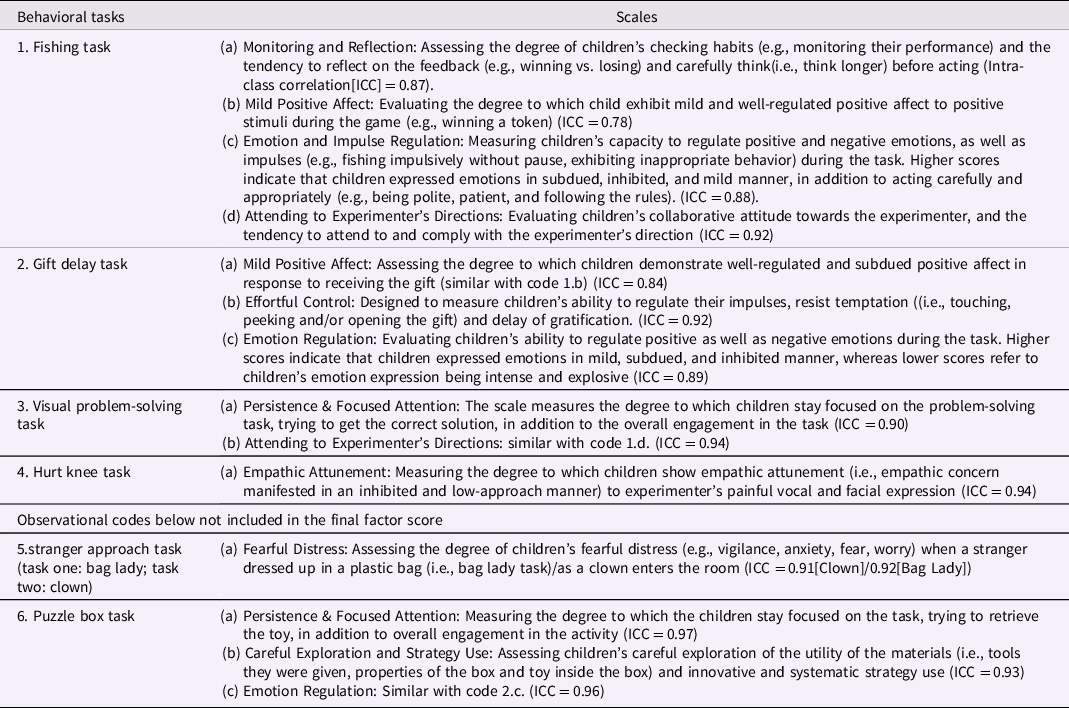
To operationalize SPS, we utilized a novel coding scheme aimed at assessing children’s SPS across tasks. The development of the behavioral rating system was guided by the theoretical meaning of SPS (Aron, Reference Aron2002; Aron et al., Reference Aron, Aron and Jagiellowicz2012), and we added scales inspired by Lionetti et al. (Reference Lionetti, Aron, Aron, Klein and Pluess2019); i.e., attending to experimenter’s directions). A total of 15 behavioral rating scales were assessed, roughly falling into five categories (see details in Table 1).
First, given SPS entails greater depth of cognitive processing, we anticipated that high SPS children would (a) show greater persistence and focused attention during problem-solving; (b) monitor their performance consistently and take a longer time to carefully think and reflect on feedback (Aron et al., Reference Aron, Aron and Jagiellowicz2012); and (c) demonstrate more thorough exploration and resourceful strategy use. Second, due to the tendency to “pause and check” (Aron et al., Reference Aron, Aron and Jagiellowicz2012) and greater inhibition to novel stimuli (Lionetti et al., Reference Lionetti, Aron, Aron, Klein and Pluess2019), we expect SPS to be captured by greater fearful distress (e.g., vigilance, anxiety) in response to stranger approach. Third, following Lionetti et al. (Reference Lionetti, Aron, Aron, Klein and Pluess2019), we expect sensitive children to demonstrate cautious yet collaborative attitudes toward the experimenter, who is an unfamiliar but friendly adult. This was due to sensitive children’s openness to experience in interpersonal relationships (Lionetti et al., Reference Lionetti, Aron, Aron, Klein and Pluess2019), coupled with their inhibition for novel stimuli. In addition, due to the sensitivity for interpersonal stimuli and heightened emotionality, Aron et al. (Reference Aron, Aron and Jagiellowicz2012) also highlighted that SPS involved characteristics of greater empathy and awareness for others’ emotions (e.g., Acevedo et al., Reference Acevedo, Aron, Aron, Sangster, Collins and Brown2014). As such, we also expect high SPS children to show greater empathic attunement (i.e., empathy expressed in a cautious, low-approaching manner) to the experimenter. Fourth, given that high SPS is reflected by heightened positive emotionality (in addition to negative emotionality, e.g., Jagiellowicz et al., Reference Jagiellowicz, Aron and Aron2016), we expect sensitive children to display more positive affect in response to positive stimuli (e.g., receiving a gift). Fifth, given children’s tendency to “pause and check” and previous evidence linking SPS with regulatory capacities (Lionetti et al., Reference Lionetti, Aron, Aron, Klein and Pluess2019; Pluess et al., Reference Pluess, Assary, Lionetti, Lester, Krapohl, Aron and Aron2018), we expect children with greater SPS to express emotions in subdued, cautious, and inhibited manner (e.g., a grin, soft cheering, and sighing) and behave in an appropriate way (i.e., being careful, polite, and patient), as captured by greater effortful control, and emotion and impulse regulation. The tasks that we used were summarized below, with each of the behavioral rating scales described in Table 1. All observational codes were rated on a 9-point Likert scale (1 = “Not at all characteristic” to 9 = “Mainly characteristic”). Three independent coders received extensive training and achieved excellent inter-rater reliability with an overlap of 22% coded families (see Table 1, Intra-class correlation values were above 0.75 for all scales).
Fishing task
Children completed a fishing task (see details in Sturge-Apple et al., Reference Sturge-Apple, Davies, Cicchetti, Hentges and Coe2017), during which they were instructed to win as many tokens as possible in exchange for a bigger prize. Children started with 10 tokens and won tokens through participating in a fishing game. In each trial, the experimenter asked children to decide whether to fish or stop, which resulted in either catching a fish (wining a token) or a boot (losing a token). The maximum number of trials was 50, and a standard algorithm was applied for all participants, with the trials at the beginning heavily balanced toward winning (e.g., 90% winning probability in the first 10 trials) and those toward the end heavily balanced toward losing (e.g., 90% losing probability in the last ten trials). Children were told that they can end the game at any time by saying “stop” or pressing a stop sign placed on the table at the beginning of the task.
Gift task
Children sat alone in the room while the experimenter entered and placed a gift bag on the table in front of children. The experimenter then claimed that they forgot the bow and asked children to wait until they came back to open the bag (Kochanska et al., Reference Kochanska, Murray, Jacques, Koenig and Vandegeest1996). The waiting period lasted for 3 min before the experimenter returned.
Visual problem-solving task
Visual problem solving was measured by the standard Block Design subtest of the Wechsler Preschool and Primary Scale of Intelligence-Third Edition (WPPSI-III; Wechsler, Reference Wechsler2002), during which children recreate block designs following standardized instructions.
Hurt knee task
The experimenter pretended to bang his/her knee on the table and then expressed a painful facial expression and vocalization of “Ouch! I hit my knee on the table” without making eye contact for around 30 s (Yarrow et al., Reference Yarrow, Waxler, Barrett, Darby, King, Pickett and Smith1976). The experimenter gradually subsided the painful voice and expression and claimed that he/she “feels better now” toward the end of the task.
Stranger approach task
The stranger approach task consisted of two separate episodes scheduled far apart from each other during the visit—the bag lady and the clown task. A trained experimenter who had never met the child before dressed up in a black plastic bag (i.e., Bag-lady task) or as a clown (i.e., clown task) and entered the room (Kochanska, Reference Kochanska1995). Both tasks lasted for 90 s, and the experimenter stood in the room without interacting with the child (i.e., no verbal or eye contact) throughout the entire time. During each task, one of the parents stayed in the room with children and received no instructions on how to behave. Furthermore, the order of the parent was counterbalanced for the task (i.e., half mothers received bag lady, and the other half received clown task).
Puzzle box task
During the 5-min task, children try to solve a puzzle box to retrieve an attractive toy inside (see details in Ashley & Tomasello, Reference Ashley and Tomasello1998). The box has a sliding plywood door in the middle, blocking the toy in the second compartment that cannot be reached by children. To solve the task, children needed to first pull the rope to lift the plywood door up through a pulley system. Then they had to secure the plywood door by putting a short stick inside a hole on the plywood door. Finally, children needed to use a long stick to reach for the toy from the gap underneath the front side of the box, while the plywood door was stuck to expose the gift.
Environmental predictors
Environmental unpredictability
Family instability (wave 1)
Family instability was measured by the mother-report on the eight-item Family Instability Questionnaire (FIQ, Ackerman et al., Reference Ackerman, Kogos, Youngstrom, Schoff and Izard1999; Forman & Davies, Reference Forman and Davies2003). Mothers were prompted to answer the frequency of various types of family events that happened during the past year, involving: (a) the loss of job for family members; (b) family member sickness or death; (c) changes of residence; (d) any changes in parent intimate relationship status (e.g., being separated with a romantic partner); and (e) children’s primary caregiver changes. Given that the questionnaire measures the frequency of occurrence for each item, traditional internal consistency measures (e.g., Cronbach’s α) are no longer appropriate. However, the soundness of FIQ was supported by (a) its strong association with child well-being (Forman & Davies, Reference Forman and Davies2003) and (b) the broad application in the field as a measurement for family instability (e.g., Li et al., Reference Li, Sturge-Apple, Martin and Davies2019; Sturge-Apple et al., Reference Sturge-Apple, Davies, Cicchetti, Hentges and Coe2017). Extreme values (> 3 SD) of the sum family instability score were treated as missing, yielding an additional five missing values (N (FIQ available) = 229).
Household chaos (wave 1)
Household chaos was measured by mother-report on the 15-item Confusion, Hubbub, and Order Scale (CHAOS; Matheny et al., Reference Matheny, Wachs, Ludwig and Phillips1995). On a four-point scale, mother rated the overall organization of the home environment and child-rearing routines (1 = “very much like your own home” to 4 = “Not at all like your own home”; e.g., “There is often a fuss going on at our home”). After the necessary reverse-scoring, a sum score was created so that a high score reflected greater household chaos (α = 0.82).
Neighborhood residential instability (wave 1)
Neighborhood residential instability was measured by the five-item residential instability subscale of the Neighborhood and Organization Affiliation Assessment-Revised (NOAA-R, Knight et al., Reference Knight, Smith, Martin and Lewis2008). Mothers rated the residential instability of the neighborhood on a four-point scale (1 = “Strongly disagree” and 4 = “Strongly agree”; e.g., “People move in and out of this neighborhood a lot”), and a sum score was created so that high scores reflected greater residential instability within the neighborhood (α = 0.88).
Environmental harshness
Family income-to-needs ratio (wave 1)
Both parents reported annual household income on an 11-category scale (1= “<$ 6000” to 6 = “$ 29,000–39,999” and 11 = “> $ 125,000”). Income categories were then converted to the actual family income by taking the median value of the corresponding income category (e.g., reported income category “$ 40,000–54,999” was converted to $ 47,500 after rounding to integer). The total family income was then divided by the federal poverty line (The United States Department of Health and Human Services) of the corresponding family size (i.e., the sum of the number of adults and children in the family). As such, greater family income-to-needs ratios represented greater economic resources after accounting for family size and family needs. Mother- and father reports were averaged to serve as the final family income-to-needs ratio due to their extremely high correlation (r = 0.95, p < .001).
Maternal sensitivity (wave 1)
Maternal sensitivity was observed during the mother–child discipline discussion task. The task lasted for 5 min, and mothers talk to children about a recent situation during which children misbehaved or broke a rule (Wieland et al., Reference Wieland, Green, Ellingsen and Baker2014). The observed maternal sensitivity was assessed globally through the Caregiving around Discipline System (CADS, Jones-Gordils et al., Reference Jones-Gordils, Sturge-Apple and Davies2021). A nine-point-scale rating (1 = “Not at all characteristic” to 9 = “Mainly characteristic”) was obtained for each family (i.e., mother), with greater score reflecting mother’s greater awareness and accurate interpretation for children’s signals and communications, and the ability to respond to the signals appropriately (i.e., with empathy and understanding), promptly, and in a well-timed manner (ICC = 0.83).
Maternal harsh discipline (wave 1)
The observed maternal harsh discipline was measured via the Caregiving around Discipline System (CADS, Jones-Gordils et al., Reference Jones-Gordils, Sturge-Apple and Davies2021) during the mother–child discipline discussion task. Mothers were rated on a nine-point scale (1 = “Not at all characteristic” to 9 = “Mainly characteristic”), with greater harsh discipline reflecting curt, impatient, critical, harsh, disapproving, and/or demeaning behavior toward children, in addition to the use of punishment (e.g., yelling, shaming, ICC = 0.70).
Child functioning
Externalizing problems (waves 1 & 2)
Mother completed the MacArthur Health Behavior Questionnaire (HBQ, Albow et al., Reference Albow, Measelle, Kraemer, Harrington, Luby and Smider1999) at both waves on a three-point Likert scale (0 = “Never or not true”, 1 = “Sometimes or somewhat true” and 2 = “Often or very true”). Sum scores were calculated for externalizing problems at each wave (21 items, α = 0.85(wave 1)/0.89(wave 2), with higher scores reflecting greater externalizing problems (e.g., “physically attacks people”, “angry or resentful”).
Internalizing problems (waves 1 & 2)
Internalizing problems were measured by the mother-reported MacArthur Health Behavior Questionnaire (HBQ, Albow et al., Reference Albow, Measelle, Kraemer, Harrington, Luby and Smider1999) at both waves (29 items, α = 0.77 (wave 1)/0.85(wave 2)). Responses were on a three-point Likert scale (0 = “Never or not true”, 1 = “Sometimes or somewhat true” and 2 = “Often or very true”), and sum scores were created at each wave, such that higher scores reflecting greater internalizing problems (e.g., “cries a lot”, “nervous, high strung, or tense”).
Data analysis plan
Data analyses consisted of two stages: the preliminary stage and the primary stage. In the preliminary stage, we conducted: (a) confirmatory factor analyses (CFA) for observed child SPS and (b) principal component analysis (PCA) to create parsimonious composites for environmental harshness and unpredictability. In the primary stage, we evaluated the interactive effect of the child observed SPS with environmental harshness and unpredictability on the development of child socioemotional functioning. Analyses were performed in Mplus 8 (Muthen & Muthen, Reference Muthén and Muthén1998–2011) using the maximum likelihood estimation with robust standard error (MLR). Missing data were addressed by full information maximum likelihood procedure (FIML, Enders & Bandalos, 2001). Following Hu and Bentler’s (Reference Hu and Bentler1999) recommendation, well-fitted models have the comparative fit indices (CFI) and Tucker-Lewis index (TLI) close to 0.95, the root mean square error of approximation (RMSEA) less than 0.06, and the standardized root mean square residual (SRMR) less than 0.08.
Preliminary stage
The first step of the preliminary analyses involved testing the factor structure of the child SPS through CFA. Given that we theorize that all behavioral manifestations (e.g., mild positive affect) would be driven by the common underlying factor of child SPS (i.e., children with greater SPS may show more and stronger behavioral signs), we consider CFA as an appropriate approach to examine the factor structure of SPS. All observational scales were specified to load on a single latent factor of child SPS, and we allowed covaried residuals suggested by modification indices to improve model fit. As shown in Supplemental Material, Table S2, although the model achieved good fit (X 2 (77) = 144.78, p = 0.01, X 2/df = 1.88, RMSEA = 0.06, CFI = 0.95, TLI = 0.93, SRMR = 0.06), fearful distress in the two stranger-approach tasks, and the scales in puzzle-box task (i.e., persistence and focused attention, and careful exploration and strategy use) did not significantly load on the latent SPS factor. This drove us to drop the nonsignificant scales (i.e., two fearful distress scales, and the three scales from the puzzle box task). Note that all three scales from the puzzle box task were removed because this task was mainly selected to measure children’s cognitive problem-solving abilities (i.e., persistence & focused attention, careful exploration and strategy use).
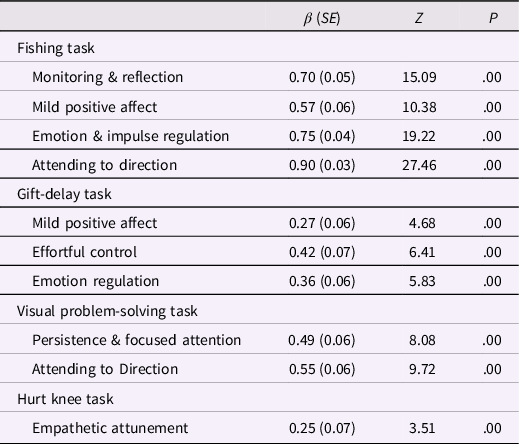
After removing the five non-ignificant scales, the 10-scale CFA model with the covaried residuals yielded great model fit (X 2 (28) = 46.94, p = 0.01, X 2/df = 1.68, RMSEA = 0.05, CFI = 0.98, TLI = 0.97, SRMR = 0.04). As shown in Table 2, all scales significantly loaded on the latent factor of child SPS and all loadings turned out in the expected direction. More specifically, greater SPS was reflected by (a) greater depth of cognitive processing, indicated by greater monitoring and careful reflection, and more persistence and focused attention during problem-solving; (b) cautious and collaborative attitude toward the experimenter, and greater empathic attunement for the experimenter’s expression of pain; (c) more mild positive affect, reflecting children’s greater positive emotionality to external stimuli; and (d) greater emotion and impulse regulation. Of further note is that some of the standardized loadings were on the moderate to low side (e.g., empathic attunement, β = 0.25). Yet, we still consider these scales to be indicators for the latent SPS factor given: (a) high internal consistency among the ten final behavioral scales (α = 0.82), suggesting that all behavioral scales measured the same construct; (b) all factor loadings were still at least modest and within the acceptable range given the large sample size (and thus the number of participants per variable) and the number of latent factor indicators (Brown, Reference Brown2006; Floyd & Widaman, Reference Floyd and Widaman1995; see examples in Wiebe et al., Reference Wiebe, Espy and Charak2008); and (c) as highlighted before, all behavioral scales, even the ones achieving relatively lower loadings (e.g., effortful control, empathic attunement), are conceptually critical dimensions that aligned with the meaning of SPS (e.g., Acevedo et al., Reference Acevedo, Aron, Aron, Sangster, Collins and Brown2014; Aron et al., Reference Aron, Aron and Jagiellowicz2012; Lionetti et al., Reference Lionetti, Aron, Aron, Klein and Pluess2019; Pluess et al., Reference Pluess, Assary, Lionetti, Lester, Krapohl, Aron and Aron2018). Finally, given our goal to evaluate the interactive effect of observed SPS with developmental experiences, we took advantage of the Mplus capacity in saving latent variable factor scores from CFA as manifest variables. More specifically, Mplus computes factor score as the maximum of the posterior distribution of the factor, which is equivalent to the widely used regression method to estimate factor scores (Estabrook & Neale, Reference Estabrook and Neale2013). The estimated factor score considers the estimated item loadings, the observed scores of our behavioral scales (e.g., monitoring and reflection), and the residual covariances among the observed scales. Then, the saved manifest variable of the child SPS was then used in all subsequent analyses, which reduced the computational complexity for large factor models (i.e., latent factor interaction).
Confirmatory factor analyses for child SPS (N = 235).

Note. All path coefficients presented in the table are standardized coefficients.
Model fit: X 2 (28) = 46.94, p = 0.01, RMSEA = 0.05, CFI = 0.98, TLI = 0.97, SRMR = 0.04.
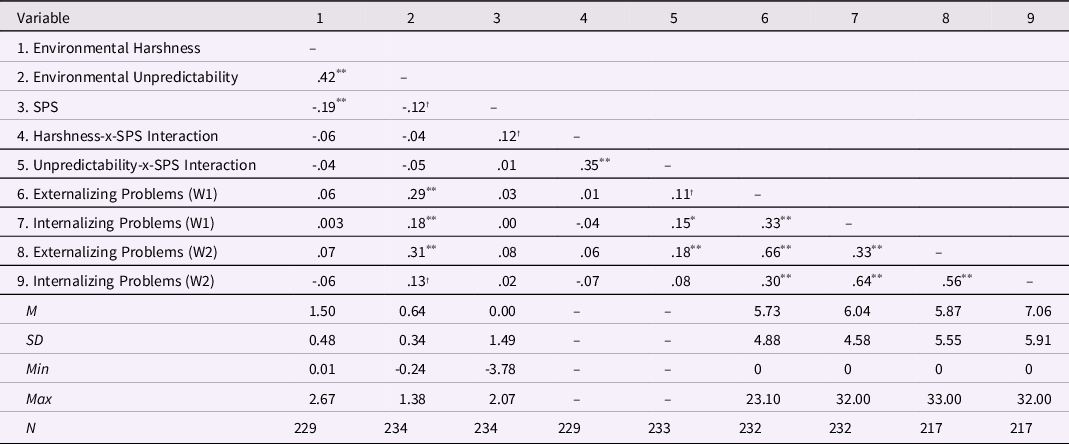
The second part of the preliminary analyses involved creating parsimonious indicators of environmental harshness and unpredictability through PCA. Notably, in contrast to adopting the confirmatory approach for data reduction for SPS due to conceptual justification that all behavioral scales should load on a single factor, here we adopted a more exploratory approach of PCA to derive the composites for environmental predictors. This was done to examine whether the indicators loaded on the single composites of harshness and unpredictability. To do so, PCA was performed separately for environmental harshness and unpredictability indicators. As shown in Supplemental Material, Table S3, a single factor emerged for both harshness (Eigenvalue = 1.91, the proportion of variance explained: 63.70%) and unpredictability (Eigenvalue = 1.32, the proportion of variance explained: 44.14%). Given these results, we created composites for environmental harshness and unpredictability by aggregating standardized indicators together (i.e., for environmental unpredictability: averaging the three standardized indicators; for harshness: adding the three standardized indicators of environmental harshness after reverse scoring [i.e., greater harshness was indicated by greater maternal harsh discipline, lower sensitivity, and lower family income-to-needs ratio]). Higher scores reflected greater environmental harshness and unpredictability, respectively. Finally, one of the goals of the present study was to evaluate the pattern of any detected interaction between child SPS and the environment. Following Roisman et al.’s (Reference Roisman, Newman, Fraley, Haltigan, Groh and Haydon2012) recommendation of testing person-x-environment interaction within the (−2, +2) SD range of the environment, we performed natural log transformation for the environmental harshness and unpredictability after adding a constant to obtain such range (see descriptive information in Table 3).
Mean, standard deviations, and the bivariate correlations for the primary variables

Note.
* P < .05.
† P < .1.
** P < .01.
Environmental harshness and unpredictability were log-transformed.
Harshness-x-SPS interaction and Unpredictability-x-SPS Interaction were both created after standardization of environmental harshness, unpredictability, and child observed SPS terms.
The former had a mean, SD, Min, and Max values equal to (−0.19, 1.01, −4.36, 4.70), respectively.
The latter had a mean, SD, Min, and Max values equal to (−0.12, 1.03, −3.71, 4.85), respectively.
Primary stage
The primary analyses involved testing whether child SPS moderated the strength of the association between environmental harshness and unpredictability and the development of child externalizing and internalizing problems. To do so, we adopted the LDS model to parameterize the intraindividual changes in externalizing and internalizing problems between the two measurement occasions (i.e., wave one to two; McArdle & Hamagami, Reference McArdle, Hamagami, Collins and Sayer2001). To avoid multicollinearity and to ensure variables were on similar scales, environmental harshness, unpredictability, and child SPS were standardized before creating the harshness-x-SPS and the unpredictability-x-SPS interaction terms. Environmental harshness, unpredictability, child SPS, and the two interaction terms were all specified as potential exogenous predictors of the LDS scores of externalizing and internalizing problems. We ran separate LDS models for externalizing and internalizing problems, and within each model, all exogenous predictors were allowed to covary. In addition, as our primary focus was to test the moderating role of SPS on environmental input, we thus did not include the environment harshness-x-unpredictability interaction, or the three-way interaction term (i.e., harshness-x-unpredictability-x-SPS interaction). Upon identifying any significant interactions, we performed the tests recommended by Roisman et al.’s (Reference Roisman, Newman, Fraley, Haltigan, Groh and Haydon2012) to rigorously probe the pattern of the interaction (i.e., differential susceptibility vs. diathesis-stress).
Results
Mean, standard deviation, and the bivariate correlation among primary study variables are presented in Table 3. Environmental harshness (i.e., lower income-to-needs ratio, harsh and insensitive maternal parenting) was moderately and positively associated with environmental unpredictability (i.e., greater family and neighborhood instability, greater household chaos), and both environmental risk factors were at least marginally correlated with lower child SPS. Turning to child functioning, although environmental harshness and unpredictability were correlated, only the latter was associated with child externalizing and internalizing problems. Furthermore, child internalizing and externalizing problems were significantly correlated with each other at both waves.
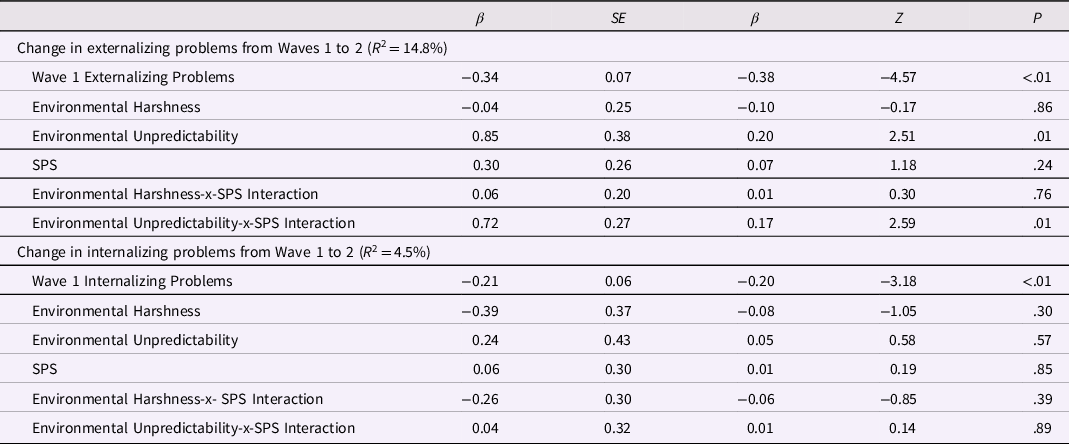
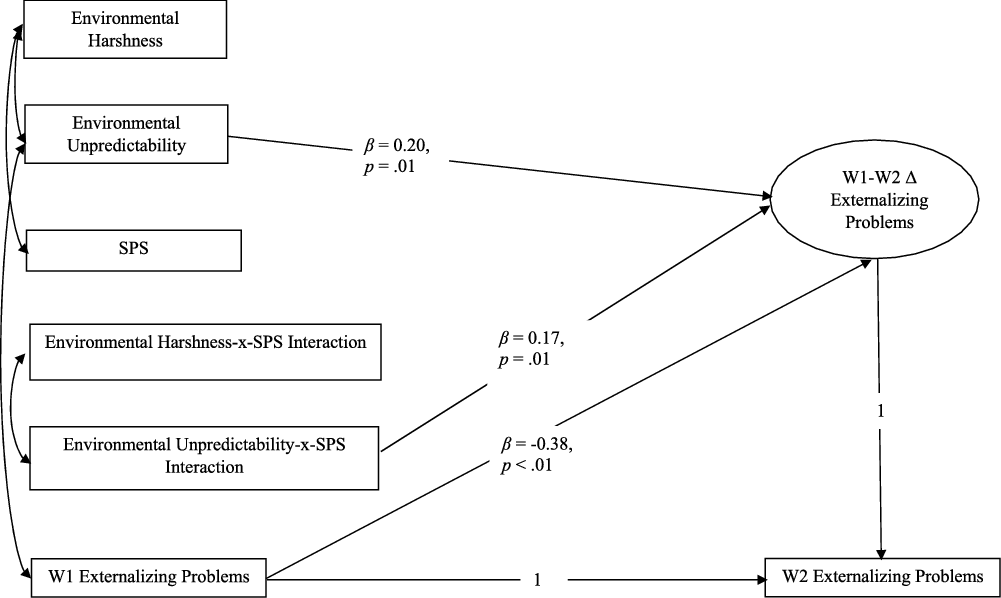
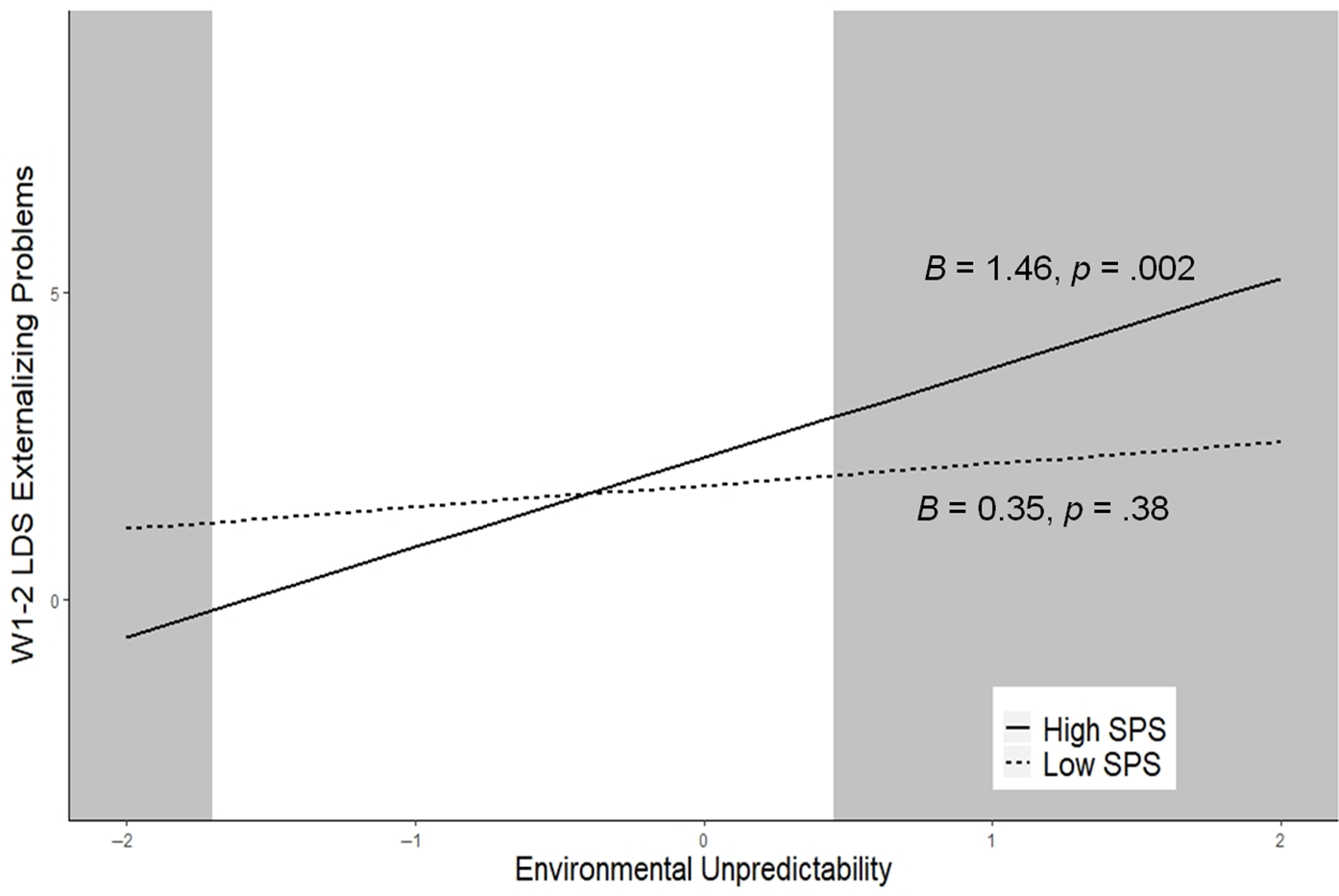
Turning to primary findings, as both LDS models (i.e., externalizing and internalizing problems) were saturated (i.e., all possible paths were estimated), these models yielded perfect model fit. As shown in Table 4 (also see Figure 1), although neither environmental harshness nor child observed SPS was associated with the changes in children’s externalizing problems, environmental unpredictability was significantly linked to the latent changes in externalizing problems. More specifically, greater environmental unpredictability was associated with greater increases in externalizing problems between the two measurement occasions. In addition, we found a significant environmental unpredictability-x-observed SPS interaction in predicting latent growth in externalizing problems. To illuminate the pattern of the interaction, we performed simple slope analyses using the cutoff values for high vs. low SPS from Lionetti et al. (Reference Lionetti, Aron, Aron, Klein and Pluess2019). High vs. low SPS were operationalized as top 25% vs. bottom 25% values of the entire sample, respectively. As shown in Figure 2, whereas the association between greater environmental unpredictability and higher increases in externalizing problems was significant for children with high SPS (i.e., top 25%, β = 1.46, p = .002), the same association was not significant for children with low SPS (i.e., bottom 25%, β = 0.35, p = .38).
Pathway coefficient estimates predicting changes in child socioemotional functioning (N = 235)

The latent difference score model examining the interactive effect of child SPS with environmental harshness and unpredictability on the growth of children’s externalizing problems. All paths were estimated whereas only significant paths were presented in the figure, and all path coefficients were standardized coefficients. W1: Wave 1; W2: Wave 2.

Environmental unpredictability-x-observed SPS on latent change of child externalizing problems. Note. Parameters presented in the figure were unstandardized coefficients. W1-2 LDS Externalizing Problems: the latent changes of externalizing problems between Wave one to two. High SPS (Solid line): top 25% observed Sensory Processing Sensitivity. Low SPS (Dotted line): bottom 25% observed SPS. Environmental Unpredictability was plotted within the (−2, +2) SD range. Gray shaded areas (i.e., X < −1.70, and X > 0.45) represents regions of significance (RoS) on X (i.e., environmental unpredictability).

Furthermore, following Roisman et al.’s (Reference Roisman, Newman, Fraley, Haltigan, Groh and Haydon2012) recommendation and Del Giudice’s (Reference Del Giudice2017) revision, we performed several follow-up tests to probe the pattern of the environmental unpredictability-x-SPS interaction. First, Regions of Significance on X test (RoS on X) indicated that the association between latent growths in externalizing problems and child SPS was significant above the standardized environmental unpredictability X = 0.45 (i.e., high environmental unpredictability) and below X = −1.70 (i.e., low environmental unpredictability). As such, given that RoS on X indicated that the association was significant on both the positive and the negative sides of the environment, RoS on X test was consistent with differential susceptibility. Second, the proportion of interaction test (PoI), which reflected the proportion of the total interaction that was represented by the ‘for-better’ side of the crossover point (i.e., low unpredictability), should be within the range of 0.20-0.80 to support for differential susceptibility (Del Giudice, Reference Del Giudice2017). Our results turned out to be 0.30 within the +/−2 standard deviation, which fell within the range to support for differential susceptibility. Finally, the percentage above (PA) test characterized the proportion of individuals showing the “for better” pattern (i.e., low environmental unpredictability à lower increases/greater decreases in externalizing problems over time), which was found to be 34% herein. Given that the PA was greater than 16% (Roisman et al., Reference Roisman, Newman, Fraley, Haltigan, Groh and Haydon2012), our result from PA test proved consistent with differential susceptibility. To sum up, all tests performed suggested that our finding for the environmental unpredictability-x- SPS interaction was consistent with differential susceptibility. That is, children with greater observed SPS not only exhibited greater increases in externalizing problems over the course of 1 year when experiencing greater environment unpredictability, but also lower increases or greater decreases in externalizing problems over the year with lower environmental unpredictability. In contrast to externalizing problems, none of our predictors were significantly associated with the changes in internalizing problems.
Discussion
Informed by Ellis et al.’s (Reference Ellis, Figueredo, Brumbach and Schlomer2009) theorization for potent dimensions of environmental adversity, the present study evaluated how environmental harshness and unpredictability were linked to the development of children’s socioemotional functioning during early childhood. In addition, we evaluated whether child SPS measured through behavioral observational methods moderated the effects of environmental harshness and unpredictability. We found that greater environmental unpredictability—but not harshness—was associated with greater increases in child externalizing problems over a year. In addition, the role of environmental unpredictability was characterized by its interaction with children’s SPS in a way that was consistent with differential susceptibility. Children with greater SPS displayed greater increases in externalizing problems over time under high environmental unpredictability, but also lower increases/greater decreases in externalizing problems under low unpredictability. Low SPS children, however, did not show any significant links between developmental experiences and the changes in externalizing problems. Our findings also demonstrated the feasibility of measuring SPS through the behavioral observational method, in that multiple behavioral scales developed according to the theoretical definition of SPS (Aron, Reference Aron2002; Aron et al., Reference Aron, Aron and Jagiellowicz2012) loaded on a latent factor of child SPS, which seemed to operate in an expected manner (i.e., high SPS seemed to reflect children’s greater susceptibility to environmental input).
Our study documented a positive association between environmental unpredictability and greater increases in externalizing problems over time. This finding proved consistent with theory (Ellis et al., Reference Ellis, Figueredo, Brumbach and Schlomer2009) and previous research that adopted different operationalizations for environmental unpredictability (e.g., Belsky et al., Reference Belsky, Schlomer and Ellis2012; Li et al., Reference Li, Sturge-Apple, Martin and Davies2019; Simpson et al., Reference Simpson, Griskevicius, Kuo, Sung and Collins2012). This may be because an unpredictable environment might foster the development of a faster life history strategy—a strategy adaptive to the unpredictable environment—which can be manifested by greater externalizing problems and risk-taking (Belsky et al., Reference Belsky, Steinberg and Draper1991; Ellis et al., Reference Ellis, Figueredo, Brumbach and Schlomer2009). However, our finding also revealed that this association may depend upon children’s SPS, particularly for externalizing problems. Of important note, although Ellis et al. (Reference Ellis, Figueredo, Brumbach and Schlomer2009) highlighted the role of environmental unpredictability, our finding for the unpredictability-x-SPS interaction adds to the existing literature by demonstrating that such unpredictable signals might be even more salient to some individuals (i.e., high SPS children) than others.
More specifically, whereas children with high SPS (i.e., the top 25%) who were exposed to greater environmental unpredictability developed greater increases in externalizing problems over a year, this association did not seem to apply in our study to children with low SPS (i.e., the bottom 25%). Furthermore, follow-up analyses adopting Roisman et al. (Reference Roisman, Newman, Fraley, Haltigan, Groh and Haydon2012) recommended tests suggested that the documented environment unpredictability-x-SPS interaction proved consistent with the differential susceptibility pattern. That is, although high SPS children developed greater increases in externalizing problems under high environmental unpredictability, these children also displayed lower increases/greater decreases in externalizing problems over time when raised under low unpredictability. In contrast, the lack of sensitivity to the external environment for low SPS children was manifested by the null association between unpredictability and the changes in externalizing problems. These findings were consistent with previous research which indicated that high SPS may operate as a marker for individuals’ heightened sensitivity to environmental stimuli, and more specifically, not only to adversity but also to the positive environment (e.g., Lionetti et al., Reference Lionetti, Aron, Aron, Klein and Pluess2019; Slagt et al., Reference Slagt, Dubas, van Aken, Ellis and Deković2018). After all, high SPS reflected a more sensitive central nervous system which renders the individuals to be more likely to process both positive and negative stimuli more thoroughly and deeply (Aron et al., Reference Aron, Aron and Jagiellowicz2012; Jagiellowicz et al., Reference Jagiellowicz, Xu, Aron, Aron, Cao, Feng and Weng2011).
In contrast to unpredictability, neither harshness nor the harshness-x-SPS interaction was significantly linked to child functioning in the present study. This finding was consistent with previous research which documented a broader and stronger role of environmental unpredictability, in contrast to harshness, in association with individual development (e.g., Doom et al., 2015; Simpson et al., Reference Simpson, Griskevicius, Kuo, Sung and Collins2012). For example, Simpson et al.’s (Reference Simpson, Griskevicius, Kuo, Sung and Collins2012) examined the predicting power of environmental harshness (i.e., family socioeconomic status) vs. unpredictability (e.g., paternal transitions, residential changes) and revealed a stronger effect of early-life unpredictability (i.e., age 0–5) in a prospective longitudinal study. That is, experiences of greater environmental unpredictability, but not harshness, predicted more aggressive behavior and delinquency, criminal activities, and more promiscuous sexual relationships in adulthood. Turning to the findings, we speculate that the null finding for environmental harshness might be attributed to two factors. First, our low- to middle-SES sample might not capture extreme values of harshness (e.g., poverty, extremely harsh, insensitive parenting) that foster substantial growth of externalizing problems during early childhood. Second, unpredictability, in contrast to harshness, might be a more salient factor that shapes the development of externalizing problems. That is, it might be harder for children to anticipate, prepare, and cope with unpredictable stressors (rather than harsh but relatively predictable environmental conditions). Thus, children exposed to unpredictability may experience greater “pressure” to shift LH strategy toward the faster end (i.e., demonstrating greater externalizing problems).
Turning to internalizing problems, the present work did not find any environmental or child factors that were significantly linked to the growth in internalizing problems. Here we advance two potential explanations. First, the evolutionary perspective highlights the role of environmental adversity (i.e., harshness and unpredictability) in promoting the development of a faster life history strategy, usually indicated by greater risk-taking, externalizing problems, lack of impulse control, and sexual promiscuity (Ellis et al., Reference Ellis, Figueredo, Brumbach and Schlomer2009). These risky strategies may enhance adaptive fitness under harsh and unpredictable environment, or at least once did, thus helping children navigate risky environment. That said, internalizing problems are not considered as a direct marker of life-history strategy that is regulated by environmental harshness and unpredictability. Second, symptoms for internalizing problems are mainly manifested as anxiety, sad affect, and withdrawal during early childhood (e.g., Gilliom & Shaw, Reference Gilliom and Shaw2004). Although our measurement for internalizing problems captured anxiety and depression (i.e., sad affect), it did not tap on the withdrawal component which may be more indicative of life-history strategies. Finally, in contrast to externalizing problems, signs for internalizing problems might be more subtle and harder to notice, even in early childhood, rendering in greater challenges for internalizing problems to be accurately assessed through parent-report.
Moving to another major goal of the present study, the present work is one of the first endeavors to assess young children’s SPS through the behavioral observational method (see Lionetti et al., Reference Lionetti, Aron, Aron, Klein and Pluess2019). Before the development of the behavioral rating systems, SPS was predominantly measured by the self- or parent-report surveys (e.g., the adult-version HSP questionnaire [Aron & Aron, Reference Aron and Aron1997], and the child-version HSC questionnaire [Pluess et al., Reference Pluess, Assary, Lionetti, Lester, Krapohl, Aron and Aron2018]). Behavioral observation, however, offers a more objective measure and a richer characterization of children’s SPS on multiple facets during early childhood. Inspired by the theoretical meaning of SPS, we selected multiple laboratory tasks that were relevant and would evoke children’s responses reflecting their heightened sensitivity to the external environment. Evaluation for the psychometric property through confirmatory factor analysis yielded an overall SPS factor, capturing most of the behavioral scales we developed.
More specifically, the overall SPS factor captured the critical theoretical characteristics of SPS highlighted by previous work (Aron & Aron, Reference Aron and Aron1997; Aron et al., Reference Aron, Aron and Jagiellowicz2012; Greven et al., Reference Greven, Lionetti, Booth, Aron, Fox, Schendan, Pluess, Bruining, Acevedo, Bijttebier and Homberg2019; Lionetti et al., Reference Lionetti, Aron, Aron, Klein and Pluess2019), including (a) thorough, perseverant, and in-depth cognitive processing; (b) greater emotional reactivity to external stimuli; (c) cautious yet collaborative attitude toward the experimenter, reflecting their openness to the interpersonal experiences coupled with inhibition to novel stimuli (i.e., unfamiliar adult figure); (d) greater empathy and awareness of other’s emotion expressed in a cautious and low-approach manner; and (e) greater emotion- and impulse- regulation, reflecting children’s cautious and subdued manner in terms of behaving and expressing their emotions. All these traits may reflect a more sensitive central nervous system, which tends to process the information on a deeper and more complex level and to generate more emotional responses to external stimuli. Of additional note is that our observational measurement of child SPS seemed to capture a relatively independent trait that was not highly correlated with more traditional temperament dimensions (See Supplemental Material, Table S4).
Notably, however, several behavioral rating scales we developed did not load on the overall SPS factor. To begin with, although Aron et al. (Reference Aron, Aron and Jagiellowicz2012) highlighted that SPS entailed characteristics of greater inhibition to novelty and the tendency to “pause and check,” the fearful distress scales in our study did not significantly share common variance with other scales that were captured by the overall SPS. We speculate that this may be due to two reasons. First, in our stranger approach tasks (i.e., bag lady and clown tasks), parents were in the room with children. As such, although we observed a substantial amount of fearful responses to the stranger (see more details in Supplemental Material, Table S1), the presence of the parents may nevertheless help ease the children’s fearfulness to a certain degree. Second, in contrast to the stranger who tried to engage children in a conversation in the Lab-TAB episodes, the stranger in our study did not interact with children in any way (e.g., verbally). That said, without the pressure of interacting with the stranger, we speculate that some children might not fully comprehend the threat and/or stress posed by the stranger.
In addition to fearful distress scales, behavioral scales from the puzzle box tasks also did not significantly load on the SPS factor. This might be attributed to two potential reasons. First, in contrast to the transparent box task (i.e., children were given a wrong key for a transparent box, which contained an attractive toy; Lionetti et al., Reference Lionetti, Aron, Aron, Klein and Pluess2019), our puzzle box task involved three consecutive steps and required children to integrate multiple tools (i.e., two sticks and a pulley system) to successfully solve the task. As such, the task was more difficult than the transparent box task and might exceed 3-year-olds’ problem-solving capacity (e.g., some children may be more likely to give up). Second, unlike the visual problem-solving task, the puzzle-box task involved an attractive toy, which might trigger different underlying processes (e.g., reward-driven problem solving, Suor et al., Reference Suor, Sturge-Apple, Davies and Cicchetti2017) compared to task evaluating the “cold” cognitive processing. These speculations warrant future validation in older children and/or alternative task forms. As a final comment, our behavioral rating system did not have tasks and scales specifically designed to measure child’s sensitivity to subtle stimuli (e.g., sounds, taste, and detailed characteristic of the surrounding environment) and children’s lower threshold for overstimulation (e.g., by loud noise, or having too many things to do). Given both aspects are important traits of SPS, we thus encourage future research to assess these traits as well. Taken together, despite the limitations, our observational system measures many key characteristics of SPS, some of which are challenging to assess via self-report questionnaires (e.g., depth of cognitive processing). Thus, our system may at least be used in combination with questionnaire to obtain more robust measurement of SPS.
Several limitations of this study are worth mentioning. First, the present sample mainly consisted of low- to middle-SES families, thus the generalization of the finding should be cautious. This is particularly the case since the majority of the children in our sample were living with both biological parents at the beginning of the study, thus may experience fewer unpredictability due to the transitions of parental figures. Second, although we utilized a multimethod (i.e., survey, observation) and longitudinal design, child functioning was measured only through mother-report. Future research might employ additional methods (e.g., experiment, observation) to assess child development. Third, rather than simply undermining development, exposure to harshness and unpredictability may shape the development toward being adaptive under risky environment. That is, children experienced harsh and unpredictable environment may exhibit comparable or even enhanced functioning in certain domain (e.g., working memory updating; see reviews in: Ellis et al., Reference Ellis, Abrams, Masten, Sternberg, Tottenham and Frankenhuis2020; Ellis et al., Reference Ellis, Bianchi, Griskevicius and Frankenhuis2017; Young et al., Reference Young, Griskevicius, Simpson, Waters and Mittal2018). Yet, the present study only involves negative child sequelae (i.e., externalizing and internalizing problems) and thus is limited in the capacity to test how children adapt to risky environment (by showing enhanced performance). We encourage future endeavors to empirically test this promising proposition. Furthermore, although the field has called for the assessment of both positive and negative ends of the environment to test differential susceptibility (Ellis et al., Reference Ellis, Boyce, Belsky, Bakermans-Kranenburg and Van IJzendoorn2011), our environmental unpredictability measure only involves the negative end (i.e., unpredictability vs. the absence of unpredictability). Future research is thus encouraged to assess the positive side of the environment as well (i.e., being highly stable or predictable).
Despite the limitations, the present study illuminated the role of environmental unpredictability, directly and in interaction with child SPS—in shaping the development of young children’s socioemotional functioning. In addition, we validated a novel observational rating system to measure SPS in young children, which seemed to operate as a marker for children’s heightened sensitivity to both positive and negative environmental influences. By adopting a dimensional approach and illuminating differential effects of environmental harshness and unpredictability, our finding highlighted the importance of gaining greater specificity for understanding the impact of environmental adversity. Our findings also have implications for interventional studies by identifying the potential targets (i.e., high SPS children) who seemed to be more strongly affected by unpredictable and volatile early-rearing context. Finally, this study developed and validated a novel observational rating system for child SPS, and future research may benefit from adopting such method to obtain an objective and rigorous measurement of the personality trait of SPS during early childhood.
Supplementary material
The supplementary material for this article can be found at https://doi.org/10.1017/S0954579421001188
Acknowledgments
We are grateful to the children and parents who participated in this project. Our gratitude is expressed to the staff on the project at Mt. Hope Family Center and the graduate and undergraduate students at the University of Rochester.
Funding statement
This research was supported by the Eunice Kennedy Shriver National Institute of Child Health & Human Development awarded to Melissa L. Sturge-Apple and Patrick T. Davies (5R01HD087761).
Conflicts of interest
None.