Introduction
There is a pervasive and strong belief within social sciences that education is positively associated with health. Numerous empirical studies have focused on the protective effects of education on adult health (Arendt, Reference Arendt2005; Lleras-Muney, Reference Lleras-Muney2005; Cutler & Lleras-Muney, 2006; Silles, Reference Silles2009; Clark & Royer, Reference Clark and Royer2013; Gathmann et al., Reference Gathmann, Jürges and Reinhold2015) as well as its downward spillover effects on children’s health (Currie & Moretti, Reference Currie and Moretti2003; Lindeboom et al., Reference Lindeboom, Llena-Nozal and van der Klaauw2009; Chou et al., Reference Chou, Liu, Grossman and Joyce2010; McCrary & Royer, Reference McCrary and Royer2011; Grepin & Bharadwaj, Reference Grepin and Bharadwaj2015). Recent studies have also shed light on the previously understudied upward spillover effects of education on parental health (De Neve & Kawachi, Reference De Neve and Kawachi2017). Such studies have revealed that more educated children possess up-to-date healthcare knowledge to share with their parents (Lundborg & Majlesi, Reference Lundborg and Majlesi2018; Liu, Reference Liu2021) and have more resources to support and care for their parents (Torssander, Reference Torssander2013; Yahirun et al., Reference Yahirun, Sheehan and Hayward2017; Ma, Reference Ma2019), thus leading to a positive impact on parental health (Zimmer et al., Reference Zimmer, Martin, Ofstedal and Chuang2007; Friedman & Mare, Reference Friedman and Mare2014; De Neve & Fink, Reference De Neve and Fink2018; Ma, Reference Ma2019; Liu, Reference Liu2021; Liu et al., Reference Liu, Ma and Smith2022).
Although correlational and causal studies have demonstrated a positive relationship between children’s education and parental health, the majority of research has focused on static health outcomes using cross-sectional data (Zimmer et al., Reference Zimmer, Martin, Ofstedal and Chuang2007; Torssander, Reference Torssander2013; De Neve & Kawachi, Reference De Neve and Kawachi2017; Lundborg & Majlesi, Reference Lundborg and Majlesi2018; Ma, Reference Ma2019; Liu, Reference Liu2021; Liu et al., Reference Liu, Ma and Smith2022). Little research has been conducted to investigate whether and how adult children’s education affects their older parents’ health changes dynamically over time. As the ageing process is dynamic, the health status of older parents may vary over time. Health trends for older adults have been the subject of much attention in the past few decades due to the rising costs of medical and long-term care (Parker & Thorslund, Reference Parker and Thorslund2007). Different hypotheses are postulated regarding the health trends of older adults, along with the rises in life expectancy around the world (Crimmins & Beltrán-Sánchez, Reference Crimmins and Beltrán-Sánchez2011). The compression of morbidity hypothesis suggests that a lengthening in life expectancy comes with a delay in disability, thereby shortening the period of morbidity (Fries, Reference Fries1980). Conversely, the expansion of morbidity hypothesis posits that increasing life expectancy causes the health of older adults to deteriorate over longer periods (Gruenberg, Reference Gruenberg2005). Although various studies worldwide have provided evidence for both hypotheses, there is no consensus on health trends for older adults (Chatterji et al., Reference Chatterji, Byles, Cutler, Seeman and Verdes2015). Examining parental health beyond a single time point enables us to better understand this complex process. With respect to the potential role of children’s schooling in parental health changes, it is possible that once parents reach a certain age, children’s education no longer has an influence. Alternatively, children’s education may have an incremental effect, consistently preventing health problems or improving the health conditions of older parents over time. Investigating the influence on both short- and long-term changes can provide a more thorough understanding of the dynamics involved.
Only two correlational studies have analysed the relationship between children’s education and parental health changes over time. Yahirun et al. (Reference Yahirun, Sheehan and Hayward2017) used longitudinal data from Mexico and found that children’s education was not associated with short-term changes in the physical functioning of parents but was positively associated with parental longevity. Lee (Reference Lee2018) examined the long-term relationship in South Korea and found that adult children’s education was negatively associated with the cognitive decline of ageing parents over an 8-year period. These two studies provide some correlational evidence; however, it is not yet clear whether this relationship is causal. If adult children’s education does indeed prevent parental health decline over time, then the returns to education in terms of health may be larger than what is documented in the existing literature. Moreover, the pressure of increasing medical and long-term care costs for individuals and their households can also be alleviated.
This issue is especially important in rural China, where the growth of older population is taking place in parallel with poor health, limited access to healthcare, and inadequate public old-age support. Traditional Chinese culture places a strong emphasis on filial piety, advocating that adult children show respect and take responsibility for their older parents. When rural older parents are faced with poor health and an immature healthcare and pension system, they have to rely heavily on their adult children for support. As such, the educational attainment of adult children may be a critical resource in determining older parents’ changes in health.
In this study, by utilising nationally representative longitudinal data from China Health and Retirement Longitudinal Study (CHARLS) and by exploiting the geographic variations in proximity to junior high school as the instrument for adult children’s education, we implement the instrumental variable identification strategy to estimate the causal effect of adult children’s education on short- and long-term parental health changes in rural China. Previous studies of changes in health among older adults focused on the trends in disability (Manton, Reference Manton1988; Singer & Manton,Reference Singer and Manton1998; Fries, Reference Fries2002; Parker & Thorslund, Reference Parker and Thorslund2007; Chatterji et al., Reference Chatterji, Byles, Cutler, Seeman and Verdes2015). The primary reason for this focus is that disability typically results in increased medical and long-term care expenses (Fried et al., Reference Fried, Bradley, Williams and Tinetti2001; de Meijer et al., Reference de Meijer, Koopmanschap, D’ Uva and van Doorslaer2011). In line with this literature (Manton, Reference Manton1988; Freedman et al., Reference Freedman, Martin and Schoeni2002; Parker & Thorslund, Reference Parker and Thorslund2007; Chatterji et al., Reference Chatterji, Byles, Cutler, Seeman and Verdes2015), we use common indicators of disability – difficulties in activities of daily living (ADL) and instrumental activities of daily living (IADL). ADL and IADL assess an individual’s ability to live independently (Katz et al., Reference Katz, Ford, Moskowitz, Jackson and Jaffe1963; Lawton & Brody, Reference Lawton and Brody1969). Difficulties in ADL and IADL often reflect issues with physical and cognitive health.
In addition to estimating the average effect, we also investigate the possible heterogeneities among parents with different educational attainments and different genders. After investigating whether adult children’s education affects short- and long-term parental health changes, we analyse the channels through which the children’s education may play a role in parental health dynamically. The exploration of both the casual relationship and mechanisms is essential for understanding and improving the health of older parents later in life.
Background and hypothesis
Institutional context in rural China
The ageing of China’s population is occurring at a much faster rate than in many other high-income and low- and middle-income countries (Chen et al., Reference Chen, Giles, Yao, Yip, Meng, Berkman and Zhao2022). In 2021, there were 200.6 million people aged 65 and over, which accounted for 14.2% of the total population. According to the United Nations, this number is projected to reach 366 million by 2050, making up more than 26% of the population.Footnote 1 This rapid ageing has created considerable challenges for the healthcare system and raised concerns about the health of older adults in China, particularly those living in rural areas. Despite the significant economic growth China has experienced in recent decades, rural older people have not benefited much from this process (Cai et al., Reference Cai, Giles, O’Keefe and Wang2012). The health and functional status of rural older people is substantially poorer than their urban counterparts (Liu et al., Reference Liu, Hsiao and Eggleston1999; Zimmer et al., Reference Zimmer, Martin, Ofstedal and Chuang2007; Dong & Simon Reference Dong and Simon2009; Jiang & Wang, Reference Jiang and Wang2018). According to the baseline wave (2011) of CHARLS, 21.9% and 27.2% of adults aged 50 and over living in rural areas need assistance with their daily activities as indicated by ADL and IADL, compared to 15.3% and 19.1% of those living in urban areas. Furthermore, the access to healthcare services and other social and environmental factors that influence older people’s health also differ considerably between rural and urban areas (Chen et al., Reference Chen, Giles, Yao, Yip, Meng, Berkman and Zhao2022). According to the National Bureau of Statistics, in 2020 there were 4.95 medical institution beds and 2.06 licensed physicians per 1,000 citizens in rural areas, in comparison to 8.81 beds and 4.25 licensed physicians per 1,000 in urban areas.Footnote 2 The healthcare utilisation and health literacy also differed substantially between rural and urban areas (Liu et al., Reference Liu, Zhang, Lu, Kwon and Quan2007; Li et al., Reference Li, Shi, Liang, Ding and Xu2018). All of these suggest the disadvantages in the health trend of rural older people.
Older adults in rural China rely heavily on their adult children for old-age support and care. Despite that the social security system has expanded to rural areas in recent years, the monthly pension and replacement ratio for rural older residents were very low. In 2018, the median pension income for rural residents was 90 yuan, in sharp contrast to 2,700 yuan for urban residents (Giles et al., 2021). The average replacement ratio was 20% for rural people and 60–90% for urban employees (Fang & Feng, Reference Fang and Feng2018). Due to the insufficient social security, older parents in rural areas depend highly on resources from their adult children. Furthermore, there barely exists any long-term care hospital or insurance in rural China. The government has implemented a long-term care insurance pilot programme since 2016, yet few pilot cities cover rural residents and the eligibility to claim for the insurance is very stringent (Feng, et al., Reference Feng, Glinskaya, Chen, Gong, Qiu, Xu and Yip2020). Additionally, there is a large intergenerational education gap in rural China. According to our sample from the 2011 CHARLS, the average years of schooling for rural older parents is 4.04, which is less than half of that for their most-educated adult children (9.82). When rural older adults are unhealthy and need long-term care, they are likely to rely on resources such as material and informational support from their adult children. This is especially important for disadvantaged parents whose educational attainment is much lower than that of their adult children. Research shows that education is positively correlated with the ability to acquire and understand health-related information (van der Heide et al. Reference van der Heide, Wang, Droomers, Spreeuwenberg, Rademakers and Uiters2013). It is possible that when the education gap between parents and children is large, parents can learn more health knowledge from their adult children and thus benefit more from adult children’s education. Furthermore, adult children from rural areas have a strong sense of family obligations (Fuligni & Zhang, Reference Fuligni and Zhang2004), and they are thus heavily involved in the lives of their aged parents. In this context, adult children’s socio-economic status may be crucial in affecting older parents’ changes in health in later life.
Linking adult children’s education to changes in parental health
How might adult children’ education affect parental health has been widely discussed (Berkman et al., Reference Berkman, Glass, Brissette and Seeman2000; Torssander, Reference Torssander2013; Friedman & Mare, Reference Friedman and Mare2014; Lee, Reference Lee2018; Ma, Reference Ma2019; Liu, Reference Liu2021; Liu et al., Reference Liu, Ma and Smith2022). These pathways may also be relevant when considering dynamic changes in parental health over time. Generally, they are informational support, access to resources, psychological well-being, and behavioural influence.
Informational support refers to the provision of advice or guidance for health-related issues from children to parents. As education is positively associated with health literacy (van der Heide et al. Reference van der Heide, Wang, Droomers, Spreeuwenberg, Rademakers and Uiters2013), children with higher levels of education may be better at obtaining, processing and comprehending up-to-date health information, and subsequently passing it on to parents. For example, children can alert parents to the importance of preventive care and suggest regular physical examinations (Liu, Reference Liu2021). Moreover, if parents are suffering from chronic diseases, children can provide then with effective instructions on how to manage the chronic diseases (Liu et al., Reference Liu, Ma and Smith2022). The informational support is especially crucial when there is a large intergenerational gap in educational attainment, as is the case in rural China.
Access to resources mainly refers to the material resources that parents can use to improve health. Evidence from China suggests that adult children with higher levels of education provide more financial support to their older parents (Xie & Zhu, Reference Xie and Zhu2009; Cong & Silverstein, 2016; Zhu, Reference Zhu2016; Pei & Cong, Reference Pei and Cong2020). The transferred wealth allows parents to consume healthier food and better healthcare services. It can also be used to improve parents’ living environment through the use of clean cooking fuel and better sanitation facilities (Ma, Reference Ma2019). All of these are important for the maintenance of older parents’ health.
Psychological well-being comprises of both hedonic and eudemonic happiness, as well as resilience (Ryff, Reference Ryff1995; Kahneman et al., Reference Kahneman, Diener and Schwarz2003; Steptoe, et al., Reference Steptoe, Deaton and Stone2015). In Asian cultures, where educational achievement is highly valued, it has been found that having better-educated children can increase morale or decrease depression among parents (Lee, et al., 2018; Wang et al., 2020; Pei et al., Reference Pei, Cong and Wu2020). Previous studies suggest that psychological well-being has a protective role in relation to cardiovascular disease and mortality (Chida & Steptoe, Reference Chida and Steptoe2008; Davidson et al., Reference Davidson, Mostofsky and Whang2010; Boehm & Kubzansky, Reference Boehm and Kubzansky2012; Steptoe et al., Reference Steptoe, Deaton and Stone2015). As cardiovascular disease is one of the leading causes of disability (World Health Organization & World Bank, 2011), children’s education may affect parental activity limitation by influencing their psychological well-being.
Behavioural influence means better-educated children may help parents perform better health behaviours (Friedman & Mare, Reference Friedman and Mare2014). It has been largely demonstrated that education is inversely correlated with unhealthy lifestyle behaviours, such as smoking, excessive drinking, and physical inactivity (de Walque, Reference de Walque2007; Cutler and Lleras-Muney, Reference Cutler and Lleras-Muney2010; Pampel et al., Reference Pampel, Krueger and Denney2010). More educated children with better health knowledge can persuade their parents to choose healthier lifestyles or give up unhealthy habits. They can also be the ‘role models’, leading parents to imitate their own healthier lifestyle behaviours through social influence (Ram et al. Reference Ram, Dave, Lancki, Moran, Puri-Taneja, Mammen and Kandula2022). Furthermore, studies have demonstrated that smoking and excessive drinking increase the risks of impaired ADL and IADL (Moore et al., Reference Moore, Endo and Carter2003; Jung et al., Reference Jung, Ostbye and Park2006; Takashima et al., Reference Takashima, Miura, Hozawa, Okamura, Hayakawa, Okuda and Ueshima2010; León-Muñoz et al., Reference León-Muñoz, Guallar-Castillón, García-Esquinas, Galán and Rodríguez-Artalejo2017; Amiri & Behnezhad, Reference Amiri and Behnezhad2020), while physical activity can improve older people’s ability to carry out ADL and IADL (Chou et al., Reference Chou, Hwang and Wu2012; Tak et al., Reference Tak, Kuiper, Chorus and Hopman-Rock2013; Roberts et al., Reference Roberts, Phillips, Cooper, Gray and Allan2017). As a result, behavioural influence may be one pathway by which adult children’s education can lead to changes in ADL and IADL.
Hypotheses
Hypothesis 1 Adult children’s education has a positive impact on parental health changes over time. In other words, increasing in adult children’s years of schooling can prevent older parents from experiencing health decline in ADL and IADL. Additionally, the effect of adult children’s education on parental health changes is particularly pronounced for less-educated older parents.
Hypothesis 2 The pathways through which adult children’s education can affect their parental health changes may include informational support, access to resources, psychological well-being, and behavioural influence.
Data
This study utilises data from CHARLS, which is similar in design to other widely studied ageing surveys, such as the Health and Retirement Study in the USA and the English Longitudinal Study of Ageing. CHARLS has collected a representative national sample of Chinese people aged 45 and over from 450 villages and communities in 27 provinces since 2011,Footnote 3 with additional data collected in 2013, 2015, and 2018. The survey contains comprehensive information relevant to this study, including basic demographics of both parents and children, the health status and health behaviours of parents, and health-related consumption and living environment information at the household level. We analyse the impact on short-term changes using data from the first two waves in 2011 and 2013, and the long-term analysis is based on data from the baseline wave and the latest wave in 2018.
Sample
The baseline sample includes 7,987 rural older parents aged 50 and over who had at least one child aged 23 years and over at the baseline wave and were followed at least once in later waves.Footnote 4 However, 255 respondents had missing information on the main control variables, such as insurance status and work status, and 18 respondents did not report their health status for at least two waves, so they were excluded from the analysis. The final analytical sample consists of 7,714 parents from 279 villages. The observations are 7,298 and 6,646 for the short-term and long-term analysis, respectively.
Parental health change
The dependent variables in this study are changes in parental health, which are assessed using the measures of ADL and IADL. Specifically, ADL represents the sum of difficulties in the following activities: eating; dressing; bathing; controlling urination; and getting in and out of bed (Katz et al., Reference Katz, Ford, Moskowitz, Jackson and Jaffe1963). IADL is measured by the sum of difficulties in managing money, taking medication, shopping for groceries, preparing hot meals, and cleaning house (Lawton & Brody, Reference Lawton and Brody1969). To measure changes over short and long term, a dichotomous variable is used, taking the value of 1 if one has more difficulties in the later wave, and 0 otherwise.
Children’s education
The main explanatory variable is adult children’s education, which is measured in years of schooling, ranging from 0 for illiteracy to 21 for having a doctoral degree. Following existing literature on children’s education and parental health (De Neve & Fink, Reference De Neve and Fink2018; Ma, Reference Ma2019; Liu, Reference Liu2021), we measure children’s education from the highest educated adult child. The rationale for this is that adult children with more education may be able to provide more resources and informational support to their parents, thus contributing the most towards the health of their older parents (Zimmer et al., Reference Zimmer, Kaneda and Spess2007). Therefore, in the main analysis, the variable of children’s education refers to the years of schooling of the highest educated adult child aged 23 years and over. We also conduct robustness checks by using alternative measures of children’s education, such as the average years of schooling of all children or the years of schooling of the most educated adult child aged 16 years and over.
Control variables
The control variables used in this study are from the baseline wave and include a range of variables that are correlated with parental health changes. The variables comprise parents’ demographic characteristics such as age, gender, married status, years of schooling, work, and co-residence status (Lee, Reference Lee2018; Liu, Reference Liu2021). Additionally, the age and gender of the highest educated child are included (Lundborg & Majlesi, Reference Lundborg and Majlesi2018; Liu et al., Reference Liu, Ma and Smith2022), with the information of the eldest being used in cases where there is more than one highest educated child. Health insurance status (Cheng et al., Reference Cheng, Liu, Zhang, Shen and Zeng2015) and health during childhood (Smith et al., Reference Smith, Shen, Strauss, Zhe and Zhao2012) are also included as control variables, as they are known to be important factors for one’s health in China. Finally, household-level characteristics that may play a role in parental health, such as number of children and per capita expenditure, are also included (Yahirun et al., Reference Yahirun, Sheehan and Hayward2017). The detailed definitions for each variable are listed in Table 1.
Summarised statistics for main analysis

Mechanism variables
The mechanism variables are based on the discussion of pathways linking adult children’s education to changes in parental health, as outlined in Section 2. The measures for informational support are utilisations of healthcare services, such as regular physical examinations and whether take any treatment while having a certain kind of chronic disease. The measures for access to resources are health-related expenditure, access to flush toilets, and access to clean cooking fuel. The measure for psychological well-being is parental life satisfaction. The measures for lifestyle behaviours include current smoking behaviour, changes in the number of cigarettes consumed per day, frequent-drinking behaviour, and physical activity. As the exploration of the pathways is to understand changes in parental health over time, the construction of the mechanism variables considers status in both waves. They are either the changes between two waves or the consistency of behaviours in both waves. For example, the variable of health-related expenditure is the change of the health-related expenditure (in CNY) between two waves. The variable of physical examination is binary, taking the value of 1 if parents have regular physical examination in both waves. The detailed definitions for each mechanism variable are listed in Table 2.
Summarised statistics for mechanism variables

Model
In general, the model that captures the relationship between parental health change and children’s education would take the following form:
 $${Y_{ijc}} = {\alpha _0} + {\alpha _1}child\_years\_of\_schoolin{g_{ijc}} + {\alpha _2}{X_{ijc}} + {\lambda _j} + {\mu _{ijc\;}}$$
In Eq. (1),
 ${Y_{ijc}}$
represents the variables for both short-term and long-term health changes for individual
 $i$
from village
 $j$
in county
 $c$
.
 $child\_years\_of\_schoolin{g_{ijc}}$
is adult children’s education, which is measured as years of schooling for the highest educated adult child aged over 23 years.
 ${X_{ijc}}$
is a vector of control variables discussed in the data section.
 ${\lambda _j}\;$
is the village fixed effects that account for the time-invariant village characteristics.
 ${\mu _{ijc\;}}$
is the error term that captures other unobservable characteristics.
We are interested in exploring the causal relationship between children’s education and parental health changes. However, the coefficient
 ${\alpha _1}$
in Eq. (1) may be correlated with other unobserved characteristics (e.g. genes) that influence changes in parental health over time. This would only reflect the correlation, rather than the causality from children’s education to parental health changes. To overcome the endogeneity problem and estimate the causality, we need an appropriate Instrumental Variable (IV) that correlates with children’s education, but is unrelated to the error term. In this case, children’s education only influences parental health changes through the IV channel, thus obtaining an unbiased estimator. In this paper, we follow previous studies (Card, Reference Card, Christophides, Grant and Swidinsky1995; Kane & Rouse, Reference Kane and Rouse1995; Liu, Reference Liu2021) and exploit the supply-side variation of education: proximity to schools, as the IV. The logic is that variation in distance to schools directly affects the financial cost of attending school. Longer distances cause greater expenditure, such as higher transportation cost and higher living expenses resulting from the increased probability of living on campus (compared with living at home). Longer distances also indicate lower household income, as more time is required to commute, leaving children with less time to do household farm work. Consequently, an increased distance to school is negatively associated with the chances of children attending school, thus affecting their educational attainment.
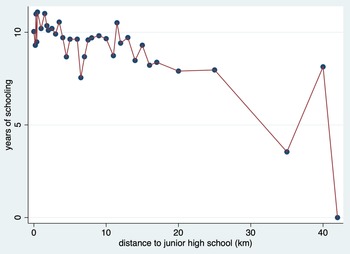
Following Liu (Reference Liu2021), we use the distance to junior high school as the IV for adult children’s education. In the baseline wave of CHARLS, distances to the nearest primary, junior high, and high school are available from the village survey. If there is a school within a village, the distance is 0. More than 60% of the villages in the sample have a primary school, and more than 95% of the highest-educated adult children have completed primary school, so the distance to primary school is not an appropriate IV due to the lack of variation. High schools are often located in central towns and cities that are far away from rural villages, and students who live beyond a certain distance have to live on campus. This means that any further distance may not change their costs of schooling or their probability of attending school. For rural villages in CHARLS, the average travel distance to high school is 25.7 km, suggesting that a large portion of the observations may have no variation in the probability of attending school. Therefore, the distance to high school is not an ideal IV either. In contrast, the distance to junior high school lies between the two extremes: less than 13% of villages have a junior high school, and the average travel distance to junior high school is 5.75 km. Figure 1 shows the relationship between the average years of schooling of the most educated adult child and the distance to junior high school, using the short-term sample. It clearly demonstrates a negative correlation between increased distance to junior high school and adult children’s education, thus fulfilling the relevance criterion.
Children’s years of schooling and distance to junior high school.

For the exogeneity criterion, as school distance is available at the village level rather than the household level, villages closer to junior high schools are possibly more developed and more likely to have advanced medical facilities and disseminate updated health information, which may correlate with parental health changes over time. To address potential threats to the instrument, we control for village-specific characteristics that may be associated with both school distance and parental health changes. These characteristics include the availability of any medical facilities, total population, share of non-agriculture hukou (as a proxy for economic development), share of people with high school and above education (as a proxy for village-level health knowledge), share of people aged 65 years and over, degree of industrial pollution, and share of households owning TV (as a measure of access to health information). Appendix Table A1 provides definitions and summarised statistics for these village-level characteristics of the sample.
We use two-stage least square (2SLS) regression to carry out the IV estimation. In the first stage, we regress the endogenous variable on the IV. With village-specific characteristics, the first stage model is
 $$child\_years\_of\_schoolin{g_{ijc}} = {\beta _0} + {\beta _1}dis\_junior\_hig{h_{jc}} + {\beta _2}{X_{ijc}} + {\beta _3}{V_{jc}} + {\beta _4}{C_c} + {\mu _{ijc}}$$
where
 $dis\_junior\_hig{h_{jc}}$
represents the distance from village
 $j$
in county
 $c$
to the nearest junior high school; V
jc
is the vector of village-specific characteristics as listed in Appendix Table A1. C
c
controls for the county fixed effect.Footnote
5
In the second stage, we plug the predictor of children’s education, estimated from the first stage, into the original model. Thus, the second stage model is
 $${Y_{ijc}} = {\gamma _0} + {\gamma _1}\widehat {child\_years\_of\_schoolin{g_{ijc}}} + {\gamma _2}{X_{ijc}} + {\gamma _3}{v_{jc}} + {\gamma _4}{C_c} + {\mu _{ijc}}$$
In Eq. (3),
 ${\widehat {child\_years\_of\_schooling}_{{\rm{ijc}}}}$
is the predicted years of schooling for the most educated adult child from the first stage. The variable of interest is
 ${{\rm{\gamma }}_1}$
, which represents the effect of adult children’s education on parental health changes over time. Standard errors are clustered at the village level.
This 2SLS model also applies to the mechanism investigations. When
 ${Y_{ijc}}$
is replaced with the mechanism variables presented in the data section, the coefficient
 ${{\rm{\gamma }}_1}{\rm{\;}}$
captures the effect of an additional schooling year of the most educated adult child on that particular pathway.
Threat to identification
Before considering the empirical results, we should address concerns relating to the IV validity. The identification of children’s education rests on the assumption that the distance to junior high school in the survey year of 2011 truly reflected adult children’s chances of going to school several decades ago when they received education. If the junior high school location varies significantly over time in our sample, this assumption may not hold. The biggest concern is the school reorganisation period around the 2000s, when school closures and mergers occurred in China due to a declining school-age population in rural areas. However, following this period, the average distance to junior high school was much farther nationally than that in the CHARLS sample (Liu, Reference Liu2021). This suggests that the villages in our study were largely unaffected by the junior high school reorganisations. Additionally, the CHARLS village survey asked whether there was any primary school reorganisation within each village, and 142 out of the 276 villages had such reorganisation. The average distance to primary school in these villages was 3.30 km, in sharp contrast to 0.45 km in villages without such experience. Although no similar question was asked regarding junior high school reorganisation, we compare travel distance to junior high school between the two types of village (those with and without primary school reorganisation). The logic here is as follows. The decline of school-age children led to school reorganisation around the 2000s. In any village where the junior high school merged or was dissolved, it must follow the primary school reorganisation in the same village. If our sample villages also experienced large-scale junior high school reorganisation, we may expect significant differences in travel distance to junior high school between the two types of villages. However, unlike the large discrepancy in travel distance to primary school, travel distance to junior high school between the two types of villages remained relatively close: 4.73 km and 5.03 km, respectively. The t-test also failed to reject the null hypothesis that the average distance to junior high school of the two village groups was the same (p-value is 0.659). This implies that although there were closures and mergers in primary schools in our sample villages, no similar reorganisations happened to junior high schools.
Another concern arises from the massive migration in China over the past few decades. One may wonder if older parents raised their children at one village and moved to the current village later in life, the current distance to school might not reflect the cost of education for their children at the time of schooling. However, this should not be a problem in this study. The massive migration in China is mainly rural residents migrating to cities for better employment opportunities (Démurger et al., Reference Démurger, Gurgand, Li and Yue2009; Bairoliya & Miller, Reference Bairoliya and Miller2021). Rural-to-rural migration is very rare, as people are constrained to their own land due to the land property arrangement (Yang, Reference Yang1997; Kung, Reference Kung2002; Mullan et al., Reference Mullan, Grosjean and Kontoleon2011). This study focuses on rural older adults. When they were interviewed in a certain village in CHARLS, it is likely that they lived and raised their children in the same village.
Previous studies have analysed the causality of children’s education on parental health by exploiting the exposure to education reforms as instruments (De Neve & Fink, Reference De Neve and Fink2018; Lundborg & Majlesi, Reference Lundborg and Majlesi2018; Ma, Reference Ma2019; Liu et al., Reference Liu, Ma and Smith2022). China passed the Law on Nine-Year Compulsory Education in 1986, but there were different timetables and implementation levels across different areas due to differentials in economic and educational development. For example, more developed areas were asked to comply by 1990, while areas with medium-level development were expected to comply by 1995. For the under-developed areas, there was no strict time limit, and they were expected to take several steps in universalising primary school education as local conditions allowed. Although the exposure to the educational reform was generally available at the provincial level, it was difficult to specify the year and intensity at the city or county level, especially for the less-developed rural areas, as in our sample. Furthermore, when instruments that exploited the variations of the law’s enforcement time at the provincial level (Ma, Reference Ma2019; Liu et al., Reference Liu, Ma and Smith2022) were used, the first-stage F-statistics of short- and long-term health changes were far less than 10 for the rural sample, which failed to reject the weak instrument hypothesis. Therefore, the instruments of education reform are not applicable in rural China. Meanwhile, though the law required universal junior secondary education for school-age children, there were large numbers of students dropping out. According to the Educational Statistics Yearbook of China, middle school enrolment was 13.94 million in 1987, while only 11.09 million students completed it 3 years later – a dropout ratio of 20.4%. This lasting high dropout ratio suggested that the increasing opportunity cost of schooling as children grow up was the main problem in China. As the distance to junior high school reflects the cost of attending school, a greater distance means less time for children helping with farm work, and so our choice of IV is further supported.
Empirical results
Summarised statistics
Table 1 presents the summarised statistics for the variables used in the main analysis, which are reported separately for the short- and long-term samples. It is evident that the proportion of parents experiencing deterioration in ADL and IADL increases over time, particularly when evaluated from 2011 to 2018. The average years of schooling for the highest-educated children is nearly 10, which is much higher than that of their elderly parents (around 4). The respondents are, on average, around 62 years old at the base year, and both genders are equally represented. More than 88% of the respondents are married, 72% report good health during childhood, and around 70% are currently working. Additionally, more than half of the respondents co-reside with a child. Due to the broad coverage of New Cooperative Medical Insurance, 95% of rural older parents have health insurance. The average number of children is around 3, and the yearly per capita expenditure is approximately 2,300 yuan.
Table 2 shows the summarised statistics for the mechanism variables. It reveals that the mean probability of using healthcare services (such as conduct regular physical examinations and take continuous treatment for diseases) is slightly higher in the long-term sample than in the short-term sample. Significant differences are observed between the short- and long-term samples in terms of changes in health expenditure, access to flush toilet, and access to clean cooking fuel. Additionally, the average probability of life satisfaction and daily exercise is slightly higher in the long-term sample than in the short-term sample. On average, there is a 0.99 decrease in the number of cigarettes consumed per day during the long-term sample. The probability of frequent drinking is lower in the long-term sample than in the short-term sample.
First stage result: distance to junior high school and adult children’s education
Table 3 presents the first stage results when the outcome variable is decline in ADL. Columns (1) and (3) use the absolute distance to junior high school as the instrument, while columns (2) and (4) use the logarithmic distance to junior high school as the instrument.Footnote 6 The logarithmic form was chosen because when distance to junior high school exceeds a specific point, students may opt to live on campus instead of commuting daily, making the cost of schooling more affordable. The logarithmic form can capture the smooth pattern. The results show a statistically significant negative relationship between children’s years of schooling and distance to junior high school, which is consistent with the cost explanation: the farther the school, the higher the cost of attendance, and the lower the academic attainment of the adult children. Additionally, the F-statistics for the weak identification test are all above 10, which eliminates the concern of the weak instrument. The coefficient of logarithmic distance is more significant (p < 0.01) than that of absolute distance (p < 0.05), and the F-statistics are apparently larger when the instrument is in the logarithmic form. Therefore, the logarithmic distance to junior high school is chosen as the instrument for adult children’s education.
First stage results of adult children’s education

1 The F-statistics here are for the ADL sample.
Notes: Control variables include age and gender of highest educated adult child, individual’s age, gender, years of schooling, indicators for being married, indicators for good health during childhood, work status, co-residence status, health insurance status, number of children, and household per capita expenditure in the baseline wave. Village characteristics include availability of any medical facilities, the total population, share of non-agriculture hukou, share of people with high school and above education, share of people aged 65 years and over, degree of industrial pollution, and share of households owning TV. Robust standard errors clustered at village level in parentheses.
*** p < 0.01,
** p < 0.05,
*p < 0.1.
Second stage result: effects of adult children’s education on parental health changes over time
Tables 4 and 5 present the estimation results for the decline in parental health in terms of ADL and IADL in the short and long term, respectively. The OLS and IV estimates of models with and without village-specific characteristics are reported, along with the first stage F-statistics and the p-value of the endogeneity test for each IV regression.
Effects of adult children’s education on parental health decline over short term (2011–2013 sample)

Notes: Control variables include age and gender of highest educated adult child, individual’s age, gender, years of schooling, indicators for being married, indicators for good health during childhood, work status, co-residence status, health insurance status, number of children, and household per capita expenditure in the baseline wave. Village characteristics include availability of any medical facilities, the total population, share of non-agriculture hukou, share of people with high school and above education, share of people aged 65 years and over, degree of industrial pollution, and share of households owning TV. Robust standard errors clustered at village level in parentheses.
*** p < 0.01,
**p < 0.05,
*p < 0.1.
Effects of adult children’s education on parental health decline over long term (2011–2018 sample)

Notes: Control variables include age and gender of highest educated adult child, individual’s age, gender, years of schooling, indicators for being married, indicators for good health during childhood, work status, co-residence status, health insurance status, number of children, and household per capita expenditure in the baseline wave. Village characteristics include availability of any medical facilities, the total population, share of non-agriculture hukou, share of people with high school and above education, share of people aged 65 years and over, degree of industrial pollution, and share of households owning TV. Robust standard errors clustered at village level in parentheses.
*** p < 0.01,
** p < 0.05,
*p < 0.1.
As shown in Table 4, both the OLS and IV estimates for ADL suggest that adult children’s education has no statistically significant influence on parental health decline in ADL in the short term. Regarding IADL, the OLS results suggest a negative relationship between adult children’s education and parental health decline in IADL, but the IV results indicate that there is no effect. For models with and without village-specific characteristics, there are no changes in the signs and significance of the coefficients. The F-statistics for all the IV regressions are larger than 10, which eliminates the concern of weak instrument bias. Additionally, the endogeneity test rejects the null hypothesis that children’s education can be treated as exogenous, indicating that the IV results should be given more attention (Hayashi, Reference Hayashi2000; Baum et al., Reference Baum, Schaffer and Stillman2003).
Table 5 reveals that adult children’s education is negatively and significantly associated with parental health decline in both ADL and IADL in the long term. The F-statistics and endogeneity tests demonstrate that the IV results are reliable. The inclusion or exclusion of village-specific characteristics does not affect the sign or the significance of the coefficients, but the magnitude is slightly larger after controlling for village-specific characteristics. Specifically, an extra year of schooling of the highest educated adult child could reduce the probability of parents having more difficulties in ADL by 7.43 and 7.56 percentage points for models with and without village-specific characteristics, respectively. Similarly, there was a 6.76 and 7.55 percentage-point decrease in the likelihood of parental long-term health decline in IADL. Considering that the probabilities of long-term health decline in ADL and IADL among older parents are 22 and 26 percentage points, respectively, these estimates suggest that an additional year of schooling could decrease the probability of older parents getting worse in ADL and IADL by appropriately 34% (7.56/22) and 29% (7.55/26), respectively, in the long term.Footnote 7
Robustness checks
The above analysis has shown that adult children’s education has no statistically significant effect on parental health changes in the short term. However, it can prevent long-term deterioration in parental physical and cognitive health, as measured by ADL and IADL. To further validate the results, we conduct several robustness checks.
Alternative measures of children’s education
The definition of children’s education in the main analysis is the years of schooling of the most educated adult child who is at least 23 years of age. To access whether different definitions could affect the results, we also examine other measures of children’s education. The IV estimates are presented in Appendix Table A2.
First, we change the age limit to 16 years old, which is the minimum age of legal work. The estimates in Panel A are similar to those in the main analysis, which is understandable as most of the highest educated children are above 23 years of age.
The second measure of children’s education checked is the average years of schooling for adult children above 23 years of age. The estimates in Panel B are larger in magnitude than the main results, indicating that parents with more educated children have a lower probability of declining physical and intellectual daily activities in the long term. The increase in the magnitude of the coefficients suggests that all adult children’ education matters for parental health changes.
After measuring children’s education as a continuous variable, we further examine whether the results hold when redefined as a binary variable. Specifically, if the highest educated child has completed junior high school, it takes the value of 1, otherwise 0. Panel C estimates reveal that over the long-term period, compared to adult children whose highest educational attainment was less than junior high school, those who completed junior high school reduced the likelihood of parents experiencing health decline in ADL and IADL by 58.1 and 58.88 percentage points, respectively. This magnitude of the coefficients was consistent with our expectation, as completing junior high school requires 9 years of schooling.
Use a common sample for all outcome variables in both periods
The respondents in CHARLS may not answer all the ADL and IADL questions in different time periods, and some respondents may not be interviewed in either the short or the long term. To ensure the largest sample size for each outcome measure, in the main analysis, the sample size is different across different outcome variables for different time periods. It is possible that the differences in the estimates between the short and long term are due to the composition of the sample. To avoid this concern, we construct a common sample without any missing information in ADL and IADL during the two time periods. The estimates using the common sample in Appendix Table A3 are consistent with the main results, indicating that adult children’s education can prevent parents from experiencing health decline in ADL and IADL in the long term, but no statistical significant influence is found in the short term.
Use multiple imputation to handle missing data
In the main analysis, we exclude observations with missing values in the main outcome variables and control variables. It is possible that this deletion may introduce bias if missing is not completely at random. To avoid this concern, we conduct a multiple imputation using the Markov chain Monte Carlo procedures that assume all the variables have a joint multivariate normal distribution. We choose 40 imputations,Footnote 8 and the results, reported in Appendix Table A4, are consistent with those of the main analysis.
Change in ADL and IADL as a continuous variable
In order to facilitate interpretation of the estimates, the outcome measures in the main analysis were binary. To further investigate the results, we also examined the absolute changes in the difficulties of ADL and IADL between the short and long term, using the differences in the number of difficulties for ADL and IADL between two waves as continuous outcome variables. The IV results in Appendix Table 5 again show that parents with more educated adult children have fewer difficulties in ADL and IADL in the long term, with no similar short-term effects being found.
Heterogeneous analysis
The estimates provided above are the average effects. As we discuss in Section 2, it is possible that the effects may differ among parents of different educational attainments, particularly for the disadvantaged parents with low levels of education. Additionally, the effects may also differ by gender. To further explore this, we investigate the heterogeneous effects using different subsamples.
Heterogeneous effects for parents with different educational attainments
We first investigate the heterogeneous effects of adult children’s education on parents with different levels of education. As 58% of rural older parents in the sample did not complete primary school, we use primary school education to divide parents into two groups. The results from Panel A of Table 6 indicate that there is no short-term effect on parental health change in ADL and IADL. In the long term, however, adult children’s education is more beneficial for low-educated parents. For parents whose educational attainment is less than primary school, one extra year of schooling of the highest educated adult child can decrease the probability of parents having more difficulties in ADL and IADL by 12.51 and 9.06 percentage points, respectively. In contrast, for those who completed primary school, we do not observe any statistically significant influence on health decline ADL. The effect on health decline in IADL was also smaller in magnitude.
IV estimates of adult children’s education on parental health change – heterogeneous analysis

Notes: All models control for child characteristics, demographic characteristics of the respondents, household characteristics, village characteristics, and county fixed effects. Robust standard errors clustered at village level in parentheses.
***p < 0.01,
** p < 0.05,
* p < 0.1.
These heterogeneous effects suggest that less-educated parents are more responsive to increase in their children’s education than their more-educated counterparts. This may be explained by the differences in the intergenerational education gap between the two groups. For the low-educated parents who did not finish primary school, their years of schooling were on average 7.94 years less than their highest educated children. However, for parents who completed primary school, the average intergenerational education gap was only 2.94 years. As education positively correlates with the ability to acquire and understand health-related information, it is likely that when the education gap between parents and children is small, the health knowledge that parents can learn from their children is limited; thus, the influence from the children is smaller.
Heterogeneous effects for different genders
We then examine the heterogeneous effects for different genders. Panel B in Table 6 presents the relevant IV estimates, which indicate that adult children’s years of schooling have no statistically significant short-term effect on parental health decline in ADL and IADL. However, in the long term, adult children’s education significantly impacts maternal health changes. An additional year of schooling for the highest educated adult child can reduce the probability of mothers having more difficulties in ADL and IADL by 16.16 and 15.23 percentage points, respectively. No similar effect is found for fathers.
The gender differentials are also found in a previous correlational study in Mexico (Yahirun et al., Reference Yahirun, Sheehan and Hayward2017), which shows that the timing of death among mothers is more sensitive to children’s education than fathers. This is further supported by a causal study on static health measures in China (Liu et al., Reference Liu, Ma and Smith2022), which suggests that mothers benefit more from adult children’s education than fathers in terms of hypertension. This may be due to the fact that mothers tend to form closer bonds with their children than fathers (Chen & Jordan, Reference Chen and Jordan2019), making them more likely to take their children’s opinions and advices, and thus gain more benefits from their more highly educated children.
Potential mechanisms
In the previous section, we find a causal relationship between adult children’s education and long-term parental health changes. However, the mechanisms through which adult children’s education affects parental health changes remain to be explored. In this section, we estimate the impact of children’s schooling on various pathways, as discussed in Section 2.
Informational support
We first analyse whether children’s education increases parents’ adoption of preventive care and management of chronic diseases, due to better informational support associated with education. Panel A in Table 7 shows that one additional year of schooling of the most educated adult child increases the likelihood of parents pursuing regular physical examinations in the short term by 14.43 percentage points. Though not statistically significant, there is positive sign for the long-term sample. To study the pathway of the management of chronic diseases, we investigate whether parents take continuous treatment after having been diagnosed with a certain chronic disease. We focus on the three most commonly seen chronic diseases among rural older adults: arthritis, hypertension, and digestive diseases. It reveals that parents with more educated children are more likely to take continuous treatment towards hypertension in both the short and long term, with a larger magnitude in the long term. While no significant influence is found on arthritis and digestive diseases, the coefficient of interest is positive.
IV estimates of adult children’s education on different pathways

Notes: All models control for child characteristics, demographic characteristics of the respondents, household characteristics, village characteristics, and county fixed effects. Robust standard errors clustered at village level in parentheses.
*** p < 0.01,
** p < 0.05,
* p < 0.1.
Access to resources
The results in Panel B reveal that access to resources is likely a mechanism through which children’s education affects parental health. Although we cannot directly measure the financial transfer from the highest educated child due to data limitations, we analyse several health-related items that parents may spend money on if they have more material support. Firstly, we estimate the influence on the change in per capita health-related expenditure, which includes medical expenditure and fitness expenditure. It shows that one additional year of schooling of the highest educated adult child increases health-related expenditure by 1,303.74 yuan in the long term. A positive but insignificant influence is found in the short term. We then examine the improvement of home health-related facilities. Conditional on parents who do not have flushable toilets at home in the baseline wave, those with higher educated adult children are more likely to have in-house flushable toilets in both the short and long term. Additionally, for those parents using non-clean cooking fuel in the first wave, their children’s education is positively associated with the parents’ adoption of clean cooking fuel in the long term. These results indicate that children’s education may affect long-term parental health changes by increasing health-related expenditure, improving sanitation facilities, and promoting the usage of clean cooking fuel.
Psychological well-being
Panel C presents the estimate for parental satisfaction with life. It shows that one additional year of adult children’s schooling increases the probability of parental satisfaction with life by 3.88 percentage points in long term. No statistically significant influence is found in the short term, though the coefficient of interest remains positive.
Lifestyle behaviours
Finally, we examine the effects on lifestyle behaviours in Panel D. It is evident that adult children’s schooling has a negative correlation with paternal active smoking behaviours in the long term. Additionally, parents with more educated children tend to reduce the number of cigarettes they consume daily in the long term. Adult children’s education does not exert a statistically significant influence on parental lifestyle behaviours with regard to drinking behaviour and physical activity, in either the short or long term. However, the sign of the coefficients suggests a positive relationship between adult children’s education and parental lifestyle behaviours.
When taken together, the results of these mechanisms indicate that children’s schooling has a positive effect on parental health changes in the long term by better management of chronic diseases, increased health-related expenditure, improved home facilities such as flushable toilet and clean cooking fuel, improved psychological well-being, and reduced smoking behaviours.
Discussion and conclusions
This study uses longitudinal data from CHARLS to provide the first evidence of the causal relationship between adult children’s schooling and short- and long-term parental health changes in rural China. By exploiting the geographic variations in proximity to school as instrumental variable, we find that adult children’s education has no statistically significant influence on short-term parental health changes, although the coefficient of interest is positive. This short-term result is consistent with a correlational study (Yahirun et al., Reference Yahirun, Sheehan and Hayward2017), which shows that adult children’s schooling is not associated with short-term changes in older parents’ functional limitations in Mexico. Our study adds to this by demonstrating the insignificant short-term causal relationship between adult children’s education and a variety of parental health change measures.
Different from the influence on short-term health changes, we find that adult children’s education has a positive effect on parental health changes in the long term. An additional year of adult children’s schooling can reduce the probability of older parents experiencing long-term health decline in ADL and IADL by 7.56 and 7.55 percentage points, respectively. Our results are robust to several sensitivity checks, including alternative measures of children’s education and alternative subsamples. Furthermore, this positive effect is also observed when using alternative measures of parental health change. These long-term results are consistent with the findings of a recent correlational study (Lee, Reference Lee2018), which shows that adult children’s schooling is negatively associated with long-term unfavourable cognitive decline in South Korea.
Two potential reasons may explain the differences in the effects over the short and long term. The first reason may be that the health deteriorations of parents become more evident after certain at-risk ages. When evaluating the effect in a relatively short period of time during which parental health change occurs very slightly, the influence of adult children’s schooling may be too weak to be detected statistically. This explains why the short-term coefficient is in the expected direction but is statistically insignificant. In the long term, however, when parental health decline is more evident, the influence of children’s education also becomes significant. The second reason may be that it takes a relatively longer period of time for children’s schooling to significantly affect parental health changes through different pathways. For example, it can be observed that parents with more educated children are more likely to perform regular physical examinations and take continuous treatments when diagnosed with hypertension in the short term, but those effects may need more time to be reflected in changes in health.
Our results suggest that the influence of adult children’s education on parental health in China goes beyond what has been previously discovered using cross-sectional data (Ma, Reference Ma2019; Liu, Reference Liu2021; Liu et al., Reference Liu, Ma and Smith2022). We also find that it makes a difference in dynamic health changes for older parents over long periods of time. In other words, the effect of children’s education on parental health can accumulate over time, consistently preventing health problems for older parents in the long term. This finding suggests that the overall effect of adult children’s education on older parents’ health over life span is larger than that estimated by existing studies.
The heterogeneous effects on parents with different levels of education suggest that less-educated parents are more responsive to increases in children’s education than their more-educated counterparts. This implies that better-educated children can help to alleviate the disadvantages of their low-educated parents in terms of health literacy. Furthermore, it suggests the potential for reducing education-related health inequality among the older population in rural China. Although there may be large discrepancies in parental health due to differences in their own education, this could be mitigated through the convergence of their children’s schooling.
In addition, this study investigates the underlying mechanisms through which adult children’s schooling affects long-term parental health changes. In particular, along with the dynamics of parental health, we explore the dynamics of the pathways to better understand the positive long-term influence. We identify the following channels: better chronic disease management, improved access to health, sanitation and clean fuel facilities, improved psychological well-being, and reduced smoking behaviours. These mechanisms are similar to those found in previous studies that analyse the mechanisms from children’s education to static parental health outcomes using cross-sectional data (De Neve & Fink, Reference De Neve and Fink2018; Lundborg & Majlesi, Reference Lundborg and Majlesi2018; Ma, Reference Ma2019; Liu, Reference Liu2021; Liu et al., Reference Liu, Ma and Smith2022).
The establishment of the casual influence and pathways from adult children’s schooling to the dynamics of parental health has several implications for household, society, and policy makers. First, it further highlights the upward spillover of children’s education, demonstrating that its influence on parental health accumulates over time, particularly after a long period. The various mechanisms also suggest that adult children’s education is an essential family resource that provides psychological, informational, and material support to older parents. This emphasises the importance of parental investment in children’s education, which not only increases children’s human capital but also has a lasting impact on their own health changes later in life, forming a virtuous cycle. Second, it provides further support for government and other public entities to keep expanding education in rural China. Greater investment in education would boost the educational level of younger generations, leading to improved health-related knowledge not only among the more educated young individuals but also their older parents. This would improve population health, particularly among less-educated rural older adults, ultimately easing the strain on public medical and long-term care services. Additionally, the world is now ageing at a faster pace than in the past. Understanding what will assist older people to improve health and well-being at older ages provides guidance towards healthy ageing. Though this study focuses on older adults in rural China, it also sheds light on other ageing societies with inadequate public provision of formal care and old-age support.
This paper has several limitations that warrant further study. Firstly, we have only estimated the causal effect between adult children’s education and parental health changes in rural China, where public old-age support is inadequate and the intergenerational gap in educational attainment is large. It remains to be explored whether, and to what extent, this causal effect exists in urban China. As the rapid ageing in China includes both the rural and urban population, future work on urban China is also important. Secondly, due to data limitations, some important measures of the mechanisms cannot be checked. For example, we are unable to look into the financial transfer from the highest educated adult child to parents. Additionally, we do not know whether the behavioural influence is due to advice from children or through their social influence as ‘role models’. A detailed exploration of different mechanisms may provide a better understanding of the casual relationship, making it an intriguing topic for future research.
Acknowledgements
I am grateful for Zhiqiang Liu, Neel Rao, and Joanne Song Mclaughlin for their valuable feedback and guidance. I also extend my thanks to the editors and the two anonymous reviewers for their constructive comments, which have greatly improved the quality of the paper. All errors that remain are solely my own.
Funding
This research has been supported by the Fundamental Research Funds for the Central Universities at Southwestern University of Finance and Economics (Grant No. JBK2304127) and the National Natural Science Foundation of China (Grant No. 72273111).
Competing interests
The author reports no conflicts of interest.
Appendix
Summarised statistics of village-level characteristics

IV Estimates for alternative measure of children’s education

Notes: All models control for child characteristics, demographic characteristics of the respondents, household characteristics, village characteristics, and county fixed effects. Robust standard errors clustered at village level in parentheses.
*p < 0.1.
IV estimates for a common sample

Notes: Control variables include age and gender of highest educated adult child, individual’s age, gender, years of schooling, indicators for being married, indicators for good health during childhood, work status, co-residence status, health insurance status, number of children, and household per capita expenditure in the baseline wave. Village characteristics include availability of any medical facilities, the total population, share of non-agriculture hukou, share of people with high school and above education, share of people aged 65 years and over, degree of industrial pollution, and share of households owning TV. Robust standard errors clustered at village level in parentheses.
***p < 0.01,
IV estimates under multiple imputation

Notes: Control variables include age and gender of highest educated adult child, individual’s age, gender, years of schooling, indicators for being married, indicators for good health during childhood, work status, co-residence status, health insurance status, number of children, and household per capita expenditure in the baseline wave. Village characteristics include availability of any medical facilities, the total population, share of non-agriculture hukou, share of people with high school and above education, share of people aged 65 years and over, degree of industrial pollution, and share of households owning TV. Robust standard errors clustered at village level in parentheses.
*p < 0.1.
IV estimates when outcome variable is continuous

Notes: Control variables include age and gender of highest educated adult child, individual’s age, gender, years of schooling, indicators for being married, indicators for good health during childhood, work status, co-residence status, health insurance status, number of children and household per capita expenditure in the baseline wave. Village characteristics include availability of any medical facilities, the total population, share of non-agriculture hukou, share of people with high school and above education, share of people aged 65 years and over, degree of industrial pollution, and share of households owning TV. Robust standard errors clustered at village level in parentheses.
**p < 0.05,
*p < 0.1.