


INTRODUCTION
The standard view of the accountability relationship between politicians and voters is understood through theories of delegation. Voters delegate policymaking authority to politicians who are responsible for producing good policy outcomes. Citizens hold them accountable by removing politicians who produce bad policy outcomes and retaining those who produce good ones. A key component of this account is that the incumbent politician can be assigned credit or blame for policy outcomes because they are clearly responsible for producing them (Powell and Whitten Reference Powell and Whitten1993; Schwindt-Bayer and Tavits Reference Schwindt-Bayer and Tavits2016).
However, politicians and citizens are often jointly responsible for producing good policy outcomes, which blurs the lines of responsibility and affects electoral accountability. This situation is known as citizen coproduction (Whitaker Reference Whitaker1980). For example, a governor can choose policies to ameliorate the effects of a COVID-19 outbreak, but the success of the policy could depend on citizens taking voluntary actions, such as vaccination, social distancing, testing, or masking. Similarly, a school board may make curriculum decisions that affect student success, but student learning outcomes depend on inputs from students and parents. In these situations, making inferences about politicians from policy failures may be difficult and policy choices themselves may be driven by expectations about citizen coproduction.
How successful are citizens at selecting and disciplining politicians when policies are coproduced? What distortions in policy choices may occur in anticipation of coproduction and its electoral effects? We argue that in policy areas where citizen coproduction—operationalized as aggregate citizen participation based on individual incentives—is salient, there are anticipatory effects on politician choices that are not captured in standard theories of accountability. Citizen coproduction shapes the likelihood of policy success, which affects how clearly citizens can attribute blame to incumbents when reforms fail to produce good outcomes. Policy failures can occur due to incompetent incumbents making poor policy choices or due to a lack of citizen participation. When there is low coproduction it is hard to assign blame to the incumbent and citizens are more prone to give them the benefit of the doubt. In contrast, high coproduction leads citizens to assign the lion’s share of blame to the incumbent and punish them at the ballot box.
Coproduction also shapes the incumbent’s incentives to pursue reform. In uncompetitive elections, where policy outcomes do not affect reelection, coproduction expectations are irrelevant and the incumbent responds only to policy considerations. In competitive elections, however, coproduction interacts with the incumbent’s electoral position. When trailing but able to win with a policy success, higher expected coproduction encourages the incumbent to gamble on reform. When instead leading but vulnerable to losing if reform fails, higher expected coproduction pushes the incumbent toward avoiding reform altogether, even though success becomes more likely. This produces a counterintuitive implication: when coproduction is more costly for citizens, aggregate participation falls and policy failures become less informative about incumbent quality. Incumbents therefore become more willing to pursue reform because reelection is more secure, even though reform is also more likely to fail. More broadly, our argument highlights how citizen coproduction and political incentives jointly shape electoral accountability.
To understand these effects more concretely, consider a stylized example. Imagine two states in which each governor is responsible for controlling a disease outbreak. Some experts recommend a “test and trace” policy involving widespread testing, contact tracing, and isolation of infected individuals. Governors may adopt policies that expand testing access or build tracing infrastructure, but they cannot compel citizens to participate. Both citizens and governors are uncertain whether the policy will be effective. Governors receive signals about this policy, the accuracy of which depends on their competence.
Whether a state successfully controls the disease depends both on choosing the right policy—implementing test and trace if it is effective and refraining if it is not—and on the number of citizens who participate when the policy is adopted. Citizens observe the governor’s decision and the policy outcome and use this information to infer the governor’s competence when deciding whether to reelect her. The setting therefore presents a standard electoral accountability problem in which policy outcomes depend partly on citizen coproduction.
Imagine that these two states differ in that, in one state, citizens are hesitant to test and trace, and in the other state, they are more willing to do so. How does this affect the governors’ decisions and the citizens’ ability to hold the governors accountable? Our analysis identifies three key effects:
-
1. The preferences of the citizenry affect the likelihood that the policy is successful and therefore might affect the likelihood that a governor chooses to implement the policy even if she is purely policy motivated.
-
2. If the governor chooses the test and trace policy, she is less likely to be punished electorally for policy failure when citizens are more hesitant to test and trace. A failure may be because the governor lacked competence, but also may be due to a lack of citizen participation. In contrast, in the state where more people will participate, a failure is much more informative about the governor because it is much more likely to be because the governor had poor information.
-
3. Anticipation of electoral punishment may have unexpected effects on the likelihood that the governor chooses the test and trace policy when she is reelection-motivated. For instance, assume that initially both governors are believed to be competent by citizens. It may be that the governor in the less test-and-trace-friendly state has less to lose from choosing the reform, because a failure will not be informative enough to voters to get her thrown out of office. In contrast, the governor in the state where more citizens will be willing to test and trace may lose the election if the policy does not work because failures are more likely due to incompetence.
In what follows, we spell out a model of citizen coproduction and electoral accountability that captures these main effects.
The stylized example above also highlights potential sources of heterogeneity that help to better understand empirical patterns of electoral accountability focused on policy areas where citizen coproduction is important. For example, there has been sustained scholarly interest in electoral accountability related to COVID-19 because it was an unusually salient social and political crisis that coincided with a major American election, and for which there are straightforward measures of policy success.
One part of this literature analyzes whether politicians are punished for negative COVID-19 outcomes, ultimately providing mixed results. For instance, Warshaw, Vavreck, and Baxter-King (Reference Warshaw, Vavreck and Baxter-King2020) and Baccini, Brodeur, and Weymouth (Reference Baccini, Brodeur and Weymouth2021) find some evidence that voters punished incumbents for bad COVID-19 outcomes, but Sides, Tausanovitch, and Vavreck (Reference Sides, Tausanovitch and Vavreck2023) found that Trump did better in counties that experienced more cumulative COVID-19 deaths.
To see why the relationship between policy outcomes and incumbent success may appear to be reversed as in Sides, Tausanovitch, and Vavreck (Reference Sides, Tausanovitch and Vavreck2023), suppose a researcher observes policy and election outcomes but does not observe coproduction costs or choices. If we compare across otherwise similar districts with high and low coproduction costs, we may see this reversal. In districts with high coproduction costs, we would observe few policy successes due to low coproduction. However, the citizens also would not be able to learn very much about incumbents from a failure, so electoral outcomes would not depend strongly on policy outcomes. In districts with low coproduction costs, we would see policy success more often but also incumbents more often punished when they fail to produce a success.
School board elections are another example of elections with clear measures of policy success where scholars have analyzed accountability issues. This is also a classic policy area where citizen coproduction is crucial in driving policy outcomes (i.e., learning outcomes). In this case, there is some evidence that voters hold school boards accountable for learning outcomes, but this depends on the media environment (Berry and Howell Reference Berry and Howell2007).
Our results suggest a source of potential heterogeneity in accountability effects in this setting. Here, we can interpret the costs of coproduction as inversely related to the average motivation or ability of students to learn (or in parents to support learning) in that school district. It might suggest that in school districts that are already well-off, it is also easier to hold school board officials accountable for failed educational reforms. In school districts where students have difficulty devoting time to their studies (say, because of other social problems in the community), it is also harder to evaluate the performance of local officials.
Citizen Coproduction and Accountability
Ostrom (Reference Ostrom1996) defines coproduction as “the process through which inputs used to produce a good or service are contributed by individuals who are not ‘in’ the same organization” (1073). In many policy areas, citizens are more than consumers of public policy, they are active participants in the process and implementation (e.g., Brudney Reference Brudney, Loeffler and Bovaird2021; Fuchs Reference Fuchs1968; Whitaker Reference Whitaker1980).Footnote 1 Put simply, coproduction involves both government agents and citizens providing productive efforts through either coordinated participation in the same production process or indirectly through independent but related effort (Parks et al. Reference Parks, Baker, Kiser, Oakerson, Ostrom, Ostrom and Percy1981, 1002).
Though research on citizen coproduction in political science and public administration has developed to include various stages of coproduction, including co-creation, co-design, and co-assessment (Nicholson-Crotty, Nicholson-Crotty, and Li Reference Nicholson-Crotty, Nicholson-Crotty and Li2023, 1121), our focus is on a narrower set of activities occurring at the stage of policy implementation. Specifically, we follow Brandsen and Honingh (Reference Brandsen and Honingh2018) in drawing a distinction between coproduction, which “is generally associated with services citizens receive during the implementation phase of the production cycle” (13) and co-creation in which citizens are involved in design and planning a policy. Furthermore, as implied by the classic definitions, we are interested in situations where citizen coproduction is voluntary and necessary for the core purpose of the policy. For example, a literacy program for young students relies on coproduction from parents for implementation (Thomsen and Jakobsen Reference Thomsen and Jakobsen2015), but there is no law enforcing that parents read with their children. In the United States, COVID-19 policies relied on citizens to voluntarily take vaccines and engage in social distancing, in many places with no mandates or enforcement. A community garden without voluntary public involvement is just an area with a lot of dirt. In contrast, traffic laws do not have coproduction in implementation since, though they rely on citizens to follow the law, the government mandates that they do so and uses coercion to make sure they do so. We also do not think of, for example, Medicaid as being coproduced by its recipients because, although recipients must apply and show proof of income and so on, this work is associated with consumption rather than production of the core goods and services.
Our core contribution is connecting citizen coproduction to dynamics of electoral accountability. We study how the nature of the electoral environment and citizen beliefs about politician quality impact decisions to participate in coproduction. Further, we link these coproduction dynamics with upstream political choices and show how politician expectations about citizen coproduction affect the likelihood of policy reform being pursued at all. Central to our theory is the fact that citizen coproduction affects how informative policy outcomes are for citizen vote choice and, in turn, how coproduction structures the electoral environment incumbents face. This can lead, counter-intuitively, to politicians pursuing reform precisely when coproduction is expected to be lower, which also implies that those reforms are relatively less likely to produce policy successes.
Relatedly, our argument is reminiscent of recent work examining how institutions affect mass behavior of citizens. For example, Penn and Patty (Reference Penn and Patty2026) study feedback between classification algorithms and mass citizen behavior when incentives are tied to algorithmic decisions, and Alexander (Reference Alexander2024) studies how policy instruments (rewards vs. punishments) alter incentives for citizen compliance and thereby affect aggregate outcomes. We are similarly interested in the interplay between institutions and mass behavior but our focus is on how citizen participation affects the informativeness of policy outcomes for electoral accountability.
Theories of Electoral Accountability
Our theory builds on classic models of electoral accountability (e.g., Fearon Reference Fearon, Przeworski, Stokes and Manin1999).Footnote 2 Our model shares many features with the pandering model of Canes-Wrone, Herron, and Shotts (Reference Canes-Wrone, Herron and Shotts2001), with some important distinctions.Footnote 3 First, like Canes-Wrone, Herron, and Shotts (Reference Canes-Wrone, Herron and Shotts2001), our incumbent is either competent (high quality) or incompetent (low quality), which affects the likelihood they match policy decisions to an unknown state of the world. Unlike Canes-Wrone, Herron, and Shotts (Reference Canes-Wrone, Herron and Shotts2001) and other signaling models of accountability,Footnote 4 we adopt a “career concerns” model where the incumbent politician does not know their own competence (Lohmann Reference Lohmann1998; Persson and Tabellini Reference Persson and Tabellini2000). This suppresses any signaling motive for the incumbent. Second, we also employ a binary state of the world—the policy environment is either amenable to policy reform or not—but assume that both states are equally likely. This eliminates pandering incentives—that is, incentives to ignore new information and just choose the ex ante more popular choice—since neither state of the world is believed to be more likely by citizens. Finally, in Canes-Wrone, Herron, and Shotts (Reference Canes-Wrone, Herron and Shotts2001), an important feature is the probability that citizens learn the outcome of policy choices prior to voting. In our model, citizens always learn the outcome—success or not—of a policy reform prior to voting, but their individual choices to participate in coproduction affect the probability that the outcome yields a success. The upshot is that our assumptions ensure that accountability pathologies like pandering cannot arise due to the standard forces illustrated in Canes-Wrone, Herron, and Shotts (Reference Canes-Wrone, Herron and Shotts2001).Footnote 5 Instead, any pathology that arises is due to citizen coproduction and how that affects policy outcomes and the electoral environment itself. Thus, our model provides unique theoretical insights while also complementing the existing literature by keeping many familiar modeling details.
There is also a growing literature that studies models of electoral accountability that incorporate policy outcomes generated through team production, though typically this team production involves elected officials and government bureaucrats (e.g., Foarta Reference Foarta2023; Forand Reference Forand2019; Forand, Ujhelyi, and Ting Reference Forand, Ujhelyi and Ting2023; Li, Sasso, and Turner Reference Li, Sasso and Turner2023a; Reference Li, Sasso and Turner2023b; Martin and Raffler Reference Martin and Raffler2021; Slough Reference Slough2024; Vlaicu and Whalley Reference Vlaicu and Whalley2016; Yazaki Reference Yazaki2018).Footnote 6 These theories, from myriad angles, illustrate how electoral accountability can be altered when politicians and bureaucrats jointly produce policies. But, citizens are still passive consumers of policy in these theories and have no direct impact on policy beyond their ability to vote. In our model, we abstract away from bureaucratic inputs but instead focus on a more complicated problem from voters’ perspective. Citizens directly contribute (or not) to the potential success of policy reform, which, in turn, affects the information they have at the time they cast their ballots. In that sense, we complement these previous studies by focusing on a different type of coproduction that includes voters themselves.
More broadly, our model relates to other work in which the informativeness of policy success depends on other inputs. Ashworth, Bueno de Mesquita, and Friedenberg (Reference Ashworth, Bueno de Mesquita and Friedenberg2017) show that effective accountability reduces the informativeness of policy outcomes and therefore make selecting good types more difficult. Slough (Reference Slough2024) shows that bureaucratic quality affects what voters can infer about politicians from policy outcomes. Shaver (Reference Shaver2025) shows how ideological incentives shape what voters infer about politicians’ competence from policy reform. We highlight a similar mechanism arising from citizen coproduction.
THE MODEL
We study a model with a continuum of citizens,
$ N=[0,1] $
 , and two politicians, an Incumbent (I) and a non-strategic Challenger (C).Footnote
7 Citizens are differentiated by their cooperation incentive, which for each citizen i is denoted by
$ {\gamma}_i $
 . Citizen cooperation incentives are distributed uniformly on the unit interval
$ [0,1] $
 . Each politician
$ j\in \{I,C\} $
 is characterized by their competence, which we denote with
$ {\theta}_j\in \{L,H\} $
 , where
$ {\theta}_j=L $
 (
$ {\theta}_j=H $
 ) is low (high) competence. Competences are independent with
$ Pr[{\theta}_I=H]={\rho}_I $
 and
$ Pr[{\theta}_C=H]={\rho}_C=\frac{1}{2} $
 . Competences are unobserved by all players, including the politicians. The game begins with the Incumbent in office.
Incumbent Policy Choice
At the beginning of the game, Nature draws a state of the world
$ \omega \in \{0,1\} $
 , where
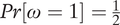
$ Pr[\omega =1]=\frac{1}{2} $
 .Footnote
8 When
$ \omega =0, $
 a reform policy is never beneficial, but when
$ \omega =1, $
 implementing a reform may provide societal benefits. The incumbent then receives a signal about
$ \omega $
 , denoted by
$ s\in \{0,1\} $
 . The distribution of the signal depends on the Incumbent’s type: if the Incumbent is competent,
$ {\theta}_I=H $
 , then she learns the state perfectly,
$ s=\omega $
 , but if the Incumbent is incompetent,
$ {\theta}_I=L $
 , then she receives an uninformative signal (i.e.,
$ Pr[s=1]=Pr[s=0]=\frac{1}{2} $
 ). Since the Incumbent does not know her own type she treats this as a noisy, but informative signal in either case. Following the Incumbent’s observation of
$ s, $
 she chooses a policy
$ x\in \{0,1\} $
 , where
$ x=1 $
 is the reform policy and
$ x=0 $
 can be interpreted as no reform or retention of the status quo.
Citizen Coproduction and Policy Outcomes
Following the Incumbent’s policy choice each citizen simultaneously chooses whether or not to contribute to policy coproduction. We denote citizen i’s decision with
$ {a}_i\in \{0,1\} $
 , where
$ {a}_i=1 $
 means citizen i contributes to coproduction and
$ {a}_i=0 $
 means citizen i does not contribute.
The policy outcome depends on both the Incumbent’s policy choice and aggregate citizen coproduction. It can be a policy success,
$ y=1 $
 , or a policy failure,
$ y=0 $
 . The distribution of this policy outcome is given by

where
$ \overline{a}={\int}_0^1{a}_idi $
 measures the proportion of coproducers in the population. If the Incumbent does not pursue reform,
$ x=0 $
 , then there is no chance for a policy success. If instead the Incumbent does pursue reform,
$ x=1 $
 , then the likelihood of success depends on how many citizens contributed to coproduction (i.e.,
$ \overline{a} $
 ).
Elections
After observing x,
$ \overline{a} $
 , and y, the citizens simultaneously vote to retain the Incumbent or replace her with the Challenger. The politician who wins the most votes wins the election, which we denote with
$ W\in \{I,C\} $
 . Citizens want to elect a competent politician.
Payoffs
The payoffs for each citizen i are given by

The term
$ y(1+{\gamma}_i{a}_i) $
 captures two benefits of a successful reform: a common benefit of
$ 1 $
 to all citizens and a selective additional benefit equal to
$ {\gamma}_i $
 only to those citizens who contributed to coproduction. This is the sense in which we interpret
$ {\gamma}_i $
 as player i’s private coproduction or cooperation incentive, since it represents the value that they place on helping to achieve a successful outcome. The parameter
$ c\in (0,1) $
 represents the cost of contributing to policy coproduction, which we assume to be constant across citizens.Footnote
9 Finally,
$ k\in (0,1) $
 represents the common cost of the reform, which is bounded between zero and one to represent the idea that the safe policy is inferior to a successful reform but superior to an unsuccessful reform. The last term is an indicator capturing the idea that citizens want to elect the more competent candidate.Footnote
10
The payoff to the Incumbent is given by

where
$ {1}_{\{W=I\}} $
 is an indicator function that takes the value of one if and only if the Incumbent wins reelection, and
$ \beta \ge 0 $
 is a benefit to winning the election. Outside of office benefits, the Incumbent’s payoff captures the fact that she prefers to implement a successful reform over choosing the default policy and prefers the default policy over an unsuccessful reform.Footnote
11
Equilibrium
We analyze perfect Bayesian equilibria in which citizens play symmetric strategies. Strategies for each citizen consist of the following:
-
• A coproduction strategy, which takes the form of a cutoff $ \overset{\sim }{\gamma } $
 such that citizen i chooses
$ {a}_i=1 $
and contributes to coproduction, given policy
$ x=1 $
, if
$ {\gamma}_i\ge \overset{\sim }{\gamma }. $
-
• A voting strategy $ {\tilde{v}}_i(x,\overline{a},y) $
, which gives each citizen i’s vote choice for each combination of x and y given aggregate coproduction level
$ \overline{a} $
.


A strategy for the Incumbent consists of a policy strategy
$ {\sigma}_x(s) $
 which gives a probability of choosing
$ x=1 $
 for each signal.
Players’ beliefs consist of a joint distribution over
$ {\theta}_I $
 and
$ \omega . $
 The Incumbent’s belief after receiving a signal s is denoted by
$ {\mu}^x(s). $
 The citizens’ beliefs after observing x are denoted by
$ {\mu}_i^a(x) $
 for each citizen i. Finally, the citizens’ beliefs after observing the policy outcome are
$ {\mu}_i^v(x,y,\overline{a}). $
 The superscripts on the beliefs remind us of the decision that must be made when the player holds this belief. For a given decision, a player may only care about
$ \omega $
 or only care about
$ {\theta}_I $
 , so it is convenient to keep track of marginal beliefs. Given some beliefs
$ \mu $
 at an arbitrary history h and player j (with I representing the incumbent and i an arbitrary citizen), the marginal belief that
$ \omega =1 $
 is
$ {\widehat{\omega}}_j(h)={\sum}_{\theta^{\prime}\in \{L,H\}}\mu (\omega =1\wedge {\theta}_I={\theta}^{\prime }|h) $
 and the marginal belief that
$ {\theta}_I=H $
 is
$ {\widehat{\theta}}_j(h)={\sum}_{\omega^{\prime}\in \{0,1\}}\mu ({\theta}_I=H\wedge \omega ={\omega}^{\prime }|h). $
 Equilibrium requires that each component of the player’s strategy maximizes their expected utility at each information set given beliefs and that the beliefs are consistent with Bayes’s rule at all information sets reached with positive probability.
Before moving to the analysis, we briefly reinterpret the model in light of some substantive examples, keeping in mind that we only wish to capture some of the main forces of these situations rather that explicitly capturing all of their features.
Example 1 (Education Policy). Consider a school board member who may implement an innovative new literacy program for elementary school students (
$ x=1 $
 ) or stick with the existing policy (
$ x=0 $
 ). Assume that the existing policy has known effects and coproduction levels and the new policy would require parents and children to exert more effort to learn the new curriculum. The desirability of the new policy depends on whether the new pedagogy is sound (
$ \omega =1 $
 ) or not (
$ \omega =0 $
 ). The school board member receives information about the policy in the form of some evidence, which may favor the new approach (
$ s=1 $
 ) or not (
$ s=0 $
 ). The school board member is better at interpreting the evidence if she is competent (
$ {\theta}_I=H $
 ) than if she is not
$ ({\theta}_I=L). $
 The program also relies on citizen input in the sense that it asks them to engage in different activities when they are reading to their kids. Parents
$ i\in N $
 have the option to make this adjustment with their children
$ ({a}_i=1) $
 or not
$ ({a}_i=0) $
 in the event that the reform is chosen. Their decisions depend on their belief that the underlying pedagogy is sound but also on the likelihood that other parents make the change, since the program will not successfully translate to the classroom without enough student involvement. All citizens benefit if the policy succeeds, but those that participated benefit more since their students’ reading scores should improve more dramatically. Citizens also evaluate the performance of the incumbent school board member on the basis of the success of the program at improving reading scores.
Example 2 (Disease Outbreak). Consider a governor facing a crisis in the form of a disease outbreak affecting millions of people in her state. She may develop a new containment policy (
$ x=1 $
 ) which may take the form of a vaccination program or a social distancing protocol, or she may choose the status quo (
$ x=0 $
 ). The merits of the different policy choices depend on underlying facts that determine whether these methods are effective or necessary (
$ \omega =1 $
 ) or whether there is more merit in letting the disease run its course normally (
$ \omega =0 $
 ). The governor can observe some evidence suggesting extraordinary measures are needed (
$ s=1 $
 ) or not (
$ s=0 $
 ), and she is more likely to interpret this evidence correctly if she is competent (
$ {\theta}_I=H $
 ) than if she is not
$ ({\theta}_I=L). $
 The governor cannot feasibly mandate vaccination or social distancing so must rely on voluntary coproduction. Each citizen
$ i\in N $
 can comply (
$ {a}_i=1 $
 ) or not (
$ {a}_i=0 $
 ) if the more aggressive policy is chosen. Their decisions depend on whether they think the approach is justified and on whether they think other citizens will comply, since complying unilaterally may not significantly reduce the spread of the disease.Footnote
12 All citizens benefit from a policy success since the spread of the disease will slow but those who comply will benefit more since they will have taken actions that reduced their own likelihood of contracting the disease. Citizens evaluate their governor based on the success or failure of the policy, taking into account levels of coproduction.
ANALYSIS
In this section, we analyze the game starting from the election decisions and working backwards to coproduction and then policy choices.
Election Stage
By the time citizens vote, they have observed the Incumbent’s policy choice, the aggregate coproduction level, and the policy outcome. These choices potentially reveal information about the Incumbent’s competence,
$ {\theta}_I $
 , which then dictates whether or not it is optimal to retain the Incumbent or replace her with a randomly chosen Challenger (who is competent with probability one-half). That is, if
$ {\widehat{\theta}}_I(h)\ge \frac{1}{2} $
 , then citizens vote to reelect and if
$ {\widehat{\theta}}_I(h)<\frac{1}{2} $
 , then they vote to remove the Incumbent and replace her with the Challenger.
Citizen beliefs depend on the Incumbent’s policy strategy, which can be either uninformative (i.e.,
$ {\sigma}_x(0)={\sigma}_x(1) $
 ), in which case the Incumbent chooses to implement the reform with the same probability regardless of her signal, or informative (i.e.,
$ {\sigma}_x(0)=0 $
 and
$ {\sigma}_x(1)=1 $
 ), in which case the Incumbent always follows her signal and implements the reform if and only if she receives
$ s=1 $
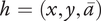
 . Table 1 collects the relevant beliefs depending on (i) the Incumbent’s policy strategy and (ii) the history
$ h=(x,y,\overline{a}) $
 and presents the conditions on prior beliefs about the Incumbent’s competence (
$ {\rho}_I $
 ) to be retained following different histories. Lemma 1 characterizes citizen voting behavior, given a generic level of coproduction
$ \overline{a} $
 .
Citizen Beliefs Conditional on Incumbent Policy Strategy and History

Table 1. Long description
The table consists of four columns: Incumbent policy strategy, History (x, y, a-bar), Posterior belief theta-hat sub I (h), and Retention condition.
* Row 1: Uninformative strategy where sigma sub x (0) equals sigma sub x (1). For all histories, the posterior belief is rho sub I and the retention condition is rho sub I is greater than or equal to 1 over 2.
* Row 2: Informative strategy where sigma sub x (0) equals 0 and sigma sub x (1) equals 1. This is broken down into three historical outcomes:
- No reform (0, 0, a-bar): Posterior belief is rho sub I and retention condition is rho sub I is greater than or equal to 1 over 2.
- Reform failure (1, 0, a-bar): Posterior belief is the fraction with numerator 2 open parenthesis 1 minus a-bar close parenthesis rho sub I all over denominator 2 minus a-bar open parenthesis 1 plus rho sub I close parenthesis. The retention condition is rho sub I is greater than or equal to rho-bar (a-bar) which is defined as the fraction 2 minus a-bar all over 4 minus 3 a-bar.
- Reform success (1, 1, a-bar): Posterior belief is 2 rho sub I all over rho sub I plus 1. The retention condition is rho sub I is greater than or equal to 1 over 3.
Lemma 1. Let
$ \overline{a} $
 and
$ {\sigma}_x $
 be given. The following hold for the election stage:
-
1. If $ {\sigma}_x(0)={\sigma}_x(1) $
(uninformative policy choices) then the citizens retain the Incumbent if and only if
$ {\rho}_I\ge \frac{1}{2} $
, regardless of policy outcomes. -
2. If $ {\sigma}_x(0)=0 $
and
$ {\sigma}_x(1)=1 $
(informative policy choices), then citizens retain the Incumbent if and only if:-
(a) the Incumbent did not pursue reform, $ x=0 $
, and
$ {\rho}_I\ge \frac{1}{2} $
; -
(b) the Incumbent pursued a failed reform, $ x=1 $
and
$ y=0 $
, and
$ {\rho}_I\ge \overline{\rho}(\overline{a}):=\frac{2-\overline{a}}{4-3\overline{a}} $
; -
(c) the Incumbent pursued a successful reform, $ x=y=1 $
, and
$ {\rho}_I\ge \frac{1}{3} $
.
-






A few aspects of Lemma 1 deserve further attention. First, when the Incumbent plays an uninformative policy strategy citizens learn nothing about competence and therefore reelect the Incumbent solely based on prior beliefs about her competence: if she was ahead of the Challenger (i.e.,
$ {\rho}_I>\frac{1}{2} $
 ), then she is reelected and if she was trailing the Challenger (i.e.,
$ {\rho}_I<\frac{1}{2} $
 ), then she is replaced.
Second, if the Incumbent plays an informative strategy, then citizens are only able to update about Incumbent competence when reform is pursued. If
$ x=0, $
 then citizens learn nothing about the Incumbent and therefore reelect the Incumbent if and only if she is initially more likely to be competent than the Challenger (
$ {\rho}_I\ge \frac{1}{2} $
 ). It is worth noting that this characteristic of equilibrium is fragile and depends critically on the assumption that
$ Pr[\omega =1]=\frac{1}{2} $
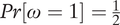 . As discussed above, however, this assumption is deliberate as it rules out the standard pandering incentives that arise in, for example, Canes-Wrone, Herron, and Shotts (Reference Canes-Wrone, Herron and Shotts2001) due to the fact that one state of the world is more likely ex ante.
Otherwise, when
$ x=1 $
 and reform is pursued, citizens learn that the Incumbent received a positive signal
$ s=1 $
 and policy outcomes y matter. Specifically, the retention threshold is more lenient following a policy success,
$ y=1 $
 , relative to a policy failure,
$ y=0 $
 :
$ \frac{1}{3}<\overline{\rho}(\overline{a}) $
 . This illustrates that policy success is always good news about Incumbent competence and policy failure is always bad news. However, how bad policy failure affects the chances for Incumbent reelection depend further on citizen coproduction,
$ \overline{a} $
 .
The derivative of the retention threshold following failed policy reform,
$ \overline{\rho}(\overline{a}) $
 , with respect to
$ \overline{a} $
 is positive, implying that higher levels of citizen coproduction lead to a more demanding retention threshold. The citizens remove more Incumbents, in terms of their prior likelihood of being competent, following a failed reform when coproduction is higher. This is illustrated graphically in the first three scenarios (from the top) of Figure 1: as coproduction levels increase the relevant retention threshold following failed reform is more demanding. The Incumbent has to initially be more likely to be competent to be able to withstand the way that citizens negatively update about her competence in the face of policy failure when more citizens participate in coproduction.
Election Stage with Informative Policy Strategy, Conditional on (x, y, ā)
Note: The gray shaded regions denote the priors about Incumbent competence (
$ {\rho}_I $
 ) that would lead citizens to vote to remove the Incumbent and the non-shaded regions denote the range of priors that would lead citizens to vote to retain the Incumbent. The top three rows illustrate citizen electoral strategies following a failed reform at different levels of coproduction: the top row illustrating high coproduction,
$ \overline{a}=\frac{3}{4} $
 ; the second row moderate coproduction,
$ \overline{a}=\frac{1}{2} $
 ; and the third row low coproduction,
$ \overline{a}=\frac{1}{4} $
 . The bottom rows denote citizen electoral strategies following no reform and a successful reform, respectively. From top to bottom, the rows are ordered by how demanding citizen retention rules are.

Figure 1. Long description
The diagram consists of five horizontal bars stacked vertically above a numerical axis ranging from 0 to 1. Each bar is divided into a gray shaded region on the left labeled Replace and a white region on the right labeled Retain.
* The top three bars are grouped under the heading Failed reform.
* The first bar, where a bar equals 3 over 4, shows the Replace: reform failure region extending to the rightmost point, approximately 3 over 4 on the axis.
* The second bar, where a bar equals 1 over 2, shows the Replace: reform failure region ending at the midpoint of the axis.
* The third bar, where a bar equals 1 over 4, shows the Replace: reform failure region ending at approximately 5 over 8 on the axis.
* The fourth bar is titled No reform (independent of a bar). The Replace: no reform region ends exactly at the 1 over 2 mark.
* The fifth bar is titled Successful reform (independent of a bar). The Replace: reform success region is the smallest, ending at the 1 over 3 mark.
The horizontal axis at the bottom provides specific inflection points. From left to right, the marked points are 0, 1 over 3, 1 over 2, rho bar (1 over 4), rho bar (1 over 2), rho bar (3 over 4), and 1. The gray Replace regions shrink as the reform outcome improves from failure to success.
Moreover, following a failed reform, the retention threshold can never drop below the threshold required to retain the Incumbent following no reform:
$ \overline{\rho}(\overline{a})\ge \frac{1}{2} $
 :
$ {\lim}_{\overline{a}\to 0}\overline{\rho}(\overline{a})=\frac{1}{2} $
 and
$ {\lim}_{\overline{a}\to 1}\overline{\rho}(\overline{a})\to 1 $
 . This follows from the fact that policy success depends on more than the Incumbent’s competence; it also depends on citizen coproduction. If there is no citizen coproduction at all (
$ \overline{a}=0 $
 ), then a failed reform is completely uninformative. A reform, assuming that
$ \omega =1 $
 , succeeds proportional to the aggregate level of coproduction, which implies that, when there is no coproduction, there can be no policy success regardless of the type of Incumbent in office. On the other hand, if there is full coproduction (
$ \overline{a}=1 $
 ), then the only way a reform could have failed is because the Incumbent chose
$ x=1 $
 when
$ \omega =0 $
 , which, assuming an informative policy strategy, will only happen when an incompetent Incumbent is in office. Thus, in that case, no Incumbent will be retained since the citizens learn that the Incumbent must have been incompetent. The main theoretical upshot is that citizen coproduction alters how informative policy failures are since success and failure is the joint product of both politician and citizen choices.
The fact that
$ \overline{\rho}(\overline{a})\in \left[\frac{1}{2},\hskip2.77695pt 1\right] $
 also means that there are essentially four relevant regions for what happens when policy choices are informative. First, the Incumbent’s initial likelihood of competence may be so poor that there is nothing she can do to win the election. This is the case when
$ {\rho}_I<\frac{1}{3} $
 . Even if the Incumbent pursues successful reform, she cannot overcome her poor initial standing with citizens. Second, the Incumbent may have to produce a successful reform in order to win the election. This is the case when
$ \frac{1}{3}\le {\rho}_I<\frac{1}{2} $
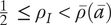
 . The Incumbent has a moderately low prior probability of competence, but this disadvantage could be overcome by successful policy reform. Third, the Incumbent may have a relatively strong prior likelihood of competence:
$ \frac{1}{2}\le {\rho}_I<\overline{\rho}(\overline{a}) $
 . In this case, the Incumbent will win the election unless she pursues reform and it fails. Finally, the Incumbent may have such a strong initial likelihood of competence that she could never lose, even if reform fails. Her initial standing with the citizens is so high that even a failed reform, which does downgrade citizens’ opinion of her, is not enough to propel the Challenger to a victory. This is the case when
$ {\rho}_I>\overline{\rho}(\overline{a}) $
 . These regions are illustrated in Figure 1.Footnote
13
Coproduction Stage
In the previous section, we analyzed citizen voting behavior taking aggregate coproduction as given. We now analyze the coproduction stage and characterize when citizens choose to contribute to the success of a reform. Citizens face a coordination problem where their coproduction decisions are a function of the cost of coproduction, c, and their belief in the likelihood of achieving a policy success, which depends on their beliefs about
$ \omega $
 and the total amount of coproduction in the population. While the coproduction stage has similarities to a global game (e.g., Carlsson and Van Damme Reference Carlsson and Van Damme1993; Morris and Shin Reference Morris and Shin1998; Reference Morris, Shin, Dewatripont, Hansen and Turnovsky2003), for example, there are strategic complementarities, it is not a global game. In particular, the model does not satisfy the limit dominance property central to global games (i.e., there is no
$ {\gamma}_i $
 such that coproduction is a dominant strategy).Footnote
14 Accordingly, as we show below, there is not a unique equilibrium to this stage of the game: some equilibria are characterized by zero coproduction while others have positive coproduction.
In fact, following any policy choice, there is always an equilibrium in which there is zero coproduction. To see this, suppose that all citizens choose
$ {a}_i=0 $
 . Then the probability of a policy success is zero regardless of the state. Each citizen i is therefore best responding by playing
$ {a}_i=0 $
 , since no citizen captures the benefit
$ {\gamma}_i $
 and would still pay the cost c in order to coproduce.
Of course, there can also be equilibria in which some citizens engage in coproduction and there is the possibility of successful policy reform. We start by observing that citizens’ optimal strategies are cutoff rules with respect to
$ \gamma . $
 A citizen has a best response to choose
$ {a}_i=1 $
 and participate in coproduction if:

If
$ x=0, $
 then
$ \Pr [y=1]=0 $
 and no citizens will coproduce. Otherwise, if
$ x=1 $
 , then
$ \Pr [y=1] $
 can be decomposed as follows. Taking as given the proportion
$ {\overline{a}}_{-i} $
 of other citizens who coproduce, and conditioning beliefs on the observed choice of x, we have
$ \Pr [y=1]={\widehat{\omega}}_i(x){\overline{a}}_{-i} $
 and can reduce each citizen’s incentive compatibility condition to coproduce:

This condition is monotone in
$ {\gamma}_i $
 , which implies that citizens use a cutoff rule. Define
$ \overline{\gamma}(x) $
 as the common cutoff rule used by citizens after observing the Incumbent’s choice of policy. Condition presented in Equation 4, recalling that
$ {\gamma}_i\sim U[0,1] $
 and rearranging, can be rewritten as

The equilibrium cutoff rule is at the point of indifference, which yields an interior solutionFootnote 15

This cutoff is interior only when
$ {\widehat{\omega}}_i\ge 4c $
 . Otherwise, if
$ {\widehat{\omega}}_i<4c $
 , then the only equilibrium is one in which there is zero coproduction. When citizens believe that
$ \omega =1 $
 is sufficiently unlikely, no individual has a strong enough incentive to cooperate and bear the costs of coproduction, as everyone is too pessimistic about the chances of successful reform. Citizens need to believe that
$ \omega =1 $
 is sufficiently likely, relative to coproduction costs, to justify individual decisions to engage in coproduction. We can now characterize equilibrium behavior in the coproduction phase.
Lemma 2. In the coproduction stage:
-
• When the Incumbent does not pursue reform, $ x=0 $
, no citizens engage in coproduction. -
• When the Incumbent pursues reform, $ x=1 $
, and
$ {\widehat{\omega}}_i(1)<4c $
, the unique equilibrium in the coproduction phase has zero coproduction (i.e.,
$ {\overline{\gamma}}^{*}(1)=1 $
). -
• When $ x=1 $
and
$ {\widehat{\omega}}_i(1)\ge 4c, $
there is a zero coproduction equilibrium and a positive coproduction equilibrium where citizens adopt the cutoff: $$ \begin{array}{rll}{\overline{\gamma}}^{*}(1)=\frac{{\widehat{\omega}}_i(1)-\sqrt{{\widehat{\omega}}_i(1)({\widehat{\omega}}_i(1)-4c)}}{2{\widehat{\omega}}_i(1)}.& & \end{array} $$


When Do Incumbents Pursue Policy Reform?
The Incumbent’s beliefs about
$ \omega $
 following their private signal s, denoted by
$ {\widehat{\omega}}_I(s) $
 , are

Naturally, an Incumbent who receives
$ s=0 $
 is more pessimistic that
$ \omega =1 $
 than an Incumbent who receives
$ s=1 $
 , and the difference is increasing in the Incumbent’s belief that they are competent,
$ {\rho}_I $
 . However, the Incumbent’s policy choice depends not only on their beliefs about whether the state of the world is conducive to reform, they also take into account how anticipated citizen coproduction affects both their reelection prospects and the likelihood of a policy success.
Accordingly, the Incumbent implements policy reform if and only if:

The direct effect of the Incumbent’s information on anticipated policy success always leads to an Incumbent who received
$ s=1 $
 being more confident of reform leading to success, all else equal (i.e.,
$ \Pr [y=1|s=1,x=1,\overline{a}]>\Pr [y=1|s=0,x=1,\overline{a}] $
 ), which makes Equation 6 easier to satisfy. That is, from a pure policy perspective, an Incumbent who received favorable information (
$ s=1 $
 ) has stronger incentives to pursue reform than an Incumbent who received unfavorable information (
$ s=0 $
 ). In terms of electoral motivations, the likelihood of being reelected after no reform,
$ x=0 $
 , is deterministic: if
$ {\rho}_I\ge \frac{1}{2} $
 , then the Incumbent is reelected (i.e.,
$ \Pr [W=I|x=0,{\rho}_I\ge \frac{1}{2}]=1 $
 ) and if
$ {\rho}_I<\frac{1}{2} $
 , then she is replaced (i.e.,
$ \Pr [W=I|x=0,{\rho}_I<\frac{1}{2}]=0 $
 ). Thus, the net effect of pursuing reform is always either weakly negative—in a context where
$ {\rho}_I\ge \frac{1}{2} $
 —or weakly positive—in a context where
$ {\rho}_I<\frac{1}{2} $
 . When the net effect is negative, increased office motivations make it harder to satisfy the condition in Equation 6 while when it is positive, it makes the condition easier to satisfy. That is, when the Incumbent would be reelected for sure after
$ x=0, $
 pursuing reform could be risky if a failure would lead to her losing the election and if she would be replaced for sure after
$ x=0, $
 then there may be an incentive to pursue reform in the hopes of producing a success to improve voters’ evaluation of her competence and secure reelection. How these incentives manifest depend on the Incumbent’s strategy—uninformative or informative—and the associated level of citizen coproduction.
Lemma 2 characterizes citizen coproduction generally, but the Incumbent’s policy strategy—uninformative or informative—also affects equilibrium coproduction because it affects citizen beliefs about
$ \omega $
 . Aggregate coproduction depends on the equilibrium cutoff
$ \overline{\gamma} $
 , which further depends on coproduction costs and citizen beliefs about
$ \omega $
 . When the Incumbent plays an uninformative strategy so that x is the same regardless of s equilibrium coproduction, after plugging in citizen prior beliefs about
$ \omega $
 , is given by

Citizens retain their prior beliefs,
$ {\widehat{\omega}}_i=\frac{1}{2} $
 , since they cannot infer anything about the Incumbent’s signal. Thus, equilibrium coproduction only depends on the costs of participating c. Intuitively, aggregate coproduction is decreasing in coproduction costs. If instead the Incumbent plays an informative policy strategy so that
$ x(s)=s $
 equilibrium coproduction, after plugging in the Incumbent’s updated beliefs after receiving their signal for citizen beliefs, is given by

In contrast to when the Incumbent plays an uninformative policy strategy, now citizens are able to infer the Incumbent’s signal s and update their beliefs about
$ \omega $
 . Since the Incumbent’s strategy is informative, the citizens learn that the Incumbent received signal
$ s=1 $
 when they observe policy reform
$ x=1 $
 . Accordingly, now aggregate coproduction is increasing in the prior about the Incumbent,
$ {\rho}_I $
 , because the more likely it is that the Incumbent is competent the more likely it is that they accurately learned that
$ \omega =1 $
 . Aggregate coproduction is also decreasing in coproduction costs c, just as when the Incumbent plays an uninformative policy strategy.
Comparing across the two policy strategies, citizen coproduction is always higher when the Incumbent plays an informative strategy and only pursues reform when they received a positive signal
$ s=1 $
 :
$ {\overline{a}}^{\mathrm{inf}}(c,{\rho}_I)>{\overline{a}}^{\mathrm{un}}(c) $
 . The coproduction gap is also increasing in the Incumbent’s initial competence probability
$ {\rho}_I $
 . The more likely it is that the Incumbent is competent, the bigger the coproduction premium is to playing an informative policy strategy.
In the equilibria to follow,Footnote 16 we characterize the Incumbent’s incentives in different political environments to determine when she pursues policy reform.
Uninformative Equilibria
In this section, we assume that the Incumbent either never implements reform or always implements reform and characterize when these strategies constitute equilibria. In either case, the citizens do not learn anything about
$ \omega $
 and, therefore, the reelection rule is to retain the Incumbent if and only if
$ {\rho}_I\ge \frac{1}{2} $
 . The Incumbent’s reelection prospects are not responsive to policy choice and therefore only the Incumbent’s policy motivations matter. Accordingly, taking into account equilibrium coproduction, the Incumbent pursues reform if and only if:

which yields two reform cost thresholds that depend on the Incumbent’s private signal s:

where
$ 0<{k}^{*}(0)<{k}^{*}(1)<1 $
 . An incumbent who receives signal s chooses to implement reform if and only if
$ k\le {k}^{*}(s) $
 . With these thresholds in hand, we can now characterize uninformative equilibria, beginning with an equilibrium where the Incumbent never pursues reform.
Proposition 1. The Incumbent never pursues policy reform if any of the following conditions are satisfied:
-
1. There is zero citizen coproduction: $ \overline{a}=0 $
. -
2. Reform costs are prohibitively large: $ k>{k}^{*}(1) $
.


If
$ c>\frac{1}{8} $
 or
$ k>{k}^{*}(1), $
 then the unique uninformative equilibrium features zero citizen coproduction and the Incumbent never pursuing reform.
There are two reasons that the Incumbent may never choose reform regardless of her information: (i) there is zero citizen coproduction, which we show in the previous section is always possible or (ii) there would be positive citizen coproduction, but the cost of reform k is too large. While an equilibrium with zero coproduction and no reform always exists, it is the unique equilibrium if either coproduction costs are too high or reform costs are too high.
Of course, it is also possible that there would be positive coproduction following a policy reform and that reform costs are so low that the Incumbent will always pursue reform.
Proposition 2. There is an equilibrium in which the Incumbent always pursues reform if and only if both of the following conditions are satisfied:
-
1. There is positive citizen coproduction, which requires that $ c<\frac{1}{8} $
. -
2. Reform costs are sufficiently low: $ k\le {k}^{*}(0) $
.


In terms of uninformative equilibria in which the Incumbent always pursues reform both conditions—positive citizen coproduction and low reform costs—are necessary and jointly sufficient. If either of the conditions fails, then there are equilibria in which the Incumbent will forego reform and choose
$ x=0 $
 . If there is no citizen coproduction then the Incumbent, regardless of the signal s, will always set
$ x=0 $
 . If there is positive citizen coproduction but
$ k>{k}^{*}(1), $
 then even an Incumbent who received
$ s=1 $
 will forego reform. Having characterized equilibria in which the Incumbent either never pursues reform or always pursues reform we now turn to informative equilibria.
Informative Equilibrium
In an informative equilibrium, the Incumbent follows her signal and reveals that information to the citizens. Whether or not she pursues policy reform depends on where she stands electorally prior to her policy choice. When her initial competence probability is either very low,
$ {\rho}_I<\frac{1}{3} $
 , or very high,
$ {\rho}_I\ge \overline{\rho}(\overline{a}) $
 , then her reelection prospects do not depend on her policy choice—she either always loses or always wins. If the Incumbent’s prior competence probability is moderately low,
$ {\rho}_I\in \left[\frac{1}{3},\hskip2.77695pt \frac{1}{2}\right) $
 , then she can win reelection only if she pursues successful policy reform. Finally, if the Incumbent’s prior competence probability is moderately high,
$ {\rho}_I\in \left[\frac{1}{2},\hskip2.77695pt \overline{\rho}(\overline{a})\right) $
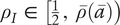 , then she wins reelection unless she produces failed policy reform. The Incumbent’s incentives to pursue policy reform depend critically on whether or not the electoral environment is competitive and, if it is, whether she is behind or ahead ex ante.
Uncompetitive Election. When the election is uncompetitive the Incumbent pursues policy reform solely based on the likelihood of a policy success, which depends on their beliefs about the state of the world given their signal (
$ {\widehat{\omega}}_I(s) $
 ) and the anticipated level of coproduction (
$ {\overline{a}}^{\mathrm{inf}}(c,{\rho}_I) $
 ). Accordingly, the Incumbent, after receiving signal s, pursues policy reform if and only if:

This incentive compatibility condition yields two thresholds depending on the Incumbent’s private signal s:


where
$ 0<{k}^{**}(0)<{k}^{**}(1)<1 $
 . The Incumbent engages in informative policymaking where she pursues reform (
$ x=1 $
 ) only when
$ s=1 $
 if and only if
$ k\in ({k}^{**}(0),\hskip2.77695pt {k}^{**}(1)) $
 . Reform costs need to be high enough that the Incumbent would not pursue reform after a pessimistic signal (
$ s=0 $
 ) but low enough that the Incumbent will pursue reform after a positive signal (
$ s=1 $
 ). This decision depends solely on the Incumbent’s assessment about how likely it is that reform will be successful since electoral considerations do not come into play.
Competitive Election. In a competitive election, reelection incentives are activated: either the Incumbent is slightly behind the Challenger (i.e.,
$ {\rho}_I\in (\frac{1}{3},\hskip2.77695pt \frac{1}{2}) $
 ) or slightly ahead of the Challenger (i.e.,
$ {\rho}_I\in (\frac{1}{2},\hskip2.77695pt \overline{\rho}(\overline{a}) $
 ) ex ante. In the former case, this pushes the Incumbent toward gambling for reelection since she will lose reelection unless she produces successful policy reform. In the latter case, the Incumbent is incentivized to play it safe and forego reform since she will be reelected unless she produces failed reform.
First, consider the case where the Incumbent can only win reelection by implementing a successful policy reform:
$ {\rho}_I\in \left(\frac{1}{3},\hskip2.77695pt \frac{1}{2}\right] $
 . Given signal s, the Incumbent chooses
$ x=1 $
 if:

Compared to the settings where reelection is determined based on the Incumbent’s prior likelihood of competence, in this case, there is the additional incentive to produce a policy reform in order to secure reelection and enjoy the benefit
$ \beta $
 . Once again, we can state these conditions in terms of
$ {k}^{**}(s) $
 . Specifically, in this case, an informative policy strategy is incentive compatible if

Now that the Incumbent also has an incentive to pursue policy reform, since the only way she can secure reelection is by producing a successful reform, the cost thresholds that support pursuit of reform are higher relative to uncompetitive elections. As the benefit from winning reelection (
$ \beta $
 ) increases so do the relevant thresholds on k, regardless of the Incumbent’s signal.
Now consider the case where the Incumbent always wins reelection unless she pursues reform and it fails:
$ {\rho}_I\in \left(\frac{1}{2},\hskip2.77695pt \overline{\rho}({\overline{a}}^{\mathrm{inf}}(c,{\rho}_I))\right] $
 . In this case, the Incumbent pursues reform if and only if:

Compared to the previous case, now the Incumbent has an incentive to forego reform because doing so secures reelection with certainty and the associated benefit
$ \beta $
 . This makes pursuing policy reform more demanding. Again, expressing this in terms of cost thresholds conditional on the Incumbent’s signal, we have that informative policy choice is supportable if:

Now the relevant thresholds on k shift down, proportional to office benefits
$ \beta $
 , relative to the previous cases. On the one hand, this means that incumbents who receive signal
$ s=0 $
 are less likely to set
$ x=1 $
 , but, on the other hand, it is also less likely that incumbents who receive signal
$ s=1 $
 will implement reform.Footnote
17 With analysis of both uncompetitive and competitive elections in hand, we can now characterize informative equilibria.
Proposition 3. Suppose c is small enough so that positive coproduction is feasible (i.e.,
$ c<\frac{1+{\rho}_I}{8} $
 ). There exists an equilibrium with informative policy choices and positive coproduction under the following circumstances:
-
• The election is uncompetitive (i.e., $ {\rho}_I<\frac{1}{3} $
or
$ {\rho}_I>\overline{\rho}({\overline{a}}^{\mathrm{inf}}(c,{\rho}_I)) $
) and
$ {k}^{**}(0)<k\le {k}^{**}(1). $
-
• The election is competitive and the Incumbent trails the Challenger so that she wins reelection only if she pursues successful policy reform (i.e., $ {\rho}_I\in \left(\frac{1}{3},\hskip2.83864pt \frac{1}{2}\right] $
) and
$ (1+\beta ){k}^{**}(0)<k\le (1+\beta ){k}^{**}(1). $
-
• The election is competitive and the Incumbent leads the Challenger so that she wins reelection unless she pursues failed policy reform (i.e., $ {\rho}_I\in \left(\frac{1}{2},\hskip2.83864pt \overline{\rho}({\overline{a}}^{\mathrm{inf}}(c,{\rho}_I))\right] $
) and
$ (1+\beta ){k}^{**}(0)-\beta <k\le (1+\beta ){k}^{**}(1)-\beta . $







If instead the cost of coproduction is prohibitively large, that is,
$ c>\frac{1+{\rho}_I}{8} $
 , then the unique equilibrium is uninformative and features zero coproduction and the Incumbent never pursuing reform.
Proposition 3 highlights how the Incumbent’s incentives respond to the electoral environment. The Incumbent is most likely to pursue reform when the election is competitive and she is moderately unpopular (
$ {\rho}_I\in (\frac{1}{3},\hskip2.77695pt \frac{1}{2}) $
 ) and least likely to pursue reform when the election is competitive and she is moderately popular (
$ {\rho}_I\in (\frac{1}{2},\hskip2.77695pt \overline{\rho}({\overline{a}}^{\mathrm{inf}}(c,{\rho}_I))) $
 ). This follows directly from the way that the electoral environment impacts the Incumbent’s incentives. When the election is competitive the Incumbent considers her electoral motivations and when she is moderately unpopular these motivations push her to gamble for reelection, making policy reform more attractive, while when she is moderately popular, she can secure reelection as long as she does not produce failed reform, which pushes her away from policy reform. These incentives are amplified by increased benefits to securing reelection (i.e., by increasing
$ \beta $
 ). In an uncompetitive electoral environment, the Incumbent pursues reform solely based on her policy motivations. This is the moderate case where policy reform is more likely than when the Incumbent holds a small lead over the Challenger but less likely than when she sits at a slight electoral disadvantage ex ante.
These dynamics are illustrated graphically in Figure 2, which plots equilibrium regions based on the Incumbent’s prior competence probability
$ {\rho}_I $
 (x-axis) and reform costs k (y-axis). As noted above, there can always be an uninformative equilibrium in which the Incumbent does not pursue reform (
$ x=0 $
 ) and there is zero coproduction. This is the unique equilibrium anytime coproduction costs are too high or reform costs are too high. There are also informative equilibria where the Incumbent follows her signal when reform costs are intermediate (light gray regions). Comparing panels a and b in Figure 2 also illustrates the impact of office benefits
$ \beta $
 on Incumbent incentives. Specifically, we can see that when the Incumbent’s prior competence probability is moderately low and she trails the Challenger in a competitive election (i.e.,
$ {\rho}_I\in (\frac{1}{3},\frac{1}{2} $
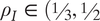 ), the thresholds that support informative policy choice both shift up and reform is more likely as
$ \beta $
 increases.Footnote
18 When instead the Incumbent is moderately popular and leads the Challenger (i.e.,
$ {\rho}_I\in (\frac{1}{2},\overline{\rho}(\overline{a})) $
 ), the thresholds shift down and reform becomes less likely as
$ \beta $
 increases.
Equilibrium Regions
Note: The x-axis is the Incumbent’s prior competence probability
$ {\rho}_I $
 and the y-axis is the cost of reform k. In all figures,
$ c=\frac{1}{10} $
 and
$ \beta \in \left\{\frac{1}{4},\hskip2.77695pt \frac{3}{4}\right\} $
 , from (a) to (b). Each region is labeled with the equilibria that exist within that region: NR denotes an uninformative equilibrium where the Incumbent never pursues reform and citizens never engage in positive coproduction; AR denotes an uninformative equilibrium where the Incumbent always pursues reform provided that and citizens engage in positive coproduction; and FS denotes informative equilibrium where the Incumbent pursues reform if and only if
$ s=1 $
 and citizens engage in positive coproduction.

Figure 2. Long description
A two-panel figure with panel (a) labeled Low office motivation beta equals 1 over 4 and panel (b) labeled High office motivation beta equals 3 over 4. Both panels use a horizontal x-axis for rho sub I (competence probability) from 0 to 1 and a vertical y-axis for k (cost of reform) from 0 to 1.
In panel (a):
* The top region is dark gray, labeled Never Reform (N R).
* A large central light gray region is labeled Follow Signal and Never Reform (F S and N R).
* The bottom-left region is medium gray, labeled Always Reform and Never Reform (A R and N R).
* As rho sub I increases past 1 over 2, a triangular region at the bottom is labeled A R, F S, and N R.
* Near rho sub I equals 1, small slivers are labeled N R and A R and N R.
In panel (b):
* The dark gray N R region is larger, particularly between rho sub I values of 1 over 2 and 1.
* The light gray F S and N R region is split into two distinct sections by a vertical dark gray N R block between rho sub I values of 1 over 3 and 1 over 2.
* The bottom regions for A R and N R and the combined A R, F S, and N R follow a similar downward-sloping trend as in panel (a) but with slightly different boundary intersections.
EXTENSION: INDIVIDUALISTIC BENEFITS FROM COPRODUCTION
In Appendix G of the Supplementary Material, we extend the baseline model to allow citizens to receive individualistic benefits from coproduction even when reform does not generate policy success. We add a benefit for coproducing that accrues in the event of a policy failure that is due to insufficient community-level coproduction (i.e.,
$ \omega =1 $
 but the policy still failed). A concrete example is getting vaccinated during a public health crisis: the more people get vaccinated in a community, assuming the vaccine is in fact effective (i.e.,
$ \omega =1 $
 ), the more likely it is that something like herd immunity is achieved (i.e.,
$ y=1 $
 ), which yields a benefit of
$ {\gamma}_i $
 to citizen i if she chose to get vaccinated. However, even if herd immunity is not achieved (i.e.,
$ y=0 $
 ), the vaccine, if effective (i.e.,
$ \omega =1 $
 ), could still provide the individual getting vaccinated with important protection, which is perhaps even more important when herd immunity has not been achieved. This yields a benefit of
$ \delta \in [0,1] $
 , which is the same for all citizens choosing to get vaccinated. This represents the protection benefit from vaccination if not enough others get vaccinated assuming the vaccine is effective (i.e.,
$ Pr[y=0|\omega =1]\cdot Pr[\omega =1] $
 ). Accordingly, we can write citizen i’s utility function as

We assume that the individualistic benefits from coproduction are realized after the election so that coproducing citizens do not learn
$ \omega $
 prior to the election.
This extension changes citizens’ calculations in the coproduction stage but leaves the basic accountability mechanisms more or less intact. In the baseline model, coproduction is driven by coordination incentives. With
$ \delta >0 $
 , individual coproduction might be privately optimal even though total coproduction is so low that the policy is unlikely to globally succeed. The key differences from the baseline model are as follows:
-
• Coproduction is feasible more often. In the baseline, we can always support an equilibrium with no reform and no coproduction off the path of play, since coproduction is driven by coordination incentives. In the extension, since there is a private benefit to coproduction that does not depend on other citizens also coproducing, the feasibility conditions for coproduction are relaxed from $ c\le \frac{1}{8} $
to
$ c\le \frac{{(1+\delta )}^2}{8} $
(Proposition G.1 in the Supplementary Material). -
• Accordingly, the equilibrium in which the Incumbent always pursues reform is easier to support (Propositions G.2 and G.3 in the Supplementary Material).
-
• The logic of informative equilibria is more or less unchanged though there are quantitative differences in the thresholds at which the Incumbent’s incentives switch from gambling for reelection to playing it safe (Proposition G.4 in the Supplementary Material).
-
• Furthermore, in the informative equilibrium, policy reform is supportable for a wider range of costs due to increased coproduction, which increases the likelihood that reform succeeds (Proposition G.5 in the Supplementary Material).


DISCUSSION
In this section, we turn to implications that follow from the preceding analysis, including empirical implications for some prominent policies involving coproduction as well as how electoral pressure and coproduction interact to produce policy distortions and the incentives for politicians to subsidize coproduction when they pursue reform.
Substantive Examples
We return to the examples of education policy and disease outbreak prevention in order to interpret the implications of the model for empirical work on these topics.
Education Policy
Our model can be used to understand variation in electoral accountability in education policy. In general, there is reason for pessimism about the capacity of school board elections to hold elected officials accountable. Kogan, Lavertu, and Peskowitz (Reference Kogan, Lavertu and Peskowitz2025) find that school board turnover is only weakly related to learning outcomes, while Berry and Howell (Reference Berry and Howell2007) show that school board members are evaluated on the basis of student outcomes only in especially favorable media environments. In this section, we explain how patterns of accountability might be reinterpreted through the lens of our model.
Although we do not attempt to definitively explain the sources of accountability failures in school board elections, we can clarify what we would expect to observe if our model captured this phenomenon and identify the types of evidence relevant for evaluating that possibility. A world consistent with the model would look roughly as follows. Consider districts that differ in parental resources. In high-resource districts, parents possess the means to support their children’s success, but students already perform well at baseline, leaving limited scope for policy interventions to generate large gains. In low-resource districts, by contrast, policy interventions have greater potential to improve outcomes, yet parents face constraints that limit their ability to coproduce educational success. Consequently, reforms may be attempted more frequently where potential gains are largest, but even well-designed policies may often fail. Policy failures therefore become less informative about politician quality, making it harder for voters to learn from observed outcomes. In equilibrium, this dynamic can generate a weak relationship between student outcomes and school board election results.
A central challenge for this interpretation is that it may be observationally equivalent to a more conventional account in which voters are inattentive and school board members, facing weak electoral discipline, exert low effort. Nevertheless, the model suggests potential ways to distinguish between these explanations. In particular, it implies that interventions that relax constraints on parental coproduction—for example, policies that make it easier to maintain home environments conducive to learning (Nag et al. Reference Nag, Vagh, Dulay, Snowling, Donolato and Melby-Lervåg2024)—may improve not only student outcomes but also the strength of the accountability relationship between voters and elected officials.
Disease Outbreaks
We can also apply our model to the case of disease outbreaks such as COVID-19. Evidence on accountability for COVID-19 evidence was mixed. For instance, Warshaw, Vavreck, and Baxter-King (Reference Warshaw, Vavreck and Baxter-King2020) and Baccini, Brodeur, and Weymouth (Reference Baccini, Brodeur and Weymouth2021) find some evidence that voters punished incumbents for bad COVID-19 outcomes, but Sides, Tausanovitch, and Vavreck (Reference Sides, Tausanovitch and Vavreck2023) found that in 2020 Trump (the incumbent) did better in counties that experienced more cumulative COVID-19 deaths. One interpretation of these mixed findings is along the lines of the heterogeneity we just described: if the worst outcomes are concentrated in places where coproduction costs are higher because of cultural stigmas against masking, social distancing, or vaccinations, then the bad outcomes might be least informative about the quality of politicians in exactly the places where we expect to see them the most.
Our model makes some sense of these mixed results once we allow for unmeasured heterogeneity in the parameters related to coproduction. In the extension focused on individualistic benefits, participation is shaped by the cost of coproduction (c) and the individualistic benefits (
$ \delta $
 ). When coproduction costs are high—say, because masking or vaccination is socially stigmatized—aggregate participation will be lower in equilibrium. Similarly, when the perceived private health benefits of coproduction are low (a low
$ \delta $
 ) participation also decreases. As our model suggests, these facts might simultaneously make health outcomes worse and decrease the informativeness of those outcomes for holding politicians accountable. Hence, these factors may represent omitted variables that explain apparent accountability reversals such as those observed by Sides, Tausanovitch, and Vavreck (Reference Sides, Tausanovitch and Vavreck2023).
Citizen Coproduction and Political Inefficiencies
Having characterized equilibria, we now turn to the policy distortions that are introduced through electoral accountability and how citizen coproduction interacts with those distortions. To do so, we focus on informative equilibria and take as our benchmark what the Incumbent would do in terms of implementing policy reform if she had no electoral considerations. This is a useful benchmark in that it illustrates how the Incumbent would pursue reform if the only considerations she had were based on her private information and how that informs the likelihood of policy success. We will compare her propensity to pursue reform when electoral considerations are introduced. When the Incumbent’s policy behavior differs when electoral considerations are introduced we will have identified distortions introduced by elections. Since citizen coproduction can impact the likelihood that the Incumbent produces a policy success, and therefore increases her chances of reelection, coproduction will also shape the nature of these distortions.
As shown in the previous analysis, when the Incumbent is in an uncompetitive election her decision to pursue policy reform does not depend on electoral considerations. Thus, there is no difference between the benchmark in which we assume away elections: the Incumbent already behaves as if there is no election since her policy choice has no bearing on whether or not she is reelected. However, when the Incumbent has an intermediate prior competence probability electoral considerations play a central role. When she trails the Challenger, but could win reelection with successful reform, these electoral considerations lead to more policy reform than would occur without electoral pressures. This follows from the incentives for the Incumbent to gamble for reelection. If instead the Incumbent would win reelection unless she produces failed reform then electoral pressures lead to distortions that imply less policy reform than the no-election benchmark. Now the Incumbent’s incentives are to play it safe precisely because that is in her best interest from an electoral perspective. These distortions are amplified as the Incumbent’s benefits from holding office,
$ \beta $
 , increase. This is illustrated in Figure 3 comparing the left column (low office benefit) to the right column (high office benefit). Increasing
$ \beta $
 expands the gray shaded regions that illustrate the policy distortions introduced through electoral pressure.
Policy Reform Thresholds for Informative Policymaking as Office Benefits
$ \beta $
 and Coproduction Cost c Vary
Note: The solid black lines display the reform cost thresholds given
$ \beta $
 and c in an informative equilibrium. The dashed lines illustrate the reform cost thresholds when there are no electoral considerations. The light gray shaded regions illustrate how electoral considerations lead to more policy reform and the dark gray shaded regions illustrate how electoral considerations lead to less policy reform.

Figure 3. Long description
Four panels labeled a through d are arranged in a two by two grid. Each panel shares the same axes: the horizontal x-axis represents rho sub I ranging from 0 to 1, and the vertical y-axis represents k ranging from 0 to 1. Two solid black lines originate from k equals 1 half at rho sub I equals 0, diverging symmetrically toward the top and bottom right. Dashed lines run parallel or adjacent to these solid lines.
* Panel a: beta equals 1 fourth and c equals 1 over 20. Light gray regions appear between rho sub I equals 1 third and 1 half. Dark gray regions appear between rho sub I equals 1 half and rho bar of a super star.
* Panel b: beta equals 3 fourths and c equals 1 over 20. The light gray region above the midline is significantly taller, extending to k equals 1 between rho sub I equals 1 third and 1 half.
* Panel c: beta equals 1 fourth and c equals 1 over 10. Similar to panel a, but the shaded regions are vertically narrower, indicating a smaller range for policy reform.
* Panel d: beta equals 3 fourths and c equals 1 over 10. Combines the increased height of the light gray region from panel b with the narrower dark gray regions from panel c.
In all panels, light gray shading indicates areas where electoral considerations increase policy reform, while dark gray shading indicates areas where they decrease it.
Comparing the top row (low coproduction cost) to the bottom row (high coproduction cost) in Figure 3 illustrates how citizen coproduction impacts these distortions. Holding office benefits constant (within column) we can see that raising coproduction costs leads to a smaller range of incumbents who face competitive elections where they lead the Challenger (i.e., the retention threshold
$ \overline{\rho}(\overline{a}) $
 decreases as coproduction costs increase because aggregate coproduction declines). The level of citizen coproduction scales the range of the policy distortions by fundamentally altering the electoral landscape: as citizen coproduction decreases some incumbents who previously faced competitive elections with incentives to play it safe are now electorally insulated and win reelection with certainty, which eliminates any electoral pressure they previously felt. They are free to pursue policy reform as if there were no election, which eliminates policy distortions. This dynamic provides the following implication.Footnote
19
Proposition 4. Increasing coproduction costs sometimes increases the likelihood of policy reform.
Counterintuitively, increasing the costs of coproduction can promote more policy reform even though doing so reduces coproduction and the likelihood that reform is successful. This highlights a core accountability pathology that arises in our model: reducing (increasing) coproduction makes policy failures less (more) informative about Incumbent competence, which expands (contracts) the range of incumbents, in terms of prior probability of competence, who face uncompetitive elections where they win with certainty. This allows them to disregard any electoral pressures and instead pursue policy reform purely based on their informed assessment about whether or not reform is justified. Put another way, citizen coproduction amplifies electoral pressures when they are present, but also dictates when they arise by altering the electoral environment itself.
Subsidizing Coproduction
In many cases, politicians are in a position to subsidize citizen coproduction when policies are pursued that require public buy-in. For example, new policies might introduce administrative burdens through the need for citizens to fill out complicated paperwork, to learn about their program eligibility, or to find the time to participate in the new program (e.g., Herd and Moynihan Reference Herd and Moynihan2019). As part of policy reform, then, politicians might build in ways to lower these costs—for example, online applications, information campaigns, and hiring personnel. However, given the subtle dynamics explored in the previous section it is not clear that incumbent politicians concerned about reelection, in addition to producing successful policy reforms, will always find it optimal to subsidize coproduction. Since subsidizing coproduction will induce higher coproduction, and higher coproduction will increase the informativeness of policy failures, some incumbents would benefit from relatively higher coproduction costs that drive down coproduction.Footnote 20
Proposition 5. If office benefits are sufficiently large, then some incumbents prefer lower citizen coproduction.
Table 2 presents the Incumbent’s expected utility from policy reform for each electoral environment. Within each environment, the Incumbent always benefits from promoting higher coproduction through subsidizing coproduction costs. This is evident from the fact that each expected utility is strictly increasing in
$ \overline{a} $
 , which increases as c decreases. In any scenario, so long as changes in c do not alter the electoral environment she faces the Incumbent’s expected utility is increasing in aggregate coproduction, which implies that she benefits from lowering coproduction costs.
Incumbent Expected Utility for Pursuing Policy Reform by Electoral Environment

Table 2. Long description
The table consists of two columns: Electoral environment and Expected utility from x = 1.
* Row 1: Uncompetitive, losing. Defined by rho sub I < 1/3. The expected utility is omega-hat sub I (s) dot a-bar minus k.
* Row 2: Competitive, trailing. Defined by rho sub I in the interval (1/3, 1/2). The expected utility is omega-hat sub I (s) dot a-bar dot (1 plus beta) minus k.
* Row 3: Competitive, leading. Defined by rho sub I in the interval (1/2, rho-bar (a-bar)). The expected utility is omega-hat sub I (s) dot a-bar dot (1 plus beta) minus k.
* Row 4: Uncompetitive, winning. Defined by rho sub I > rho-bar (a-bar). The expected utility is omega-hat sub I (s) dot a-bar plus beta minus k.
However, when coproduction costs change and aggregate coproduction shifts so does the retention threshold
$ \overline{\rho}(\overline{a}) $
 —as aggregate coproduction increases (decreases), the threshold also increases (decreases). Incumbents with prior probabilities of competence around that threshold face a trade-off: subsidizing coproduction boosts aggregate coproduction, which also raises
$ \overline{\rho}(\overline{a}) $
 and increases the range of incumbents who face a competitive election rather than an uncompetitive election where they win with certainty. Conversely, as coproduction costs increase, the threshold
$ \overline{\rho}(\overline{a}) $
 decreases and some incumbents move from a competitive electoral environment to an uncompetitive one. Thus, some incumbents benefit from higher coproduction costs that suppress aggregate coproduction because it alters the electoral environment from a competitive one where incumbents are pushed to play it safe to an uncompetitive one where they win reelection with certainty.
Consider the scenario where there are two levels of aggregate coproduction,
$ \overline{a} $
 and
$ {\overline{a}}^{\prime } $
 , where
$ \overline{a}>{\overline{a}}^{\prime } $
 . This produces two retention thresholds
$ \overline{\rho}(\overline{a}) $
 and
$ \overline{\rho}({\overline{a}}^{\prime }) $
 , where
$ \overline{\rho}({\overline{a}}^{\prime })<\overline{\rho}(\overline{a}) $
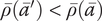 . For incumbents with prior competence probabilities at the original threshold
$ \overline{\rho}(\overline{a}), $
 a decrease in aggregate coproduction and shift to
$ \overline{\rho}({\overline{a}}^{\prime }) $
 shifts them from a competitive election to an uncompetitive election. This is beneficial whenever the expected utility from being in an uncompetitive electoral environment where the incumbent wins with certainty (but coproduction is lower) outweighs the expected utility from being in a competitive electoral environment where the incumbent wins unless she produces a failed reform (but coproduction is higher):

Rearranging this inequality shows that incumbents benefit from lower coproduction in exchange for electoral safety if office benefits are sufficiently large:

When the benefits from winning office are sufficiently large, relative to the decreased likelihood of policy success, measured by the reduction in aggregate coproduction
$ \overline{a}-{\overline{a}}^{\prime } $
 , an incumbent would prefer increased coproduction costs. That is, they would introduce, for example, administrative burdens to discourage coproduction even though doing so reduces the chances of producing a policy success. This follows from the fact that local changes in aggregate coproduction and the associated effects on expected policy benefits are continuous while a shift from an uncompetitive to competitive electoral environment leads to a discontinuous jump in expected electoral benefits (from
$ {\widehat{\omega}}_I(s)\overline{a}\beta $
 to
$ \beta $
 ). In these cases, the incumbent does not benefit from subsidizing coproduction even though doing so increases the likelihood of a policy success, which also increases the chances of higher policy benefits and an improved evaluation of competence from voters. Citizen coproduction structures the underlying political environment in a way that can lead to reduced electoral pressures, which is attractive to some incumbents even though it comes at the cost of potential policy success.
CONCLUSION
We propose a model of electoral accountability in which policy outcomes depend partly on voluntary citizen cooperation. This framework helps analyze situations where citizen coproduction is crucial to a policy’s success. We use the model to examine how coproduction affects citizens’ ability to hold politicians accountable for policy failures. When citizens are less willing to coproduce, policy failures reveal less about the incumbent’s competence. Anticipating this, politicians may adjust their policy choices. In some cases, citizen reluctance to coproduce can deter a politician from pursuing a beneficial reform, as citizen preferences reduce its chances of success. In other cases, a politician may be more likely to pursue reform precisely because citizens are unlikely to coproduce, since failures can then be blamed on citizen inaction rather than poor policymaking.
Some of our assumptions limit the scope of application for this particular model and leave the door open for other models of coproduction and accountability better suited to different applications. For instance, in our model, the citizens agree on some desired outcomes (educated students, healthy populations, etc.) and are primarily concerned about whether the politicians are competent enough to recognize policies that are most likely to achieve these aims. In other settings, citizens have an intrinsic preference for one policy or another and their concern about incumbents is preference congruence.Footnote 21 This other setting could clearly have different implications in the situations we describe. For example, if citizens have an intrinsic preference for reform, this would undercut the incentives of politicians to “play it safe” by choosing no reform to avoid unfavorable learning. The incentives to gamble versus play it safe also depend on a feature of our elections that are modeled after general elections in the United States or similar contexts, where an incumbent wants to beat a single opponent and therefore her incentive is just to have a better likelihood of competence than her opponent. Many of the distortions we discuss in this article are based on this feature since the incumbent does not want to maximize her likelihood of competence but instead the probability that her likelihood of competence is above a particular level. This may not be true in parliamentary systems, for instance, so the comparative statics of incumbent’s choices may not be as intricate in that setting.
Our model offers a first step toward understanding electoral accountability with citizen coproduction, but much remains to be explored. For example, we do not address co-design, that is, citizen involvement in shaping policy before implementation, for example, participatory budgeting (Barbera, Sicilia, and Steccolini Reference Barbera, Sicilia and Steccolini2016). Extending our framework to such settings is a promising direction for future work. Additionally, we largely set aside informational motivations for coproduction, aside from a limited discussion in Appendix F of the Supplementary Material. In some contexts, citizens may coordinate their level of coproduction to influence the information voters use, especially when preferences toward the incumbent are polarized. This highlights the need for further theoretical development on the interaction between coproduction and accountability.
SUPPLEMENTARY MATERIAL
To view supplementary material for this article, please visit https://doi.org/10.1017/S0003055426101889.
ACKNOWLEDGEMENTS
The authors would like to thank Avi Acharya, Axel Anderson, Kevin Angell, Peter Bils, Laurent Bouton, Peter Buisseret, Steve Callander, Chuck Cameron, Martin Castillo-Quintana, Tom Clark, John Duggan, Anthony Fowler, Scott Gehlbach, Matias Iaryczower, Gleason Judd, John Kastellec, Woojin Kim, Roger Lagunoff, Frances Lee, Zhaotian Luo, Nolan McCarty, Adam Meirowitz, Tali Mendelberg, Monika Nalepa, Patricia Posey, Jon Rogowski, Larry Rothenberg, Ruth Bloch Rubin, Greg Sasso, Ken Shotts, Hannah Simpson, Anthony Taboni, Elaine Yao, and seminar audiences at Chicago, Florida State, Georgetown, Pitt, Princeton, Purdue, Stanford Graduate School of Business, and Yale for very helpful comments.
CONFLICT OF INTEREST
The authors declare no ethical issues or conflict of interests in this research.
ETHICAL STANDARDS
The authors affirm this research did not involve human participants.





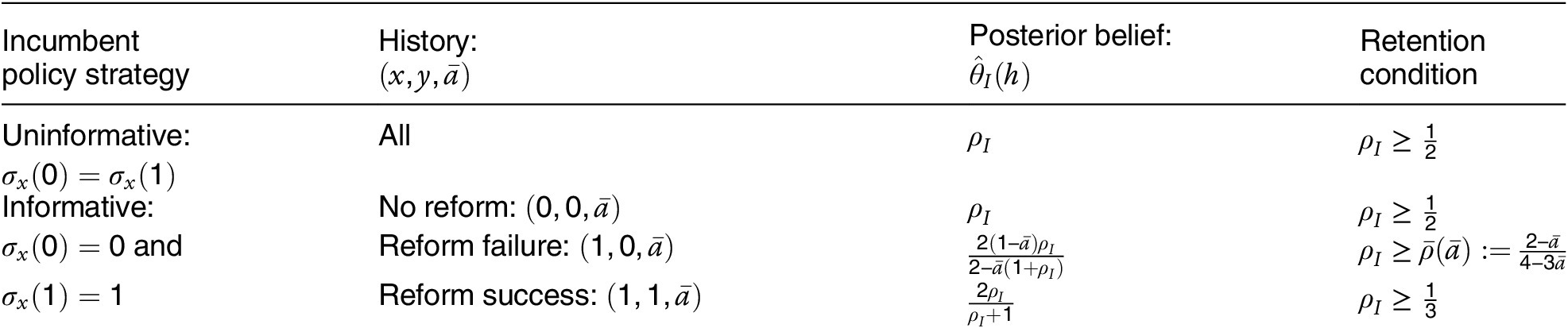
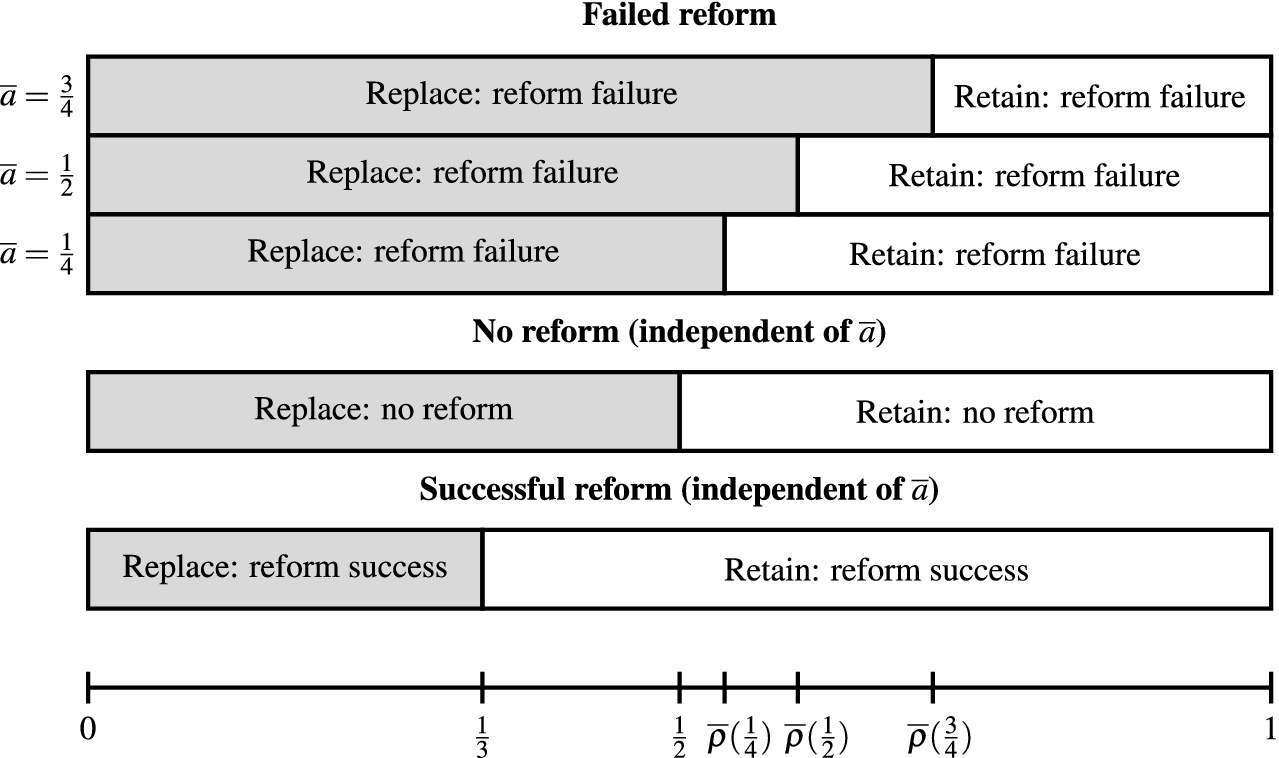


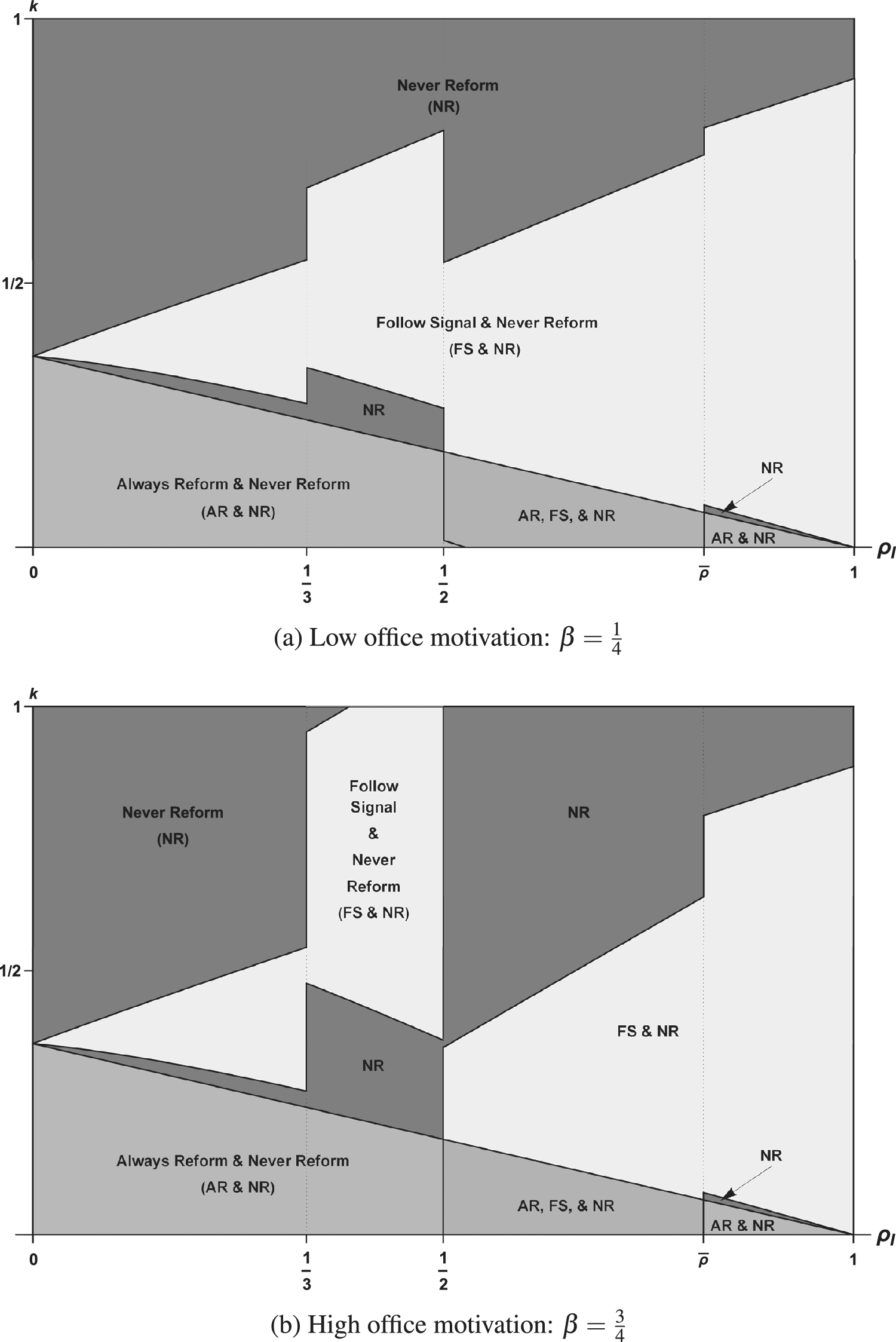


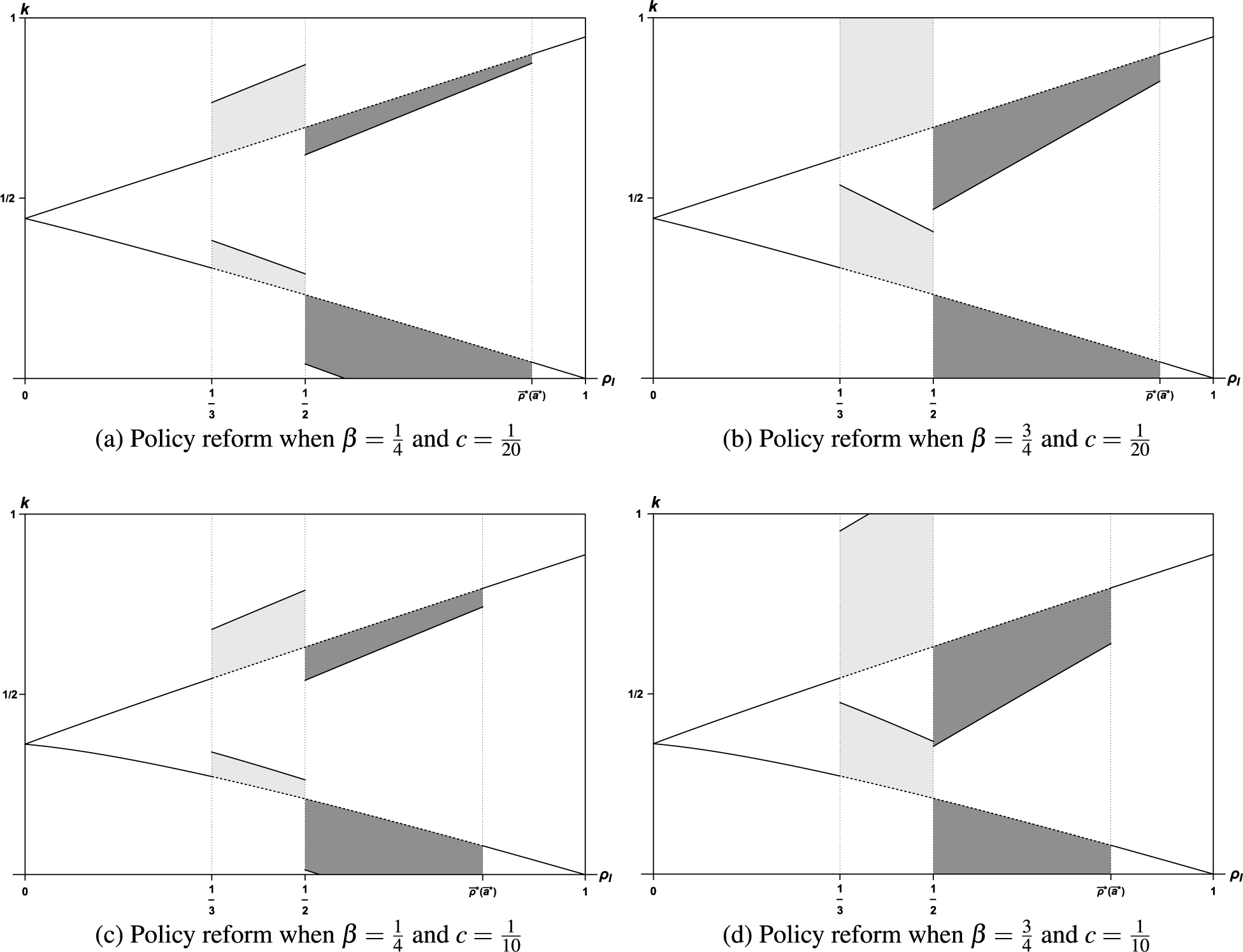


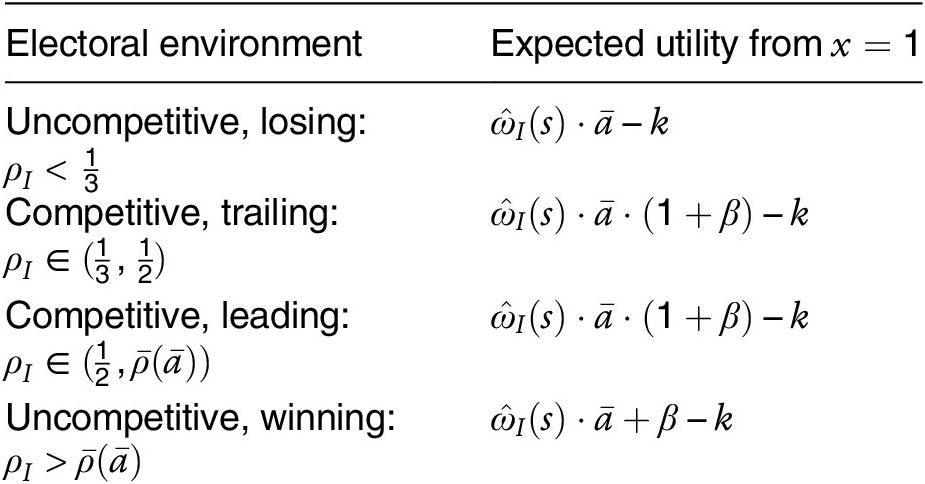


 Open access


Comments
No Comments have been published for this article.