Introduction
Carabid beetles show a wide range of feeding behavior and a continuum of diets, from complete carnivore to complete phytophage, with granivorous and omnivorous species lying between these extremes (Lundgren, Reference Lundgren2009). Many carabid species are considered to be potentially important biological control agents (Lövei & Sunderland, Reference Lövei and Sunderland1996; Kromp, Reference Kromp1999; Kotze et al., Reference Kotze, Brandmayr, Casale, Dauffy-Richard, Dekoninck, Koivula, Lövei, Mossakowski, Noordijk, Paarmann, Pizzoloo, Szyszko, Taboada, Turin, Venn, Vermeulen and Zetto2011). Pest control potential by carabid beetles, has for example, been established on both slugs (Bohan et al., Reference Bohan, Bohan, Glen, Symondson, Wiltshire and Hughes2000; McKemey et al., Reference McKemey, Symondson and Glen2003), and aphids (Sunderland et al., Reference Sunderland, Crook, Stacey and Fuller1987; Firlej et al., Reference Firlej, Doyon, Harwood and Brodeur2013). Forsythe (Reference Forsythe1983) explored buccal parts of carabid beetles in relation to feeding habits and proposed three general feeding groups: carnivorous, polyphagous, and phytophagous, with several subgroups in each. Similarly, polyphagous feeders have different prey types according to the proventiculus morphology (Evans & Forsythe Reference Evans and Forsythe1985; Chapman, Reference Chapman1985) and their mandibles (Forsythe, Reference Forsythe1983). Phytophagous species typically show wide and rounded mandibles since they need powerful mandibular movements to crush plant materials such as leaves and seeds (Ingerson-Mahar, Reference Ingerson-Mahar2014).
In temperate agroecosystems, carabid beetles are a numerically abundant taxonomic group, with many of these being granivorous species (Zhang et al., Reference Zhang, Drummond, Liebman and Hartke1997). Therefore, several studies have investigated weed seed predation by carabid beetles (Honek et al., Reference Honek, Martinkova and Jarosik2003, Reference Honek, Martinkova and Saska2005, Reference Honek, Saska and Martinkova2006, Reference Honek, Martinkova, Saska and Pekar2007; Fawki & Toft , Reference Fawki and Toft2005; Petit et al., Reference Petit, Boursault and Bohan2014), typically using cafeteria-style experiments (Saska et al., Reference Saska, Martinkova and Honek2010; Kulkarni et al., Reference Kulkarni, Dosdall and Willenborg2015). The main granivorous carabid beetle species found in agroecosystems belong to two different tribes (Honek et al., Reference Honek, Martinkova, Saska and Pekar2007): Pterostichini (genera Amara, Zabrus, Pterostichus) and Harpalini (Harapalus, Ophonus, Pseudoophonus), although other tribes present also contain granivorous species, e.g. Trechini or Platinini (Honek et al., Reference Honek, Martinkova and Jarosik2003, Reference Honek, Martinkova, Saska and Pekar2007; Hurst & Doberski, Reference Hurst and Doberski2003). Carabid beetles are believed to play a role in the biocontrol of weed seeds (Honek et al., Reference Honek, Martinkova and Jarosik2003; Bohan et al., Reference Bohan, Boursault, Brooks and Petit2011), but quantification of such a role largely remains elusive (see review in Kulkarni et al., Reference Kulkarni, Dosdall and Willenborg2015). The lack of knowledge regarding this role may also result from the complexity of the carabid-weed seed system, which collectively comprises hundreds of species. Indeed, in our study site, more than 100 carabid beetle species have been identified in studies over the last 20 years, whilst the weed community contains at least 450 species. Carabid beetles (mouthparts morphology) and weed seed functional traits (i.e. physical and chemical defenses) probably further complicate the system (Davis et al., Reference Davis, Schutte, Iannuzzi and Renner2008; Rusch et al., Reference Rusch, Birkhofer, Bommarco, Smith and Ekbom2015).
In our study, we explored a carabid interspecific variation in consumption whilst focusing on a single seed species. The aim was to elucidate how a carabid community was ordered in relation to their seed consumption to a weed species, which could be based on either their feeding habits or their phylogenetic classification.
Carabids morphological traits, as well as climatic conditions may impact on their consumption rate (Honek et al., Reference Honek, Saska and Martinkova2006; Rusch et al., Reference Rusch, Birkhofer, Bommarco, Smith and Ekbom2015; Russell et al., Reference Russell, Lambrinos, Records and Ellen2017). Thus, we used standardized experimental conditions (Deroulers et al., Reference Deroulers, Gauffre, Emeriau, Harismendy and Bretagnolle2017), and selected two morphological traits of carabids, namely body size and the ratio of mandible length to labrum width (ML/LW), which are strongly related to feeding habits of carabid beetles (Forsythe, Reference Forsythe1983). Thus, we verified whether the ratio ML/LW and body mass explained variation in seed consumption. Finally, we investigated whether consumption shown by the 28 species studies was related to their relative abundance in the field.
Materials and methods
Literature survey
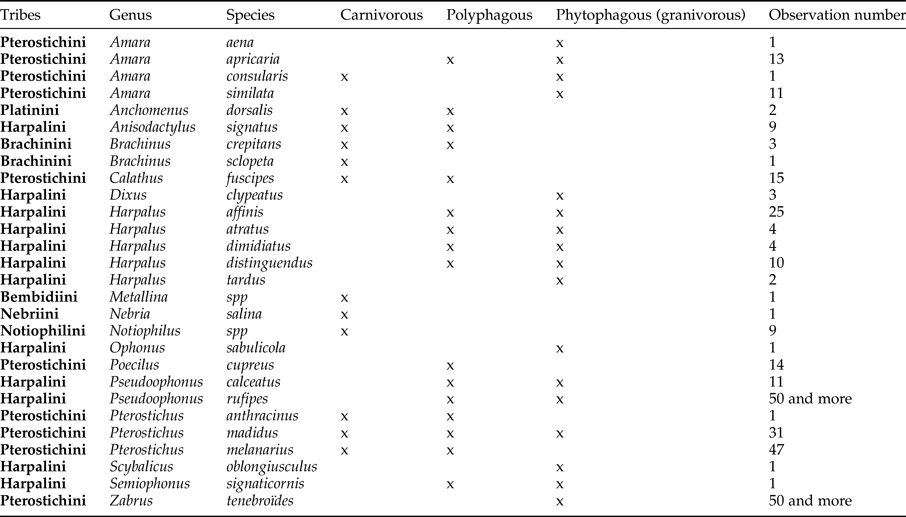
Based on a literature review of carabid beetles feeding habits and diet (reviewed in table 1), we classified the tested species according to main feeding habits groups, from species almost strictly carnivorous, to intermediate polyphagous species (feeding on seeds) and finally phytophagous species, which are mainly granivorous. Tribes of each species were also noted to allow comparison of consumption according to phylogeny.
Feeding preferences of 28 carabid beetle species tested during our experimentation based on literature survey (Larochelle, Reference Larochelle1990; Honek et al., Reference Honek, Martinkova and Jarosik2003; Lundgren, Reference Lundgren2009).

Feeding experiments
We tested the most common carabid beetles found in the Long Term Social Ecological Research – Zone Atelier Plaine et Val de Sèvre (LTSER-ZAPVS). The LTSER site covers approximately 450 km2 of an intensively managed agricultural landscape, mostly dedicated to cereal crop production, located in western France, South of Niort (79, Deux-Sèvre department) (Bretagnolle et al., Reference Bretagnolle, Berthet, Gross, Gauffre, Plumejeaud, Houte, Badenhausser, Monceau, Aliier, Monestiez and Gaba2017). Adult carabid beetles were collected alive with pitfall traps placed in the fields that were known to provide high capture rates and high species diversity, from April to August in 2015 and 2016. Traps were filled with soil pebbles placed at the bottom of the trap to provide shelter for trapped arthropods. Each trap was emptied daily to avoid cannibalism or predation. Carabid beetles were then brought back to the laboratory and placed in a room kept at a temperature of 20–23°C. Specimens were stored in plastic boxes (diameter: 5.5 cm, height: 6.5 cm) with moist cotton, and fed with weed seeds and crushed dried cat food (Purina®, Friskies®) to prevent cannibalism. Specimens were stored in this way until we collected five individuals of the same species. Due to limitations in the capture rate for scarce carabid beetle species, some of the tests were occasionally performed on a smaller number of individuals.
All feeding experiments were carried out in climatic chambers set to optimize carabid beetle predation activity (humidity: 70%, temperature: 25°C, day/night conditions: 17/7 h) (Honek et al., Reference Honek, Martinkova and Jarosik2003; Eskelson et al., Reference Eskelson, Chapman, Archbold, Obrycki and Harwood2011; Petit et al., Reference Petit, Boursault and Bohan2014). Before consumption measures, carabid beetles were left to starve for 72 h in order to standardize the level of satiation amongst individuals (Sunderland et al., Reference Sunderland, Crook, Stacey and Fuller1987; Lövei et al., Reference Lövei, Sopp and Sunderland1990). All individuals were weighted to assess body mass before and after the experimentation.
The initial number of seeds offered to carabids during experimentation was 50, in order to match the average field seed density (2000 seeds per m2) from our study site (Powolny, Reference Powolny2012). Seeds were placed in a 63.60 cm2 area, corresponding to 25% of the experimental box and covered by 5 mm of sand in order to hide seeds (granulometry: 300 µm, color: chocolate; Le marchand de sable, Challans 85). All tests were conducted with Viola arvensis, a common dicotyledonous annual weed found in the study site (Gaba et al., Reference Gaba, Chauvel, Dessaint, Bretagnolle and Petit2010; Meiss et al., Reference Meiss, Médiène, Waldhardt, Caneill and Munier-Jolain2010). This species is known to be attractive (and accessible) to carabids because of their high lipid content (Bretagnolle et al., Reference Bretagnolle, Matejicek, Gregoire, Reboud and Gaba2015) and thin seed coat. Seeds were obtained from Herbiseed® (Twyford, the UK).
We used plastic boxes (11 × 23 × 8 cm) with rounded corners and with six screened openings on the sides (mesh: 1 × 1 mm) that provided good air circulation within the box. All tests were carried out with one individual in one box. Moist cotton and a paper shelter (5 × 4 cm) were placed in the plastic box. After 24 h of experimentation, the remaining seeds were counted; missing seeds and those consumed >50% were considered to be eaten (Honek et al., Reference Honek, Martinkova and Saska2005). After each test, in order to erase any smell from previous individuals (Kielty et al., Reference Kielty, Allen-Williams, Underwood and Eastwood1996), all boxes were washed with water and black soap.
Carabid beetles occurrence and morphological traits measurements
Carabid beetles were also trapped on the LTSER-ZAPVS in order to study occurrence. To estimate occurrence, we used data collected in a previous study where data were collected over 3 years (2014, 2015, and 2016) with samples collected across 635 fields (see Marrec et al., Reference Marrec, Badenhausser, Bretagnolle, Börger, Roncoroni, Guillon and Gauffre2015, Caro et al., Reference Caro, Marrec, Gauffre, Roncoroni, Augiron and Bretagnolle2016). Between four (2015 and 2016) and five (2014) traps per experimental field (around 1250 m2) were utilized. Two traps were placed in the field's border and two (2014) or three placed in the core. Pitfall traps consisted of plastic cups (8.5 cm in diameter and 7 cm deep) and were filled with a solution containing ten drops of odorless soap and 10 g of salt per liter of water to improve insect preservation. Pitfall traps were left in place for four trapping effective days during two trapping sessions with a 1-month interval between. Beetles were brought back to the laboratory, stored in alcohol, and identified at species level.
The morphological traits measured focused on those that could impact on weed seed consumption, such as body mass or size (see Honek et al., Reference Honek, Martinkova, Saska and Pekar2007), and mandibles (Forsythe, Reference Forsythe1983). Since the latter are asymmetrical in carabid beetles, we systematically measured the left mandible, as well as the labrum width. These measurements were then used to calculate the following ratio: ML/LW. This ratio is considered to be a good proxy to estimate robustness and strength of mandibles in carabid beetles (Brandmayr et al., Reference Brandmayr, Giglio, Marano and Brandmayr1998). We used an average measurement for each carabid beetle species. Mandible length and labrum width were measured on dead individuals from 2013 collected in a previous study. Individuals were selected randomly irrespective of the crop that they were trapped within. We used trapped individuals from random years (2011 and 2012) to avoid any year effect on trait measurement. All individuals had been conserved in alcohol ethyl 96 surfin (99.9% of ethanol). Body and trait measurements were performed using a stereo microscope (Leica Microsystems M50) equipped with an integrated high-definition microscope camera (Leica IC80 HD). Ten carabid species were not measured in 2013; we therefore measured individuals trapped in 2016 following the same process to provide data for our study.
Statistical analyses
All tests were performed on R 3.2.5 (R Development Core Team, 2013). A preliminary analysis was completed to test the relationships between selected morphological traits (body mass and ratio ML/LW) with a spearman correlation test. We then analyzed the variation of seed consumption between carabid beetle species using generalized linear model with Poisson's error included. Since some species ate very few seeds, we fixed two threshold values of consumption to analyze the effects of each morphological trait on seeds consumption. Then, to analyze the effects of body mass and of the ratio ML/LW on seeds consumption, we varied the threshold value, from zero (including all species) to at least five seeds consumed. Then, the effect of body mass and ratio ML/LW on seed consumption was analyzed using a linear model. Similar analyses were conducted between carabid beetle occurrence (caught in traps in 2014, 2015, and 2016) and V. arvensis seed consumption observed in our experiments.
Results
In total, 225 carabid individuals from 28 different species were tested to measure their consumption on V. arvensis seeds. Two main tribes were identified, Harpalini with 12 species and Pterostichini with ten species. Other tribes represented comprised one or two species (Platinini, Brachinini, Bembidiini, Nebriini, Notiophilini). Feeding habits found in our literature survey showed different classifications for carabid species. Five species were classified as strict carnivorous. Only Poecilus cupreus was classified as a strictly polyphagous species. Eight species were classified as strictly phytophagous, especially for Amara species (between three and four individuals tested for each species). All other species were classified either as carnivorous–polyphagous or polyphagous–phytophagous.
There were obvious variations in the consumption shown by different beetle species for the seed (fig. 1). Ten of the 12 species tested in Harpalini tribes seemed to actively seek and eat Viola seeds (five seeds or more). For species of the Pterostichini tribe, individuals ate on average between 0 and 3.28 seeds.
Mean seed intake of Viola arvensis consumed by 28 carabid beetle species (±1 SE), with the number of individuals tested on the bottom of the histogram for each species. Species are grouped according to their tribe, within tribe they are classified from the lowest consumer to the highest.

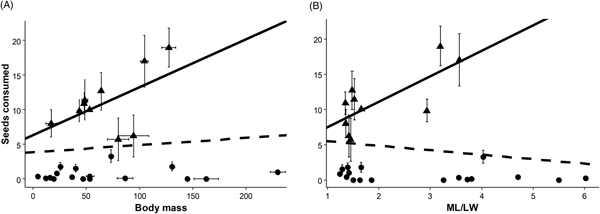
There was no correlation between body mass and the ratio ML/LW (S = 2949; P = 0.62). However, relationships between body mass and mandible length (S = 622.59; P < 0.0001) and body mass and labrum width (S = 1655.8; P < 0.01) were observed. We found no effect of body mass on Viola seed consumption when all species were included in the analysis (F = 0.231; df = 1; P = 0.635; fig. 2a). Similarly, there was no effect of body mass on seed consumption within species which ate more than five seeds (F = 3.27; df = 1; P = 0.108). No relationship was observed for ML/LW ratio when all species were included (F = 0.56; df = 1; P = 0.462). However, there was a significant positive correlation for species which had eaten more than five seeds (F = 9.58; df = 1; R 2 = 0.49; P = 0.015; fig. 2b).
Mean consumption rate of Viola arvenis seeds (±1 SE) in relation to morphological traits of body mass (±1 SE) and buccal parts. (a) Seed consumption in relation to body mass; (b) seed consumption in relation to the ratio between the mandible length and the labrum width. The dashed line represents the relationship when all species are considered, whilst the solid line represents only species that consumed at least five seeds.

Occurrence of species from field site that consumed V. arvensis seeds
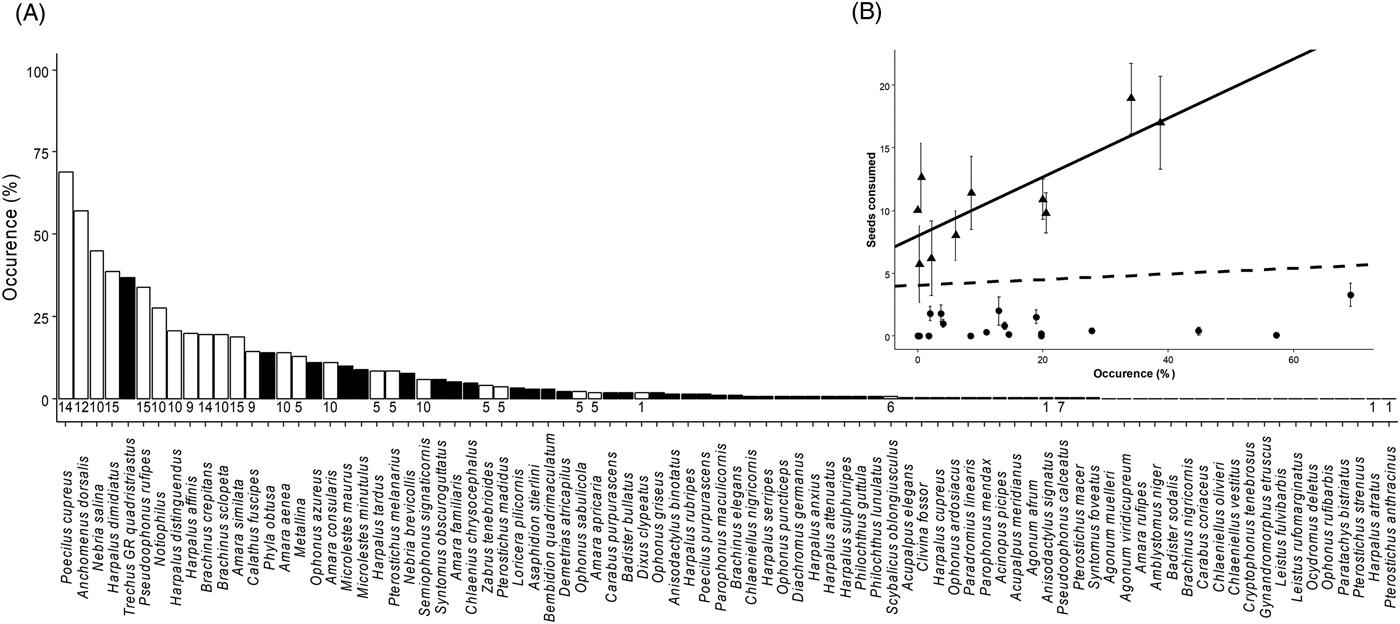
Across 3 years, 86 carabid beetle species were trapped at our study site (fig. 3a). The dominant species, P. cupreus showed a frequency of occurrence of 69% in cultivated fields, followed by Anchomenus dorsalis (57%). Of these 86 species, the consumption of Viola seeds could be measured for 26 of them, since Pterostichus anthracinus and Harpalus atratus were not trapped in spring/summer over these 3 years. Again, there was no overall correlation between occurrence and consumption rate (F = 0.13; df = 1; P = 0.72), but restricting the analysis to species which had eaten more than five seeds yielded a significant positive correlation (R 2 = 0.59; df = 1; P < 0.01; fig. 3b). Therefore, amongst carabid species that ate Viola seeds, the most common carabid species (from our study site) were those that consumed seeds at a higher rate of consumption. Specifically, H arpalus dimidiatus and P seudoophonus rufipes were, respectively, the fourth and sixth most common amongst the 86 carabid beetle species found in the study area.
(a) Occurrence of 86 carabid beetles captured in the LTSER ‘Zone Atelier Plaine & Val de Sèvre’ over 3 years (2014–2016), among which 28 have been tested to measure their consumption rate of Viola arvensis seeds (in white + number of individuals tested on the bottom of the histogram), other species are in black; (b) seed consumption rate in relation to the frequency of occurrence (two thresholds as in fig. 2: dashed line when all species are considered and solid line when species ate at least five seeds).

Discussion
Three feeding groups are usually recognized for carabid beetles: polyphagous predators, carnivorous predators, and phytophagous species (Thiele, Reference Thiele and Wieser1977; Forsythe, Reference Forsythe1983; Dajoz, Reference Dajoz2002). But carabids are also claimed to be mainly polyphagous predators in some studies (Kotze et al., Reference Kotze, Brandmayr, Casale, Dauffy-Richard, Dekoninck, Koivula, Lövei, Mossakowski, Noordijk, Paarmann, Pizzoloo, Szyszko, Taboada, Turin, Venn, Vermeulen and Zetto2011). We found that the claimed carnivorous species actually consumed seeds (e.g. Nebria salina consumed on average 0.4 seeds) as much as species known as strict and obligate granivorous and seed eaters, like Amara similata (average 1.5 seeds). The genus Pterostichus is known as a generalist carnivore (Pollet & Desender, Reference Pollet and Desender1985, Reference Pollet and Desender1986), although Hurst & Doberski (Reference Hurst and Doberski2003) indicated that Pterostichus madidus is a potential predator of weed seeds. Conversely, species within the genus Amara, which did not consume V. arvensis seeds during our experiments, is believed to be a strong seed consumer (Toft & Bilde, Reference Toft, Bilde and Holland2002; Fawki et al., Reference Fawki and Toft2005). However, Boursault (Reference Boursault2012) also found that Amara does not eat Viola seeds, perhaps because this genus prefers Brassicaceae seeds (Thiele, Reference Thiele and Wieser1977). Another possibility is that the composition of the bacterial guts symbionts could result in an inability of Amara species to consume seeds of Viola (Lundgren & Lehman Reference Lundgren and Lehman2010). Our results were in close agreement with regard to other genera such as Harpalus, Ophonus, and Pseudoophonus species, which are regarded as high consumers of seeds (Tooley et al., Reference Tooley, Froud Williams, Boatman, Holland, Boatman, Davies, Chaney, Feber, Snoo and Sparks1999; Toft & Bilde, Reference Toft, Bilde and Holland2002). Our results also showed a phylogenetic signal on seeds consumption (species of the same tribes showed similar abilities to consume Viola seeds). The tribe Harpalini (e.g. Harpalus, Ophonus, and Pseudoophonus) appears less specialized than the tribe Pterostichini (Amara, Zabrus) (Brandmayr, Reference Brandmayr and Stork1990; Honek et al., Reference Honek, Martinkova, Saska and Pekar2007). Thus, they may consume a wider range of weed seed species than specialist granivorous species from Pterostichini.
It is possible that V. arvensis is a ‘peculiar’ seed, with a chemical composition which is not suitable for some carabid beetle species (e.g. Amara spp.). In addition, weed seeds differ in mechanical traits, in particular regarding the seed coat hardness (Lundgren & Rosentrater, Reference Lundgren and Rosentrater2007; Davis et al., Reference Davis, Schutte, Iannuzzi and Renner2008; Gaba et al., Reference Gaba, Collas, Powolny, Bretagnolle and Bretagnolle2014). Furthermore, the buccal apparatus is different according to carabid beetle species. Thus, their abilities to consume weed seeds is variable (Forsythe, Reference Forsythe1983). Therefore, some carabid beetle species which did not eat V. arvensis seed may be able to consume other weed seed species (Honek et al., Reference Honek, Martinkova, Saska and Pekar2007).
Body mass and ratio of ML/LW were poor predictors of seed consumption. However, the correlation between the ratio of ML/LW and consumption became significant when restricted to species which ate more than five seeds. Indeed, all these species belong to the recognized category of strict phytophagous species, with mandibles being wider and stouter than for the other species (Forsythe, Reference Forsythe1983). Therefore, at least in seed predator specialists, consumption increased with both body mass and the degree of specialization in morphological traits. For these species, we found a positive correlation between their consumption toward seeds and their occurrence. Indirectly, these results imply that carabids may contribute to weed seed control. Limitations of our study primarily relate to the use of a single seed species and the specific control conditions that we chose to use. Our study also did not consider the species’ trophic network position within the specialist–generalist gradient (Thébault & Fontaine, Reference Thébault and Fontaine2008), or the effects of natural conditions on seed consumption by carabid beetles. However, our study provides a comparative assessment among a fairly large range of carabid species. It would be valuable to extend such studies to investigate the consumption for other seed species.
Acknowledgements
The authors thank Gaétanne Leprovost who provided trait measurements, Isabelle Badenhausser for help in measurements, Marilyn Roncoroni who helped in species identification and for sharing her knowledge on ground beetles. Many thanks to Edoardo Tedesco and Charlotte Gibson who read and improved this manuscript. Many thanks too for their help, to Alexis Harismendy and Simon Emeriau. PHD funding was obtained from Conseil Départemental Des Deux-Sèvres and Région Poitou Charentes. This study took place under and was funded by ANR AGROBIOSE and LISEA foundation projects.