




No CrossRef data available.
A TASTE FOR PUNISHMENT: Black and White Americans' Views on the Death Penalty and the War on Drugs
Published online by Cambridge University Press: 11 March 2004
Abstract
It is commonly accepted that Black and White Americans hold divergent views about the criminal justice system. Furthermore, many accept the view that U.S. public opinion is unflinchingly punitive where issues of criminal justice policy are concerned, with this punitiveness among White Americans deriving to a significant degree from anti-Black prejudice. Using a series of survey-based experiments and large, nationally representative samples of White and African American respondents, we subject the questions of Black-White polarization, unyielding punitiveness, and the influence of racial prejudice to close scrutiny. Our results, first, confirm large Black-White differences in opinion with Blacks consistently less punitive than Whites. These differences are substantially a result of beliefs about the extent of racial bias in the criminal justice system. Second, the framing experiments suggest that responses to the death penalty are very different than responses to drug-related crimes like crack or powder cocaine use, with the former exhibiting far less malleability than the latter. Third, racial prejudice is a consistently large influence on White public opinion and a weaker, but sometimes important influence among Blacks as well. Implications for discourse on race and crime are also discussed.
Information
- Type
- STATE OF THE ART
- Information
- Copyright
- © 2004 W.E.B. Du Bois Institute for African and African American Research
INTRODUCTION
At the same time that our criminal justice policies have taken on an aggressive and deeply punitive tenor, they have also fallen with special severity on minority communities, particularly on African Americans. These changes are sufficiently large that many scholars now write of a qualitatively distinct policy-regime governing criminal justice issues in the U.S. today (Beckett and Western, 2001; Garland 2001; Miller 1996; Wacquant 2001). To wit, after a century of relative stability, incarceration rates in the U.S. are at an all time high and greatly exceed, by a factor of anywhere from five times to ten times, those in all other Western industrial nations (Garland 2001). Total annual expenditures on jails and prisons now approach fifty billion dollars. In some large states, like California, such spending now exceeds that on higher education (Chambliss 1999). Crime is now such a large preoccupation of what government does at all levels that issues of crime and control occupy a place in the national political discourse unheard of prior to the mid-1960s (Beckett 1997; Parenti 1999). With respect to African Americans, the years from 1980 to 2000 witnessed a near tripling of the rate of Black incarceration, increasing the Black-White disparity in the odds of incarceration to an extreme of eight to one (Blumstein 2001). Although African Americans constitute only 12% of the U.S. population, they currently make-up about half of those in jail or in prison, and constitute more than half of those on death row (Bureau of Justice Statistics 2002).
The social underpinnings and effects of the new criminal justice policy regime are the subject of far greater controversy. A number of factors doubtlessly contribute to the current state of criminal justice policy, ranging from the nature and actual rate of crime, the larger economic and political contexts in which crime and criminal justice policy formation occur, and prevailing ideas about the causes and appropriate responses, both practically and morally, to violations of societal rules. A major factor mentioned in many lay and scholarly accounts, and the one that is the center of our attention, is the putatively staunch “law and order” appetite of public opinion in the U.S., and the possibility that such outlooks are heavily rooted in anti-Black racial prejudice.
Indeed, a number of scholars see in changing U.S. criminal justice policy a deliberate, if loosely coordinated, effort to re-assert control and domination over African Americans. The elevation of so-called social disorder and “lawlessness” to matters of national political discourse was first undertaken by Republican presidential nominee Barry Goldwater in his 1964 campaign. This was a time when the struggle over Black civil rights was widely recognized as “the nation's most important problem” (Schuman et al., 1997). This often racialized law and order message was subsequently honed to precision by Richard Nixon in 1968, just as the Black Power movement grew in potency (Beckett 1997). Parenti (1999) argues that the turn toward harsh criminal justice policies became necessary to maintain class and racial hierarchies in the wake of Black political mobilization, labor law changes, and re-structuring global capitalism. More specifically, the reintroduction of the harshest form of punishment—the death penalty—has been credited by some analysts to a decidedly racial politics. Accordingly, “Whites from all classes successfully demand enhanced criminal punishments in areas with the largest minority populations” (Jacobs and Carmichael, 2002, p. 111). Indeed, these researchers find strong and consistent support for a racial threat hypothesis which holds that the death penalty is most likely to exist in states with large African American populations. Net of other economic, crime related, and ideological indicators, Jacobs and Carmichael find that the effect of the size of the Black population in their analyses of state-level data from 1971 to 1991 is so large and durable that:
… our most important results concern race. Findings that document a close relationship between the presence of African Americans in a state and the presence of the death penalty may not be surprising, but they show how important the politics of racial division and the racial foundations of punishment continue to be in the United States (Jacobs and Carmichael, 2002, p. 128).
Casting an even broader theoretical net, sociologist Loic Wacquant characterizes current rates of Black incarceration and changes in policing practices and policy as tantamount to a new “peculiar institution,” or fourth stage of American racial oppression aptly termed the “carceral state” (Wacquant 2001).
We wish to subject three aspects of these notions about the popular underpinnings of the new racialized “law and order” regime to careful empirical scrutiny. First, we take as problematic the assumption of an unflinching punitive “law and order” tilt of U.S. public opinion on crime. A close reading suggests that there is a measure of ambiguity in the extant research literature on the degree of flexibility and on the underlying sources of attitudes on criminal justice policy issues. This is particularly true as regards the degree of support for policies such as the death penalty and some aspects of the now more than decade old “war on drugs.”
Second, we hope to increase our leverage on the magnitude and sources of Black-White differences in attitudes on criminal justice policy. Many studies and polls have pointed to substantial racial differences in opinion about criminal justice. The differences are so large and recurrent as to begin to raise basic questions about the democratic legitimacy of the criminal justice system, at least in the eyes of African Americans (Blumstein 2001; Hagan and Albonetti, 1982; Hawkins 2001; Kennedy 2001). Yet, few studies have had large enough samples of African American respondents to shed much light on these differences. Fewer still have combined large samples of both Blacks and Whites with systematic measures of other theoretically relevant variables such as the general salience of, or perceived vulnerability to crime, perceived racial bias in the criminal justice system, and racial prejudice. We are in a position to do both.
These two concerns have a natural point of intersection. Namely, third, we seek to pinpoint just how substantial a role individual level anti-Black racial prejudice plays in the contemporary “taste for punishment.” Some analysts suggest that anti-Black prejudice is a critical source of staunchly punitive criminal justice views among many White Americans. Such a factor may serve to sharply differentiate the wellsprings of Whites' opinion on crime issues from those observed among Blacks. And by the same token, Blacks' policy views on crime may be driven more by the practical exigency of controlling crime in the neighborhood rather than by an array of general sociopolitical attitudes and beliefs (Cohn and Barkan, forthcoming; Meares and Kahan, 1998; Young 1991).
In pursuing answers to these queries, we also seek to move beyond simple correlational analyses in understanding the contours of public opinion on criminal justice policy. Specifically, we report on a series of survey-based experiments that manipulate cues about bias in the criminal justice system, both racial- and non-racial, given to respondents (Schuman and Bobo, 1988).1
Survey-based experiments combine the capacity to generalize to important populations characteristic of sample surveys with the experimental control that allows stronger conclusions as to cause and effect (see Schuman and Bobo, 1988, especially pp. 273–274). The use of experiments embedded within surveys has a long history in the social sciences, though until the last decade or so such experiments were aimed mainly at methodological research on, for example, question order and response format effects (Schuman and Presser, 1981) rather than substantive hypothesis testing. Kinder and Palfrey (1993) provide an excellent general introduction to the use of experiments in studies of public opinion. This approach has been used to test theories of attitudes on affirmative action and related race-targeted policies (Bobo and Kluegel, 1993; Kinder and Sanders, 1996; Sidanius et al., 2000; Sniderman and Carmines, 1997), social welfare policy (Peffley et al., 1997; Smith 1987), residential composition preferences (Charles 2000 and 2001; Emerson et al., 2001), and political campaign messages (Mendelberg 2001; Reeves 1997; Valentino et al., 2002).
BACKGROUND
Criminal justice policies range from policing practices and policies, to prosecutorial and judicial authority, to the functioning of the jails, prison, probation, and parole monitoring systems. Two major thrusts of criminal justice policy over the last two decades have garnered significant attention. First, the death penalty was re-introduced in a number of states.2
Since 1976, thirty-eight states have reinstated capital punishment. Only six of these states have not held an execution. Reinstating the death penalty is not a hollow gesture. As Jacobs and Carmichael explain: “From 1991 to 1995, only 2 of the 35 death-penalty states did not impose this sentence. The mean number of death sentences in these three five-year periods in death penalty states was 30.7 (after 1980 and the reversal of the Furman decision, this mean rises to 39.4). If states allow the death sentence, their courts use it. The legality of this punishment is not just a symbolic issue” (Jacobs and Carmichael, 2002, p. 116).
The Malleable Public?
Some research suggests that the American public is more flexible in its thinking about criminal justice policy issues than is often assumed. First, when allowed more qualified or nuanced options, many respondents endorse less punitive policy outcomes. Thus, studies that use vignettes to compare global and specific attitudes or allow respondents to choose from a variety of sentences suggest that support for punitive policies is “mushy” and that information can change opinion. Vignette studies demonstrate that support for harsh policies declines when respondents have more information about the criminal or about the circumstances of the crime (Applegate et al., 1996; Cullen et al., 2000; Zamble and Kalm, 1990). Studies that offer respondents a choice between various sentencing options also suggest that policy preferences are flexible. For instance, several academic studies find that support for the death penalty drops significantly when life without parole (and especially life without parole plus restitution) is offered as a specific alternative to capital punishment (Bowers 1993; McGarrell and Sandys, 1996; Moon et al., 2000; Sandys and McGarrell, 1995). A number of Gallup Polls since 1985 report similar findings (Jones 2001). Taken together, these studies suggest that public opinion on criminal justice issues is not unalterably set on the most punitive position.
To be sure, there is much evidence of a punitive tilt in public opinion on crime. Yet, as Cullen et al. (2000) stressed: “This punitiveness is not fixed on a single point but is ‘mushy.’ Even when expressing punitive opinions, people tend to be flexible enough to consider a range of sentencing options, including sanctions that are less harsh than those they may have favored either at first thought or when provided with only minimal information on which to base their views… They moderate punitiveness when less stringent interventions have utility for victims, the community, and offenders” (Cullen et al., 2000, p. 8). If the public is more open and malleable, we hypothesize that framing criminal justice policies as unfair or biased should, all else equal, move public opinion in a less punitive direction (Hypothesis 1).
Second, the demographic correlates of attitudes on criminal justice views suggest potential malleability. Political scientist Shmuel Lock (1999) has recently stressed the importance of education and the openness it brings to new information as influences on public opinion about law and order issues. To the extent that better educated people express less punitive points of view, and to the extent those who are better informed express less punitive points of view, there may be grounds to expect even greater movement toward a less punitive tilt in the future, or at least substantial openness to elite leadership in that direction. Accordingly, we hypothesize that bias framing effects should interact with education such that it is the better educated who should show the greatest sensitivity to bias framing (Hypothesis 2).
The general logic of these patterns is to suggest that public opinion on criminal justice is importantly reasoned and tempered rather than unreasoned and obdurately harsh. If so, it is legitimate to hypothesize that framing particular criminal justice policies as unfair or biased should substantially move public opinion. To some degree, of course, a test of these hypotheses rests on the ability to successfully depict a policy or outcome as inequitable. For the purposes of the tests reported below, we rely on actual levels of disparity or inequality in framing tests of support for criminal justice policies. That is, our experiments focus on providing respondents with “the facts” and are not intended to be a search for particularly appealing political rhetoric. We believe this is the appropriate starting point for our research given our theoretical interest in the nature of public opinion (as opposed to an advocacy agenda where the goal might appropriately be to find the rhetoric or strategy that works best).
The Rigid Public?
In contrast, other research indicates that public opinion on criminal justice matters may be much more fixed and inflexible than the studies reviewed above suggest. Previous research indicates that punitive attitudes are largely rooted in certain fairly stable underlying social psychological predispositions. Central among these predispositions are sociopolitical ideology and racial prejudice (Barkan and Cohn, 1994; Cohn et al., 1991; Ellsworth and Gross, 1994; Ellsworth and Ross, 1983; Johnson 2001, Tyler and Boeckmann, 1997; Tyler and Weber, 1982). Given the sources of these attitudes, and the fact that political and social values are developed early in life and are rather stable, it is likely that views on the criminal justice system are rather rigid and resistant to change. As Tom Tyler explained: “Since social values represent long-term political orientations, they reflect a stable influence on public opinion and are unlikely to change in reaction to contemporary public events. Hence, the strong influence they have over punitiveness suggests that current levels of public support for punitiveness are not simply the result of highly visible events like the Polly Klaas kidnapping. Instead, they develop from underlying social values that are stable and that will shape public views for the near future” (Tyler and Boeckmann, 1997, p. 199). Indeed, studies have found that information does little to shift opinion on the death penalty (Bohm et al., 1991; Ellsworth and Ross, 1983; Sarat and Vidmar, 1976). Even Lock (1999), who had hoped to find substantial effects of information levels, produced at best mixed results in terms of reducing punitiveness. And Johnson (2001), using General Social Survey data for the period of 1974–1994, has recently shown that indicators of racial prejudice strongly predict Whites' levels of support for the death penalty and their desire for harsher courts.
To the extent that harsh criminal justice policy views are based in stable social psychological orientations such as political ideology and racial prejudice, we should find that bias framing has little effect on policy views (Hypothesis 3). That is, cueing a form of inequity or bias should not greatly influence levels of support for criminal justice policies because the roots of such views have a moral and normative foundation unlikely to be sensitive to information about the problematic aspects of policy implementation or consequences. In addition, we should find consistent effects of demographic background characteristics such as the respondent's level of education (Hypothesis 3A).
Black/White Differences on Crime and the Role of Prejudice
Numerous studies identify substantial differences between Blacks and Whites on issues of criminal justice. These differences emerge in views of police behavior and practices, the functioning of prosecutors and the courts, and a range of policy views on how to respond to crime and punish criminals. The general pattern of these differences shows Blacks to be more skeptical of the equal application of law (Hagan and Albonetti, 1982; Henderson et al., 1997; Hurwitz and Peffley, 2001; Wortley et al., 1997), more critical of the police and their tactics (Huang and Vaughn, 1996; Peek et al., 1981; Smith and Hawkins, 1973; Taylor et al., 2001; Tuch and Weitzer, 1997), less supportive of harsh punishments (Blumstein and Cohen, 1980; Bohm 1991; Combs and Comer, 1984; Miller et al., 1986; Secret and Johnson, 1989), and more supportive of rehabilitative strategies (Gerber and Engelhardt-Greer, 1996; McCorkle 1993). Thus, all else equal, we hypothesize that African Americans should express less punitive views than Whites and show greater responsiveness to bias framing cues than Whites (Hypothesis 4).
More important than this baseline expectation of race-based differences, however, is the goal to increase our leverage on understanding the sources of Black-White differences. Previous research points to three major possibilities regarding Black-White differences in criminal justice views. First, Blacks are more likely to be the victims of crime than Whites and to live in communities with higher levels of crime and disorder (Blumstein 2001; Hawkins 2001; Kennedy 2001). As a result, African Americans usually express higher levels of fear and concern about crime than do Whites. On this basis it is plausible to expect that the heightened general salience of crime in the lives of African Americans may encourage greater punitiveness in the criminal justice policy views of Blacks than is likely to be found among Whites. As legal scholars Tracey Meares and Don Kahan (1998) argue, residents of inner city Black communities may be more ready for, and see themselves more in need of, draconian crime control measures than do Whites. They suggest that for many Blacks it is far more important to fight crime, regain “control of the streets,” and assert a strong position about the norms that should govern youth activity than it is to scrupulously preserve traditional civil liberties protections. Hence, for example, Meares and Kahan argue that Blacks will support many harsh law enforcement strategies such as tough curfews, loitering, and other anti-gang ordinances that might appear as unwarranted state intrusions on individual freedom to many suburban Whites. Accordingly, they maintain Blacks may have a strong taste for expanding police powers and punishing crime:
What the civil libertarian critique ignores is the grounding of these laws in the efforts of inner-city African Americans to shape their own norms. Far from opposing curfew and gang-loitering laws, the African American residents of the inner city have in fact supported much of the impetus for the resurgence of them (Meares and Kahan, 1998, p. 830).
At the same time, many studies of White public opinion have found that the general salience of crime does little to influence Whites' views on criminal justice policy. As a result, we hypothesize that the salience of crime should matter more for the policy views of African Americans than it does for Whites (Hypothesis 5).
Second, beliefs about the fundamental fairness of the criminal justice system may help account for different policy views in this domain between Blacks and Whites. Much prior research suggests that African Americans are far more likely to believe that the criminal justice system is riddled with systematic bias on the basis of race than are Whites. To the extent this is so, perceptions of bias in the functioning of the criminal justice system may account for much of the Black-White difference in support for specific harsh punishments or other new anti-crime initiatives (Hypothesis 6). Both the overall level of support for a particular criminal justice policy and reactions to experimental manipulations that frame issues of punishment in terms of potentially racially differential effects are likely to be contingent on the degree of perceived racial bias in the criminal justice system as a whole. Thus, while we expect perceptions of bias to influence the views of Blacks and Whites, these effects should be more pronounced among African Americans.
Third, a handful of studies suggest that anti-Black racial prejudice may be a key factor differentiating the crime policy views of Blacks and Whites (Cohn et al., 1991; Hurwitz and Peffley, 1997; Johnson 2001). Issues of race and crime have a long history of interconnection in the U.S. In particular, ideologies of anti-Black inferiority in the U.S. have consistently depicted Blacks as more violent and prone to crime (Du Bois 1996 [1899]; Fredrickson 1971). As such a central component not only of American race ideology, but also of American jurisprudence, we would naturally expect those Whites scoring higher in racial prejudice to support an array of criminal justice policies that fall with greater severity on African Americans.3
Distinguished jurist A. Leon Higginbotham convincingly argued that a foundation stone of American law has been the “precept of black inferiority.” He writes: “But the truth was that our nation was founded explicitly, prospered implicitly, and still often lives uneasily on the precept of black inferiority and white superiority. Indeed, that precept helped to legitimize slavery in America and served to justify the segregation of African Americans in this nation long after slavery had been abolished. To this day, the premise of black inferiority and white superiority remains an essential element of the ‘American identity,’ mesmerized as we still are by race and color” (Higginbotham 1996, p. 9).
DATA AND MEASURES
The data for this paper come from the 2000 National African American Election Study (NAAES) and from the 2001 Race, Crime and Public Opinion Study (RCPOS). Each survey is a representative national sample of White and Black Americans living in U.S. households. The NAAES was conducted in the fall of 2000 and included 831 African Americans and 724 Whites. The Race, Crime and Public Opinion Study was conducted by the authors in the summer of 2001, and included 978 White and 1,010 Black respondents. Data for both studies was collected by Knowledge Networks using new Internet-based survey technology. See the Appendix for detailed information on survey methodology and sample characteristics for the NAAES and the RCPOS.
The analyses below include several demographic and background variables. Race is treated as a dummy variable labeled “White,” and is coded 1 for White, 0 for Black. Education is a nine-category variable, ranging from “less than high school” (coded 1) to “doctorate degree” (coded 9). Political conservatism is a five category variable, ranging from “very liberal” (coded 1) to “very conservative” (coded 5).
To measure perceived racial bias in the criminal justice system, respondents were asked, “In general, do you believe the criminal justice system ‘is biased in favor of blacks’ (coded 1), ‘gives blacks fair treatment’ (coded 2), or ‘is biased against blacks?’” (coded 3). Salience of crime is an index created by averaging the responses to three items—perceptions of the crime problem in one's neighborhood, fear of having one's house burglarized, and fear of being robbed—and ranges from low (coded 1) to high (coded 4). The alpha for the Crime Salience Index is .74. Finally, as an indicator of prejudice we use the Racial Resentment Scale, created by averaging responses to the following six items: 4
We employ this measure despite a long history of controversy surrounding its meaning and that of the closely allied notion of “symbolic racism” (see Sears et al., 2000 for a review). Here it is mainly important to emphasize that we understand the measure as tapping a set of group-level or collective sentiments that have much in common with theories of group conflict and group position (Blumer 1958; Bobo 1999.) Theoretically, Eliot Smith has persuasively argued that: “there is reason to identify symbolic racism with group-based, emotion-linked appraisals” (Smith 1993, p. 308) and that such appraisals may not flow from discrete individual exigencies or experiences but do very much flow from “perceivers' views of their group interests' (Smith 1993, p. 309, emphasis in original). Or, as Michael Hughes put it on the basis of a careful analysis of National Election Study data: “In short, symbolic racism may, in itself, constitute self-oriented group interest in the sense of status defense.…The critical issue, however, is also not moral resentment and irrational antagonism: The issue represented by symbolic racism is status and power and whites' fear of losing them” (Hughes 1997, p. 74).
- Irish, Italian, Jewish and many other minorities overcame prejudice and worked their way up. Blacks should do the same without any special favors.
- Over the past few years, Blacks have gotten less than they deserve.
- Government officials usually pay less attention to a request or complaint from a Black person than from a white person.
- Most Blacks who receive money from welfare programs could get along without it if they tried.
- It's really a matter of some people not trying hard enough; if Blacks would only try harder, they could be just as well off as Whites.
- Generations of slavery and discrimination have created conditions that make it difficult for Blacks to work their way out of the lower class.
Response options for these items ranged from “strongly disagree” (coded 1) to “strongly agree” (coded 5) (some items were reversed scored). Those who answered, “don't know,” or refused, were coded at the midpoint (3). Scores on the Racial Resentment Scale range from 0 (low racial resentment) to 5 (high racial resentment). The alpha for the Racial Resentment Scale is .77.
The variables and coding for analyses using the NAAES data differ slightly from those above. In these analyses, perceived racial bias is measured with a different item; respondents were asked to indicate which statement is most true: a) “Generally, the American legal system treats all groups fairly” or b) “The American legal system is unfair to Blacks.” Respondents who answered that the system is fair to all groups were coded 1, those who answered that the system is unfair to Blacks were coded 3, and those who answered “both,” “neither” or “don't know” were coded at the midpoint (2). These analyses also include a measure of common fate identity: “Do you think what happens generally to Black people in this country will have something to do with what happens in your life?” Response options included “a lot” (coded 4), “some” (coded 3), “not very much” (coded 2), and “none” or “don't know” (both coded 1).
ANALYSIS AND RESULTS
Experiment One: Death Row Demography
In order to gauge the potential malleability of public opinion on criminal justice issues we began with a focus on the most severe form of punishment the state can apply to criminals, namely the death penalty. Specifically, we call our first experiment the “Death Row Demography” experiment. It focuses on the heavy overrepresentation of Blacks on death row as compared to their numbers in the general population. We sought to determine if, by drawing attention to this racial disproportionality alone, public opinion might shift in a less punitive direction. Any number of social science critiques of the criminal justice system point to just such racial disparities as evidence of a problem of serious racial bias (Cole 1999; Kennedy 2001; Miller 1996; Parenti 1999; Sidanius and Pratto, 1999; Tonry 1995). Still, we conceived of this manipulation as but a weak test of a racial cue effect. Committing the grave offense of homicide is essentially a pre-requisite to death row status; hence, even if the question cues a substantial racial inequity, it may have only a modest mitigating effect on death penalty support. In order to enhance the contrast, we employed a three-way split-ballot with one-third of the sample receiving a baseline or standard death penalty question with no racial cue, one-third receiving the positive racial cue of Black overrepresentation on death row, and one-third receiving a negative racial cue of disproportionate Black commission of homicides. We assume the latter condition, highlighting as it does the commission of a deadly violent crime, should elicit the strongest level of support for the death penalty. And the disproportionate involvement of Blacks in the commission of violent offenses is precisely the sort of pattern that more conservative social science analysts tend to emphasize (Thernstrom and Thernstrom, 1997). Exact question wording and basic distributions by race and experimental ballot are shown in Table 1.
Death row demography experiment

Does explicitly mentioning the overrepresentation of Blacks on death row decrease support for the death penalty? The results of Table 1 show that for neither the Black nor the White respondents did our experimental manipulation influence the level of death penalty support. Better than 80% of Whites favor (combining responses of strongly or somewhat) the death penalty across all three conditions and, if anything, including a racial cue of any kind slightly (insignificantly so) reduces death penalty support. Somewhat better than 50% of Blacks support the death penalty (combining responses of strongly or somewhat), with a negligible rise in the percentage supporting the death penalty when the question mentioned the percentage of Blacks committing homicides.
The absence of a strong main effect of the racial disproportionality cue does not mean that no important experimental effects exist. As Kinder and Sanders (1996) stressed, when public policy questions are framed in importantly different ways they may well elicit different resonances in the mass public. If so, the absence of a main experimental effect can mask important underlying differences in patterns of correlation with respondent background characteristics and social psychological outlooks. The analyses reported in Table 2 begin to address this possibility.5
For each experiment, dependent variables are a one to four scale, with higher scores indicating more punitive attitudes.
OLS regression analysis of the death row demography experiment

Model 3 reports results for only the White respondents. Ultimately, our interest is to determine whether the racial cue manipulation interacts with respondent background characteristics or key psychological measures like political ideology. That is, even if the overall distribution did not change, the better educated as compared to the poorly educated, and the political liberal as compared to the political conservative, may well have moved in response to the experimental manipulation.6
White respondents to the NAAES were not asked the criminal justice racial bias question or the common fate identity question.
Models 5 and 6 report results separately for the Black respondents. In this case we are interested not only in the possibility of differences based in background characteristics and in political ideology, but also based in perceptions of racial bias in the criminal justice system and levels of group identification. That is, Blacks who see the criminal justice system as systematically biased on the basis of race or who generally express high levels of common fate identification may be especially sensitive to the manipulation of racial cues in the experiment. Although Blacks scoring higher in common fate identity are indeed generally less likely to support the death penalty, there is no interaction with the experimental manipulation. However, perceptions of racial bias in the criminal justice system do not reduce support for the death penalty (in the context of the common fate identity measure). The absence of a main experimental effect among either Blacks or Whites and the general absence of interactions with other factors may mean that for most Americans the application of the ultimate penalty for the ultimate crime operates as a fairly strong general principle. Minimally, the results suggest that the mere racial inequity cue we developed here does little to move significant numbers of respondents and does not lead to a sufficient re-framing of the issue so as to tap into distinctive points of resonance in the mass public.
Experiment Two: Murder Victim Race Bias
We now shift attention to one of the remaining signs of clear racial bias in the application of the death penalty: People who murder Whites, whether they be Black or White, are more likely to receive a death sentence than those who murder non-Whites.7
A 1990 report by the U.S. General Accounting Office (GAO) synthesized the results from twenty-eight studies of death penalty sentencing since 1976. The report concluded that “In 82 percent of the studies, race of victim was found to influence the likelihood of being charged with capital murder or receiving the death penalty, i.e., those who murdered whites were found to be more likely to be sentenced to death than those who murdered blacks. This finding was remarkably consistent across data sets, states, data collection methods, and analytic techniques. The finding held for high, medium and low quality studies” (U.S. General Accounting Office, Death Penalty Sentencing: Research Indicates Pattern of Racial Disparities, February 1990).
Murder victim race experiment [At present, someone who murders a white person is much more likely to be sentenced to death than someone who murders a black person.] Do you favor or oppose the death penalty for persons convicted of murder?

Here we do find a statistically discernible effect of the experimental manipulation among Blacks, but not among Whites. Support for the death penalty among Blacks falls from 63% in the basic question condition to 52% in the racial bias cue condition. There is a very slight, but insignificant trend in the same direction among Whites, where death penalty support falls from 77% to 75%. Given the slight trend in the same direction for both Whites and Blacks, the three-way interaction of race, experimental ballot, and response does not attain conventional criteria for statistical significance.
The Murder Victim Race experiment data were collected as part of our Race, Crime, and Public Opinion Study. As a result, we have more extensive measures in these models including a measure of criminal justice bias against Blacks, a multiple item index of the perceived salience of crime to the respondent, and a multiple-item measure of racial prejudice (the racial resentment scale). Table 4 reports results including these measures in models pooled for Black and White respondents and separately by race.
OLS regression analysis of the murder victim race bias experiment

The results for Whites show that those with less education, political conservatives, the racially resentful, and those who see little racial bias in the criminal justice are more supportive of the death penalty. None of the tests for interactions between the racial bias ballot and any of the background or social psychological measures met conventional criteria for statistical discernability among the White respondents. This indicates that with or without an explicit racial bias cue, two racially explicit sets of attitudes—resentment and perceived racial bias—contribute to how Whites feel about the death penalty. Whatever else these results may show, emphasizing the persistent bias in application of the death penalty to those who murder Whites does nothing to enhance or reduce how many or even which Whites support the death penalty. Among Blacks, we also find that those who perceive racial bias in the criminal justice system and those who are low in racial resentment are least likely to support the death penalty.
Two further points are worthy of note here. First, racial resentment has much stronger effects on death penalty attitudes among Whites than among Blacks (see Table 10 below). Second, for neither Blacks nor Whites does the perceived salience of crime matter for their views on the death penalty. That is, concrete apprehensions about criminal victimization do not appear to play an important role in how Americans feel about the death penalty.
Experiment Three: Innocent on Death Row
Since we had not produced large changes in death penalty support, at least among White respondents, with either a racial disproportionality cue or a racial bias cue, we developed a strong test of seemingly implacable death penalty support by testing a race-neutral, but, we believe, powerful challenge to the death penalty: Namely, the risk of executing innocent people. We also wanted to put matters in a more realistic political context so we focused on a potential gubernatorial candidate taking a stand on the death penalty. If the candidate's stated position was framed in terms of the real risk of executing innocent people, would support for the death penalty finally waver? The short answer, unexpectedly, is not much.
Specifically, we asked respondents a hypothetical question about a candidate for governor. In the baseline condition the question notes only that the candidate has announced her/his opposition to the death penalty “because there was too great a risk that innocent people might be executed” and asks whether the respondent would be more likely to vote for or against such a candidate. In the “informed” condition, the question opens with the statement: “Since 1976, seventy-nine people convicted and sentenced to death were later found to be innocent and have now been released from prison.” We regard this as the strongest of the framing cues considered here because it essentially places before the respondent the possibility of the state executing an innocent person. We expected to produce substantial movement in the direction of opposition to the death penalty; that is, toward greater support for the candidate opposed to the death penalty. However, Table 5 shows a shift of 7% (borderline significance) among White respondents toward the “more likely to vote for” response in the “informed” condition. A shift in the same direction, but of only 2%, occurs among Black respondents.
Innocent on death row experiment
[Since 1976, seventy-nine people convicted and sentenced to death were later found to be innocent and have now been released from prison.] If a candidate for Governor of your state said that he or she opposed the death penalty because there was too great a risk that innocent people might be executed, would that make you more likely to vote for this candidate, less likely to vote for this candidate, or not influence your vote?

Model 2 in Table 6 shows that there is no significant interaction of race and experimental ballot. Among the White respondents we find that political conservatism and racial resentment enhance support for the death penalty (reduce support for the candidate who has announced opposition to the death penalty). Perceptions of racial bias in the criminal justice system had the opposite effect. Among Blacks we find that racial resentment increases support for the death penalty and that political ideology interacts with the experimental ballot (Model 6). The interaction shows that in the “informed” condition, the impact of ideology among Blacks is reduced to a negligible size.
OLS regression analysis of the innocent on death row experiment

One possible interpretation of the small or non-existent experimental effects in the Death Row Demography, Murder Victim Bias, and Innocent on Death Row experiments is that the information we provided in each of the bias cues is already known to respondents. Since the information is not “new” it does not provide a basis for shifting opinions. However plausible, we think this an unlikely explanation. In general, we know that the public does not have high levels of knowledge on many political issues (Delli Carpini and Keeter, 1997). And although media coverage of death penalty cases has been high in some selected places (e.g., in the state of Illinois following former Governor Ryan's decision to announce a death penalty moratorium), it is far from constituting a steady top news item nationwide. To check on this possibility, however, we examined whether poorly educated respondents showed any unusual sensitivity to the experimental manipulations. The poorly educated are generally less interested in politics, less informed on political matters, and less politically sophisticated in their thinking (Kinder 1998; Zaller 1992). Hence, if political information or knowledge is key to the general absence of effects, this should be the segment of the population in which our experimental manipulations are most likely to introduce previously unknown facts and to show the greatest impact on respondents.
To test this possibility we examined experimental results for the two lowest education groups: those with less than a high school diploma level of schooling and those who had only graduated from high school. As Table 7 shows, whether we looked at the results for Blacks and Whites combined, or just among the White respondents, there is no sign that important shifts occurred among the most poorly educated in response to the experimental framing cues. This, of course, is only an indirect test of the possibility that information is the key to the relative absence of framing effects, but it is strongly suggestive that the reasons for the non-findings lie elsewhere, and are not an artifact of giving people information they already possessed.
Low education and means on the death penalty experiments

Experiment Four: Crack versus Powder Cocaine
To this point we have focused on punishment for those who have committed the most serious violent offense of homicide. Generally, the results suggest only a small degree of malleability of public opinion as a function of the framing of the issues. As we moved from framing cues of simple racial inequity, to more clear-cut racial bias, to potentially irrevocable injustice, we find, surprisingly, only mild evidence of a capacity to move the distribution or the underlying wellsprings of public opinion. But these results may tell us more about how the public thinks about only the most violent crime of homicide, not how reactions will play out in other important domains of criminal justice. Indeed, much of the debate on racial bias in the criminal justice system focuses on the effects of the “war on drugs.” In particular, enormous attention has centered on the sharp differential in sentences applied to those caught using crack cocaine versus those caught using powder cocaine.8
Federal legislation in 1986 and 1988 established higher penalties for the possession and distribution of crack cocaine as compared to powder cocaine. These provisions treat one gram of crack as the equivalent of 100 grams of powder cocaine. Thus, it takes only five grams of crack, but 500 grams of powder cocaine to trigger a five-year mandatory minimum prison sentence for possession with intent to distribute. Similarly, it takes fifty grams of crack compared to 5,000 grams of powder cocaine to trigger a ten-year mandatory minimum sentence for trafficking (United States Sentencing Commission, Special Report to Congress: Cocaine and Federal Sentencing Policy, February 1995).
We sought to determine public support for the more severe sanctioning of crack cocaine. Under one condition, respondents were asked a baseline question on support for the dramatically more severe punishment of crack versus powder cocaine. In the Racial Bias cue condition the question opens by pointing out that “Most of those convicted for crack cocaine use are Blacks and most of those convicted for powder cocaine use are Whites.” The basic distribution of results is reported in Table 8. Here there is strong evidence of a racial bias framing effect. The level of support for the stiffer punishment of crack vs. powder cocaine is cut in half among both White and Black respondents in the racial bias condition. This level falls from 44% approving of the differential (combining responses of strongly and somewhat) to 22% among Whites (with most of this coming out of the strongly approve category), and from 32% to 16% among Blacks. Most of this shift moves into the “strongly disapprove” category among both Whites and Blacks.
Crack versus powder cocaine experiment
[Most of those convicted for crack cocaine use are blacks and most of those convicted for powder cocaine use are whites.] Under Federal law, the punishment for possession and distribution of crack cocaine is 100 times more severe than for powdered cocaine. Do you approve or disapprove of much harsher punishments for crack cocaine as compared to powdered cocaine?

The magnitude of the racial bias effect is similar for Blacks and Whites, resulting in an insignificant coefficient for test of the interaction of ballot with race, as shown in Model 2 of Table 9. Among Whites a number of variables contribute to views on the crack vs. powder issue. In general, Whites who are poorly educated, politically conservative, who deny the existence of racial bias in the criminal justice system, and are racially resentful are more supportive of the differential punishment. However, a significant interaction with political ideology exists. Conservatives are more likely to support the differential than liberals in the baseline condition, but ideology has no effect in the racial bias condition.
OLS regression analysis of the crack versus powder cocaine experiment

Among Blacks, those who deny the existence of racial bias, who worry most about crime, and who harbor racial resentments, are the most likely to support the crack vs. powder sentencing differential. Here too, however, important interactions exist. There is a strong interaction with perceived bias in the criminal justice system. There is a very large negative effect of perceived racial bias in the criminal justice system in the racial bias condition of the experiment (more than twice the size of the effect in the baseline condition).
The crack versus powder cocaine experiment is the only case where we find a significant impact of the salience of crime on policy views. It is particularly telling that this effect emerges only among the African American respondents. It points to the frictions within the Black community over the issue of drug-related crime. On the one hand, the general doubts about the fairness of the criminal justice system greatly reduce the willingness of Blacks to support the sharply differential treatment of a type of drug used more commonly in Black communities. On the other hand, fighting drug use and attendant crime is clearly a priority for those Blacks most apprehensive about criminal victimization.
A Focus on Black-White Differences
Three of the four experiments came from the Race, Crime, and Public Opinion Study which contained measures of perceived criminal justice system bias, crime salience, and racial prejudice. Each of these factors may be implicated in the Black–White differences in levels of punitiveness observed in the above analyses. Since we did not find significant interactions between respondent race and any of the experimental ballots, we pooled the data across experimental conditions and focused attention on Black–White differences in the effects of these measures. (See Table 10.)
OLS regression analysis of the impact of race, prejudice, and crime-related beliefs

Three consistent patterns emerge regarding Black–White differences in punitiveness. First, across the three experiments, the dummy variable for race always produces the single largest effect in the models. These effects range in size from about a third of a point to almost two-thirds of point, recalling that each dependent measure is a 1 to 4 scale, with standard deviations of approximately 1.0. Second, introducing the measures of perceived criminal justice system bias and racial resentment significantly reduce the size of the Black-White difference in each model. Indeed, introducing these two measures cuts in more than half the size of the race dummy variable in the Murder Victim Race and Innocent on Death Row experiments, and reduces the effect to insignificance in the Crack vs. Powder Cocaine experiments.
Third, we find significant interactions between respondent race and racial resentment for each of the experiments. The patterning is very straightforward for the Murder Victim Race and Innocent on Death Row experiments: The impact of racial resentment on support for the death penalty is about twice as large for Whites as it is for Blacks. The results are more complicated in the case of the Crack versus Power Cocaine experiment where the sign of the interaction coefficient actually reverses direction. Remarkably, racial resentment has a stronger effect on Blacks' support for the crack versus powder sentencing differential than it does among Whites. Three observations seem important to understanding this effect: (1) The crack versus powder sentencing case is the only occasion where we find a significant influence of the salience of crime. (2) Omitting the interaction of respondent race and racial resentment, we do find a significant interaction of perceived criminal justice bias and race (b = −.30, p < .001, model not shown). This suggests that perceived racial bias substantially reduced Whites' support for the sentencing differential, but had essentially no effect among Blacks. (3) Careful examination of patterns among the Black respondents indicated that the effect of racial resentment was largest among those Blacks aged sixty-six or older. Taken together, we speculate that these patterns indicate that a segment of the Black population that is older, probably more fearful of crime, and came of age prior to the civil rights movement (and thus more likely to come under the cultural sway of anti-black cultural ideas) very much wants to control youth crime associated with the trade in drugs.
DISCUSSION AND CONCLUSION
Over the past two decades criminal justice policy in the U.S. became sharply more punitive. Judicial discretion in sentencing has been curtailed and “mandatory minimum sentences” introduced. We've passed three-strikes laws. We increasingly try juveniles in adult court. We pressed for more police on the streets and “zero-tolerance” style policies are lauded as reducing crime. The result of these and other changes has been a rapid increase in the number of people incarcerated or under some form of supervision by the criminal justice system, and in social expenditures on jails and prisons. These changes have taken a heavily disproportionate toll on Black communities, especially low-income Black communities. Among the most widely discussed and debated aspects of this change in criminal justice policy regimes has been the reinstitution of the death penalty, perhaps the greatest symbolic instantiation of a shift from rehabilitation to retribution, and the greater severity in punishment attached to the use of crack cocaine as compared to powder cocaine, as an element of the nation's “war on drugs,” as well as broader efforts to stem the tide of urban street violence.
To varying degrees, many discussions of this transformation of policy regimes make assumptions about the tenor, malleability, and sources of public opinion on criminal justice policy. Using survey-based experiments we sought to explicitly test these ideas. We believe our results support three broad conclusions.
First, on the subject of the basic malleability of public opinion on criminal justice issues, at least with respect to the death penalty, our results largely point in the direction of the relative fixity of opinion. In none of three death penalty related experiments did our framing experiments shift White opinion by as much as ten percentage points. In addition, there were no consistent indicators of particular types of respondents, either on the basis of background characteristics such as level of education or social psychological attributes such as political ideology, who were especially susceptible to move on the basis of framing cues of racial inequality or racial bias. Indeed, that even cueing the risk of executing a wrongly convicted person does little to change opinion suggests a special rootedness to this domain of criminal justice thinking.
Second, a racial bias frame has more effect in the domain of drug-use policy than in regard to capital punishment. This may be read to mean that people react very differently to violent crimes than to those criminal acts more apt to be regarded as self-inflicted or victimless. Thus, the racial bias cue in the crack versus powder cocaine experiment produced a full twenty percentage change among both White and Black respondents. If our interpretation is right, then these results suggest that attempts to re-frame some specific “war on drugs” reforms as racially biased may produce important changes in public opinion.
At least two issues require more careful examination in order to tease out the effects of abhorrence for violent crime versus other policy features as influences on public opinion. For instance, it is important to better specify whether the involvement with violence is what so sharply differentiates the magnitude of experimental effects in capital punishment experiments from the crack versus powder cocaine experiment. It is entirely possible that homicide is viewed as such a serious crime that no amount of effort to provide cues of racial inequity or racial bias in the application of the law overrides a desire for punishment where the crime of murder is concerned.
Focus group discussions we held as part of our Race, Crime, and Public Opinion project are strongly suggestive in this regard. Two illustrations make the point. Participants in separate White and Black focus group discussions were almost uniform, for example (and in strong contrast to our original expectations), in their expressed willingness to see teenagers as young as fourteen and fifteen tried as adults if they were accused of committing murder. After the moderator of the White focus group had gone around the room on this subject and heard everyone voice support for trying juvenile killers as adults, one of the White male participants said: “Does everybody realize that we think it is all right to try a child younger for murder than it is to try them for shoplifting? It just struck me that that is what we have decided.” No one in the group seriously re-examined their opinions in the wake of this pointed observation. Furthermore, in the Black focus group one of the participants who's own son had been arrested for what she regarded as a trivial possession of marijuana charge and who bemoaned the stultifying presence of police officers and metal detectors in her son's school, nonetheless took a very harsh position with regard to the death penalty even though some other members of the group argued against her. In the course of a discussion on the death penalty the focus group moderator said: “Should we be using it more aggressively?” Despite an immediate answer of “no” from one of the Black male participants, the woman whose son had the marijuana arrest and attended a barricaded school said: “Yes we should! People have been sitting on death row for years. It is time to electrocute them. Make room for the new ones! …. I understand that who are we to judge? But, hey, you do the crime, you do the time. Forget the time. You killed that person [and] if it's that severe, they should go. And I would pull the switch.”
In addition, the crack versus powder experiment also focuses on a type of racial bias that may be especially troubling to many respondents: that is, a racial bias built into the design or formulation of a policy. Differential outcomes by race in the effects of a policy may occur in other circumstances without such a clear-cut prior basis to have expected sharply differential outcomes for Blacks and Whites.
Third, the most consistent predictor of criminal justice policy attitudes is, in fact, a form of racial prejudice. While racial resentment does not ever explain a large share of the variation in any of the attitudes we have measured, it is the most consistently influential of the variables outside of race classification itself. This pattern has at least two implications. It further buttresses the concern that some of the major elements of public support for punitive criminal justice policies are heavily tinged with racial animus and thus quite likely to be resistant to change based on suasion and information-based appeals. What is more, this pattern reinforces the claim by criminological conflict theorists (Jacobs and Carmichael, 2002; Miller 1996; Parenti 1999; Turk 1969) that one major function of the criminal justice system is the regulation and control of marginalized social groups such as African Americans.
APPENDIX
Knowledge Networks' Methodology
Knowledge Networks has created an innovative research design that allows survey questionnaires to be administered over the Internet to a representative sample of U.S. households. Knowledge Networks employs a Random Digit Dialing (RDD) telephone methodology using a complex sample stratification design that takes into account the known probabilities of selection associated with geographical location, the number of phone lines and people in each household, and whether or not the phone number is listed, to provide a representative and valid sample of the U.S. population. Once a Knowledge Networks household is selected, members are contacted first by an express delivery mailing and then by telephone for enrollment in the Knowledge Networks panel. Every participating Knowledge Networks household receives free hardware, free Internet access, free e-mail accounts and ongoing technical support. Participants receive a short multimedia survey about once a week. Surveys are delivered by e-mail on the same standardized hardware, through a television set (Knowledge Networks Methodology Report).
Knowledge Networks maintains a panel of approximately 40,000 members at any given time. The average Knowledge Network respondent remains a panel member for three years, and generally receives three surveys a month. Approximately 20 percent of these surveys are fielded for academic or government research, another 20–30 percent are internal surveys (to build up profile databases, etc.), and the rest are commercially sponsored surveys. Panel members are not assigned a survey on the same topic in a three-month period. Due to the mode of delivery, respondents answer questions at their convenience; some respondents complete a survey in one sitting while others answer questions over a matter of hours or days. For this reason, calculating the average duration of surveys is not meaningful.
The benefits of this new Internet-based survey design include the ability to use multimedia presentations, which are often more engaging than a traditional telephone interview. Moreover, the use of standardized hardware ensures a consistency across interviews; and the lack of an interviewer may reduce response bias that is often associated with social desirability pressures in a traditional interview setting.
The Knowledge Networks Panel closely resembles the demographic characteristics of the U.S. population. Tables A1 and A2 show that the demographic characteristics of the Knowledge Networks Panel mirror current population data from the U.S. Census. Table A1 presents a comparison of the Knowledge Networks Panel with Current Population Survey estimates of the population in the top twenty-five metropolitan areas. A comparison of the demographic characteristics of the Knowledge Networks Panel and estimates from the U.S. Census' Current Population Survey of the U.S. adult population is shown in Table A2. The Knowledge Networks Panel slightly under-represents those with incomes under $25,000 and less than a high school diploma, while slightly over-representing those whose incomes exceed $75,000 and the highly educated. Census methodology for the Current Population Survey allocates survey participants into one of four racial categories. In contrast, the Knowledge Networks method retains an “other” category for uncertain situations. To reiterate, in all other demographic categories, the characteristics of the panel members are very similar to the national population.
Comparison of Knowledge Networks' Panel as of January 2001 with population counts from the 1998 Current Population Survey for the top twenty-five metropolitan areas

Comparison of the demographics characteristics of the adult U.S. population, the Knowledge Networks Panel, and the 2001 Race, Crime, and Public Opinion Study

2000 National African American Election Study
The 2000 NAAES (National African American Election Study) was collected in two waves, including a pre-election survey of 831 African Americans (conducted between October 18th and 29th) and a post-election survey of 605 Blacks and 724 Whites (conducted between December 1st and 15th). The pre-election survey of African Americans had a within-panel response rate of 56%. The post-election survey had a within-panel response rate of 78% for Whites, and a re-interview rate of 75% for blacks. Under the most stringent assumptions (taking into account the panel recruitment response rate, the household connection rate and the within-panel completion rate) the overall response rate was 21% for Blacks and 31% for Whites. Lawrence D. Bobo and Michael C. Dawson were the co-principal investigators for the NAAES.
2001 Race, Crime, and Public Opinion Study
The Race, Crime and Public Opinion Study (RCPOS) was conducted by the authors in the summer of 2001. Due to the length of the questionnaire, the data were collected in two waves. The first wave of the survey was conducted between June 4th and June 20th, with a within-panel response rate of 72% for African Americans and 61% for Whites. These respondents were contacted for the second wave of the survey between August 7th and August 20th. The second wave included 725 Blacks and 783 Whites, with a re-interview response rate of 72% and 80%, respectively. Under the most stringent assumptions (taking into account the panel recruitment response rate, the household connection rate and the within-panel completion rate), the overall response rate was 22% for Whites and 25% for Blacks.
As Table A2 shows, the demographic characteristics of the weighted sample (Column 4) generally match those of the U.S. population as a whole (Column 1). A demographic breakdown of the White and Black respondents by wave is shown in Table A3. Overall, the demographic characteristics of the respondents who completed Wave 2 closely match those of the respondents who completed Wave 1, indicating that there was no systematic bias in the cases that were lost to attrition.
Characteristics of the 2001 Race, Crime, and Public Opinion Study

Ballot Randomization
We performed a series of tests for effective experimental ballot randomization. We compared distributions across race, gender, age, education, household income, region, and political ideology. In all, we performed twenty-three separate tests, twenty-one of which yielded no statistically significant differences in respondent characteristics across experimental ballot.
References
REFERENCES
Adams, B. D.
(1978)
Inferiorization and self-esteem.
Social Psychology Quarterly.
41:
442–53.Google Scholar
Applegate, Brandon et al.
(1996)
Assessing public support for three-strikes-and-you're-out
laws: Global versus specific attitudes.
Crime and Delinquency.
42(4):
517–534.Google Scholar
Barkan, Steven E. and
Steven F. Cohn
(1994)
Racial prejudice and support for the death penalty by whites.
Journal of Research in Crime and Delinquency,
31:
202–209.Google Scholar
Beckett, Katherine
(1997).
Making Crime Pay: Law and Order in Contemporary American Politics.
New York:
Oxford University Press.
Beckett, Katherine and
Bruce Western
(2001).
Governing social marginality: Welfare, incarceration, and the
transformation of state policy. In
Garland (Ed.),
Mass Imprisonment: Social Causes and Consequences.
Thousand Oaks, CA:
Sage Publications.
Blumer, Herbert
(1958)
Race prejudice as a sense of group position.
Pacific Sociological Review,
1:
3–7.Google Scholar
Blumstein, Alfred
(2001).
Race and criminal justice. In
Smelser,
Wilson, and
Mitchell (Eds.),
America Becoming: Racial Trends and Their Consequences, Volume II,
pp.
21–31.
Washington, DC:
National Academy Press.
Blumstein, Alfred and
Jacqueline Cohen
(1980)
Sentencing of convicted offenders: An analysis of the public's
view.
Law and Society Review.
14:
223–261.Google Scholar
Bobo, Lawrence D.
(1999)
Prejudice as group position: Microfoundations of a sociological
approach to racism and race relations.
Journal of Social Issues,
55:
445–472.Google Scholar
Bobo, Lawrence D. and
James R. Kluegel
(1993)
Opposition to race-targeting: Self-interest, stratification
ideology, or racial attitudes?
American Sociological Review,
58:
443–464.Google Scholar
Bohm, Robert M.
(1991).
American death penalty opinion, 1936–1986: A critical
examination of the Gallup polls. In
Bohm (Ed.),
The Death Penalty in America: Current Research.
Cincinnati, OH:
Anderson.
Bohm, Robert M.,
Louise J. Clark, and
Adrian F. Aveni
(1991)
Knowledge and death penalty opinion: A test of the Marshall
hypotheses.
Journal of Research in Crime and Delinquency,
28:
360–387.Google Scholar
Bowers, William
(1993)
Capital punishment and contemporary values: People's
misgivings and the court's misperceptions.
Law and Society Review,
27:
157–175.Google Scholar
Bureau of Justice Statistics
(2002).
Correctional Populations in the United States
1998—Statistical Tables.
(Publication No. NCJ 192929).
Washington, D.C.
Chambliss, William J.
(1999).
Power, Politics, and Crime.
Boulder, CO:
Westview.
Charles, Camille Z.
(2000)
Neighborhood racial-composition preferences: Evidence from a
multiethnic metropolis.
Social Problems,
47:
379–407.Google Scholar
Charles, Camille Z.
(2001).
Processes of racial residential segregation. In
O'Connor,
Bobo, and
Tilly (Eds.),
Urban Inequality: Evidence From Four Cities, pp.
217–271.
New York:
Russell Sage Foundation.
Clark, Kenneth B.
(1965).
Dark Ghetto.
New York:
Harper & Row.
Cohn, Steven F. and
Steven E. Barkan (
forthcoming).
Racial prejudice and public attitudes about the punishment of
criminals. In
Browning (Ed.),
For the Common Good: A Critical Examination of Law and Social
Control.
Durham, NC:
Carolina Academic Press.
Cohn, Steven,
Steven E. Barkan, and
William A. Halteman
(1991)
Punitive attitudes toward criminals: Racial consensus or racial
conflict?
Social Problems,
38:
287–296.Google Scholar
Cole, David
(1999).
No Equal Justice: Race and Class in the American Criminal Justice
System.
New York:
The New Press.
Combs, Michael W. and
John C. Comer
(1984)
Race and capital punishment: A longitudinal analysis.
Phylon,
43:
350–359.Google Scholar
Cross, William E.
(1991).
Shades of Black: Diversity in African-American Identity.
Philadelphia, PA:
Temple University Press.
Cullen, Francis T.,
Bonnie S. Fisher, and
Brandon K. Applegate
(2000)
Public opinion about punishment and corrections.
Crime and Justice: A Review of Research,
27:
1–79.Google Scholar
Delli Carpini, Michael X. and
Scott Keeter
(1997).
What Americans Know About Politics and Why it Matters.
New Haven, CT:
Yale University Press.
Du Bois, W. E. B.
(1996 [1899]).
The Philadelphia Negro: A Social Study.
Philadelphia, PA:
University of Pennsylvania Press.
Ellsworth, Phoebe C. and
Samuel R. Gross
(1994)
Hardening of the attitudes: Americans' views on the death
penalty.
Journal of Social Issues,
50:
19–52.Google Scholar
Ellsworth, Phoebe C. and
Lee Ross
(1983)
Public opinion and capital punishment: A close examination of the
views of abolitionists and retentionists.
Crime and Delinquency,
29:
116–169.Google Scholar
Emerson, Michael O.,
George Yancey, and
Karen J. Chai
(2001)
Does race matter in residential segregation?: Exploring the
preferences of white Americans.
American Sociological Review,
66:
922–935.Google Scholar
Fredrickson, George M.
(1971).
The Black Image in the White Mind: The Debate on Afro-American
Character and Destiny, 1817–1914.
New York:
Harper and Row.
Garland, David
(2001).
Mass Imprisonment: Social Causes and Consequences.
Thousand Oaks, CA:
Sage Publications.
Gerber, Jurg and
Simone Engelhardt-Greer
(1996).
Just and painful: Attitudes toward sentencing criminals. In
Flanagan and
Longmire (Eds.),
Americans View Crime and Justice: A National Opinion Survey.
Thousand Oaks, CA:
Sage Publications.
Grier, William H. and
Price M. Cobbs
(1968).
Black Rage.
New York:
Basic Books.
Hagan, John and
C. Albonetti
(1982)
Race, class, and the perception of criminal injustice in America.
American Journal of Sociology,
88:
329–355.Google Scholar
Hawkins, Darnell F.
(2001).
Commentary on Randall Kennedy's overview of the justice
system. In
Smelser,
Wilson, and
Mitchell (Eds.),
America Becoming: Racial Trends and Their Consequences, Volume II,
pp.
32–51.
Washington, DC:
National Academy Press.
Henderson, Martha L. et al.
(1997)
The impact of race on perceptions of criminal injustice.
Journal of Criminal Justice,
25:
447–462.Google Scholar
Higginbotham, A. Leon.
(1996).
Shades of Freedom: Racial Politics and Presumptions of the American
Legal Process.
New York:
Oxford University Press.
Huang, W., and
M. Vaughn
(1996).
Support and confidence: Public attitudes toward the police. In
Flanagan and
Longmire (Eds.),
Americans View Crime and Justice: A National Survey of Public
Opinion.
Thousand Oaks, CA:
Sage.
Hughes, Michael
(1997).
Symbolic racism, old-fashioned racism, and whites' opposition
to affirmative action. In
Tuch and
Martin (Eds.),
Racial Attitudes in the 1990s: Continuity and Change, pp.
45–75.
Westport, CT.:
Praeger.
Hurwitz, John and
Mark Peffley
(1997)
Public perceptions of race and crime: The role of racial
stereotypes.
American Journal of Political Science,
41:
375–401.Google Scholar
Hurwitz, Jon and
Mark Peffley
(2001).
Racial polarization on criminal justice issues:
Sources and political consequences of fairness judgments. Paper
presented at the meeting of the American Political Science Association
in San Francisco, CA, August 30 to September 2, 2001.
Jackman, Mary R.
(1994).
The Velvet Glove: Paternalism and Conflict in Gender, Class and
Race Relations.
Berkeley, CA:
University of California Press.
Jacobs, David and
Jason Carmichael
(2002)
The political sociology of the death penalty: A pooled time-series
analysis.
American Sociological Review,
67:
109–131.Google Scholar
Johnson, Devon
(2001)
Punitive attitudes on crime: Economic insecurity, racial prejudice,
or both?
Sociological Focus,
24:
33–54.Google Scholar
Jones, Jeffrey M.
(2001).
Two-thirds of Americans support the death penalty. Gallup Poll Release
March 2, 2001.
Kennedy, Randall
(2001).
Racial trends in the administration of criminal justice. In
Smelser,
Wilson, and
Mitchell (Eds.),
America Becoming: Racial Trends and Their Consequences, Volume II.
Washington, DC:
National Academy Press.
Kinder, Donald R.
(1998).
Opinion and action in the realm of politics. In
Gilbert,
Fiske, and
Lindzey (Eds.),
The Handbook of Social Psychology
(4th Ed.), pp.
778–867.
London:
Oxford University Press.
Kinder, Donald R. and
Thomas Palfrey
(1993).
On behalf of an experimental political science. In
Palfrey (Ed.),
Experimental Foundations of Political Science.
Ann Arbor, MI:
University of Michigan Press.
Kinder, Donald R. and
Lynn M. Sanders
(1996).
Divided by Color: Racial Politics and Democratic Ideals.
Chicago:
University of Chicago Press.
Lock, Shmuel
(1999).
Crime, Public Opinion, and Civil Liberties: The Tolerant Public.
Westport, CT:
Praeger.
McCorkle, Richard C.
(1993)
Research note: Punish and rehabilitate? Public attitudes toward six
common crimes.
Crime and Delinquency,
39:
240–252.Google Scholar
McGarrell, Edmund F. and
Marla Sandys
(1996)
The misperception of public opinion toward capital punishment:
Examining the spuriousness explanation of death penalty support.
American Behavioral Scientist,
39:
500–513.Google Scholar
Meares, Tracey and
Dan Kahan
(1998).
Laws and (norms of) order in the inner city.
Law and Society Review,
32:
805.Google Scholar
Mendelberg, Tali
(2001).
The Race Card: Campaign Strategy, Implicit Messages, and the Norm
of Equality.
Princeton, NJ:
Princeton University Press.
Miller, Jerome G.
(1996).
Search and Destroy: African-American Males in the Criminal Justice
System.
New York:
Cambridge University Press.
Miller, J.L.,
Peter H. Rossi, and
Jon E. Simpson
(1986)
Perceptions of justice: Race and gender differences in judgments of
appropriate prison sentences.
Law and Society Review,
20:
313–334.Google Scholar
Moon, Melissa M. et al.
(2000)
Putting kids to death: Specifying public support for juvenile
capital punishment.
Justice Quarterly,
17:
663–684.Google Scholar
Parenti, Christian
(1999).
Lockdown America: Police and Prison in the Age of Crisis.
New York:
Verso.
Peek, Charles W.,
George D. Lowe, and
Jon P. Alston.
(1981)
Race and attitudes toward local police: Another look.
Journal of Black Studies,
11:
361–374.Google Scholar
Peffley, Mark,
John Hurwitz, and
Paul M. Sniderman
(1997)
Racial stereotypes and whites' political views of blacks in
the context of welfare and crime.
American Journal of Political Science,
41:
30–60.Google Scholar
Reeves, Keith
(1997).
Voting Hopes or Fears?
New York:
Oxford University Press.
Roberts, Julian V. and
Loretta J. Stalans
(2000).
Public Opinion, Crime, and Criminal Justice.
Boulder, CO:
Westview.
Sachdev, Itesh and
R.Y. Bourhis
(1991)
Power and status differentials in minority and majority group
relations.
European Journal of Social Psychology,
21:
1–24.Google Scholar
Sandys, Marla and
Edmund F. McGarrell
(1995)
Attitudes toward capital punishment: preference for the penalty or
mere acceptance?
Journal of Research in Crime and Delinquency,
32:
191–213.Google Scholar
Sarat, A. and
N. Vidmar
(1976).
Public opinion, the death penalty, and the eighth amendment:
Testing the Marshall hypothesis.
Wisconsin Law Review,
171–206.Google Scholar
Schuman, Howard and
Lawrence Bobo
(1988)
Survey-based experiments on white racial attitudes toward
residential segregation.
American Journal of Sociology,
94:
273–299.Google Scholar
Schuman, Howard and
Stanley Presser
(1981).
Questions and Answers in Attitude Surveys.
New York:
Academic Press.
Schuman, Howard,
Charlotte Steeh,
Lawrence Bobo, and
Maria Krysan
(1997).
Racial Attitudes in America: Trends and Interpretations
(Revised Ed.).
Cambridge, MA:
Harvard University Press.
Sears, David O.,
Jim Sidanius, and
Lawrence Bobo
(2000).
Racialized Politics: The Debate About Racism in America.
Chicago:
University of Chicago Press.
Secret, Philip E. and
James S. Johnson
(1989)
Racial differences in attitudes toward crime control.
Journal of Criminal Justice,
17:
361–375.Google Scholar
Sidanius, Jim and
Felicia Pratto
(1999).
Social Dominance.
New York:
Cambridge University Press.
Sidanius, Jim,
Pam Singh,
John J. Hetts, and
Chris Federico
(2000).
It's not affirmative action, it's the blacks: The
continuing relevance of race in American politics. In
Sears,
Sidanius, and
Bobo (Eds.),
Racialized Politics: The Debate About Racism in America.
Chicago:
University of Chicago Press.
Smith, Eliot R.
(1993).
Social identity and social emotions: Toward new conceptualizations
of prejudice. In
Mackie and
Hamilton (Eds.),
Affect, Cognition, and Stereotyping: Interactive in Group
Perception, pp.
295–315.
New York:
Academic Press.
Smith, Tom W.
(1987)
That which we call welfare by any other name would smell sweeter:
An analysis of the impact of question wording on response patterns.
Public Opinion Quarterly,
51:
75–83.Google Scholar
Smith, Paul E. and
Richard O. Hawkins
(1973)
Victimization, types of citizen–police contacts, and
attitudes toward the police.
Law and Society Review,
8:
135–152.Google Scholar
Sniderman, Paul M. and
Edward Carmines
(1997).
Reaching Beyond Race.
Cambridge, MA:
Harvard University Press.
Tajfel, Henri
(1981).
Human Groups and Social Categories.
Cambridge:
Cambridge University Press.
Taylor, Terrance J.,
K.B. Turner,
Finn-Aage Esbensen, and
L. Thomas Winfree_Jr.
(2001)
Coppin' an attitude: Attitudinal differences among juveniles
toward police.
Journal of Criminal Justice,
29:
295–305.Google Scholar
Thernstrom, Stephan and
Abigail Thernstrom
(1997).
America in Black and White.
New York:
Simon and Schuster.
Tonry, Michael
(1995).
Malign Neglect: Race, Crime and Punishment in America.
New York:
Oxford University Press.
Tuch, Steven A. and
Ronald Weitzer
(1997)
Trends: Racial differences in attitudes toward the police.
Public Opinion Quarterly,
61:
642–663.Google Scholar
Turk, Austin
(1969).
Criminality and Legal Order.
Chicago:
Rand McNally.
Tyler, Tom R. and
Robert J. Boeckmann
(1997)
Three strikes and you are out, but why?: The psychology of public
support for punishing rule breakers.
Law and Society Review,
31:
237–207.Google Scholar
Tyler, Tom R. and
Renee Weber
(1982)
Support for the death penalty: Instrumental response to crime, or
symbolic attitude?
Law and Society Review,
17:
21–45.Google Scholar
Valentino, Nicholas A.,
Vincent L. Hutchings, and
Ismail K. White
(2002)
Cues that matter: How political ads prime racial attitudes during
campaigns.
American Political Science Review,
96:
75–90.Google Scholar
Wacquant, Loic
(2001)
Deadly symbiosis: When ghetto and prison meet and mesh.
Punishment and Society,
3:
95–134.Google Scholar
Wortley, Scot,
John Hagan, and
Ross Macmillan
(1997)
Just des(s)erts? The racial polarization of perceptions of criminal
injustice.
Law and Society Review,
31:
637–676.Google Scholar
Young, Robert L.
(1991)
Race, conceptions of crime and justice, and support for the death
penalty.
Social Psychology Quarterly,
54:
67–75.Google Scholar
Zaller, John R.
(1992).
The Nature and Origin of Mass Opinion.
Cambridge:
University of Cambridge Press.
Zamble, Edward and
Kerry Lee Kalm
(1990)
General and specific measures of public attitudes toward sentencing.
Canadian Journal of Behavioral Science,
22:
327–337.Google Scholar
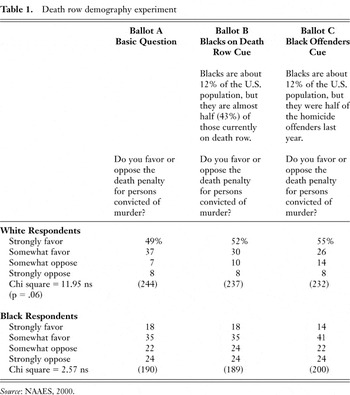
Death row demography experiment
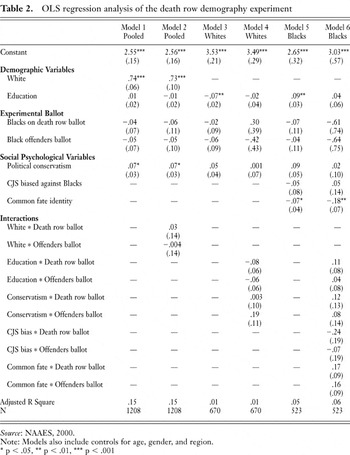
OLS regression analysis of the death row demography experiment
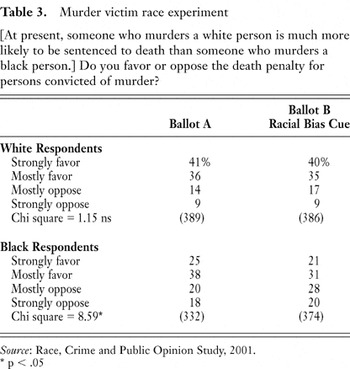
Murder victim race experiment [At present, someone who murders a white person is much more likely to be sentenced to death than someone who murders a black person.] Do you favor or oppose the death penalty for persons convicted of murder?
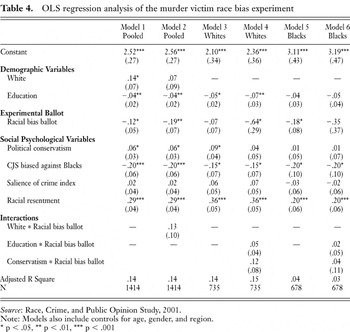
OLS regression analysis of the murder victim race bias experiment
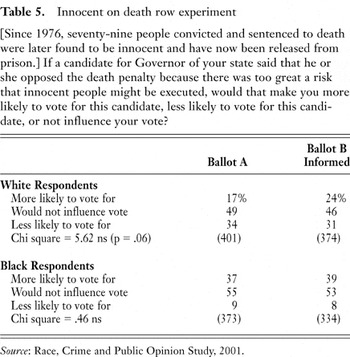
Innocent on death row experiment[Since 1976, seventy-nine people convicted and sentenced to death were later found to be innocent and have now been released from prison.] If a candidate for Governor of your state said that he or she opposed the death penalty because there was too great a risk that innocent people might be executed, would that make you more likely to vote for this candidate, less likely to vote for this candidate, or not influence your vote?
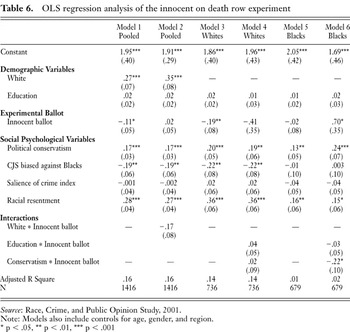
OLS regression analysis of the innocent on death row experiment
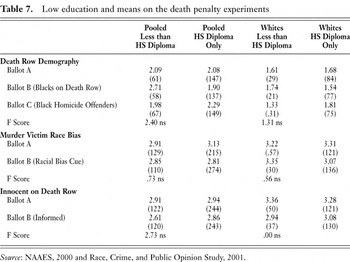
Low education and means on the death penalty experiments
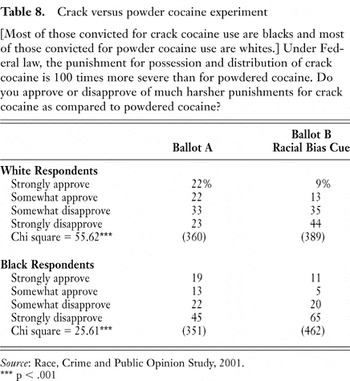
Crack versus powder cocaine experiment[Most of those convicted for crack cocaine use are blacks and most of those convicted for powder cocaine use are whites.] Under Federal law, the punishment for possession and distribution of crack cocaine is 100 times more severe than for powdered cocaine. Do you approve or disapprove of much harsher punishments for crack cocaine as compared to powdered cocaine?
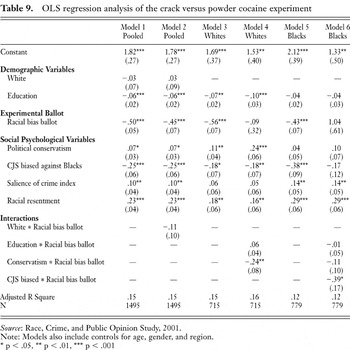
OLS regression analysis of the crack versus powder cocaine experiment
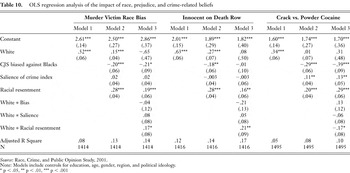
OLS regression analysis of the impact of race, prejudice, and crime-related beliefs
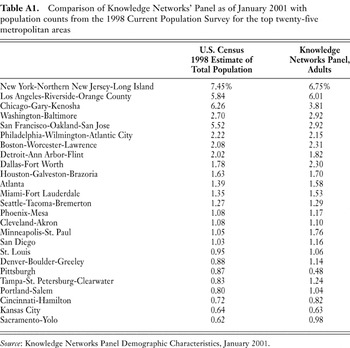
Comparison of Knowledge Networks' Panel as of January 2001 with population counts from the 1998 Current Population Survey for the top twenty-five metropolitan areas
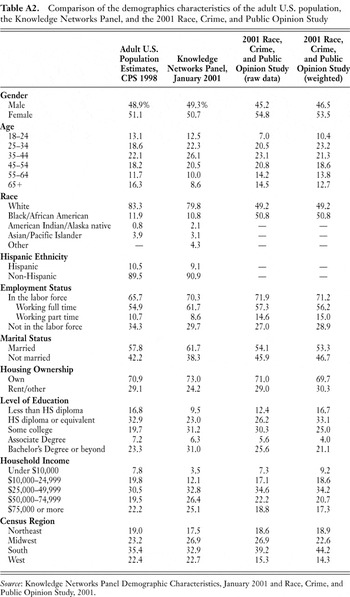
Comparison of the demographics characteristics of the adult U.S. population, the Knowledge Networks Panel, and the 2001 Race, Crime, and Public Opinion Study
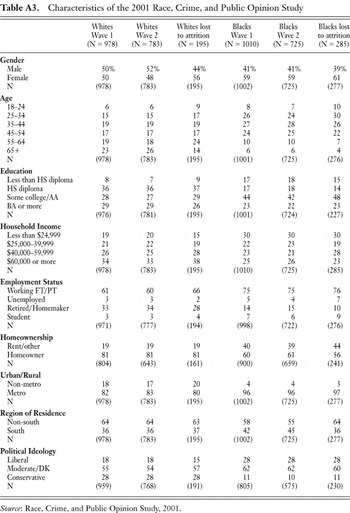
Characteristics of the 2001 Race, Crime, and Public Opinion Study
 You have
Access
- 263
- Cited by