




No CrossRef data available.
Legal Integration and Use of the Preliminary Ruling Process in the European Union
Published online by Cambridge University Press: 17 May 2005
Abstract
Scholars agree that the preliminary ruling system of the European Court of Justice has been instrumental in promoting European integration; however, no consensus has been reached as to why the system is used. Although many explanations have been posited, there has been no systematic comparative test among them to date. In this article, we perform this test. We find evidence that transnational economic activity, public support for integration, monist or dualist tradition, judicial review, and the public's political awareness influence use of the preliminary ruling system.We would like to acknowledge Matthew Gabel, Eric Reinhardt, Georg Vanberg, and Christopher Zorn for helpful comments. We would also like to acknowledge the support of NSF grant #0079084.
Information
- Type
- Research Article
- Information
- Copyright
- © 2005 The IO Foundation and Cambridge University Press
During the past fifty years, European integration has exceeded most observers' expectations. Among other accomplishments, the European Union (EU) has completed its Common Market, created a common currency, greatly increased the influence of the directly elected European Parliament, and expanded to more than twenty member states. One of the institutions that has emerged as a driving force behind European integration is the European Court of Justice (ECJ).1
See Burley and Mattli 1993; Mattli and Slaughter 1995 and 1998; Garrett and Weingast 1993; Garrett 1995; Garrett, Kelemen, and Schulz 1998; Alter 1996, 1998, 2000, and 2001; and Alter and Meunier-Aitsahalia 1994.
Critical to the ECJ's influence is the preliminary ruling system. Preliminary rulings are an adjudicatory process by which national courts make references over questions of EU law to the ECJ. As many scholars have argued, this process is central to the legal, and thereby economic and political, integration of Europe because it allows national courts to enforce EU law over national law. However, while there is strong consensus over the importance of the preliminary ruling system for European integration, there is significant disagreement over why it is used. For example, some scholars believe transnational business interests determine the use of the preliminary ruling process,2
See Stone Sweet and Brunell 1998a and 1998b.
Systematic empirical work has lagged behind the impressive theoretical efforts. Although numerous possible motivations have been posited and substantial empirical evidence has been collected to support the various arguments, no tests have been performed that also control for alternative explanations. As a result, one cannot say which among these various explanations is actually right.
In this article, we take this next logical step in the study of the preliminary ruling process. By supplementing Stone Sweet and Brunell's data set on preliminary references,4
See Stone Sweet and Brunell 1998a and 1998b.
Among the existing explanations, we focus on a number of the most often cited alternatives that provide clear, cross-national and intertemporal predictions over use of the preliminary ruling system.
The rest of this article proceeds as follows. In the first section, we provide background on the EU legal system by describing its evolution, justifying in further detail why scholars believe the preliminary ruling system is so important to the overall process of European integration, and demonstrating that there is substantial variation across countries and over time in its use. The second section presents a set of plausible alternative explanations for this variation. The third section presents the data, the fourth section tests among the alternative explanations, and the final section concludes.
The Evolution of the European Legal System
In 1959 six European nations created the European Economic Community (EEC). Among other policy and institutional characteristics, the foundation of this community—the Treaty of Rome—created the ECJ to hear cases involving EEC, and later EU, law. The system was designed such that the vast majority of cases arise through one of two paths, direct actions or preliminary references. Direct actions are cases brought directly to the ECJ by either the EU Commission or a member state government. Preliminary references arise when a private litigant brings a case to his/her national court, the national court makes a determination that EU law is relevant to the case, and the national court asks the ECJ for an interpretation of EU law. Once that opinion is passed back down to the national court, the national court then makes a final ruling. Importantly, while the Treaty of Rome sanctioned challenges over the legality of EU secondary law through preliminary references, charges of noncompliance with EU law could only be brought through direct actions. Thus, when founded, the EU legal system was not particularly integrated; the promotion and protection of rights granted under the EU treaty and EU secondary legislation were not enforceable through national institutions.
Since 1959 the ECJ has changed this situation. In the 1963 Van Gend en Loos case and the 1964 Costa v. ENEL case, the ECJ created the doctrines of direct effect and supremacy. Direct effect declared that citizens have rights under EU law and, thus, national courts could apply EU law themselves. Supremacy declared that EU law should take precedent over national law, even if national law is passed subsequent to EU law. As has been widely documented, these two doctrines transformed the preliminary ruling system.6
See Alter 1996, 1998, and 2001; Stone Sweet and Brunell 1998a and 1998b; Garrett 1995; Burley and Mattli 1993; and Mattli and Slaughter 1995 and 1998.
Critical to this process of legal integration, however, was the complicity of other nonstate actors. While the ECJ could promote using the preliminary ruling system in this revolutionary way, private litigants and national courts had to follow the ECJ's lead and actually use the system. In fact, several conditions must be met before a preliminary reference is ever observed. First, there must be an opportunity for a violation that raises issues of EU law. Second, some individual or institutional actor must choose to take advantage of that opportunity and violate the national or EU law raising a question worthy of reference to the ECJ. Third, some individual or institutional actor must choose to take the violator to court; and fourth, that court must choose to make a reference to the ECJ. Without each of these conditions, a preliminary reference is never observed.
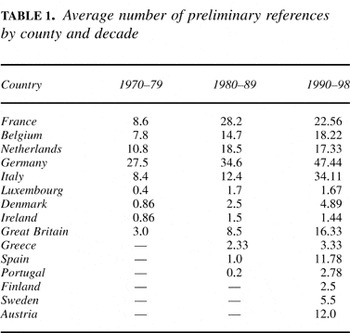
To what extent has the preliminary ruling system been used? Table 1 presents the average number of preliminary references by country and decade between 1970 and 1998 for all fifteen member states.7
The table is truncated at 1970 because that is the first year we have all the necessary data to run our subsequent analysis. The observed trends hold before 1970 as well.
Average number of preliminary references by county and decade

Explaining Use of the Preliminary Ruling System
Scholars have proposed numerous explanations for the adoption and use of the transformed preliminary ruling system. However, these alternatives are far from exhaustive. In fact, several of the factors that these arguments claim help explain use of the preliminary ruling procedure actually can be motivated by other plausible arguments, and these alternative arguments can even result in the opposite predicted relationships. Thus, in this section, we present a set of existing and a set of novel hypotheses. The existing hypotheses are derived from four of the most common arguments used to explain the use of the preliminary ruling procedure, while the novel hypotheses come from an array of alternatives explanations. Arguments are organized by the economic, institutional, demographic, or other factors predicted to matter for ease of exposition.
Variation in Transnational Economic Activity
Stone Sweet, in conjunction with several coauthors,8
See Stone Sweet and Brunell 1998a and 1998b; and Stone Sweet and Caporaso 1998.
While plausible, a simpler explanation for why transnational economic activity should be related to use of preliminary references lies at the heart of Stone Sweet's argument. The majority of EU law is designed to create a Common Market. As such, it relates to transnational economic activity, or more simply, trade. Thus if one considers the volume of trade as a measure of the opportunities for a conflict over EU law to arise, we would expect the amount of trade to be positively related to the number of preliminary references. By implication, we could observe Stone Sweet's predicted relationship even if there is no virtuous circle.
H1: Member states with higher levels of transnational activity are more likely to make preliminary references to the ECJ.
Variation in Legal Culture: Judicial Review
A second claim in the literature is that the legal culture of a country can affect a court's willingness to make preliminary references. In particular, scholars have argued that the presence or absence of judicial review matters.10
See Alter 1996; and Mattli and Slaughter 1998.
H2: Member states with judicial review should be more likely to make preliminary references to the ECJ than member states without judicial review.
While not disagreeing with the basic argument stated above, there is good reason to believe that a more nuanced expectation should hold. In particular, there are two types of judicial review, abstract and concrete. Concrete judicial review is the power to declare laws unconstitutional after they have been implemented, while abstract judicial review is the power to declare laws unconstitutional before they are implemented. Countries with judicial review may employ one or both of these procedures.
If Alter is right,11
countries that employ only concrete or both abstract and concrete judicial review should be more likely than countries without judicial review to make preliminary references. These are all countries familiar with laws being challenged after they are passed. However, if anything, countries with only abstract judicial review should be the least likely to make preliminary references. Courts in these countries not only are unfamiliar with challenging laws after they are passed but they are explicitly adopting a standard of review that is contrary to their legal tradition. This argument implies the following hypothesis.H3: Member states with concrete judicial review should be more likely to make references to the ECJ than those without concrete review, while member states with only abstract judicial review should be less likely to make references to the ECJ than those without abstract review.
Variation in Legal Doctrines: Monism versus Dualism
Just as the legal culture might influence use of the preliminary ruling system, so too might the legal doctrines of a state. In particular, scholars have argued that it matters whether a state has a monist or dualist tradition.12
In a state with constitutional monism, international treaties are directly applicable, meaning that international treaties do not have to be translated into national law to have effect. Conversely, under dualism, legislative action at the national level is necessary for international treaties to have effect. Scholars have argued that the direct applicability of international agreements in monist states made it easier for judges to accept the notion of direct effect. Accordingly, this implies that there should be higher levels of preliminary references in monist member states, purely because of a greater willingness of judges to make references.H4: Monist member states should be more likely to make references than dualist member states.
If this argument is correct, a second testable implication might hold as well. EU secondary legislation takes one of two forms, regulations and directives. Regulations are laws that are binding on member states the moment they are passed, while directives are laws that must be passed by member states before they take effect. Before 1990 the notion of direct effect only applied to EU regulations. However, in the 1990 Marleasing case, the ECJ stated that national courts should interpret national law in light of EU directives, even if these directives have not yet been translated into national law.13
Garrett, Kelemen, and Schulz 1998, 169. This stricture only applied once the time period granted for translating the directive into national law had passed.
H5: The difference between the number of rulings made in monist and dualist states should increase after the 1990 Marleasing ruling.
While this argument is plausible, there is good reason to believe that one might observe exactly the opposite relationship from the one predicted. The previously stated argument focuses just on the behavior of judges. However, other actors—such as economic actors, administrative agencies, and governments—might well condition their behavior on whether the system is monist or dualist as well. In particular, these actors might be more likely to act as if national law is not vulnerable to contradictory EU law in dualist systems, because dualist systems do not automatically apply international treaties. As a result, while judges in dualist systems might be less likely to make preliminary references, other actors might be more likely to engage in behavior that leads to disputes over the applicability of EU law. If the higher rate of disputes outweighs the lower rate of references by judges, one could observe more references in dualist systems than in monist systems.
H6: Monist member states on average should make fewer references than dualist states.
Variation in Public Support for Integration
A fourth claim in the literature focuses on the role of public opinion in legal decision making. As in any national legal system, citizens have opinions over how decisions should be made. These opinions matter to courts because the more the weight of public opinion is against a particular decision, the greater the cost to the court's legitimacy if it chooses to make that decision.14
See Caldeira 1991; and Mishler and Sheehan 1993, 1996.
See Mattli and Slaughter 1995 and 1998; and Burley and Mattli 1993.
One could also argue that preliminary references are related to support for integration, because support for integration should influence the frequency with which cases arise. Simply put, support for integration is positively related to the benefit one receives from integration (see Gabel and Palmer 1995; and Gabel 1998a, 1998b, and 1998c). Thus, individuals who dislike European integration tend to be people who are hurt by, and so have a reason to violate EU law, while individuals who like integration tend to be people who benefit from integration, and so have a reason to bring cases to protect their rights. However, this pair of expectations does not lead to a well-defined prediction over support, because the predictions lead in opposite directions. The frequency of cases arising should increase as support increases because there are more people with an incentive to bring cases, but the frequency of cases arising should decrease as support increases because there are fewer people with an incentive to violate EU law in the first place.
H7: The less popular integration is among a nation's public, the less likely courts from that country are to make preliminary references.
Variation in Political Information
Finally, one additional factor is worth considering. Litigants can only bring a dispute over EU law if they are aware of the opportunity to do so. This issue is particularly salient in the case of the preliminary ruling system, because it is both a relatively new and quite novel institutional avenue through which citizens can protect their rights. Thus, the more politically informed a public is, the more likely individuals are to be aware of the option of protecting their rights under EU law, and therefore the more preliminary references one should observe on average.18
Note that plaintiffs are not always private individuals. However, to the degree that private individuals can and do bring cases, we would expect more cases on average when private individuals are more aware of the option of protecting EU granted rights.
H8: The more politically informed a nation's public is, the more likely individuals are to bring preliminary references.
Data
Each of the hypotheses generated in the previous section predicts a causal relationship between some factor, or set of factors, and the number of preliminary references in a country in a given year. Using data compiled by Stone Sweet and Brunell, we calculate the number of references per country and year from 197019
We start in 1970, because that is the first year for which there is data on all of the relevant variables.
Stone Sweet and Brunell 1999. For further discussion on this data set, see Stone Sweet and Brunell 1998a and 1998b.
The first factor predicted to influence preliminary reference frequency is transnational economic activity. For consistency with previous research,21
See Stone Sweet and Brunell 1998a and 1998b.
The total amount of imports and exports is recorded in 1995 US dollars. Information pertaining to inter-EU trade was gathered from two sources, The World Trade Analyzer and the Organization for Economic Cooperation and Development (OECD), because there was not a single source for the entire time period covered in this study. See Statistics Canada 2002; and OECD 2003.
The second factor predicted to influence preliminary reference frequency is the type of judicial review. Here we code two dummy variables, one variable that takes a value of one if the country only has abstract judicial review, and a second variable that takes a value of one if the country has concrete judicial review.23
If Alter is correct (Hypothesis 2), both dummies should be positively related to occurrences of preliminary references. However, if our expectations are correct (Hypothesis 3), countries with only abstract review should make fewer references on average.The third factor predicted to influence preliminary reference frequency is the country's legal doctrine. Here we code two independent variables. The first variable is a dummy that takes a value of one if the state has a monist tradition and zero otherwise. The second variable, monist post marleasing, is a dummy that takes a value of one if the state has a monist tradition after 1990, and zero otherwise. If the received wisdom is correct, both the monist dummy and the post-1990 monist dummy should be positively related to reference frequency. The former should hold if judges in monist states have been more comfortable making references than dualist states (Hypothesis 4), and the latter should hold if this tendency was exacerbated by the Marleasing ruling (Hypothesis 5). Conversely, if other state and nonstate actors tend to violate EU law sufficiently less frequently in monist systems, there should be fewer references in monist states (Hypothesis 6).
The fourth factor predicted to influence preliminary reference frequency is public support for integration.24
As is common to the literature, we rely on the following Euro-barometer survey question: “Generally speaking, do you think that (your country's) membership in the European Community (Common Market) is (1) A good thing; (2) A bad thing; (3) Neither good nor bad.” See Schmitt and Scholz 2002.
The fifth factor is political information. To measure political awareness, we rely on the Euro-barometer survey question that asks, “When you get together with friends, would you say you discuss political matters frequently, occasionally, or never?”25
See Ibid.
Scholars interested in understanding public support for integration have used this measure to explore the role of what Inglehart calls “cognitive mobilization” (see Inglehart 1970a, 1970b, 1971, and 1990; and Inglehart, Rabier, and Reif 1991). In particular, Inglehart argues that support for integration should be positively related to the amount a person thinks about and discusses politics (that is, is cognitively mobilized over politics) because most political messages, at least historically, have been supportive of integration. While the evidence for the role of cognitive mobilization in public opinion has been mixed (see Gabel 1998c), there is good reason to believe that this measure should affect use of the preliminary ruling process.
Finally, we also include several control variables. The first variable is included to control for the amount of time that the transformed preliminary ruling system has been available in a member state. For the founding members of the EU, the first possible year to use the transformed system was 1963. For the remaining nine members, their first year is the date of their accession to the EU. This time since use variable accounts for the possibility that litigants and courts might become more accustomed to using the preliminary ruling system over time.
We also consider the effect of major treaty revisions, such as the Single European Act and Maastricht. Both of these treaty revisions expanded the scope of EU obligations, and thereby create the possibility for increased conflict over implementation. The variables single european act and maastricht—each coded one starting the year of enactment—are included to control for these possibilities.
Last, we control for a country's gdp per capita and trade to gdp ratio.27
See World Bank 2002.
Several other potential controls are worth briefly mentioning. First, national litigation rates vary across EU member states. This difference in the underlying propensity to litigate might also influence the frequency of preliminary references. However, data on national litigation rates covering the countries and years in this study are not currently available. See Galanter 1983; and Wollschlager 1998 for some work on comparative national litigation rates. Second, there is good reason to believe that litigation rates would vary with a country's GDP and population size. These variables are highly multicolinear with the trade variable, and thus are omitted from the study. Supplemental analysis demonstrates that including them changes none of the substantive findings of the study.
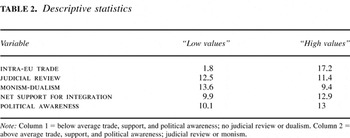
Table 2 presents some simple descriptive statistics based on these variables. The first column summarizes the average number of references when there is below average trade, support for integration, conflict over integration or political awareness, no judicial review, and when a country has a dualist tradition. The second column summarizes the average number of references when the opposite is true. Consistent with Stone Sweet and Brunell's findings, preliminary references seem to rely most strongly on the level of intra-EU trade. Also consistent with their findings, the difference in average references is comparatively small for judicial review and monist or dualist tradition. Finally, all of the other differences seem to be of the same order of magnitude as judicial review and monist or dualist tradition. Thus, these findings would suggest that intra-EU trade should be a large determinant of references, but it is not clear which, if any, of the other variables should matter.
Descriptive statistics

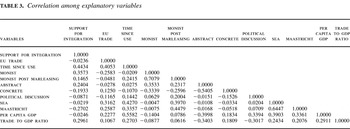
Table 3 provides correlations among the explanatory variables. As can be seen, only the monist—monist post marleasing and sea—maastricht pairs have high correlations. These are unsurprising because the monist post marleasing variable is an interaction variable partly comprised of the monist dummy, while the sea and maastricht dummies only differ in the year in which they start.
Correlation among explanatory variables

Results
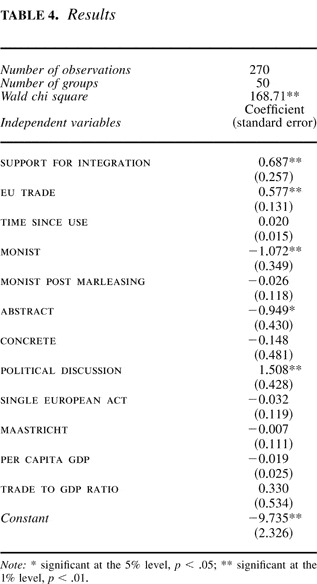
To test the hypotheses, a negative binomial panel regression using fixed effects is estimated.30
The regression was run in Stata using the xtnbreg [variables], fe i (nation) command.
time since use is not lagged because it is an ordered count variable.
Note that the negative binomial model fits the data extremely well (Wald chi square p < .000).
Results

Consistent with the descriptive statistics, we find that EU trade levels are positively and significantly related to use of the preliminary ruling system (Hypothesis 1). Importantly, however, we also find a number of other interesting results that we could not learn from the descriptive statistics.
First, consider public opinion. Consistent with Hypothesis 7, public opinion is positively related to use of the preliminary ruling system, that is, there are more references when support is higher. Thus, the evidence is consistent with the argument that member state judges operate under a legitimacy constraint.
Next, consider legal doctrine. The monism dummy is significant and negative, while the post-Marleasing monism dummy is insignificant. That is, monist states make fewer references on average than dualist states, and this difference was not affected by the Marleasing ruling. These finding are consistent with Hypothesis 6, and inconsistent with Hypothesis 4 and Hypothesis 5. Thus, the evidence is consistent with the argument that disputes over the applicability of EU law arise more frequently in dualist systems than in monist systems, while it is inconsistent with the argument that judges in Monist states are more likely to make references than judges in non-Monist states.
Third, consider judicial review. Here, only the abstract review measure is significant, and it has a negative sign. That is, inconsistent with Hypothesis 2, nations with judicial review do not make more references on average than nations without judicial review. However, these results are at least partly consistent with Hypothesis 3. Judicial systems with only abstract review do tend to make fewer references on average than those without judicial review. Thus, the evidence suggests that judges, at least in abstract review systems, have been hesitant to engage in behavior that violates their domestic legal culture.
Finally, consider the public's political awareness. The discussion variable is positively and significantly related to use of the preliminary ruling system. Therefore, consistent with Hypothesis 8, the evidence suggests that political discussion influences use of the preliminary ruling system.
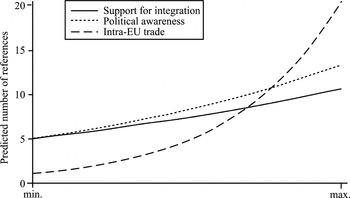
In sum, there is support for a number of different arguments. However, are all of these explanations equally significant? To address this question, we generated estimates of the number of predicted references by varying one measure at a time and holding all others at their means and medians.33
The dummy variables were held at their median values, all others were held at their means.
Figure 1 presents these estimates for the three significant continuous variables: intra-eu trade, support for integration, and political discussion. Each measure was varied from its in-sample minimum to its in-sample maximum. As can be seen, intra-eu trade has the largest substantive effect, ranging from just over one reference per year for the smallest trading countries to approximately twenty per year for the largest ones. In contrast, support for integration can lead to a change of just over five references per year, while political discussion can lead to a change of approximately eight references per year. Thus, consistent with Stone Sweet and Brunell's findings, trade has a very large substantive effect on the average number of references per year. However, public opinion and political discussion also have a nontrivial effect as well. Looking back at Table 1, notice that only Germany averages greater than twenty cases per year. Thus, a swing of five to eight observations in a year is far from a trivial change.

Predicted number of references
Importantly, the two discrete variables are also substantively significant. The predicted difference in cases per year between a monist and a dualist system is approximately eight, while the predicted difference based on having abstract judicial review is also approximately eight. Thus all of the statistically significant relationships are also substantively significant.
In sum, these findings provide mixed support for existing arguments. One the one hand, some of the evidence is consistent with established expectations. Consistent with Stone Sweet and Brunell's expectation, we find that trade is an important predictor of preliminary references; and consistent with Mattli and Slaughter's expectation,34
we find that public opinion is also an important predictor. Thus, even when tested in competition with alternative theories, we cannot reject Stone Sweet and Brunell's argument that transnational actors are using the preliminary ruling process to expand transnational economic activity.35We also cannot reject the possibility that trade is positively related to preliminary rulings simply because trade conditions the opportunity for conflict over EU law.
On the other hand, some findings are inconsistent with existing expectations. Although the evidence suggests that the institutional features of monism–dualism and judicial review matter, they do not matter in the ways that Alter and Mattli and Slaughter argue.36
See Alter 1996; and Mattli and Slaughter 1998.
Finally, we also find support for some new expectations. In particular we find that political awareness is strongly, and substantively, related to use of the preliminary ruling system.
These findings have a number of implications for future study of the ECJ. Most directly, they provide evidence that no single, mono-causal argument is sufficient for explaining the development of European legal integration. While Stone Sweet and Brunell focus solely on transnational actors as the source of variance in the adoption of the preliminary ruling system, and Alter focuses primarily on national courts, this study finds that national legal institutions, judicial behavior, and litigant behavior all matter.37
See Stone Sweet and Brunell 1998a and 1998b; and Alter 1998.
Beyond that, these findings also suggest that one's understanding of legal integration needs to be more than just “top-down.” That is, scholars have generally focused on how elite actors—the ECJ, national courts, and organized business interests—have driven legal integration, but have not allowed a role for the European public at large. These findings suggest that this may be an important oversight. The evidence suggests both that public opinion influences the likelihood that judges are willing to make preliminary references, and public awareness influences the likelihood that citizens use the preliminary ruling system to protect rights granted under EU law. These findings are consistent with other areas of EU research that suggest a bigger role for the European public in the integration process than has been traditionally conceived.38
Finally, it is important to recognize that this study, consistent with existing research, focuses on preliminary references. While the importance of the preliminary reference system to European integration justifies this attention, one should not overlook the fact that even today approximately half of the cases heard by the ECJ are direct action cases. Further, these direct action cases are important. They often involve governments being taken to court for violations of EU law, governments often lose these cases, and governments regularly comply with the Court's decisions. Thus a better understanding of direct action cases is important if one is to fully understand the process of European integration.
Conclusion
While there is broad agreement over how legal integration occurred, there is much less agreement over why it occurred. Or, put differently, although scholars agree that the ECJ's doctrines of direct effect and supremacy legally integrated Europe, they do not agree over why these doctrines were adopted. Was the transformation driven by transnational business interests, as Stone Sweet and Brunell claim?39
See Stone Sweet and Brunell 1998a and 1998b.
In this study, we performed a simultaneous test of these and several other plausible explanations for legal integration in Europe. This test allowed us both to evaluate which of these theories best explains use of the transformed preliminary ruling system as well as provided evidence on the relative importance of these factors.
As described previously, we find support for a number, but not all, of these existing arguments. These results are important for three reasons. First, for most of the arguments posited in the existing literature, this is the first systematic test of those arguments. Other than Stone Sweet and Brunell's work, no test of the arguments has been performed.
Second, these findings demonstrate why performing a simultaneous test that controls for alternative explanations is critical to theory testing. In their 1998 articles, Stone Sweet and Brunell specifically reject the significance of legal tradition and culture in the use of the preliminary ruling system by looking at descriptive statistics. “There is little point in formally testing these explanations. We know by simply looking at the raw data on references comparatively that alleged relationships do not hold between the factors cited above and national levels of Article 177 references (for example, the more monist the constitutional order, the more references generated).”41
Stone Sweet and Brunell 1998b, 67, fn. 4.
Third and finally, these results demonstrate that legal integration is not a simple process. Trade, litigant behavior, and judicial behavior all condition the use of the preliminary ruling system. While some of these characteristics should help compensate for inconsistent application of EU law (that is, using the preliminary ruling system more in dualist states where there can be delays in the transposition of EU law into national law), others may create systematic inequalities. In particular, we should expect citizen rights under EU law to be substantially better protected in countries with more politically aware and more pro-EU populations. This observation does not necessarily bode well for protection of citizen rights in countries such as the aspiring East European entrants.
This third conclusion also implies that one should not treat legal integration as a fait accompli. While citizens formally may have the ability to turn to the legal system for protection of their EU rights, that protection is only truly available if (1) citizens are politically aware enough to take advantage of the opportunity, and (2) the court actually chooses to make a reference. The worse these two conditions, the more rights under EU law are a matter of principle than of fact.
References
REFERENCES
Alter, Karen J.
1996.
The European Court's Political Power.
West European Politics
19 (3):458–87.Google Scholar
Alter, Karen J.
1998.
Who Are the “Masters of the Treaty?: European Governments and
the European Court of Justice.
International Organization
52 (1):121–47.Google Scholar
Alter, Karen J.
2000.
The European Union's Legal System and Domestic Policy:
Spillover or Backlash?
International Organization
54 (3):489–518.Google Scholar
Alter, Karen J.
2001.
Establishing the Supremacy of European Law: The Making of an
International Rule of Law in Europe.
Oxford:
Oxford University Press.
Alter, Karen J., and
Sophie Meunier-Aitsahalia.
1994.
Judicial Politics in the European Community: European Integration
and the Pathbreaking Cassis de Dijon Decision.
Comparative Political Studies
26 (4):535–61.Google Scholar
Burley, Anne-Marie, and
Walter Mattli.
1993.
Europe Before the Court: A Political Theory of Legal
Integration.
International Organization
47 (1):41–76.Google Scholar
Caldeira, Gregory A.
1991.
Courts and Public Opinion. In
American Courts: A Critical Assessment, edited by
John Gates and
Charles Johnson,
303–34.
Washington, D.C.:
Congressional Quarterly Press.
Carrubba, Clifford J.
2001.
The Electoral Connection in European Union Politics.
Journal of Politics
63 (1):141–58.Google Scholar
Gabel, Matthew J.
1998a.
Interests and Integration: Market Liberalization, Public Opinion,
and European Union.
Ann Arbor:
University of Michigan Press.
Gabel, Matthew J.
1998b.
Economic Integration and Mass Politics: Market Liberalization and
Public Attitudes in the European Union.
American Journal of Political Science
42 (3):936–53.Google Scholar
Gabel, Matthew J.
1998c.
Public Support for European Integration: An Empirical Test of Five
Theories.
Journal of Politics
60 (2):333–54.Google Scholar
Gabel, Matthew J., and
Harvey Palmer.
1995.
Understanding Variation in Public Support for European
Integration.
European Journal of Political Research
27 (1):3–19.Google Scholar
Garrett, Geoffrey.
1995.
The Politics of Legal Integration in the European Union.
International Organization
49 (1):171–81.Google Scholar
Garrett, Geoffrey,
R. Daniel Kelemen, and
Heiner Schulz.
1998.
The European Court of Justice, National Governments, and Legal
Integration in the European Union.
International Organization
52 (1):149–176.Google Scholar
Garrett, Geoffrey, and
Barry R. Weingast.
1993.
Ideas, Interests, and Institutions: Constructing the European
Community's International Market. In
Ideas and Foreign Policy, edited by
Judith Goldstein and
Robert Keohane,
173–206.
Ithaca, N.Y.:
Cornell University Press.
Inglehart, Ronald.
1970a.
Cognitive Mobilization and European Identity.
Comparative Politics
3 (1):45–70.Google Scholar
Inglehart, Ronald.
1970b.
Public Opinion and Regional Integration.
International Organization
24 (4):764–95.Google Scholar
Inglehart, Ronald.
1971.
Public Opinion and Regional Integration. In
Regional Integration: Theory and Research, edited by
Leon Lindberg and
Stuart Scheingold,
335–63.
Cambridge, Mass.:
Harvard University Press.
Inglehart, Ronald.
1990.
Culture Shift in Advanced Industrial Society.
Princeton, N.J.:
Princeton University Press.
Inglehart, Ronald,
Jacques-Rene Rabier, and
Karlheinz Reif.
1991.
The Evolution of Public Attitudes toward European Integration:
1970–86. In
Eurobarometer: The Dynamics of European Public Opinion, edited
by Karlheinz Reif and
Ronald Inglehart,
135–55.
London:
Macmillan.
Kritzer, Herbert M., ed.
2002.
Legal Systems of the World: A Political, Social, and Cultural
Encyclopedia, vols. 1–4.
Santa Barbara, Calif.:
ABC-CLIO.
Mattli, Walter, and
Anne-Marie Slaughter.
1995.
Law and Politics in the European Union: A Reply to Garrett.
International Organization
49 (1):183–90.Google Scholar
Mattli, Walter, and
Anne-Marie Slaughter.
1998.
Revisiting the European Court of Justice.
International Organization
52 (1):177–209.Google Scholar
Mishler, William, and
Reginald S. Sheehan.
1993.
The Supreme Court as a Countermajoritarian Institution? The Impact
of Public Opinion on Supreme Court Decisions.
American Political Science Review
87 (1):87–101.Google Scholar
Mishler, William, and
Reginald S. Sheehan.
1996.
Public Opinion, the Attitudinal Model and Supreme Court Decision
Making: A Micro-Analytic Perspective.
Journal of Politics
58 (1):169–200.Google Scholar
Organization for Economic Cooperation and Development
(OECD).
2003.
ITCS: International Trade by Commodities Statistics Database. SITC
Revision 2. Total Trade in Values—Historical Series
1961–1990.
Available at
〈http://hermia.sourceoecd.org/vl=2051682/cl=24/nw=1/rpsv/statistic/s15_
about.htm?jnlissn= 16081218〉. Accessed 28 January 2005.
Schmitt, Hermann, and
Evi Scholz.
2002.
Mannheim Eurobarometer Trend File, 1970–1999 [computer
file]
(study no. 3384).
Ann Arbor, Mich.:
Inter-University Consortium for Political and Social
Research.
〈www.icpsr.umich.edu〉.
Statistics Canada.
2002.
World Trade Analyzer [CD-ROM].
Ottawa:
Statistics Canada.
Stone Sweet, Alec, and
Thomas L. Brunell.
1998a.
The European Court and the National Courts: A Statistical Analysis
of Preliminary References, 1961–95.
Journal of European Public Policy
5 (1):66–97.Google Scholar
Stone Sweet, Alec, and
Thomas L. Brunell.
1998b.
Constructing a Supranational Constitution: Dispute Resolution and
Governance in the European Community.
American Political Science Review
92 (1):63–81.Google Scholar
Stone Sweet, Alec, and
Thomas L. Brunell.
1999.
Data Set on Preliminary References in EC Law.
Fiesole, Italy:
Robert Schuman Centre, European University Institute.
Stone Sweet, Alec, and
James A. Caporaso.
1998.
From Free Trade to Supranational Polity: The European Court and
Integration. In
European Integration and Supranational Governance, edited by
Wayne Sandholtz and
Alec Stone Sweet,
92–133.
New York:
Oxford University Press.
Wollschlager, Christian.
1998.
Exploring Global Landscapes of Litigation Rates. In
Soziologie des Rechts: Festschrift für Erhard Blankenburg zum
60, edited by
Erhard Blankenburg,
Jürgen Brand, and
Dieter Strempel,
580–88.
Baden-Baden, Germany:
Nomos.
World Bank.
2002.
World Development Indicators [CD-ROM].
Washington, D.C.:
World Bank.
Average number of preliminary references by county and decade
Descriptive statistics
Correlation among explanatory variables
Results
Predicted number of references
 You have
Access
- 65
- Cited by