Background
Meaning-centered psychotherapy (MCP) was created by William Breitbart to address despair, hopelessness, and desire for hastened death (Breitbart Reference Breitbart2017). It was inspired by psychiatrist and Holocaust survivor Viktor Frankl who believed that even in the most trying times, people can derive meaning from their lives; this is crucial to human motivation and, ultimately, well-being (Frankl Reference Frankl2014). MCP consists of 8 sessions focused on diminishing despair, hopelessness, and demoralization by helping the patient identify and create sources of meaning amidst suffering in their lives. The patient and therapist explore attitudinal, creative, and experiential sources of meaning. Concepts such as identity, legacy, creativity, courage, responsibility, love, nature, art, and humor are explored (Breitbart and Poppito Reference Breitbart and Poppito2014). MCP is particularly helpful in increasing spiritual well-being and quality of life and reducing psychological stress (Breitbart et al. Reference Breitbart, Pessin and Rosenfeld2018, Reference Breitbart, Poppito and Rosenfeld2012). To date, most MCP research has focused on patients with stage IV cancer and in other palliative care settings (Breitbart Reference Breitbart2017). Patients with severe depression may also benefit from MCP, as they face similar challenges to patients with other severe medical diseases. There is current societal debate as to whether depression and mental illness can, at times, be considered terminal. Some scholars suggest that although palliative care is not suitable for all patients with severe mental illness, particular cases may benefit from a palliative care approach. A clear example would be a patient with severe anorexia nervosa with multiple admissions for refeeding and progressive physical deterioration (Trachsel et al. Reference Trachsel, Irwin and Biller-Andorno2016). In contrast to the United States, some European countries consider mood disorders a terminal illness that can be treated with euthanasia. A recent report in Belgium showed that 46% of psychiatric patients receiving euthanasia had a mood disorder (Dierickx et al. Reference Dierickx, Deliens and Cohen2017).
Similarly to MCP, psychedelic medicines have also been primarily studied and shown effective in the treatment of anxiety and depression related to cancer and terminal illness (Griffiths et al. Reference Griffiths, Johnson and Carducci2016; Grob et al. Reference Grob, Danforth and Chopra2011). Ketamine, a non-classic psychedelic, enhances feelings of empathy, insights, the recovery of old memories, and spirituality and transcendence and has antidepressant effects (Aleksandrova et al. Reference Aleksandrova, Phillips and Wang2017; Dore et al. Reference Dore, Turnipseed and Dwyer2019; Krupitsky and Grinenko Reference Krupitsky and Grinenko1997). Here, we discuss a patient with severe major depressive disorder and post-traumatic stress disorder at extremely high risk for suicide in whom ketamine-assisted MCP treatment was effective at reducing the severity of acute suicidality.
Case report
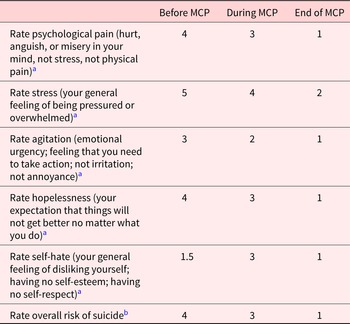
The patient is a 37-year-old African American man who was driving to procure a firearm with the intent of using it to end his life when a chance call from his daughter led him to divert to the emergency department. Once at our unit, we learned that our patient had suffered extreme interpersonal loss. He witnessed 5 close family members, including a child, a parent, a sibling, a niece, and a nephew, pass away. Two of these deaths were murders, one was due to medical complications, one was a self-inflected gunshot wound, and another was a suicide after which he found the body. The patient himself had a prior interrupted suicide attempt during which he attempted to end his life by gunshot and was stopped by his daughter. All these experiences were traumatic for the patient, who tends to suffer relapses into depression around the anniversaries of family members’ deaths. His core symptoms were increased hopelessness, anhedonia, and suicidal ideation. During the psych assessment, the patient stated: “I know I have children and I don’t want them to feel what I felt … but I also have people telling me to do things for me and if I did that, I wouldn’t be here right now.” On the complex assessment and management of suicide (CAMS) tool (Tyndal et al. Reference Tyndal, Zhang and Jobes2021), he scored highly on stress, psychological pain, hopelessness, and risk of suicide (Table 1). CAMS is a flexible and interactive framework for suicide-specific assessment and for the reduction of suicide risk. It has been developed over the course of 25 years, and there have been several studies supporting its use (Jobes et al. Reference Jobes, Comtois and Brenner2016). CAMS was administered weekly during the patient stay. MCP was also administered on these days while the patient was admitted. The patient said that while he did not want to be alive, he was open to learn from us and perhaps “change his perspective.” Unfortunately, he had not improved with other conventional therapies and psychopharmacological interventions. The patient had tried at least 3 different modalities of psychotherapy including cognitive behavioral therapy and eye movement desensitization reprocessing. Pharmacologically, he had tried 4 different antidepressants, including a tricyclic, and at least one antipsychotic, lamotrigine, and lithium with no success. After a thorough medical workup, he was found to have low vitamin D levels and low testosterone. Therefore, he was treated with vitamin D and testosterone replacement during the admission.
CAMS scores before, during, and at the end of MCP

a Scale from 1 to 5, with 1 being low and 5 being high.
b Scale from 1 to 5, with 1 being extremely low risk (will not kill self) and 5 being extremely high risk (will kill self).
Feeling the severity of the patient’s depressive symptoms and the near-palliative nature of his presentation, the team offered to start MCP and the patient agreed. During his treatment, the patient identified his family as the greatest source of meaning in his life. He reflected on how his long-term experience of suffering had shaped his identity. He had become more compassionate and was able to recognize his resilience. The patient identified the importance of being honest as the legacy he had inherited from his grandparents and, as part of the legacy, tried to impart to his children. A week after he was admitted, the patient was offered electroconvulsive therapy or ketamine to treat his severe suicidal thinking. He decided on the latter. After the third MCP session, ketamine infusions were started. The dose used was 0.38 mg/kg. He felt that adding ketamine to MCP helped him feel more hopeful and less depressed. He still endorsed wanting to die, but the idea was less intense. At that time, he confessed that at the hospital, he had written suicide notes that he kept with him on the unit, as he had been planning to end his life after discharge. However, after 3 sessions of MCP and one ketamine infusion, he tore those notes out of his notebook. He also reported that he felt more open to talking about difficult topics. The patient had 2 more sessions of ketamine throughout the remaining 5 MCP sessions. During these sessions, he expressed increasing feelings of hope, empathy, and love. The ideas of creativity, courage, and responsibility resonated with him. He found joy in journaling and wrote beautiful appreciative letters to his family and the staff members. The patient stated that he had begun to appreciate the beauties of this world and the importance of feeling connected with other human beings. Of note, the patient had a sense of humor that he kept during the entire admission. Toward the end of his admission, he felt that he could change this narrative and that he did not have to end his life like others in his family had. His CAMS scores reflected this significant improvement (Table 1). Despite continuing to endorse chronic feelings of depression, MCP helped him understand that he had the freedom to choose between ending his life or becoming a role model for his daughters. Now he could teach them perhaps the most important lesson as part of his legacy: how to cope with suffering in a way that is compatible with life. Three months after discharge, the patient was seen again. He endorsed well-being and good quality of life.
Discussion
The combination of MCP with ketamine improved our patient’s severe hopelessness, anhedonia, and suicidal behavior. MCP combined with ketamine helped him find meaning in serving as a model for his children. MCP helped him achieve a new mission. Now, he could change the family narrative. He did not have to end his life and instead, he could teach them how to deal with suffering. He could stop the family trauma and be present in this world with his loved ones.
To our knowledge, there are no other publications about ketamine or other psychedelic treatments and MCP. It is important to note the limitation of a case report. Future scientific endeavors in this area might include replicating similar outcomes in repeated case reports and, eventually, open-label trials. Of note, the patient had a history of sleep apnea and tolerated the ketamine treatment well. Other than dizziness, which resolved shortly after each treatment, he had no side effects (Jelen et al. Reference Jelen, Young and Stone2021). This case report suggests that the use of MCP with ketamine can be an effective treatment in patients with severe depression and medical comorbidities and should seriously be considered in patients with treatment-resistant depression. With the help of ketamine and MCP, our patient shifted from writing suicide notes to writing thank-you notes. Ketamine-assisted psychotherapy is an effective treatment for suicidal behavior. However, in the United States, inpatient psychiatry units do not typically offer ketamine to their patients admitted for treatment of suicidal thoughts. This case supports the practice of ketamine-assisted therapy to our vulnerable and frequently underserved and ethnically diverse inpatient population.
Similarly to MCP, psychedelic substances have shown to help with depression and with anxiety related to the fear of dying. As of April 2022, ketamine is the only psychedelic medicine physicians in the United States can prescribe. Adding ketamine to MCP enhances the patient’s treatment by inspiring feelings of empathy, love, beauty, interconnectedness, and transcendence. When we added ketamine to MCP, the nature of his therapy shifted slightly in that the therapist felt the patient resonated more to MCP practiced in a less directed and structured manner. During the MCP sessions, the patient also wanted to discuss other topics of importance to him, such as exploring old memories and traumas that surfaced during the ketamine infusions. As an open reflection, we wonder if a less directed model of MCP could be effective when using ketamine or other psychedelic medicines. In summary, MCP can be an effective treatment for depression and suicidal ideation. Ketamine and other psychedelic treatments can help synergistically with MCP.
Acknowledgments
The authors want to thank editors and reviewers for their dedicated time and their help in improving the quality of this manuscript; Drs. David Jobes and Tatiana Falcone for their supervision of this case with CAMS therapy; Drs. Cristina Cusin, Tracy Barbour, and Carlos Fernandez-Robles and the staff of MGH ketamine clinic for their help with the ketamine infusions; and Dr. Stuart Beck and the nurses and staff of MGH Blake 11 inpatient psychiatry unit for their help with logistics regarding the treatment of this patient.
Conflicts of interest
All authors report no conflict of interest with this paper.