Implications
We compared whole genome DNA sequence of 13 half-sib pairs, discordant for their clinical mastitis (CM) status, but matched by age, age of calving and lactation season. Results indicated that deletions of genomic regions were more likely to be associated with increased susceptibility to CM than duplications of genomic regions and single nucleotide polymorphisms (SNPs). In total, 191 genomic regions deleted in a mastitis-prone sib and present in a healthy sib, observed in at least nine pairs, overlapped with exons of 46 genes with functions related to immune response and gene expression. Such regions can be used in selection for mastitis resistant cows.
Introduction
Mastitis is an inflammatory disease of the mammary gland that occurs in response to a physical injury or infection by pathogenic microorganisms, such as Escherichia coli, Streptococcus uberis and Staphylococcus aureus (Schukken et al., Reference Schukken, Günther, Fitzpatrick, Fontaine, Goetze, Holst, Leigh, Petzl, Schuberth, Sipka, Smith, Quesnell, Watts, Yancey, Zerbe, Gurjar, Zadoks and Seyfert2011). Following infection of the mammary gland, macrophages and epithelial cells release cytokines that cause the migration of neutrophils, monocytes and other leukocytes from the blood to the site of infection in the mammary tissue. The cost associated with mastitis in Europe, according to current estimates, is 1.55 billion € per year (European Union http://www.sabre-eu.eu/). The frequency and cost of mastitis, and rising public concerns for animal welfare, have made mastitis one of the most important diseases for the dairy sector (Thompson-Crispi et al., Reference Thompson-Crispi, Atalla, Miglior and Mallard2014). There have been 292 genetic associations reported for risk of CM distributed across most chromosomes (Animal QTLdb www.animalgenome.org/ www.animalgenome.org/QTLdb rel. 36. August 2018; Detilleux, Reference Detilleux2009). Recent developments in genome sequencing technologies applied to livestock have facilitated the identification of copy number variations (CNVs) and millions of SNPs in a relatively cost efficient manner. This has enabled researchers to describe the genomic landscape of livestock species (e.g. Choi et al., Reference Choi, Liao, Stothard, Chung, Jeon, Miller, Choi, Lee, Yang, Lee, Han, Kim, Jeong, Oh, Kim, Kim, Lee and Lee2014; Szyda et al., Reference Szyda, Frąszczak, Mielczarek, Giannico, Minozzi, Nicolazzi, Kamiński and Wojdak-Maksymiec2015; Mielczarek et al., Reference Mielczarek, Fraszczak, Giannico, Minozzi, Williams, Wojdak-Maksymiec and Szyda2017), and to combine this whole genome sequence data with phenotypic information for genomic prediction (VanRaden et al., Reference VanRaden, Tooker, O’Connell, Cole and Bickhart2017) or in genome-wide association studies to identify variations associated with various traits (Sanchez et al., Reference Sanchez, Govignon-Gion, Ferrand, Gelé, Pourchet, Amigues, Fritz, Boussaha, Capitan, Rocha, Miranda, Martin, Brochard and Boichard2016; Sanchez et al., Reference Sanchez, Govignon-Gion, Croiseau, Fritz, Hozé, Miranda, Martin, Barbat-Leterrier, Letaïef, Rocha, Brochard, Boussaha and Boichard2017). Combining SNP microarray genotyping with whole genome DNA and RNA sequencing is beginning to disentangle the genomic regulation of economically important traits, such as mastitis susceptibility in dairy cattle (Fang et al., Reference Fang, Sahana, Su, Yu, Zhang, Lund and Sørensen2017).
The current work examined the association between single base pair (SNPs) and structural polymorphisms (CNVs), identified in whole genome DNA sequences, with the incidence of CM. Unlike previous studies, we compared SNP and CNV variation identified in sequence data from 16 paternal half-sibs that were selected to be discordant for susceptibility to CM.
Material and methods
Animals
Whole genome DNA sequences were produced for 32 cows of the Holstein-Friesian breed that were selected from a dataset of 991 individuals, which had veterinary records for incidence of CM. All the cows were kept in the same barn, managed in the same way, cared for by the same staff, fed the same balanced diet in the form of a total mixed ration, and milked in the same herringbone milking parlour. A potential case of CM was reported to the stud veterinarian by the milking staff. Then a veterinarian made the definitive diagnosis based on the following clinical symptoms: (i) alterations in consistency, colour and smell of milk; (ii) occurrence of redness, swelling, pain, tissue hardening, increased temperature of udder; (iii) deterioration of a cow’s general condition manifested by fever, reduced feed intake, significant decrease in milk production and anxiety. In unresolved cases microbiological tests were performed. The 32 cows comprising 16 paternal half-sibs were matched for: (i) age – half-sibs born in the same year and season (the mean age difference between half-sib pairs was 15.36 days), (ii) age at calving, and (iii) year and season of the start of lactation (mean difference ±30.19 days), but discordant in their mastitis status. Mastitis resistant cows had never been diagnosed with mastitis and had been in the herd for a minimum of three full lactations. Mastitis-prone cows had several episodes of CM in the first two full lactations. The incidence of the disease in the study group ranged between 6 and 14 cases, with a mean of 8.00. Cows with mastitis were generally culled, therefore none of those remaining in the herd to the third and subsequent lactations had the highest incidence of mastitis.
Whole genome DNA sequence and bioinformatic pipelines
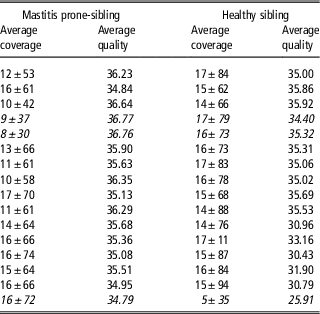
Whole genome sequences of the 32 cows were obtained using the Illumina HiSeq2000 Next Generation Sequencing platform. A detailed description of the protocol has been described previously (Szyda et al., Reference Szyda, Frąszczak, Mielczarek, Giannico, Minozzi, Nicolazzi, Kamiński and Wojdak-Maksymiec2015). The total number of raw reads generated for a single animal ranged between 164 984 147 and 472 265 620. Raw reads were aligned to the UMD3.1 reference genome using BWA-MEM software (Li and Durbin, Reference Li and Durbin2009) with the number of aligned reads varying from 155 202 885 (94.07% of UMD3.1) to 454 412 859 (99.57% of UMD3.1) per animal and the average depth of coverage between 5× and 17× (Table 1). Resulting BAM files were processed using a combination of tools from the Picard (http://broadinstitute.github.io/picard/) and SAMtools (Li et al., Reference Li, Handsaker, Wysoker, Fennell, Ruan, Homer, Marth, Abecasis and Durbin2009) packages and included re-alignment to the reference sequence as well as removal of PCR duplicates. In order to make use of the half-sib structure of the data set, the variants (SNPs and CNVs) were identified by comparison of healthy and mastitis-prone siblings. In particular, SNPs were identified by comparing the discordant sib pairs using the somatic mutation caller Varscan2 (Koboldt et al., Reference Koboldt, Zhang, Larson, Shen, McLellan, Lin, Miller, Mardis, Ding and Wilson2012). ‘Somatic’ SNPs were called when a healthy cow was homozygous for a reference allele and the mastitis-prone half-sib was heterozygous or homozygous for the alternative allele. Differences in the number of reads were tested using the Fisher’s Exact Test with Bonferroni multiple testing correction. The number of ‘somatic’ SNPs per half-sib pair ranged from 314 564 to 6 765 038 (
 $\bar{x}$
=4 932 444±1 615 483) (Supplementary figure S1). Copy number variations were identified using the CNVnator software (Abyzov et al., Reference Abyzov, Urban, Snyder and Gerstein2011). Copy number variations longer than 1 Mbp were removed. To exclude false positive variants being a consequence of artefacts arising from errors in the reference genome, deletions shared by at least 15 cows were removed if they had a 50% or higher overlap with gaps in the reference genome. As CNVnator is based on differences in read depth along the genome, three cows with average depth of coverage below 10 and their respective half-sibs were excluded leaving 13 half-sib pairs which were used to identify CVNs. The total number of CNVs identified for the 26 individuals ranged between 1694 and 5187 (
 $\bar{x}$
=4 932 444±1 615 483) for duplicated sequences and between 9731 and 18 479 (
 $\bar{x}$
=12 787±1 792) for deleted sequences with lengths ranging between 200 to 724 000 bp for deletions and 200 to 439 300 bp for duplications (Supplementary Figure S2). Deleted sequences covered from 2.71% to 6.09% of the whole genome, while duplications accounted for a 0.51% to 1.58% increase in the total sequence length.
Average depth of coverage and per-read quality score for each of the Polish Holstein-Friesian cows half-sib pairs

Half-sibs-pairs removed from the analysis due to a low coverage are shown in italics.
Quantifying the association of variants with clinical mastitis
Somatic SNPs were identified by comparing the number of reads supporting an alternative and a reference allele between a healthy and a mastitis-prone half-sib. The ‘tumour purity’ parameter was set to 0.75 to reflect the genotypic similarity between half-sibs. We focused on CNVs, which were deleted in a mastitis prone cow, but present in its healthy sibling, and on CNVs that were duplicated in a healthy cow, but not duplicated in its mastitis-prone sibling. Such genomic sequences were identified by comparing CNVs in each discordant sib-pair and defined as CNV regions (CNVRs).
Annotation
The genomic annotation of SNPs and CNVs exhibiting a differential polymorphism between a mastitis-prone and a healthy sib was performed using Variant Effect Predictor software (McLaren et al., Reference McLaren, Pritchard, Rios, Chen, Flicek and Cunningham2010). Functional, non-coding sequences were annotated based on the miRBase database (http://www.mirbase.org) for micro-RNA and the Noncode database (http://www.noncode.org), Billerey et al. (Reference Billerey, Boussaha, Esquerré, Rebours, Djari, Meersseman, Klopp, Gautheret and Rocha2014) and Koufariotis et al. (Reference Koufariotis, Chen, Chamberlain, van der Jagt and Hayes2015) for long non-coding RNA.
Results
Association of somatic single nucleotide polymorphisms with clinical mastitis
Altogether 672 272 SNPs were identified that showed allele differences between discordant sibs in the number of reads supporting an alternative and a reference allele, which were significant at the 10% type I error level. Among these only 17 SNPs were in common in at least eight half-sib families and were considered in further analysis. Three of these SNPs were located within introns of genes. The most common somatic SNP was found in 10 half-sib families and was located at the position 28 810 758 bp on BTA27 in an intron of RNF122, a RefSeq sequence corresponding to the gene coding for ring finger protein 122. Interestingly, ten other somatic SNPs located within this gene with alternate alleles were identified in seven or eight half-sib pairs. RNF22 encodes a protein involved in basic processes such as protein–protein and protein–DNA interactions. It may therefore be expected to play a role in cell viability, and has been reported to have a role in immune response (Wang et al., Reference Wang, Ju, Hou, Jiang, Yang, Zhang, Sun, Li, Wang, Zhong and Huang2016). The second most common SNP, present in nine families, was identified on BTA04 at 51 991 924 bp and overlapped with an intron of the proto-oncogene, receptor tyrosine kinase (MET, ENSBTAG00000006161), which plays a role in cellular migration and invasion, processes which are related to inflammation. The third SNP, which was common in eight families, was also located on BTA27 (26 370 233 bp) within the WRN gene (ENSBTAG00000021592), which is responsible for the Werner syndrome and encodes Werner syndrome RecQ-like helicase protein. Mutations in this gene result in premature aging in humans and an increased susceptibility to infection (Domínguez-Gerpe and Araújo-Vilar, Reference Domínguez-Gerpe and Araújo-Vilar2008).
Association of copy number variant regions with clinical mastitis
The structural variation examined were (i) genome duplications present predominantly in healthy animals in at least nine half-sib pairs, and (ii) genome deletions present predominantly in mastitis-prone animals, also in at least nine half-sib pairs. The biological hypothesis underlying strategy (i) was that healthy sibs may harbour a duplication in a region functionally important for CM resistance, which may then be associated with a higher level of expression, while in strategy (ii) deletion of functionally important genomic region may increase the risk of CM.
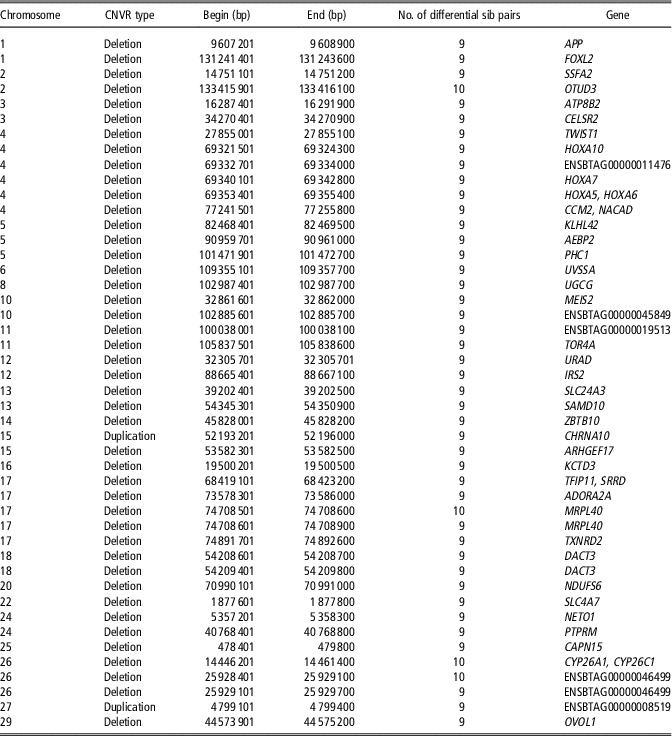
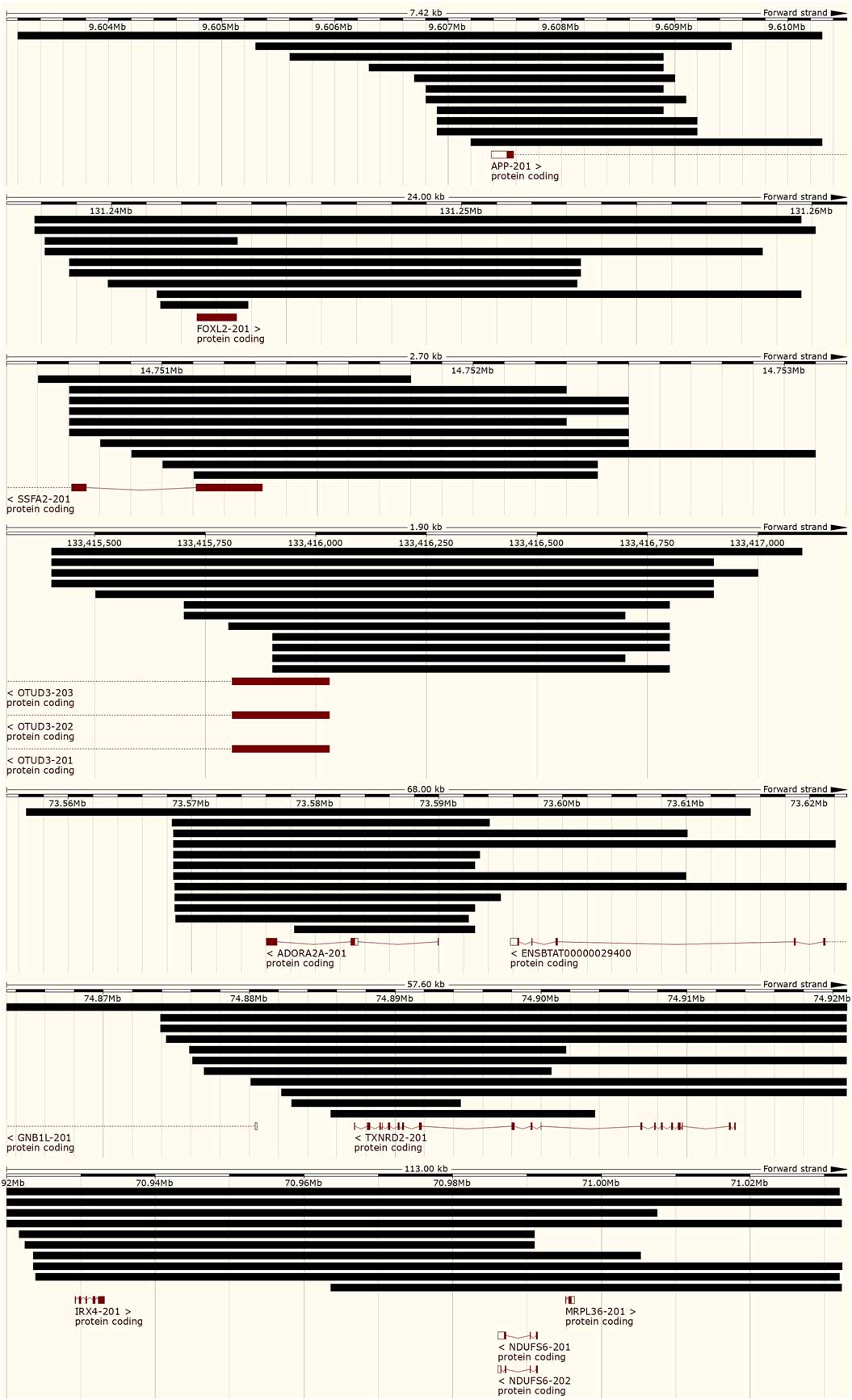
Altogether, 28 755 duplicated CNVRs were present in the mastitis-prone sibs and absent from the healthy sibs, among these only 36 (0.13%) CNVRs were present in at least nine sib-pairs. Two of the regions overlapped with exons of a gene coding for a cholinergic receptor nicotinic alpha 10 subunit on BTA15 and a novel Bos taurus gene with Ensembl ID ENSBTAG00000008519 located on BTA27. A more interesting picture emerges when regions deleted in mastitis-prone sibs were compared with healthy sibs. 141 066 such regions were identified including 191 (0.14%) deletions observed in at least nine pairs. Those regions were annotated as exonic sequences of 46 genes (Table 2). 25 of the regions represented novel deletions, while the reminder have already been reported in the Database of Genomic Variants (www.ebi.ac.uk/dgva), albeit not always as deletions. The length of the deleted regions varied between 100 and 15 200 bp and covered part of a single exon through to several exons. Seven of the affected genes potentially influence the incidence of mastitis (Figure 1). Genes with deletions found in the mastitis-prone sibs have been implicated in immune response and variations in somatic cell score, which is an indicator trait for mastitis. FOXL2 coding Forkhead box L2 protein (ENSBTAG00000031277), located on BTA1, had a 2 200 bp deleted region in the only exon of this gene, which was observed in nine of the mastitis-prone sibs but was not present in the healthy half-sibs. The forkhead transcription factor, encoded by FOXL2, plays a role in inflammation processes (Moumné et al., Reference Moumné, Batista, Benayoun, Nallathambi, Fellous, Sundaresan and Veitia2008). Sperm specific antigen 2 (SSFA2; ENSBTAG00000000937), located on BTA2 had a short deletion of 100 bp in the first exon in nine mastitis-prone sibs. Variations in this gene are associated with somatic cell score, which is an indicator trait for mastitis (Strillacci et al., Reference Strillacci, Frigo, Schiavini, Samoré, Canavesi, Vevey, Cozzi, Soller, Lipkin and Bagnato2014). SSFA2 also overlaps with a QTL for bovine immunoglobulin G level (QTL ID: 20470). NADH-ubiquinone oxidoreductase subunit S6 protein gene (NDUFS6; ENSBTAE00000106646) is located on BTA20 and had a 900 bp deletion that removes a whole exon 2 and has been reported previously (Boussaha et al., Reference Boussaha, Esquerré, Barbieri, Djari, Pinton and Letaief2015). This genomic region harbours a quantitative trait locus for somatic cell score (Durán Aguilar et al., Reference Durán Aguilar, Román Ponce, Ruiz López, González Padilla, Vásquez Peláez, Bagnato and Strillacci2016; Animal QTL database ID: 122069). OTU Deubiquitinase 3 protein gene (OTUD3; ENSBTAG00000017108), located on BTA2 contained a 200 bp deletion in 10 mastitis-prone compared with healthy sibs. This deletion removes a part of the first exon and has also been reported previously (Keel et al., Reference Keel, Keele and Snelling2017). OTUD3 plays a role in inflammation and is associated with inflammatory bowel disease in humans (e.g. McGovern et al., Reference McGovern, Gardet, Törkvist, Goyette, Essers, Taylor, Neale, Ong, Lagacé, Li, Green, Stevens, Beauchamp, Fleshner, Carlson, D’Amato, Halfvarson, Hibberd, Lördal, Padyukov, Andriulli, Colombo, Latiano, Palmieri, Bernard, Deslandres, Hommes, de Jong, Stokkers, Weersma, NIDDK, Consortium, Sharma, Silverberg, Cho, Wu, Roeder, Brant, Schumm, Duerr, Dubinsky, Glazer, Haritunians, Ippoliti, Melmed, Siscovick, Vasiliauskas, Targan, Annese, Wijmenga, Pettersson, Rotter, Xavier, Daly, Rioux and Seielstad2010). Adenosine A2a receptor gene (ADORA2A; ENSBTAG00000016944), located on BTA17 had a deletion of 7700 bp covering the whole exon 2 in nine mastitis-prone sibs. This deletion was previously reported by Hou et al. (Reference Hou, Liu, Bickhart, Cardone, Wang, Kim, Matukumalli, Ventura, Song, VanRaden, Sonstegard and Van Tassell2011). ADORA2A is involved in inflammatory diseases by modulating tissue response to inflammation (Salmon et al., Reference Salmon, Brogle, Brownlie, Edberg, Kimberly, Chen and Erlanger1993) and is assigned to the GO terms: inflammatory response biological process (GO:0006954) and a negative regulation of inflammatory response biological process (GO:0050728). ADORA2A is expressed at high levels in the mammary gland (Yue et alet al., Reference Yue, Cheng, Breschi, Vierstra, Wu, Ryba, Sandstrom, Ma, Davis, Pope, Shen, Pervouchine, Djebali, Thurman, Kaul, Rynes, Kirilusha, Marinov, Williams, Trout, Amrhein, Fisher-Aylor, Antoshechkin, DeSalvo, See, Fastuca, Drenkow, Zaleski, Dobin, Prieto, Lagarde, Bussotti, Tanzer, Denas, Li, Bender, Zhang, Byron, Groudine, McCleary, Pham, Ye, Kuan, Edsall, Wu, Rasmussen, Bansal, Kellis, Keller, Morrissey, Mishra, Jain, Dogan, Harris, Cayting, Kawli, Boyle, Euskirchen, Kundaje, Lin, Lin, Jansen, Malladi, Cline, Erickson, Kirkup, Learned, Sloan, Rosenbloom, Lacerda de Sousa, Beal, Pignatelli, Flicek, Lian, Kahveci, Lee, Kent, Ramalho Santos, Herrero, Notredame, Johnson, Vong, Lee, Bates, Neri, Diegel, Canfield, Sabo, Wilken, Reh, Giste, Shafer, Kutyavin, Haugen, Dunn, Reynolds, Neph, Humbert, Hansen, De Bruijn, Selleri, Rudensky, Josefowicz, Samstein, Eichler, Orkin, Levasseur, Papayannopoulou, Chang, Skoultchi, Gosh, Disteche, Treuting, Wang, Weiss, Blobel, Cao, Zhong, Wang, Good, Lowdon, Adams, Zhou, Pazin, Feingold, Wold, Taylor, Mortazavi, Weissman, Stamatoyannopoulos, Snyder, Guigo, Gingeras, Gilbert, Hardison, Beer and Ren2014). Two other genes with deletions have been associated with susceptibility to bacterial infection. Thioredoxin reductase 2, mitochondrial precursor protein gene (TXNRD2; ENSBTAG00000043581) is located on BTA17 and had a 900 bp deletion in nine mastitis-prone sibs, that removes a part of the 12th exon. A CNV in this region was also reported by Hou et al. (Reference Hou, Liu, Bickhart, Cardone, Wang, Kim, Matukumalli, Ventura, Song, VanRaden, Sonstegard and Van Tassell2011). TXNRD2 is a candidate gene influencing susceptibility to S. aureus, which is one of the most common causes of mastitis, in mice (Ye et al., Reference Ye, Vasco, Carter, Brilliant, Schrodi and Shukla2014), humans (Nelson et al., Reference Nelson, Pelak, Podgoreanu, Ahn, Scott, Allen, Cowell, Rude, Zhang, Tong, Ruffin, Sharma-Kuinkel and Fowler2014) and cattle (Ghorbani et al., Reference Ghorbani, Tahmoorespur, Masoudi Nejad, Nasiri and Asgari2015). Amyloid β precursor protein gene (APP; ENSBTAG00000017753) located on BTA1, had a 1700 bp deletion in first exon, which was observed in nine sib-pair comparisons. The gene product is known to have bactericidal and antifungal activities and amyloid proteins have been shown to be associated with sub-CM in ruminants (Miglio et al., Reference Miglio, Moscati, Fruganti, Pela, Scoccia, Valiani and Maresca2013). One CNVR, deleted in nine mastitis-prone sibs overlapped two neighbouring long non-coding RNA sequences located on BTA12 (90 641 959 to 90 643 802 bp and 90 644 418 to 90 646 031 bp) reported by Koufariotis et al. (Reference Koufariotis, Chen, Chamberlain, van der Jagt and Hayes2015).
Copy number variant regions (CNVRs) within coding sequences of the Bos taurus genome, represented by duplications present in at least nine healthy cows, but absent in their mastitis-prone half-sibs and deletions present in at least nine mastitis-prone cows, but absent in their healthy half-sibs

ADORA2A=Adenosine A2a receptor; AEBP2=AE binding protein 2; APP=Amyloid β precursor protein; ARHGEF17=ρ guanine nucleotide exchange factor 17; ATP8B2=ATPase phospholipid transporting 8B2; CAPN15=Calpain 15; CCM2=CCM2 scaffold protein; CELSR2=Cadherin, EGF LAG seven-pass G-type receptor 2; CHRNA10=Cholinergic receptor nicotinic α 10 subunit; CYP26A1=Cytochrome P450, family 26, subfamily A, polypeptide 1; CYP26C1=Cytochrome P450 family 26 subfamily C member 1; DACT3=Dishevelled-binding antagonist of β catenin 3; FOXL2=Forkhead box L2; HOXA5=Homeobox A5; HOXA6=Homeobox A6; HOXA7=Homeobox A7; HOXA10=Homeobox A10; IRS2=Insulin receptor substrate 2; KCTD3=Potassium channel tetramerization domain containing 3; KLHL42=Kelch-like family member 42; MEIS2=Meis homeobox 2; MRPL40=Mitochondrial ribosomal protein L40; NACAD=NAC α domain containing; NDUFS6=NADH:ubiquinone oxidoreductase subunit S6; NETO1=Neuropilin and tolloid like 1; OTUD3=OTU deubiquitinase 3; OVOL1=Ovo-like transcriptional repressor 1; PHC1=Polyhomeotic homolog 1; PTPRM=Protein tyrosine phosphatase, receptor type M; SAMD10=Sterile α motif domain containing 10; SLC24A3=Solute carrier family 24 member 3; SLC4A7=Solute carrier family 4 member 7; SRRD=SRR1 domain containing; SSFA2=ITPR interacting domain containing 2; TFIP11=Tuftelin-interacting protein 11; TOR4A=Torsin family 4 member A; TWIST1=Twist family bHLH transcription factor 1; TXNRD2=Thioredoxin reductase 2; UGCG=UDP-glucose ceramide glucosyltransferase; URAD=Ureidoimidazoline (2-oxo-4-hydroxy-4-carboxy-5-) decarboxylase; UVSSA=UV stimulated scaffold protein A; ZBTB10=Zinc finger and BTB domain containing 10
Positions of copy number variant regions deleted in mastitis-prone siblings in Bos taurus genome covering exons of APP and FOXL2 (chromosome 1), SSFA2 and OTUD3 (chromosome 2), ADORA2A and TXNRD2 (chromosome 17), NDUFS6 (chromosome 20) genes. APP=Amyloid β precursor protein; FOXL2=Forkhead box L2; SSFA2=ITPR interacting domain containing 2; OTUD3=OTU deubiquitinase 3; ADORA2A=Adenosine A2a receptor; TXNRD2=Thioredoxin reductase 2; NDUFS=NADH:ubiquinone oxidoreductase subunit S6.

Discussion
Our comparison of the genomes of mastitis resistant and mastitis-prone cows suggested that deletions of genomic regions were more likely to be associated with increased susceptibility to the disease. The function of genes in the affected regions was enriched in terms related to immune response and gene expression (RNA polymerase II core promoter proximal region sequence-specific DNA binding GO:0000978 and transcription factor activity, RNA polymerase II core promoter proximal region sequence-specific binding GO:0000982). Similar functions were reported in the analysis of genes that were up-regulated after an artificially induced intra-mammary infection with lipopolysaccharide (Fang et al., Reference Fang, Sahana, Su, Yu, Zhang, Lund and Sørensen2017). These included, among others, genes related to RNA processing, the regulation of gene expression and the inflammatory response. There has been strikingly low reproducibility across other studies carried out to disentangle the genetic background of mastitis resistance in dairy cattle (e.g. Sodeland et al., Reference Sodeland, Kent, Olsen, Opsal, Svendsen, Sehested, Hayes and Lien2011; Sahana et al., Reference Sahana, Guldbrandtsen, Thomsen, Holm, Panitz, Brondum, Bendixen and Lund2014; Olsen et al., Reference Olsen, Knutsen, Lewandowska‑Sabat, Grove, Nome, Svendsen, Arnyasi, Sodeland, Sundsaasen, Dahl, Heringstad, Hansen, Olsaker, Kent and Lien2016; Wang et al., Reference Wang, Ju, Hou, Jiang, Yang, Zhang, Sun, Li, Wang, Zhong and Huang2016). The only common feature emerging were genes related to immune response. This disparity reflects the multifactorial nature of the disease, which makes identification of genes involved difficult. In our study, we reduced variation in management by working within a single cohort at the same farm and minimised the genetic variation by studying half-sib pairs, which share the same allele IBD with 0.5 probability. Moreover, the advances in technologies for whole genome sequencing have increased the proportion of variants identified in a genome, which can then be tested for association traits, by the availability of whole genome sequences with potentially (ignoring technical error in variant detection) all point and structural variants present in a genome. In this study we identified variants differing between healthy and mastitis-prone sibs and identified putative causal polymorphisms and candidate genes for CM. However, production of whole genome sequence still has a high cost and the management of the large data sets poses logistical problems. As a result studies using whole genome sequence generally have a small sample size that do not permit rigorous statistical testing of associations, so that the number of false associations (type I errors) cannot be determined. This is the case for the small data set used here, and also means that some true associations could have been missed. Data quality also presents problems, as some regions could have been missed or have a sequence depth that was insufficient to determine variants. Nevertheless, the results presented here provide information on regions putatively involved in mastitis susceptibility and are a starting point for further studies.
Conclusions
The present study identified genomic regions and genes, which potentially harbour causal mutations contributing to mastitis susceptibility. Many of these regions contain structural polymorphisms in the form of CNVs within genes involved in immune response, that are likely to play a role in disease susceptibility. Interestingly sequence deletions were most frequently found in the mastitis-prone sibs, suggesting that loss of function reduces resistance against CM, rather than sequence duplication, increases susceptibility to mastitis. An interesting further extension of these findings will be estimating effects of the polymorphisms at a population-wide level.
Acknowledgements
The research was supported by the European Union Seventh Framework Programme through the NADIR (FP7-228394) project, by the Polish National Science Centre (NCN) grant 2014/13/B/NZ9/02016, and by The Leading National Research Centre (KNOW) programme for 2014–2018. Computations were carried out at the Poznan Supercomputing and Networking Centre.
Declaration of interest
The authors declare that they have no competing interests
Ethics statement
Not applicable.
Software and data repository resources
Deoxyribonucleic acid sequences of the 32 cows are available from the NCBI BioProject database under the accession ID PRJNA359667.
Supplementary material
To view supplementary material for this article, please visit https://doi.org/10.1017/S1751731119000338