Introduction
This article discusses how three Finnish regional newspapers represented older people's digital competences and internet use in their daily coverage. The premise of this article is that the media has a powerful role in the social construction of reality, and in terms of the topic of the present research, in the construction of older people's digital competences, and internet use and non-use.
The digitalisation of services, both public and private, creates a need for older people to have digital competences. The European Commission's DigComp – Digital Competence Framework for Citizens 2.0 defines digital competence as the confident and critical use of information and communication technology (ICT) tools in work, employability, education, leisure, inclusion and participation in society (Vuorikari et al., Reference Vuorikari, Punie, Carretero and Van den Brande2016). The framework defines five competence areas in which citizens need to have adequate digital competences: (a) information and data literacy, (b) communication and collaboration, (c) digital content creation, (d) safety, and (e) problem solving. In terms of the competence area of ‘information and data literacy’, the need for citizens to have digital competences has been recently recognised, especially in relation to online disinformation, hate speech and propaganda. According to the framework, citizens should be able to ‘analyse, compare and critically evaluate the credibility and reliability of sources of data, information and digital content’ (Vuorikari et al., Reference Vuorikari, Punie, Carretero and Van den Brande2016: 17). In terms of ‘communication and collaboration competences’, citizens are expected to have adequate skills to participate in society through the use of public and private digital services.
The internet is a major arena in terms of communication and service provision. The context of the present research, Finland, is one of the top European performers in the supply and demand of digital public services (European Commission, 2020a). Towards the end of the data collection period for the present study (2006–2016), the rhetoric that Finland needed to take ‘a digital leap’ became popular in public discussion and policy documents (Jungner, Reference Jungner2015; Saari and Säntti, Reference Saari and Säntti2018). In Finland, digitalisation of services, such as health-care services, is a governmental priority (Ministry of Social Affairs and Health and the Association of Finnish Local and Regional Authorities, 2015). However, government policies also acknowledge that digitalisation poses challenges for citizens and may have an exclusionary effect that must be prevented, e.g. through improving citizens’ digital skills (Digi arkeen -neuvottelukunta, 2019). In terms of private services, for instance, banking services in Finland are predominantly internet-based, and around the time of the data collection for the present study, 61 per cent of adults ages 65–74 were reported to have used online banking services, while the percentage in the 75–89 age group was 22 (Official Statistics of Finland, 2014).
Internet demands digital competences from its users, and a significant amount of research has focused on how older people use or do not use the internet. In studies focusing on older people's digital competences, as well as their use of and attitudes towards the internet, older people are commonly defined as being aged 65 years and above (e.g. Anderson and Perrin, Reference Anderson and Perrin2017; Ofcom, 2019). This research has concluded that the proportion of internet non-users increases with age (Rasi, Reference Rasi and Warf2018) and that older people use the internet less and somewhat differently than younger age groups as, for example, their range of online activities is narrower than among younger people (e.g. Anderson and Perrin, Reference Anderson and Perrin2017; Ofcom, 2019; European Commission, 2020b). Around the time of the data collection of the present study, in Finland, 68 per cent of adults aged 65–74 were reported to have used the internet, while the percentage in the 75–89 age group was 28 (Official Statistics of Finland, 2014). Much of the so-called barrier-analysis approach to internet non-use suggests that older people stay away from the internet, for example, because they have insufficient skills and/or negative attitudes towards the internet: they perceive no benefit, lack interest or motivation, or have stereotypical thinking (Rasi, Reference Rasi and Warf2018; Ofcom, 2019). In addition, internet non-use is related to the areas in which people live: rural areas have slightly more non-users than do urban and suburban areas in Finland (Official Statistics of Finland, 2014).
In terms of older people's digital competences, recent studies point to older people's lack of ability to understand, analyse and evaluate, for example, the trustworthiness of online news (Guess et al., Reference Guess, Nagler and Tucker2019) and health information presented in the media (Eronen et al., Reference Eronen, Paakkari, Portegijs, Saajanaho and Rantanen2019). This suggests that older people lack adequate competences in the DigComp framework's competence area of ‘information and data literacy’ (Vuorikari et al., Reference Vuorikari, Punie, Carretero and Van den Brande2016). However, previous studies also indicate that many older people have positive attitudes towards ICTs and are competent and confident users (Damodaran et al., Reference Damodaran, Olphert and Sandhu2014; Rasi and Kilpeläinen, Reference Rasi and Kilpeläinen2015). Previous research also highlights the diversity of digital competences and internet use of people aged over 65 years due to, for example, their lifestage, health status, education, socio-economic status, gender, family situation and the areas in which they live, such as rural areas having more internet non-users than urban and suburban areas (Helsper and Reisdorf, Reference Helsper and Reisdorf2016; Rasi, Reference Rasi and Warf2018; Abad Alcalá, Reference Abad Alcalá, Hobbs and Mihailidis2019; Ofcom, 2019; European Commission, 2020b).
The present research focuses on media representations of older people's digital competences, with the premise being that representations participate in the social construction of reality. Through media, the public learns about scientific and political issues and risks that are beyond people's perceptual capacity of experience (Höijer, Reference Höijer2010). Furthermore, representations in the media can reinforce stereotype formation, and encountering such stereotypes of themselves in the media can impact older people's self-esteem, self-concepts and cognitive performance (Westerhof and Tulle, Reference Westerhof, Tulle, Bond, Peace, Dittmann-Kohli and Westerhof2007; Bai, Reference Bai2014; Loos, Reference Loos2018). Studying how the media socially constructs older people's digital competences and internet use is therefore important. Furthermore, studying the representation of older Finnish people in regional newspapers is important because of the significance and trust that the regional, non-political press enjoys in the lives of Finnish people (TNS opinion & social, 2016).
Media representations of older people
A significant amount of research has focused on the representation of older people and ageing across different media (Barrett et al., Reference Barrett, Raphael, Gunderson, Harrington, Bielby and Bardo2014; Ylänne, Reference Ylänne, Twigg and Martin2015), such as magazines and newspapers (Wada et al., Reference Wada, Hurd Clark and Rozanova2015), television (Oró-Piqueras, Reference Oró-Piqueras2014; Kovács et al., Reference Kovács, Aczél and Bokor2021), popular music (Kelly et al., Reference Kelly, Watson, Pankratove and Pedzeni2016), the internet (Loos et al., Reference Loos, Ivan, Fernández-Ardèvol, Sourbati, Ekström, Wilińska, Carlo and Schiau2017a; Loos, Reference Loos2018; Loos and Ivan, Reference Loos, Ivan, Ayalon and Tesch-Roemer2018), social media (Makita et al., 2021) and advertisements (Williams et al., Reference Williams, Wadleigh and Ylänne2010; Baumann and de Laat, Reference Baumann, de Laat, Harrington, Bielby and Bardo2014; Prieler et al., Reference Prieler, Kohlbacher, Hagiwara and Arima2015; Ylänne, Reference Ylänne, Twigg and Martin2015). Previous research indicates that older people, particularly people over 65 years of age, are underrepresented in the media and that media images do not therefore realistically reflect the demographic reality (Westerhof and Tulle, Reference Westerhof, Tulle, Bond, Peace, Dittmann-Kohli and Westerhof2007; Bai, Reference Bai2014; Barrett et al., Reference Barrett, Raphael, Gunderson, Harrington, Bielby and Bardo2014; Baumann and de Laat, Reference Baumann, de Laat, Harrington, Bielby and Bardo2014; Prieler et al., Reference Prieler, Kohlbacher, Hagiwara and Arima2015; Ylänne, Reference Ylänne, Twigg and Martin2015). In addition, research demonstrates that older women are depicted less often than older men and that people in their fourth age less often than people in their third age (Westerhof and Tulle, Reference Westerhof, Tulle, Bond, Peace, Dittmann-Kohli and Westerhof2007; Bai, Reference Bai2014; Barrett et al., Reference Barrett, Raphael, Gunderson, Harrington, Bielby and Bardo2014).
Previous research has indicated that negative media portrayals of older people predominate the media (e.g. Westerhof and Tulle, Reference Westerhof, Tulle, Bond, Peace, Dittmann-Kohli and Westerhof2007; Bai, Reference Bai2014; Kelly et al., Reference Kelly, Watson, Pankratove and Pedzeni2016), with the exception of portrayals of older people in marketing (Ylänne, Reference Ylänne, Twigg and Martin2015). However, even research into the representation of older adults in television marketing has found that there is a strong tendency for advertisers to portray age through employing hegemonic cultural schemas of older people as incompetent and desexualised (Baumann and de Laat, Reference Baumann, de Laat, Harrington, Bielby and Bardo2014). Based on their research on the representation of older adults in television marketing, Baumann and de Laat (Reference Baumann, de Laat, Harrington, Bielby and Bardo2014: 23) conclude that ‘these portrayals cannot be considered liberating and instead reinforce damaging and constraining cultural schemas’, e.g. by constraining the range of consumer identities available for older people. Negative portrayals of older people have also been found in social media. Based on their study of the representation of old age and older people on Twitter, Makita et al. (Reference Makita, Mas-Bleda, Stuart and Thelwall2021) concluded that tweets reinforced and reproduced existing negative discourses, according to which, older adults are disempowered and vulnerable and old age is a problem.
A shift to more positive portrayals has also been reported (e.g. Westerhof and Tulle, Reference Westerhof, Tulle, Bond, Peace, Dittmann-Kohli and Westerhof2007; Prieler et al., Reference Prieler, Kohlbacher, Hagiwara and Arima2015; Wada et al., Reference Wada, Hurd Clark and Rozanova2015). However, even if the media depictions may have become more positive, that is, having changed from ‘frail’ to ‘remarkably youthful’ depictions, older people are still portrayed in a limited way (Hodgetts et al., Reference Hodgetts, Chamberlain and Bassett2003: 417; see also Bai, Reference Bai2014; Barrett et al., Reference Barrett, Raphael, Gunderson, Harrington, Bielby and Bardo2014). For example, older people are often represented as being healthy and active, thus reflecting the dominant discourses of successful and active ageing (Loos et al., Reference Loos, Ivan, Fernández-Ardèvol, Sourbati, Ekström, Wilińska, Carlo and Schiau2017a; Loos, Reference Loos2018; Loos and Ivan, Reference Loos, Ivan, Ayalon and Tesch-Roemer2018). Furthermore, the study by Wada et al. (Reference Wada, Hurd Clark and Rozanova2015: 46) revealed that magazine and newspaper portrayals of online dating challenged the stereotype of older adults as being non-sexual, but at the same time ‘established and reinforced the paradox that while sexuality was crucial to remaining youthful and aging successfully, youth and beauty were essential requisites for active sexual engagement’. Older people in advertisements have been shown to reflect stereotypical expectations about older people's behaviour, and they have most often been recruited as advertisers of food, pharmaceutical products, health aids, and insurance products and services (Williams et al., Reference Williams, Wadleigh and Ylänne2010; see also Ylänne, Reference Ylänne, Twigg and Martin2015).
Yet another tendency reported by previous research is portraying older people as a homogenous group. For example, on their websites, several European senior citizens’ organisations were often found to represent older people visually as a homogeneous group, not considering the differences related to age, civil status and health conditions (Loos et al., Reference Loos, Ivan, Fernández-Ardèvol, Sourbati, Ekström, Wilińska, Carlo and Schiau2017a; Loos, Reference Loos2018).
Media representations of digital competences and internet use
Despite the growing need to promote older people's digital competences, there is practically no up-to-date research on how older people have been represented in the media as internet users. An exception to this is a study by Loos et al. (Reference Loos, Kubinski and Romero2017b), who conducted a case study of how digital game use by older people was visually represented in a Dutch short film. The authors argued that ‘the grandparents are clearly represented as “digital immigrants”, digitally illiterate persons who are not able to learn to play a digital game’ (Loos et al., Reference Loos, Kubinski and Romero2017b: 55), while the granddaughter of the grandparents is portrayed as a digitally literate ‘digital native’. Reflecting on their results with the help of Dutch statistics on older people's digital gaming, the authors concluded that ‘the representation of Dutch older adults as “digital immigrants” does not reflect their actual position in today's digitized society’ (Loos et al., Reference Loos, Kubinski and Romero2017b: 56).
Instead, researchers have explored how children and young people have been represented in the media in relation to new technologies. This research provides an interesting comparative view for the present research and, therefore, three examples will be briefly reviewed here. First, Selwyn (Reference Selwyn2003) analysed different discursive constructions of the child computer user in the United Kingdom over 20 years in broadcast and print media, commercial advertising and marketing, and political discourse. He identified the following six discursive themes: (a) the ‘natural’ child computer user; (b) the ‘successful’ child computer user; (c) the ‘adult’ child computer user; (d) the ‘dangerous’ child computer user; (e) the ‘victimised’ child computer user; and (f) the ‘needy’ child computer user. The portrayals of the child computer user were consistent in their positive and sometimes utopian visions of empowered children using technology for a variety of enriching activities, but an alternative dystopian theme also emerged strongly from the data. Selwyn (Reference Selwyn2003) concluded that there is a need to consider the wider societal functions that such discourses may serve. The six discursive constructions of child computer users are, according to Selwyn, all, predominantly, attempts to ‘sell’ information technology to the adult population. The notion of the child computer user has also functioned as a powerful means of ‘selling’ government strategies and policies to the general public. Viewed in this light, much of the ‘child computer user’ discourse can be seen as an integral part of the promotion of the information society as an economic, political, cultural and societal ‘matter-of-fact’.
Second, Shaw and Tan (Reference Shaw and Tan2015) performed a quantitative content analysis of news reports (N = 797) in the most popular children's newspaper in Taiwan between 2000 and 2011, and they examined the frequencies of Selwyn's (Reference Selwyn2003) five themes of ‘child computer user’ and the six dimensions of children's needs and the argumentation patterns of the media framing of the ICT effect. The study revealed how the cultural assumptions of contemporary Taiwanese towards children and childhood, viewed in terms of children's nature, agency and needs, have influenced media representations of child computer users. The child computer users were constructed as dependent and passive, and ICT effects were primarily assessed for their societal relevance rather than individual relevance, leading the authors to conclude that ‘In contemporary Taiwan, children's use of ICT has been mainly reconstructed as a public issue rather than a private individual issue’ (Shaw and Tan, Reference Shaw and Tan2015: 1880). According to the authors, the effects of computer use for children were portrayed predominantly in positive terms.
Third, Yoon (Reference Yoon2006) examined representations of the mobile phone and its young Korean users in three distinct discourses: those of the state, the market and the mass media. Using critical discourse analysis, the study examined articles about young mobile phone users published in three Korean newspapers between 1997 and 2002. Yoon found distinctive features of negative representations of youth and the mobile phone in the Korean context. First, youths were portrayed as representative of the excessive or ‘over-consumption’ of mobile phones, and even as pathologically addicted users. Second, mobile phones were represented as harmful to young people's socialisation in school and the home. However, domestic marketers tried to reduce social concern over the excessive consumption of mobile phones by providing positive images of the technology and promoting cheap products.
Theory of social representations
In the present study, media representations are examined through Moscovici's (Reference Moscovici1976, Reference Moscovici and Duveen2000, Reference Moscovici2008) theory of social representations. The theory is a social constructivist and discursively oriented approach, in which social representations are understood as models for social construction as well as for the distribution of knowledge (Wagner et al., Reference Wagner, Duveen, Farr, Jovchelovitch, Lorenzi-Cioldi, Marková and Rose1999). Social representation has been defined as ‘the ensemble of thoughts and feelings being expressed in verbal and overt behaviour of actors which constitutes an object for a social group’ (Wagner et al., Reference Wagner, Duveen, Farr, Jovchelovitch, Lorenzi-Cioldi, Marková and Rose1999: 96). For Moscovici, communication is an integral part of the study of representations ‘because representations are generated in this process of communication and then, of course, expressed through language’ (Moscovici and Marková, Reference Moscovici, Marková and Duveen2001: 275). Social representations can be embodied in habitual behaviour, individual cognition, as well as informal and formal communication, and thus, they need to be observed in ‘speech and conversation, scripture and texts, images, sounds, and movement, even smell and taste’ (Bauer, Reference Bauer, Sammut, Andreouli, Gaskell and Valsiner2015: 58).
According to Moscovici (Reference Moscovici and Duveen2000), the purpose of social representations is to make the unfamiliar familiar. The construction of social representations is a process of dynamic familiarisation: ‘objects, individuals and events are perceived and understood in relation to previous encounters or paradigms’ (Moscovici, Reference Moscovici and Duveen2000: 37). The construction of social representations proceeds through two mechanisms: anchoring and objectifying. Anchoring means classifying an unfamiliar phenomenon, placing it in a given category and labelling it with a familiar name (Moscovici, Reference Moscovici and Duveen2000). Emotional anchoring refers to
communicative processes by which a new phenomenon is attached to well-known positive or negative emotions, for example, fear or hope. In this way, the unknown becomes recognizable as, for example, a threat, a danger, or as something nice and pleasurable. (Höijer, Reference Höijer2010: 719)
According to Höijer (Reference Höijer2010), emotionalisation is a common phenomenon in the news media. Objectifying means discovering the iconic quality of an imprecise idea or reproducing a concept in an image, and during this process, an icon, metaphor or trope ends up standing in the new phenomenon or idea (Moscovici, Reference Moscovici and Duveen2000; see also Arruda, Reference Arruda, Sammut, Andreouli, Gaskell and Valsiner2015). Metaphors and tropes that groups use for representing a particular phenomenon are not ‘correct or accurate in the sense of scientific truth’, but rather, they are just ‘good to think’ (Wagner et al., Reference Wagner, Duveen, Farr, Jovchelovitch, Lorenzi-Cioldi, Marková and Rose1999: 100). For example, images of ‘curdling like milk’ and ‘going off like milk’ have been found in lay persons’ understanding of mental illness (Wagner et al., Reference Wagner, Duveen, Farr, Jovchelovitch, Lorenzi-Cioldi, Marková and Rose1999: 99).
When studying social representations, considering their pragmatic value is important, in other words, considering ‘what do representations do for the actors and how do they do it’ (Bauer, Reference Bauer, Sammut, Andreouli, Gaskell and Valsiner2015: 52). Previous research has, for example, demonstrated that social representations may be functional for maintaining existing world views and justifying human practices (Eicher and Bangerter, Reference Eicher, Bangerter, Sammut, Andreouli, Gaskell and Valsiner2015; Sammut et al., Reference Sammut, Andreouli, Gaskell, Valsiner, Sammut, Andreouli, Gaskell and Valsiner2015).
In the development process of social representations, information communicated by media has a central meaning, because thinking and discourse are affected by media contents (e.g. Lage, Reference Lage, Myyry, Ahola, Ahokas and Sakki2014). Television, press and internet utilise images that concretise abstract ideas (Wagner and Kronberger, Reference Wagner, Kronberger, Deaux and Philogène2001; Lage, Reference Lage, Myyry, Ahola, Ahokas and Sakki2014). Research on social representations in the media has focused, for example, on media representations of psychoanalysis (Moscovici, Reference Moscovici1976, Reference Moscovici2008), madness (Wagner et al., Reference Wagner, Duveen, Farr, Jovchelovitch, Lorenzi-Cioldi, Marková and Rose1999) and biotechnology in Europe's and North America's elite newspapers (see Bauer and Gaskell, Reference Bauer and Gaskell2008).
Methods
This study examined how older internet users are portrayed in three Finnish regional newspapers from the perspective of the theory of social representations and using content analysis. Analyses of newspaper representations have been predominantly performed using the analytic frameworks of critical discourse analysis (e.g. Wada et al., Reference Wada, Hurd Clark and Rozanova2015), qualitative thematic analysis (e.g. Black, Reference Black2016) or content analysis (e.g. Godoy-Pressland, Reference Godoy-Pressland2014), while the theory of social representations has been used significantly less. The present study seeks to answer the following research questions:
• In what kind of internet user roles do the articles portray older people?
• How and with what kinds of images do the articles portray older people's digital competences in various internet user roles?
• How are older people positioned at a societal level in the articles?
Sample
A corpus consisting of 121 articles published between January 2006 and October 2016 was collected from Lapin Kansa (LK; N = 52), Pohjolan Sanomat (PS; N = 36) and Kainuun Sanomat (KS; N = 33), which are regional non-political daily newspapers published in the regions of Lapland and Kainuu, Finland. These two northern and eastern regions are the most sparsely populated areas of Finland, and have a higher proportion of the population living in rural municipalities than in other parts of Finland. Until 2015, all three newspapers were published by the Finnish media and service company Alma Media. The daily circulation in 2015 of these newspapers was 26,585 for Lapin Kansa, 15,054 for Pohjolan Sanomat and 14,513 for Kainuun Sanomat (MediaAuditFinland, 2017). The overall corpus size of the data is 43,967 words, including headlines.
The data were collected using the online archive of Alma Media. The search function of the online archive was used to identify articles containing references to older people as internet users. The articles of interest in this study were reports, editorials and readers’ letters. The selection criteria entailed at least one combination of two sets of keywords in the articles. The first set of keywords contained three words used for older people in the Finnish language (‘ikäihmiset’, ‘vanhukset’ and ‘seniorit’), best translated as ‘older people’, ‘elderly’ and ‘seniors’. The second set of keywords was ‘computer’ (‘tietokone’), ‘online’ (‘netti’), ‘internet’ (‘internet’), ‘tablet’ (‘tabletti’) and ‘games’ (‘pelit’). Finally, a search was performed with the keyword ‘older people’ (‘ikäihmiset’) to make sure that the search results were comprehensive. The results were then manually scanned, and only articles whose contents explicitly focused on older people's internet use were included. The internet user(s) referred to in the news article had to be older people, and at least one sentence in the article had to refer to how older people use or can use the internet.
Data analysis
A qualitative and quantitative content analysis was first conducted on all the news articles (N = 121) with NVivo qualitative data analysis software. Each article was coded according to which of the following internet user roles the article portrayed older people in: (1) recipient of public services (N = 66), (2) consumer of private services (N = 39) or (3) family and community member (N = 8). Some of the articles portrayed older people in multiple roles, and therefore a category called A person with multiple roles (N = 8) was created. The internet user roles were determined mainly through iterative inductive thematic coding. However, statistics indicating that older Finnish people use the internet mainly to consume various products and services (e.g. banking, entertainment) and to keep in contact with their families and friends confirmed the analysis (Official Statistics of Finland, 2014).
After the data were categorised, the theory of social representations was applied to each of the identified internet user roles. In particular, the articles were analysed in terms of how older internet users are anchored, both cognitively and emotionally (Höijer, Reference Höijer2010), and objectified with the help of images and metaphors (Moscovici, Reference Moscovici and Duveen2000; Arruda, Reference Arruda, Sammut, Andreouli, Gaskell and Valsiner2015). Besides looking at what was present in the social representations, absence was considered as well (see Flick et al., Reference Flick, Foster, Caillaud, Sammut, Andreouli, Gaskell and Valsiner2015). Finally, when drawing conclusions, attention was paid to the functions of social representations, in other words, ‘what do representations do for the actors and how do they do it’ (Bauer, Reference Bauer, Sammut, Andreouli, Gaskell and Valsiner2015: 52).
Findings
Recipients of public services: incompetent outcasts willing to learn
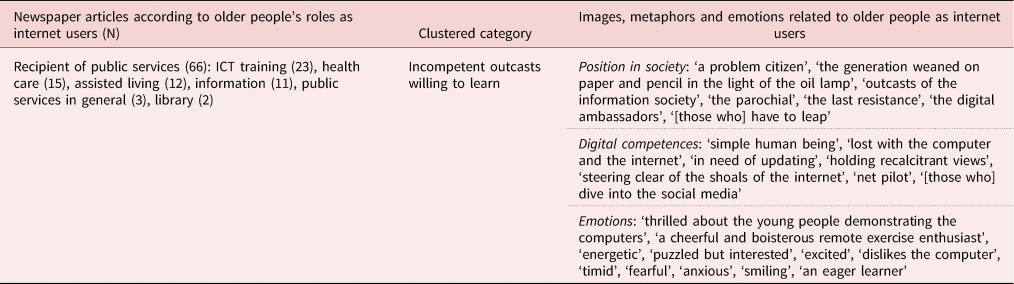
More than half (N = 66) of the articles (N = 121) portrayed older people as recipients of public services, namely ICT training (N = 23) and digitalised public services related to health care (N = 15), assisted living (N = 12), information (N = 11), public services in general (N = 3) and libraries (N = 2). Older people were portrayed as using the internet for monitoring their health, rehabilitation, surveillance and safety, making doctor or laboratory appointments, recreation and seeking, for example, municipal information online.
In terms of their position in society, older people were classified (Moscovici, Reference Moscovici and Duveen2000) in the articles as incompetent outcasts of the digitalised society, who were, however, willing to learn the necessary digital competences. They were positioned as being left behind or outside modern developments, and even at war with them, and this was communicated with many images and metaphors, such as ‘outcasts of information society’, ‘the parochials’ and ‘the generation weaned on paper and pencil in the light of the oil lamp’, and ‘the last resistance’. Their digital competences were described with metaphors such as ‘lost’ and ‘recalcitrant’, and with metaphors related to swimming in and surviving the sea: ‘diving’, ‘shoals’ and ‘net pilot’ (Table 1).
Summary of the data analysis and results of older people as recipients of public services

Notes: N = 121. ICT: information and communication technology.
However, older people were positioned predominantly as welcoming the services provided for them by public authorities or their development projects. In this respect, the emotional tone of the articles was positive and older people were portrayed as, for example, being ‘thrilled about the young people demonstrating the computers’, ‘laughing and boisterous’, ‘energetic’, ‘puzzled, but interested’, ‘smiling’, and ‘excited’. In this way, older people's internet use was emotionally anchored (Höijer, Reference Höijer2010), mostly to positive emotions, recognising it as pleasurable for them to learn to use, and therefore, the public services provided for them as needed and welcomed by older people. For example, in the following data extracts that describe development projects to promote older people's remote exercising and digital gaming, older people's emotions, as well as their attitudes and the outcomes of the initiative, are described as being very positive:
The weekly exercise sessions via remote access have brought improvements in health, too. One pensioner [name removed] assures that exercise has made the entire village look and feel ten years younger – ‘We are in such good health now that there is no way of getting us to the old people's home or hospital any more.’ (LK43)
The older adults displayed a positive attitude towards the digital games and many have tried them out already … We had some doubts about how the games would be received, but the reception was better than expected. At the senior fair, in particular, you were able to see how excited the people were, say the teachers who participated in the project [name of educational institution removed; names removed]. (PS26)
The articles (N = 23) reporting on ICT training for older people portrayed older people who attended a formal ICT course provided by a local adult education institute or a project, and the topics included, for example, the use of computers, tablets, smartphones, webcams, wlan, digital television (TV) adapters and e-books. Some articles portrayed older people as peer-to-peer instructors, who ‘steer clear of the shoals of the internet’ and worked as ‘net pilots’ or ‘digital ambassadors’ for their peers. The learning of the digital competences was described as a successful process, even though elements of fear or stereotypical thinking could be present:
Everyone will learn to use the tablet, all you need to do is to grab it and try it out. It is easier to use than the computer, [name removed] says. There are much harder things older adults have already learned in the course of their lives. (LK5)
The members [names removed] of the project [name removed] have heard the following sentences more than once: People of my age can't and won't learn new things. It is too difficult … Age, however, is not an obstacle. The oldest participant of our project so far was 103 years old and painted artworks on the tablet. (LK4)
Consumers of private services: incompetent and reluctant outcasts
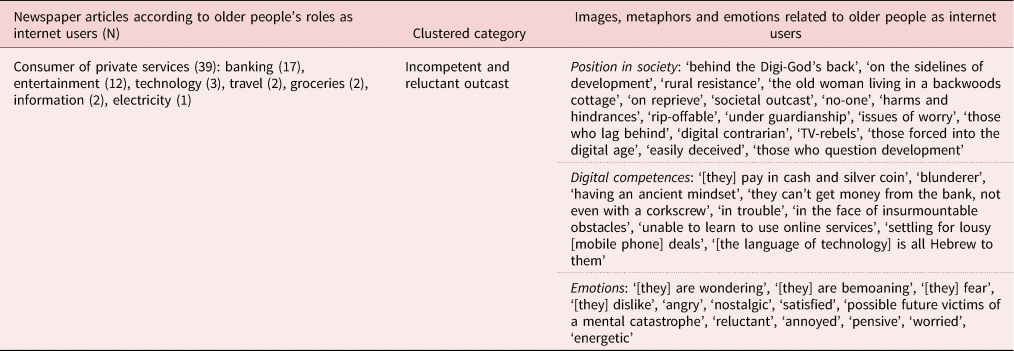
Approximately one-third (N = 39) of the articles (N = 121) portrayed older people as consumers of private services, namely online services related to banking (N = 17), entertainment (N = 12), technology (N = 3), travel (N = 2), groceries (N = 2), information (N = 2) and electricity (N = 1). Unlike in the previous category, ‘recipients of public services’, the social representation of older people as internet users was highly negative and can be summarised as ‘incompetent and reluctant outcasts’. Furthermore, unlike the previous category, this category included only a few positive portrayals (Table 2).
Summary of the data analysis and results of older people as consumers of private digital services

Note: N = 121.
Older people were again classified (Moscovici, Reference Moscovici and Duveen2000) and positioned in the articles as outcasts of a digitalised society, who were being left behind or outside modern developments, and who were even fighting against or rebellious towards society. This position was communicated with numerous images and metaphors such as ‘behind the Digi-God's back’, ‘the old woman living in a backwoods cottage’, ‘societal outcast’, ‘those who lag behind’ and ‘TV-rebels’. Unlike the articles describing older people as recipients of public services, articles describing them as consumers of private services predominantly described older people as being reluctant to use the private digital services. Reluctancy was communicated with images and metaphors such as ‘rural resistance’, ‘digital contrarian’ and ‘those forced into the digital age’.
In terms of older people's digital competences, the internet was objectified (Moscovici, Reference Moscovici and Duveen2000; Arruda, Reference Arruda, Sammut, Andreouli, Gaskell and Valsiner2015) as an arena where older people were not able to function, but rather made mistakes and were prone to being ‘ripped off’. Their digital competences were described with metaphors like ‘[they] pay in cash and silver coins’ and ‘having an ancient mindset’. Technological language was portrayed as ‘Hebrew’ for older people, thus pointing out their incompetence in understanding this language. For example, one article argued that because of the digitalisation of banking services, ‘ordinary citizens’ could no longer retrieve money from their bank accounts, not even using a ‘corkscrew’:
The ordinary citizen is no longer welcome to the bank teller desk. Those who have managed to squirrel away a few euros in their bank accounts won't get one red cent from the bank, not even with a corkscrew. Certain banks have a time window of two hours for cash withdrawal [at the teller desk]. For some other banks you need to make an appointment, the purpose of which is hardly clear to most older people. (PS25)
The articles portrayed older people's emotions towards the internet as, for example, ‘fear’, ‘dislike’, ‘anger’, ‘nostalgia’, ‘annoyance’ and ‘worry’. In this way, older people's internet use was emotionally anchored (Höijer, Reference Höijer2010), mostly to negative emotions, and thus was recognised not as a pleasurable phenomenon, but rather, as a challenging phenomenon. However, one exception to this was regarding them as online consumers of food, where older people living in remote areas were represented as content customers who benefit from online shopping:
In Finland, there are many municipalities where the local grocery stores have been closed down. The older adults are satisfied now that they get their groceries delivered all the way to the backwoods, [name removed] says. (LK33)
Family and local community members: avid and competent communicators
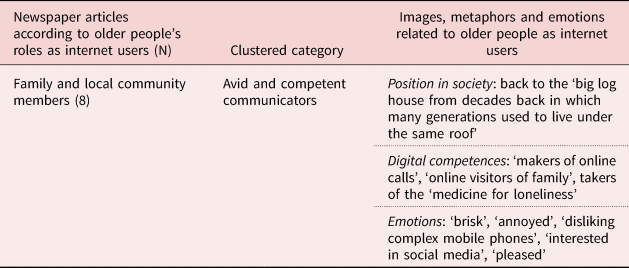
Finally, in a small number (N = 8) of articles (N = 121), older people were portrayed as family and local community members, who communicated rather avidly and competently with their children, grandchildren, families, neighbours and villagers via digital technologies. In the articles coded in this category, no clear positioning of older people as outcasts of society could be found, although an element of nostalgic longing to previous times was visible in one article (Table 3).
Summary of the data analysis and results of older people as members of families and communities

Note: N = 121.
In some of these articles, internet and social media were described as ‘preventing and alleviating loneliness’ (LK9), as ‘a medicine for loneliness’ (PS15) and as a means to get back the good old times:
The big log house from decades back in which many generations used to live under the same roof has now made a return with the help of computers, [name removed] says. (KS17)
In terms of their internet use and digital competences, older people were classified (Moscovici, Reference Moscovici and Duveen2000) as ‘makers of online calls’ and ‘online visitors of family’. Here, internet is constructed as a new means to continue old communication activities, and the use of the metaphors ‘visiting’ and ‘calling’ communicates a connection with previous times. For example, one article underlines that between their traditional face-to-face visits older people can continue ‘visiting’ their family online, too:
Luckily, in today's world it is so much easier to keep in touch with relatives, even those who live far away. A flight ticket from Rovaniemi to Helsinki is not that expensive any more either, and between visits, it is possible ‘to visit’ through the internet. On grandma's table sits a computer, and a familiar face appears on the screen as we make an online call. (LK2)
In some articles, new technologies such as digital platforms were portrayed in comparison with the old ones such as physical notice boards, and in this comparison, new technologies were portrayed as better ones:
Modern technology is connecting people more effectively than the bulletin board at the local grocery store. Especially now that the grocery store exists no more … That is exactly what neighbourly help at its best is all about. Because distances between houses are long and the river runs through the village, we need more than a bulletin board, a digital platform, to connect the inhabitants. (LK35)
…on the internet, the threshold of contacting someone is lower than in real life. [Name removed] is pleased to have reconnected with old friends from school days through Facebook. He believes that, without the internet, finding the old friends would not have been possible. (PS15)
The articles portrayed older people's emotions towards the new digital communication media with both positive and negative emotions, such as ‘being annoyed’, ‘disliking complex mobile phones’, ‘interest in social media’ and ‘pleased’.
Finally, a small number (N = 8) of the articles (N = 121) portrayed older people in multiple roles, and therefore a category ‘a person with multiple roles’ was created. The articles coded in this category were in line with the previous categories in that they portrayed older people as outcasts of modern society, whose digital competences were predominantly inadequate.
Discussion
This study focused on how three Finnish regional newspapers represented older people's digital competences and internet use in their daily coverage between January 2006 and October 2016. The study explored media representations from the perspective of social representations (Moscovici, Reference Moscovici1976, Reference Moscovici and Duveen2000) and sought to answer the following questions: In what kind of internet user roles do the articles portray older people? How and with what kind of images do the articles portray older people's digital competences in various internet user roles? How are older people positioned at a societal level in the articles?
The corpus of articles gathered for this study (N = 121) portrayed older people's digital competences in a negative and constrained way. In terms of the DigComp framework (Vuorikari et al., Reference Vuorikari, Punie, Carretero and Van den Brande2016), the articles concentrated predominantly on the competence area of ‘communication and collaboration’, while the other areas received considerably less attention. In the majority (N = 105) of the articles, older people were predominantly represented as digitally incompetent outcasts of a digitalised society, and the internet was objectified (Moscovici, Reference Moscovici and Duveen2000; Arruda, Reference Arruda, Sammut, Andreouli, Gaskell and Valsiner2015) as a potential danger to older people (cf. Hakkarainen, Reference Hakkarainen2012). In line with previous research on social representations, the articles frequently objectified older people's poor digital competences and their position in society as outcasts through using images and metaphors (Moscovici, Reference Moscovici and Duveen2000; Hakkarainen, Reference Hakkarainen2012; Arruda, Reference Arruda, Sammut, Andreouli, Gaskell and Valsiner2015; Bauer, Reference Bauer, Sammut, Andreouli, Gaskell and Valsiner2015), such as ‘behind the Digi-God's back’. The present study is, therefore, in line with previous research indicating that negative media portrayals of older people predominate the media (Westerhof and Tulle, Reference Westerhof, Tulle, Bond, Peace, Dittmann-Kohli and Westerhof2007; Bai, Reference Bai2014; Kelly et al., Reference Kelly, Watson, Pankratove and Pedzeni2016; Makita et al., 2021). Furthermore, the results of the present study corroborate previous research indicating that older people are portrayed in the media as illiterate digital immigrants (Loos et al., Reference Loos, Ivan, Fernández-Ardèvol, Sourbati, Ekström, Wilińska, Carlo and Schiau2017a). Thereby, the results contrast with previous research on how children and young people have been represented in the media in relation to new technologies as natural, successful and competent digital natives (Selwyn, Reference Selwyn2003; Yoon, Reference Yoon2006; Shaw and Tan, Reference Shaw and Tan2015; Loos et al., Reference Loos, Kubinski and Romero2017b).
The articles included in the data of the present research are part of the tendency, reported by previous research, to portray older people as a homogenous group (Loos et al., Reference Loos, Ivan, Fernández-Ardèvol, Sourbati, Ekström, Wilińska, Carlo and Schiau2017a; Loos, Reference Loos2018). The articles portrayed older people in a somewhat constrained way and failed to capture the diversity within the internet use and digital competences of older people (Damodaran et al., Reference Damodaran, Olphert and Sandhu2014; Official Statistics of Finland, 2014; Rasi and Kilpeläinen, Reference Rasi and Kilpeläinen2015; Helsper and Reisdorf, Reference Helsper and Reisdorf2016; Abad Alcalá, Reference Abad Alcalá, Hobbs and Mihailidis2019; Ofcom, 2019; European Commission, 2020b). The articles may, therefore, reinforce stereotype formation in media audiences as well as negatively impact older people's self-esteem, self-concepts and cognitive performance (Westerhof and Tulle, Reference Westerhof, Tulle, Bond, Peace, Dittmann-Kohli and Westerhof2007; Bai, Reference Bai2014; Loos, Reference Loos2018).
A central finding of the present study was, however, that although the social representations of older people as users of both public and private services portrayed them negatively as incompetent outcasts of a digitalised society, there was a clear difference according to whether older people were portrayed as recipients of public services or as consumers of private digital services. This difference concerned their attitude towards the services provided for them.
As targets of public services, ICT projects and initiatives, older people were predominantly portrayed as happy targets, who welcomed the services and training provided for them. This way, older people's digital competences were reconstructed as a public issue, much in the same way as in media representations of children's use of ICT (Shaw and Tan, Reference Shaw and Tan2015). The public services and ICT projects provided for older people were portrayed in positive terms and, therefore, justified (Sammut et al., Reference Sammut, Andreouli, Gaskell, Valsiner, Sammut, Andreouli, Gaskell and Valsiner2015) as successful, needed and welcomed services. However, it is difficult to interpret whether this positive portrayal is in line with how older people themselves perceive their need to improve their digital competences and the meaning of the provided ICT training. Although previous research on older people's ICT training mostly reports increased ICT skills and positive attitudes towards ICT as outcomes of the training (Rasi et al., Reference Rasi, Vuojärvi and Rivinenin press), research on the outcomes of training provided for older people by public services, ICT projects and initiatives in Finland is very scarce.
To explain this representation of older people as happy targets of public services, we also need to consider the potential and wider societal functions that the representations may serve (Buckingham, Reference Buckingham1994; Selwyn, Reference Selwyn2003; Bauer, Reference Bauer, Sammut, Andreouli, Gaskell and Valsiner2015; Eicher and Bangerter, Reference Eicher, Bangerter, Sammut, Andreouli, Gaskell and Valsiner2015). As argued by Selwyn (Reference Selwyn2003), media representations of children as computer users can function as powerful means of ‘selling’ government policies to the general public. In terms of the present research, the social representation of older people as welcoming recipients of public services can be interpreted in a similar way: as part of the promotion of the Finnish government's digitalisation policies, digitalised public services and ICT projects. In other words, they are part of the ‘digital leap’ that Finland is determined to take (Jungner, Reference Jungner2015; Saari and Säntti, Reference Saari and Säntti2018).
In contrast, as consumers of private services, older people were portrayed predominantly as not welcoming the private digital services and as being reluctant to use them (see Hakkarainen, Reference Hakkarainen2012; Rasi, Reference Rasi and Warf2018). Older people were portrayed as users of digital services related to banking, entertainment, technology, travel, food, information and electricity, which is in line with Finnish statistics reporting on the reasons that older people use the internet around the time of the data collection (Official Statistics of Finland, 2014). However, when considering what is absent from the social representations (Flick et al., Reference Flick, Foster, Caillaud, Sammut, Andreouli, Gaskell and Valsiner2015), it is evident that older people are not represented as, for example, online shoppers of products other than food (see Williams et al., Reference Williams, Wadleigh and Ylänne2010; Ylänne, Reference Ylänne, Twigg and Martin2015), consumers of online sexual content and online daters, even if the existing research indicates that older people in Finland and beyond use the internet for these purposes, too (e.g. Kontula, Reference Kontula, Heikkinen, Jyrkämä and Rantanen2013; Official Statistics of Finland, 2014; Wada et al., Reference Wada, Hurd Clark and Rozanova2015; European Commission, 2020b). Considered from this perspective, the present research corroborated previous research indicating that media representations may desexualise older people and constrain the range of consumer identities available for them (Baumann and de Laat, Reference Baumann, de Laat, Harrington, Bielby and Bardo2014; Ylänne, Reference Ylänne, Twigg and Martin2015).
Finally, older people's digital competences were portrayed positively as members of the family and local community. This category included a small number of articles (N = 8) which depicted older people as relatively avid and competent communicators. When considering this finding from the perspective of what is absent from the social representation (Flick et al., Reference Flick, Foster, Caillaud, Sammut, Andreouli, Gaskell and Valsiner2015), it is clear that older people were not portrayed as active citizens participating in society as members of a larger community at regional, national or even international levels, which reflects a restricted view of older people as active agents only in the spheres of their personal lives and within their families and local communities (Livingstone et al., Reference Livingstone, Van Couvering and Thumim2005; Hobbs, Reference Hobbs2010).
However, it must be acknowledged that even if the social representations of older people's digital competences and internet use were predominantly negative and restricted, the data also included positive portrayals or older people as peer-to-peer instructors, who worked as ‘net pilots’ or ‘digital ambassadors’ for their peers. In addition, two articles included highly positive and dramatically counter-stereotypical representations of exceptional senior citizens (Hodgetts et al., Reference Hodgetts, Chamberlain and Bassett2003; Harwood, Reference Harwood2007): a description of a 92-year-old ‘energetic lady’ who was active on Facebook (LK37) and a 103-year-old who ‘painted artworks on the tablet’ (LK4).
The study has limitations. The present study does not allow for arguing what kind of variation there was depending upon the selected newspaper or type of articles of interest in this study, namely reports, editorials and readers’ letters. Furthermore, the analysis does not allow for assessing whether older people were underrepresented as an age cohort across the newspapers studied in the present research, or portrayed differently depending on, for example, their gender or chronological age (Westerhof and Tulle, Reference Westerhof, Tulle, Bond, Peace, Dittmann-Kohli and Westerhof2007; Bai, Reference Bai2014; Barrett et al., Reference Barrett, Raphael, Gunderson, Harrington, Bielby and Bardo2014).
Finally, the results of this study are culture-specific. Finland is one of the top European performers in the supply of digital public services (European Commission, 2020a) and in the use of internet services by citizens (European Commission, 2020b). Therefore, the challenge to take ‘the digital leap’ expected of older Finnish citizens may be considerable for some of them, and this may partly explain the negative newspaper portrayals. Furthermore, the challenge may be particularly considerable in the geographical coverage of the newspapers under investigation in the present study, that is, in the two most non-urban and sparsely populated areas of Finland (Official Statistics of Finland, 2014). However, I would expect there to be some similarities in the media representations of older people's digital competences and internet use in settings resembling the one of the present research, that is, in non-urban sparsely populated areas in developed countries.
From this study, it is clear that the articles portrayed older people's digital competences and internet use in a predominantly negative and constrained way. This social representation only partly reflects the present reality where some older people lack the digital competences, attitudes or willingness (Hakkarainen, Reference Hakkarainen2012; Rasi, Reference Rasi and Warf2018) expected from them to participate fully in a digitalised society, but where, at the same time, some older people are avid, competent and confident internet users (e.g. Damodaran et al., Reference Damodaran, Olphert and Sandhu2014; Rasi and Kilpeläinen, Reference Rasi and Kilpeläinen2015). To avoid reinforcing negative stereotypes in media audiences and to promote digital inclusion, media coverage should reflect this diversity better. In addition, media coverage should portray older people's digital competences in their multiple life roles (Peace et al., Reference Peace, Dittmann-Kohli, Westerhof, Bond, Bond, Peace, Dittmann-Kohli and Westerhof2007), both in their personal and public life spheres.