1. Introduction
In this paper, I describe how intersecting scapes in contemporary life are creating new contexts for language use and language learning that have many implications for language teachers. These scapes are the mechanisms that produce linguistic and cultural hybridity in the current era of new millennium globalization, and they are providing language learners with new identity options. In exploring these ideas, I first examine how scapes function in language use by focusing on sociolinguistic landscapes, and I then explore their relevance to additional (L2) language learning. The paper finishes with a discussion of what this all means for language teachers in terms of ‘target’ language varieties, appropriate materials and classroom activities, and linkages between the classroom and the worlds in which students find inspiration for learning languages in the first place.
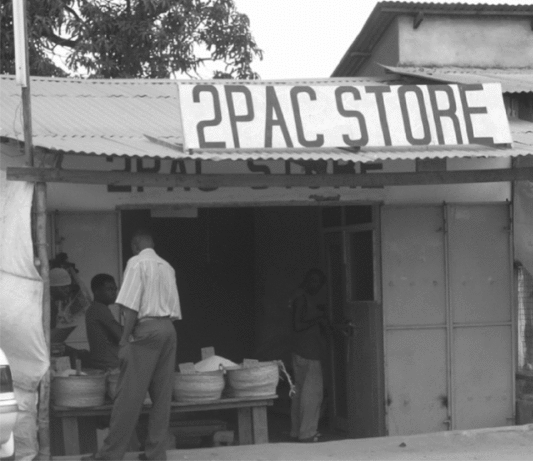
I first developed the concept of intersecting scapes while researching multilingualism in Tanzania and Kenya. I began to notice the phenomenon while doing my dissertation research in 2001 on English and Swahili code-switching at a newspaper office in Dar es Salaam, Tanzania. I entered this research site expecting work to be the most relevant domain, and that was often the case. But I also saw that in getting work done, the journalists regularly invoked other domains of life, particularly popular culture. They used varieties of language that were associated with these domains while at work in order to negotiate projects, make requests of fellow workers, and entertain one another over their long work hours (Higgins Reference Higgins2007). As I continued to research language in Tanzania, I began to reconsider whether the classic sociolinguistic domains such as home, work, and the marketplace were really discrete domains at all, since the everyday talk I recorded – and the signs and symbols around me – displayed a hybridity that blended language varieties in fascinating ways. A striking example of this comes from a storefront in a suburb of Dar es Salaam, which I photographed in 2005. The store sign reads 2PAC STORE, referencing Tupac Shakur, the famed American rapper who was murdered in 1996 (Figure 1).
2PAC STORE in Dar es Salaam, 2005

Of course, Tupac is famous internationally, and he is particularly well known in sub-Saharan Africa. Perhaps due to Tanzania's place as a premiere site for popular music, including local forms of hip hop and rap, his likeness appeared everywhere at the time, even a decade after his death – on barber shops, on busses, and, most interestingly to me, on this small business selling basic groceries. 2PAC STORE was a humble kiosk that offered customers the chance to buy ‘two packs’ of rice and beans, staples for many Tanzanian households, yet they were marketed with a reference to a West-based hip hop icon. This example shows how popular culture in the form of West-based popular culture intersects with Tanzania's local symbolic economy and affects how local commerce is presented to Tanzanians.
Another example of what I mean by intersecting scapes comes from a photograph I found online when searching for additional uses of hip hop nation language (cf. Alim Reference Alim, Finegan and Rickford2004) in various linguistic landscapes. The photo was of a sign in front of Bellegrove Missionary Baptist Church in Syracuse, New York. Below the name of the church was a space for messages to be delivered to passers-by with removable letter panels, allowing the church to change its message as often as desired. The photograph must have been taken near Christmas, as the message read Jesus is the rizzle for the sizzle. Here again, we can see an innovation of sorts, with a Baptist church taking on the language of hip hop to draw the attention of young generations of potential church-goers, and to underscore the religious nature of the Christmas holiday in the face of increasing commercialism. The message used language that had become popularized by rappers such as Snoop Dog, an artist who in the early 2000s produced a new form of language play by taking the first sound of a word and adding -izzle to it. Hence, for sure became for shizzle, amongst other examples. At Bellegrove Baptist Church, the message is that Jesus is the reason for the season.
A final example comes from Thailand, courtesy of one of my graduate students (see Figure 2). This illustration demonstrates that scapes are intersecting in a range of geographical and linguistic contexts. Here, the Japanese company Oishii is marketing its green tea to Thai consumers in Bangkok, Thailand, by drawing on the world of popular culture. The ad features Usopp, a character from Japan's all-time best-selling manga series, which more recently became an anime that is now followed worldwide. The ad is framed with Japanese: at the top, where the word ‘taste’ appears in kanji in the middle of a circle, and on the right, where おいしい (‘delicious’) 緑茶 (‘green tea’) appear. However, the central message right above Usopp's head is in Thai, albeit an interesting hybrid form of Thai that has been transliterated from Japanese and English. In white letters, the word oishii appears first, but spelled in the Thai alphabet as  . The letters are noticeably roundish, imitating the feel of Japanese hiragana. Below this, in Thai script,
 appears, which is a Thai phonetic representation of /grin ti/. The letters here mimic the shape of the Roman alphabet, again suggesting that the word itself is foreign, even though it is written in Thai. Here, a Japanese tea is marketed to Thai consumers through localizing reference points and through drawing on Thai consumers’ participation in a specific and now transnational sphere of entertainment: Japanese otaku (‘popular’) culture.
Usopp, from One Piece, a popular Japanese manga and anime. Photo courtesy of Daisuke Kimura.
So, what do these examples have to do with language learning and even language teaching? My answer is that such phenomena – intersecting scapes – are increasingly relevant for understanding language learners’ contexts, desires, and identities. To explain how this works, I extend these examples from linguistic landscapes to a language learning context: the Concordia Language Village in Minnesota, where American youngsters learn Japanese (among other languages) in an immersion setting. Through a graduate student's M.A. thesis work (Seo Reference Seo2008), I learned about the tight linkages between otaku (‘popular’) culture and desire to learn Japanese among most of the students. These adolescent language learners lived and studied in the summer immersion camp for two to eight weeks at a time, during which every part of their lives was meant to be carried out in Japanese. Seo discovered that the learners frequently engaged in cosplay, or the wearing of costumes of their favorite anime characters, and that they spent a great deal of time drawing and painting characters from manga in art class. The students arrived at camp as longtime fans of these popular culture worlds, and they reported learning about anime and manga through their American friends who were also fans. Not coincidentally, rather than targeting standard Japanese, they aspired to learn the type of Japanese words and expressions used in the otaku world, and they enjoyed sharing their knowledge of manga and anime with their fellow learners. Skits that they performed as part of their camp requirements often followed plotlines from these stories which only anime and manga fans would understand, and camp activities were often based on otaku culture. The teachers who had knowledge of this realm were popular, and those who did not – often the Japanese L1 teachers – often struggled to connect with the learners.
2. Hybridity as a result of intersecting scapes
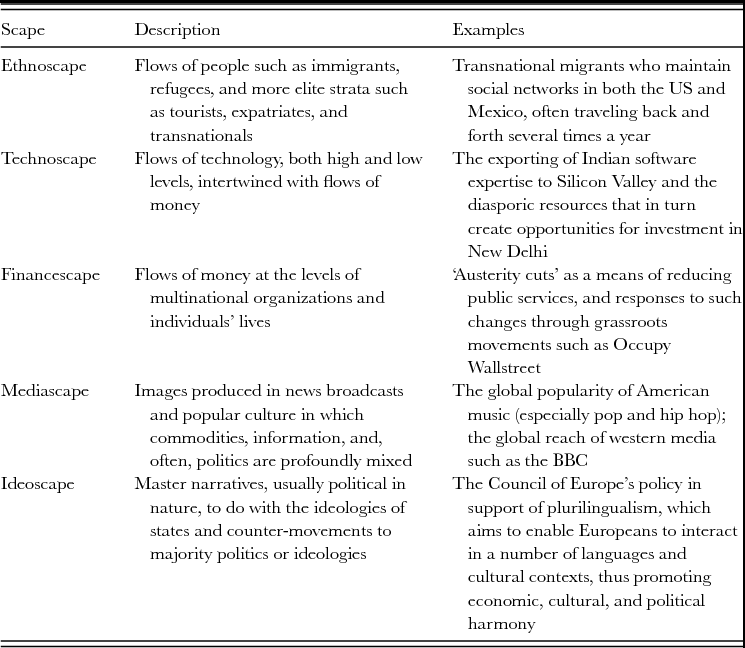
The idea of intersecting scapes builds on Arjun Appadurai's (Reference Appadurai1990, Reference Appadurai1996, Reference Appadurai2013) writings on globalization, and especially the ways that flows of people, money, technology, media, and ideologies move through the world. He uses the term scapes to refer to how these flows have deterritorialized modernist understandings of ethnicity, capital, culture, and even the nation-state, with enduring effects (see Table 1). These flows result in disjuncture and difference in each context. For example, Indians who migrate to the Middle East to work as manual laborers and service workers live radically different lives from those who relocate to the United States to work as software engineers. Both types of migrants contribute to the ‘return’ flows to India, however, as breadwinners in the Middle East provide capital and new forms of cultural consumption to their families, while wealthy transnational Indians use their financial resources to invest in various projects in their home towns. Meanwhile, both sets of migrants consume the same Indian films and other media created for – and also by – the diaspora, in the form of Indian cinema that represents India as bounded by its current national borders, thus perpetuating an imaginary vision of what it means to be Indian in the global age. Given the ‘fundamentally fractal’ nature of human experience, then, Appadurai argues that ‘our very models of cultural shape will have to alter, as configurations of people, place and heritage lose semblance of isomorphism’ (Reference Appadurai1990: 20).
Appadurai's scapes
In discussing intersecting scapes, the point I want to underscore is that, when these scapes intersect, new millennial hybrid and alternative identities are made possible. When Tanzanian shop owners draw on the mediascape to embed Tupac Shakur in their local economies, or when Baptist churches in the US index hip hop in conveying a spiritual message, they are doing something innovative. Similarly, when young people's enthusiasm for anime and manga sends them to Japanese immersion camp, the mediascape influences – and may even change – the way language education is designed and implemented. This last example also demonstrates that global flows do not only originate in the West. Global flows originating from elsewhere can also be seen in the elevators of the building where I work at the University of Hawai’i at Mānoa. This building is where the foreign language departments are located, and each semester, flyers are posted on the walls of common spaces and corridors advertising courses such as Korean 101. No mention is made of what studying Korean might do for one's career or one's cultural heritage. Instead, potential enrollees are invited to share their enthusiasm for K-drama (Korean television dramas) in the Korean-as-a-foreign-language classroom. While Appadurai does not discuss language or the effects of intersecting scapes, his ideas are foundational to what I see as an explanatory mechanism for describing linguistic and cultural hybridity in many contexts, including in settings where language learning is taking place.
Intersecting scapes are emblematic of the new millennium, a phase of globalization that ‘entails a radical unsettling of the boundaries of social life’ (Chouliaraki & Fairclough Reference Chouliaraki and Fairclough1999: 83) and which is characterized by the growing importance of global terms of reference that have been appropriated in their local contexts. This process is more than just appropriation, however; also observable is the mixing of domains of life such as hip hop and religion, anime and selling tea, and K-pop and learning Korean. Applied to language learning, intersecting scapes in the new millennium provide opportunities to unsettle conventional associations with concepts like ‘target’ language and ‘target’ community, and to expand these ideas to reflect the mixing of domains which language learners experience.
Whether learning a language of the majority or learning a language in a location far removed from what might be thought of as the target culture, there is a great deal of evidence that learners are forming new kinds of identities that result from the transcultural flows (Pennycook Reference Pennycook2007) within intersecting scapes. This development is at odds with modernist visions of language learning, which often posit a more linear relationship in which individuals acquire additional languages and are socialized into the corresponding communities, where they undergo some form of cross-cultural adaptation. How learners and teachers cope with the co-existence of these imagined futures for learners demands further attention.
3. Shifting scapes and language learning
In the field of applied linguistics, researchers have been examining how transnational flows of people impact the contexts of L2 use, with implications for language learning. Here, the ethnoscape provides many examples of how a diverse set of transnational migrants means that the links between cultural and geographic associations with a target language and the goals of language learning have become more complex. Research on transnational South Korean families is particularly revealing in this regard, given the degree of ‘English fever’ that drives English education, even leading some Koreans to relocate all or part of their families for ‘early study abroad’ in English-dominant countries such as the United States. The parents do not usually have long-term plans to become citizens of the country they have moved to, instead expecting their children to become conversationally fluent in English so that, upon return to their home country, their English abilities will give them an advantage. In other words, the local context of English in countries like the United States is not the context for which English is learned. In a study of two Korean families in the United States, Song (Reference Song2012) noted how a family who planned to return to Seoul focused almost entirely, while in the United States, on finding ways to make their son's pronunciation more ‘native-like’, with little attention to his development of grammatical, lexical, or pragmatic competence. The family's adherence to native-speakerism (Holliday Reference Holliday2006), which is dominant in Korean English education and in Korean society, shaped the learning trajectory they desired for their son in the United States. A similar case is reported in Park & Abelmann's (Reference Park and Abelmann2004) study of Korean families and English education. One Korean family had lived in Scandinavia for three years, and their son attended an English-medium school, where he developed highly proficient English. When the family returned to Korea, however, the family's friends and relatives expressed little interest in his communicative competence; instead, his mother was encouraged to register him to take TOEFL and TOEIC tests, the measures of success within the borders of South Korea.
In contrast, ‘heritage’ language learning provides a context in which learners who have a dominant affiliation with their local context are instead positioned as culturally and linguistically connected to their families’ countries of origin. In their research on complementary schools for Bengali, Cantonese, Gujarati, Mandarin, and Turkish instruction to heritage learners in the United Kingdom, Blackledge & Creese (Reference Blackledge and Creese2010) highlight the failure of the instructors and the curricula to engage with the learners’ realities as British citizens. Though the mission of these schools is to instruct learners in their heritage languages, Blackledge & Creese found that they also regularly invoked primordialist and nationalist visions of cultures that were linked directly to language and ethnicity and which constructed limited identities for the learners. At a Turkish school, for example, pictures of Atatürk, the first president of Turkey, and the Turkish flag were prominently displayed in the classroom, and children sang along to the national anthem each day. Afterwards, older children were invited to the front of the room where they spoke for a few moments on how proud they were to be Turkish (Blackledge & Creese Reference Blackledge and Creese2010: 191). Despite these efforts, the students sometimes outwardly expressed resistance toward adults’ imposition of heritage identities, preferring to identify with British or global youth culture instead. Furthermore, their language use did not align with the one culture–one language sentiments of the classrooms, for the students often exhibited partial or hybrid language proficiency in their heritage languages, and both they and their teachers engaged in high degrees of translanguaging (García Reference García, Makoni and Pennycook2007), or the use of bilingualism without the functional separation of languages.
Other research on immigrants reveals the importance of their ties to their country of emigration and to their new identities as transnationals and as people who ‘shuttle between communities’ (Canagarajah Reference Canagarajah2002), rather than as acculturating newcomers (e.g., Sánchez Reference Sánchez2007; Menard-Warwick Reference Menard-Warwick2009). Many language learners develop deep connections with people like themselves – that is, other members of the L2 speaking communities – finding alternative zones or third spaces for identity construction, including in-between identities and transnational identities that are more closely tied to others who share their experiences. Menard-Warwick (Reference Menard-Warwick2011) describes how Latina immigrant women in California often developed limited-needs English because of their transnational community membership. Some worked in jobs that did not require English, and others were able to rely on their transnational networks in California for instrumental literacy needs in English. Moreover, many of the women's literacy practices were in Spanish, and these L1 literacy practices allowed them to share more with their fellow transnational friends who read contemporary Spanish novels and the Bible in Spanish. Similarly, Allen (Reference Allen2011) describes how adolescent migrant newcomers in secondary schools in Montreal, Quebec, identified more strongly with the social network they had left before arriving in Canada. Because the intensive French (accueil) program was only for newcomers, its very structure made it difficult for the students to make friends with long-term or native-born Canadian residents, thus compounding the difficulty they encountered in establishing social networks. Consequently, a number of students were not successful in the program, and some even withdrew altogether.
These examples show how global flows of people in the ethnoscape are changing the nature of language learning and use. Next, I discuss in greater detail three more examples which also represent a wider range of intersecting scapes.
4. Case studies of intersecting scapes in language learning contexts
To more thoroughly illustrate the idea of intersecting scapes, I present examples from my recent edited volume (Higgins Reference Higgins2011a) that present learners’ experiences in the acquisition of English, Swahili, and Japanese. I intentionally use these three very different languages and associated contexts of learning to emphasize how shifting scapes do not only involve English or Western forms of culture in the production of hybridity, but rather, can easily be found in many places – from formal to informal learning contexts – and among a range of learners, including secondary students, expatriates, and university students. In discussing both language learners whose engagement with the language is primarily in instructional contexts, as well as those who are active users of their additional language (cf. V. Cook Reference Cook2002), my aim is to show how intersecting scapes are relevant for a wide range of learners.
4.1 Hip hop and English in a low-banded school in Hong Kong
The first example is from a project in Hong Kong that was deliberately designed to bring scapes together for pedagogical purposes. The project began with the vision of Angel Lin and Evelyn Man, who, with a team at the Chinese University of Hong Kong, designed a curriculum called ELT Rap to be used at a secondary school that was slated to close due to poor academic performance and lack of community support (Lin & Man Reference Lin, Man and Higgins2011). The school was a Band 3 English-medium public school, which meant that it admitted the lowest 33% of primary school leavers. Most of the children attending the school were from working class homes, and most had very little confidence or proficiency in English. The project was highly innovative, as it brought hip hop from the mediascape into public secondary education in Hong Kong, a context where, usually, only monolithic, inner-circle, nation-based forms of English are typically valued.
Given that social class divisions in Hong Kong are shaped by the banding system and by access to English through education, the researchers saw rap in English as an appealing prospect for connecting to working class students in Hong Kong's secondary schools. In its very design, ELT Rap was disassociated from the English of the students’ classrooms and the ideoscapes that govern the centralized education system. The project provided a space for students to reconcile the importance of English to their future and their sense of frustration caused by their perceived inability to master a foreign language that is deemed so necessary for socio-economic mobility. The project also brought Hong Kong's hip hop artists into the school to work directly with the students, a measure that led to high motivation and interest.
Though many of the students were not invested in English learning in general, they were very engaged in the project and dedicated themselves to practicing oral English through composing and performing hip hop lyrics and dance. The research team used questionnaires and focus-group interviews to assess how well the project worked, and recordings of the raps were made as students worked with the resident artists and their English teacher toward their final goal, a performance that was attended by the entire school. In terms of identity construction, the project was an opportunity to expand the students’ vision of themselves as ‘deficient’ language learners and to embrace a new and more empowered identity as English users who compose raps in Cantonese, English, and hybrid varieties. Situating their theoretical perspectives in Bourdieu's (Reference Bourdieu and Nice1977) concept of habitus, the researchers used hip hop to create a curriculum that would provide access to the cultural capital of English while drawing on the students’ own investments in global youth culture.
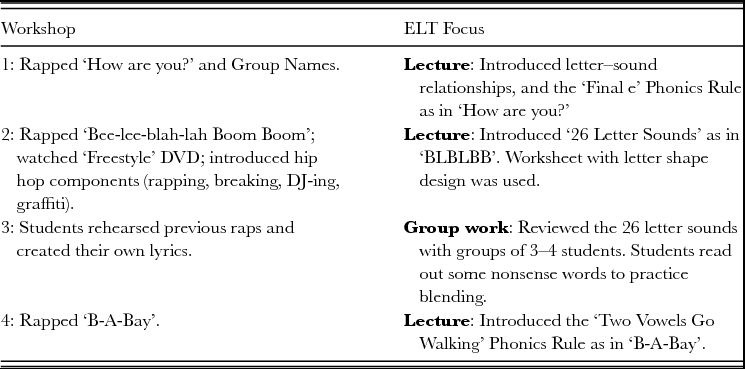
In the after-school program, the students participated in 11 workshops over the course of a year, during which they focused on very skills-oriented learning like phonics and spelling. They also explored cultural components of rap and hip hop such as breakdancing and DJ-ing, and learned the rhythms of the artform. Table 2 provides a summary of the first four lessons, with the ELT focus spelled out, as this was necessary for the Ministry of Education to approve the program (Lin & Man Reference Lin, Man and Higgins2011: 208).
Summary of workshops 1–4 of ELT Rap
Below is one of the raps produced after the third workshop by a team of three girls (Carrie, Apple, and Nadia), which also makes reference to the invited hip hop artist instructor, Double T. The lyrics demonstrate how the students are experimenting with rhyme, syllable structure, and beats per line. In addition, the example shows a positive expression of identity and ability in English (Lin & Man Reference Lin, Man and Higgins2011: 211).
My team name is C-A-N
Carrie, Apple, and Nadia Tang
Double T is our friend
We are making a horrible plan
Hey! Are you scared?
The project aimed to introduce Hong Kong students to a prestigious new English speaker identity, ‘the young emcee’. In total contrast with the identity of ‘low-proficiency English speaker’ in terms of which the students usually saw themselves in their classrooms (cf. Lin Reference Lin1999), this identity offered them an opportunity to enhance their English abilities by identifying themselves as capable learners and, more importantly, as artists who were using their voices to connect with others. In a post-project interview, the school principal observed changes that reflected this young emcee identity as a powerful force in English language learning and self-concept (Lin & Man Reference Lin, Man and Higgins2011, p. 217):
I believe teenagers need channels to express themselves, and we need to give them room for building self-confidence. So raps, hip hop, performing on stage, are really good opportunities. We really hope that our teaching professions can support this kind of teaching approach, letting more students benefit from it.
Though there were some obstacles, such as limited English proficiency among the hip hop artists who collaborated with the project team, the project was a success story. The students honed their creative verbal skills in writing and performing Chinese, bilingual, and English raps but, more importantly, they began to acquire new cultural capital that led to more positive dispositions towards English and towards themselves as capable English speakers. A shift in the school morale was also evident. Though the school had originally been selected by the Hong Kong Education Bureau for possible closure due to decreasing new student enrollments, the students’ participation in the 2007 English Festival changed their fate. Ten of the students were invited to perform their ELT Rap songs at the kick-off ceremony, where they performed three English raps and one Chinese rap. This event enhanced the school's public image and partially contributed to the cancelation of the government's closure plan.
4.2 Expatriates learning Swahili
I now turn to the context of Tanzania, and to a study (Higgins Reference Higgins2011b) that I carried out on people like myself, that is, L2 Swahili speakers who have long-term commitments to Tanzania. In including this example, I illustrate how flows in the ethnoscape – here in the form of expatriates – create identity options for learners both in their ways of using the additional language and in the cultural affiliations they develop through learning and using it. Here, the ethnoscape intersects with the ideoscape of a national-political identity, a realm of life often shaped by territorial notions of culture and primordial categories for ethnic identity as the source of cultural belonging. However, as foreigners spend time in Tanzania, and as Tanzanians themselves develop a wider range of cultural practices, the identity options available to learners multiply. Just as Tanzanians are increasingly transnational and engaged in a wide range of cultural practices themselves, so too are expatriates.
The study began with my interest in learning how expatriates living and working in Tanzania responded to the possibility of taking on a Swahili self, or an L2 identity that encourages cross-cultural adaptation and belonging within a new cultural community of practice. Since this population represents an elite stratum of the ethnoscape, I wanted to know how their identities had formed over the course of learning Swahili and living in Tanzania. I interviewed three women, all of whom had had experience working in gender development agencies and international aid offices, contexts which often encouraged a deep understanding of Tanzanian lifestyles and cultural norms.
The narratives that I collected provide evidence that the Swahili learners were aware of the possibility of ‘becoming Swahili’, and also that they enjoyed inhabiting this subject position. However, their stories also revealed that the women's identities as feminists, sojourners, and world citizens were sometimes at odds with their interpretation of a Swahili-speaking identity. Rather than adapting to a new L2 self or resisting it, however, their experiences appear to have created an intercultural third place (Kramsch Reference Kramsch1993) in which to form their identities.
Tatu, a Canadian citizen living in Tanzania for ten years, told stories in which she positioned herself as an outsider because of her L2 pragmatics, which she characterized as feminist in nature. One of our conversations included experiences about using Tanzania's public bus system, where children are often asked to stand instead of sit, since they pay a reduced fare. Though Tanzanian bus riders generally take this system for granted, Tatu explained how she would make a point of speaking out against the system, and how doing so was at conflict with Tanzanian norms for ‘female’ ways of interacting with others (Higgins Reference Higgins2011b: 161).
Tatu: The fact that I speak out is another thing. People don't do that. I mean I get on the daladala (‘bus’) and if they don't want the kids to sit down and I tell them [to sit], so then I’m mzungu (‘foreigner’) because I’m speaking out. A woman would not speak out like that . . . my mannerisms are not typical of here.
Tatu also created a third place identity in her L2 Swahili by using language that she described as ‘old fashioned’, in comparison with the ways that many urbanites in fast-paced Dar es Salaam communicate (Higgins Reference Higgins2011b: 156).
Tatu: it's funny because in some ways people will laugh at me and say ‘oh my god you’re so old-fash, I remember my mother did that’. You know, whereas, like, nobody does that anymore nobody says that anymore, nobody expects that anymore. And so that's funny to me because I’m starting to pick up certain things but I guess it's from the older generation.
C: Like what.
Tatu: Um, I suppose you know in Tanzania when you greet somebody like you shake their hand and you look at them in the eye. And people don't do that anymore, like my age group and younger, you know we’re all working in offices so we’re too important for that. But I still do that and they’ll go ‘oh my goodness oh you still do that’.
At the other end of the spectrum, Kate, an American expatriate who had also lived in Tanzania for a decade, drew attention to how her own ways of speaking Swahili were included in contemporary Tanzanians’ communicative styles. In an email she sent to me after our interview, Kate narrated what happened when she answered a phone call from the local university about her husband being offered a position (Higgins Reference Higgins2011b: 157). Though Kate is a white American, she ‘passed’ – as a certain, very modern, kind of Swahili/Tanzanian – due to her language proficiency.
Kate: When my husband got hired, the university called my cell phone instead of his. I was in the middle of teaching a lesson, so I just explained that I wouldn't see him till the evening, so ‘here's his number, could you call him directly?’ I didn't know it was the head of dept. I was speaking to! And he didn't know I was an mzungu. (the whole conversation was in Swahili – I can fool people for short phone conversations :-)) He is apparently still in shock to this day that I wasn't so impressed and thankful that my husband was hired by the university, that I actually suggested he should make another phone call! And the funniest part is he reportedly said to another staff member Anavyoongea . . . Anajifanya mzungu (‘the way she talks . . . she's acting like a white person/foreigner’).
Since Kate did not show deference and extensive gratitude in taking the phone call, she was described as anajifanya mzungu (‘acting like a white person/foreigner’), a phrase commonly used to describe Tanzanians who are seen as overly Westernized (and rude). Tatu's and Kate's stories reveal the range of possible Tanzanian identities, from ‘old fashioned’ to ‘like a Westerner’, and also show that these women were able to take up these identities for themselves in ways they chose.
Across the women's narratives, it became clear that their communicative repertoires in Swahili fit into the range of options of L1 Swahili speakers, and that they were aware of how their language use might be interpreted by Tanzanians. Perhaps because of their expatriate status, they expressed a high level of intercultural awareness (Byram Reference Byram and Byram2008) and often took very decentered stances toward their own Swahili use and its social meanings among Tanzanians. As I learned from the interviews, none of the women planned to stay in Tanzania for the remainder of their lives, and none expressed a strong interest in returning to their home country either. This mobility and detachment from any particular place seems to have engendered a nuanced awareness of the different ways that additional language learning and use constructs identity.
4.3 Anime and manga fans learning Japanese
Now I turn to the case of Japanese language learning, drawn from Yumiko Ohara's (Reference Ohara2011) work on Japanese pedagogy at the University of Hawai’i, Hilo. In this context, shifting scapes are responsible for providing some new identity options for language learners, options that were not available until recent decades. In the 1980s, much of the interest in Japanese as a Foreign Language (JFL) learning in the West was motivated by Japan's increasing economic power and operations such as the JET program, an outlet provided by the Japanese government to encourage international exchange. At that time, language learning fit well with conventional notions of foreign language teaching that typically draw on modernist ideologies and teach national standard varieties with little to no attention to social or regional varieties. These conventions are still the norm in present-day instructed JFL contexts, where polite forms such as keigo are emphasized (Siegal & Okamoto Reference Siegal and Okamoto2003; Cook Reference Cook2008). Due to shifting scapes, however, learners are often more motivated by the media/technoscape of anime and manga, and otaku culture in general.
To acknowledge students’ interests in Japanese otaku culture, Ohara researched the consequences of incorporating language from popular culture in her own classroom through critical pedagogy. She instructed groups of students in two different sections of her beginning JFL classes to write a script for a dialogue and subsequently to act it out in front of the entire class, with the intention of presenting it later at a speech contest at their university.
The skit below focuses on the students’ preparation for their upcoming Japanese final examination (Ohara Reference Ohara2011: 248). There are three participants: Wang, a female international student from Taiwan; Chen, a male international student from Taiwan, and Rob, a male student from Hawaiʻi.
Ohara points out that the many of the students’ linguistic choices were at one time not in beginning level textbooks; now, they are increasingly part of beginner students’ linguistic repertoires due to their consumption of anime before they enter the classroom. Rob's use of boketeru (‘lose one's mind’, line 3) and Wang's use of kueru (‘to eat’, line 6) are often found in the media, but are considered regional dialects of the Kanto region. Kueru, spoken by the female student, Wang, is generally seen as a vulgar version of the verb taberu (‘to eat’), and is considered a prototypical item of male language. Similarly, the male student, Chen, uses the expression yamete yo (‘stop it’), which is often seen as feminine. Ohara makes the point that in crossing these gendered language lines and borrowing regional words from non-standard varieties of Japanese, the students are constructing identities as youth by challenging traditions and norms.
Throughout the course, the students showed an awareness of their role in their construction of their own identities. An interview that Ohara carried out with Deborah, a female student from a western state in the USA, shows how she agentively chose certain ways of speaking taken from anime. The topic of discussion was a course that Deborah had considered taking from another professor, whose teaching style she did not enjoy (Ohara Reference Ohara2011: 246).
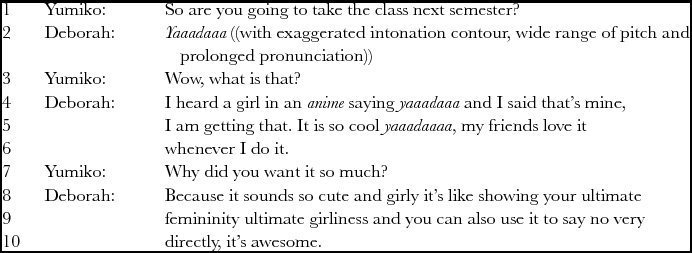
Yaaadaa is a phonetic variant of iya da that literally means ‘it is no’, which serves as a way to reject something or express a lack of desire for something. When the [i] sound is dropped and the others elongated as in yaaadaa, it becomes an emphatic, even exaggerated way of saying ‘no’, as in ‘no way!’. This expression is typically used by young women in Japan who are often referred to as burikko ‘cuties’. When spoken with a high pitch, it maintains its meaning but becomes distinctly feminine speech, thus allowing women the ability to say ‘no’ quite strongly but in a way that underscores their femininity. From her evaluation of the expression in lines 4–5 and 10, it is clear that Deborah appreciates the meanings that come with this non-standard form, as they provide her with a way of expressing an identity that is not available in her class textbook.
Japanese media, and especially anime, provide learners with a wider range of possible options in terms of identity construction than is usually available in language textbooks. Based on their consumption of anime, learners become familiar with the speech styles of young (and cool) characters and then determine what aspects of those styles they themselves want to adopt. Likewise, the learners Ohara studied adopted forms of gendered language they witnessed among anime and manga characters, transforming these aspects to create L2 personalities they wanted to create for themselves. Some chose to employ the first-person singular pronoun ore, indicating strong masculinity, and other ‘rough’ Japanese to emphasize masculine identities, while others chose to adopt yaadaa and feminine language resources to underscore their femininity.
5. Implications for teaching
Because new millennium hybridities co-exist with modernist visions of the world, thereby allowing more identity options, they also challenge language teachers. In considering the context of teaching Japanese as a foreign language, for example, teachers are faced with textbooks that present modernist and prescriptive forms of Japanese in terms of gender identities for male and female students. However, Japanese popular culture presents learners with a much more fluid array of options. Teachers most certainly face dilemmas when their students are dissatisfied with the materials of textbooks, yet must pass standardized exams which test their knowledge of prescriptive norms. The key factor in making decisions may be the investments learners make in the identities and how they relate to their linguistic choices. Learners of languages such as Japanese may value non-standardized dialects over prescribed forms, as in Ohara's study, because of how language resonates with who they are. Consequently, teachers may be able to connect lessons on language forms (such as female and male language in Japanese) to the reality of dialect diversity and gender identity diversity in Japanese (and English) as a way of engaging students in thoughtful learning about these topics. Of course, teachers also need to ensure that their students are making informed choices, and that they are able to consider the ramifications of their choices when interacting with speakers who may or may not appreciate how they have chosen to gender-identify in their L2. In Seo's study of Japanese immersion students, for example, several of the camp graduates who had developed high proficiency over their years of Japanese study were placed in the lowest level Japanese class when they started university. Since the language camp emphasized oral communication, their placement was often due to the lack of conventional literacies in Japanese, but the fact that they spoke hybrid varieties of Japanese also impacted their placement.
In other educational contexts, there may be less of a ‘real world’ consequence of using hybrid language varieties associated with youth and popular culture, however. As Lin & Man (Reference Lin, Man and Higgins2011) indicated, students they worked with were unlikely to actually need English in their lives beyond schooling. Nonetheless, because their schooling required English as an academic subject, they needed to develop some degree of competency in the language. The main contribution made by bringing ELT Rap into the school was not so much the acquisition of a certain variety of language, but rather the confidence that the students built as capable learners with something to say and the ability to articulate it in English.
Other contexts of language teaching have demonstrated how intersecting scapes are already seen as a useful resource, though perhaps not in these theoretical terms. For example, Sayer's study on English-Spanish linguistic landscapes in Oaxaca, Mexico (Reference Sayer2010) provides teachers with ideas for turning students into ‘language detectives’ (p. 152) by taking pictures of signs posted in their own neighborhoods and analyzing them, as a way of studying English and its role in their society. This approach links the ideoscape of education, where center varieties of English predominate as the ‘target’ because of the assumption that English is needed to communicate with foreigners, with the mediascape of advertising and global popular culture. In Oaxaca, this intersection of scapes produces interesting forms of local linguistic hybridity that only Oaxacans can appreciate. Of the 250 images he analyzed, Sayer found that 88% represented intracultural messages that were designed for communication between Mexicans. Examples of intracultural texts included signage on schools, ads for clothing, computers, and nightclubs, graffiti, and forms of anti-government protest, such as t-shirts worn during demonstrations against the local governor. Through designing tasks that require students to analyze the language in their own communities, and to make sense of the linguistic hybridity that they capture, teachers can encourage students to see English as a local language (Higgins Reference Higgins2009), rather than as something foreign in EFL contexts.
There are many ways that language teachers can consider bringing students’ engagements with other scapes into the classroom. Studies of online communities of fans of anime and manga shows that young ESL speakers are often more motivated in these contexts than they are in traditional schooling, especially their ESL classrooms (Lam Reference Lam2000, Reference Lam2004). Young people who use English as an additional language may even experience forms of language instruction and scaffolding in such contexts that produce meaningful language learning. For example, Black (Reference Black2008) illustrates how English learners write fanfiction in English and receive feedback from other contributors about their plots, their writing style, and even their grammar and spelling. Like Ohara (Reference Ohara2011), teachers may find ways to invite these practices from the mediascape into their language classrooms as ways of connecting with their students in highly motivating ways.
6. Conclusion
This paper has aimed to demonstrate that intersecting scapes produce new millennium forms of hybridity that in turn have an effect on language and language learners. I have suggested that these new forms of hybridity, in the form of identities and language varieties, can best be explained by examining the flows of people, ideas, technology, money, and more underneath language. By acknowledging that the meanings produced in language originate from these flows, we may better understand why language learners form the identities that they do, and through creative responses in pedagogy, we may be able to provide materials and activities that take them up on these identities.
Christina Higgins is Associate Professor in the Department of Second Language Studies at the University of Hawai’i at Mānoa, where she is also co-director of the Charlene J. Sato Center for Pidgin, Creole, and Dialect Studies. Her interests include identity, multilingualism, and globalization. Her recent books include Identity formation in globalizing contexts: Language learning in the new millennium (Mouton de Gruyter, 2011) and English as a local language: Post-colonial identities and multilingual practices (Multilingual Matters, 2009).